


Likes
Comments
Share


@Ciocanna
Follow
From the 15th day I start adding half the norm of Hesi TNT Complex 2ml/L, we test with 210 ppm so as not to burn the roots.
On the 18th day, I moved the plant into a larger pot and watered it with half the recommended amount of nutrients and of course, transplanted the plant into a larger pot.
On the 21st day, I did LST (Low-Stress Training).

Likes
6
Share


@ThinkDankGenetics
Follow
So what to say about this week sadly we ended up having to kill one because it turned out hermied
we ended up moving the other into the closet in the hallway and put it under a blurple100 watt by par spectra from wayb ack in the day. The good news is the one didn't hermied and it's still in veg so it might be a large plant. So we shall see same thing keeping it moist last feed was on December 20th next will be January 10th

Likes
4
Share

@The_Doctor_Green
Follow
Hola a todos!
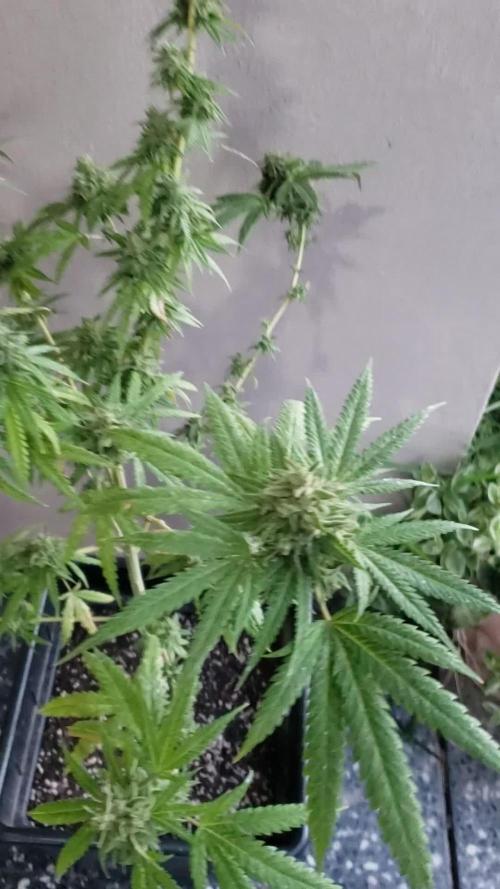
Esta semana no he agregado fertilizantes,solo he regado con agua de ph 6.4
Han vuelto a aparecer los trips 😔, porque han llegado varios días con alta humedad.
Ya dentro de poco hare el lavado de raices.

Likes
6
Share


@RzDreams
Follow
18/10/2022 Se controló la plaga de mosca del sustrato, no están exterminadas definitivamente pero no se siguen reproduciendo a la misma velocidad.
19/10/2022 Mediados de la 4ta semana de crecimiento se trasplantan 03 y 09, queda pendiente 04 no contamos con más macetas y el espacio no es suficiente dentro de la carpa se deja dentro la semana completa.
22/10/2022 Se aplica tierra diatomea para exterminar por completo la plaga de la mosca del sustrato.
23/10/2022 Se quita excedente de tierra diatomea de las hojas para no ralentizar el crecimiento. 04 se saca del indoor para continuar con la semana 5 de crecimiento solo con 4 plantas y buen espacio para su correcto crecimiento, 04 se pretender pasar a maceta más grande y se deja en exterior esperando sobreviva.
No se agregan nutrientes específicos aún hay buenas reservas y restos de control de plaga
Likes
1
Share


@Ultraviolet_
Follow
Copper Cathode Plates & Zinc Anode Plates
Not all minds think the same, it's a hard concept to grasp from one who has only ego. When someone operates solely from the ego, they tend to view their own perspective as the objective truth. To them, if someone else thinks differently, it is seen as a flaw, a lack of intelligence, or a personal affront, rather than simply a different, valid experience.
The ego assumes that others are just extensions of itself. It cannot easily differentiate between "I think this" and "This is the universal truth". This is called the Mirror Fallacy. True understanding of another mind requires stepping out of oneself. The ego, by definition, is obsessed with self-preservation and being "right," which blocks empathy. Different perspectives are interpreted as attacks on the ego's stability. Instead of curiosity, it feels defensive. Acknowledging that others have entirely different internal worlds—with unique motivations, fears, and histories—requires dismantling the illusion that the world revolves around one’s own viewpoint. It’s a shift from "Why are they wrong?" to "How did they get to that perspective?"
Gospel of Thomas #17 "I shall give you what no eye has seen, what no ear has heard, and no hand has touched, and what has not come into the human heart." precedes saying #18, which questions the "beginning" and "end".
First, you need The Eyes to See, The Ears to Hear & The Mind of the Heart.
"Alpha to omega" refers to the first (Α/α) and last (Ω/ω) letters of the Greek alphabet, symbolizing "the beginning and the end". It represents totality, eternity, or the entirety of something.
Revelation 22:13, "I am the Alpha and the Omega, the First and the Last, the Beginning and the End" (NKJV, NIV).
Alpha & Atom: Both originate from Greek. Alpha (Α/α) is the first letter of the Greek alphabet (representing the beginning). Atom comes from atomos, meaning "indivisible," often seen as the foundational "first" particle of matter.
Adam & Atom: In some esoteric and linguistic theories, the biblical name "Adam" (Hebrew for man/earth) is connected to "atom" because both represent the original, foundational unit (the first man vs. the first particle).
Alpha Particles are particles emitted during radioactive decay, named "alpha" because they were the first type of nuclear radiation discovered. They are atomic nuclei consisting of two protons and two neutrons.
The study of the atom often deals with the "beginning" (alpha) of chemical reactions and fundamental building blocks.
The terms are linked primarily as symbols for "the beginning" (Alpha), the "fundamental unit" (Atom), and the "original man" (Adam).
The uppercase symbol Omega (Ω/ω) is primarily used in electronics and physics to measure electrical resistance in ohms, representing how materials resist electron flow. It is also used in various fields to represent the density parameter in cosmology, solid angles in physics, and special constants or asymptotic growth rates in mathematics.
In quantum mechanics, "Omega" (Ω/ω) can refer to several concepts related to measuring or representing quantum coherence, generally categorized into dynamical, mathematical, or physical parameters:
Dynamical Coherence Measures
Omega Pattern (Superconducting Circuits)
Coupling Strength
Angular Frequency
Quantum Coherence Framework (Omega v24.0)
Electron flow is not the same as electrical conductivity, but they are intimately related. Electron flow is the physical motion of electrons, while electrical conductivity is the material property that determines how easily that flow can happen.
Electron Flow (The "What"): The physical movement of negatively charged electrons through a conductor (usually from negative to positive). It is the act of carrying charge.
Electrical Conductivity (The "How Well"): An intrinsic material property that measures how easily a material allows electrons (or other charge carriers) to move through it.
Electron Flow (The Action): The actual physical movement of electrons from one molecule (donor) to another (acceptor) in a pathway, such as the photosynthetic electron transport chain or cellular respiration. The current itself (dynamic electricity).
Electrical Conductivity (The Property): An intrinsic property of a material (like copper vs. glass) that measures how easily it allows electric current (electron flow) to pass through it. A measure of ease. A high-conductivity material has low resistance and lets electrons move freely.
Electron transport rate (ETR), the rate at which electrons travel through the chain.
You can have Electron Flow occurring (electrons moving through the chain), but a very low Electron Transport Rate if the plant is in the shade. If light increases, the Electron Flow still follows the same path, but the Electron Transport Rate increases because more electrons are moving per second. In summary, ETR is a quantitative measure of electron flow.
The Electron Transport Rate (ETR) is not exactly the same as Electron Flow, although they are intimately related. Think of "Electron Flow" as the movement itself, and "Electron Transport Rate" as the speed or quantity of that movement.
Photosystem II (PSII) is a critical multi-subunit protein complex in thylakoid membranes that initiates photosynthetic light reactions by splitting water and transferring electrons.
"Et lux in tenebris lucet, et tenebrae eam non comprehenderunt,"


Likes
20
Share


@MrWolfe
Follow
They bounced back great after breaking some necks, I’ll add one more layer of trellis a foot above each of these to seperate new growth but otherwise we just let it ride to harvest from here.
Adding mammoth microbes at .6 ml/gal also. For veg just use b1/b2 at 5g/gal same for clones. Start microbes with clones through flower.


Likes
8
Share


@Spliffing_Around
Follow
We continue to mix our own nutes, but I started also testing Nutra Hydro . One rack only for now. Next project is upcoming for organic beds or huge pots. STAT TUNED BROTHERS ANS SISTERS ! Grower love ❤️❤️❤️!!!!


Likes
25
Share


@gottagrowsometime
Follow
Welcome to my Purple Haze Autoflower sponsored & by MSNL seed company.
Well, its pretty much in the name. And I think even the most newest person to cannabis has heard of it. Like White Widow and Skunk. Its kinda a house hold name in this industry. And been what it is. I've no doubts MSNL will have made a blinder. As for achieving purple in the pheno. I find. You've to have everything going strong and no mess ups to give you a higher chance of getting purple. Even, then you may not get it. But, color of fan leafs has never really been important, nor will it ever be. I do have the temperatures to help me get purple if I want. But, asl I do so many grows at the same time. I keep an even temperature as much as I can throughout the entire crop. 19-22c atm that is. My drying room i can reach 10c at the moment. That will come up to 19c by April. (At this stage I should have my winter crop all dried) This is my last plant to start for this crop. I'm pushing it to the max this year. I've many plants. A few I plan to grow big. But 70% will be average grows which I'll be happy once they hit or go by 40g per plant.
She has between 15-19% THC.. not normally a preference for myself. I like much stronger phenos. But, I had to give this strain a go. I'm getting round to the classics. As this is more or less what I grew up on as a teen. So, looking forward to tasting this baby.
Edit
After 30+hrs. Seed was placed on wet substrate that was soaked in 1L of Pure Zym.& Power Roots. After placing the seed i then added 0.1 of a liter of dry substrate on top of the seed. (Just moist soil) this will lower the risk of damping of completely nearly as this won't need watering for at least 10+ days. 1/5th of BatMix was added to the end of the pot with the rest been filled with Royal Mix, both are fertilised soil. But to get Alga Grow going as its an Organic product you should try get that going early. Just a small amount to kick-start the Organic process which takes longer while using Organic products. Pure zym & PR will help it break down any nutes as she's a seedling after all. So, I hope the soil won't be too hot. So, I'll hold off on any NPK feeds for now or anything else until she's into veg.
Thanks to my sponsor MSNL and to all who work tiresomely to bring us fantastic strains.
Also, to whomever drops by. I appreciate you. Drop a like so I can visit your diaries. Either way thanks for stopping by.

Likes
34
Share


@Grey_Wolf
Follow
Original Sensible seeds GIRL SCOUT COOKIES 8th Week Of Veg December 30th 2019
Firstly ignore the white residue on the leaves as it's only Diatomaceous Earth that I mixed in with the Worm casting and Mollasses tea that I brewed up and sprayed on all my Plants. I did it after dark to alleviate any stress from sunshine or heat. The Diatomaceous Earth should hopefully deter some of the insects that are taking the odd bite out of some of my plants leaves. I suspect grasshoppers are the culprit and I know that they do not like the DE.
The Cookies plant is looking really healthy and as you can see from the above pics I topped her to make the plant bushier.
Cheers for Looking in on my Diary update Have a Safe and Happy New Years Celebration and I will be back Next week in 2020 💪💪

Likes
Comments
Share


@Pixie
Follow
Still not started to flower pistols are shouting out everywhere tho can't wait to see it flower iv never grow weed before so it's going to be good having a ganja plant
Likes
13
Share


@DeepRootsGrowTrees
Follow
DIVINE OG KUSH / DIVINE SEEDS
WEEK #20 OVERALL
WEEK #8 FLOWER
This week her buds are really getting weight to them they have that OG bud structure smaller tight dense buds that are covered in trichomes!! She got a overpowering smell to her that's WOW!! She's almost done a few left!! Stay Growing!!!
Thank you for stopping by and taking a look it's much appreciated!!
THANK YOU DIVINE SEEDS!!!
DIVINE OG KUSH / DIVINE SEEDS
Likes
1
Share

@GreenEldritchGardens
Follow
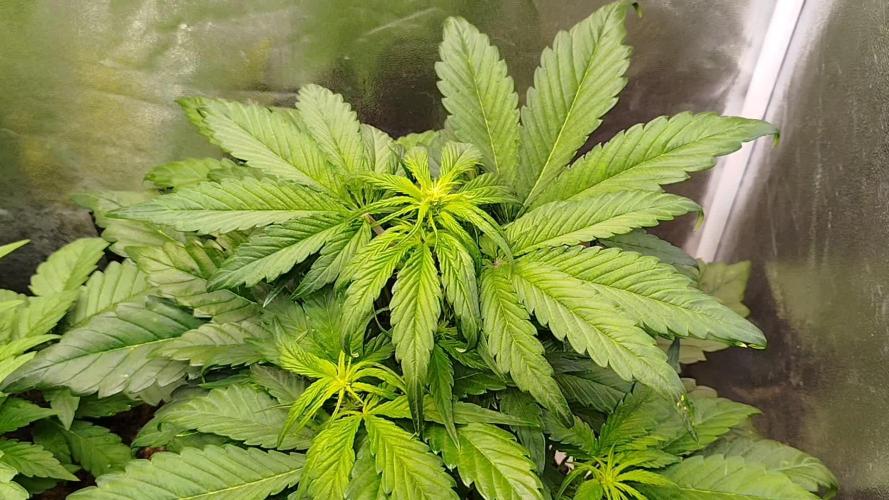
She is growing amazingly and now stretching in the first week of flower. This one is gonna be big as AN Auto flowers, I love them like this.
If I had more space I would scrog her or do some more LST to promote the lower brwnches, but this is not my goal in this grow.
Next week I'm gonna do some heavy defoliation.

Likes
13
Share


@w4tch2gr0w
Follow
D57
nearly 2 month since germination also my first autos which are nearly growing at 12-12 only since the beginning. Quite happy so far if i consider they share one pot and have not so much light.
D60
It’s going alright 👍
Next to it the buds are developing pretty well. I love it
D63
End of the week for those little ladies
Likes
3
Share

@Z420Organics
Follow
Fastbuds Auto Update – Week 7 🌱
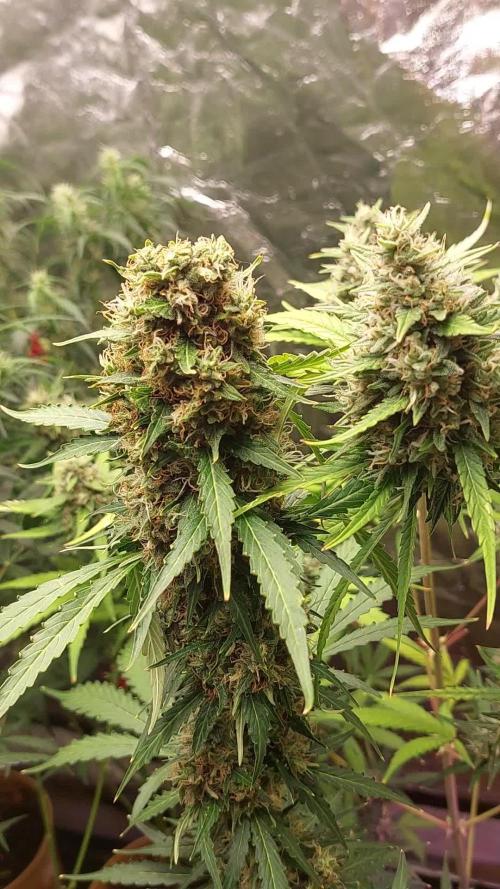
Another week has passed, and things are looking great! 🌿 This week I did a deep watering, almost like a mini flush, to bring down the PPM levels and keep everything balanced. 💧⚖️
The plants are thriving beautifully, and something really interesting has come up — three of them remind me so much of Blue Dream, which was actually the very first strain I ever grew! 🌸💭
The structure, the aroma, everything about them instantly took me back to those early days. It’s very likely that 3 seeds from this 10-seed mix pack are Blue Dream. 🍇✨
Such a pleasant surprise and a nice bonus of growing mix packs — you never know when a strain will unlock some great memories! 🌱💚.
Likes
2
Share


@EtnoGrow
Follow
well everything is going well without pests without at least not noticeable or minimal deficiencies surely, which leaves us calm, potassium soap and neem oil were purchased but it was not applied at the end, it will be the next one, after this pruning work a new one was installed scrog mesh and as you can see we also did with some or one at least the 2nd largest an attempt at sog, so it's like a mixture, then this big ugly mesh, we change it for an ideal girl what we want is that it doesn't grow too much in that The mesh helps us, well, we also change and go to flowering officially when we see that the plant is already flowering by itself, we spread a little so that the small 5 small pots grow a little more, the intensive pruning is to compensate for the ventilation that The temperatures may still be somewhat high, the air circulation in general, my closet is 60x60x160cm, so it comes in handy, it seems to me that we have carried out a good sativa plant by taming it in such a small space and it is I am proud, in addition to having the other copies as well, I hope I have taken advantage of the space and the light as best as possible, that was the idea.
Likes
13
Share


@jardindeautos
Follow
El cultivo parte de 16 semillas regulares, pasadas 2 semanas hacemos el primer descarte por anomalía en el crecimiento, en la tercera semana de cultivo se muestran 4 machos y 11 hembras, descartamos 2 machos y separamos otros 2 para la posterior polinización de las 4 hembras seleccionadas para dar luz a la siguiente generación de esta cepa!!
Olores pungentes a kush a limón, bayas y uvas verdes
La polinización se realizó en ramas bajas de las hembras seleccionadas
Likes
16
Share


@GreenMesa
Follow
Todo dentro de los parámetros adecuados, esta semana no aplicaré nutrientes.👌
En el día 15 se aplicó riego foliar por primera vez dando un gran resultado en solo 24
AGUANTE ARGENTINA 🇦🇷 EL CANNABIS Y SWEET SEEDS 💪


Likes
14
Share


@Kendoda
Follow
It’s the final week. I’m just giving them a couple of waterings with ph’d water before the chop.

