


Likes
Comments
Share


@jayizrollin
Follow
Top Gun #2 finishing up nicely, checking for mold every day, humidity is back in the 50s.
I just trimmed up Top Gun #1 yesterday. 9 day dry, humidity started dropping into the 40s the last couple of days.
Only one other tip of the buds had some mold on it. I’m smoking it idc🤷.
Total dry weight was 50grams minus the molded buds, I’ll make butter with those.
Small plant but smoking it right after drying it was one of the best things I’ve tried, very proud.

Likes
23
Share


@Firepharmer
Follow
Day 23 stacking and packing!!!
She’s getting stinky and dank......
got a slight nutrients burn on a couple remo nutrients plants been flushing to get the EC down lots of growth lots of trichome


Likes
13
Share


@SzkolaZiola
Follow
Stretch is done - I hope - Strawberry Cough is almost touching the light - Mimozz is not far behind.
I need to move the light up even more. That is first time I did not ScrOG them right after flip - and so far I regret it - but we'll see - maybe I'll harvest more than usually and will not use scrog any more... who knows !?
All are in full flowering mode now - stacking nodes on nodes, producing pistills and forming flowers. One month to go 💪


Likes
17
Share

@Flavors
Follow
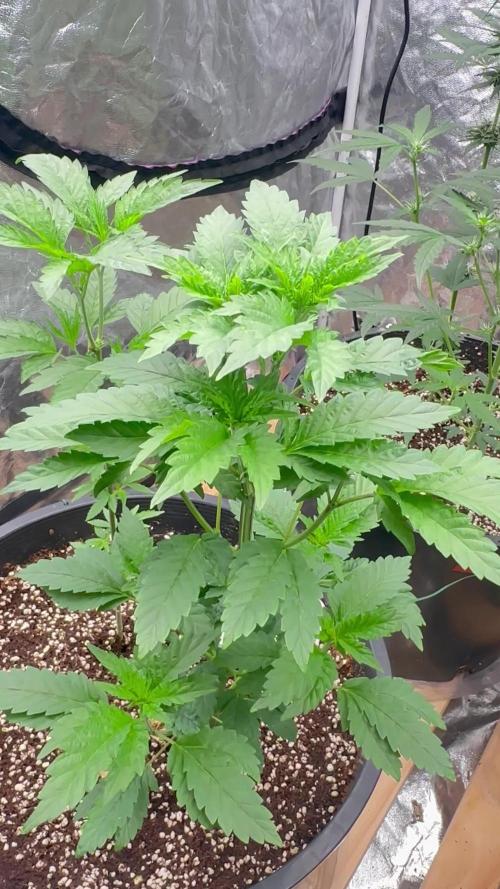
🗓️ Week 7 Grow Journal Update 🌱✨
✂️ This week was all about defoliation! I removed the older leaves to help the plants focus their energy on fresh new growth 💪🌿 — and they’re loving it!
🍋 Fast Buds Lemon Zkittlez is smelling incredible — a sweet, fruity mix with that sharp lemon zest punch 🍬🍋🔥
🍇 Grape Wedding Force is stacking up with a strong, solid structure — it’s looking like a powerhouse in the making 💒🌲💥
🌶️💜 Red Hot Violet is coming along beautifully with a structure perfect for LST — can’t wait to see her stretch and train

Processing
Likes
3
Share


@camo420
Follow
NEW BOX: 130x60x120
DIY: storage shelf, solid sheet metal
ELECTRO ################################
thermometer top
thermometer bottom
hydrometer
wlan ip cam (+ir filter)
----------------------------------------------------------------
input: x2 USB PC fan
exhaust: x2 USB PC fan
circulation: x2 USB fan
----------------------------------------------------------------
led panel 1: 300W ASUNDOM LED (Veg/Bloom/Full)
led panel 2: 300W XHGrow Reflector-Series LED (Full)
----------------------------------------------------------------
studio light 1 (vegetation): 36W TaoTronics LED Gold
studio light 1 (vegetation): 50W Balai LED full
studio light 2 (vegetation): 8W VINGO LED blue ligh
studio light 2 (vegetation): 50W Balai LED full
----------------------------------------------------------------
studio light 1 (bloom): 36W TaoTronics LED Green
studio light 1 (bloom): 36W TaoTronics LED Gold
studio light 1 (bloom): 50W JADIDIS LED IR full
studio light 2 (bloom): 36W TaoTronics LED Green
studio light 2 (bloom): 36W TaoTronics LED Green
studio light 2 (bloom): 36W KINGBO LED Deep red 660nm
3x PLANTS ###############################
FastBuds Girl Scout Cookies
pots: 14L
soil: plagron grow mix

Likes
22
Share


@Ghostguy1337
Follow
I am shocked at how beautiful these nugs are...I have never seen so many fat nugs in my life. Sticky, dense. I can wait until they are dried and cured.
Update: found some mold on 4 of my nicest nugs, so i trashed them. A real shame. I had to go away for a few days and i think it was a combo of having dense colas, with a humidity around 60%. Live and learn for next grow. Still have plenty left.

Likes
5
Share


@Unnamed
Follow
Added a photo to show where I take RH/Temp measurements from in the tent, pretty much inside the canopy.
Went lower on EC this week to give the plant a little time to regenerate and pack some more before harvest.
The dehumidifier is pulling less and less moisture out of the air every day, this is a additional sign to me that the plant is nearing its end.
Not quite sure when to harvest, maybe next week or the week after, the plant isn't really stacking, it is frosty but I am missing the quantity, the pictures are kinda deceiving.
Values are average of the day.
DATE - °C - RH% (Tent Temp/RH)
20241216 23.6 61.7
20241217 24.2 62.2
20241218 23.3 61.5
20241219 22.9 61.7
20241220 22.1 60.7
20241221 23.1 61.5
20241222 22.6 60.9
DATE - PH
20241216 6.09
20241217 6.03
20241218 6.14
20241219 6.16
20241220 5.99
20241221 5.97
20241222 5.87
DATE - ORP (mV)
20241216 74
20241217 63
20241218 30
20241219 11
20241220 50
20241221 24
20241222 82
DATE - EC(us/cm)
20241216 2097
20241217 2004
20241218 1692
20241219 1749
20241220 1636
20241221 1688
20241222 1695
DATE - CF
20241216 20.97
20241217 20.05
20241218 16.92
20241219 17.49
20241220 16.36
20241221 16.88
20241222 16.95
DATE - °C (Reservoir)
20241216 22.1
20241217 22.1
20241218 21.8
20241219 22.2
20241220 20.9
20241221 21.6
20241222 21.4
Likes
27
Share


@Veteransgrow710
Follow
They stretched so much i almost ran outta room for my light lol. They loving their feed and doing really well so far i think.


Likes
44
Share


@RakonGrow
Follow
Note: jegliches Equipment findet ihr in der Germinations Woche .
Day 22:
PPFD 410 * 20h = DLI 29.52
Day 23:
Day 24:
+ Dünger
+ + 0.5 Flaschenwasser
+ + + Rhizotonic
+ + + Terra Vega
+ + 0.6 Leitungswasser
+ final PH 6.5
Day 25:
Day 26:
Day 27:
+ Flaschenwasser 2.5 L (PH 7.2 EC 0.26)
+ + CanaCym
+ Final PH 6.1
= Drain : EC 1.325
Sieht bissel danach aus als hab ich etwas zuviel Urgesteinsmehr in die Erde eingearbeitet :)) Muss ich halt bissel spaarsamer mit der Düngung umgehen .
Day 28:
Das Wetter und die liebe Luftfeuchtigkeit :(( Manchmal denk ich das ich Outdoor growe :))
Im Video sieht man schön wie der kleine Zwerk sich selber mit seinen riesen Blättern SCROG mäßig den Wuchs in die Breite erzwingt :)) Die Blütentriebe müssen halt den Weg zum Licht mit aller Anstrengung erreichen .

Likes
4
Share


@pzwags420
Follow
I'm now on vacation for 2 weeks so all photos will be from my security camera. From what I can tell my new clones are greening up and putting out some new growth. My blumats had a runaway on day 3... luckily my neighbor was around and was able to slow the drip rate down on my one plant which was starting to flood my box. It has now stopped dripping and my hope is there will be no more hiccups..I will be watching closely over my vacation. 😅🙏

Likes
47
Share


@GanjaReaper
Follow
Day 21:
From day 10 to 21 I couldn't take care of the plants because of private reasons,
I asked my friend to take care of the plants and he didn't do a good job!
He should had asked me or alerted me when he saw mayor problems, not just saying a little bit of light green or yellow.
As you can see, we have alot of yellowing beneeth the plants, different sizes and even got some burnt leafs indicate that he didn't water on time.
Did some run-off checks and saw many various values😓
Ph between 6.8-7.5 and EC between 1 to 2.
The PH should had been 5.8-6 and EC at this stage 1.8+ since they need alot of nutrients because cocos soil doesn't have any.
Because of this shit, they have been underfed, burnt, stress and more. Not ideal for autoflowers.
Even the reservoir from humidifier was empty, indicating that it hasn't been filled for days!!
Also he didn't sorted the plants out, there are always spots that get dryer faster or stay more wet. Get more light or less.
Therefore it is wise to change spots of your plants all the time, I call it dancing.
Your plants will grow more equally.
If you look at the bigger plants, this should had been the size of all the plants sadly.
They now look like they are in end of week 2 instead of week 3 and the bad plants end of week 1 😕
I did some defolation on some plants on the lower area.
Roots start to show underneeth the pots, which is really good.
I putted the bad plants in left under corner, Lets hope I can still nurse them.
I still have 1-2 weeks to fix this before it goes into flowering, lets hope they will still grow double in size, otherwise this will be a lower rewarding grow.
Likes
47
Share


@MadeInGermany
Follow
Info:
Unfortunately, I had to find out that my account is used for fake pages in social media.
I am only active here on growdiaries.
I am not on facebook instagram twitter etc All accounts except this one are fake.
Have fun with the update.
Hey everyone 😃.
Another week of beautiful growth goes by 😀.
She continues to develop very well and beautifully.
All shoots were topped up again.
I think I'll go back a few more times do topping before it goes into bloom :-).
The tent was cleaned and the humidifier refilled 👍.
Otherwise nothing exciting happened this week.
I wish you all the best and have fun with the update 👍.
Stay healthy 🙏🏻
You can buy this Strain at :
https://www.exoticseed.eu/
Type:
Herz Og
☝️🏼
Genetics:
Larry OG X Kosher Kush
Indica 60 % / Sativa 40 %
👍
Vega lamp:
2 x Todogrow Led
Quantum Board 100 W
💡
Bloom Lamp :
2 x Todogrow Led
Cxb 3590 COB 3500 K 205W
💡💡☝️🏼
Soil :
Canna Coco Professional +
☝️🏼
Fertilizer:
Green House Powder Feeding
☝️🏼🌱
Water:
Osmosis water mixed with normal water (24 hours stale that the chlorine evaporates) to 0.2 EC. Add Cal / Mag to 0.4 Ec Ph with Organic Ph - to 5.5 - 5.8 .


Likes
52
Share


@Salokin
Follow
Hi growmies,
She is developing alright, however I feel that she isn’t stretching enough. Maybe this will start now that she has started preflower, she was topped towards the end of this week, even though she is so stubby, as i want to guarantee that all colas receive the same amount of love from the plant. Even though she is growing super horizontal, I will still install a ScrOG; to be able to control her bushyness a little. Have also finally come around to channel off some air from one of my pumps into the reservoir.
Likes
32
Share

@All_our_small_plants
Follow
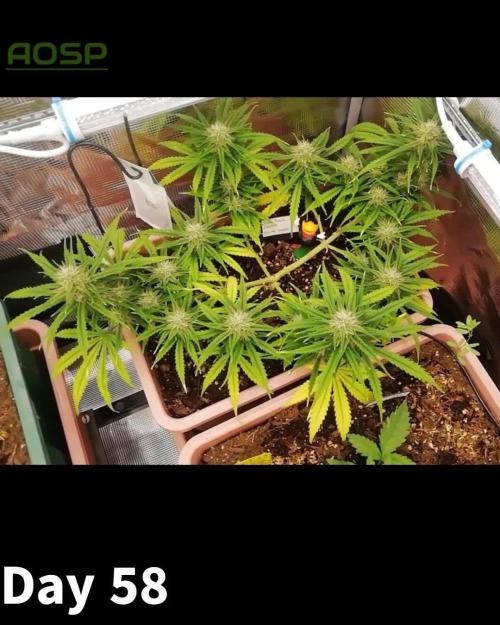
Bewässerung: 2000 ml jeden 2 Tag in der zehnten Woche
pH-Wert: 6,4
EC-Wert: 2 mS/cm
Temperatur: 30ºC
Luftfeuchtigkeit: 65%
Schädlingsbekämpfung: im Moment haben wir keine Anzeichen das es was zu bekämpfen gibt, sobald die ersten Anzeichen da sind werden wir handeln :), aber zur Sicherheit haben wir wieder ein paar Raubmilben an die Pflanzen gehenkt.
PPFD: 600 µmol/m²/s
DLI: 38 mol/m²/Tag
Düngemittel: Sie bekommt CalMag von BioBizz zu Prävention. Ab Tag 44 haben wir angefangen sie mit einem Mineralischen NPK Dünger (NPK 3,5-6-6) zu Gießen, Plagron wurde auch hinzugefügt.
Besonderheiten: wir versuchen bei diesem Grow Effektive Mikroorganismen aus.
-Tag 58 Pablito hat heute nur Wasser bekommen, wieder Runoff gemessen 0.72mS/cm 😀
-Tag 60 Pablito hat heute wieder etwas Dünger bekommen, wir denken dass sie noch 2 Wochen hat
-Tag 62 wir haben sie heute wieder mit den Mikroorganismen gegossen und die stinken schon sehr stark, irgendwie nach Erbrochenem 😖

Likes
16
Share


@DaddyPrime2
Follow
7/10/24
testing testing. can i post updates now?
beautiful buds. the leaves are changing into a blue color. it reminds me of some of the blue city diesel i got from a buddy back in the medical days.


Likes
9
Share


@HollowSource
Follow
This girl has been topped twice and is loving life. Really strong growth. She wants to stretch. She isn't far behind the amnesia. Tapering up the ferts gently as I've read she can be a bit sensitive. Hard to believe she was incredibly stressed as a young 'un.

Likes
19
Share


@Little_E
Follow
Day 105-
So we are on week 8 of flower as of 2 days ago. Day 105 from seed. I watered both plants today with Jack's. I'm hoping this is the last time with nutes for at least one of the girls. My sativa has mostly cloudy trichomes so I'm going to start flushing her after this. I'm thinking she will be where I want her to be in a week. Maybe a tad longer. I'm waiting out the indica a little while longer because I'm shooting for a decent amount of amber. I can see the finish line What a major learning experience. So humbled to share this journey with you all. Not a perfect grow by any means but I hope to use this knowledge and crush my second grow.
Day 109-
Started 36 hours of dark at 5:30am
Day 110-
Trimmed and hung. What a ride it has been! Can't wait to update with a dry weight.

Likes
7
Share


@Ton_Trichomen
Follow
Day 14 🤩 vegi is starting
Piccas from this morning 8.30 and 17.00 after LST
So today was the first time I had Terra, Generator & Root Stimulator, only ¼ of the specified amount of everything and of course Hy Pro Fertilizers, my fertilizer barrel is finally ready, is being supplied with oxygen and the fertilizer is in motion, which means that as I am lazy I make 50l and leave it in the corner 😉 but always ready to use...
Then today was the first light LST, I will leave it alone for 4 days and then see where and how I pull it out, it doesn't really matter because I want to put up a net and lay it flat underneath
The Frosted Agave from Original Sensible Seeds has also seen the light of day
This grow is sponsored by:
Zamnesia Seeds
Hy-Pro Fertilizers
Mars Hydro LED
Start 26.4.024
Germination date 30.4 024
Germination 6v6
From Zamnesia
Do Si Dos f1 Auto.2x
Green Crack f1 Auto 2x
Pineapple Express f1 Auto 2x
Growing method
L.S.T with the help of a scrog net..🙈
Light led 1x fc 4800 from mars hydro
Exhaust air, I replaced the heavy pk 150 with my Mars Hydro 6 inch fan
Filter Rhino pro 900m³
Inlet air 305 m³ with filter 160mm
Soil:
Atami Light Mix &
5 mm pumice stone &
16 mm expanded clay on the floor
In 15 l. Factory pot
Temperature inside: 26.50°C 79 Fahrenheit
Outside temperature 21°C
R/H 64%
Light: 19/5 dimmed to 75% distance 70cm
Roots 21.00°C
Ph medium 7.0
Ph water 6.3 1.5 liters today
Ec 0.8
Nutes Hy-Pro Fertilizers Terra ml to 1l
Terra Veg & Bloom 0.6ml
Roots Stimulator 2.0 ml
Spraymix 5 ml
Generator 0.3 ml
Epic Boost 0 ml
Enhancer by Greenhouse
0 g
😉🤜🤛
#marshydroreview
#HyProFertilizers
#zamnesia
#originalsensibleseeds

Likes
20
Share


@Insaniac_0
Follow
8set Mainline & 6/4set Manifold in Auto Pot - Selfie Seeds Sweet Slurry x Sugar Cane (6X4) - Week 14
Flower Week 5 Day 35 to 41 - 4/22 to 4/28
They both look extremely healthy this week. The calyx are swelling with maturing hairs, the pistols are orange, the trichomes are mostly white, and the leaves are fading/changing colors - still not ripe enough for me, but flushing with half nute feeds now.
Feed this week was an auto pot reservoir flush feed at 400ppm total before add-ins. I used 400ppm of Bloom concentrate mix (recipe week 5). However, I also added 1ml/gal of CaliMagic (General Hydroponics 1-0-0) and ph balance this week was for 5.8 where Io plan to maintain it until harvest.
Next week will continue the same half nute feed. I will continue to monitor the signs of trichomes, pistols, and calyx for a better harvest and allow the buds to mature more.