


Likes
Comments
Share


@Cannabeast40
Follow
Week 3 and a repot is done and now in day 3. Finally it’s settling down after the repot, which was not pretty at all😂
Hope to get some massive plants this run 🌱
________________________________________________________________________________________
Light from @MedicGrowLED 😎
NEO 780 LED🔥
780 Watt⚡️💥
PPF of 2184 μmol/s & 2.8 μmol/J🔥
Full Spectrum V1/F1 🌈
WiFi smart connection & Smart Aura Control 😱

Processing
Likes
45
Share


@AsNoriu
Follow
Day 65 . Girls love theirs shitty life ;)))
Looks everything fine, they started to smell really berry , time to put air filter on.
The only toped and most delayed girl is showing super results, you can check her size on week 4. Its crazy what upside down plant delivered. Good i left her and always hoped that she will be special ..
Day 66. And its friday 13 ;))) I see that late FastDiesel is way behind, so i made it even worse ;)) i stripped her hard, just to know how this strain reacts. All other girls are way upfront and for some it would be second round of defoliation in flower, but they never tried it and its just to late to experiment with all of them. After two hours she still hates it.
Fast Diesel really loves CalMag, on day 67 all girls will get CalMag + Molasses mix, for some girls it will be last CalMag i think. They will have a heavy feed aswell. Planing on day 69-70.
Thats all action and plans for this week. All girls got striped a bit on day 66 and changed left with right . Thinking new possition will light up other buds, maybe flower will develop more evenly...
Looks like thats it, hope no budrot, thats my only fear ....
And i forgot to make earliest Tangie photo, but she was always in front at the entrance and she is nothing special, looks like too leafy bud phenotype, the only plus, i hope she will be choped this year.
Day 67. Morning, girls still not thursty, they drink pure ph water slowest from all mixes. Defoliated girl prays like nothing happend, she should make long colas ;) just in february i quess ;)))
Way too long run with autos, i was hoping to flush by now ... Wont make it with two waterings this week. Its a first week for them without nute boost. Will reduce a bit amount, was feeding almost 2 liters per pot, thinking to go back to 1.5-1.7 area and stop giving silica and cal mag mix. So feed will be in 3 steps from now
1. Heavy feed
2. Ph Water
3. Molasses and calmag mix
Day 67. Late Eve. They are finally light, maybe i will make feeding on tuesday, right at the end of week, today calmag and molasses mix. Raised 3 pots, girls should love more light, now have more even canopy.
Everytime i say thats it , but after pot raise i dont see what can i do more with them...
Toped tangie looks having some bleaching on top cola, raised lights half inch ;))
Day 70. Heavy feed day. They look happy and fatten a bit.
End of week
Next run if i ever do autos i will check #FastBuds beans, from all diaries this house make it super fast.


Likes
31
Share


@JeyGanesha
Follow
🦍 cookies ancora pochi giorni ed è cotta anche lei.. buonissima,!! Ha un profumo delizioso super.
I'attesa si fa lunga 🤣😉🤣😉

Likes
1
Share


@LennyBach
Follow
Lots of growth this week and working to solve the humidity issues.
I think it's probably because of the size of my pots but these girls just won't stop growing! I think I'm going to have to consider some defoliation for her next week.
I noticed some rust spots on some of the leaves this week, I'm fairly certain that it's down to the humidity. Where leaves were gathering condensation they seem to have discoloured, probably because of magnifying the light - I'm just a beginner though so I'm happy for other people's opinions.
I've kept feeding her a little bloom every couple of days, there was a little bit of yellowing to the tips of some leaves which I though could be down to nute burn but I'm not too worried about it at the moment.
I think this plant has overtaken the Jack Herer now, she seems to be flowering a lot more. She smells divine - really strong citrus notes, I think she's going to be tasty!
To fix the humidity issues I diverted the extraction duct to another room which seems to have made a big difference, RH is now consistently under 57% and usually around 55% - still not ideal but I don't think I'll get it much lower. I've moved the fan so that there's plenty of air moving over the canopy - hopefully enough to keep away the mould as the grow progresses.

Likes
56
Share


@Ultraviolet
Follow
What's in the soil? What's not in the soil would be an easier question to answer. 16-18 DLI @ the minute. +++ as she grows.
Probably not recommended, but to get to where it needs to be, I need to start now.
Vegetative @1400ppm 0.8–1.2 kPa 80–86°F (26.7–30°C) 65–75%, LST Day 10, Fim'd Day 11
CEC (Cation Exchange Capacity):
This is a measure of a soil's ability to hold and exchange positively charged nutrients, like calcium, magnesium, and potassium. Soils with high CEC (more clay and organic matter) have more negative charges that attract and hold these essential nutrients, preventing them from leaching away.
Biochar is highly efficient at increasing cation exchange capacity (CEC) compared to many other amendments. Biochar's high CEC potential stems from its negatively charged functional groups, and studies show it can increase CEC by over 90%. Amendments like compost also increase CEC but are often more prone to rapid biodegradation, which can make biochar's effect more long-lasting. biochar acts as a long-lasting Cation Exchange Capacity (CEC) enhancer because its porous, carbon-rich structure provides sites for nutrients to bind to, effectively improving nutrient retention in soil without relying on the short-term benefits of fresh organic matter like compost or manure. Biochar's stability means these benefits last much longer than those from traditional organic amendments, making it a sustainable way to improve soil fertility, water retention, and structure over time. Needs to be charged first, similar to Coco, or it will immobilize cations, but at a much higher ratio.
a high cation exchange capacity (CEC) results in a high buffer protection, meaning the soil can better resist changes in pH and nutrient availability. This is because a high CEC soil has more negatively charged sites to hold onto essential positively charged nutrients, like calcium and magnesium, and to buffer against acid ions, such as hydrogen.
EC (Electrical Conductivity):
This measures the amount of soluble salts in the soil. High EC levels indicate a high concentration of dissolved salts and can be a sign of potential salinity issues that can harm plants.
The stored cations associated with a medium's cation exchange capacity (CEC) do not directly contribute to a real-time electrical conductivity (EC) reading. A real-time EC measurement reflects only the concentration of free, dissolved salt ions in the water solution within the medium.
98% of a plants nutrients comes directly from the water solution.
2% come directly from soil particles.
CEC is a mediums storage capacity for cations. These stored cations do not contribute to a mediums EC directly.
Electrical Conductivity (EC) does not measure salt ions adsorbed (stored) onto a Cation Exchange Capacity (CEC) site, as EC measures the conductivity of ions in solution within a soil or water sample, not those held on soil particles.
A medium releases stored cations to water by ion exchange, where a new, more desirable ion from the water solution temporarily displaces the stored cation from the medium's surface, a process also seen in plants absorbing nutrients via mass flow. For example, in water softeners, sodium ions are released from resin beads to bond with the medium's surface, displacing calcium and magnesium ions which then enter the water. This same principle applies when plants take up nutrients from the soil solution: the cations are released from the soil particles into the water in response to a concentration equilibrium, and then moved to the root surface via mass flow.
An example of ion exchange within the context of Cation Exchange Capacity (CEC) is a soil particle with a negative charge attracting and holding positively charged nutrient ions, like potassium (K+) or calcium (Ca2+), and then exchanging them for other positive ions present in the soil solution. For instance, a negatively charged clay particle in soil can hold a K+ ion and later release it to a plant's roots when a different cation, such as calcium (Ca2+), is abundant and replaces the potassium. This process of holding and swapping positively charged ions is fundamental to soil fertility, as it provides plants with essential nutrients.
Negative charges on soil particles: Soil particles, particularly clay and organic matter, have negatively charged surfaces due to their chemical structure.
Attraction of cations: These negative charges attract and hold positively charged ions, or cations, such as:
Potassium (K+)
Calcium (Ca2+)
Magnesium (Mg2+)
Sodium (Na+)
Ammonium (NH4+)
Plant roots excrete hydrogen ions (H+) through the action of proton pumps embedded in the root cell membranes, which use ATP (energy) to actively transport H+ ions from inside the root cell into the surrounding soil. This process lowers the pH of the soil, which helps to make certain mineral nutrients, such as iron, more available for uptake by the plant.
Mechanism of H+ Excretion
Proton Pumps: Root cells contain specialized proteins called proton pumps (H+-ATPases) in their cell membranes.
Active Transport: These proton pumps use energy from ATP to actively move H+ ions from the cytoplasm of the root cell into the soil, against their concentration gradient.
Role in pH Regulation: This active excretion of H+ is a major way plants regulate their internal cytoplasmic pH.
Nutrient Availability: The resulting decrease in soil pH makes certain essential mineral nutrients, like iron, more soluble and available for the root cells to absorb.
Ion Exchange: The H+ ions also displace positively charged mineral cations from the soil particles, making them available for uptake.
Iron Uptake: In response to iron deficiency stress, plants enhance H+ excretion and reductant release to lower the pH and convert Fe3+ to the more available form Fe2+. The altered pH can influence the activity and composition of beneficial microbes in the soil. The H+ gradient created by the proton pumps can also be used for other vital cell functions, such as ATP synthesis and the transport of other solutes. The hydrogen ions (H+) excreted during photosynthesis come from the splitting of water molecules. This splitting, called photolysis, occurs in Photosystem II to replace the electrons used in the light-dependent reactions. The released hydrogen ions are then pumped into the thylakoid lumen, creating a proton gradient that drives ATP synthesis.
Plants release hydrogen ions (H+) from their roots into the soil, a process that occurs in conjunction with nutrient uptake and photosynthesis. These H+ ions compete with mineral cations for the negatively charged sites on soil particles, a phenomenon known as cation exchange. By displacing beneficial mineral cations, the excreted H+ ions make these nutrients available for the plant to absorb, which can also lower the soil pH and indirectly affect its Cation Exchange Capacity (CEC) by altering the pool of exchangeable cations in the soil solution.
Plants use proton (H+) exudation, driven by the H+-ATPase enzyme, to release H+ ions into the soil, creating a more acidic rhizosphere, which enhances nutrient availability and influences nutrient cycling processes. This acidification mobilizes insoluble nutrients like iron (Fe) by breaking them down, while also facilitating the activity of beneficial microbes involved in the nutrient cycle. Therefore, H+ exudation is a critical plant strategy for nutrient acquisition and management, allowing plants to improve their access to essential elements from the soil.
A lack of water splitting during photosynthesis can affect iron uptake because the resulting energy imbalance disrupts the plant's ability to produce ATP and NADPH, which are crucial for overall photosynthetic energy conversion and can trigger a deficiency in iron homeostasis pathways. While photosynthesis uses hydrogen ions produced from water splitting for the Calvin cycle, not to create a hydrogen gas deficiency, the overall process is sensitive to nutrient availability, and iron is essential for chloroplast function.
In photosynthesis, water is split to provide electrons to replace those lost in Photosystem II, which is triggered by light absorption. These electrons then travel along a transport chain to generate ATP (energy currency) and NADPH (reducing power). Carbon Fixation: The generated ATP and NADPH are then used to convert carbon dioxide into carbohydrates in the Calvin cycle. Impaired water splitting (via water in or out) breaks the chain reaction of photosynthesis. This leads to an imbalance in ATP and NADPH levels, which disrupts the Calvin cycle and overall energy production in the plant. Plants require a sufficient supply of essential mineral elements like iron for photosynthesis. Iron is vital for chlorophyll formation and plays a crucial role in electron transport within the chloroplasts. The complex relationship between nutrient status and photosynthesis is evident when iron deficiency can be reverted by depleting other micronutrients like manganese. This highlights how nutrient homeostasis influences photosynthetic function. A lack of adequate energy and reducing power from photosynthesis, which is directly linked to water splitting, can trigger complex adaptive responses in the plant's iron uptake and distribution systems.
Plants possess receptors called transceptors that can directly detect specific nutrient concentrations in the soil or within the plant's tissues. These receptors trigger signaling pathways, sometimes involving calcium influx or changes in protein complex activity, that then influence nutrient uptake by the roots. Plants use this information to make long-term adjustments, such as Increasing root biomass to explore more soil for nutrients. Modifying metabolic pathways to make better use of available resources. Adjusting the rate of nutrient transport into the roots. That's why I keep a high EC. Abundance resonates Abundance.
Likes
5
Share


@Deltatigrou0169
Follow
Bonjour à tous les amis,
Je suis content et fière de mes fifilles elles ce plaisent dans leur climat, à part mes Petites Mutantes qui elles ont dû mal à pousser.
Je m'inquiète pas,je pense qu'elles vont grandir tout doucement y faut être patient 🙄 avec ces fifilles 😊.
Je vous dit à plus tard, et bonne soirée à tous.
Merci 😃 👍👍👍


Likes
63
Share


@DogDoctorOfficial
Follow
She just did great, amazing numbers, amazing quality , amazing everything, big shout out to GANJAFARMER great job.
As always thank you all for stoping by, for checking my journey , for the love support and for it all, i am blessed and humble with you all.
Just a reminder , all i grow is medicine for myself, for me and for my best friend with is me nothing to sell, so don’t even ask.
All info and full product details can be find in can find @
https://ganjafarmer.com
https://aptus-holland.com/
#aptus #aptusplanttech #aptusgang #aptusfamily #aptustrueplantscience #inbalancewithnature #trueplantscience #Ganjafarmer #growerslove
With true love comes happiness 💚🙏 Always believe in your self and always do things expecting
nothing and with an open heart , be a giver and the universe will give back to you in ways you could not even imagine so 💚💚💚
More info and updates @
https://growdiaries.com/grower/dogdoctor
https://instagram.com/dogdoctorofficial
https://youtube.com/channel/UCR7ta4DKLFMg2xxTMr2cpIg
💚💚💚Growers love to you all 💚💚💚

Processing
Likes
69
Share


@TOTEM
Follow
Back on track with feeding schedule. Yay! Last week I removed all the lower branches that were not hit by the light. This should move move energy to the top. Look at the buds, aren’t they lovely? I’m in love with this Euphoria, you know... ❤️

Likes
109
Share


@Prototype0181
Follow
Got a little yellow on one of the cookies 🤦♂️🏻 i think i stopped feeding N a bit to early this round. Next feed i'm gonna give her a shot of Canna mono Nitrogen to perk her up.
The rest of the lady's are in good shape and stacking nicely 👌
Rock on Growmies 💚


Likes
11
Share


@Nutrient_gro
Follow
These lady’s still in veg. I see the hairs forming slowly on both, it’s almost week 7 so I’ll call it week 7 flower. Doesn’t seem to have any problems she just keeps growing.
Likes
10
Share


@MG2009
Follow
01/17/2021
One more week of feeding then water only
01 22/2021
It's Day # 54 of flowering and starting plain water in two days till day 63 last one I took at 50 days and it was good can't wait to compare.
01/24/2021
Day # 56 of flowering and I switched to plain water, at lights on will be in plain water till day #63 at which time I will chop and dry , after 7 days of flushing. I'm curious to see how she depletes her reserves.
Ps.
I did chop the two tallest buds to dry and test. I'll keep y'all
posted.😉


Likes
4
Share


@TheGreenGroomer
Follow
Today marks the start of Week 6, Day 2 for the grow, and I’ve got a few updates. The PPMS aren’t quite where I want them after the last couple of feeds, so I’ll be continuing with higher feeds to bring those levels back up. It’s a bit of a balancing act, but I’m staying on top of it.
I also made the decision to flip the light schedule from 16/8 to 12/12 today to initiate the flowering phase. I’m excited to see the plants start stretching and showing their full potential. It’s a big step, and I’m feeling good about the direction things are heading.
Happy growing! 🌱💡🌿
Likes
9
Share


@Love2Bud_UK
Follow
Have not been disappointed by this strain, from start to finish! Blown away by her resilience. Very smelly girl, literally has my mouth watering 🤤 Nugs are really solid and dense, they have been the best I've grown so far. RQS have done an excellent job 🤯🤯
Likes
9
Share

@PSK23
Follow
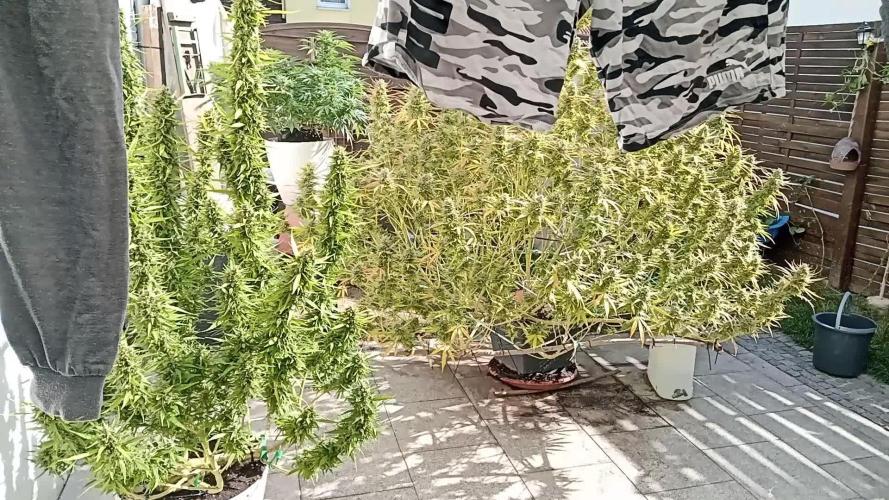
The plant has just entered the seventh week of flowering. During the previous week, the sixth, I performed three waterings, tapering from 5ml of Plagron Terra Bloom to 1.5ml per liter for the third watering. Now, starting this seventh week, I am beginning the flushing process with pH 6.0 water to maintain the soil around 6.2. The plant will spend the final 7 to 10 days flushing. Thanks to the pruning techniques used at the beginning, lollipopping wasn't necessary. I also apply a daily, meticulous defoliation method specifically targeting leaves attacked by pests like aphids or spider mites. Furthermore, I use Low-Stress Training (LST) on the larger inflorescences, pulling them outwards to increase light and air penetration. Drawn from years of outdoor cultivation experience, I shelter the plant under a gazebo or tarp during wet or humid nights and provide ventilation to prevent rot. I strongly advise this practice to all outdoor growers; after losing many harvests in the past, I will not allow bad weather to destroy my work.
Likes
2
Share


@Homestickycannabis
Follow
Easy,fast,fat,dense,stinky,sticky and absolutely tasty. These were 2 clones I took at the middle of flowering and the only retreat or issues I had is I wish I would have vegged these two clones at least 3 weeks more. Dos si Dos 33 from Barney's Farm is one the most beautiful strains to look at. !!!!

Likes
3
Share


@PalmaGrow
Follow
Excelente genética excelentes olores y aromas un terreno delicioso, productora al 100% tiene una muy buena capacidad de producir cogollos robustos y compactos
26/10/2024 fecha de la cosecha.
Likes
8
Share


@BlackForestGrower
Follow
Week 25 Day 1 Flushing
Week 25 Day 4 plant 1/2 for 48h in the darkroom and then hung up

Likes
93
Share


@PEAKYPLANTERS
Follow
Hi guys, What's up?
Welcome back to Queen Peaky's Flower Gardens
We have decided to further extend this beautiful woman's stay in our tent to continue developing the fantastic buds she has developed
Likes
3
Share


@MissBudReefer
Follow
Amazing week for the gorgeous lady 😁 I removed all bottom stems and leaves 🌱🌿