


Likes
Comments
Share


@Borberad
Follow
Woche drei der Blüte und alles Bestens! Aufgrund der dichten Struktur habe ich die Pflanze an Blütetag 19 großzügig ausgedünnt. Bei photoperiodischen warte ich damit bis mind. Blütetag 21. Die kleine Auto Blueberry Banana scheint aber schon recht weit, daher habe ich hier keine Bedenken. Seit Mitte der Woche scheinen die Blattspitzen etwas Überdüngung anzuzeigen. Der Drain mit Osmosewasser bei ph 6,4 und 20 microSiemens hat ph6,7 und 800microSiemens. Setze die Stickstoffgabe etwas herab indem ich Hesi Blüte reduziere und pk13/14 ergänzend zuführe. Erhöhe somit gleichzeitig Phosphor und Kalium.

Processing
Likes
62
Share


@DudeGrowsWeed
Follow
February 28, 2019 Update:
Getting close to the end here. I'm going to start flushing the Cherry Hemp plants this weekend and chop them down the following weekend. The DinaMed, Critical+ and Cream & Cheese should only be a week or two away from flush also.
Feeding only MegaCrop & Cal+Mag Pro until the flush. This week I took pictures with the lights off and my camera flash on, I think these pics look better than last weeks. Bonus pic at the end of the view from my bedroom window. I'd love to see my buds get that frosty! 👍


Likes
13
Share


@knicko
Follow
Auf der Waage im getrockneten Zustand waren es 130g somit habe ich mir den Fixkosten ein €/g von 2.55€/g das finde ich nicht schlecht
Likes
4
Share

@Gorillagrower
Follow
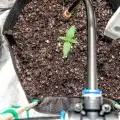
Week 3 and they are starting to take off. I used some Recharge by Real Growers. Instant compost soil amendment ingredients. Great stuff.

Likes
Comments
Share


Likes
10
Share


@DeepWaterGrower
Follow
Welcome to my new diary! I'll be chronicling my experience growing Runtz photoperiod by Zamnesia. This is actually a grow I just finished, but I'm excited to share the journey with you now.
As always I'll grow in a DWC system, this time in a 2x2 grow tent. To manage the environment, I'm using a Vents TT100 for air extraction and an Hailea air pump to keep the 20-liter DWC pot well-oxygenated. That 20-liter capacity should be enough to let the plant cruise for a few days without needing a refill, even when it's deep into the flowering stage. Lighting will be provided by a 150 watt lamp, which I'll run on an 18/6 schedule during veg and switch to 12/12 for flowering. As for nutrients, I'll be using the Plagron hydro line.
To keep a really close eye on all the critical parameters like temperature, RH, CO2, PH, and PPFD, I'm relying on my Tent-X system by TrolMaster. It's a fantastic piece of kit that allows me to control and dim the light remotely, also includes a smoke detector.
🌱🌱🌱🌱🌱🌱 GROW JOURNAL 🌱🌱🌱🌱🌱🌱
🗓️ WEEK 1 (veg)
🔙 Kicking things off, I prepared all the materials. The clay pebbles received a 20-minute boil followed by a 24-hour soak in demineralized water adjusted to pH 5.8. I gave the air stones a 24-hour bath in a water and vinegar solution, rinsing them thoroughly afterward. The root riot cube also soaked for a few hours in water at pH 5.8.
🌱 With preparations complete, I placed the seed into the root-riot cube on day 1, nestled it in the net-pot, and surrounded it with clay pebbles. The light was set to an 18/6 cycle, positioned 50 cm away, and running at 50 watts.
I hand-watered the seedling with approximately 5 ml of demineralized water directly onto the clay twice daily, while the DWC reservoir below held 20 liters of a light nutrient solution: EC 0.6 - pH 5.8.
On day 4, the seedling emerged and was exposed to the grow light for the first time. Concluding a successful first week, by day 7, it had already pushed several roots out of the net pot and down into the nutrient solution.

Likes
2
Share


@Ultraviolet_
Follow
18 hours in seconds, 60x60x18 = 64,800 seconds, now multiply by the 833μMol/s reading off the PAR metre. μMol/s (micromol) is the unit in which P.A.R. is expressed.
64,800x833=53,784,000μMol
53,784,000μMol = 54 Mol
54 DLI @ 800ppm, powerful combination. Pushing photosynthesis to peak capacity, accelerated growth and increased biomass. Applied net, stretching her around for a week. Maintaining a minimum air velocity of 0.3m/s within the inner canopy.
E=MC2 looks like a simple multiplication problem; it describes a fundamental physical truth: mass and energy are the same thing. The equation doesn't just calculate a value; it reveals that mass is effectively "congealed" energy. Energy is just numbers. Energy isn't a physical "substance" you can hold or touch. It is essentially an abstract, calculated number that we assign to a system to predict how it will change, interact, or move. A numerical label we attach to matter to track how it behaves. Because the universe runs on laws of symmetry (specifically, that the laws of physics don't change over time), a single global number must be conserved. We call that number "energy".
How well a seedling grows is down to how much knowledge one can acquire to increase the level of conversion to occur. Applying knowledge effectively requires intuition, which comes from hands-on experience. A seasoned stoner learns to read subtle signs—like a slight change in leaf turgor (stiffness), subtle color shifts, or the specific texture of the soil—before a textbook diagnosis can be made. Ultimately, growing is the application of botanical science blended with active observation. Knowledge dictates your potential, but adaptability and attentiveness to the plant's immediate environment determine your results. The human eye is capable of distinguishing more shades of green than any other color in the visible spectrum.
1.618
Nature mathematically optimizes quantum energy transfer and light absorption efficiency within the photosynthetic machinery, as it naturally dictates energy scaling hierarchies and resonance dynamics. External vibration or electromagnetic wave that perfectly matches a plant's natural frequency directly influences plant growth. Low-frequency sound waves and targeted electromagnetic fields stimulate cellular processes and boost photosynthetic efficiency. An angular frequency aligned with the Golden Ratio is often used in wave mechanics and quantum physics to optimize energy transfer.
Does it produce better yields? All I know is the IVM loves being aligned with it. Here is how I "think" of it to simplify it for myself when I give it thought. Quantum is the firmware, DNA is the software read/write expression.
Alignment with that of which already exists.
Law of nature, not my opinion: Constructive interference occurs when two or more overlapping waves meet in phase, meaning their crests and troughs perfectly align. Their amplitudes add together, creating a new, amplified wave with greater intensity than the individual components.
Constructive interference is the foundational mechanism that establishes a resonance hierarchy across physical, structural, and acoustic systems.
"Frequencies utilizing this ratio naturally minimize resistance (or impedance) and allow for highly efficient resonance, which can facilitate an increase in Electron Transfer Reactions (ETR) or energy pathways in molecular structures."
Quantum coherence in photosynthesis occurs when a photon of sunlight strikes a leaf; the energy it carries must travel to a reaction center to be converted into chemical energy. This process operates at nearly 100% efficiency. If the energy moved in a traditional "bunching" or random hopping manner, a large portion of it would be lost as heat. Instead, plants utilize quantum superposition. The energy particle (exciton) doesn't just take one path; it exists in a wave state and explores multiple pathways simultaneously. It essentially "chooses" the most efficient route to the reaction center simultaneously.
Research shows that molecular vibrations and the specific network arrangements of chlorophyll molecules (like the naturally evolved Chlorophyll A & B ratios) actively protect against energy overflow, optimizing light capture across different light intensities. Enzymes are the biological catalysts that speed up chemical reactions within a plant's cells, allowing them to grow, metabolize, and repair. Rather than relying solely on the classical kinetic energy of molecules colliding, plants use quantum tunneling. Subatomic particles like electrons and protons (hydrogen ions) can literally "teleport" through energy barriers that they normally wouldn’t have the energy to climb over. This makes vital metabolic reactions happen far faster than classical physics could ever explain!
Chloryphyll b has peak absorption at 460nm (Blue) and at 647nm(Red). If we take the blue peak wavelength 460nm and a UV-B, UVR8 peak absorption wavelength 285nm, Tryptophan-285 (W285) Sensing protein. 460/285=1.618 Φ If we take chlorypyhll b's Red absorption peak 647nm and a UV-A of 400nm, we get 647/400=1.618 Φ. "Structure of light". The cryptochrome photoreceptor (CRY) is a UV-A/blue light receptor that shares this dual sensitivity with several other biological structures and functions, including significant sequence similarity and a common evolutionary ancestor with DNA photolyase enzymes. These are light-activated enzymes that use blue/UV-A light to repair DNA damage caused by UV-B radiation in plants. Synergistic.
Effective quantum efficiency of photosystem II, often denoted as ΦPSII, represents the proportion of light absorbed by Photosystem II (ΦPSII) that is actually used in photosynthetic electron transport. It is a key indicator of how efficiently a plant is using light for photosynthesis, as opposed to losing it as heat or fluorescence. ΦPSII (effective quantum yield of photosystem II) functions primarily as a "multiplier" (a coefficient of efficiency) rather than an additive factor when estimating the overall photosynthetic electron transport rate (ETR). Multipliers are considered far more beneficial than additions because they generate exponential growth, leverage existing resources to their full potential, and create sustainable, self-multiplying capacity, rather than just incremental, linear increases. This fascinating observation is rooted in the intersection of subatomic geometry, fractal scaling, and quantum dynamics. In specific molecular arrangements—such as in conjugated polymer networks or biomolecular architectures—the Golden Ratio (PHI) naturally dictates energy scaling hierarchies and resonance dynamics. Mathematically tied to the fine-structure constant, which defines the strength of the electromagnetic interaction. The Golden Ratio can be mapped geometrically as the Golden Angle (137.5 degrees) in atomic structures, linking the charge of the electron to fundamental quantum constants like Planck's constant.
An electromagnetic wave is neither electric nor magnetic, but a combination of both. 137.5
The Golden Angle (137.5) This angle is derived from the Golden Ratio (1.618). It is the smaller of two angles created when a circle is divided such that the ratio of the arcs equals the Golden Ratio.
An electromagnetic wave (like light or radio waves) is not a static electric field or a static magnetic field, it is a self-propagating combination of both. An oscillating electric field creates an oscillating magnetic field, which then regenerates the electric field. They feed off each other and travel together through space at the speed of light, carrying energy without needing a material medium.
The Fine-Structure Constant Alpha (Α/α): In quantum physics, is the approximate denominator of the fine-structure constant (often represented by the Greek letter Alpha (Α/α). It is a fundamental, dimensionless number that dictates how strongly charged particles (like electrons) interact with the electromagnetic field. Its value has puzzled physicists for over a century, as it bridges quantum mechanics, electromagnetism, and relativity.
In quantum mechanics, Omega (Ω/ω) usually represents angular frequency. When applied to "quantum coherence"—the ability of particles to exist in overlapping states without immediately degrading—is key to calculating how long these states last.
The Golden Angle, the value 137.5° is the geometric Golden Angle. It is derived from the Golden Ratio (1.618) and is famously responsible for the beautiful, mathematically optimized spiral patterns found in nature (such as sunflower seeds, pinecones, and leaf arrangements). Because of this, theoretical physicists and mathematicians have long speculated about why nature relies so heavily on the number 137 and the golden angle to govern everything from subatomic light interactions to the macroscopic geometry of the universe.
Quantum coherence allows particles to maintain superposition and entanglement. In realistic, open environments, interactions with a noisy background typically cause decoherence, destroying the system's quantum information. A major challenge in quantum physics and quantum computing is preventing this decoherence at large scales. In quantum optics and driven systems, the Greek letter Omega (Ω/ω) often represents the Rabi frequency, which dictates the strength of the coherent driving laser or electromagnetic field interacting with the quantum system.
The interaction of light and water generates specific Coherent Domains. Trapped electromagnetic fields cause water molecules to vibrate in unison at a coherent frequency, separating the liquid into structured quantum areas and an unstructured phase. When water interacts with hydrophilic (water-attracting) surfaces, the energy from UV and Infrared light can drive the formation of larger, structured layers known as Exclusion Zone (EZ) water. Exclusion Zone (EZ) water represents a structured, negatively charged phase of water critical to cellular biology. Driven by light energy and hydrophilic surfaces, this ordered state acts as a natural biological battery, with far-reaching implications for cell function and human health. In this domain, water molecules arrange themselves into a highly ordered, negatively charged lattice that excludes solutes and particles. At higher energy levels, UV light acts as a catalyst for photochemical reactions. Photons can provide enough energy to break the hydrogen and oxygen bonds in molecules, resulting in free radicals and a plasma of quasi-free electrons. This transfer of electrons forms the fundamental basis for redox reactions and energy metabolism in ALL biological systems.
Input: The energy, time, and focus you dedicate.
Process: Continuous growing, refining, and learning.
Output: A superior, highly polished final product.


Likes
14
Share

@HazeLiebhaber
Follow
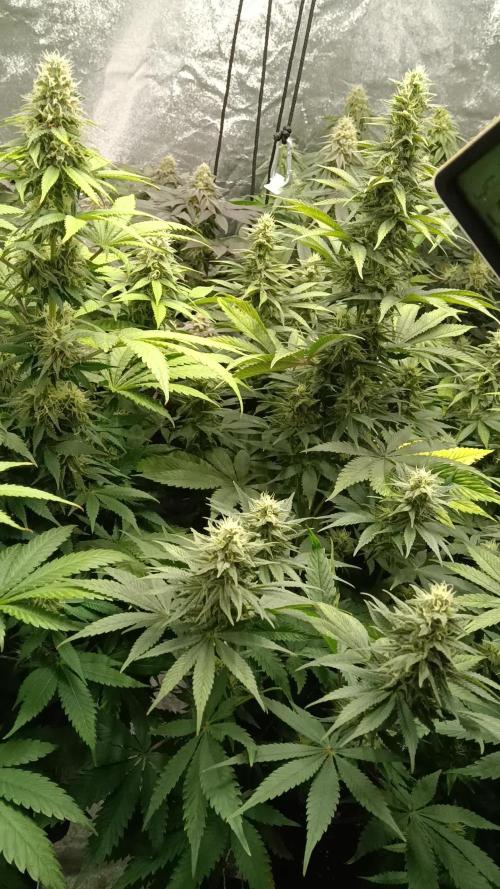
Die Lemon Orange und die Grapefuel Gelato haben bereits ordentlich an Blütenmasse zugelegt und auch so einige Orange-braune Pistillen entwickelt. Die beiden werden wohl als erstes fertig. KISS und Amnesia fangen gerade damit an, an Blütenmasse zuzulegen. Denke die beiden werden mind. eine Woche länger brauchen, um fertig zu werden, als die anderen beiden.
Die Pflanzen im Video: vorne-links Amnesia, hinten-links Lemon Orange, hinten-rechts Grapefuel Gelato, vorne-rechts KISS.



Likes
19
Share


@LittleBigTrees
Follow
This plant was germinated along side three other strains , it stayed short and compact ,it was very leafy and compact .
If I was to grow it again I would spread and thin out the canopy and defoliate more heavily .
This strain was in a10 litre pot and produced 90g of dried trimmed bud .
It was a low producer but the flower is really nice , a very enjoyable evening flower through a volcano vaporizer.


Likes
18
Share


@Hashy
Follow
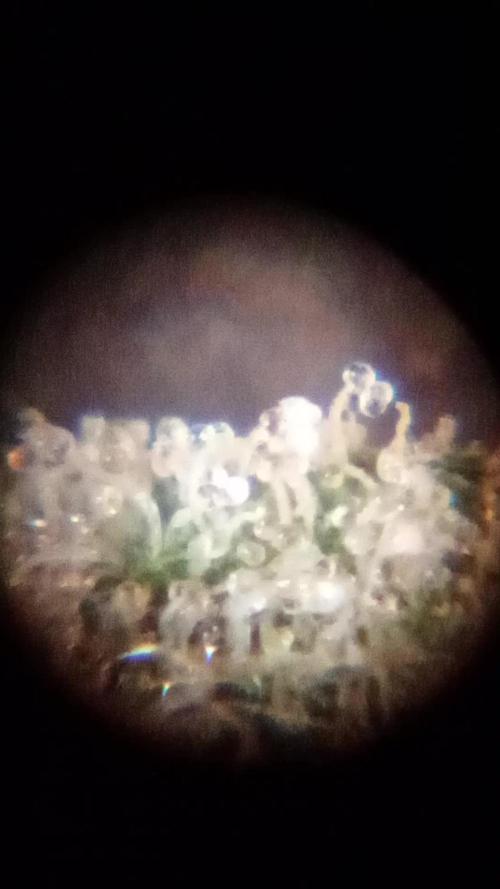
This week has gone well. 6 plants in such a small space is playing havoc with the humidity but I feel I'm just about on it enough not to cause any rot.
The New York Turbo Diesel auto is looking like she also won't need any HST and I can just leave her to do her thing. She has a few issues but nothing I'm overly concerned about.
Notes.
Extractor settings.
Temp 28c step 2c
Humidity 50% steps 2%
Max speed 8
Min speed 1
Day 43 Saturday 15/10/22
Feed= autofeed 2hrs
Volume= 10L, Ec= 1.51, PH=6.2
Left= 4L, Used= 6L = 1L each
Runoff= 0L, Ec= , PH=
Lifted light 4cm
Day 44 Sunday 16/10/22
#2 H=CM, D=CM, DLI=43.2, PPFD=600
Day 45 Monday 17/10/22
Feed=autofeed 2.5hrs
Volume= 10L, Ec= 1.5, PH=6.2
Left= 2.5L, Used= 7.5L =1.25L each
Runoff= 0.7L, Ec= 2.3, PH=6.1
Big defol on all 6. Humidity to high really.
Day 46 Tuesday 18/10/22
Extractor settings.
Temp 26c step 2c
Humidity 55% steps 2%
Max speed 10
Min speed 1
#2 H=CM, D=CM, DLI=41.5, PPFD=576
Day 47 Wednesday 19/10/22
Feed=autofeed water 3hrs
Volume= 10L, Ec= 0.2, PH=6.2
Left= 1L, Used= 9L = 1.5L each
Runoff= 1.8L, Ec= 2.2, PH=6.1
Day 48 Thursday 20/10/22
Day 49 Friday 21/10/22
Neutral 0.1ml/L
Silicon 0.75ml/L
Calmag 0.25ml/L
Bloom 3.0ml/L
Boost 2.0ml/L
Pk boost 1ml/L
Ec 1.85
Ph 6.6
Feed=autofeed 3hrs
Volume= 10L, Ec= 1.85, PH= 6.6
Left= 1L, Used= 9L = 1.5L each
Runoff= 1.8L, Ec= 2.12, PH=6.1
#2 H=57CM, D=43CM, DLI=38.2, PPFD=530
Viparspectra xs2000
75% power 7 days
£0.30 /Kwh = £7.56 for the week.
Thanks for stopping by.
Take it easy.



Likes
30
Share


@Canadian
Follow
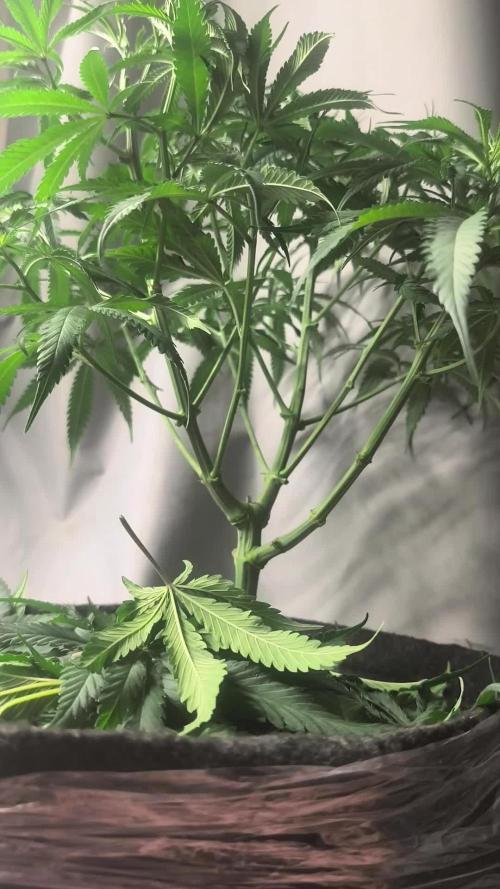
Still in the process of drying and curing I wait for the snap Branch drying and they're not there yet but I two of the branches were ready and I cut them and taste them even though not cure was smooth and delicious.
I did not collect popcorns I kept everything in small pieces and put it in a pot for edibles. One of them main colas waiting 23.75 grams.
After curing this it is a very enjoyable and smooth blueberry smoke with a very strong THC content plus the very big yield and a very good recovery from abuse make this plant a real champ


Likes
72
Share


@Natrona
Follow
Week 11 July 16-22 hello friends and followers, welcome to week 11.
I started seeing trichomes last week on Gaia and Circe. I don't smell anything from them. Only cream caramel gives off any fragrance. After flushing for 3 weeks, I've reintroduced fertilizer. I am using 1/3 to 1/4 the recommended dosage. How do I know what is the correct range for ec and whether I've unlocked the nutritional bind.?
7/16 flushed each with 1 gallon of water.
7/17 flushed each with 1 gal
7/18 fertilized at reduced strength each got 3.5 liters. Tps1 15ml, cal mag 1 top, big bloom 6 tbsp, signal 2.5 ml. Pictures and video.
7/19 no water, tent cleaning day, vacuum, wipe up dried spills. Took the girls outside for a few hours.
7/20 reduced fertilizer in 2 gals Tps1 7.5 ml, signal 1.25ml. Each girl got only 2 liters today. There was very little run off only Gaia with EC .80, ppm 570. Their tent mate cream caramel is very sticky and fragrant.
This week has been very busy. I packed up more geneology albums and shipped to my sister. I found my some of grandmother's award winning photographs and awards, certificates and brass plaques. Until WWII women did not work outside the home. If they did, they were teachers, nurses or secretaries.
During the early 1920-40 she raised her son as a single mother and found work during the depression as an executive secretary.
Her family men were bankers and merchants so she had awareness of business practices. During her employ, she won an award of $2 for a human resource suggestion on the proper attire for women in the offices and women on the manufacturing lines.
She continued working until the 50s. Her family always had cameras . That's how i have so many pictures from 1900. But she immersed herself in photography once she retired.. So when my Dad was in post WWII Japan, he bought her a state of the art camera. I came across so many self photos. She was the queen of selfies. Interesting to see the fashions over the years. Let me know if you would like to see some fashion pics.
7/21 made cookies. See week 1 Natronas recipes. The almond flour cookie is the basic recipe for cookies. The r3cipe calls for chocolate chips but It is versatile in that you can add nuts, dried fruit, caramels etc. If you want to taste my cookies the way I make them, you have to chop Lindt 78% dark chocolate bars and use that instead of chips which are sweeter.This time I added macadamia nuts as well. Yummy.
7/22 light defoiliation , and no water or nutrients.


Likes
19
Share

@Doofy
Follow
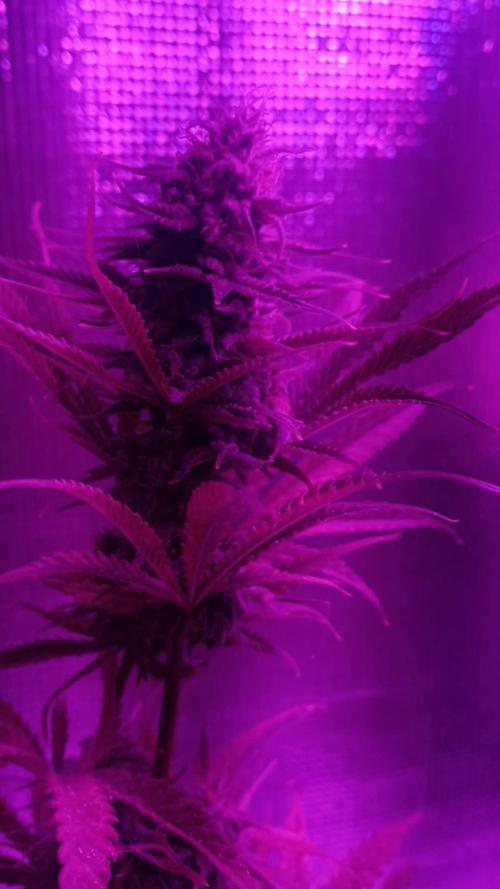
3 lamps, looks big and good!! 👍👍
Reinstalled the tent, lamps, plants, mills 👍
Likes
2
Share


@Huckleberry39
Follow
This is the 5th ILGM OG kush I've grown, the first I've tried to top. Now I know that I topped about 2 or 3 nodes to soon. But what I know from the other og's I've grown, buds will be fat and sticky and from the looks of her she is going to be all bud!!
Likes
6
Share


@SecretC8keSociety
Follow
This week I had to refill 5 gallons water to make sure I’ll constantly give em water every day, but not heavy just when the soil looking dry.
Before putting on the net trellis. I did a little LST . I hold ‘em down first before putting the net trellis on. Slide the net trellis down and then cut off the string that holding the plants down for LST. After cut the canopy shoot up into the square hole. Then from there I reorganized tucked the big fans leave under so other can get lighten . When going into flower which is next week that when I’m going to clean the bottom .
Good morning Growmies and hope y’all stay green and positive . Feeling good today 🎶 Larry June. Off to work I go :)
Likes
6
Share


@PeppeItalia
Follow
La settimana passata non sono riuscito a trovare tempo per le foto.
Oramai è la terza settimana di crescita .
Tutte le piante crescono rigogliose e felici. Tranne una che si era spezzata mentre avevo travasato il piantino, però piano piano sta recuperando.
Tenendo l umidità molto alta intorno al 70 per cento fin ora le ho annaffiate solo una volta per settimana.
Praticato fimming nel 25 giorno dal seme in terra
