




Likes
6
Share


@Lordviper28
Follow
All the girls looking good all have bud forming on their tops this strain has been really with no problems at all. All except one has staid short and bushy the one topped stretched up and fanned out real nice

Likes
3
Share
@Chrisandweed
Follow
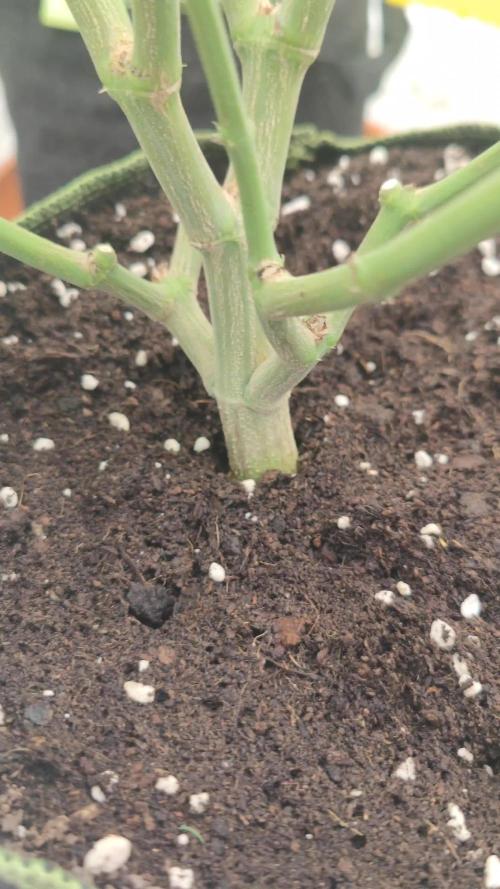
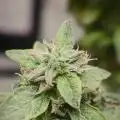
Bueno, ya empiezan a tocar las fotos guapas jajajajaja
Les metí el corte este domingo pasado a todas para dejarlas listas para el engorde. Vamos a ver que tal.

Likes
4
Share

@DogDoctorOfficial
Follow
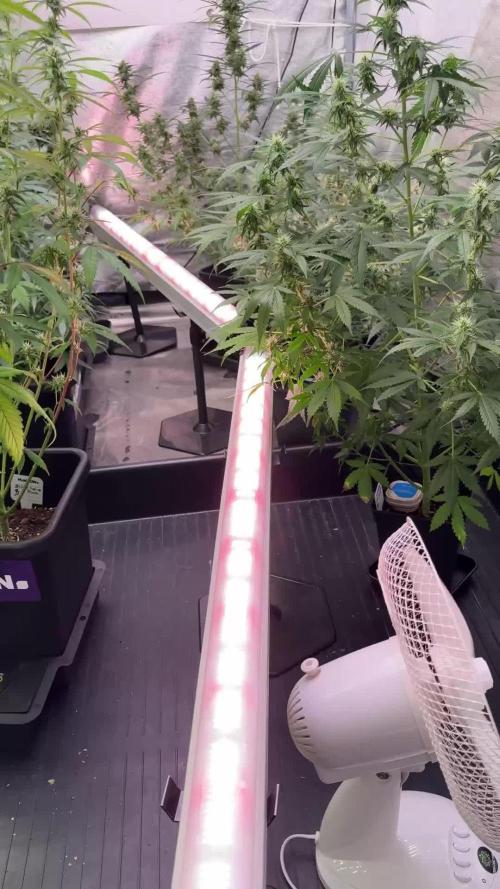
💜 Purple Haze by Zamnesia – Pheno A Week 9 | The Definition of Beautiful
Welcome back to another chapter of the 8×8 Adventure! 🌱💚
Sometimes a plant makes you work for the compliments.
Sometimes a plant keeps you guessing.
Sometimes a plant gives you problems that make you spend half your time trying to understand what she's asking for.
And then...
Sometimes you have Purple Haze Pheno A.
😂💜
This girl keeps doing her thing.
She keeps growing.
She keeps developing.
She keeps building beautiful flowers.
And honestly, the more I look at her, the more I struggle to find something I would want to change.
She may not be the biggest plant in the room.
She may not be the tallest.
She may not be the most demanding.
But when it comes to balance...
she might just be one of the most beautiful plants in this entire run.
And this week, I think she deserves to shine.
🌱 The Plant That Just Gets It
One of the things that has impressed me most about Purple Haze Pheno A is how naturally everything seems to fit together.
The leaves.
The branches.
The flower sites.
The spacing.
The proportions.
The overall size of the plant.
Nothing feels excessive.
Nothing feels missing.
She's developed a structure that simply makes sense.
There's enough foliage to support the plant without making the flowers disappear.
There are enough flowers to make the canopy interesting without completely overwhelming the structure.
And when you look at the plant as a whole, there is a beautiful relationship between everything she's producing.
It's one of those plants where you step back and think:
"Yeah... that's a beautiful plant."
And then you step closer.
And it gets even better.
💜 The Colour
The foliage continues to be one of my favourite things about her.
That healthy green.
That beautiful contrast between the leaves and the developing flowers.
The way the light catches the foliage.
The way the plant looks from a distance and then completely changes character when you move closer.
There's something very elegant about her.
She's not trying to be spectacular.
She simply is.
And that's probably why I enjoy photographing her so much.
There is always something worth looking at.
🌸 The Flowers Are Coming Together
The flower formation continues looking beautiful this week.
The calyxes are becoming increasingly obvious, while the white pistils continue covering the developing flowers.
This is the part of flowering where the individual components begin coming together into something that looks increasingly like the finished structure they're going to become.
And Purple Haze is doing exactly that.
The flowers are developing along the branches with a really pleasing structure.
The proportions are beautiful.
The pistils are giving everything that classic early-to-mid flowering appearance.
And the resin development is becoming increasingly noticeable.
There's still plenty of time ahead.
But you can already see where this is going.
And I like what I see.
Very much.
🍃 The Perfect Balance
If I had to choose one characteristic that defines this phenotype for me, it would probably be balance.
She's not just producing flowers.
She's not just producing foliage.
She's producing what feels like the right combination of both.
The leaves are beautifully formed.
The flower-to-leaf relationship is pleasing.
The branches are carrying their flowers naturally.
And the plant maintains a compact, manageable profile.
This is something that becomes particularly interesting when you're running multiple phenotypes together.
Because you can see all these different interpretations of the same basic environment.
Some plants want to stretch.
Some want to stay compact.
Some want more attention.
Some seem perfectly happy being left alone.
Purple Haze Pheno A has quietly established herself as one of the plants that simply gets on with the job.
And I absolutely love that.
🌿 No Need to Fix What Isn't Broken
Last week I talked about letting her shine without unnecessary intervention.
This week, that philosophy hasn't changed.
Why would it?
She's healthy.
She's developing.
She's maintaining beautiful colour.
Her flowers are progressing.
Her structure is exactly where I like it.
So there is no reason to interfere simply because we can.
Growing plants sometimes creates this strange temptation to constantly do something.
Remove something.
Change something.
Adjust something.
But sometimes the best decision is simply:
Leave her alone.
Purple Haze Pheno A is giving me very little reason to pick up the scissors.
And I'm perfectly happy with that.
💡 One Environment, Twelve Personalities
This is where the 8×8 Adventure continues to become more interesting every week.
We're running multiple genetics inside the same overall ecosystem.
Same general environmental philosophy.
Same lighting strategy.
Same shared feeding approach.
Same irrigation system.
Same room.
Yet look at the differences.
Every phenotype is interpreting that environment in her own way.
And Purple Haze Pheno A is giving us one of the nicest examples of a naturally balanced expression.
She's not fighting the environment.
She's not demanding constant intervention.
She's simply adapting and expressing herself.
And that is exactly what I wanted this project to reveal.
💡 Light From Above & Below
The lighting strategy continues supporting the room as flowering progresses.
The primary overhead lighting provides the main source, while the additional lighting deeper within the canopy gives us another perspective on how the lower flowering sites develop.
With Purple Haze, I particularly enjoy being able to look through the structure and see flowers developing at different levels.
She's not simply a plant with one impressive top.
She's developing a network of flowering sites throughout her structure.
And as those flowers continue building, it'll be fascinating to see how that balance develops further.
💧 Feeding & Consistency
The flowering nutrition strategy remains consistent across the room:
🌱 Terra Bloom – 2.2 ml/L
🌱 Power Buds – 1 ml/L
🌱 Green Sensation – 1 ml/L
🌱 Sugar Royal – 1 ml/L
⚗️ pH Plus / Lemon Kick as required
The measured EC remains around 2.0 mS/cm, with pH around 6.0.
There are no dramatic changes to report.
And that's exactly the point.
Purple Haze doesn't appear to be asking for anything different.
She's responding beautifully to the existing environment, so consistency remains the priority.
🌡️ The Environment
This week's recorded conditions are:
🌸 Flower Week: 9
📏 Height: 120 cm
💡 Light schedule: 12/12
🌡️ Day temperature: 29°C
🌙 Night temperature: 25°C
💧 Relative humidity: 60%
⚗️ pH: 6.0
⚡ EC: approximately 2.0 mS/cm
💦 Solution temperature: 25°C
🌱 Substrate temperature: 26°C
🌬️ CO₂: 639 ppm
? Pot size: 15 L
💧 Watering: approximately 1.2 L/plant/24h
The environment remains stable, giving this phenotype exactly what she needs to continue doing what she's been doing so well.
📸 This Girl Deserves the Camera
Looking through the photographs this week, I keep coming back to the same thought:
She is charming.
The overall plant.
The flowers.
The calyxes.
The pistils.
The leaves.
The colour.
The structure.
Even the size.
Everything about her seems to fit together.
And this is where photography becomes such a big part of the project for me.
A wide photograph shows you the plant.
A close-up shows you the flower.
A macro photograph shows you an entirely different world.
You start seeing the individual calyxes.
The pistils.
The trichomes.
The veins in the leaves.
The textures.
All those tiny details that disappear when you're simply looking at the plant as a whole.
Purple Haze rewards that closer look.
Every time.
💜 The Plant I Wouldn't Change
I think every grower eventually encounters a plant that makes them think:
"If I could start this one again, I wouldn't change much."
Purple Haze Pheno A is becoming that plant for me.
Not because she's perfect in some impossible sense.
Plants aren't machines.
But because she's developed a combination of characteristics that I genuinely enjoy.
Beautiful colour.
Beautiful foliage.
Beautiful flower structure.
Excellent proportions.
A manageable size.
Healthy development.
And a natural architecture that doesn't seem to require me constantly stepping in.
That's a pretty wonderful combination.
🔮 Looking Ahead
So what's next?
More of the same.
And honestly, that's exactly what I want.
The flowers should continue developing.
The calyxes should continue becoming more prominent.
Resin production should continue increasing.
The flowers will gradually become denser and more mature.
And eventually, we'll move from watching her build toward watching her finish.
But we're not there yet.
For now, I'm enjoying the process.
Watching.
Photographing.
Documenting.
And letting her continue doing what she's already proven she can do.
💜 Let Her Shine
There are plants that make you excited because they surprise you.
There are plants that make you excited because they challenge you.
And then there are plants that simply make you stop and admire them.
Purple Haze Pheno A is becoming that plant.
She doesn't need a dramatic story this week.
She doesn't need a major intervention.
She doesn't need me to invent something to say.
She's beautiful.
And sometimes that's enough.
The leaves are beautiful.
The colour is beautiful.
The flower-to-leaf ratio is beautiful.
The bud formation is beautiful.
The calyxes are beautiful.
The pistils are beautiful.
The structure is beautiful.
The size is beautiful.
The whole plant simply has charm.
And when a plant gives you that feeling...
you let her shine.
💜🌿
🙏 Thank You
Another week of the 8×8 Adventure, and another reminder of why I love growing multiple phenotypes side by side.
They all have their own personalities.
Their own rhythms.
Their own structures.
Their own ways of expressing themselves.
And Purple Haze Pheno A is writing one of my favourite stories of the entire run.
A huge thank you to:
💚 GrowDiaries — for providing the platform where growers can document, learn, share and inspire each other.
💜 Zamnesia — for these beautiful Purple Haze genetics and for giving us the opportunity to explore what different phenotypes can become.
🌱 Plagron — for the nutrition supporting the garden throughout this journey.
💡 Future of Grow LED — for providing the lighting driving the room.
🌡️ TrolMaster — for helping maintain a stable environment behind the scenes.
✨ LumiFlora — for the additional lighting helping us explore flowering throughout the canopy.
And, of course, thank you to everyone following the 8×8 Adventure.
Every comment, every question, every bit of encouragement and every person simply stopping by to see how the girls are doing makes documenting this project even more enjoyable.
Purple Haze Pheno A doesn't need to shout.
She doesn't need to demand attention.
She doesn't need to be the biggest girl in the room.
She simply stands there...
beautifully balanced, beautifully green, beautifully structured, and quietly building something special. 💜
Week 9.
Still doing her thing.
Still looking amazing.
Still giving me very little to complain about.
And honestly?
I wouldn't have it any other way.
Let's keep watching her shine. 💜🌿🌸
Growers Love, my friends, and happy growing! 🌱💚

Likes
9
Share


@burnercorona
Follow
Decent week. I had some trouble figuring out my nutes in this tiny pot but she's doing her job. I'm thinking top dressing is not the easiest way to go on a tiny pot lol. But hey she's alive and getting frosty so it's good. Haha
Likes
31
Share


@MxGrow
Follow
Estoy teniendo un inicio de plaga al parecer de araña roja en la Gorilla Ghost, realice una pequeña poda de hojas donde encontré araña o huevesillos, me recomendaron aplicar jabón y ajo, pero no quise arriesgar a contraer un hongo por la humedad, tratare de controlar la plaga con podas y matando las arañas una por una.


Likes
9
Share


@TheBulldozerSicily
Follow
Inizio nuovo ciclo
Giovedì 26 settembre 2024
Aggiungo 75 lt acqua osmosi inversa ec 146 ph 9
Aggiungo tutti I nutrienti ottenendo ec 908 ph 6.5




Processing
Likes
6
Share


@Ferenc
Follow
Hey! Just back well
They are getting better and better soon need to start to flower them. Fertilization happens 3x a week with the mixture of Biobizz family (Biobloom, Topmax, BioGrow, Epsom salt, Gunokalong extract.) They grow as hell. 600W LED, 18 hours on 6 hours off, 200 ml water per plant a day, humidity approx 35 percent.
Day 53: They are bushy keep doing LST on them.
Day 56: I constantly do LST for them and also some lollipopping so I removed the bottom unwanted leaves especially the yellow ones. From tomorrow I provide darkness for 2 days and then Monday the beggining of the 9th week I will switch to 12/12.


Likes
3
Share


@TTerpz
Follow
Fade colors are really starting to push through
Fed with nutrients: 5/7/25
Fed with ph water at 6.5 : 5/11/25
Fed with nutrients 5/12/25
Likes
252
Share


@Tropicannibis_Todd
Follow
Well folks we chopped the Ztrawberriez 😁
And the second of the Strawberry Blast 🍓 🍓 🍓 🍓 Shes a killer for sure , incredibly frosty , and sticky , not the best of nugs as I said a bit airy , the smell is sweet and berry-licious ......
FC4800 from MarsHydro Lights being readjusted and chart updated .........: 1:I've added a RU45 to the mix : 1:
www.marshydro.ca
👉I am using Agrogardens for nutrients for my grows and welcome anyone to give them a try .👈
👉 www.agrogardens.com 👈
Agrogardens Cal MAG
Agrogardens Grow A B
Agrogardens Bloom A B
Agrogardens Bud Booster
Agrogardens PK13/14
I GOT MULTIPLE DIARIES ON THE GO 😱 please check them out 😎
👉THANKS FOR TAKING THE TIME TO GO OVER MY DIARIES 👈
Would you like to hang with the growdiary community 👉 https://discord.gg/gr4cHGDpdb 👈


Likes
371
Share


@love_2_grow
Follow
D60.
I'm back again after being out of town for six days. The tent was packed when I opened it! The girls had stretched more, and a couple of leaves were even touching the lights and had gotten burnt.
They are now 125 cm tall. That's five times the height they were when I flipped to flower. Five times!!! I have never had a strain stretch this much, and I hope they are done now since there's no more room in the tent.
I removed the fan and carbon filer and placed them outside the tent. It looks a bit stupid and is far from stealthy, but what to do?
I moved up the lights as far as possible, but I will probably switch the lights with the one I have in my autotent. That light has a much lower profile, so raising it even further is possible.
Should that not be enough, I will have to cut off some tops, but I hope it doesn't come to that.
The first girl already has dark purple flowers, while the second looks more green with some purple.
------------------------------
D61.
I opened the tent today, only to find that the second girl had stretched another 2 cm overnight! This is getting ridiculous, and I hope they stop soon. I super-cropped the tallest top, hoping it would slow down the stretch. A few hours later, she had already recovered. These genetics are nuts!
In other news, my girlfriend found spider mites on her papaya plants that are in the same room as my tents. We immediately removed the plants from the room, and I started to scout my plants for an infestation.
The good news is that I didn't find any spider mites. However, the bad news is that I found thrips on the lower leaves of the second girl. Ugh!
I had thrips last grow season, and I guess some survived.
The thrips were only on the lower part of the plant, so I defoliated the girls by removing a bunch of leaves and tiny branches down low and immediately threw them out of the apartment.
Thrips don't like it humid, and since the buds are still tiny, I don't need to worry about botrytis yet, so I cranked up the humidity into the high 70s to low 80s.
Finally, I ordered a bunch of lacewing larvae that will get here next week.
They should eat the thrips and any spider mites that I might not have been able to find.
------------------------------
D63.
The girls have slowed their stretch, BUT they are still stretching somewhat. I freaked out when I opened the tent today and saw they were taller, so I attacked them immediately and super-cropped the highest tops. I will switch out the lights next week, gaining me another few centimeters, which I hope will be enough.
The VPD in the tent is way off, but I'm more interested in figuring out the light and getting rid of the thrips.
Finally, I watered each girl with 2.5 liters of water L pH 6.1, with 10 ml humic acid and 5 ml Fermented Fruit Juice I made a few months ago.
------------------------------

Likes
6
Share

@viejo
Follow
May 18th
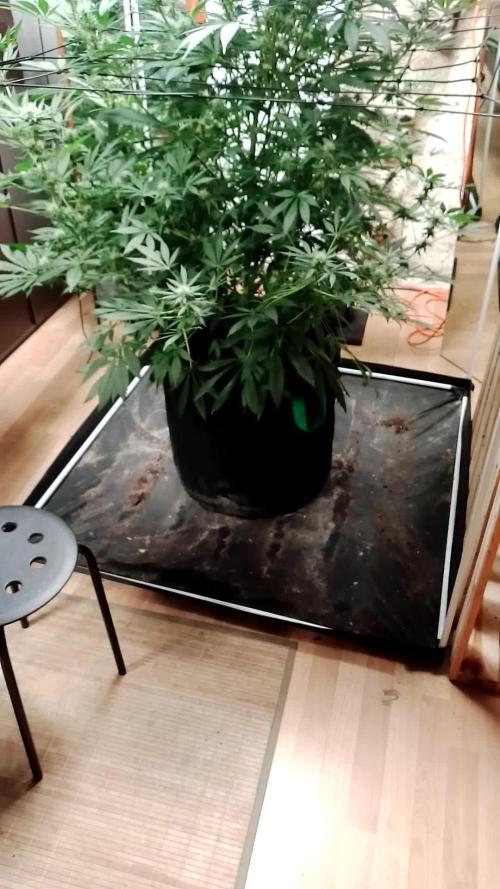
Time for low-stress drastic measures. Her height has now reached the point where all google inquiries suggest she's sure to become badly light stressed if left to her own devices. We're flying too close to the sun, folks.
I'm not convinced heat is an issue, as there's great ventilation in the room and two fans blowing constantly, but something had to be done about the diminishing distance to the light. We're down to 20cm~ from the tip of the main cola, to 25cm~ after pulling her to the side a little with some trusty red string. Somehow there's no sign of stress on the leaves, but they say this usually shows up after the damage has been done, so we'll so how things pan out. I'll keep pulling her further away as needed. Hardly ideal, but not exactly unexpected.
I've also ripped out some mosquito netting that was blocking some of the airflow from the window the extractor fan vent tube leads to. It was all gummed up with dust and cobwebs. Since removing it the airflow from the room is venting outside much more smoothly, lowering the humidity of the room by a few points. I've even seen it reach as low as 55%, which is a new low. Previously the humidity wouldn't go lower than 69%, which is a funny number I admit but I'll take a number without meme-connotations in favor of a lessened likelihood of bud rot any day.
I've doubled the dose of top-max from 1lm/l to 2ml/l. Bio-biz suggest 4ml/l at this point, so we're playing it safe.
Fingers crossed as always.
Processing
Likes
16
Share


@Dunk_Junk
Follow
20cm growth this week.
Flowers are forming and I can see purple on them 😍
The bad news this week is I was bending her lower branches.. trying to spread her out a bit. I've managed to snap both of them!
She has been repaired best I can do, so will monitor it over next day or so to see how effective the fix is. I don't hold out much hope for one branch.. Looks like it's wilting already 😞


Likes
2
Share


@Velk1
Follow
Plant grew out doing its thing , med feeder can handle rough conditions and heat ! Great for beginners


Likes
4
Share


@m0use
Follow
***Sponsored Grow*** = Medic || https://medicgrow.com || Grow = ***Sponsored Grow***
Not a whole lot is happening this week, still having some PH issues in the medium, I believe this is from the microbial mass I added a while back. A microbe product, PH going into the medium is around 6.5-6.8 and coming out is between 5.5-5.8, so something is acidifying it up. Also noticed the runoff last week was a bit higher at times. So lowered the feed down quite a bit, going in at 1.4EC vs 1.8 will bump it up to 1.5 and 1.6 in the next few weeks. I also added in a bit of a PK booster. nothing to crazy only 60ppm worth on a total allowance of 700PPM
Lights now running at 100% with V1 spectrum, decided to go with 100% now vs after stretch, will see how it works out.
Till next week.
https://medicgrow.com/
+
https://seedstockers.com/
Facebook:
https://www.facebook.com/medicgrowled
+
https://www.facebook.com/SeedstockersBarcelona/
Twitter:
https://twitter.com/medicgrow
+
https://twitter.com/seedstockersb
Instagram:
https://www.instagram.com/medicgrow420/
+
https://www.instagram.com/seedstockers_seeds
YouTube:
https://www.youtube.com/channel/UCNmiY4F9z94u-8eGj7R1CSQ
+
https://www.youtube.com/channel/UC4GiFYrIWeNtwtXjcivCmfw
Growdiaries:
https://growdiaries.com/grower/medicgrowled
https://growdiaries.com/grow-lights/medic-grow
+
https://growdiaries.com/grower/seedstockersofficial
https://growdiaries.com/seedbank/seedstockers

Likes
37
Share


@Cheeba_Inu
Follow
Overall this was an excellent grow. I was not prepared for the huge growth and yield from the high frequency fertigation growing in coco, and the genetics of the Blue Dream'Matic. I should have defoliated it a bit more earlier on, just due to how vigorous the growth was. But I will not complain with 200g dried bud from 3sqft of tent under a HLG100 light. Hats off to Fastbuds for the great genetics. I really feel like my growing came together at a new level this time, and I am excited to experiment with even more improvements next grow! Thanks for reading!
Likes
25
Share


@EBxAH
Follow
Week 5 started Monday. Everything is still the same. Looking very healthy! I'll be honest, I'm not doing much, lol. Just giving them what they need, when they need it. I'm not using an oscillating fan this time and the knuckles on the shoots are super thick! I'll add more pics in a day or two.
Happy Growing Everyone
✌️❤️😁🍀🎶👽
EB
