Likes
Comments
Share
@Takeaims
Follow
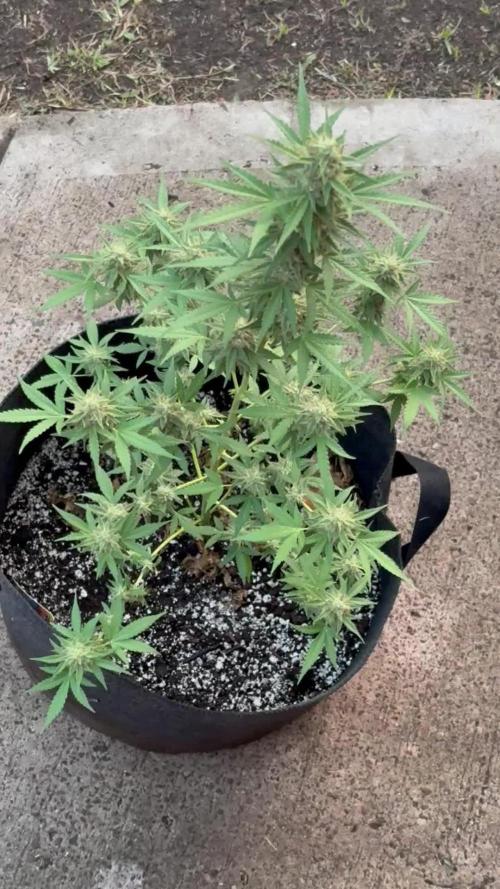
Here we go a little loom at my Mars hydro tent
Likes
17
Share
@Naujas
Follow
She is much prettier than she was a week ago :) I remembered that I have my first grow light, which is more compact and it will give me more space, so I changed my light, now the girl's side branches get light too:) I add a lot of video memes, because I really want to win Iphone16 pro ;) and those who don't take risks don't drink champagne:) good luck to everyone.
Processing
Likes
27
Share
@Reaper
Follow
START OF WEEK 8 of the critical start of week 7 for the girl scout coockies. the critical is the plant u see first the coockies are in top left corner and bottom right. the midle and top right are my 2 new criticals who are still in VEG but i put them in the flowertent to speed it up a litle (the light is stronger and i got the space) when the flower light goes out i move those back to my veg room (bathroom uhum) 😅 nothing too special this week ill probably harvest the critical next weekend and let the coockies go another 3-4 weeks. the buds are fattening and i see the tips of those leaves have slight signs of nute burn so just water from here. see u next week (edit: lol the critical has major calmag issues do not watch those leaves shes almost done and surviving my heatwave torture tent)
Likes
4
Share
@Krissci
Follow
Day 4 - light LST training. This window is very small to Train correctly and not lost any main stems..the knuckle tends to solidify quite quickly and begins to swell if feed properly...making bending by the knuckle risky
Likes
2
Share
I was hoping to harvest this weekend as the days are getting colder. The trichomes arent't quite ready. So, I'm going to have to hold out another week. My garage is not heated. So, I have to plan my grows around the local weather despite growing in a tent. The Afghani has turned purple on the leaves that see the most light. Likely due to the drop in temperature at night. I have stopped feeding the plants. The EC has remained unchanged for the last week. There is no point in wasting nutrients if the plant won't eat.
Likes
3
Share
Heute Samstag, der erste Tag von Woche zwei.. gerade gute Gelegenheit zum toppe und Runter binden LST , da ich eine fette scrog Wachstum will für dieses mal... Mal schauen wie moby dick das vertragt..
Likes
18
Share
@Madd_Rez
Follow
Tapered off feedings and did a small flush. About a foot difference between the 2 plants. Smells like candied dirt!
Likes
2
Share
67 days since April 16th, 2026 We become aware at such times of man's wonderful ability to bring seemingly unrelated elements into harmonic balance, and receive a glimpse into a world where everything exists in conscious sympathetic attunement to everything else. When we listen to a piece of music that seems to strike a beautiful chord somewhere inside us, or view a painting that simply glows with harmonic awareness well executed, we probably do not spare much time to contemplate the wonderfully intricate combination of vibrations that our sensors make it possible for us to perceive. We tend to appreciate the relationship between the parts of something by an awareness of the harmony or dissonance of the whole. This ability enables us to say "what a beautiful house!" instead of "analysis has proven that this collection of building materials exhibits certain elements of harmonic proportion." While this ability to instinctively appreciate the beauty of true harmony has an important role to play in evolution, a more analytical understanding of the laws involved can be most useful. This is especially so if we wish to create works of art where each part exists in true harmony, not only with the other part of that particular whole, but with the universe within which the creator and the created exist. Everything vibrates. From the most dense matter to the most subtle cosmic rays, everything which our senses allow our thoughts to become aware of, can be specified in terms of wavelength or frequency of vibration. These two terms define the same thing, but from different points of view. The following are the approximate wavelengths of various energy carriers: Cosmic rays 0.000,000,001 mm Gamma rays 0.000,000,1 mm X rays 0.000,500 mm Ultraviolet rays 0.003 mm Visible light 0.006 mm Infrared 0.01 mm Sound waves 1 meter Radio waves 300 meters Violet light 400 nm to 450 nm Blue light 450 nm to 500 nm Green light 500 nm to 570 nm Yellow light 570 nm to 590 nm Orange light 590 nm to 610 nm Red light 610 to 700 nm 1 nanometer (nm) = 0.000,000,1 cm = 1/10,000,000 cm If a guitar string is plucked and we hear a sound, it is not too difficult for the human mind to associate this sound with the vibration of the guitar string. With color it is quite different. It is difficult for us to conceive that the color of a substance is not an inherent property of the substance itself, but an indication picked up by our senses of that substance's ability to absorb or reflect the light which happens to be shining on it at that moment. Neither the matter nor the light is colored. What happens is that the brain learns to differentiate between the frequencies reflected or transmitted by the substance the eyes are focused on. The same thing happens with sound. When we say "Oh! Listen, they're playing my favorite song," what we really mean is: "My brain has stored within it a particular pattern of frequencies. I have compared the new information being received with this stored pattern and have deduced the answer that the two patterns are similar within certain specified tolerances." The 'pleasure' involved could have something to do with our running the pre-recorded pattern at the same time, in 'sympathy' with the new pattern as it is received. The word sympathy describes very well our ability to appreciate color and sound. It also describes the reason behind certain elements of harmony. For instance, if a substance vibrating at 100 cycles per second (tone 1) is in the proximity of another substance vibrating at 200 cycles per second (tone 2), we could perceive, if we had the right equipment, a certain sympathetic relationship between the two. We will see from this that there is a uniform doubling of the first tone seen in the second. At various points along the waves, the two are the same in amplitude. At other points, they are at opposite poles to each other. This doubled frequency has more points of similarity to the original than any other frequency except the original itself. If the equipment we had available for measuring these two frequencies was a soundboard amplifier and a pair of ears, then we would hear what would sound to us like one tone. If we had the opportunity to hear one at a time, we would hear that although they sound the same, one is higher in pitch than the other. This characteristic of 'the same but different in pitch', musicians have called the octave. Any two tones produced where one has exactly doubled the frequency of the other is called an octave. Speaking in ratios, an octave would appear then as the ratio 2:1 or 1:2, depending on whether we are talking of an octave up or down. A single note produced by almost any instrument will contain more than one wavelength or frequency. It will have a dominant frequency, the wavelength of which we would call the note's 'fundamental' or 1st harmonic. It will also have a varying number of upper harmonics, gradually fading in intensity into infinity or silence. Natural harmonics always have the same pattern of intervals between them. The interval between the 1st and 2nd harmonic is a perfect octave; between the 2nd and 3rd a perfect fifth; between the 3rd and 4th a perfect 4th; and so on, the intervals becoming smaller and smaller until they lose any relationship with the western 12 tone scale as it exists at the moment. Just as an octave has certain elements of sympathy with its fundamental, so some intervals have been noted to be more perfectly in sympathy with the fundamental than others. The ratio of the 'perfect 5th' or interval of 7 semitones, as it occurs in the harmonic series, is 3:2 or 2:3, while that of the 'perfect fourth" is 4:3 or 3:4. All the tones in the western 12 tone scale can be expressed in terms of the ratio between the upper tone and its fundamental. This would seem to be an ideal way of generating a scale from any given fundamental and several attempts have been made to do this, the Pythagorean system being probably the most well known. Although when working with a single tone instrument playing on its own, the Pythagorean formula works wonderfully well, if we had several instruments tuned this way together and asked them to play almost any western music, we would find that at times they sounded quite out of tune to each other. The lack of flexibility of the various scale systems based on the harmonic series has led to what is known as the 'tempered' scale. This uses as its primary unit of interval the ratio of the octave or 2:1. It then proceeds to divide the interval between any fundamental and its upper octave into 12 smaller intervals by applying the ratio: two to the one-twelfth power, to one (21/12:1). This equals 1.059463094, so by multiplying any frequency by this number, we will obtain the tempered semitone next up from our fundamental. We will also find that any tone twelve semitones up from any other tone, in a scale generated in this way, will have exactly double the frequency. If we took the note middle C on a piano and halved the wavelength, we would have the note C one octave above. If we halved this, we would have the C above, and so on. However, within about 6 octaves, we would find that although a 'sound' was being produced, no human ear could perceive it. If we kept on going, halving and producing upper octaves of our fundamental C, we would proceed through the infrared band, into the visible light spectrum. If we happened to be outside during the day, we would, for one octave only, see the note C with our eyes. The next octave above would already be in the ultraviolet band, and outside the eye's sensitivity range. If we can think of color as being an indication of a substance's vibratory rate or wavelength, we may begin to see a relationship that could exist between the color and sound spectrums. The logical extension of what has so far been said is that there exists a scale in the color spectrum that corresponds exactly to the scale in the sound spectrum, each color tone being an octave of the equivalent note in the sound range. This is not the end of the story but only the beginning. If we can for the moment accept that any wavelength in one band has upper and lower octave stretching out to infinity, then the next question is 'fine, but what shall we use as our fundamental? A particular color? A particular sound frequency?' The musicians among us will probably say 'A 440'. This means that the note A should vibrate at 440 Hertz, or 440 times per second. They would tell us that this is standard pitch has been adopted by most orchestras around the world; pianos are tuned to it, instruments are constructed to formulas based on it, and so to them it would probably seem the most appropriate place to begin. Some of these musicians may know of the battle that is still raging with regards to this being the standard, but few would know why A = 440 Hz was chosen except that it worked when it was set to be a suitable compromise between the many different pitches in use at the time. 432 Hz is said to be mathematically consistent with the patterns of the universe. Studies reveal that 432 Hz tuning vibrates with the universe’s golden mean PHI and unifies the properties of light, time, space, matter, gravity, and magnetism with biology, the DNA code, and consciousness. When our atoms and DNA start to resonate in harmony with the spiraling pattern of nature, our sense of connection to nature is said to be magnified. Another interesting factor to consider is that the A=432 Hz tuning correlates with the color spectrum, while the A=440 Hz is off. Audiophiles have also stated that A = 432 Hz music seems to be non-local and can fill an entire room, whereas A=440 Hz can be perceived as directional or linear in sound propagation. Once you adopt the idea that sound (or vibration in general) can have an equalizing and harmonizing effect (as well as a disturbing effect), the science of harmony can be applied to bring greater harmony into one's life or tune to specific energies. There is a form of absolute and relative harmony. Absolute harmony can, for example, be determined by the tuning of an instrument. The ancients tuned their instruments at an A of 432 Hz instead of 440 Hz - and for a good reason. There are plenty of music examples on the internet that you can listen to in order to establish the difference for yourself. Attuning the instrument to 432 Hz results in a more relaxing sound, while 440 Hz slightly tenses up the body. This is because 440 Hz is out of tune with both macro and micro cosmos. On the contrary, 432 Hz is in tune. To give an example of how this is manifested microcosmically: our breath (0,3 Hz) and our pulse (1,2 Hz) relate to the frequency of the lower octave of an A of 432 Hz (108 Hz) as 1:360 and 1:90. It is interesting to note that 432 Hz was the standard pitch of many old instruments and that it was only recently (19th and 20th century) the standard pitch was increased. This was done in order to be able to play for bigger audiences. Bigger audiences (more bodies) absorb more of the lower frequencies, so the higher pitch was more likely to “cut through”. One of the oldest instruments of the world is the bell ensemble of Yi Zeng (dated 423 BC), tuned to a standard F4 of 345 Hz, which gives an A= 432 Hz. The frequency of 345 Hz is that of the platonic year! Similarly, many old organs are tuned in A=432 as well; for example, St. Peter’s Capella Gregoriana, St. Peter’s Capella Giulia, S. Maria Maggiore in Rome. Maria Renold’s book “Intervals Scales Tones and the Concert Pitch C=128 Hz” claims conclusive evidence that 440 Hz and raising concert pitch above scientific “C” Prime=128 Hz (Concert A=432 Hz) disassociates the connection of consciousness to the body and creates anti-social conditions in humanity. The difference between concert pitch A=440 Hz and Concert A=432 Hz is only 8 cycles per second, but it is a perceptible difference of awareness in the human consciousness experience of the dream we share called existence.
Likes
41
Share
******** Week 3 of flower, Week 12 growth - Oct 3 to 9/20 *********** It has been less exciting this week with respect to new issues👍😃 Leaves are getting a little darker for my liking this week. It is one of the things I have often struggled with using AN Sensi Grow and Bloom base nutes.,,,,,,keeping the feeding at 1ml.L to maybe 1.5ml at max.....stopped using their CalMag Basie of nitrogen levels as well. Not sure where else to go and will just give her some time for now and stay the course and see what the next two weeks bring.......keep up, increase, the plain water feedings. Little more detail........ Oct 3/20, Day 15 - 4L watering with CalMag, Rezin @ 2ml, Sensyzime @ 1.5ml - 450ppm and 5.7pH - they look to be stretching a bit. Oct 4/20, Day 16 - 4L feed with Rezin, Terpinator @ 2ml, CalMag, Sensi Bloom, Big Bud, B52, Bud Candy @ 1ml - 1025ppm and 5.8pH - left alone for the most part. - C472 needs some lower branching removed. Oct 5/20, Day 17 - 3L - Vitathrive, Piranha, Microbial Mass @ 1.5ml = 110ppm and 5.9pH - 100ppm and 5.9pH - fair bit of runoff yesterday with 4L so backing down a bit. Oct 7/20, Day 19 - 4L - Rezin, Terpinator @ 2ml, Rhino, Big Bud, B52 @ 1.5ml, CalMag, Sensi Bloom, Bud Candy @ 1ml - 1025ppm and 5.9pH - girls are really frosting up! Bud sites stacking......feeling might be a little slow though???? Oct 9/20, Day 21 - 3L- Rezin @ 2ml, CalMag, B52, Sensi Bloom @ 1ml, - 500ppm and 5.9pH Girls are looking good.....slow though?????
Processing
Likes
34
Share
Ladies and gentlemen, I would like to proudly present to you my diary in which, for the next winter time outside the window, I begin a magical adventure with the famous gorillas in a rather exotic climate - and here I want to point out that the seeds were a gift from RQS. Once again I want to thank for the grinder that I use every day, the Vertafort fertilizer which will land in the soil, the posters that decorate the walls in my room (you chose my favorite varieties btw) and the 10 seeds of the Royal Haze which will surely be in the next project. So today I feel like I'm in a position to share with an adventure that starts here and now. I feel obliged to post new updates every day. Please also comment and give advice by colleagues in the field. Here is a list of things I will use: Soil: Biobizz ALL-MIX Fertilizers: All Biobizz Bio-Grow Bio-bloom Bio-heaven Top-Max Leaf-Coat Acti-Vera ALG-A-MIC Veg setup: Growbox 70x45x150 MH 150W GIB Lighting GROWTH SPECTRUM Advanced Humidifier 5L AERI Advanced Star 13W Fan Carbon filter ORIGINAL 75 - 100 M3 per H Axial Flo Fan 100 Peat pots: 7x 10X8cm and 3x 11X10cm And much much love Flo setup: Growbox Secret Jardin 120x120x185 Dark Street LED 2x200W ADVANCED STAR DUAL HPS 150W GIB Lighting FLOWER SPECTRUM Pro Secret Jardin Monkey Fan 20 Secret Jardin Monkey Fan 30 Fan PK125 MES 420m Coal Filter Prima Klima ECO 360 - 480 m3 I will soon describe more details. Regards
Likes
Comments
Share
Uno de los mejores cultivos que he tenido
Likes
44
Share
@Aedaone
Follow
The temperatures, humidity, height, and watering volume(if measured) in grow conditions are all averaged for the week. The pH is soil pH. Any watering done by me is well water which is 7.6 pH and 50° F. Coop Poop, Molasses, Feather Meal, and Soluble Kelp are ml/gallon of soil top dressed. Everything else listed in nutrients is ml/gallon of water fed to plants without checking the solution Ph. Day 1 we had a high temperature of 76°F. Skies were overcast and cloudy. I watered about 4 gallons. Day 2 we had a high temperature of 80°F. Skies were sunny, but everything was still humid. I watered about 4 gallons. Day 3 we had a high temperature of 84°F. Skies were sunny, but humidity was running high. I watered 4-5 gallons. Day 4 we had a high temperature of 73°. Skies were clear and sunny. The humidity only reached a high in the mid 50% and a low of 30%. There truly is a God who knows this garden needs some dry air for harvest. Day 5 we had a high temperature of 71°. Skies were super sunny and humidity is averaging around 40%. I watered about 5 gallons. We are having excellent weather to finish. Day 7 we had a high temperature of 82°. There was abundant sunshine. Super clear skies and humidity dipped into low 30%'s. I watered about 5 gallons. Not so much because of them feeding heavy but the arid conditions and sunshine. I've treated these with very thorough washing of the pm. This week was a success. We've gotten so busy, it's all we can do to keep the garden going, while harvesting, drying, and processing. I've had to wash all the fastbuds repeatedly this week to get the pm off of them. We had a brutal mid and late flower. Extremely high humidity, ridiculous amounts of rain and cool nights, thunderstorms blowing in and just overall brutal weather for cannabis. It's a blessing to have late flower perfect weather. We should harvest next week.
Likes
86
Share
I have made it 45 days of curing. Before that she dried for 14 days in a environment controled room and I have to say now this shit is fire. Made it to the top 3 photo periods that I have grown for effect, aroma, flavor and looks. Very potant cerebral euphoric high that settles down into a very relaxing body stone. After opening or even smoking, it leaves the room smelling of baked sugar cookies
Likes
10
Share
📅​ 28/04/26 🗓️ D057 (B3 / D1) 🌡️ 1.1 💨 1300 💧 1L 🥗 Bloom A-B, CalMag, BigBud, Bud Candy, B52 ⚗️ 1.4 🔬​ 6 🛠️ Removeed SCroG 📋 I removed the net to allow them to stretch without constrains. I'm going to put another net just above to address the buds in the right place 📅​ 29/04/26 🗓️ D058 (B3 / D2) 🌡️ 1.2 💨 1300 💧 1L 🥗 Bloom A-B, CalMag, BigBud, Bud Candy, B52, Urtimax ⚗️ 1.5 🔬​ 5.7 🛠️ - 📋 - 📅​ 30/04/26 🗓️ D059 (B3 / D3) 🌡️ 1.2 💨 1300 💧 - 🥗 - ⚗️ 1.4 🔬​ 5.9 🛠️ - 📋 - 📅​ 01/05/26 🗓️ D060 (B3 / D4) 🌡️ 1.2 💨 1300 💧 - 🥗 - ⚗️ 1.4 🔬​ 5.9 🛠️ - 📋 - 📅​ 02/05/26 🗓️ D061 (B3 / D5) 🌡️ 1.2 💨 1300 💧 - 🥗 - ⚗️ 1.4 🔬​ 5.9 🛠️ - 📋 - 📅​ 03/05/26 🗓️ D062 (B3 / D6) 🌡️ 1.2 💨 - 💧 2L 🥗 Bloom A-B, Calmag ⚗️ 1.8 🔬​ 5.9 🛠️ - 📋 CO2 run out 📅​ 04/05/26 🗓️ D063 (B3 / D7) 🌡️ 1.2 💨 1200 💧 - 🥗 - ⚗️ 1.8 🔬​ 5.9 🛠️ - 📋 CO2 tank refilled ============================================================= Legend: 📅 DATE ​🗓️ ​DAY (StageWeek / Day) 🌡️ VPD ​​💨 CO2 💧 WATER ADDED 🥗 FOOD ADDED ⚗️ EC 🔬​PH (adjustements) 🛠️​ ACTIONS 📋 NOTES​ 📅​🗓️​🌡️​​💨💧🥗⚗️🔬​🛠️📋​
Likes
6
Share
Enjoyed growing this strain, easy to grow and needed little attention :)
Likes
9
Share
@Canadian
Follow
Day 71 from seed the plant seems to be growing beautifully and now they are starting to develop beautiful flowers and they are entirely covered with white snow trichomes it is a very strong and powerful plant to grow what a beauty . I also I defoliate some of the lower branches that will not going to develop well enough because lack of light so they can use that energy on the upper buds instead of the lower ones. thank you for reading I will continue to update have a happy grow.
Likes
3
Share
@RandA
Follow
Ciao a tutti, dopo 4GG le bimbe sono esplose! Grazie al Rizhotonic aggiunto sia in terra sia per via fogliare. Ho evitato di fertilizzare con BioVega in quanto ho utilizzato il terriccio Biocanna che lo è gia. Attendo impaziente!😛😎 Giorno 14-03 le bimbe si presentano omogenee e forti, non rilevo nessuna carenza, continuo ad aggiungere il Rizhotonic e annaffio solo con acqua. Giorno 16-03 2ml di Rizhotonic per via fogliare. Giorno 17-03 passo alla 600 HPS per la fioritura, ho aggiunto 2ml di BIOVEGA la temperatura è stabile a 26.5C.
Likes
2
Share
Venga familia que ya viene la cosecha de estas Pink Runtz de RoyalQueenSeeds , que ganas que tenia ya de darles machetazo. No veas que pinta que tienen estas plantas. Las flores aparte se ven bien resinosas, y con unos tonos muy llamativos. a sido una genética con la que disfruté mucho cultivarla, es algo complicada cultivarla pero merece la pena si eres cultivador con experiencia no te será problema cosechar. Hasta aquí es todo , espero que lo disfrutéis, buenos humos 💨💨.
Likes
4
Share
Took seeds 7 Days to pop fully out of soil.