


Likes
Comments
Share


@XoticGROW666
Follow
🍬 she finicky to dail in hope in the future I can really dail her in and get pheno a buds of the gushers cake lookin perfect pheno b of the gushers cake looks good tho

Likes
12
Share


@HIAZ_urbanbudfarmer
Follow
Hi gromie's welcome to week 8.
These girls are going great, started flushing on Monday 11/11/24 with plain ph'd water and Resin from Green Planet Nutrients at 2ml/ltr.
I also reduced watering to just 2 times a day for 15 minutes on each time.
Just trying something different as I usually do high fertigation . 15 minutes on watering cycle every 2 hours.
From what I've read, I was hoping they would draw moisture from within themselves to help with drying but also some people believe it can increase THC??
It has worked at bringing out some more of that beautiful colour with in the buds but you can really notice the back plant has started canabilising itself!
Starting to see some really nice fading of colours on the vegetation of the plant at the back, which is something I don't usually get with hydro because you usually feed them right to the end & Only need to flush for 2 to 3 days. Gave them a long flush this time.
I've been waiting on a new microscope to arrive to check trichomes, but these girls are looking about done going off pistills turned orange/brown & curling in , Calyx closed & swelling up, looking really frosty!!! Will harvest this week! As I need to get veging plants into Flower
Come on Grow diaries get your act together!!!
I'm tired of updating my
Diary only to see it's all wrong, things have been changed, put my day temp at 28°c save it & it shows -2°c & it's like that All through the diaries????


Processing
Likes
15
Share


@Wicked_Stix
Follow
I did her first water change on day 10 upped the nutrient dose and increased the reservior to 12 gallons. Gave her the first dose of armor si and humic acid. I topped her on day 12 to start 4 main branches. Will most likely top again and start training in about a week depending on how she wants to grow. The goal is a maximum of 5 weeks veg if they cooperate. They are under 240w qb and a galaxyhydro pulling about 140w for now. Will be adding more qb when I spread the buckets out.


Likes
78
Share

@Ultraviolet
Follow
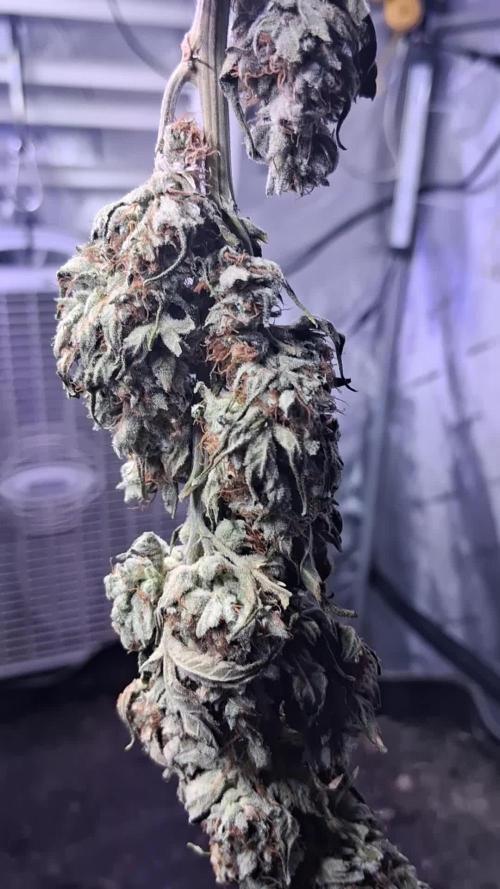
Inhale for 13s, Exhale for 13s,
Inhale for 8s, Exhale for 8s,
Inhale for 5s, Exhale for 5s,
Inhale for 3s, Exhale for 3s,
Inhale for 1s, Exhale for 1s,
Alignment. 1.618
More energy, more blueprint.
A plant with both standard cellular respiration (occurring throughout the plant, including leaves and stems) and adequate root respiration will have a significantly higher ATP throughput than one restricted to only general cellular respiration in a limited way.
Cellular respiration is the fundamental metabolic process that occurs in all living plant cells (roots, stems, leaves, flowers, seeds) to convert glucose into usable energy (ATP). It requires oxygen and produces carbon dioxide and water as byproducts.
Root respiration is not a separate type of respiration, but rather a specific instance of cellular respiration occurring in the roots. Roots absorb oxygen from the air spaces in the soil to fuel their energy needs.
Roots require a substantial amount of ATP for essential functions like nutrient and water absorption, as well as growth and maintenance of their tissues.
The primary form of respiration in healthy plant roots is aerobic respiration, which is highly efficient, yielding up to 30-38 ATP molecules per glucose molecule.
Anaerobic Respiration (Inefficient): If roots are deprived of oxygen (e.g., in waterlogged soil), they switch to anaerobic respiration, which is far less efficient, producing only 2 ATP molecules per glucose molecule and also generating alcohol, which can be toxic and kill the plant. Therefore, a plant with healthy, oxygenated roots performing efficient aerobic respiration in addition to the rest of the plant's cellular respiration has a much greater overall ATP production and energy capacity.
A soil without organic matter will generally have a low Cation Exchange Capacity (CEC).
Biochar is often prized for its potential to increase soil cation exchange capacity (CEC), but this effect is highly dependent on the specific properties of the biochar (feedstock and pyrolysis temperature) and the soil type to which it is applied. High-ash biochars, especially those produced at lower temperatures and applied to acidic or sandy soils, can significantly boost CEC by providing abundant binding sites for cations like calcium (Ca²⁺), magnesium (Mg²⁺), and potassium (K⁺).
Biochar is more sustainable than typical organic matter for long-term soil improvement primarily due to its high stability and resistance to microbial decomposition, allowing it to persist in the soil for hundreds to thousands of years. This longevity provides a lasting positive effect on soil properties, particularly by increasing the cation exchange capacity (CEC) over time, while regular organic matter breaks down much faster.
Biochar generally offers a much higher CEC than coco coir, though specific values vary greatly; while coco coir might sit around 40-60 cmol/kg, biochar can range from tens to over 200 cmol/kg, with sources like Acacia wood biochar or even coconut shell biochar often surpassing coco's capacity due to its porous structure, creating significantly more cation-binding sites for nutrients, making it superior for nutrient retention.
Needs to be charged similar to coco but at a much higger rate. But shhhh.. It's a secret. Ancient biochar-rich soils in the Amazon basin (known as Terra Preta) provide evidence of carbon stability lasting over 500 to 2,000+ years.
Recommend a balanced ratio of key cations, particularly calcium (Ca), magnesium (Mg), and potassium (K). A widely accepted general "ideal soil" cation saturation ratio is approximately 65-85% Ca, 6-12% Mg, and 2-5% K. That's roughly what I give mine. Can even add N in its NH4+ form


Likes
6
Share

@HowtoBubatz
Follow
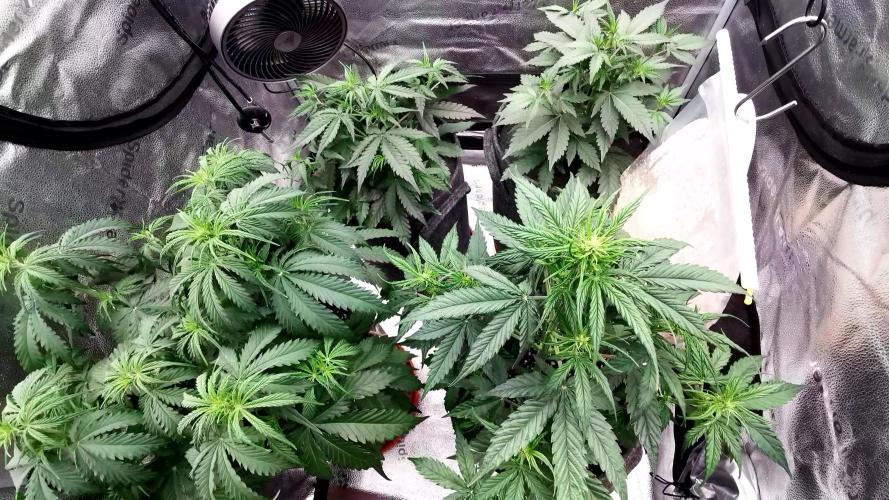
The Bruce Banner girls had a strong week! 💪
#1 is still the biggest plant in the tent and looks super happy. She handled the LST perfectly and keeps stretching nicely 🔥.
#2 is catching up and growing more balanced now.
#3 has finally found her rhythm and started growing normally 🙌.
Both #2 and #3 are now showing their first pistils, so they’ve officially entered the flowering stage 🌸.
This week all three received a watering with Green House Bio Enhancer, and aside from that, just RO water + CalMag (Advanced Nutrients) 💧.
No issues or signs of deficiency, leaves are lush green and healthy across the board 🌿.
They’re growing in the 90×90 tent with the AC Infinity AI setup and Spider Farmer SE5000, keeping everything dialed in: 25–26 °C, 60 % RH, and around 500–600 µmol/m²/s PPFD 🌡️.
Overall, #1 remains the queen of the tent 👑, while #2 and #3 are catching up as they ease into early flower. Excited to see them start stacking buds soon! ✨


Processing
Likes
3
Share


@Ogbangbang2981
Follow
last week only feeding water trichomes level is low but plant looks healthy and strong loving the smell coming off her waiting to harvest


Likes
5
Share


@Ryno1990
Follow
Starting out great in the begining of week 3 we had a little accident in week 2 were her pot fell over an she got a little roughed up but she came back nice an strong can deffinetly tell she stalled out for a day or 2 tho other then that she's been growing great seems to be loving this fold 6 led from medic grow
Ending week 3 the Tropicana Cookies is doing pretty good now she's not doing as good as the other auto but seeing how we had a little accident with her she's doing pretty good deff loving the cronk nutrients


Likes
8
Share


@Chubbs
Follow
What up Fam, I apologize for the late update. Been away for 2 weeks from the ladies and my son who was watching them did amazing, as I came back to an absolute forest. The plants almost doubled in size which is crazy the growth they had while I was gone. I started adding bloom nutes and did a defoliation and lollipop this week. I'd normally start my training around week 3 but over all they're happy and healthy as can be. Let's Go Happy Growing.


Likes
47
Share


@Sativfaction
Follow
En esta segunda semana aumento la intendidad del LED hasta alcanzar 18.000 LUX en la punta de las plantas, manteniendo la distancia de 50cm.
En uno de los riegos agrego nitrógeno (Fish Mix), en otro Bio Heaven, y siempre CalMag, ya que parto de un agua de baja mineralización (EC 0.05)


Likes
Comments
Share


@dwotTV
Follow
Moving along into flower nicely, spent a day and change inside hiding from the rain and wind from the hurricane remnant. Back outside now.
Likes
17
Share


@JonnyKush
Follow
hello growmies! day 51 finally the pre-flowers begin to appear. I apologize for the few photos but unfortunately they really filled the box and I find it difficult. overall I have to say they look in perfect shape! I will keep you updated thanks for passing by. like and comment! good day and beautiful growth to you 🌳🌱

Likes
1
Share


@Elguacho420
Follow
Hola, buenas a tod@s... Pasamos la séptima semana de esta Red cookie gelato... Buenísima, hermosa planta, punteros y cogollos pretos, tonalidades rosas, purpura, amarillo, luego fuera de la luz es más negra,oscura, es hermosa x donde la veas, mas alla de los signos en sus hojas, esta muy bien y el olor q tiene es espectacular, dulce, afrutado, terrible... Está hermosa... Espero verla ya en la semana final prevía al corte... De momento no hay problema, todo genial .. 👌🏻😎 buen fin de semana para tod@s y buenos humos... 🇦🇷🤝🏻🇪🇦 👍🏻
Likes
14
Share


@Kakui
Follow
11 Noviembre: Primer riego con 2.5EC y 5.9pH, runoff de 2.9EC y 6.2pH, en una semana más ya deberían estar recibiendo 3.0EC y seguir con esa concentración por todo el cultivo. Alturas están entre 15cm y 20cm.
13 Noviembre: Riego 2.5EC y 5.9pH, runoff de 3.3EC y 6.2pH. Hoy se removieron los primeros nodos de cada planta y se les hizo poda apical.
14 Noviembre: Riego 2.5EC y 5.9pH, runoff de 3.3EC y 6.2pH en la mañana. En la tarde se realizó transplante a maceteros definitivos de 5 litros con 4 litros de sustrato aprox. el cual fue pre cargado hasta la capacidad de campo, con 3.0EC y 5.8pH, desde este punto se debe esperar un par de días hasta que el dryback(secado) del sustrato sea de un 35-40%, lo cual vendría siendo el primer P3 del cultivo, una vez se alcance ese porcentaje de secado, se comenzará con los primeros riegos de precisión llamados P1.
