Check the winners The Grow Awards 2026 šŸ†
Likes
Comments
Share
@Ambz_1990
Follow
Just approaches week 7, I don't know when to initiate the dragon force, kill feed and then flush, iv gotta buy a camera lens this week to check trichomes but I'm nearing the end
Likes
19
Share
@Dunk_Junk
Follow
This week she grew 11cm taller & got a lot bushier. I still say she is an Indica pheno... Nutrients used this week: 20 grams 20-20-20 powder mixed with 10 litres of water + 40ml of Cannazym = ~1470ppm Timelapse sequence is: *** Auto Jack *** Pineapple express CBD Lime Blue Dream *** Auto Jack *** Pineapple Express CBD Lime Blue Dream
Likes
55
Share
2nd net is up. Early bud formations are promising. holding up to the extremes pretty well, some leaves taking minor damage, but overall, she is holding up, gave her 1 night at 50F see how she would react, stressful. Not advised as it messes with her metabolism, but I want to see if it triggers any anthocyanin response. Love to see her purp up but no signs yet. Remember, For every molecule of glucose produced during photosynthesis, a plant needs to split six molecules of water. This process provides the hydrogen needed for synthesizing glucose and other organic compounds, while oxygen is released as a byproduct. Homework. If Rubisco activity is impaired and it cannot properly function or regenerate its substrate, the plant's leaves are likely to turn a pale green or lime green, a condition known as chlorosis. Essentially, Rubisco activity is highly regulated and susceptible to various environmental and metabolic factors that can cause it to become inhibited, leading to an apparent failure in RuBP regeneration due to a lack of consumption. Rubisco regeneration is intrinsically linked to nitrogen supply because Rubisco is a major sink for nitrogen in plants, typically accounting for 15% to over 25% of total leaf nitrogen. The regeneration phase itself consumes nitrogen through the synthesis of the Rubisco enzyme and associated proteins (like Rubisco activase), and overall nitrogen status heavily influences the efficiency of RuBP regeneration. RuBisCO is a very large enzyme that constitutes a significant proportion (up to 50%) of leaf soluble protein and requires large investments in nitrogen. Insufficient nitrogen supply limits the plant's ability to produce adequate amounts of RuBisCO, thereby limiting the overall capacity for photosynthesis and carbon fixation. Maintaining the optimal, slightly alkaline pH is crucial for the proper function and regeneration of Rubisco. Deviations in either direction (too high or too low) disrupt the enzyme's structure, activation state, and interaction with its substrates, leading to decreased activity and impaired RuBP regeneration. (Lime/yellowing) Structural Component: Nitrogen is an essential building block for all proteins, and the sheer abundance of the Rubisco protein makes it the single largest storage of nitrogen in the leaf. Synthesis and Activity: Adequate nitrogen supply is crucial for the synthesis and maintenance of sufficient Rubisco enzyme and Rubisco activase (Rca), the regulatory protein responsible for maintaining Rubisco's active state. Nitrogen deficiency leads to a decrease in the content and activity of both Rubisco and Rca, which in turn limits the maximum carboxylation rate, Vmax, and the rate of RuBP regeneration Jmax, thus reducing overall photosynthetic capacity. Nitrogen Storage and Remobilization: Rubisco can act as a temporary nitrogen storage protein, which is degraded to remobilize nitrogen to other growing parts of the plant, especially under conditions of nitrogen deficiency or senescence. Nitrogen Use Efficiency (NUE): The allocation of nitrogen to Rubisco is a key determinant of a plant's photosynthetic nitrogen use efficiency (PNUE). In high-nitrogen conditions, plants may accumulate a surplus of Rubisco, which may not be fully activated, leading to a lower PNUE. Optimizing the amount and activity of Rubisco relative to nitrogen availability is a target for improving crop NUE. Photorespiration and Nitrogen Metabolism: Nitrogen metabolism is also linked to the photorespiration pathway (which competes with carboxylation at the Rubisco active site), particularly in the reassimilation of ammonia released during the process. To increase RuBisCO regeneration, which refers to the process of forming the CO2 acceptor molecule Ribulose-1,5-bisphosphate (RuBP) during photosynthesis, the primary methods involve optimizing the levels and activity of Rubisco activase (Rca) and enhancing the performance of other Calvin-Benson-Bassham (CBB) cycle enzymes. Biochemical and Environmental Approaches: Optimize Rubisco Activase (Rca) activity: Rca is a crucial chaperone protein that removes inhibitory sugar phosphates, such as CA1P (2-carboxy-D-arabinitol 1-phosphate), from the Rubisco active site, thus maintaining its catalytic competence. •Ensure optimal light conditions: Rca is light-activated via the chloroplast's redox status. Adequate light intensity ensures Rca can effectively maintain Rubisco in its active, carbamylated state. •Maintain optimal temperature: Rca is highly temperature-sensitive and can become unstable at moderately high temperatures (e.g., above 35°C/95F° in many C3 plants), which decreases its ability to activate Rubisco. Maintaining temperatures within the optimal range for a specific plant species is important. •Optimize Mg2+ concentration: Mg2+ is a key cofactor for both Rubisco carbamylation and Rca activity. In the light, Mg2+ concentration in the chloroplast stroma increases, promoting activation. •Manage ATP/ADP ratio: Rca activity depends on ATP hydrolysis and is inhibited by ADP. Conditions that maintain a high ATP/ADP ratio in the chloroplast stroma favor Rca activity. Enhance Calvin-Benson-Bassham (CBB) cycle enzyme activity: The overall rate of RuBP regeneration can be limited by other enzymes in the cycle. •Increase SBPase activity: Sedoheptulose-1,7-bisphosphatase (SBPase) is a key regulatory enzyme in the regeneration pathway, and increasing its activity can enhance RuBP regeneration and overall photosynthesis. •Optimize other enzymes: Overexpression of other CBB cycle enzymes such as fructose-1,6-bisphosphate aldolase (FBA) and triose phosphate isomerase (TPI) can also help to balance the metabolic flux and improve RuBP regeneration capacity. Magnesium ions, Mg2+, are specifically required for Rubisco activation because the cation plays a critical structural and chemical role in forming the active site: A specific lysine residue in the active site must be carbamylated by a CO2 molecule to activate the enzyme. The resulting negatively charged carbamyl group then facilitates the binding of the positively charged Mg2+ion. While other divalent metal ions like Mn2+ can bind to Rubisco, they alter the enzyme's substrate specificity and lead to dramatically lower activity or a higher rate of the non-productive oxygenation reaction compared to Mg2+, making them biologically unfavorable in the context of efficient carbon fixation. The concentration of Mg2+ in the chloroplast stroma naturally increases in the light due to ion potential balancing during ATP synthesis, providing a physiological mechanism to ensure the enzyme is activated when photosynthesis is possible. At the center of the porphyrin ring, nestled within its nitrogen atoms, is a Magnesium ion (Mg2+). This magnesium ion is crucial for the function of chlorophyll, and without it, the pigment cannot effectively capture and transfer light energy. Mg acts as a cofactor: Mg2+ binds to Rubisco after an activator CO2 molecule, forming a catalytically competent complex (Enzyme-CO2-Mg2+). High light + CO2) increases demand: Under high light (60 DLI is a very high intensity, potentially saturating) and high CO2, the plant's capacity for photosynthesis is high, and thus the demand for activated Rubisco and the necessary Mg2+ cofactor increases. Mg deficiency becomes limiting: If Mg2+ is deficient under these conditions, the higher levels of Rubisco and Rubisco activase produced cannot be fully activated, leading to lower photosynthetic rates and potential photo-oxidative damage. Optimal range: Studies show that adequate Mg2+ application can enhance Rubisco activation and stabilize net photosynthetic rates under stress conditions, but the required concentration is specific to the experimental setup. Monitoring is key: The most effective approach in a controlled environment is to monitor the plant's physiological responses e.g., leaf Mg2+ concentration, photosynthetic rate, Rubisco activation state, and adjust the nutrient solution/fertilizer to maintain adequate levels, rather than supplementing a fixed "extra" amount. In practice, this means ensuring that Mg2+ is not a limiting factor in the plant's standard nutrient solution when pushing the limits with high light and CO2. Applying Mg2+ through foliar spray is beneficial to Rubisco regeneration, particularly in alleviating the negative effects of magnesium (Mg) deficiency and high-temperature stress (HTS). While Mg can be leached from soil, within the plant it is considered a mobile nutrient, particularly in the phloem. Foliar-applied Mg is quickly absorbed by the leaves and can be translocate to other plant parts, including new growth and sink organs. Foliar application of: NATURES VERY OWN MgSO4 @ 15.0g L-1 in a spray bottle. For those high-intensity workouts when 1 meal a day is just not enough! Foliar sprays are often recommended as a rapid rescue measure for existing deficiencies or as a supplement during critical growth stages, when demand for Mg is high. Application in the early morning or late evening can improve absorption and prevent leaf burn. The plant was getting a little limey yellow in the centre. Shortly thereafter, she was back in business, green mostly regenerated. The starting point [of creativity] is curiosity: pondering why the default exists in the first place. We’re driven to question defaults when we experience vuja de, the opposite of dĆ©jĆ  vu. DĆ©jĆ  vu occurs when we encounter something new, but it feels as if we’ve seen it before. Vuja de is the reverse—we face something familiar, but we see it with a fresh perspective that enables us to gain new insights into old problems. Confidence is evidence... nothing more. You are confident because you have driven 10,000 times, you are confident because you have spoken 10,000 times. People think confidence is a feeling, but it's not. If you want more confidence, then you need to create evidence, take more shots, collect more data, build more experiences, take more risks; fail, confidence doesn't come first; it is the reward you get for doing the work. no one else wants to do.
Likes
50
Share
@ClubRiot
Follow
Start week 7 , Top-Max 4 ml/L + Cal-Mag Xtra 2 ml/L + Bio Bloom 4 ml/L + CarboLoad 2 ml/L + Alg-A-Mic 2 ml/L + Bio-Heaven 2 ml/L ( Ph 6.6 )
Likes
28
Share
Likes
38
Share
Hello friends here we are in week seven of flower. Sorry there was no daily time lapse or pics went out on vacation. So today Day 105 12/24/2021 marks the end of the week, She is coming along nicely and the smell is just WOW. She should be ready to start flush after next week. I checked the Trichomes and mostly all cloudy few clear and few amber. Also got a new tent last night that will be setting up for next year grow.
Likes
14
Share
@Weedbadk
Follow
Día 1 y todas geminaron vamos a usar lst a todas y algunas lst y poda apical Día 5 desde puesta en sustrato Solo pulverizó
Likes
40
Share
@BudXs
Follow
Here we go, my first attempt to be blown away by the most designer genetics I could find. Spoke with GreenMachine back in November 2019 on getting these, watched him do it first in his version of hempy buckets (do check him out, quite unique) 6 plants run in 4 gallon hempy buckets 30% perlite, 70% coco. Top feed twice daily till resevoir spills out of the buckets. Will up it in flower to at least 3 feedings. All drains to waste Room is dialed in. See my build journal, this space is in a non climatised garage. Insulation and air conditioning are key, as well as odor control for my neighbors sake. Growing out 4 phenos to look for the frostiest nuglet and will then clone it over the winter for next years run. Follow my son on his first Grow Diaries adventure - Budxless I go live on insta Sunday nights from the garden at 9:30pm EST - Budxsmedical
Likes
4
Share
Day 71 Update: Watered both plants with almost a gallon until runoff. Water was just plain pH balanced water. Plant #1 has 5 days left on flush and Plant #2 has 11 days left on flush. Although with my tent filling up, I will probably harvest Plant #1 tomorrow as I don't think 4 days of being in there will make a difference in the end product. Day 72 Update: Harvested Plant #1 today. Plant #2 has 10 days left on flush. Day 74 Update: Watered plant with 3/4gal of pH balanced water until runoff. Plant #2 has 8 days left on flush. Also, added another stake to help support a heavier branch. Day 76 Update: Placed buds from Plant #1 in jars to start curing...maybe a little bit too long drying, but if that's the case I'll toss a boveda pack in. Plant #1's yield was 57.2g or 2oz 1.2g. Plant #2 will be harvested sometime next week and I will update the harvest page as soon as buds are dried and weighed.
Likes
14
Share
Likes
6
Share
Likes
5
Share
In flush, 2 smaller ones got cut and just got put into cure bucket. smaller stuff got pressed. 44g in 8.2g out
Likes
27
Share
@WestOzzie
Follow
She's nearly all done,smells amazing,looks amazing
Likes
55
Share
@Max1973
Follow
Week 2, all 7 repotted in 4.5L and 7.5L pots.... all lights wired up properly...... holding perfectly with 24oC, 40% humidity... relying on the soil nutes, and just tap water...... the PH of the tap water is abit high- 6-7... so i'll try to get some rainwater, or 10L box of spring water....
Likes
61
Share
@WhiteEdge
Follow
16.04.2024 Continue into week 7 Replaced all filters in the system and cleaned them. Mixed a new batch with the following components: 56ml AN Connoisseur Bloom A+B Total volume: 34 liters Electrical Conductivity (EC): 1.1 Target EC for this week: 1.0-1.1. Adjustments will be based on plant observations. Performed one long misting session (3 minutes). Environmental Conditions: Outside temperatures going down, today is raining but this week is lower in temperatures Smallest Wedding Cheesecake: Great bud development, already buds are hard and juicy. Exceptional odors Tropicana Cookies: Phenomenal strain; One girl is going to finish before 8 weeks Purple Lemonade: Tall plants, think ist finish flowering the last Lighting Parameters: PAR Map: Maximum PPFD is 850, minimum PPFD is 600. VPD: Ranges from -1.2 to -1.3. Daytime Temperature (DT): 24-25°C. Nighttime Temperature (NT): 20-21°C. Leaf Temperature: 22-23°C. Light Distance: 45-55 cm from the plants. CO2 Levels: 700+ ppm. HLG Scorpion Diablo: Set at 60%, positioned at a 45-55 cm distance. Daytime: ON for 70 seconds, followed by 25 minutes OFF. Nighttime: OFF for 70 seconds, followed by 35 minutes OFF. Nutrient Tank (NT): pH: Maintained between 5.90 and 6.10. EC: 1.20. Temperature: 20-21°C 18.04.2024 Mixed a 15-liter solution with 20+30ml AN Connoisseur AB . The liquid temperature is 18.8°C. Replaced all filters in the system and cleaned them The outside temperature getting lower this days. Its help a lot to maintain temps in grow box I hope, as per the forecast, temperature will remain low during the upcoming week. The ladies are looking fantastic. Purple Lemonade is slowest on flowering but i think it will be rewarding to wait Tropicana Cookies are racing toward harvest; . Lighting Parameters: PAR Map: Maximum PPFD is 900, minimum PPFD is 650. VPD: Ranges from -1.2 to -1.3. Daytime Temperature (DT): 23-24°C. Nighttime Temperature (NT): 20°C. Leaf Temperature: 22°C. Light Distance: 45-55 cm from the plants. CO2 Levels: 700+ ppm. HLG Scorpion Diablo: Set at 70%, positioned at a 45-55 cm distance. Misting Schedule: Daytime: ON for 70 seconds, followed by 25 minutes OFF. Nighttime: OFF for 70 seconds, followed by 35 minutes OFF. Nutrient Tank (NT): pH: Maintained between 5.90 and 6.10. EC: 1.1. Temperature: 20-21°C 20.04.2024 Today, we had a storm accompanied by a power outage. Nothing serious, just a few hours. The temperature and humidity remained within appropriate values. Upon the return of power, the DH48-S relay timer, which controls irrigation, failed again. This has happened for the third time in the last 4 months. Unfortunately, I couldn’t react immediately, so the ladies were without water again for a few hours. I’ve ordered a TrolMaster program device and additional sensors AMP-3 for pH, EC and humidity, and temperature control. No more messing around! Water consumption is gradually decreasing, and electrical conductivity of the water is slowly rising. I’m starting to reduce the strength of the nutrient solution. Each subsequent tank refill will be at approximately 1.0EC. The outdoor temperature is still cooler; let’s hope it stays that way for another week or two! šŸŒ±ā„ļø Mixed a 15-liter solution with 25+25ml AN Connoisseur AB . The liquid temperature is 18.8°C. Replaced all filters in the system and cleaned them Lighting Parameters: PAR Map: Maximum PPFD is 900, minimum PPFD is 650. VPD: Ranges from -1.2 to -1.3. Daytime Temperature (DT): 23-24°C. Nighttime Temperature (NT): 20°C. Leaf Temperature: 22°C. Light Distance: 45-55 cm from the plants. CO2 Levels: 700+ ppm. HLG Scorpion Diablo: Set at 70%, positioned at a 45-55 cm distance. Misting Schedule: Daytime: ON for 70 seconds, followed by 25 minutes OFF. Nighttime: OFF for 70 seconds, followed by 35 minutes OFF. Nutrient Tank (NT): pH: Maintained between 5.90 and 6.10. EC: 1.12 Temperature: 20-21°C 22.04.2024 Tropicana Cookies is the only one that got scars in the form of slightly burnt leaf tips. It’s not too severe; due to the lack of water, some mineral residue remained directly at the root. All in all, it could have been worse. I hope the timer won’t deceive me again until my TrolMaster program device arrives. One Tropicana Cookies and one Wedding Cheesecake will finish during the next week, so I’ll slowly start preparing them for harvest. Purple Lemonade and one Wedding Cheesecake will continue flowering into the ninth week, but they’ll be the largest ladies in this batch. All the ladies look and smell fantastic, and the buds are already firm to the touch, especially the Wedding Cheesecake. Starting tomorrow, I’ll gradually reduce the nutrient strength and light intensity. I’ll make an effort to keep the temperature around 23-24°C. Lighting Parameters: PAR Map: Maximum PPFD is 900, minimum PPFD is 650. VPD: Ranges from -1.2 - 1.25 Daytime Temperature (DT): 23-24°C. Nighttime Temperature (NT): 20°C. Leaf Temperature: 21°C. Light Distance: 45-55 cm from the plants. CO2 Levels: 700+ ppm. HLG Scorpion Diablo: Set at 75%, positioned at a 45-55 cm distance. Misting Schedule: Daytime: ON for 70 seconds, followed by 25 minutes OFF. Nighttime: OFF for 70 seconds, followed by 35 minutes OFF. Nutrient Tank (NT): pH: Maintained between 5.90 and 6.15. EC: 1.14 Temperature: 20-21°C Week 7 off Flowering in Summary 105 litter off RO water, 150ml+1800ml AN connoisseur A+B 53kW electricity in total for light, Pumps and AC Infinity Fans. 51kW for Light + 1kW Dehumidification + AC Infinity ventilation Week start @ 1.21EC, nutrient strength., keep strength @ 1.1-1.2 till the end of the week Tropicana Cookies is gonna be harvested next week!! Also think one Wedding Cheesecake is waiting harvest in next week PH was stabile and move from 5.90 min to 6.2 max. From end off the week PH is start to dropping Light distance for this week - 50-55cm from tallest top , PPFD levels around 900 in center, trough whole week. Lowest reading 680 @ corner Temperature are from 20c at start off day to 24.5c max at some points. Night temps around 19.5-20c. Outside humidity is generally low This week i have DH48-S timer failure, third time in this month. Ordered TrolMaster program device for that Day RH is moved from 45% to 55% max, at night times drop to 45-48% Continue in next week, lowering temperatures, EC strength and humidity Lighting Parameters: PAR Map: Maximum PPFD is 900, minimum PPFD is 650. VPD: Ranges from -1.2 to -1.3. Daytime Temperature (DT): 24.5°C. Nighttime Temperature (NT): 20°C. Leaf Temperature: 22°C. Light Distance: 45-55 cm from the plants. CO2 Levels: 700+ ppm. HLG Scorpion Diablo: Set at 70%, positioned at a 45-55 cm distance. Daytime: ON for 70 seconds, followed by 25 minutes OFF. Nighttime: OFF for 70 seconds, followed by 35 minutes OFF. Nutrient Tank (NT): pH: Maintained between 5.8 and 6.1 EC: 1.1 - 1.20. Temperature: 20-21°C
Likes
31
Share
@MrRaid
Follow
Hello everyone had to add more calmag for these ladies as they shown me that they really want it. Accept from that they have been doing extremely well they have abit more room now I've taken out the BlackBerry kush I'm hoping for a very stinky sticky harvest with lots of good smells at first the plants seems to be very picky with nutrient strength now I would say they want as much as they can possibly take showing in there leafs that they demand more calmag iron and magnesium I have givent hem this today 42 day from seed I think now the plant will concentrate on filling out those bud sights from day 60 I'm gonna lower the temperature on the room from 24 to 21 and humidity around 45% maybe 40 gonna lower the temperature of my flush water from 21 to 18c
Likes
10
Share
Blueberry Muffin Week2 F14. After switching to 12/12 , they are still stretching and have already 2x in size. The plants smell strong already. Feeding 3x a week. 2x with grow,bloom,topmax and 1x with calmag and Alg a mic.
Likes
61
Share
Okay so thats probably the last week, though i still dont see any amber trichomes. Im scared of budrot and i cant see any huge progress.. one is behind and is getting one more week. I harvested one already at day 55 due to budrod.. Im happy to see any last advices! DAY 58 - DUE TO SOME SPIDER AND MORE BUUDROT IM GONNA HARVEST THEM ALL EXCEPT ONE NOW FUCK THIS IM MAD i think i need some bigger fans next time
Likes
12
Share
@Kirsten
Follow
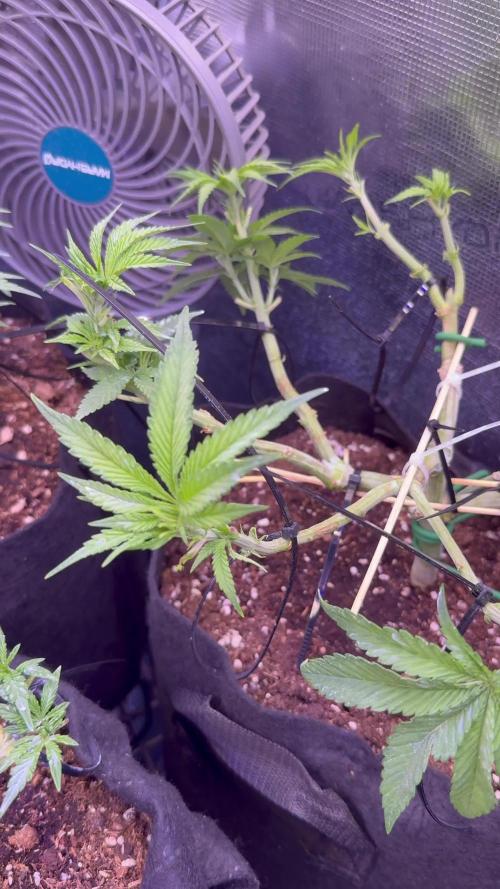
26.12.24: I have noticed light stress on my plants. I had moved the lights further away and increased the light intensity to 70%. Unfortunately that created some issues. Namely severe palour of the leaves. To try and rectify the situation, I've dimmed the lights to about 30%, staying at the same distance, about 30 inches away. I measured the par levels, after I did this. They should a reading of anywhere between 40 and 150, at the canopy of the plants. They are all different sizes. This seems to have improved the colouring on all plants. After this evenings watering, I will monitor recovery and increase lighting intensity again slowly. I am also using the light cycle of 21/3, so the plants have many hours more light to absorb, than for example 12/12 or 18/6. 29.12.24: So I finally gave LST a shot, it's probably a bit too late, however I really want to get the most of the triploid pheno, and I went a little crazy and LST'd all plants except 2, as they're too small. I did that late last night, this afternoon I was amazed to see the plants turn their leaves back to the light source. I'm glad I overcame my fear of trying it. I'm very excited to see them adapt and progress! 😁 there are videos above with before and after of my LST process. I am pleased with the progress, considering all of my mistakes! Thanks for checking out my diary šŸƒ āœŒļø