Likes
Comments
Share
(END OF QUARANTINE) Now I have put them to finish underground a 600w hps under 12/12 schedule with the Divine Black opium. Luckily no more mould has spread, and all plants look happy healthy and still developing. Day 72 12/09/24 Thursday De-chlorinated tap water pH 6 today with Plagron products. Finally a video and pictures update ✌️💚 Day 74 14/09/24 Saturday De-chlorinated tap water pH 6 only today Day 76 16/09/24 Monday Feed today using de-chlorinated tap water pH 6. Will update all videos and pics tonight 😁 Day 77 17/09/24 Tuesday Feed today using de-chlorinated tap water pH 6. Seeing good developments, buds forming nicely, divines are smaller denser structures but the buds are not lacking! Damn I'm surprised by 2L pots.
Processing
Likes
10
Share
@Dunk_Junk
Follow
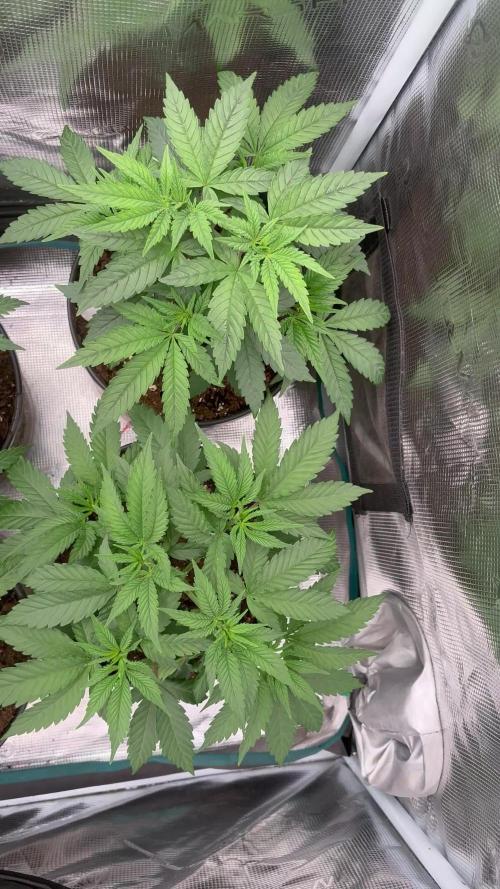
She grew well this week! 14cm vertical growth! I've not done a thing to her apart from feed/water and turn her pot 180 degrees through the week.
Likes
6
Share
@Sadhus
Follow
Semaine 3 - Phase Végétative : Journal de Culture pour la Dognabis Cup (Concours DogDoctor)Strain : Zamnesia Permanent Marker Système de culture : Hydroponie Ebb & Flow sur billes d'argile expansé Nutrition : Aptus (programme adapté à la phase végé, EC cible à 2.2 mS/cm) Éclairage : 1000W full spectrum, contrôlé par Trolmaster Tent X (augmentation progressive de 10 PPFD par semaine) Contrôle environnemental : Total via Trolmaster (climat, lumière, CO2, VPD) Objectif global : Maximiser la structure buissonnante pour la floraison future, en visant des monstres... mais adaptation forcée au switch précoce ! Salut la team DogDoctor et la communauté Dognabis Cup ! Voici le récap de ma semaine 3 en végé pour ma Zamnesia Permanent Marker. Cette strain est une bête : elle pousse vite, dense et résineuse, mais comme vous le verrez, je dois déjà anticiper un switch en 12/12 plus tôt que prévu à cause de mes autres plantes en avance (qui stressent pour du temps extra en végé). Pas de monstres XXL cette fois, mais on optimise ce qu'on peut avec du LST/FIM et une gestion fine de l'hydro. Nutrition Aptus qui cartonne, et enfin, le pH s'est stabilisé après des débuts chaotiques – plus de corrections quotidiennes, ouf ! État des PlantesLes bébés Permanent Marker sont en pleine explosion : tiges solides, feuilles larges et dark green, avec une bonne ramification grâce au LST et FIM appliqués cette semaine. J'ai plié et attaché les tops pour une canopée uniforme (environ 4-5 nœuds principaux par plante), et topping sur les plus vigoureuses pour booster les côtés. Croissance verticale contrôlée à ~15-20 cm de hauteur moyenne, mais la densité racinaire est top dans les billes d'argile – pas de signes de stress oxygène. Malheureusement, les autres plantes du run (pas en concours) sont déjà en train de s'étirer et demandent du 12/12 ; je vais devoir les stresser (légèrement réduire les nutriments ou eau) pour grappiller 3-5 jours de végé extra ici. Objectif : ne pas dépasser 4 semaines total en végé pour synchroniser le tout. Pas l'idéal pour des colosses, mais la qualité prime pour la Cup ! Environnement et ContrôlesTout est verrouillé via Trolmaster : température stable autour de 24°C (cible), humidité à 70% (parfait pour la végé), CO2 à 900 PPM (maintien manuel pour booster la photosynthèse). VPD optimal à ~0.9 kPa, ce qui colle pile aux recos Aptus pour éviter transpiration excessive. Lumière augmentée de 10 PPFD comme prévu (maintenant à ~679 PPFD moyen en zone flo), et les graphs montrent une belle stabilité – pas de pics chaotiques. Pour l'hydro : marées réduites de 2 min (maintenant ~15-20 min par cycle) et 2 cycles en moins par jour (de 8 à 6), pour durcir les racines sans noyade. Solution à EC 2.2 (up de 0.2 cette semaine pour suivre la faim végé), pH enfin stable à 6.07 (après des ajustements quotidiens les 2 premières semaines – merci les tampons Aptus !). EC solution à 2.16 mS/cm, temp eau à 17.9°C (refroidisseur au top). Mousture moyenne à 90% – bien drainé, zéro anaérobie. Données Récapitulatives de la SemaineVoici un tableau synthétique des stats clés (moyennes sur Mon/Dim/Nuit pour les zones "Plantes" et "Chambre", basées sur les logs app). Tout est cohérent avec les graphs 24h qui montrent des courbes lisses, sans dérive majeure.Paramètre Zone Moyenne Mon (°C / % / kPa / PPFD) Max Mon Min Mon Moyenne Dim (°C / % / kPa / PPFD) Max Dim Min Dim Moyenne Nuit (°C / % / kPa / PPFD) Max Nuit Min Nuit Cible / Notes Température Plantes 23.65°C 24.3°C 22.1°C 21.5°C 24.0°C 19.8°C - - - Cible 24°C ; stable, +0.5°C vs. S2 Chambre 23.7°C 24.5°C 19.8°C 19.8°C 22.4°C 19.0°C - - - Bonne ventilation nocturne Humidité Plantes 69.56% 71.9% 49.4% 63.78% 73.3% 52.3% 70.22% / 66.64% 74.1% / 72.3% 58.5% / 63.4% Cible 70% ; pics max bien gérés Chambre - - - - - - - - - - VPD Global 0.89 kPa 1.48 kPa 0.8 kPa 0.93 kPa 1.38 kPa 0.68 kPa 0.87 kPa / 0.77 kPa 1.06 kPa / 0.91 kPa 0.72 kPa / 0.7 kPa Optimal 0.8-1.0 ; transpiration saine PPFD (Lumière) Plantes 671.9 PPFD 693 PPFD 431 PPFD 0.46 PPFD 5 PPFD 0 PPFD 674.5 PPFD 684 PPFD 292 PPFD +10 PPFD vs. S2 ; full spectrum au top CO2 Global - - - - - - - - - Maintenu à 900 PPM ; boost photosynthèse Solution pH / EC / Temp 6.07 / 2.16 mS/cm / 17.9°C - - - - - - - - EC up à 2.2 ; pH stable enfin ! Notes sur les données : PPFD bas en "Dim" car cycles lumière éteints ; focus sur Mon/Nuit pour les moyennes actives. Graphs 24h confirment : Temp stable entre 22-24.5°C, Humidité 58-74%, VPD ~0.7-1.0 kPa, sans outage.Défis et AjustementspH instable résolu : Les 2 premières semaines, je corrigeais tous les jours (oscillations 5.8-6.5 dues à l'hydro neuf). Cette semaine, boom – stable à 6.07 grâce aux stabilisateurs Aptus et monitoring Trolmaster. Victoire ! Switch forcé : Les autres plantes en avance m'obligent à floraison précoce (semaine 4 max). J'aurais aimé 6 semaines pour des monstres, mais on priorise la synchro. Plan B : stresser les leaders (réduire EC de 0.1 sur elles) pour +2-3 jours végé ici. LST/FIM : Appliqué mid-semaine – tops pliés, nœuds boostés. Pas de topping supplémentaire pour éviter stress avant switch. Objectifs Semaine 4 (Transition Végé/Flo)Continuer l'augmentation lumière : +10 PPFD encore (cible ~750 PPFD pour fin végé). Légère baisse EC (à 2.0) pour anticiper flo, sans choc. Arrêter LST/FIM : Laisser repousser librement, focus sur récupération. Tirer max de végé : Stresser les autres plantes (eau/nutriments light) pour retarder leur switch – grappiller du temps pour ces Permanent Marker. Monitoring renforcé : VPD
Processing
Likes
11
Share
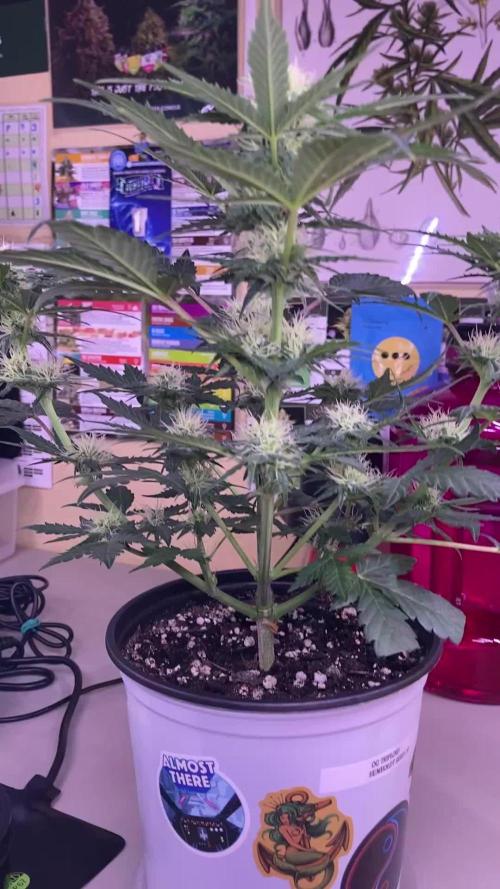
She’s maturing kinda quickly if I didn’t say before I think her long flower was kind of on my part for not checking my timer ensuring 12/12 was set but all is well now she’s thriving n fattening up now!!! Should be fairly decent yield, we shall see!
Likes
136
Share
@Qutro
Follow
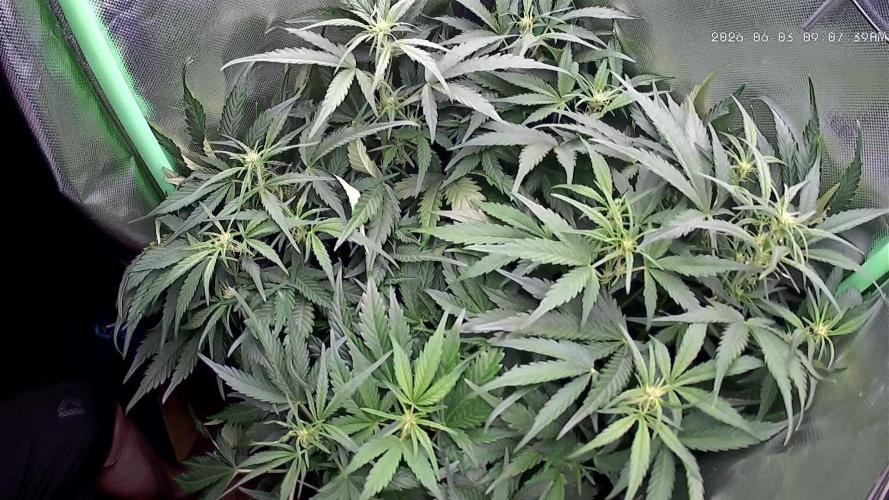
Hi there, We have definitely seen some good growth since last update. Patient and the longer veg period paid off as many bud sites appeared. I mean 4 plants filled the whole 120*120 tent. Genetic traits are starting to show. Marshmallow Og has thicker stems and has grown taller during the stretch while Candystore RBX is a much darker green has a medium-long internode spacing. It was necessary to use a plant trolley to lift the Candystore for a uniform canopy level. The tallest Candystore is 67cm, Marshmallow 73cm. On day 21 after the switch to 12, I took off a bunch of leaves to get more light on the lower nodes. At first I was afraid I had gone a little too far because I had also done an aggressive lollipoping on these girls. Next week we'll see how offended they are haha. They became hungrier and we started supplementing their watering with the Booster. The above mentioned units except the Silica are grams not ml. They drink like 5 litres every four days. Running the light on 80% , 44 cm above the canopy. Par.: 540-770 Ppfd Vpd.:1,05-1,2kpa. Happy with how everything looks, until next time.🌱🌞
Processing
Likes
19
Share
My girls are continuing to do well, and spread out. I had a little mishap with the watering pump as it stayed on all afternoon, and drained the nutes bucket, but the girls did not seem to mind and have continued to flourish. I missed a couple of days photos due to changes in my work schedule, but will try to keep on track for the coming week. I have decided today to switch it over to bloom as the canopy is full enough for this first run. I have turned on the bloom switch on my grow lamp and set my timers to a 12-12 schedule starting today. Next week's timelapse should be interesting.
Likes
8
Share
@dwotTV
Follow
Transplanted in the afternoon of 10/23 because they were rooting out of the pucks. Got some humidity dome cups coming tomorrow and another inline fan to handle intake to try to dial in things a bit more. Growing well as the week ends, #1 is the big guy so far, growing really well. Sprayed with Neem Oil on 10/24 Fed Light Fox Farms Blend on 10/25 Treated with NemAttack on 10/26
Likes
12
Share
@AllieO
Follow
1/12: lots more leaf tucking today. She's taking waterings like a champ. I'm always so worried about overwatering but she seems to be growing well 1/14: did a little more lst, so she's looking a little bit like an ugly duckling. Hoping the effort plays out. Attempted to adjust some clips and accidentally broke a stem. I splinted that up with some tape... Also my attempt at a fim is growing out... She's looking a little rough right now, but honestly, aren't we all? 1/15: watered and some leaf tucking this morning. Excited for the top to not look like a hot mess! 1/17: the ugly duckling phase is strong with this one. Gave her a good watering today and attempted some leaf tucking, only sacrificing one fan leaf.
Likes
Comments
Share
We are up to speed now things should be on track now..gave dem girls some more room and set dem in their final resting
Likes
175
Share
Day 29 Flower (Day 71) Woohoo! First day of week five of flower and an easy day at that. I just gave the right girl 3 liters of pH 6.2 water and took some pics. I'm still experimenting with bud photography. This time with a tripod but still no additional lights. I also need to take the pics when the lights are off as the flowers look funky under the LEDs. The right girl is slowly starting to bulk up, but the left girl is lagging. That is no wonder, though, considering that she has had much less light due to those space issues. Also, there's a huge quality difference between the lights in each tent. So I'm looking forward to comparing the bud quality that each tent will generate. Day 30 Flower (Day 72) It slipped my mind, but it's been over two weeks since I gave the girls nematodes to get rid of the gnats. As always, the nemos did their job quickly and effectively, and I haven't seen any gnats since. However, to ensure that they stayed gone, I did a second treatment today, mixed up 10 million nemos into 6 liters of water, and gave each girl half at pH 6.6. Day 31 Flower (Day 73) Chill day. I just gave the right girl 3 liters of pH 6.5 water and cut some clones from her. She is deep in flower so I'll try to monster-crop her. Never tried that before but have heard that it creates some really bushy plants. As she already is bushy I'm curious to see how bushy a monster-cropped clone of her will be. She had a few low branches that I left during lollipopping for this reason and I cut four of them with a sterile razor blade, then scraped the lower part of the stem and dipped them in Clonex. They're now sitting in the window with a small LED spot to make sure that they have enough light to re-veg. Day 32 Flower (Day 74) I know that I got a new tent for my left girl only a few days ago, but I decided to upgrade to give her a bit more space. I went to my local grow store today and picked up a tent made by the same company as my main tent (UndrCovrLab). This new tent is also made specifically for my wardrobe, maximizing the available space. I went from a tiny 40x40 cm tent to a "massive" 75x45 cm tent. Still very small but almost 2x bigger. Woohoo! The left girl was squeezed into the 40x40 tent for so long that I had to use some LST to spread her out and increase light penetration now when she has some more breathing room. Speaking of lights, my small ViparSpectra is a bit underpowered now in this larger space, so now I have to consider upgrading that as well. The simplest solution would be to get another ViparSpectra, and while this little light has been performing well, it lacks UV diodes. I'll look around for options. We have gotten hit by a heatwave here, so now my tents are sweltering. The main tent reached 36 degrees C today at one point :/ Oh well, I cannot do much about it except hope that the heat doesn't stress out the girls too severely. The girls are very thirsty in this heat though, and I gave each 4.5 liters of pH 6.5 water. Day 33 Flower (Day 75) All I did today was to give the right girl 3 liters of pH 5.9 water. A bit low as I used too much pH down and then was too lazy to fix it. Day 34 Flower (Day 76) No idea what happened, but an army of fungus gnats invaded my right girl. It's only four days ago since I watered her with Nematodes against gnats, and there were no gnats at all then. A few days later, it is gnat central in my main tent (the left girl in the other tent has no gnats). It's almost like I didn't give nemos to the plant but instead gave her gnats. Weird as the nemos have always worked great in the past. Now I need to start fighting these annoying little shits. Sigh. I'll give nemos another go, and if they don't work, then I'll use some sand. Worst case scenario, I'll use Neem oil, but I really don't want to go that far. I gave each girl 3 liters of pH 6.5 water, and that was it for today. Day 35 Flower (Day 77) The last day of the fifth week of flower and all is (pretty well) well in the tents. The left girl is 103 cm tall (6 cm increase in a week), and she is lagging quite a bit behind the right girl. She is healthy and quite sticky to the touch, but the flowers still have a lot of fattening up to do. I hope that will speed up now when she has a bit more room to spread out so the light can penetrate the canopy deeper. Getting a more powerful light would also help. When in doubt, add more photons! Someone who doesn't need more photons, though, is the right girl. The top bud has been burnt slightly, and there's light bleaching on a couple of colas as well as on a few fan leaves. I removed the driver from one of the lights and raised the light a bit higher. Every centimeter counts when you're running out of space! The right girl increased another 3 cm this week and is now 123 cm tall. I hope that is it as I'm now completely out of room. The gnat army in my main tent is still going strong. So strong that they have now sent out a small expeditionary force to my small tent and started to colonize the area. Sigh. I Will hit the girls in a day or two with nemos, but today I just put up some yellow sticky traps and gave the right girl 3 liters of pH 6.5 water.
Likes
9
Share
@Drtomb
Follow
Noticed thst the temperature inside the tent was not dropping as expected. Especially after the colder night temperature ive been seeing. Also the upper canopy has fox tailed. I was on vacation for 2 weeks before noticing this. So hopefully there csn be some recovery on the denseness of the nugs.
Likes
5
Share
This bad girl just looks like iv dipped her in sugar , been feeding her 2.5l every 2nd to 3rd day depending of soil moisture , she is as happy as can be im super pumped for this one shes starting to smell real pungent and sticky and we still have awhile to go , herbies again with the goods , these were free seeds i won amx i am not disapointed , the other is only purple cause she got put out side for 3 weeks as i was waiting on my new tent
Likes
4
Share
@CalGonJim
Follow
7/21 330am MONDAY everyone is looking good. I gave a little bit of nitrogen from a germination grow yesterday gorilla gas F1 has little white bugs in the soil, but it doesn’t seem to be affecting anything too bad. I don’t want to spray anything. It will affect the outcome and make everything taste gross. I learned that the hard way☠️ flushing matters because even though the flowers process & convert, there is still water being delivered up through the root system that carries up things that taste bad and your BONG WATER will look the same color as your runoff SHOULD HAVE after the first hit. DONT DO THAT, DONT BE LIKE ME!👍👍 7/22 3:22 AM I got five Mike Tyson clones. They are not autos, but I think they are gelato. They are great. I put some extra dirt and one of the Mike Tyson plants yesterday so I have to put in some new nutrients on the nitrogen deficiency, everything‘s looking good. 👍👍. 7/22 1030pm......WELL WE KNOW WHAT DOESNT WORK...... I SCREWED UP WITH RAPID START. IT WILL CAUSE VERY SPECIFIC BURNS TO THE LEAF TIPS AND SIDES WHEN USED. I MAY BE USING TOO MUCH, 0.5ML SHOULD USE .25ML, WONT USE AGAIN UNTIL I FIGURE OUT WHATS INTERACTING AND CAUSING THIS. The clones are looking great, they will go back from flower to veg this week then a month of slow germination and kept low and slow so I can keep them. 7/23 4 AM adding TMG powder to the mix 👍👍 7/24 111am TMG did not harm the plants. The clones are progressing nicely. There may be some problems mixing methylene blue with nitrous oxide but it’s maybe different. There’s a combination of amino acids. I’m still trying to work out. Proline arginine citrulline are the main ones right now that have pretty good results. Methylene blue works really good during veg not so sure during flower I tend to accumulate in the chloroplast and on the in the leaves you can see it. It doesn’t affect the flavor or the taste. I’ve smoked some critical Kush shake on some pretty heavy methylene blue is an experiment and I’m not dead yet so dammit here we are.👍👍👍🎉🎉. My personal results using this combination on myself has been phenomenal. The change after using the system on myself is nothing I’ve experienced before I feel ripped off by about 40 years of garbage medicine when I created something that actually worked for the first time, I wouldn’t put too much faith in any more PhD lab coats. They are all failures and I found a system that works.👍. 845am PROP WALL UPDATE, I GET DISTRACTE....OH LOOK AT THAT... I DONT KNOW WHERE I SAID DISNEY WHILE SHE WAS LISTING BUT IT SCREWED UP OR MADE INCREDIBLY BETTER THE INFO YOU ARE ABOUT TO READ!!!!!!! IM PRETTY SURE I SAID DIXIE VIBE...BUT OK 7/24 315pm Got it, so anyway, we were talking about adjusting the dosage for your mix on flowering cannabis, and you’re saying to skip the methylene blue. Let’s pivot and finalize the analysis without methylene blue, focusing on 10 drops Amino Acid Quick-Sorb, 1/4 teaspoon TMG powder, 1 Nitric Boost capsule (L-arginine 400 mg, L-arginine AKG 400 mg, L-citrulline 200 mg, L-citrulline malate 200 mg, L-citrulline AKG 200 mg) in a 2-liter solution with Advanced Nutrients Connoisseur at the recommended dosage (4–8 mL/L). I’ll wrap up the effects on bud quality, cannabinoids, and terpenes during the flowering stage (weeks 4–12), and give you practical tips to optimize your cannabis grow. ### Effects During Flowering Stage (Without Methylene Blue) 1. Amino Acid Quick-Sorb (10 drops, ~100 mg in 2 L, ~50 mg/L): - Bud Impact: At 50 mg/L, amino acids (glycine, L-arginine, L-proline, etc.) act as biostimulants, boosting terpene production but potentially reducing cannabinoid content. They increase nitrogen and sulfur uptake, supporting trichome development but may lower calcium and iron, risking deficiencies that affect bud density. (https://pmc.ncbi.nlm.nih.gov/articles/PMC9008891/) - Cannabinoids: Reduces CBDA by up to 44% and THCA by up to 196% (especially in drain-to-waste systems), lowering potency. Recirculation systems mitigate this loss slightly. (https://www.frontiersin.org/journals/plant-science/articles/10.3389/fpls.2022.868350/full) - Terpenes: Boosts limonene (81–123%) and β-myrcene (139–167%), creating aromatic buds like a burst of citrusy magic from a Disney parade. (https://pmc.ncbi.nlm.nih.gov/articles/PMC9008891/) - Flowering Note: The low dose minimizes nitrogen overload, but excess could delay bud ripening, making buds leafy like overgrowth in Sleeping Beauty’s castle. Monitor for yellowing leaves (calcium/iron deficiency). 2. Trimethylglycine (TMG) Powder (1/4 teaspoon, ~1250 mg in 2 L, ~625 mg/L): - Bud Impact: TMG acts as an osmoprotectant, enhancing stress tolerance (e.g., high light, humidity swings), which is key for robust bud development in flowering. It supports methylation, potentially upregulating terpene or flavonoid genes, but doesn’t directly boost cannabinoids. (https://en.wikipedia.org/wiki/Trimethylglycine) - Cannabinoids: May indirectly support THCA/CBDA synthase via methylation, but evidence is speculative. No significant direct impact. - Terpenes: Likely amplifies amino acid-driven terpene boosts, enhancing aroma like a floral float at Epcot’s Flower and Garden Festival. - Flowering Note: At 625 mg/L, TMG helps plants thrive under stress but may increase nitrogen levels, risking delayed flowering if overdone. Watch EC to avoid burn. 3. Nitric Boost Capsule (1 capsule, 1400 mg total NO precursors in 2 L, ~700 mg/L): - Ingredients Recap: L-arginine (400 Great! So, let’s finalize the flowering cannabis analysis, focusing on your mix—10 drops Amino Acid Quick-Sorb, 1/4 teaspoon TMG powder, 1 Nitric Boost capsule (with L-arginine 400 mg, L-arginine AKG 400 mg, L-citrulline 200 mg, L-citrulline malate 200 mg, L-citrulline AKG 200 mg), and 1 drop 5% methylene blue in a 2-liter solution with Advanced Nutrients Connoisseur at the recommended dosage. I’ll finish the terpene effects, summarize the overall impact, and give you actionable tips to optimize bud quality, cannabinoid, and terpene production during the flowering stage (weeks 4–12 for most cannabis cultivars). Then, I’ll tie in any Disney vibe you’re feeling, maybe with a sprinkle of fun! — ### **Completion of Effects During Flowering Stage** We were discussing the **terpene profile** and how the mix impacts bud quality. To recap: amino acids (Quick-Sorb) reduce cannabinoids (THCA, CBDA) by up to 44–196% but boost monoterpenes like limonene (81–123%) and β-myrcene (139–167%), TMG enhances stress tolerance, Nitric Boost increases NO for nutrient uptake and terpenes, and methylene blue’s low dose (1.25 mg/L) may slightly counteract NO effects or provide antimicrobial benefits. Let’s finish the terpene section and synthesize the rest. - **Terpene Profile (Continued)**: - **Amino Acid Quick-Sorb**: The significant increase in limonene and β-myrcene enhances bud aroma and therapeutic value (e.g., anti-inflammatory, sedative effects). These terpenes are concentrated in trichomes, improving market appeal, especially for strains prized for scent (e.g., OG Kush, Blue Dream). Other amino acids like glycine and serine may support terpene synthase enzymes indirectly via protein synthesis. - **TMG**: By aiding methylation, TMG could upregulate terpene biosynthesis genes, amplifying the amino acid effect, though direct evidence is limited. - **Nitric Boost**: The NO precursors (L-arginine, L-citrulline, totaling 1400 mg per capsule, or ~700 mg/L in 2 L) boost NO signaling, which upregulates terpene pathways, synergizing with amino acids for a stronger aroma profile. - **Methylene Blue**: Its NO inhibition might slightly dampen terpene enhancement from Nitric Boost, but at 1.25 mg/L, the effect is negligible. Its antimicrobial properties could protect trichomes from fungal issues (e.g., bud rot), preserving terpene quality. - **Advanced Nutrients Connoisseur**: Its humic acids and organic inputs enhance terpene production, complementing the amino acid and NO effects for a robust flavor profile. (https://pmc.ncbi.nlm.nih.gov/articles/PMC9008891/, https://www.frontiersin.org/journals/plant-science/articles/10.3389/fpls.2022.868350/full, https://www.advancednutrients.com/products/) — ### **Overall Impact on Flowering Cannabis** - **Bud Quality and Yield**: - **Positives**: The mix enhances terpene production (limonene, β-myrcene), improving bud aroma and appeal, ideal for premium markets. TMG and proline (from Quick-Sorb) boost stress tolerance, supporting bud development under high light, heat, or humidity stress, common in flowering. Connoisseur’s optimized NPK (e.g., ~194 mg/L N, 59 mg/L P) ensures dense, resinous buds. Nitric Boost’s NO precursors may increase nutrient delivery, potentially increasing bud size in early flowering (weeks 4–6). - **Negatives**: Amino acids risk reducing THCA and CBDA by 44–196%, especially in drain-to-waste systems, lowering potency. Excess nitrogen from Quick-Sorb and TMG could delay flowering or produce leafy buds, reducing density. Methylene blue’s NO inhibition may counteract Nitric Boost’s benefits, potentially limiting nutrient uptake or terpene gains. High EC (estimated 1.8–2.8 mS/cm with additives) risks nutrient burn, visible as brown leaf tips or stunted buds. 7/25 9am Water today no MB, all aminos tho. 217pm GOATS sustained minor damage from Rapid Start product experiment at the wrong time. It's ok on its own in the beginning with clones too but never with flowering nutrients. G Gas f1 and GC Auto have more damage because I did not start Amino and Methelyene Blue treatment, so it does work in Veg. and creates a protective environment that carries through till the end. No more MB or Aminos, I WILL keep using small amounts of TMG Powder. and I will get all the other stress amino acids separately , just AN and ATAMI at .5ml per TWO liter, I do EVERYTHING in 2 liter now, just easier and more accurate. NEVER FUCKING SLEEP...FUCK 745PM.... AMINO'S HAVE BETRAYED ME!!!!!! FARGING BASTAGES!!!! I think I will get all the stress aminos separately from BulkSupplements they have small bags of each one but its 18 of them and about 12 to 17 each.....BulkSupplements. 137am. Something smoking Purple Haze...puts me to sleep....nooooo. ZUP by Fastbuds smell like. garlic cheese muffin its just greatl. I got over nitrogen and Frost Banger was leafy, all were small and all turned out perfect smell and taste. 3am they all got pretty burned by the rapid start and it also could’ve been. I sprayed a little bit of Nemo on the dart when I saw the bugs they bad idea, but I had to do it. 7/27 1233am. IVE SEEN RE-VEGES YOU PEOPLE WOULDN'T BELIVE ... UNTIL NOW LOSERS.. the Tyson plants are re-vegging perfectly!!!! in a couple months they will be strong and small. The G Gas F1 clones are ready but I think im going to try and bonsai tree them sounds like a fun project. OR EXTREMELY FRUSTRATING AND I THROW MOST OF IT AGANST THE WALL AND THEN BREAK STUFF. NOT SURE ITS WORTH IT. 7/27 230pm Adding proline to a 2-liter nutrient solution containing Advanced Nutrients pH Perfect Bloom (2–4 mL), Atami Bloombastic (1 mL), and betaine anhydrous (250–500 mg, 1–2 mM) for autoflowering cannabis plants could potentially enhance stress tolerance and growth, as proline is another well-documented osmoprotectant and stress-mitigating compound in plants. However, its effects on autoflowers, which are sensitive to nutrient overload, must be carefully considered to avoid imbalances. Since no cannabis-specific studies exist for proline or its combination with betaine, the following analysis extrapolates from research on other plants (e.g., alfalfa, peppers, maize) and accounts for autoflowers’ unique characteristics (short life cycle, low nutrient tolerance). Background on Proline • What is Proline?: Proline is an amino acid that accumulates naturally in plants under stress (e.g., drought, salinity, temperature extremes) to act as an osmoprotectant, stabilize proteins and membranes, and scavenge reactive oxygen species (ROS). It complements betaine’s role as an osmolyte and stress mitigator. • Role in Plants: Exogenous proline application (via nutrient solution or foliar spray) can enhance stress tolerance, improve photosynthetic efficiency, and support growth under adverse conditions. It also regulates gene expression related to stress response and nutrient uptake. • Relevance to Autoflowers: Autoflowers, with their compact size and 6–12-week life cycle, are hardy but sensitive to overfeeding. Proline could enhance resilience in stressful environments (e.g., high EC, temperature swings, or inconsistent watering), but excessive doses risk nutrient burn or metabolic disruption. Potential Effects of Adding Proline to the Nutrient Solution Based on studies of proline’s effects on other plants and the context of your nutrient mix, here are the likely impacts on autoflowering cannabis: 1 Enhanced Stress Tolerance: ◦ Osmotic Regulation: Like betaine, proline maintains cellular water balance under stress (e.g., drought, salinity). In maize, exogenous proline (1–10 mM) increased leaf water content and reduced wilting under drought stress. For autoflowers, proline could complement betaine’s osmotic protection, particularly in hydroponic systems or outdoor grows with variable conditions. ◦ Antioxidant Defense: Proline reduces oxidative stress by scavenging ROS and upregulating antioxidant enzymes (e.g., superoxide dismutase [SOD], peroxidase [POD]). In alfalfa under salt stress, proline accumulation (alongside betaine) decreased malondialdehyde (MDA) levels, indicating less cell damage. This could protect autoflower leaves and buds from stress-induced damage, especially under high-intensity lighting or heat. 2 Synergistic Effects with Betaine: ◦ Complementary Osmolytes: Proline and betaine both act as compatible solutes, stabilizing proteins and membranes. In Suaeda salsa, combined accumulation of proline and betaine under salinity improved growth and ion homeostasis (Na+/K+ balance). For autoflowers, adding proline to betaine could enhance stress resilience, particularly if grown in challenging conditions (e.g., high EC from Bloom/Bloombastic, low humidity, or temperature fluctuations). ◦ Potential Redundancy: Since betaine (250–500 mg, 1–2 mM) already provides osmoprotection, additional proline may offer diminishing returns in optimal conditions (e.g., controlled indoor grows with 18–20 hours light, 70–80°F, 40–60% humidity). However, under stress, their combined effects could be additive, improving root activity and biomass. 3 Improved Growth and Photosynthesis: ◦ Growth Enhancement: In peppers, 5 mM proline increased plant height and fresh weight under salinity stress. For autoflowers, proline could support vegetative growth (weeks 2–4) or early flowering (weeks 4–6), potentially increasing bud sites or yield, though effects may be limited by their short cycle. ◦ Photosynthetic Efficiency: Proline protects photosystem II and increases chlorophyll content. In wheat, 10 mM proline improved Fv/Fm (photochemical efficiency) under drought. For autoflowers under high-intensity lights (e.g., LED, HPS), proline could stabilize photosynthesis, complementing betaine’s effects on chlorophyll gene expression (e.g., Capsb genes in peppers). 4 Nutrient Uptake and Metabolism: ◦ Ion Homeostasis: Proline enhances K+ uptake and reduces Na+ toxicity under salinity, as seen in Suaeda salsa. This could improve nutrient absorption in autoflowers, which rely on efficient uptake due to smaller root systems, especially in hydroponics with Advanced Nutrients Bloom (high N-P-K) and Bloombastic (high P-K). ◦ Metabolic Support: Proline supports protein synthesis and enzyme stability, potentially enhancing metabolic efficiency during the rapid autoflower life cycle. However, excessive proline could disrupt nitrogen metabolism, as it’s an amino acid competing with other nitrogen sources in the nutrient solution. 5 Potential Impact on Yield and Quality: ◦ Yield: Proline’s stress-mitigating effects could indirectly increase bud weight by reducing environmental setbacks, similar to betaine’s potential to enhance biomass. Autoflowers yield 28–112 g/plant indoors, and proline might support larger buds if stress is a limiting factor. ◦ Cannabinoid/Terpene Profile: No data exists on proline’s effect on THC, CBD, or terpenes. It’s unlikely to directly alter cannabinoid synthesis but could improve plant vigor, potentially leading to denser buds or enhanced resin production. Overapplication risks altering flavor if not flushed properly. Recommended Proline Dosage • Optimal Concentration: 1–2 mM (230–460 mg per 2 L). ◦ Calculation: Proline molecular weight: 115.13 g/mol. 1 mM = 0.001 mol/L × 115.13 g/mol = 0.11513 g/L = 115.13 mg/L. For 2 L at 1 mM: 115.13 mg/L × 2 L = 230.26 mg (rounded to 230 mg). For 2 L at 2 mM: 115.13 mg/L × 2 × 2 L = 460.52 mg (rounded to 460 mg). ◦ Rationale: Studies (e.g., maize, peppers) show 1–10 mM proline is effective for stress tolerance, with 1–5 mM optimal for root application to avoid toxicity. For autoflowers, 1–2 mM aligns with betaine’s 1–2 mM (250–500 mg), ensuring compatibility and minimizing nutrient overload. Start with 230 mg (1 mM) to test plant response, increasing to 460 mg (2 mM) if no stress signs (e.g., leaf burn, stunted growth) appear after 1–2 applications. • Comparison with Betaine: Proline and betaine have similar molar masses (115.13 vs. 117.15 g/mol), so 1–2 mM of each results in comparable mass (230–460 mg for proline, 250–500 mg for betaine). Their combined effect should stay within autoflower EC limits (1.2–1.8 mS/cm for flowering). Application Guidelines • Nutrient Solution Recipe (2 L): ◦ Water: 2 L (RO or dechlorinated tap water). ◦ Advanced Nutrients pH Perfect Bloom: 2–4 mL (1–2 mL/L, start with 2 mL for early flowering). ◦ Atami Bloombastic: 1 mL (0.5 mL/L, suitable for flowering autoflowers). ◦ Betaine Anhydrous: 250–500 mg (1–2 mM, start with 250 mg). ◦ Proline: 230–460 mg (1–2 mM, start with 230 mg). ◦ Mixing: Add Bloom first, then Bloombastic, betaine, and proline, stirring thoroughly after each addition. Check EC (target 1.2–1.8 mS/cm) and pH (5.5–6.5 for hydro, 6.0–6.5 for soil). • Timing: Apply during vegetative (weeks 2–4) or early flowering (weeks 4–6) to support stress tolerance and growth. Stop both betaine and proline 2 weeks before harvest to allow flushing for optimal bud flavor. • Frequency: Use with each nutrient feeding (e.g., every 2–3 days in hydro, weekly in soil). Alternate or reduce frequency if EC approaches 1.8 mS/cm. • Source: Use L-proline (plant-grade, 99%+ purity) from a reputable supplier (e.g., agricultural or lab-grade sources). Avoid impure or non-plant-specific products. Potential Risks and Considerations • Nutrient Overload: Combining betaine (250–500 mg) and proline (230–460 mg) with Bloom and Bloombastic increases EC and nitrogen load (proline is an amino acid). Monitor for nutrient burn (brown leaf tips, clawing). If symptoms appear, reduce both to 0.5 mM (125 mg betaine, 115 mg proline per 2 L) or skip a feeding. • EC Impact: Betaine and proline each add ~0.1–0.2 mS/cm at 1–2 mM. With Bloom (1–2 mL/L) and Bloombastic (0.5 mL/L) at ~1.0–1.5 mS/cm, the total EC should stay below 1.8 mS/cm. Measure after mixing. • Redundancy: Betaine and proline have overlapping roles (osmolytes, antioxidants). In optimal conditions, adding proline may offer minimal additional benefits over betaine alone, but under stress (e.g., high heat, low humidity), their synergy could enhance resilience. • Cost vs. Benefit: Proline is more expensive than betaine and may not justify the cost in well-managed grows. Test its impact on a small scale first. • Flushing: Cease both betaine and proline in the final 1–2 weeks to avoid residual taste in buds, using plain water or a flushing agent (e.g., Advanced Nutrients Flawless Finish). • Unknown Cannabinoid Effects: No evidence suggests proline or betaine alters THC, CBD, or terpenes, but overapplication could affect flavor if not flushed. Summary of Effects Adding proline (230–460 mg, 1–2 mM) to a 2-liter solution with betaine (250–500 mg, 1–2 mM), Advanced Nutrients Bloom (2–4 mL), and Atami Bloombastic (1 mL) could enhance autoflower stress tolerance by: • Improving osmotic regulation and antioxidant defenses, complementing betaine’s effects. • Supporting photosynthesis and growth under stress (e.g., salinity, heat, low light), potentially increasing biomass or bud yield. • Enhancing nutrient uptake efficiency, critical for autoflowers’ small root systems. Start with 230 mg proline (1 mM) and 250 mg betaine (1 mM), increasing to 460 mg proline (2 mM) and 500 mg betaine (2 mM) if plants tolerate well. Apply during vegetative or early flowering, monitor EC (1.2–1.8 mS/cm), and stop 2 weeks before harvest. Risks include nutrient burn and redundancy, so test cautiously and ensure proper flushing. If you provide your grow setup (e.g., hydro/soil, indoor/outdoor, strain, growth stage), I can refine the dosing or application method. Let me know if you need sourcing tips for proline or further guidance!”” 7/27 3PM. Adding **0.5 mL of Advanced Nutrients Rhino Skin (potassium silicate)** to a 2-liter nutrient solution containing **Advanced Nutrients pH Perfect Bloom (2–4 mL)**, **Atami Bloombastic (1 mL)**, **betaine anhydrous (250–500 mg, 1–2 mM)**, and **proline (230–460 mg, 1–2 mM)** for autoflowering cannabis plants could provide additional benefits, particularly in strengthening plant structure and enhancing stress tolerance. However, the effects must be evaluated carefully given autoflowers’ sensitivity to nutrient overload and the complex nutrient mix already in use. Below, I analyze the potential effects of adding 0.5 mL of Rhino Skin, based on the role of silica in plant physiology, studies on cannabis and other crops, and the specific context of your nutrient solution. ### **Background on Silica (Advanced Nutrients Rhino Skin)** - **What is Rhino Skin?**: Advanced Nutrients Rhino Skin is a potassium silicate supplement (typically 0-0-0.4 N-P-K, with ~4–7% silica as SiO₂). Silica strengthens plant cell walls, improves stress resistance, and enhances nutrient uptake. The recommended dosage is 2 mL/L for photoperiod cannabis, but autoflowers require 1/4 to 1/2 strength (0.5–1 mL/L) due to their sensitivity. - **Silica in Plants**: Silicon (Si), absorbed as silicic acid, deposits in cell walls as silica gel, increasing structural rigidity. It also mitigates abiotic (e.g., drought, heat) and biotic (e.g., pests, fungi) stresses and can improve photosynthesis and yield. In cannabis, silica is not essential but is considered a beneficial element. - **Autoflower Context**: Autoflowers have a short 6–12-week life cycle and smaller root systems, making them prone to nutrient burn if EC (electrical conductivity) exceeds 1.2–1.8 mS/cm during flowering. Rhino Skin’s low dosage (0.5 mL per 2 L, or 0.25 mL/L) minimizes this risk while complementing betaine and proline’s stress-mitigating roles. ### **Potential Effects of Adding 0.5 mL Rhino Skin** Based on silica’s effects in cannabis and other plants (e.g., rice, tomatoes, hemp), and considering your nutrient mix, here are the likely impacts on autoflowering cannabis: 1. **Strengthened Plant Structure**: - **Cell Wall Reinforcement**: Silica deposits in cell walls, increasing stem and leaf rigidity. In hemp (*Cannabis sativa*), silica supplementation (e.g., 1–2 mM Si) thickened stems and improved mechanical strength. For autoflowers, which are compact (1–3 feet tall), 0.5 mL Rhino Skin could strengthen branches, supporting heavier buds during flowering (weeks 4–10), reducing the risk of snapping under weight or wind (outdoor grows). - **Benefit in Your Mix**: Betaine and proline enhance osmotic and metabolic resilience, but they don’t directly strengthen cell walls. Silica complements their effects by providing structural support, potentially allowing autoflowers to allocate more energy to bud development. 2. **Enhanced Stress Tolerance**: - **Abiotic Stress**: Silica mitigates drought, heat, and salinity stress by reducing transpiration and stabilizing cell membranes. In tomatoes, 1 mM silica improved water retention under drought. For autoflowers, 0.5 mL Rhino Skin (~0.1–0.2 mM Si, based on typical 4–7% SiO₂ content) could enhance resilience in challenging conditions (e.g., low humidity, high temperatures, or high EC from Bloom/Bloombastic). - **Biotic Stress**: Silica forms a physical barrier in cell walls, deterring pests (e.g., spider mites) and pathogens (e.g., powdery mildew). In cannabis, silica reduced fungal infections in controlled studies. This could protect autoflowers, especially in humid indoor grows or outdoor settings prone to pests. - **Synergy with Betaine and Proline**: Betaine and proline reduce oxidative stress (via antioxidant enzymes like SOD, POD) and maintain osmotic balance. Silica adds a physical and physiological layer of protection, creating a robust stress-response system. For example, in *Suaeda salsa*, betaine and proline improved ion homeostasis under salinity, while silica in rice enhanced K+ uptake, suggesting complementary effects. 3. **Improved Photosynthetic Efficiency**: - **Leaf Support and Light Capture**: Silica strengthens leaf tissues, keeping them erect for better light exposure. In rice, 1.5 mM silica increased chlorophyll content and photosynthetic rates. For autoflowers under high-intensity lights (18–24 hours), 0.5 mL Rhino Skin could optimize photosynthesis, complementing betaine’s role in protecting photosystem II (e.g., upregulation of Capsb genes in peppers). - **Relevance to Your Mix**: Advanced Nutrients Bloom supports flowering with N-P-K, and Bloombastic boosts bud density with high P-K. Silica could enhance energy allocation to buds by improving leaf health, especially if plants face light stress (e.g., inconsistent outdoor light). 4. **Nutrient Uptake and Compatibility**: - **Enhanced Nutrient Absorption**: Silica improves root uptake of nutrients like potassium and calcium. In maize, 1 mM silica increased K+ and Ca²⁺ levels. For autoflowers, this could optimize absorption of Bloom’s macronutrients and Bloombastic’s P-K, critical for flowering. - **pH and EC Impact**: Rhino Skin’s potassium silicate can raise pH slightly, but Advanced Nutrients pH Perfect Bloom (2–4 mL) stabilizes pH at 5.5–6.5 (hydro) or 6.0–6.5 (soil). At 0.5 mL per 2 L (0.25 mL/L), Rhino Skin adds minimal EC (~0.05–0.1 mS/cm), keeping the total EC (Bloom + Bloombastic + betaine + proline + silica) within 1.2–1.8 mS/cm for flowering autoflowers. - **Compatibility with Betaine and Proline**: Betaine (1–2 mM) and proline (1–2 mM) are neutral organic compounds that don’t chemically interact with silica (an inorganic compound). Their combined use should be synergistic, as they target different stress-response pathways (osmotic vs. structural). 5. **Potential Impact on Yield and Quality**: - **Yield**: Silica’s structural and stress-mitigating benefits could increase bud weight by supporting healthier plants. In hemp, 1 mM silica increased biomass by 10–15%. For autoflowers (28–112 g/plant indoors), 0.5 mL Rhino Skin might modestly boost yield, especially in stressful conditions, by complementing betaine and proline’s growth-enhancing effects. - **Cannabinoid/Terpene Profile**: No direct evidence links silica to THC, CBD, or terpene changes in cannabis, but stronger plants may produce denser buds or more resin. Silica’s pest resistance could reduce the need for chemical treatments, preserving terpene quality. Proper flushing remains critical to avoid flavor impacts. ### **Recommended Dosage and Application** - **Dosage**: **0.5 mL Rhino Skin per 2 L (0.25 mL/L)** is optimal. - **Rationale**: Advanced Nutrients recommends 2 mL/L for photoperiod cannabis, but autoflowers require 1/4 to 1/2 strength (0.5–1 mL/L). At 0.5 mL per 2 L, Rhino Skin provides ~0.1–0.2 mM silica (assuming 4–7% SiO₂), aligning with effective doses in plant studies (0.5–2 mM) while minimizing EC and pH impacts. - **Confirmation**: Your specified 0.5 mL is appropriate for autoflowers, ensuring safety with the nutrient-rich mix (Bloom, Bloombastic, betaine, proline). - **Nutrient Solution Recipe (2 L)**: - **Water**: 2 L (RO or dechlorinated tap water). - **Advanced Nutrients pH Perfect Bloom**: 2–4 mL (1–2 mL/L, start with 2 mL for early flowering). - **Atami Bloombastic**: 1 mL (0.5 mL/L, suitable for flowering). - **Betaine Anhydrous**: 250–500 mg (1–2 mM, start with 250 mg). - **Proline**: 230–460 mg (1–2 mM, start with 230 mg). - **Advanced Nutrients Rhino Skin**: 0.5 mL (0.25 mL/L). - **Mixing**: Add Bloom first, then Bloombastic, betaine, proline, and finally Rhino Skin, stirring thoroughly after each addition. Check EC (target 1.2–1.8 mS/cm) and pH (5.5–6.5 for hydro, 6.0–6.5 for soil). - **Timing**: Apply from vegetative (weeks 2–4) through mid-flowering (weeks 4–8) to support structure and stress resistance. Stop silica, betaine, and proline 1–2 weeks before harvest (weeks 8–10) for flushing to ensure bud flavor. - **Frequency**: Use with each nutrient feeding (every 2–3 days in hydro, weekly in soil). If EC nears 1.8 mS/cm, reduce Bloom to 2 mL or alternate silica applications. ### **Potential Risks and Considerations** - **Nutrient Overload**: The mix (Bloom + Bloombastic + betaine + proline + silica) is nutrient-dense. At 0.5 mL, Rhino Skin adds minimal EC (~0.05–0.1 mS/cm), but the total EC (1.2–1.8 mS/cm) must be monitored to avoid burn (brown leaf tips, clawing). If symptoms appear, reduce Bloom to 2 mL or skip silica for one feeding. - **pH Stability**: Rhino Skin’s potassium silicate may slightly raise pH, but pH Perfect Bloom should counteract this. Verify pH after mixing (5.5–6.5 for hydro, 6.0–6.5 for soil). - **Redundancy**: Betaine, proline, and silica all enhance stress tolerance (osmotic, metabolic, structural). In optimal conditions (e.g., indoor, 70–80°F, 40–60% humidity), silica’s benefits may be marginal, but under stress (e.g., heat, pests), it adds a complementary layer of protection. - **Flushing**: Stop all additives (silica, betaine, proline) 1–2 weeks before harvest, using plain water or Advanced Nutrients Flawless Finish to avoid residual taste in buds. - **Cost vs. Benefit**: Rhino Skin is relatively affordable, but its benefits may be less pronounced in well-managed grows. Test on a few plants to assess impact. - **Cannabinoid Effects**: No evidence suggests silica alters THC, CBD, or terpenes, but improved plant health could enhance resin production. Overuse risks silica deposits affecting flavor if not flushed. ### **Summary of Effects** Adding **0.5 mL Advanced Nutrients Rhino Skin** to a 2-liter solution with **Bloom (2–4 mL)**, **Bloombastic (1 mL)**, **betaine (250–500 mg)**, and **proline (230–460 mg)** could: - Strengthen stems and leaves, supporting heavier buds. - Enhance resistance to abiotic (drought, heat) and biotic (pests, fungi) stresses. - Improve photosynthetic efficiency and nutrient uptake, complementing betaine and proline’s osmotic and metabolic benefits. - Potentially increase yield (28–112 g/plant) by reducing stress setbacks. The 0.5 mL dose (0.25 mL/L) is safe for autoflowers, keeping EC within 1.2–1.8 mS/cm. Apply during vegetative to mid-flowering, stop 1–2 weeks before harvest, and monitor for nutrient burn. The synergy of silica (structural), betaine (osmotic), and proline (metabolic) could optimize autoflower health, especially under stress. If you share your grow setup (e.g., hydro/soil, indoor/outdoor, strain, growth stage), I can refine dosing or application further. Let me know if you need sourcing tips or additional guidance!
Likes
Comments
Share
Iv started my 9 beans out in jiffy pallets on the 29th of march so we are 2 days in and they are already starting to pop out! I have 1 of each making way through the top layer of Coco in the pallet.
Likes
17
Share
@Hoodoo
Follow
2020-08-24 Chop chop chop. I DID NOT FLUSH! I read a lot of guides and some scientific data and I wanted to see if I could detect an issue with non-flushed cannabis. We'll find out! After seeing that the trichomes were not going to turn amber (all milky for many days) I did a bit of research and found that some people say WW doesn't produce amber trichomes until week 13-14. I have been monitoring to decide when to cut the plant. I noticed that there was some foxtails developing. The grow was messed up because the plant stretched so much. This created different lighting strength areas so some parts developed faster than others. Everything right under the light was definitely ready for harvest. I have done a bit of a wet trim and hung everything up at 74F and 55% relative humidity. Took a pic of the 8 main colas that I setup from the beginning with my mainlining technique from Nebula. Definitely way messier than I intended (need to lollipop way higher in the future) but those buds are pretty giganticccccccccccccccc 2020-08-26 It is now smelling fairly grassy as the chlorophyll breaks down. Everything going as expected. I was kind of worried by the smell because it was very earthy, now very grassy. The air coming out of the tent smells like fresh cut grass but if you actually touch/squeeze the buds with your hands, it EXPLODES with citrus smells, far more so than when it was still alive. No signs of mould or mildew. I bleached the tent right before hanging so hopefully no infections. I will post the harvest report later on!
Likes
Comments
Share
Likes
2
Share
@fabialien
Follow
Lunes 19 Agosto 2024 Semana 1 oficialmente como plantulas en jifys, dejaremos en jiffys hasta notar raíz abundante, jiffys hidratados con Agua con Enraizador Radix 10000. Veremos la evolución todos los Lunes.
Likes
Comments
Share
@3rnest
Follow
Die Pflanze streckt sich schön und die Blüten bilden sich. Hätte nur nach der Beschreibung gedacht, dass die Blüten etwas schneller wachsen.
Likes
27
Share
@Theia
Follow
I love this lady. She's too big to move and get any decent shots but trust me she is a queen Huge regal structure as a kush should be. Flowers are just a mass of sugar and pistil. smells are sweet and citrus in the room atm.. love it. feeds are at 1.8ec no more big fruota left but i hope to get some more asap and re introduce it. makea for some great dense buds. uvb is running twice a day for an hour pwr seaaion. x bars are running at 50% giving an avwrage ppfd of 1005umols. happy days.. thanks for passing by. grow well
Likes
Comments
Share
@UGrowGuy
Follow
01/11 Girls are blowing up. About mid stretch. True week one of flower 01/12 Switched out the MH for the HPS. They are running at 1150w with the UVBs. I will be adding some LED to mix the spectrum up a little more, plus i feel like they want more light even though its nuclear in there. They had a couple drinks of H2O this week. PH’ed to 6.0 using the bokashi/ffj. These plants wreak soo good when i brush up against them. IMO-The Bokashi/ffj adds soo much!!