


Likes
Comments
Share


@fabialien071
Follow
Semana sel 2 de septiembre al 8 de septiembre 8 de septiembre, fotos del dia Jueves 5 de septiembre 2024.
Se regaron con Floralicius plus adicionado con Hidrol-pez + vitaminas.


Likes
4
Share


@Daniel_Tri95
Follow
this is the start of the GG4 sherbet FF by 420 fast buds I’m super excited to start this one. I can’t wait to see if there’s any citrus notes in it and remember gave one seed to a buddy
it’s 420 somewhere ™️


Likes
16
Share


@AlpAge_Cino
Follow
2025/02/12: third flowering week is last Orgatrex/Bactrex shot week... I decided to lighten it as I can see lock or deficiencies again. I may flush another time : maybe rain water isn't as good as I thought? Anyway, trichromes are here!
Likes
3
Share


@DeeDeeKushner
Follow
Easy grow and the overall quality is great. I feel like I definitely could yield way more if I did way more training. If included trim and shake, this planted yield 2 ozs which isn’t bad for sharing space with 3 other plants in a 2x2 space. I have a few more seeds of this strain and will be growing them again definitely. I’ll catch yall on the next one ☝️🏾

Likes
41
Share

@Growbody
Follow
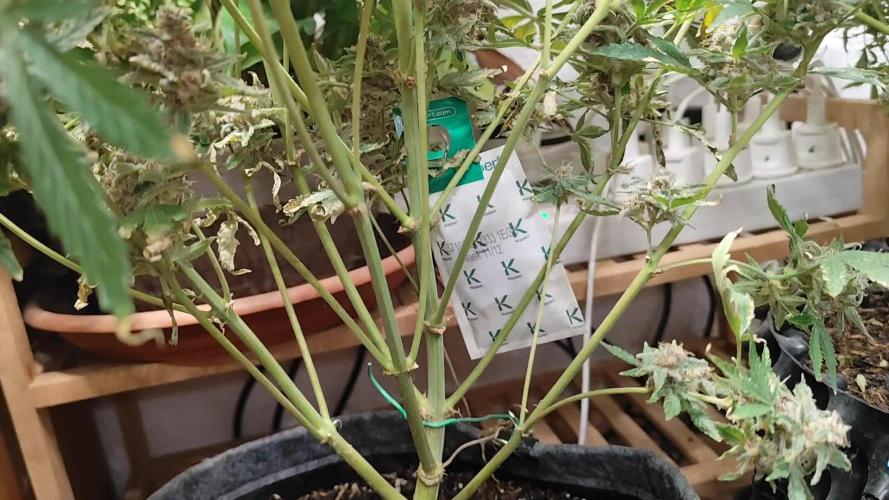
Willkommen zu meinem Growbericht der Gorilla Cookies Auto von 2Fast4Buds. Der Strain wurde 2022 zur besten Indica beim Autoflower World Cup gewählt. Laut FastBuds deren meistverkaufter Strain. Grund genug, den Strain zu testen. Ganz Aktuell wurde die Gorilla Cookies Auto von 2Fast4Buds hier bei den Grow Awards 2026 in der Kategorie Best Strain auf Platz 3 und in der Kategorie Best Autoflowering Strain auf Platz 1 gewählt. Das macht mich noch neugieriger...
Für den Grow verwende ich 15 Liter ROOTiES Stofftöpfe.
Ich war sehr zufrieden mit der Sonnenerde, deshalb habe ich nachbestellt. Sonnenerde hat seine Mischung für die Bio Hanferde letzten Oktober/November geändert. Jetzt sind da kleine Tonkügelchen drin und kleine Gipsstückchen. Laut Sonnenerde soll das die Erde luftiger machen. Auf den Fotos kann man die unterschiedlichen Mischungen gut erkennen. In den AirPots ist die alte Sonnenerde, in den Stofftöpfen die neue. So kann man das Wachstum in den verschiedenen Erden schön vergleichen.
Die Smart Start Plugs von zamnesia hab ich wieder verwendet.
Tag 99: Also, die Gorilla Cookies Auto von 2Fast4Buds bekommt noch diese eine Woche, aber dann wird sie geerntet. 1,25 Liter Wasser.
Tag 101: 1,0 Liter Wasser.
Tag 103: 0,5 Liter Wasser.
Tag 97: 0,5 Liter Wasser.
Schön, das du dir meinen Bericht ansiehst. Schau gerne wieder rein. Schöne Pfingsten 👋😎
Likes
5
Share


@CanadianFillmore
Follow
Harvest time, chopped this lady and she's now drying in the mesh rack. Sticky buds, lots of trichomes. I'll update in 6-7 days with the dry weight and initial smoke report.




Likes
41
Share


@Skinnytalls420
Follow
Day 57-17/12/21 oh dear I don’t know what is going on after giving them some calmag they seem to being doing better day 61-21/12/21 some are behind others but should be taken a few down next week!!!


Likes
11
Share

@Xpie77
Follow
Growers Diaries – Sweetopia (Paradise Seeds)
Week 6 Bloei (dag 42 van 12/12) – 2 planten
Strain 🌱 Sweetopia – Paradise Seeds
Algemene status 📈
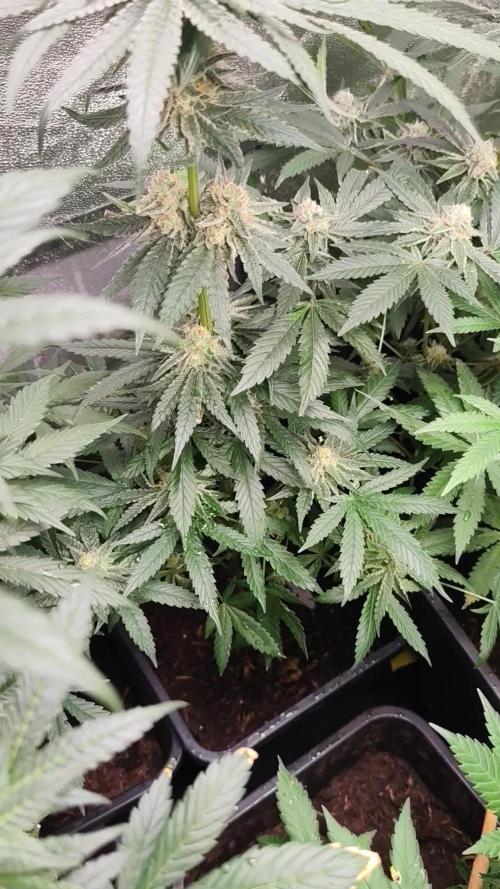
De stretch is allang klaar en de planten zijn nu volop in de dikke bloeifase. Buds zwellen fors op, worden hard en compact. Suikerblaadjes zijn bijna volledig bedekt met trichomen. Pistils zijn grotendeels bruin/oranje aan het worden. Geur is intens: zoet tropisch fruit (mango/ananas), citrus en een zware gas/hasy ondertoon – de tent ruikt al heerlijk als je binnenkomt!
Omgeving 🌡️
Dag 24–26 °C Nacht 19–20 °C
RV 42–48 % (laag gehouden voor harsproductie)
VPD 1.2–1.4 kPa
Luchtcirculatie sterk met oscillerende fan + clipfan – geen hot spots onder de BestVA
Licht 💡
BestVA BP4000/Pro4000 @ 415W (12/12, dim op 90–100%)
Afstand tot canopy 35–38 cm
PPFD 900–1100 µmol/m²/s op de buds
Bloom-modus volledig aan – diepe penetratie, buds worden dikker en dichter
Pot & wortels ?
11 liter Air-Pot
BioBizz Light-Mix + 20–25 % perliet
Wortels zitten vol in de pot, maar focus ligt nu helemaal op de bloemen
Voeding week 6 bloei 🌿
pH altijd 6.2–6.3
EC in 1.6–1.8 EC run-off 1.9–2.1 (lichte opbouw, volgende week spoelen)
Schema deze week:
Bio-Bloom 5 ml/L + TopMax 4 ml/L + Acti-Vera 2 ml/L + CalMag 1 ml/L
3.5–4 L per plant, 3x per week
Trichome productie is nu echt explosief
Training & ontwikkeling ✂️
Defoliatie ronde 2 en 3 gedaan (alle grote fan leaves die licht blokkeren verwijderd)
Canopy nog steeds mooi gelijkmatig
Buds zijn dik, compact en beginnen al wat kleur te krijgen (lichte paarse tinten mogelijk)
Calyxen zijn gezwollen en bedekt met hars
Gezondheid & trichomen ✅
Bladeren nog grotendeels donkergroen, wat ouder blad geel (normaal in late bloei)
Geen plagen, geen schimmel, geen tekorten
Trichomen: 70–80% melkachtig, al wat amber begin te zien op suikerblaadjes
Super plakkerig – vingers blijven eraan plakken bij aanraking
Hoogte nu 📏
Plant 1 → 52 cm
Plant 2 → 62 cm
Sweetopia maakt haar naam meer dan waar! Met de 11L potten en de krachtige BestVA 415W Pro LED worden dit echte harsmonsters. Nog 1–2 weken tot oogst (rond dag 50–55), flush starten binnenkort. Dit gaat een dikke, zoete en plakkerige oogst worden!
Tot week 7 bloei (eindfase)
Super sticky vibes ✌️


Likes
14
Share


@KGrow
Follow
During the first period of flowering they seemed a little bit slowed down..Now they're starting to swell pretty good! :D Atami products work very well!

Likes
6
Share


@Mr_nugs_lover_David
Follow
This lady has been Transplanted on day 39 since she was planted and she will be grown with the complete biotabs organic line, I have applied for this 50L pot: 25g of startrex for every 5L of soil so I've used 250g of startrex in total, then I've dropped a spoon of mycotrex in the planting hole and when I finished I finally added 5 slow release tabs for this 50L pot, and then I watered right after the transplant with 1g of bactrex per liter of water and 1ml/L of orgatrex, this is gonna be a fun season, stay tuned everybody!!

Likes
6
Share


Likes
4
Share


@GERGrowDesigns
Follow
Welcome to Flower Week 3 of Sweet Seeds Strawberry Cola Sherbet F1
I'm excited to share my grow journey with you from my
Sweet Seeds Project . It's going to be an incredible ride, full of learning, growing, and connecting with fellow growers from all around the world!
For this Project , I’ve chosen the Feminized Photo strain Strawberry Cola Sherbet F1 :
Here’s what I’m working with:
• 🌱 Tent: 120x60x80
• 🧑🌾 Breeder Company: Sweet Seeds
• 💧 Humidity Range: 50
• ⏳ Flowering Time: 7weeks
• Strain Info: 18-22%THC
• 🌡️ Temperature: 26
• 🍵 Pot Size: 16
• Nutrient Brand: Narcos
• ⚡ Lights : 600W x 2
A huge thank you to Sweet Seeds for allowing me to try my Best with this amazing collection from Photo Strains they managed to Sponsore . Big thanks for supporting the grower community worldwide! Your genetics and passion speak for themselves!
I would truly appreciate every bit of feedback, help, questions, or discussions – and of course, your likes and interactions mean the world to me as I try to stand out in this exciting competition!
Let’s grow together – and don’t forget to stop by again to see the latest updates!
Happy growing!
Stay lifted and stay curious!
Peace & Buds!

Likes
46
Share


@Drgreen13
Follow
Hi guys, so I think she's starting to flower. I can see tiny pistol hairs now. I shall be bringing her indoors in a few weeks when I have space because we will most certainly be having lots of rain here in the UK. Please check out my other diaries, and feel free to leave a like, maybe even a follow.
Drgreen13#6724 (discord)
Stay high, stay fly, #420everyday.

Likes
23
Share


@BB_UK
Follow
Been an amazing week as she’s formed her buds and now she’s coming to her final weeks she’s beginning to pack on them trichromes, showing her colour now too! Can’t wait to see them swell up and fatten! I’ll flush next week even though I don’t have to! Just hoping for some nice fades! 😉
Likes
47
Share


@Ultraviolet
Follow
The cannabis strain Grape Guava can be a purple strain, depending on its specific phenotype and genetic makeup. While not all phenotypes of Grape Guava are purple, some variations, such as the Zatix Grape Guava, are noted for their striking purple appearance due to the genetic expression of anthocyanin pigments.
https://www.youtube.com/watch?v=cKdVmdoKJ5k
In a garden of green, Grape Guava gleams,
With its fruity aroma, enchanting dreams.
Clusters of grapes, guava's sweetness ignite,
A strain so divine, in purple and white.
Euphoria whispers, a lush fruity haze,
Grape Guava's embrace, a tranquil daze.
Off and away.@1400ppm. The increased CO2 allows plants to thrive at higher temperatures, which in turn necessitates higher humidity to maintain the ideal VPD for healthy growth and transpiration. 80F -5F = 75F LST with 70% RH = 0.72 kPa. Higher temperatures and humidity promote rapid growth, nutrient uptake, and photosynthesis while maintaining a lower stress level. Temperature influences the rate of enzymatic reactions involved in aerobic respiration. Enzymes, such as those involved in glycolysis, the Krebs cycle, and the electron transport chain, work most efficiently at an optimal temperature range. In low temperatures, enzymatic activity will slow down, thus reducing the rate of aerobic respiration. In high temperatures, enzymes can become denatured, thus impairing their function and stopping the process of aerobic respiration. Glucose is the primary fuel for aerobic respiration. The rate of aerobic respiration increases with the availability of glucose, as it is the starting point for glycolysis. If glucose levels are low, cells may rely on alternative energy sources such as fatty acids or amino acids , but these processes may yield less ATP or be less efficient. To determine this effect, carbon dioxide volume was measured (as carbon dioxide is an output of aerobic respiration)
18/6 with the 6 being IR. The near infrared (IR-a) borders around 700nm up to 1400nm @ photon par flux density of 1.8 instead of darkness, keeping temps overnight a neat 77F-80F.
Think of my tent as a lung. What goes in must come out. When the rate of air going out exceeds the amount of air coming in, it creates a negative pressure. Tent concaves (bends in). If set up correctly, your RH will begin to drop slowly to the desired level you set, and the extraction turns off when it reaches desired% RH. The plant, as it performs cellular respiration, will always be releasing more water into the air, so the RH% of the tent overnight will always increase, so long as oxidative phosphorylation is occurring. As soon as the RH% creeps back up to 55%, the extraction turns back on, over and over. This creates a strong pressure differential which will work wonders on your grow. Replicating high and low-pressure fronts in nature. Critical for oxygen diffusion at the critical time of peak cellular respiratory function..
Moisture will not transfer from a saturated atmosphere to another if that air is already at or above its saturation point, meaning the air can't hold any more water vapor. Once I understood that water is produced as a by product during cellular respiration, specifically at the very end of the electron transport chain (ETC) where electrons are finally transferred to molecular oxygen, the higher the RH of the air, the more resistance there is for more moisture to be added to that environment, and effects the ease with which it does so. But none of that water comes from the pot; it's pulled from the air. If you run high daytime RH, your medium/pot is 100% reliant on transpirational root pull to move water. ZERO evaporation happens across the atmosphere if the tent air has high RH%, the medium cannot release its water through evaporation. Once a canopy develops, light no longer slowly wicks and evaporates from the topsoil. The Soil-Plant-Atmosphere Continuum (SPAC) describes the continuous pathway and process of water movement, driven by a gradient in water potential, from the soil, through the plant's roots, stem, and leaves, and finally evaporating into the atmosphere through transpiration. There is evaporation, there is transpiration, and then there is evapotranspiration; Evapotranspiration (ET) is the combined total of two processes: evaporation (water lost directly from soil and surface water into the atmosphere) and transpiration (water released from plants to the atmosphere through their leaves). Evapotranspiration represents the total amount of water that moves from the medium into the air. There is no such thing as a medium with too much water, only a medium that retains too much for too long.
The water must always flow efficiently from one atmosphere(Medium) to another(Air) in a timely manner. Moisture is a critical factor for bacterial growth and decay. Dictating how long it's allowed to sit in any one location for any given period is a key preferred control. To ensure a net reduction in a bacterial population, the rate of removal (ET) must exceed the rate of bacterial growth (decay rate), which is often modeled as a growth rate for the specific bacterium under the given conditions. By optimizing daytime VPD, we also optimize conditions for bacterial growth to explode exponentially above 77°F.. If water is allowed to sit in a medium without an escape within a timeframe, nothing good will happen. IF High RH is maintained overnight as well as during the day, placing 100% of water movement at the behest of daytime transpiration, roots can only pull where they can reach, and if soil is compressed above a certain point, moisture will become trapped in a medium with no way of moving day or night. This will begin the countdown for decay to take hold. When water stagnates in a medium, it loses oxygen, creating anaerobic conditions that foster the growth of harmful microorganisms like bacteria and fungi, which can produce toxins and disease vectors.
Thigmomorphogenesis, the process by which plants respond to mechanical stimuli like touch by altering their growth and development, results in significant morphological changes to improve survival against mechanical perturbations. This complex response involves sensing touch and initiating physiological and genetic responses, leading to changes in form and structure over days or weeks. The process is triggered by physical forces such as wind, rain, or touch. Plants adapt to these stimuli by changing their shape and structure, which may include slower growth, thickened stems, or altered leaf development. Plants possess sophisticated mechanisms to detect even subtle mechanical stimuli and initiate responses. A variety of molecules, including calcium ions, jasmonates, ethylene, and nitric oxide, are involved in signaling these mechanical inputs. Touch can induce the expression of genes that encode proteins for calcium sensing, cell wall modification, and defense mechanisms. A plant exposed to constant wind may become shorter and sturdier. A plant that is touched frequently might grow more slowly to conserve energy and develop thicker cell walls. These changes increase a plant's resilience and ability to survive in harsh environments.
Let's get Thiggy with it.


Likes
12
Share


@Donbehzad
Follow
In this week, the only concern and things I monitor daily are the temperature and humidity. Temperature should always be around 20C-23C, while humidity should be around 60-70%. No nutrients is given to the plant just balance ph of water (6.5) if the top soil is dry.
