Likes
Comments
Share
@CalGonJim
Follow
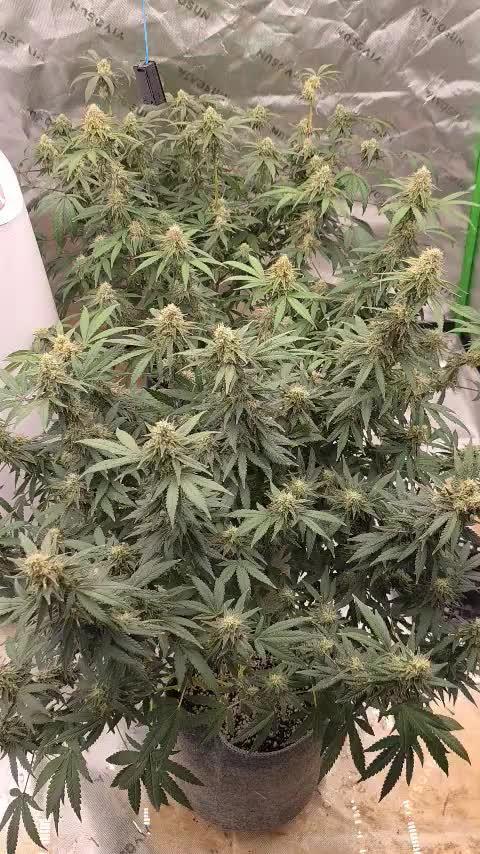
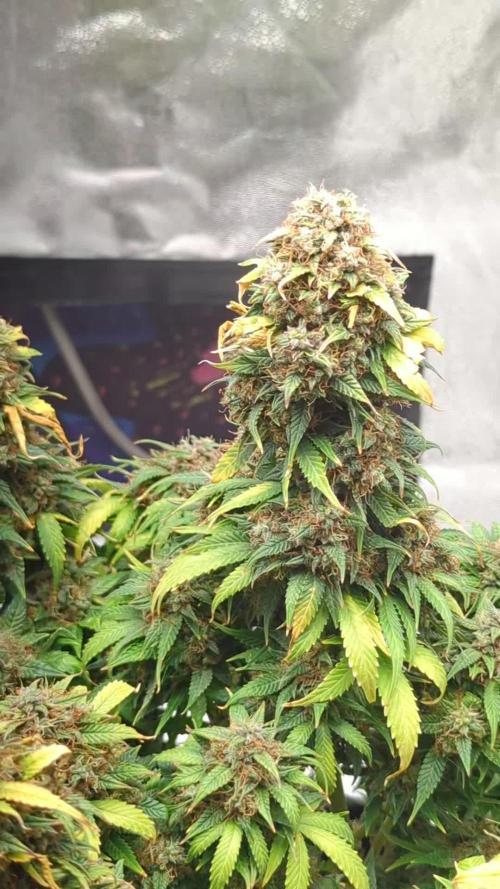
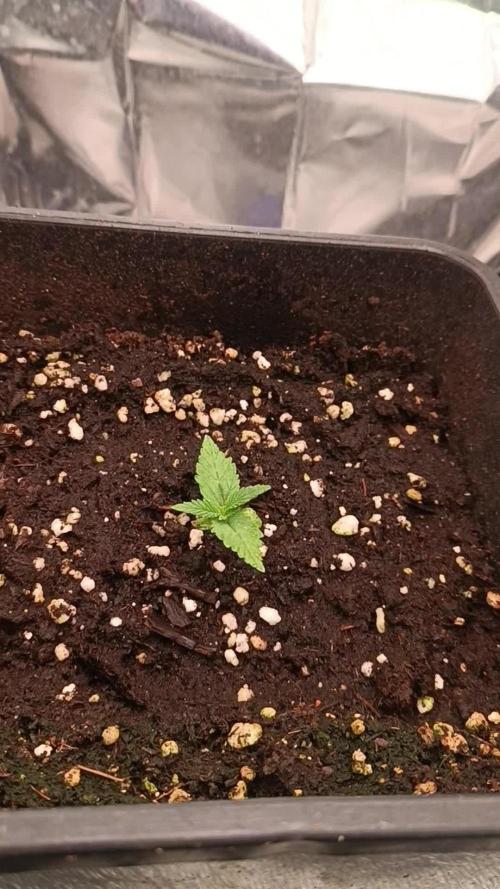
8/26 Monday morning 12am They are doing good. The camera fell into a plant...so lucky it didn't hurt the plant..that never happened before. My grow is HAUNTED!!!! Dark Devils are doing pretty good. All the others are great. I need more dirt in Blueberry Auto by Seedsman I'll do top filling later this week. 2am got the microscope 👍👍👍👍 I swear she is like a pet and she’s playing dead with her tongue hanging out. It’s hilarious. I’m really enjoying this one. This is gonna be a lot of fun.👻👻👻👍👍👍👍. 11 am I ordered a new microscope!!! 8/27 Dark Devil looks pretty cool. All other plants are doing just great!! 8/28 turned lights up to 52 looking good 4/28 Dark Devil Auto Monster crawls out of Hell!!!! Dark Devil Auto looks like the war boy that figured out Furiosa stole the War Rig. !!!! I put a light tent over Dark Devil monster. I will need to trim the roots and make sure the trays aren't in standing water. Blueberry is in mostly Perlite doesnt take up water the same. New microscope nice picture but no zooming in, I got the kind with the wider mouth, narrow mouth is better getting close to plants.... after 2 years I just NOW figured out the plastic cover comes off?? not the lens cap....im retarded there's just no other way to explain it 8/29 She's ALIVE and wow! got some amazing pics a little blurry and shaky but Dark Devil Auto by Sweetseeds is the coolest thing ive seen. Doing the seed surgery worked. 8/30 Some amazing progress on the Dark DEvil. The others are great Medusa F1 is the strongest followed by Gorilla Strawberry. The lights on the right side of the Mars Hydro light dont seem to be as strong as the ones on the left is ill rotate the plants today. 8/31 5 am lights up to 55 Watts. They are doing good. RSQ Medusa F1 showing the strongest so far, not a surprise there! Fast Buds Straw Gorilla taking off strong next. Pink Kush CBD and Blueberry Auto by Seedsman up next and surviving in almost all Perlite. I will put more dirt in when she gets taller. Dark Devil is going steady and very strong just amazing. 9/1 Growing nice now I will top them all above the 3rd node to keep the grow small
Likes
2
Share
67 days since April 16th, 2026 We become aware at such times of man's wonderful ability to bring seemingly unrelated elements into harmonic balance, and receive a glimpse into a world where everything exists in conscious sympathetic attunement to everything else. When we listen to a piece of music that seems to strike a beautiful chord somewhere inside us, or view a painting that simply glows with harmonic awareness well executed, we probably do not spare much time to contemplate the wonderfully intricate combination of vibrations that our sensors make it possible for us to perceive. We tend to appreciate the relationship between the parts of something by an awareness of the harmony or dissonance of the whole. This ability enables us to say "what a beautiful house!" instead of "analysis has proven that this collection of building materials exhibits certain elements of harmonic proportion." While this ability to instinctively appreciate the beauty of true harmony has an important role to play in evolution, a more analytical understanding of the laws involved can be most useful. This is especially so if we wish to create works of art where each part exists in true harmony, not only with the other part of that particular whole, but with the universe within which the creator and the created exist. Everything vibrates. From the most dense matter to the most subtle cosmic rays, everything which our senses allow our thoughts to become aware of, can be specified in terms of wavelength or frequency of vibration. These two terms define the same thing, but from different points of view. The following are the approximate wavelengths of various energy carriers: Cosmic rays 0.000,000,001 mm Gamma rays 0.000,000,1 mm X rays 0.000,500 mm Ultraviolet rays 0.003 mm Visible light 0.006 mm Infrared 0.01 mm Sound waves 1 meter Radio waves 300 meters Violet light 400 nm to 450 nm Blue light 450 nm to 500 nm Green light 500 nm to 570 nm Yellow light 570 nm to 590 nm Orange light 590 nm to 610 nm Red light 610 to 700 nm 1 nanometer (nm) = 0.000,000,1 cm = 1/10,000,000 cm If a guitar string is plucked and we hear a sound, it is not too difficult for the human mind to associate this sound with the vibration of the guitar string. With color it is quite different. It is difficult for us to conceive that the color of a substance is not an inherent property of the substance itself, but an indication picked up by our senses of that substance's ability to absorb or reflect the light which happens to be shining on it at that moment. Neither the matter nor the light is colored. What happens is that the brain learns to differentiate between the frequencies reflected or transmitted by the substance the eyes are focused on. The same thing happens with sound. When we say "Oh! Listen, they're playing my favorite song," what we really mean is: "My brain has stored within it a particular pattern of frequencies. I have compared the new information being received with this stored pattern and have deduced the answer that the two patterns are similar within certain specified tolerances." The 'pleasure' involved could have something to do with our running the pre-recorded pattern at the same time, in 'sympathy' with the new pattern as it is received. The word sympathy describes very well our ability to appreciate color and sound. It also describes the reason behind certain elements of harmony. For instance, if a substance vibrating at 100 cycles per second (tone 1) is in the proximity of another substance vibrating at 200 cycles per second (tone 2), we could perceive, if we had the right equipment, a certain sympathetic relationship between the two. We will see from this that there is a uniform doubling of the first tone seen in the second. At various points along the waves, the two are the same in amplitude. At other points, they are at opposite poles to each other. This doubled frequency has more points of similarity to the original than any other frequency except the original itself. If the equipment we had available for measuring these two frequencies was a soundboard amplifier and a pair of ears, then we would hear what would sound to us like one tone. If we had the opportunity to hear one at a time, we would hear that although they sound the same, one is higher in pitch than the other. This characteristic of 'the same but different in pitch', musicians have called the octave. Any two tones produced where one has exactly doubled the frequency of the other is called an octave. Speaking in ratios, an octave would appear then as the ratio 2:1 or 1:2, depending on whether we are talking of an octave up or down. A single note produced by almost any instrument will contain more than one wavelength or frequency. It will have a dominant frequency, the wavelength of which we would call the note's 'fundamental' or 1st harmonic. It will also have a varying number of upper harmonics, gradually fading in intensity into infinity or silence. Natural harmonics always have the same pattern of intervals between them. The interval between the 1st and 2nd harmonic is a perfect octave; between the 2nd and 3rd a perfect fifth; between the 3rd and 4th a perfect 4th; and so on, the intervals becoming smaller and smaller until they lose any relationship with the western 12 tone scale as it exists at the moment. Just as an octave has certain elements of sympathy with its fundamental, so some intervals have been noted to be more perfectly in sympathy with the fundamental than others. The ratio of the 'perfect 5th' or interval of 7 semitones, as it occurs in the harmonic series, is 3:2 or 2:3, while that of the 'perfect fourth" is 4:3 or 3:4. All the tones in the western 12 tone scale can be expressed in terms of the ratio between the upper tone and its fundamental. This would seem to be an ideal way of generating a scale from any given fundamental and several attempts have been made to do this, the Pythagorean system being probably the most well known. Although when working with a single tone instrument playing on its own, the Pythagorean formula works wonderfully well, if we had several instruments tuned this way together and asked them to play almost any western music, we would find that at times they sounded quite out of tune to each other. The lack of flexibility of the various scale systems based on the harmonic series has led to what is known as the 'tempered' scale. This uses as its primary unit of interval the ratio of the octave or 2:1. It then proceeds to divide the interval between any fundamental and its upper octave into 12 smaller intervals by applying the ratio: two to the one-twelfth power, to one (21/12:1). This equals 1.059463094, so by multiplying any frequency by this number, we will obtain the tempered semitone next up from our fundamental. We will also find that any tone twelve semitones up from any other tone, in a scale generated in this way, will have exactly double the frequency. If we took the note middle C on a piano and halved the wavelength, we would have the note C one octave above. If we halved this, we would have the C above, and so on. However, within about 6 octaves, we would find that although a 'sound' was being produced, no human ear could perceive it. If we kept on going, halving and producing upper octaves of our fundamental C, we would proceed through the infrared band, into the visible light spectrum. If we happened to be outside during the day, we would, for one octave only, see the note C with our eyes. The next octave above would already be in the ultraviolet band, and outside the eye's sensitivity range. If we can think of color as being an indication of a substance's vibratory rate or wavelength, we may begin to see a relationship that could exist between the color and sound spectrums. The logical extension of what has so far been said is that there exists a scale in the color spectrum that corresponds exactly to the scale in the sound spectrum, each color tone being an octave of the equivalent note in the sound range. This is not the end of the story but only the beginning. If we can for the moment accept that any wavelength in one band has upper and lower octave stretching out to infinity, then the next question is 'fine, but what shall we use as our fundamental? A particular color? A particular sound frequency?' The musicians among us will probably say 'A 440'. This means that the note A should vibrate at 440 Hertz, or 440 times per second. They would tell us that this is standard pitch has been adopted by most orchestras around the world; pianos are tuned to it, instruments are constructed to formulas based on it, and so to them it would probably seem the most appropriate place to begin. Some of these musicians may know of the battle that is still raging with regards to this being the standard, but few would know why A = 440 Hz was chosen except that it worked when it was set to be a suitable compromise between the many different pitches in use at the time. 432 Hz is said to be mathematically consistent with the patterns of the universe. Studies reveal that 432 Hz tuning vibrates with the universe’s golden mean PHI and unifies the properties of light, time, space, matter, gravity, and magnetism with biology, the DNA code, and consciousness. When our atoms and DNA start to resonate in harmony with the spiraling pattern of nature, our sense of connection to nature is said to be magnified. Another interesting factor to consider is that the A=432 Hz tuning correlates with the color spectrum, while the A=440 Hz is off. Audiophiles have also stated that A = 432 Hz music seems to be non-local and can fill an entire room, whereas A=440 Hz can be perceived as directional or linear in sound propagation. Once you adopt the idea that sound (or vibration in general) can have an equalizing and harmonizing effect (as well as a disturbing effect), the science of harmony can be applied to bring greater harmony into one's life or tune to specific energies. There is a form of absolute and relative harmony. Absolute harmony can, for example, be determined by the tuning of an instrument. The ancients tuned their instruments at an A of 432 Hz instead of 440 Hz - and for a good reason. There are plenty of music examples on the internet that you can listen to in order to establish the difference for yourself. Attuning the instrument to 432 Hz results in a more relaxing sound, while 440 Hz slightly tenses up the body. This is because 440 Hz is out of tune with both macro and micro cosmos. On the contrary, 432 Hz is in tune. To give an example of how this is manifested microcosmically: our breath (0,3 Hz) and our pulse (1,2 Hz) relate to the frequency of the lower octave of an A of 432 Hz (108 Hz) as 1:360 and 1:90. It is interesting to note that 432 Hz was the standard pitch of many old instruments and that it was only recently (19th and 20th century) the standard pitch was increased. This was done in order to be able to play for bigger audiences. Bigger audiences (more bodies) absorb more of the lower frequencies, so the higher pitch was more likely to “cut through”. One of the oldest instruments of the world is the bell ensemble of Yi Zeng (dated 423 BC), tuned to a standard F4 of 345 Hz, which gives an A= 432 Hz. The frequency of 345 Hz is that of the platonic year! Similarly, many old organs are tuned in A=432 as well; for example, St. Peter’s Capella Gregoriana, St. Peter’s Capella Giulia, S. Maria Maggiore in Rome. Maria Renold’s book “Intervals Scales Tones and the Concert Pitch C=128 Hz” claims conclusive evidence that 440 Hz and raising concert pitch above scientific “C” Prime=128 Hz (Concert A=432 Hz) disassociates the connection of consciousness to the body and creates anti-social conditions in humanity. The difference between concert pitch A=440 Hz and Concert A=432 Hz is only 8 cycles per second, but it is a perceptible difference of awareness in the human consciousness experience of the dream we share called existence.
Likes
13
Share
@Nerohero
Follow
Looks healthy and strong I think, I maybe transplanted into main pot about 5-7 days to early but its recovering now, next water im going to switch from the root it feed to the growth stage vegging feed I have,
Likes
209
Share
@BioBuds
Follow
They are going slow but steady. Holding back on watering to help fight the gnats. They were with too many last week. Some yellow points because of an 'on the limit' foliar feed. Nothing to worry about. Still very lush greens. I'm thinking the main reason for their slower growth, is the fan that is on high. My mission from the start s to get thick stalks and branches, to facilitate larger buds. Also, I'm pushing the SP 3000 to its max for the age of my plants, they don't have to reach for the light, resulting in shorter, bushier plants. I don't mind, I think the flowering stretch will make up for that and fill the tent. Still very happy with the SP-3000 from Mars Hydro, a much more constant and manageable climate in the tent, a dream to work with. I made a thank you video for @MarsHydroLED, of course, to also show off my music. I'm thinking one or two more weeks before resetting the light schedule for flowering. I'm already late and if another week will deliver bigger and more buds, I will give them what they need. For those living in Europe, wanting to try super soil, see my recipe in the images. Thank you for following and your likes and support! It really keeps me motivated. Big Hug Bud
Likes
142
Share
Hi everyone 🤗. Everything is going great 👍. There are no defects or anything unusual :-). Today the Blue Cheese Pheno 1 became the first time rinsed, and now only gets 0.4 Ec water for the next 10 days ca :-). Everyone else needs a while. otherwise there is not much to report this week. I wish you all a nice week, stay healthy 🙏🏻 and let it grow 🌱
Likes
12
Share
@Melacola
Follow
Bien et bonnes graines 12 zaines de graines fractal et blak opium euphorias 60graines enfin heureuxde la participation au concours divine seed mercis a tout ces acteurs de la culture tous confondut petit et grand merci a growdiaries
Likes
9
Share
@DE_BW
Follow
The plant has clearly reached its final stage of flowering. Bud development is complete and the structure looks fully finished. Trichome coverage is extremely dense across buds and sugar leaves, giving the flowers a heavy, frosty appearance. The pink and purple coloration has continued to spread further down the plant, creating a very appealing contrast and confirming full genetic expression. Aroma has intensified significantly and is now strongly dominated by a sweet, ripe apricot / marmalade note with no harsh or green undertones. Flushing has been initiated this week, with harvest planned in approximately four days. Overall plant health remains solid, and no further swelling is expected. Focus is now on preserving terpene profile and optimal ripeness.
Likes
35
Share
Info: Unfortunately, I had to find out that my account is used for fake pages in social media. I am only active here on growdiaries. I am not on facebook instagram twitter etc All accounts except this one are fake. Hi everyone :-) . This week she continued to develop very well 😊. It was poured twice with 1 l each time. She got training again (topping) and will get it a few more times so that she becomes a real bush :-). Otherwise everything was cleaned and checked. Have fun and stay healthy 🙏🏻 You can buy this Nutrients at : https://greenbuzzliquids.com/en/shop/ With the discount code: Made_in_Germany you get a discount of 15% on all products from an order value of 100 euros. You can buy this Strain at : https://greenhouseseeds.nl/ ☝️🏼☝️🏼☝️🏼☝️🏼☝️🏼☝️🏼☝️🏼☝️🏼☝️🏼☝️🏼☝️🏼☝️🏼 Green House Seeds Company Cup Clone 🏆 Type: Wonder Pie ☝️🏼 Genetics: Wedding Cake x OG Kush 👍😍 Vega lamp: 2 x Todogrow Led Quantum Board 100 W 💡 Flower Lamp : 2 x Todogrow Led Cxb 3590 COB 3500 K 205 W 💡💡☝️🏼 Earth: Canna Coco Professional + ☝️🏼 Nutrients : Green Buzz Liquids : Organic Grow Liquid Organic Bloom Liquid Organic more PK More Roots Fast Buds Humic Acid Plus Growzyme Big Fruits Clean Fruits Cal / Mag Organic Ph - Pulver ☝️🏼🌱 Water: Osmosis water mixed with normal water (24 hours stale that the chlorine evaporates) to 0.2 EC. Add Cal / Mag to 0.4 Ec Ph with Organic Ph - to 5.8
Likes
10
Share
Poco que añadir , siguen creciendo despacio por que el tiempo no acompaña , semana buena , semana de lluvia ....
Likes
5
Share
@AustinRon
Follow
TH 1Q2025 - Week 6 - Bolt 3 
(ON Haze X Original Haze) X Northern Lights #2 “Todd’s Haze” Objective - 8 Female Plants, Topped ONCE @ Flip, 12” when topped - Modified Sea of Green Week’s Objectives - Auto-Fertigation Installed and operational - Twice/Day, 440 ml/ Day (Initial Rate) - 220 ml/Event Weeks Observations - We have a smattering of pistils showing - looks like pre-flowers with Haze morphology - Confirms (for me) the known property of Haze - that 7+ weeks of veg (from seed) is required BEFORE the plants can initiate flowering. (Noting that CUTS will be ready to flower @ Flip. Seeds Wet: 1139PM, 28.2.2025 Germinated: 2.3.2025 Flip: 21.3.2025 Harvest: 77 Days, DATE: 6.6.2025 _________________________________________ __ Fri Apr 11, 2025 TH 1Q25 22:F:3:1 EC: 1.8 LightDistance: [ 20.5, in] # We’re in STRETCH, ~1.5”/day! LightIntensity: [ 640, µMol/m2/s] - [x] TM-7: [ 0.125, g] # Prep - [x] Fertigation: [8.5:8.5:3.4:3.4:3.4:0:3.4] # [Primer A:Primer B:CalMag Fuel:Silica Skin:Lush Green:Root Anchor:Peak Bloom] - [x] Photosynthesis Plus: [ 6, ml] - [x] Quillaja 60 Powder: [scant] - [x] PCAL 1660: [ 0.5, gm] # Once or Twice/Week - [x] TM-7 (µNutrients): [ 0.125, g] __ Sat Apr 12, 2025 TH 1Q25 23:F:3:2 LightDistance: [ 18, in] # We’re in STRETCH, ~1.5”/day! LightIntensity: [ 703, µMol/m2/s] LightDimmer: [ 85, %] We’re bringing up Intensity SLOWLY, as the plants adapt. Allowing the plants to grow INTO the LightField and naturally raise PPFD as it does. - [x] TM-7: [ 0.125, g] # Prep - [x] Fertigation: [7.8:7.8:3.1:3.1:3.1:0:3.1:0.0] # [Primer A:Primer B:CalMag Fuel:Silica Skin:Lush Green:Root Anchor:Peak Bloom:Resin Bloom] - [x] Photosynthesis Plus: [ 6, ml] - [x] Quillaja 60 Powder: [scant] - [x] PCAL 1660: [ 0.5, gm] # Once or Twice/Week - [x] TM-7 (µNutrients): [ 0.125, g] __ Sun Apr 13, 2025 TH 1Q25 24:F:3:3 LightDistance: [ tbd, in] # We’re in STRETCH, ~1.5”/day! LightIntensity: [ tbd, µMol/m2/s] LightDimmer: [ 85, %] - [x] TM-7: [ 0.125, g] # Prep dilution in 250 ml plain water - [x] Fertigation: [7.8:7.8:3.1:3.1:3.1:0.0:3.1:0.0] # [Primer A:Primer B:CalMag Fuel:Silica Skin:Lush Green:Root Anchor:Peak Bloom:Resin Bloom] - [x] TM-7: [ 0.125, g] # Delivered - [x] Photosynthesis Plus: [ 6, ml] - [x] Quillaja 60 Powder: [scant] __ Mon Apr 14, 2025 TH 1Q25 25:F:3:4 LightDistance: [ tbd, in] # We’re in STRETCH, ~1.5”/day! EC: [ 1.9, mS/cm] - [x] TM-7: [ 0.125, g] # Prep dilution in 250 ml plain water - [x] Fertigation: [7.8:7.8:3.1:3.1:3.1:0.0:3.1:0.0] # [Primer A:Primer B:CalMag Fuel:Silica Skin:Lush Green:Root Anchor:Peak Bloom:Resin Bloom] - [x] Photosynthesis Plus: [ 6, ml] - [x] Quillaja 60 Powder: [scant] - [x] PCAL 1660: [ 1, tsp] # Once or Twice/Week __ Tue Apr 15, 2025 TH 1Q25 26:F:3:5 EC: [ 1.8, mS/cm] # [Primer A:Primer B:CalMag Fuel:Silica Skin:Lush Green:Root Anchor:Peak Bloom:Resin Bloom] - [x] Fertigation: [8.7:8.7:3.5:3.5:3.5:0.0:3.5:0.0] - [x] Photosynthesis Plus: [ 6, ml] - [x] Quillaja 60 Powder: [scant] - [x] Terps Plus: [ 2, ml] - [x] PCAL 1660: [ 1, tsp] # Once or Twice/Week __ Wed Apr 16, 2025 TH 1Q25 27:F:3:6 Stretched another 1.5” Main Canopy @ 740 (PPFD) Fertigation 1L/Plant/Day - 2 x 500 ml, 6 hour freq LightDistance: [ 17, “] LightIntensity: [ 740, µMol/m2/s] EC: [ 1.8, mS/cm] 
Fertigation Amount: [ 2.0, gal] # We’re a little low at a gallon/day … Light Intensity: [ 750, µMol/m2/s] # Adjust Light Height to Achieve. Light Dimmer: [ 100, %] # Photone is ok, but I think reads low . . . # [Primer A:Primer B:CalMag Fuel:Silica Skin:Lush Green:Root Anchor:Peak Bloom:Resin Bloom] - [x] Fertigation: [17.5:17.5:7.0:7.0:7.0:0.0:7.0:0.0] # [ 10, 4, 4] - [x] Photosynthesis Plus: [ 12, ml] - [x] Terps Plus: [ 2, ml] - [x] Quillaja 60 Powder: [scant] - [x] PCAL 1660: [ 2, tsp] # Once or Twice/Week’ __ Thu Apr 17, 2025 TH 1Q25 28:F:3:7 LAST HAND WATERING: FRIDAY We Start Auto-Fertigation Light Distance: [ 13.5, in] # 2“ Today EC: [ 1.8, mS/cm] # [Primer A:Primer B:CalMag Fuel:Silica Skin:Lush Green:Root Anchor:Peak Bloom:Resin Bloom] - [x] Fertigation: [16.9:16.9:8.5:8.5:6.8:0.0:6.8:0.0] # [ 10, 5, 4] - [x] Photosynthesis Plus: [ 12, ml] - [x] Terps Plus: [ 2, ml] - [x] Quillaja 60 Powder: [scant]
Likes
13
Share
@HeavyHead
Follow
Great week this week :) been really fattening up and putting out a really sweet sugary smell. Really liking the purpling I’m getting in the one. Had one of my males accidentally pop too soon so might end up with a few seeds :p
Likes
16
Share
@EaRtH
Follow
19.1. - Plants are entering their first week of flowering as the bud sites are clearly visible and pistils are shooting up! 21.1. - Watered 💧 24.1. - Watered 💧 25.1. - Wrap-up of the week: Plants went through another successful week. Lots of bud sites are visible and already developing. I've also spot some first sugar. However, I've also managed to snap the main stem on the Gelato plant, not completely. I've fixed it back, so we'll see but I must have som bad luck as this was second time during this run 🙄 19.1. - 25.1.2024
Likes
7
Share
@x_grower
Follow
Last week, first of flowering, was outstanding, I could water the girls regulary and the work paid off they stretched a lot and are looking super healthy. The girl right below the upper fan is suffering a bit with the shadows and is notoriously shorter than her sisters, I will need to rethink the air circulation for the next grow. Another concern of mine is their height, hoping they dont stretch anymore as the lights are already at maximum possible height inside tent and there is only 20cm gap between it and the plants.
Likes
6
Share
02-02-2026 Lamb’s Bread has started to stink! I don’t recognise this smell. I thought she maybe smells like sheep 🐑 but it isn’t quite it. I defoliated her a bit today to let more light in and because I need the space in the tent. I like how her bright green buds look like and how small crystals are forming on the leaves around her buds. She is doing a good job 👍💚
Likes
3
Share
Ya con el día 84 se da fin a este gratificante proceso. Fué una nena fácil de cultivar, a pesar de estar creciendo en un espacio reducido junto a otras hermanas de la misma familia. Eso no fué impedimento para que mostrara su calidad y unas hermosas tonalidades que mostró con el pasar de los días. Finalmente valió la pena esperar un poco más hasta el punto deseado, ya que la planta siguió evolucionando y mostrando todo lo que tenía para dar. Las flores se ven hermosas en el frasco; tienen forma de fresa puntiaguda y el aroma que desprenden hace salibar 🤤 es una mezcla dulce y tropical que a cualquiera puede cautivar. En el humo tiene un sabor frutal, cremoso y terroso con un final muy dulce y agradable.
Likes
3
Share
This grow is looking phenomenal. Can’t wait to wash for rosin! Freezing as of now update: test run of bubble this shit is fucing crazy gas. So pungent and full of flavor. Tried some wet Melt in the Puffco it hits like crazy. Great effects and gas flavor. Will be pressing asap update did a 2nd wash tonight of all the trim from plant 3. I’d say 600 wet grams. Yielded great and awesome color. update: pressed 10 gram puck of rosin to test run. See results above. She’s a squirter! Update: I’m officially done wash all of this plant. Good fuckin riddance in the best way. Ugh I’m just pooped hands are killin me. Over 3 batches the yeild is insane: the coloring in the first hash batch has such an orange/ yellow tint compared to the pale merky other 2 batches. Anywho ids say 35 grams total in hash. We will have to see the total numbers but to say I yielded 10 grams with the smaller batch I’d say on par. Fuck I can prolly make some thumbprints with the 2 different hues make it fancy. Great time for it being cold! Update: I am done officially washing this strain. 4 batches I’m going to estimate 50 grams of fresh frozen dried hash out.
Likes
21
Share
@AutoCrazy
Follow
Week 2 There has been an explosion of growth over the last week. I am amazed by how explosive it was. There are some nice bud sites forming as well. I did get a little bit of yellowing at the tops of a few fan leaves so I don’t think I will go quite as high feeding wise. I’ll go a 100ppm or so lower than what the feeding schedule recommends. I had a bit of an accident though. I was doing a little LST and I snapped a top clean of 🤦‍♂️ So now I am down to 15 tops, doh! Cooler internals for the week were: 6.0 pH 420 ppm on the 500 scale 0.9 EC 66F water temp. I can’t wait to see what week three brings! Onward 😎🍻🌱
Likes
5
Share
@84ruk
Follow
Primera semana en un sustrato malo del cual fue trasplantada la siguiente semana