Likes
Comments
Share
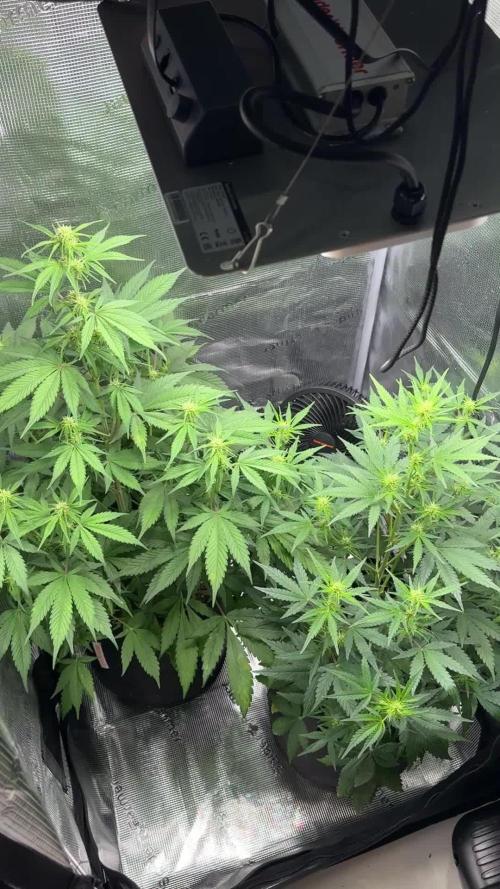
-Sensi Seeds Research: The Sensi Seeds Research breeding project has created eleven cannabis seed varieties. How? By combining new cannabis cultivars with a selection of strains from their long-established cannabis gene bank. For the first time in thirty-six years, they are opening the doors of the Sensi Seeds Research and Development Department. Week #9: The plants are vigorous, they started to stretch about 2 days before the week finished. The ScrOG is filling up gently and the canopy is at the same level. There’s not much to do in the first 2 weeks of 12/12 photo period. For Beginners and new growers, this is where you stick on your Veg nutrients for another 2 weeks. They need Nitrogen to support the stretch and if you switch to bloom nootz to early they will start yellowing around the end of week 3 of Flowering, by moving their Nitrogen to save the top. Adding the right amount of Nitrogen during this phase is crucial. Not enough and it will run out for sure at the end of stretch, too much and you will start to see some claws on the leaves , tips of the leaves pointing down, and way too much nootz burns will appear. Both cases will make you loose around 20% to 25% on the yield ! To conclude the Veg, I have change one important factor that was the soil, but Cellmax BIO Soil is doing a really good job, plus the Sensi Seeds genetics which are extremely easy to grow, makes me feel very happy 😊 (I’m looking for a job in the Cannabis industry as Master Grower, Mineralogist, Quality Control 🐞)
Likes
2
Share
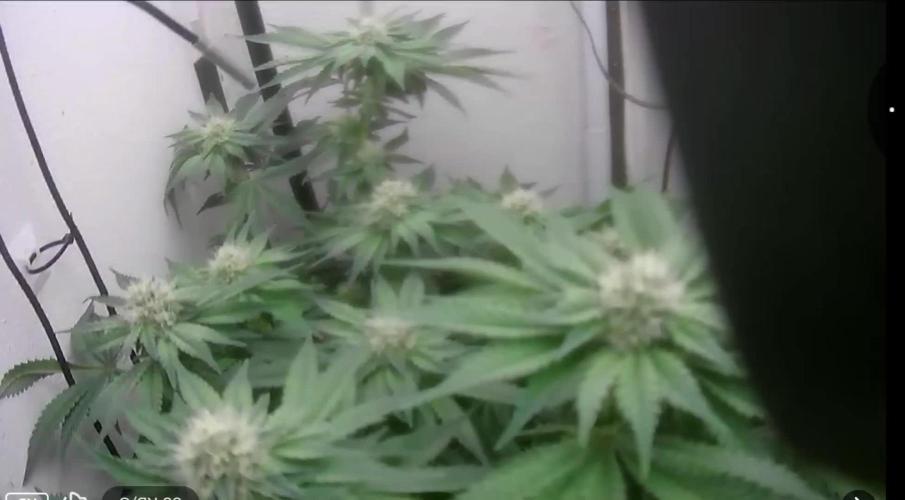
This are pictures taken on the first day into the fifth week of flowering for closet plant and seventh week of flowering for window plant. I've kept my daily routine of plucking anything that looks as male growth on window plant (After the first plucking session, I can hardly find any nanners). Also had a moment of OCD in which I tried to find all swollen bracts that contained anything similar to a developing seed. I read that plucking baby seeds out is not really helpful, quite the opposite actually. But I really wanted to learn to identify this sort of growth. I did find quite a few of them (and I'm pretty sure I caused some damage to the buds), but I still think that the plant will yield a decent harvest for my expectations. If anything, it's been a great learning experience. Closet plant doesn't seem to be pollinated at all (I mist the air around both plants quite often to prevent this) , and its growth continues to amaze me. I think it's yield will probably double WP's harvest. This week I dropped window plant's feeding. Giving it Bloom mix that's got way less nutrients. And starting on friday of this same week I'll start flushing the roots (this will continue for it's last 10 days). I'm super excited about this last weeks for both plants. Next will be window plant's last week of life!! Harvest is so close! I think I'll actually miss them.
Likes
14
Share
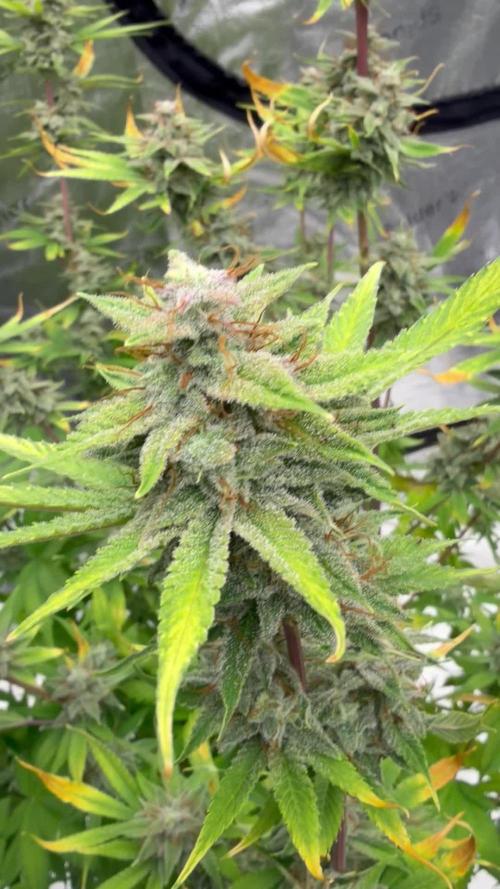
Okay so I'm trying something new, since I've gone away from a switch to water for the last week flush I harvested the tops and best smalls and packed the cannatrol full. I'm giving the under growth a bit more time to rippen before I harvest that for the the freezer. If this turns out to be a bad idea I'll not do it again in the future. The last long video is what's left in the tent right now. Let me know if any of you have experience doing this. Updated with a bunch of pictured of dried and cured. Ended up with 186g of beautiful flower. 72g of untrimmed smalls I'll make into RSO, I have a lot of back and nerve pain and RSO hands down the only thing that brings me actual relive, I'm late to the party on this one but I set a side part of the grow for it now. I let the under canopy and shorter tops go another 10 days feed at half strength and I'm glad I did, it ripened up nicely and definitely got a lot of color. I forgot to get pictures of that harvest but I will when I pull it from the freezer to wash. My test jar of this washed at 4+% (the last picture). Last update will be results of that wash. Last update on this one, I added a couple hash/rosin pics at the end. She washed from plant to rosin at 4.03% the terps are musky skunk, sweet pastries, and fresh Linen. I'd definitely grow this one again.
Likes
8
Share
@Rich2083
Follow
Tapered off the nutrients over the last week, now down to just the bloom supplements for this week then just water to finish. Harvest is getting closer now and I'm so excited to get these babies cut, dried and cured!
Likes
Comments
Share
Day 56 flower getting very close to harvest now just a bit longer needed only water from here on out 💚😍🙏
Likes
5
Share
@Borberad
Follow
Die letzten Tage haben begonnen und die Buds sind nochmal richtig angeschwollen. 😊 45 Tage sind angegeben und es scheint gut zu passen.
Likes
12
Share
🗓️ Week 13 complete – 9th week of flowering (final stage & flush) 🌿 General: We’re in the final stretch – all three plants are currently being flushed with Flawless Finish. The fade-out is clearly visible, trichomes are mostly milky with the first hints of amber. pH remains steady at 6.2–6.3, and drain EC is slowly dropping as the plants break down their internal reserves. 🔴 Seriotica: Flush is going very smoothly – drain EC has dropped from 2.2 to 1.8. She’s responding evenly to the Flawless Finish flush (EC ~0.5). Buds are compact, heavily frosted, and trichomes are hitting the perfect milky stage – optimal harvest window is just around the corner ❄️🌕 Everything is on track – harvest coming soon!
Likes
29
Share
As of day 36, the NYC Diesel continues to have nice healthy growth and decent flowering. It started more indica in structure early in the grow, but has been showing more sativa growth traits as it has progressed in flowering. The buds have not started to bulk much, but there is still a good amount of stretch and blooming. I am trying to decide how much more defoliating I want to do, as it seems to fill in with more growth as soon as I finish a round. With the good light penetration I get I worry about over doing it and having a weakened plant later in flowering, so I am going to take my time with the next rounds of leaf removal. Thanks for reading!
Likes
6
Share
9/3/2023: Still doing some minor defoliation and tucking the branches under the scrog screen. Think this will be the final week in veg. I plan on letting her dry out a bit more before bottom watering again, so I can water in some pre-bloom nutrients, before flipping to flower. As of today there is still water in the reservoir. 9/5/2023: The reservoir dried out yesterday and today I top watered with about 1 gallon. Added Jay Plantspeaker Quillaja 60, Coconut Powder, Rootwise Bio-Catalyst and Bio-Phos, BuildASoil Big 6 and BuildABloom, Pure Protein Dry, Fermented Comfrey Extract and Fermented Peach Extract. Then I filled up the reservoir with the remaining 2 gallons of water, with a ph of 6, with Silica and cal mag added in. This will likely be the last top waterings until stretch is complete. 9/8/2023: She is showing some signs of overwatering. I think the top watering rhe other day may have made the soil a bit too wet. I've pulled back the cover to let the soil dry a bit. I will also let the reservoir dry out a few days before filling again. The other plants is doing awesome, but the Melon milk seems to be a bit more moody. Was hoping she would fill out the right side of the screen, but I'm running out of time. The plant on the left is getting too big and I'm running out of room. Plan to flip to flower very soon, but I want to get this waterings issue sorted first.
Likes
2
Share
@Bluemels
Follow
Tag 32: Ich baue ein Netz ein um mehr Struktur in die beiden Pflanzen zu bekommen.
Likes
4
Share
0.23v tuned to 7.83Hz Plants exposed to the Schumann resonance often show greater resistance to stress factors such as drought, diseases, and pests. It is possible that these natural electromagnetic waves strengthen plants' immune systems and increase their ability to resist disease. Pretty neat, in the afternoon when the tent hovers around 84F the plants are 🙏, can visually see in time around 10 minutes after I opened the tent the temp had dropped to 76 pressure was lost, she is still chilling but she doesn't quite have that perk anymore. *Salinity3.5% - 100ml H2O=100g The concentration of salt in a solution 3.5%= 3.5g in 100ml. Growing well. Not going to top or do any training, I'll let the plant do its own thing, she is constructing foundations now for what she senses ahead. Smart girl. ✨️ Let her, do her thing, let me do mine. The voltage that is needed for electrolysis to occur is called the decomposition potential. The word "lysis" means to separate or break, so in terms, electrolysis would mean "breakdown via electricity. Green hydrogen is hydrogen produced by the electrolysis of water, using renewable electricity. The production of green hydrogen causes significantly lower greenhouse gas emissions than the production of grey hydrogen, which is derived from fossil fuels without carbon capture. Electrolysis of pure water requires excess energy in the form of overpotential to overcome various activation barriers. Without the excess energy, electrolysis occurs slowly or not at all. This is in part due to the limited self-ionization of water. Pure water has an electrical conductivity of about one hundred thousandths that of seawater. Efficiency is increased through the addition of an electrolyte (such as a salt, acid or base). Photoelectrolysis of water, also known as photoelectrochemical water splitting, occurs in a photoelectrochemical cell when light is used as the energy source for the electrolysis of water, producing dihydrogen . Photoelectrolysis is sometimes known colloquially as the hydrogen holy grail for its potential to yield a viable alternative to petroleum as a source of energy. The PEC cell primarily consists of three components: the photoelectrode the electrolyte and a counter electrode. The semiconductor crucial to this process, absorbs sunlight, initiating electron excitation and subsequent water molecule splitting into hydrogen and oxygen. Water electrolysis requires a minimum potential difference of 1.23 volts, although at that voltage external heat is also required. Typically 1.5 volts is required. Biochar, a by-product of biomass pyrolysis, is typically characterized by high carbon content, aromaticity, porosity, cation exchange capacity, stability, and reactivity. The coupling of biochar oxidation reaction (BOR) with water electrolysis constitutes biochar-assisted water electrolysis (BAWE) for hydrogen production, which has been demonstrated to reduce the electricity consumption of conventional water electrolysis from 1.23v to 0.21v. Biochar particles added to the electrolyte form a two-phase solution, in which the biochar oxidation reaction (BOR) has a lower potential (0.21 V vs. RHE) than OER (1.23 V vs. RHE), reducing the energy consumption for hydrogen production via biochar-assisted water electrolysis (BAWE). BAWE produces H2 under 1 V while eliminating O2 formation: key word "eliminating". Air with a normal oxygen concentration of around 21% is not considered explosive on its own; however, if a flammable gas or vapor is present, increasing the oxygen percentage above 23.5% can significantly increase the risk of ignition and explosion due to the enriched oxygen environment. The addition of ion mediators (Fe3+/Fe2+) significantly increases BOR kinetics. Air: Nitrogen -- N2 -- 78.084% Carbon Dioxide -- CO2 -- 0.04% Hydrogen in homosphere H -- 0.00005% Hydrogen "GAS" H2 in homosphere - 0% "Nitrogen, oxygen, and argon are the three main components of Earth's atmosphere. Water concentration varies but averages around 0.25% of the atmosphere by mass. Carbon dioxide and all of the other elements and compounds are trace gases. Trace gases include the greenhouse gases carbon dioxide, methane, nitrous oxide, and ozone. Except for argon, other noble gases are trace elements (these include neon, helium, krypton, and xenon). Industrial pollutants include chlorine and its compounds, fluorine and its compounds, elemental mercury vapor, sulfur dioxide, and hydrogen sulfide. Other components of Earth's atmosphere include spores, pollen, volcanic ash, and salt from sea spray." Although the CRC table does not list water vapor (H2O), air can contain as much as 5% water vapor, more commonly ranging from 1-3%. The 1-5% range places water vapor as the third most common gas (which alters the other percentages accordingly). Water content varies according to air temperature. Dry air is denser than humid air. However, sometimes humid air contains actual water droplets, which can make it more dense than humid air that only contains water vapor. The homosphere(where you live) is the portion of the atmosphere with a fairly uniform composition due to atmospheric turbulence. In contrast, the heterosphere is the part of the atmosphere where chemical composition varies mainly according to altitude. The lower portion of the heterosphere contains oxygen and nitrogen, but these heavier elements do not occur higher up. The upper heterosphere consists almost entirely of hydrogen, cool. 78%nitrogen as N2, a far too stable bond to be used by organisms. 20%oxygen 0.04%co2 0.00005% hydrogen When lightning strikes, it tears apart the bond in airborne nitrogen molecules. Those free nitrogen atoms N2 nitrites then have the chance to combine with oxygen molecules to form a compound called nitrates N3. Once formed, the nitrates are carried down to the ground becoming usable by organisms. Will it react with the oxygen in the air spontaneously, the answer is no. The mixture is chemically stable indefinitely. A mixture with air near the release point can be ignited, but if this does not happen then when its concentration gets below 4% it will be unable to carry a flame. Taking a small detour into chemistry here, a key concept to understanding the health impact of nitrogen-based compounds is knowing the difference between nitrates and nitrites. What Are Nitrates and Nitrites? A nitrite (NO2) is a nitrogen atom bonded to only two nitrogen atoms. Very strong bond A nitrate (NO3) is a nitrogen atom bonded to three oxygen atoms. Weaker bond The optimal pH for nitrate (NO3-) depends on the process and the type of bacteria involved. Nitrification The optimal pH for nitrification is between 7.5 and 8.6 Nitrification is the process of oxidizing ammonia to nitrate and nitrite Nitrosomonas has an optimal pH between 7.0 and 8.0 Nitrobacter has an optimal pH between 7.5 and 8.0 Nitrification ceases at pH
Likes
107
Share
Greetings, fellow cultivators! It is with great pleasure that I bring you the mesmerizing tale of my magnificent Purple Lemonade FF, now gracefully waltzing through Week 4 of flowering. This chapter is laden with enchanting transformations, from the beauty of topping in her vegetative stage to the emergence of a strong and resilient Mama plant in the flowering phase. Let us first journey back to the vegetative phase, where we dared to take the bold step of topping our beloved Purple Lemonade FF. Oh, how that decision has borne fruit! Topping her allowed us to encourage lateral growth, resulting in a symphony of branches that stretch toward the sky like outstretched arms. Her canopy has become a verdant sea of green, filled with potential bud sites that promise a bountiful harvest to come. Our purple queen has indeed evolved into a formidable Mama, commanding attention and respect from her sisters in the grow room. As we glance upon her, surrounded by siblings of different genetics, it becomes evident that she is the crown jewel of our garden. Her strength and vitality serve as an inspiration to all, a testament to the care and devotion poured into her cultivation. In our quest to protect this botanical paradise, the yellow traps have proven to be invaluable defenders. Our Integrated Pest Management (IPM) strategy has been a resounding success, thanks to these humble yet effective tools. The traps act as sentinels, capturing and preventing pests from wreaking havoc on our precious plants. With these guardians in place, our Purple Lemonade FF and her companions can flourish without the fear of harmful intruders. But let us not forget what makes our Purple Lemonade FF truly remarkable—the purples! Oh, how they have grown stronger with each passing day. As if infused with magic, the hues of purple have intensified, painting the buds and leaves with a mesmerizing array of colors. The visual spectacle is a testament to the unique beauty that nature bestows upon us, and our plant is a living masterpiece, the star of the show. Now, prepare to be astonished, for the trichomes have reached levels that defy expectations for this stage of flowering. These tiny crystal-like structures sparkle like stars in the night sky, promising potent delights that await us in the future. The sheer abundance of trichomes is a testament to the care and precision with which we have nurtured our Purple Lemonade FF throughout her journey. And now, my dear companions, I am delighted to share with you some captivating photos of the entire room, where our Purple Lemonade FF stands proudly among her sisters of diverse genetics. Each plant is a unique testament to the wonders of nature, a celebration of biodiversity that fills our hearts with joy. The sight is breathtaking, and I can't help but marvel at the beauty of this green oasis we have created. As we continue to witness the wonders of flowering, I am filled with gratitude for the opportunity to share this journey with all of you. Your unwavering support and enthusiasm fuel my passion for cultivation, and I am honored to be in the company of fellow nature enthusiasts. Until our next update, may your gardens continue to thrive, and may the magic of cultivation forever inspire you. Together, we celebrate the art of nurturing life and the boundless beauty of Mother Nature's creations. Thank you, and happy growing! As always, I extend my heartfelt gratitude to each and every one of you for joining me on this enthralling journey. Your support means the world to me <3 <3 <3 Until next time, stay green and keep growing! Genetics - Fast Buds Purple Lemonade FF Ligth - Lumatek ZEUS 465 COMPACT PRO 
Food - Aptus Holland #aptus #aptusplanttech #aptusgang #aptusfamily #aptustrueplantscience #inbalancewithnature #trueplantscience #fastbuds #dogdoctorofficial #growerslove With true love comes happiness <3 <3 <3 Always believe in your self and always do things expecting nothing and with an open heart , be a giver and the universe will give back to you in ways you could not even imagine so <3 <3 <3 
All info and full product details can be find in can find @ https://2fast4buds.com/ 

https://aptus-holland.com/
 
https://autopot.co.uk/ 

https://lumatek-lighting.com/ <3 <3 <3 Growers love to you all <3 <3 <3 " Arising from a cross between purple and citrus Cali genetics, Purple Lemonade FF (Fastflowering) offers a complex high made up of perfectly balanced cerebral and body effects that are ideal for daytime use. Expect an extremely enjoyable high that boosts your mood while deeply relaxing your whole body and getting rid of muscle pain. This meticulous cross produces up to 550 g/m2 of some of the most beautiful purple buds, with pinkish and reddish hues that will catch everyone’s attention. The beautiful purple buds are ready for harvest in 7-8 weeks and come hand-in-hand with unbelievably sugary citrus terps that are just as refreshing as a cold lemonade on a hot Summer day. It’s the ideal variety for the sweet-tooth stoner seeking strains that deliver both in quality and quantity of resin. Bud Description Purple Lemonade FF grows chunky, spade-shaped buds that boast a whole range of pinkish-purple hues with rich, dark orange pistils shooting out of every direction. This variety stands out for the, oftentimes, lilac trichomes that give them a gorgeous pink tint and make for outstanding purple concentrates. The buds give off a delicious tart lemon aroma that reveals a sweeter, more fruity scent as you break the buds open. Definitely a must for flavor chasers and those looking for pungent terpene profiles. Smoke Reports Purple Lemonade FF offers an effect that’s just as unique as the flavor. Expect a potent uplifting high that gives you that energy boost you need to get things done while 100% happy and stress-free. The effect gradually transforms into a wave that works its way along the limbs and through the muscles, deeply relaxing your body and putting you in the right mindset to go through a busy day with a huge smile on your face. This is an excellent all-day smoke as it not only increases energy but can also help combat chronic pain, migraine and stress. Plant Appearance This feminized photoperiod variety develops a thick and strong structure, growing a medium-sized main cola with multiple shorter side branches, typical of hybrid strains. Purple Lemonade FF develops fairly short internodal spacing with gorgeous purple buds growing stacked on top of each other, making it the perfect choice for growers of all levels looking to get lots and lots of top-shelf purple weed, as this variety can produce up to 550 g/m2 in a 7-8 week flower cycle. Grow Tips This is a super fast feminized photoperiod version that takes approximately 7-8 weeks to flower with a 5-week vegetation cycle,, this means you can have faster harvests by shortening the veg cycle or have a longer veg cycle for bigger yields. Purple Lemonade FF (Fastflowering) makes for a great candidate for growers of all levels as it’s a vigorous strain that will thrive with basic maintenance both indoors and outdoors. This is a resin powerhouse so make sure to have your trim bin close by as all the resinous sugar leaves will make for the most mouth-watering hash and extracts. Flavor Expect a long-lasting citrus zest that taste just like it smells. Purple Lemonade FF reeks of a delicious blend of sweet fruits and tart citrus that’ll make your mouth water. On the inhale, expect sour flavors that taste just like lemon candy with hints of orange and a really subtle earthy background. And on the exhale, the citrus flavors open up, giving place to a more sugary berry fruitiness that leaves your whole mouth tasting like an extremely sweet weed-infused lemonade.
Likes
8
Share
Likes
27
Share
Sooo many bud sites!!!! I’m not even sure if I should defoliate more or try to bend and tuck leaves around but there are so many bud sites it’s impossible to get them all exposed to light without removing a lot of fan leaves. Cannot wait until those buds grow and fatten up!
Likes
90
Share
@AsNoriu
Follow
Day 50. Had big plans, but postponed them to monday/tuesday. Will strip and heavy bend/lst girls, give them 5 days and i think they will be ready for flower. Increased light power output from 50% to 70%. Girls got water with 0.5 ml/l Fish Mix. Overtimes and all weekend at work stops me a bit, but work is work ... Day 54. Girls got heavy training, started it even too late, leaves were too droopy. All went good, while last one was done, first were somewhere "happy" ;))) Pure water. Think to send them to flower this weekend. Day 55. And like nothing happend ;))) All girls are happy and bushy, one or two days, darkness and FLOWER TIME ! ;) Happy Growing !
Likes
8
Share
@Youngun
Follow
Very slow this week until I realised the timer was switching on for 15 minutes an hour into darkness, this has put me a couple of weeks behind schedule, should of been flushing for harvest this week instead I’ve been flushing for a couple of days to rid of nutrient lock, after 3 days of water I added just the pk and they’ve bounced back and the buds getting chunkier they’ve also needed a lot of defoliation throughout the week, 2 of the ladies are more a glue pheno in size, structure and a smell of pine, the other is a real chunky blueberry, hopefully I’ll get to the end with no more problems
Likes
8
Share
Very frosty buds the smell is going out of the house and I use carbon filters 😍 I can’t wait to smoke that shit , next week harvest soon new photos
Likes
7
Share
@apmcfly76
Follow
Very satisfied and impressed lasted a little bit longer than I expected in vegetation. Enjoying the process and learning
Likes
37
Share
5/25 watered with pH about six. I finished trellising everything. One end left tacked so I can slide the girls in. Wife had medical emergency or they would be in the ground right now. Oh well I imagine a day more won't hurt but I'm getting excited. Spot treated WPM on a GDP. I have a feeling I'm going to need to be on point with my IPM this year. 5/26 I finally got the girls in their homes! It's a tight fit. Only seven right now. I'm considering using axium to help with any transplant shock. They were already severely rootbound in 2 gal when I got them and some were VERY rootbound in the 3 gal. They were transplanted using mykos and info a 50 gal pot and grow bags 30 and 20 gals. I may use kangaroos or something tomorrow. A few were rough transplants since they were so big and rootbound. I'm hoping everything works out. I'll try to keep this updated. I also put most of them in backwards lol. I'm sure it doesn't matter but I turned the few I was able too. 5/27 Plants look great. I was a little worried about transplant shock but damn they seem fine. Rained lightly last night. 5/31 I see pH fluctuation on some leaves. Soil wasn't mixed enough on a couple plants. pH jumped to 8 on one I hope the rain lowered it. They survived a couple stops and still doing good. No nutes yet.