


Likes
Comments
Share


Likes
18
Share


@Ultraviolet
Follow
Green light is radiation with wavelengths between 520 and 560 nm and it affects photosynthesis, plant height, and flowering. Plants reflect green light and this is why they appear green to our eyes. As a result, some growers think that plants don’t use green wavelengths, but they actually do!
In fact, only around 5 – 10% of green light is reflected from leaves and the rest (90 – 95 %) is absorbed or transmitted to lower leaves [1].
Green wavelengths get used in photosynthesis. Chlorophyll pigments absorb small amounts of green wavelengths. Light that doesn’t get absorbed is transmitted to leaves that are shaded out from direct light. This means that leaves at the bottom of the canopy get more green light than leaves at the top. A high proportion of green wavelengths compared to other colors tells lower leaves that they are being shaded out, so they are able to react accordingly. Lower leaves may react by opening or closing their stomata or growing longer stems that help the leaves reach brighter light [1, 2, 3].
When it comes to growing cannabis, many cultivators are interested in the quality of light used for the flowering stage. In many plants, flowering is regulated by two main photoreceptors: cryptochrome and phytochrome. Both photoreceptors primarily respond to blue light but can also respond to green, although to a lesser extent. Green can accelerate the start of flowering in several species (although cannabis has yet to be tested) [1, 4, 5]. However, once flowering has begun, it’s important to provide plants with a “full spectrum” light that has high amounts of blue and red light, and moderate amounts of green, in order for photosynthesis to be optimized.
Green light mediates seed germination in some species. Seeds use green wavelengths to decide whether the environment is good for germination. Shade environments are enriched in green relative to red and blue light, so a plant can tell if it is shady or sunny. A seed that senses a shaded environment may stay dormant to avoid poor growing conditions [1]. Some examples of plant species where researchers have documented this response are: ryegrass (a grass that grows in tufts) and Chondrilla (a plant related to dandelion) [1, 6].
Although green wavelengths generally tell plants NOT to germinate, there are some exceptions! Surprisingly, green wavelengths can stimulate seed germination in some species like Aeschynomene, Tephrosia, Solidago, Cyrtopodium, and Atriplex [1, 6, 7].
Of course, light is not the only factor affecting seed germination – it’s a combination of many factors, such as soil moisture, soil type, temperature, photoperiod, and light quality.
When combined with red and blue light, green can really enhance plant growth [1, 8]. However, too much green light (more than 50% of the total light) can actually reduce plant growth [8]. Based on the most current research, the ideal ratio of green, red, and blue light is thought to be around 1:2:1 for green:blue:red [9]. When choosing a horticultural light, choose one that has high amounts of blue and red light and moderate amounts of green and other colors of light.
Not many studies can be found about the effect of green light on cannabis growth or metabolism. However, if one reads carefully, there are clues and data available even from the very early papers.
Mahlberg and Hemphill (1983) used colored filters in their study to alter the sunlight spectrum and study green light among others. They concluded that the green filter, which makes the environment green by cutting other wavelengths out, reduced the THC concentration significantly compared to the daylight control treatment. It has been demonstrated that green color can reduce secondary metabolite activity with other species as well. For example, the addition of green to a light spectrum decreases anthocyanin concentration in lettuce (Zhang and Folta 2012).
If green light only reverses the biosynthesis of some secondary metabolites, then why put green light into a growth spectrum at all? Well, there are a couple of good reasons. One is that green penetrates leaf layers effectively. Conversely red and blue light is almost completely absorbed by the first leaf layer.
Green travels through the first, second, and even third layers effectively (Figure 2). Lower leaf layers can utilize green light in photosynthesis and therefore produce yields as well.
Even though a green light-specific photoreceptor has not yet been found, it is known that green light has effects independent from the cryptochrome but then again, also cryptochrome-dependent ones, just like blue light. It is known that green light in low light intensity conditions can enhance far red stimulating secondary metabolite production in microgreens and then again, counteracts the production of these compounds in high-intensity light conditions (Kim et al. 2004). In many cases, green light promoted physiological changes in plants that are opposite to the actions of blue light. In the study by Kim et al. blue light-induced anthocyanin accumulation was inhibited by green light. In another study it has been found that blue light promotes stomatal opening whereas green light promotes stomatal closure (Frechilla et al. 2000). Blue light inhibits the early stem elongation in the seedling stage whereas green light promotes it (Folta 2004). Also, blue light results in flowering induction, and green light inhibits it (Banerjee et al., 2007). As you can see, green light works very closely with blue light, and therefore not only the amount of these two wavelengths separately is important but also the ratio (Blue: Green) between these two in the designed spectrum. Furthermore, green light has been found to affect the elongation of petioles and upward leaf reorientation with the model plant Arabidopsis thaliana both of which are a sign of shade avoidance symptoms (Zhang et al. 2011) and also gene expression in the same plant (Dhingra et al. 2006).
As mentioned before, green light produces shade avoidance symptoms which are quite intuitive if you consider the natural conditions where the plants grow. Not all the green light is reflected from the highest canopy leaves in nature but a lot of it (50-90%) has been estimated to penetrate the upper leaves at the plant level ((Terashima et al., 2009; Nishio, 2000). For the plant growing in the understory of the forest green light is a signal for the plant of being in the shade of a bigger plant. Then again, the plants growing under unobstructed sunlight can take advantage of the green photons that can more easily penetrate the upper leaves than the red and blue photons. From the photosynthetic pigments in higher plants, chlorophyll is crucial for plant growth. Dissolved chlorophyll and absorb maximally in the red (λ600–700 nm) and blue (λ400–500 nm) regions of the spectrum and not as easily in the green (λ500–600 nm) regions. Up to 80% of all green light is thought to be transmitted through the chloroplast (Terashima et al., 2009) and this allows more green photons to pass deeper into the leaf mesophyll layer than red and blue photons. When the green light is scattered in the vertical leaf profile its journey is lengthened and therefore photons have a higher chance of hitting and being absorbed by chloroplasts on their passage through the leaf to the lower leaves of the plant.
Photons of PPFD (photosynthetic photon flux density) are captured by chlorophyll causing an excitation of an electron to enter a higher energy state in which the energy is immediately passed on to the neighboring chlorophyll molecule by resonance transfer or released to the electron transport chain (PSII and PSI). Despite the low extinction coefficient of chlorophyll in the green 500–600 nm region it needs to be noted that the absorbance can be significant if the pigment (chlorophyll) concentration in the leaf is high enough.
The research available clearly shows that plants use green wavelengths to promote higher biomass and yield (photosynthetic activity), and that it is a crucial signal for long-term developmental and short-term dynamic acclimation (Blue:Green ratio) to the environment. It should not be dismissed but studied more because it brings more opportunities to control plant gene expression and physiology in plant production.
REFERENCES
Banerjee R., Schleicher E., Meier S. Viana R. M., Pokorny R., Ahmad M., Bittl R., Batschauer. 2007. The signaling state of Arabidopsis cryptochrome 2 contains flavin semiquinone. The Journal of Biological Chemistry 282, 14916–14922.
Dhingra, A., Bies, D. H., Lehner, K. R., and Folta, K. M. 2006. Green light adjusts the plastic transcriptome during early photomorphogenic development. Plant Physiol. 142, 1256-1266.
Folta, K. M. 2004. Green light stimulates early stem elongation, antagonizing light-mediated growth inhibition. Plant Physiol. 135, 1407-1416.
Frechilla, S., Talbott, L. D., Bogomolmi, R. A., and Zeiger, E. 2000. Reversal of blue light -stimulated stomatal opening by green light. Plant Cell Physiol. 41, 171-176.
Kim, H.H., Goins, G. D., Wheeler, R. M., and Sager, J. C. 2004.Green-light supplementation for enhanced lettuce growth under red- and blue-light emitting diodes. HortScience 39, 1617-1622.
Nishio, J.N. 2000. Why are higher plants green? Evolution of the higher plant photosynthetic pigment complement. Plant Cell and Environment 23, 539–548.
Terashima I., Fujita T., Inoue T., Chow W.S., Oguchi R. 2009. Green light drives leaf photosynthesis more efficiently than red light in strong white light: revisiting the enigmatic question of why leaves are green. Plant & Cell Physiology 50, 684–697.
Zhang, T., Maruhnich, S. A., and Folta, K. M. 2011. Green light induces shade avoidance symptoms. Plant Physiol. 157, 1528-156.
Wang, Y. & Folta, K. M. Contributions of green light to plant growth and development. Am. J. Bot. 100, 70–78 (2013).
Zhang, T. & Folta, K. M. Green light signaling and adaptive response. Plant Signal. Behav. 7, 75–78 (2012).
Johkan, M. et al. Blue light-emitting diode light irradiation of seedlings improves seedling quality and growth after transplanting in red leaf lettuce. HortScience 45, 1809–1814 (2010).
Kasajima, S., et al. Effect of Light Quality on Developmental Rate of Wheat under Continuous Light at a Constant Temperature. Plant Prod. Sci. 10, 286–291 (2007).
Banerjee, R. et al. The signaling state of Arabidopsis cryptochrome 2 contains flavin semiquinone. J. Biol. Chem. 282, 14916–14922 (2007).
Goggin, D. E. & Steadman, K. J. Blue and green are frequently seen: responses of seeds to short- and mid-wavelength light. Seed Sci. Res. 22, 27–35 (2012).
Mandák, B. & Pyšek, P. The effects of light quality, nitrate concentration and presence of bracteoles on germination of different fruit types in the heterocarpous Atriplex sagittata. J. Ecol. 89, 149–158 (2001).
Darko, E. et al. Photosynthesis under artificial light: the shift in primary and secondary metabolism. Philos. Trans. R. Soc. B Biol. Sci. 369 (2014).
Lu, N. et al. Effects of Supplemental Lighting with Light-Emitting Diodes (LEDs) on Tomato Yield and Quality of Single-Truss Tomato Plants Grown at High Planting Density. Environ. Control Biol. 50, 63–74 (2012).

Likes
8
Share


@Wackytabacky_420
Follow
🚨 Durbin Thai/Cinderella 99 week 12 update 🚨
🚨 week 12 of veg!! 88 days old!! 🚨
So this is a clone I received on Jan 31st. She has been transplanted from a solo cup 2 a 5 gal pot. She had 2 be topped in her second week of rooting do 2 the top frying from to much light in young clone stage. Since the topping this lady has come 2 life!! She has been defoliated 4 times! Most recent defoliation 3/24! She spent her first month feeding just off nutrients in fox farm soil. On 3/2/22 I gave her her first Gaia Green trio feeding!! She has exploded with growth since!! She was defoliated on 3/27 again. She was given her second feeding of @gaiagreenorganics on 4/02. This lady was defoliated on 4/10 and 4/19. This is what she looks like today!! 1 week till light flip!! My wife finished the Alice pot this week and she is now in Wackyland!!
💡 Grow Sponsor💡
@marshydroled__amazon
@marsnier
#marshydro
#TSW2000
Marshydro equipment--
Marshydro- 4x4 grow tent
Marshydro- Tsw2000
Marshydro- 6" inline exhaust fan with digital temp and humidity sensor
Marshydro- 6" carbon filter
Marshydro- 6" Black duct line
Other companies in this grow-
@foxfarmsoilandfertilizer - 100% ffof
@gaiagreenorganics
@inkbirdofficial - WiFi temp control
@madmanplant- 6" Tent shelves
Thanks 4 checking out my grow!! Till next week!!! Best of luck and Happy growing!!!
Likes
3
Share


@Mr_Green79
Follow
Mein erster Auto Grow auf dem Balkon.
Hatte einen Gratis Samen von 420 fast bud und bin schon richtig gespannt auf diese Pflanze.
Habe mich für den Plagron Royalmix entschieden.
Ganz unten im Topf habe ich Bad Mix von plagron genommen und als Drenage schicht am Boden habe ich Tongranulat genommen.

Likes
8
Share


@Philippovic
Follow
Die Pflanzen entwickeln sich gut. Es wird die nächsten 10 Tage nachts sehr kalt, deshalb wurde heute eine heizmatte zur Sicherheit ins Zelt gehängt und auf 25 C gestellt.
Die zwei Blumat pro Topf sind zu wenig, sie können den Wasserbedarf einer Pflanze nicht decken Halten den Boden aber trotzdem leicht feucht, wenn ich zwei Tage nicht gegossen habe.

Likes
2
Share


@Grilla
Follow
I’m not 100% done collecting all the data. By the smell of it, this plant will be one of the dankest plants I’ve ever grown. More to come.
Tuesday, September 5
I have the nugs in jars right now. Hopefully I didn’t let it dry too much. Right now the humidity is at around 52% but I think if I move the jar around a bit I can them to sweat a bit more.

Likes
18
Share


@valiotoro
Follow
Hello everyone week 4 of flower has passed for this Vanilla Latte auto 🍼
For the feeding schedule i stopped feeding Power Roots and Pure Zym and started feeding Green Sensation 0,5/l
Mars hydro FC-E6500 75%
have a great day and wish you all happy growing 😎👨🌾🏻

Likes
13
Share


Likes
76
Share


@Roberts
Follow
FBT 2307 did really well. She has aone. Ice big colas. I did have a ph issue with wrong nutrition base that damaged leaves in early flowering. Once a new solution was given it had stopped. She has a earthy flowery smell. Loaded with frost, and buds feel dense. She will hang for 24 hours then go into the cannatrol. Thank you Athena, Mars Hydro, and Fast Buds. 🤜🏻🤛🏻🌱❄️🌱
Thank you grow diaries community for the 👇likes👇, follows, comments, and subscriptions on my YouTube channel👇. ❄️🌱🍻
Happy Growing 🌱🌱🌱
https://youtube.com/channel/UCAhN7yRzWLpcaRHhMIQ7X4g
Likes
35
Share


@hornato420
Follow
Week 3 the ladies had an exceptional growth spurt. The nodes on each lady are starting to become more defined with every passing day.
I kept the feeding relatively the same however towards the end of week 3 I slightly increased the big to 1.5 tsp per gallon and the grow big to 1 tsp per gallon. I wanted to keep it simple with feedings until they get another week of growth than I’ll incorporate the tiger bloom in a small dose and also start some LST.
Today is the final day of week 3 so I decided to Carefully top the girls. I didn’t completely take the top off cause I didn’t want to completely stress them out. I think they should be fine considering I waited day 19-20 to do it.
The bigger girl(#1) of the 2 is really starting to spread out. Her leafs are touching the top of the pot. The smaller girl is not to far behind her. I’m curious to see once they start to go Into flower if this size difference will stay the same or change.
There isn’t any smells coming from these girls yet but I did a gentle stem rub and I’m getting a tropical musty citrus smell 🍍🔥😍.
I have to admit it has been such a pleasure to finally get to experience fast bud genetics. The last time I got a chance to experience a Pineapple Express high was in 2008. Let’s just say the dispensary I got it from was always out. So this grow is going to be a treat once I complete this grow.
Would like to thank each and everyone of you for viewing my diary. This is my first one. I was extremely nervous and intimidated to start one, but it’s a new year so we have to do new things ‼️💯💚.
Thank you fast buds for creating this strain cause without you I wouldn’t have been able to have this experience 💚💯.


Likes
1
Share


@KannaGrowing
Follow
Esta semana seleccionamos las plantas más adelantadas de nuestro cultivo, para colocarlas bajo la nueva luminaria Led LazerLite Pro 720 de The Pure Factory, con la potencia ajustada al 50%.
Miramos de que las cuatro variedades estén representadas bajo el led y bajo las lamparas HID, de esta forma podremos ver las diferencias entre los dos sistemas.
Seguimos con nuestra rutina de fertilización para la fase vegetativa Grow Soldier + Green Mystic by JUJU Royal y CALMAG de BioBizz.
Al final de la semana, cambiamos el ciclo lumínico para pasar a 12/12 Floración.


Likes
17
Share


@Solarcradle
Follow
Dec 12 @1am: Her light schedule was been bumped down to 14 hrs. I have a photoperiod in the tent that needs a few days for harvest. Amnesia is now under the 1000W Phlizon/245W power draw lighting.
Dec 12 @2:30am: New pot has been amended and Amnesia will be alone in this 5 gallon pot within a few days.
Dec 14 @2am: Haze was transplanted to the newly amended pot. Amnesia is by herself now. :)
Dec 14 @11:30pm: Lighting went from 14 hrs to 24 with both veg and bloom lights on. (Photoperiod in tent harvested)

Likes
158
Share


@Ezzjaybruh
Follow
Doggo update
Couple vids sprinkled in here.
Love doing slo-mo with frisbee throws and treats catching in their mouth.
Slo Mo vids didn’t upload slo mo so I had to go thru and edit them and screen record it just to get them in slow mo on the site but they’re worth it
Dukes ear has been bugging him and so he pins it down sometimes with the other ear straight up and he looks goofy as hell.

Likes
2
Share


Likes
Comments
Share

@GracelessGardens
Follow
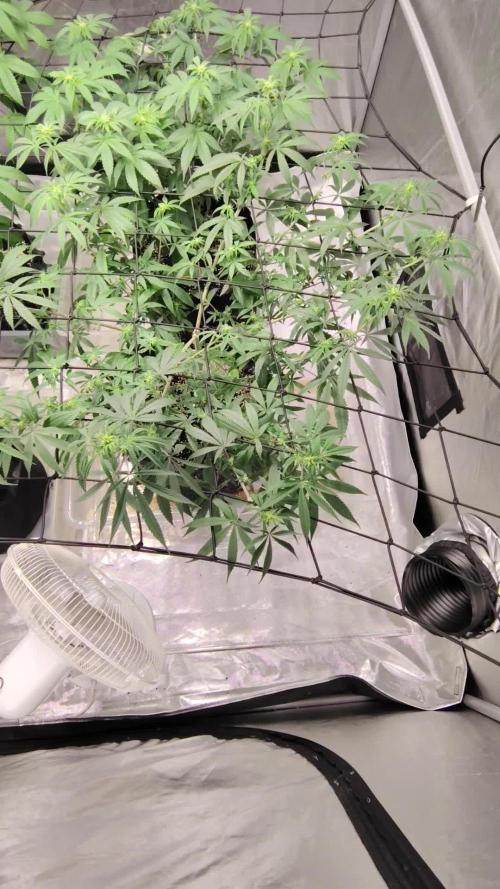
I've been giving these plants some extra car the last week, adjusting the net, branches, opening up areas for light to seep through the canopy. They started taking water more frequently (about .25-.3 per day) so I've been giving them about a 1/2 gallon every 48 hour span. The bud sites are starting to fill in really nice, the garlic is definitely my early pick for heaviest yield in the tent with almost 3 times the amount of bud sites as the other plants.
The dark passenger really started stretching this week, having to be re weaved into the net twice in 72 hours!
The blood diamond is still slowly catching up to the rest so I move it away from the other 1 extra square, hopefully it will have enough room without having to take out any branches on the other plants. The smell is weak but very noticeable, have a light skunky/pine smell starting to develop in the tent.
I'll be starting to add growganica incredible bulk in small doses this upcoming week.



Likes
14
Share


@PEAKYPLANTERS
Follow
Hello everyone and welcome back to Madame Peaky's Gardens
let's start the dance and bring the light to 12h to trigger the flowering of these splendid girls
Likes
13
Share

@Sobreruedas
Follow
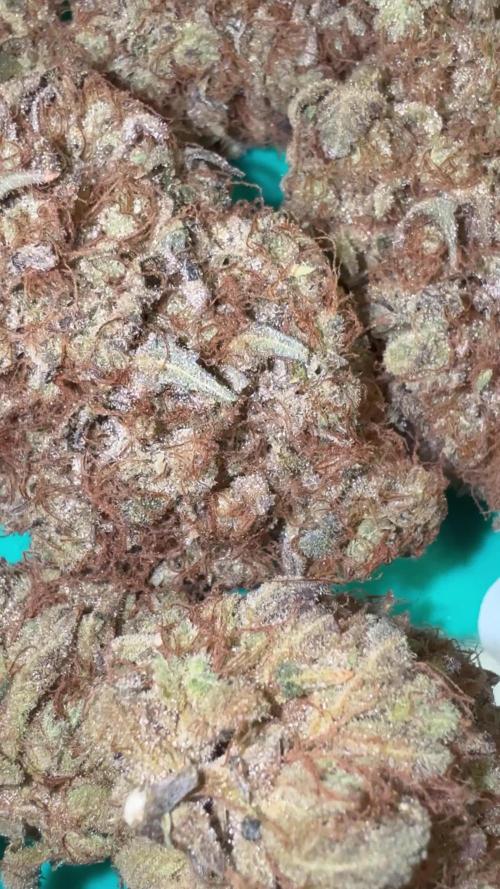
Harvest is finally complete, and after a proper dry and cure I’ve had the chance to enjoy the final result 🌿✂️
This grow had its challenges, especially the calcium deficiency during the vegetative stage and the small thrips outbreak in early flower, but fortunately both were dealt with in time and didn’t affect the final result as much as I expected.
A good genetic always makes a difference, and this one definitely showed its potential from start to finish. Combined with the mainlining, the scrog, and a stable environment throughout flowering, it produced a canopy full of dense, frosty buds.
The aroma is fantastic, the smoke is smooth, and the flavor is exactly what I was hoping for. The effect is powerful, long-lasting, and perfect for my needs.
Overall, I’m really happy with how this run turned out. Every grow is a learning experience, but this one has definitely been one of my favorites. Now it’s time to enjoy it and start thinking about the next project 💚🌱

Likes
17
Share

@EllysGrow
Follow
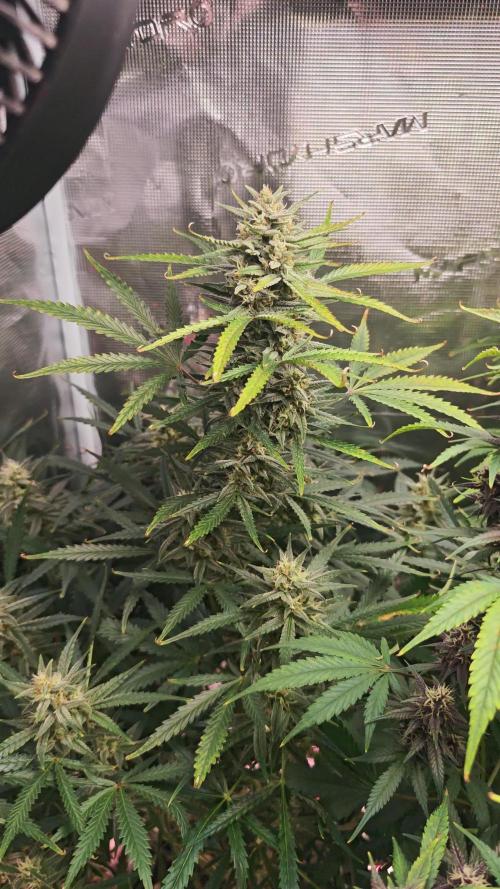
Anfang Woche 9 und es duftet.....die Tropicana Cookies versprüht wirklich einen mega tropischen Duft. Der Hammer!!!! Danke für so viele tolle Genetiken @Fast_Buds 😊