


Likes
Comments
Share


@TEAM_Piff_Paff
Follow
She is still showing some healthy growth as the weather is great these summer days.
Most notably she is getting more and more white pistils everywhere.

Likes
18
Share


@DeadJoke
Follow
i think pistills are changing more oranger this week..
but i guess buds are not growing fat this week ..
something isn't right...

Likes
16
Share


@Northern_Ent
Follow
Aug 10: now done two weeks of force flowering in the garage. This was supposed to be an auto, but like a lot of other growers here, I found this didn’t autoflower. That’s okay and I forced flowering by putting her in the dark garage along with the other photoperiod plants.
Hopefully these are just mis-packaged Overdose Fast seeds.
Aug 13: overdose is making good progress with flower development finally kicking in after a couple weeks of forcing.
Aug 14: added 3 tablespoons of a 50:50 mix of Power Bloom and malted barley as a top dressing and watered in.

Likes
19
Share

@German_GrowLab
Follow
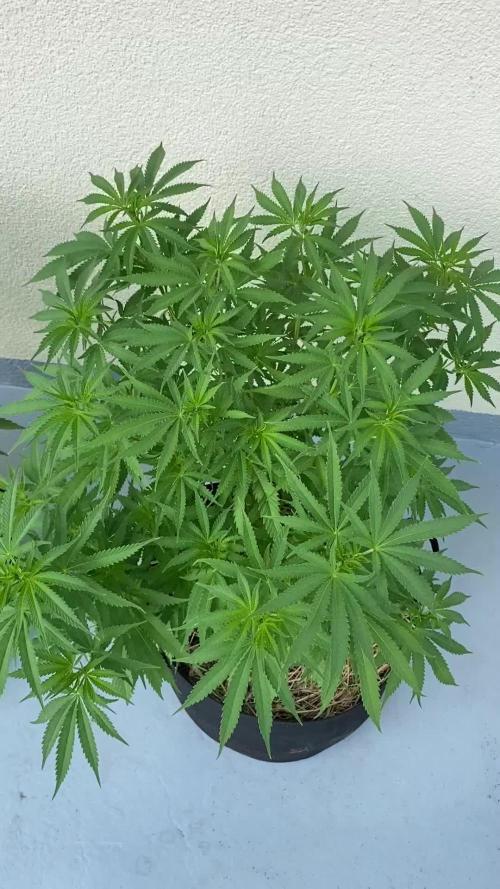
Einen wunderschönen guten Tag, liebe Grow-Community, und herzlich willkommen zur dreizehntenWoche meines kleinen Outdoorprojekts!
Diese Woche halte ich es mal wieder etwas kürzer😄.
Ich will mich hier ja nicht die ganz die ganze zeit beschweren aber das Wetter könnte echt n bisschen mehr mitspielen 😅. Die letzten Tage hatten wir. Von Niesel regen bis zu Monsun artigen Verhältnissen alles gehabt. Die Damen haben diese wiedersagen Verhältnisse gut weggesteckt und stehen in voller Pracht. Allerdings haben sie nicht übermäßig an höhe zugelegt was ich ihnen angesichts der Wetterlage auch nicht übel nehmen kann.
Aber was ist die Woche geschehen?
Ich habe den Pflanzen eine kleine Hormonkur in Form der im letzten Bericht angesetzten Jauche gegönnt. Dies besteht aus:
5l Wasser (in meinem Fall habe ich destilliertes verwendet ist aber eigentlich egal)
75g Alfalfa
75g Seegras
20g Melasse/Lab Mischung
Das ganze in einen Behalte gegeben und dann mit offen vergären lassen. Da die verwendeten Milchsäurebakterien sich anaerob vermehren, also ohne zugäbe von Sauerstoff wie beim AACT, werdende sich keinen sprudelstein. Die Jauche wird einmal am Tag mit geschlossenem Deckel geschüttelt.Wichtig ist zu erwähnen das die Jauche über die zeit immer mehr an Potenz gewinnt da die Milchsäurebakterien immer mehr Material zersetzen. Dies ist zu bedenken wenn man die Jauche verdünnt.
Die fertige Jauche ist eine absolutes Monster im garten und bringt eine reihe an benefits für die Pflanzen. Unter anderem:
+verbesserung der Bodenbeschaffenheit
+Erhöhung de Stresstoleranz
+förderung des Wachstums durch phytohormone
+erhöhen die diversität an Mikroorganismen
+Verbessern die Phosphoraufnahme durch die bessere aufspaltung im Boden
+untedrückung von Schadorganismen
eine gute und bereits Pflanzenverfügbare Silikatquelle
Und und und …
Die Jauche habe ich einerseits im Verhältnis 1:20 gespritzt hierbei ist darauf zu achten das man dies eine Stunde vor Sonnenaufgang erledigt um Verbrennungen Vorzubeugen und den Bakterien zeit zu geben einen film auf den Blättern zu bilden welcher auch die Ansiedlung von Pilzen erschwert (Mehltau etc.). Am nächsten Tag habe ich die Jauche dann noch im Verhältnis 1:10 gegossen um wirklich alle bennefits mitzunehmen . Die Pflanzen haben das Treatment gut aufgenommen und wirken bereits etwas vitaler.
Es gibt auch einen neuen Liebling im Garten:
Die bitter Orange hat sich wirklich gemacht und ein robb ein an den Stängeln (nicht dass das immer aussagekräftig wäre) ist wirklich vielversprechend.
Mit dem im letzten Bericht angekündigten lollipoppen warte ich doch noch etwas das ich mit bei dem eine oder anderen unteren trieb nicht sicher bin ob er sich nicht doch noch macht . Das alles wird sich dann in den nächsten ein bis zwei Wochen entscheiden.
Und zu guter letzt..
Habe ich den Bio Bloom in Form eines Top-dress eingearbeitet, da wir uns doch langsam aber sicher in Richtung Blüte bewegen und das Bodenlöeben diesen erst Pflanzenverfügbar machen muss. Durch das aufstreuen hat sich ein leichter Pilzfilm gebildet. Dies ist aber kein schlechtes Zeichen und wurde auch son in der akungsbeilage beschrieben.
Alles in allem sind wir gut auf Kurs 😊
Das war’s für diese Woche. Euch noch einen schönen Restmontag und einen guten start in die Woche.
Peace


Likes
12
Share


@Pussodog
Follow
Di due semi germinati uno non ha germinato. Una settimana dopo ho fatto germinare il terzo con una maggiore percentuale di start. Ma purtroppo sta crescendo rachitica con foglie prima macchiate di marrone ai bordi e successivo ingiallimento. Ho integrato con silicio della Mills.
Ho integrato con Mills A per aumentare la disponibilità di azoto e migliorare la fotosintesi.
Attualmente la soluzione ha 6,2 di pH e 0.90 m/am di ec.
È gradito ogni commento.

Likes
8
Share


Likes
15
Share


@Wizzel420
Follow
The odd amber tric is showing up, given her the first flush today, filtered water at 24 PPM ph 6.8: flushed her with 3 litres. Leaves starting to yellow expecting them to really yellow off this week. Smells of berries, baked cheesecake and pine

Likes
23
Share


@MotasKush
Follow
Strawberry Banana Reserva Privada DNA Genetics famous seeds and vegetation! Joy from beginning to end, especially their height to heaven. The smell of buds is smelled of dried bananas with a light tone of earthy strawberries and pine. I'm happy! I will give them a week to ripen and gradually harvest. The biggest plants I've had so far. Tribute to the guys from DNA Genetics! Grow Your Own!

Likes
2
Share


@Sobreruedas
Follow
Coloqué las semillas en un vaso con agua de osmosis durante 2 días. Al segundo día empezaron a reventar y se les empezó a formar la raíz.


Likes
2
Share


@LokalGrenz
Follow
Just going say today July 15th is day 1 lol they popped couple days ago just not sure what day
Likes
10
Share


@extraterrestrial1
Follow
-------------------------------------------------
Day 43
Water: 0.75 Gallon TT Water w/ 0.75 TBSP Blkstrp Mlsses 6.5 pH
Humidifier: 50% (LOW-MIST)
Dehumidifier: On
Fan Speed: High
Light on @ 19:00 (27.2° celsius @ 49% RH)
Light off @ 13:00 (23.2° celsius @ 47% RH)
-------------------------------------------------
Day 44
Water: N/A
Humidifier: 50% (LOW-MIST)
Dehumidifier: On
Fan Speed: High
Light on @ 19:00 (27.8° celsius @ 45% RH)
Light off @ 13:00 (23.2° celsius @ 44% RH)
-------------------------------------------------
Day 45
Water: N/A
Humidifier: 50% (LOW-MIST)
Dehumidifier: On
Fan Speed: High
Light on @ 19:00 (28.4° celsius @ 44% RH)
Light off @ 13:00 (22.5° celsius @ 48% RH)
-------------------------------------------------
Day 46
Water: N/A
Humidifier: 50% (LOW-MIST)
Dehumidifier: On
Fan Speed: High
Light on @ 19:00 (28.2° celsius @ 47% RH)
Light off @ 13:00 (23.3° celsius @ 49% RH)
-------------------------------------------------
Day 47
Water: N/A
Humidifier: 50% (LOW-MIST)
Dehumidifier: On
Fan Speed: High
Light on @ 19:00 (28.4° celsius @ 42% RH)
Light off @ 13:00 (22.8° celsius @ 49% RH)
-------------------------------------------------
Day 48
Water: N/A
Humidifier: 50% (LOW-MIST)
Dehumidifier: On
Fan Speed: High
Light on @ 19:00 (28.4° celsius @ 42% RH)
Light off @ 13:00 (22.8° celsius @ 49% RH)
-------------------------------------------------
Day 49
Water: 1 Gallon TT Water w/ 1 TBSP Blkstrp Mlsses + 0.75ml/L Alaska Morbloom 5.7 pH
Humidifier: 50% (LOW-MIST)
Dehumidifier: On
Fan Speed: High
Light on @ 19:00 (28.6° celsius @ 49% RH)
Light off @ 13:00 (22.7° celsius @ 49% RH)
-------------------------------------------------
Likes
48
Share


@Troy_McClure
Follow
SUMMARY:
- I killed my first to tap-root seeds, I waited for them to grow "by the book" 0.5cm and I should have just planted, I saw them get worse and said "I must of messed up with something, lets wait another night until they bounce back" and instead they died. The next germination was super easy but my lights were too high, and the humidity was too low. All the fixes were done for the next weeks.
Nov. 3
21:30 - dropped seeds into water
14:30 - get seeds into paper towel
nov. 4
1:00 - seeds moved to damp paper towel
nov. 5
18:00 - both seeds crack tap root emerging
nov. 6
7:45 - both seeds tap root growing very long and thin,
- third seed still not cracked
8:30 - both seeds placed into soil and watered lightly
- placed into grow tent and LEDs turned on
- 24H for the first day
- 18/6 for the rest
nov. 8
6:45 - first seedling spouted cotyledons leaves
13:00 - seedling (cotyledons leaves) looks droopy
19:00 - light moved down to 30”
23:00 - second seedling has reach the surface and started to sprout cotyledons
- first seedling still getting taller
- third seed still not cracked
nov. 9
15:00 - both seedlings given 50ml of water
- watered around the outside of pot
- pH of water = 7.81
- pH of runoff = 6.31
nov. 10
- second seedling has created serrated second set of leaves and stretched up to same height, but much smaller than first seedling.
Specifications:😎
Seeds:
- 2x White Widow feminized seeds from Crop King Seed
Tent:
- 4x4x6 Mammoth Grow tent
LED:
- 2x Spider Farmer SF1000 LED (default 100 watt draw for seedling but will be bumped up to 125 Watt for flowering if not sooner)
Pots:
- 2x 0.5 L starter pots
- 2x 5 gal smart pots after transplant
Soil:
- Pro-mix containing mycorrhizae and perlite, used for starter pots and mixed at roughly 1:3 ratio with Ocean Forest
- Fox Farm Ocean Forest soil, used in the 5 gallon pots and mixed with roughly 3:1 ratio with pro-mix
- note: pro mix was mixed thoroughly with ocean forest in the 5 gal pot, then pro-mix was used on the top layer, in and around where the transplant will be to help the early veg stage avoid getting too "hot" via nutrients.
Nutrients:
- Fox Farm Big Bloom
- Fox Farm Big Grow
- Fox Farm Tiger Bloom
Inline Fans:
- AC Infinity CLOUDLINE T6 6" (exhaust)
- AC infinity CLOUDLINE S6 6" (active intake)
- AC infinity 6" ducting
Oscillating fans:
- 2x Wind Devil 6" fans
Carbon Filter:
- 2x iPower Carbon Filter on both inline fans
- note: carbon filter on intake fan as basement had mold issues in furnace room far removed but same floor, some mold issue in other room, cat litter in basement, thus, avoiding all risks and sleeping sound at night :) all mold was killed, scrubbed, cleaned, sprayed, painted, and sprayed again before setting up.
Humidifier:
- TaoTronics Cool Mist Humidifier
Timers:
- 2x Kuman 15A/1800W 24-Hour Digital Timer
Overall:
Good start to the grow, germinated 2/3 seeds, both growing and healthy.
Both seedlings have developed their cotyledons and although they initially were quite droopy, they often bounce back to a decent upright/natural position.
Third seed is undergoing "emergency germination" for the next 2 days as it experienced identical conditions to the other healthy seeds yet failed to germinate, likely due to its unviable nature.
Waiting for extension cords to lower the lights further and a humidifier to hold rH steady in the next day or so.
The seedlings appear to be reaching up for the light, stretching, but it appears to be within the acceptable range as they are upright and sturdy.
The seedlings often get a little droopy, it is likely that this and even the stretching can be blamed on low humidity, temperature swings between low 60's up to 81 F.
Nov. 2
- I killed 2 germinated seeds by waiting for tap root to grow to 0.5cm.
- note: tap root looked great but was quite short so I waited another day for it to grow as instructed, the next day it looked like it had suffered, I assumed it was something I did like too damp, or too dry, but it really just needed to be planted before tap root grew to 0.5cm. So i waited another day to see the bounce back this time carefully ensuring right amount of dampness but when i looked it was clearly dead. RIP 😭
Nov. 3
21:30 - dropped seeds into water
14:30 - get seeds into paper towel
nov. 4
1:00 - seeds moved to damp paper towel
nov. 5
18:00 - both seeds crack tap root emerging
nov. 6
7:45 - both seeds tap root growing very long and thin,
- third seed still not cracked
8:30 - both seeds placed into soil and watered lightly
- placed into grow tent and LEDs turned on
- 24H for the first day
- 18/6 for the rest
nov. 8
6:45 - first seedling spouted cotyledons leaves
13:00 - seedling (cotyledons leaves) looks droopy
19:00 - light moved down to 30”
23:00 - second seedling has reach the surface and started to sprout cotyledons
- first seedling still getting taller
- third seed still not cracked
nov. 9
15:00 - both seedlings given 50ml of water
- watered around the outside of pot
- pH of water = 7.81
- pH of runoff = 6.31
nov. 10
- second seedling has created serrated second set of leaves and stretched up to same height, but much smaller than first seedling.
Summary of week:
- A rocky but good start has resulted in 2 healthy seedlings with a decent set of serrated leaves.
- MY growing pains and on the fly adjusting of grow tent climate likely resulted in a little bit of a tough week for the seedlings. LED hanging too high likely off the start (started at 60" and got as low as 30"), low rH (going down to as low as 40% and never really getting <60%), and poor temperature fluctuations (going as low as 61F early in the morning when the lights go off for 8H and as high as 81F when the lights are on for some time).
- Luckily these factors did not do much damage but in all likelihood just resulted in a slower growth rate.
- After initially planted into damp soil, I only watered once, with only 50ml for each plant and mostly watered around the edges of the pot.


Likes
15
Share


@MrJones
Follow
Mr. Jones Fast Buds Moby Dick
╰⊰´🌿 ╰⊰´🌿 ╰⊰´🌿 ╰⊰´🌿 ╰⊰´🌿 ╰⊰´🌿 ╰⊰´🌿
🏡Indoor - 3"x4"x8" Custom Built Grow Closet
🌾This strain likes to stretch, so a heavy training regiment will be needed.
🗓️Germenation - Soaking in Water Strait into Amended Soil.
⚱️3-Gallon Pots 📊6.4 / 6.8 PH
💧 Feeding - Gaia Green Grow / Bloom
🕷️ IPM - We will be using Green Cleaner" 1 OZ per Gallon, and CannControl from Mammoth alternating between products each month for Integrated Pest Management.
🌿╰⊰´🌿╰⊰´🌿 PLANT UPDATES 🌿╰⊰´🌿╰⊰´🌿
🗓️Saturday - 11.11.23 So last week I did some training 1 plant was topped, 1 plant was LST, and the last one, the smallest one, was left alone, I am happy with the recovery as we head into week 4, this week that most FB strains begin to stretch into flower, today I started a compost tea, see recipe below, will be feeding tomorrow.
Moved the plants into my stealth closet, under 2 Vipar Spectare XS 1500s.
╰⊰´🌿 ╰⊰´🌿 ╰⊰´🌿 ╰⊰´🌿 ╰⊰´🌿 ╰⊰´🌿 ╰⊰´🌿
📝 Notes - Original Moby Dick Auto is a world-renowned Sativa-dominant giant created from two of the most popular strains ever, the White Widow and Haze cannabis strains which are known for the huge delicious aroma, huge size and yields; It’s an extremely easy-to-grow variety highly recommended for growers of all levels seeking for maximum yields with minimum effort as this strain grows up to 150cm and yields up to 650 g/m2 in 10 weeks without extra maintenance. Thanks to its 23% THC, this marvelous hybrid is all about happiness as it will melt your worries away while boosting your mood, leaving you with a big fat smile on your face and ready to get things done as soon as you take the first hit, making it an excellent choice for social scenarios and busy workdays. The Sativa effect comes hand-in-hand with a mix of lemony, piney, and woody terpenes that translate into that classic aroma every stoner loves.
╰⊰´🌿 ╰⊰´🌿 ╰⊰´🌿 ╰⊰´🌿 ╰⊰´🌿 ╰⊰´🌿 ╰⊰´🌿
Compost Tea
3 Gallons Dechlorinated H20
3 Cups Malibu Compost
2T Molasses
2 T Alfalfa Meal (DTE)
2 T Kelp Meal (DTE)
1 T Bat Guano (DTE)
1 teaspoon Rootwise Bio Elixir
1)- I used a small paint strainer to hold my composts, placing an air stone right in the bag and zip-tie it nice and tight - this allows air bubbles to really agitate the micro matter off of the compost and into your tea
2)- I like to mix in the molasses (microbe food) and start my main air stone, the dry amendments and Rootwise can be just measured in the bubbles
3) - Keep the temp of the water warm to 75F/85F - too cool and the microbes reproduce too slowly and too hot will kill them.
I do not delete my teas and let the plant pots dry out slightly before feeding.

Likes
107
Share


@DogDoctorOfficial
Follow
Oh man am i excited to share my journey with my Purple Lemonade ff baby from Fast Buds. This girl is growing like a champ, and I'm just amazed by her progress in the first week!
When it was time to transplant my plant, I decided to use Aptus Mycor Mix on the roots. Let me tell you, it was like giving my plant a magical boost! The mycorrhizal fungi in Aptus Mycor Mix formed a symbiotic relationship with the plant's roots, enhancing nutrient uptake and promoting overall plant health. It's truly amazing how nature works in harmony!
Speaking of transplanting, Im so glad i opted for small fabric pots, and I'm loving the results. Fabric pots provide excellent aeration, preventing root-bound issues and allowing for better drainage. Plus, they're eco-friendly and reusable, which is a big plus for me as an environmentally conscious grower.
Now let's talk about Aptus Holland Line for nutrition. I've always been a fan of organic and mineral-based nutrients, and Aptus Holland Line fits the bill perfectly. Their nutrient lines are carefully crafted with premium ingredients that are fully organic, ensuring my plant gets the best of both worlds. I love knowing that I'm feeding my plant with natural, sustainable, and effective nutrients that support healthy growth and i dont say this because they sponsor me , i am a long before user and believer , trust me on this one <3 <3 <3
And yes, you might have noticed some smoke in the background of my pictures. Well, let's just say I like to keep myself medicated while I tend to my green beauties. It's my way of staying relaxed and focused during the growing process, and it seems to be working wonders for my plants too!
In conclusion, my Purple Lemonade fast flowering baby is thriving thanks to the transplanting methods using Aptus Mycor Mix, the benefits of fabric pots, and the organic and mineral-based nutrients from Aptus Holland Line. It's been an amazing journey so far, and I can't wait to see my baby continue to flourish. Happy growing, and cheers to a green and smoky adventure!
As always thank you all for stopping by and for supporting me on this journey, i am super passion about growing and fell blessed to have you all with me on this new journey <3 <3 <3
Genetics - Fast Buds Purple Lemonade FF
Ligth - Lumatek ZEUS 465 COMPACT PRO
Food - Aptus Holland
#aptus #aptusplanttech #aptusgang #aptusfamily #aptustrueplantscience #inbalancewithnature #trueplantscience #fastbuds #dogdoctorofficial #growerslove
With true love comes happiness <3 <3 <3 Always believe in your self and always do things expecting nothing and with an open heart , be a giver and the universe will give back to you in ways you could not even imagine so <3 <3 <3
All info and full product details can be find in can find @
https://2fast4buds.com/ wen released
https://aptus-holland.com/
https://autopot.co.uk/
https://lumatek-lighting.com/
<3 <3 <3 Growers love to you all <3 <3 <3
Likes
3
Share


@SmileyMorgen
Follow
4/27/22
Today makes the beginning of preflower. Notice the light xoxo of her tops. Also today her first white hair popped
4/28/22
Late last night i to the early hours of today I added some.LST clups qnd took 4 large fan leaves from the lower region of the plant to allow some light in to the emerging branches.
4/29/22
Today I did her first major defoliation. I only.took leaves on the inside margin of the plant that blocked light from emerging branches. This part of ganja growing always scared me because they look so yucky after for a day or two
5/1/22
My lady looks beautiful today. Looking better after her defoliation a few days ago. She I needing about 1 gal of plain dechlorinated water every other day to keep her topped off. She is drinking some water! I'm assuming this will mean I will have to feed her more that once weekly as well.
5/2/22
I realized today that the white hair I was seeing were just the plant reaching maturity and showing her gender... she is not behaving like a plant in flower. I have decided to change my light cycle to 12:12 in order to flip her I to flower. This is because she is getting too large for her to fit in my tent if she were to continue to veg any longer. The stretch during the first two weeks of flower will likely have my 4x4 filled up.


Likes
2
Share

@Catawbiense
Follow
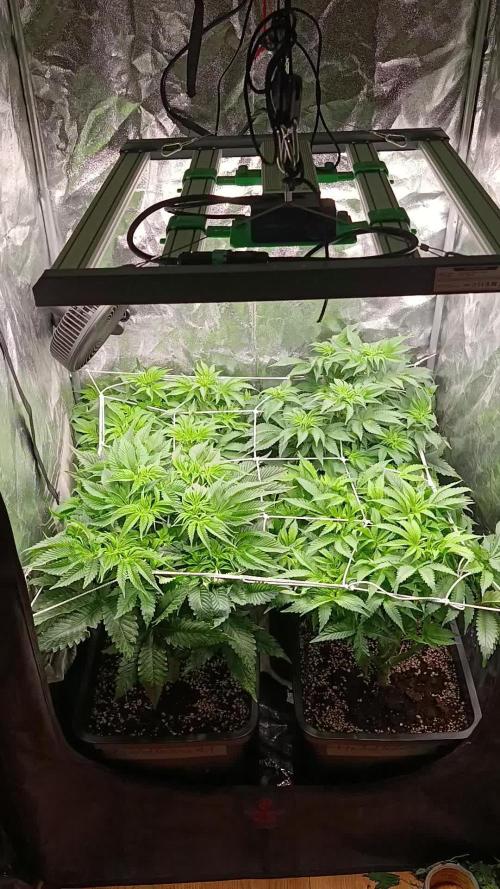
Umstellung auf 12/12 erfolgte diese Woche. Die Pflanzen haben sich gut vom CalMag-Mangel erholt und zeigen bereits Vorblüte. Wachstum ist kräftig, Blattfarbe gesund.
Das SCROG-Netz wurde abgesenkt, die Triebe werden weiterhin sanft unter das Netz geführt, um eine gleichmäßige Canopy zu erreichen. Zwei Pflanzen sind etwas höher. Aktuell wird mit je 1ml/L BioGrow BioBloom und Calmag gedüngt (PH 6.2). Tag 21 Blüte gibt es dann ein ordentliches lollipopping und eine moderate Entlaubung.
Soweit bin ich sehr zufrieden. Bin gespannt auf den Stretch, letzten Grow haben die Frosted Guavas sich nicht stark gestreckt. Allerdings sind die Bedingungen aktuell besser. Keine Trauermücken, effizientere Lampe und stabileres Klima.

Likes
52
Share


@Ultraviolet
Follow
Lacewings seemed to have mostly killed themselves by flying into hot light fixtures. I may have left the UV on which was smart of me :) Done very little to combat if anything but make a sea of carcasses, on the bright side its good nutrition for the soil.
Made a concoction of ethanol 70%, equal parts water, and cayenne pepper with a couple of squirts of dish soap.
Took around an hour of good scrubbing the entire canopy.
Worked a lot more effectively and way cheaper.
Scorched earth right now, but it seems to have wiped them out almost entirely very pleased.
Attempted a "Fudge I Missed" for the topping. So just time to wait and see how it goes.
Question?
If I attached a plant to two separate pots but it was connected by rootzone, one has a pH of 7.5 ish the other has 4.5. Would the Intelligence of the plant able to dictate each pot separately to uptake the nutrients best suited to pH or would it still try to draw nitrogen from a pot with a pH where nitrogen struggles to uptake?
Food for stoner thought experiments!
Another was on my mind.
What happens when a plant gets too much light?
Well, it burns and curls up leaves.
That's the heat radiation, let's remove excess heat, now what?
I've always read it's just bad, or not good, but when I look for an explanation on a deeper level it's just bad and you shouldn't do it.
So I did.
How much can a cannabis plant absorb, 40 moles in a day, ok I'll give it 60 moles. 80 nothing bad ever happened.
The answer, finally. Oh great........more questions........
Reactive oxygen species (ROS) are molecules capable of independent existence, containing at least one oxygen atom and one or more unpaired electrons.
"Sunlight is the essential source of energy for most photosynthetic organisms, yet sunlight in excess of the organism’s photosynthetic capacity can generate reactive oxygen species (ROS) that lead to cellular damage. To avoid damage, plants respond to high light (HL) by activating photophysical pathways that safely convert excess energy to heat, which is known as nonphotochemical quenching (NPQ) (Rochaix, 2014). While NPQ allows for healthy growth, it also limits the overall photosynthetic efficiency under many conditions. If NPQ were optimized for biomass, yields would improve dramatically, potentially by up to 30% (Kromdijk et al., 2016; Zhu et al., 2010). However, critical information to guide optimization is still lacking, including the molecular origin of NPQ and the mechanism of regulation."
What I found most interesting was research pointing out that pH is linked to this defense mechanism. The organism can better facilitate "quenching" when oversaturated with light in a low pH. Now I Know during photosynthesis plants naturally produce exudates (chemicals that are secreted through their roots). Do they have the ability to alter pH themselves using these excretions? Or is that done by the beneficial bacteria?
If I can prevent reactive oxygen species from causing damage by "too much light".
The extra water needed to keep this level of burn cooled though, I must learn to crawl before I can run.
Reactive oxygen species (ROS) are key signaling molecules that enable cells to rapidly respond to different stimuli. In plants, ROS plays a crucial role in abiotic and biotic stress sensing, integration of different environmental signals, and activation of stress-response networks, thus contributing to the establishment of defense mechanisms and plant resilience. Recent advances in the study of ROS signaling in plants include the identification of ROS receptors and key regulatory hubs that connect ROS signaling with other important stress-response signal transduction pathways and hormones, as well as new roles for ROS in organelle-to-organelle and cell-to-cell signaling. Our understanding of how ROS are regulated in cells by balancing production, scavenging, and transport has also increased. In this Review, we discuss these promising developments and how they might be used to increase plant resilience to environmental stress.
Temperature stress is one of the major abiotic stresses that adversely affect agricultural productivity worldwide. Temperatures beyond a plant's physiological optimum can trigger significant physiological and biochemical perturbations, reducing plant growth and tolerance to stress. Improving a plant's tolerance to these temperature fluctuations requires a deep understanding of its responses to environmental change. To adapt to temperature fluctuations, plants tailor their acclimatory signal transduction events, specifically, cellular redox state, that are governed by plant hormones, reactive oxygen species (ROS) regulatory systems, and other molecular components. The role of ROS in plants as important signaling molecules during stress acclimation has recently been established. Here, hormone-triggered ROS produced by NADPH oxidases, feedback regulation, and integrated signaling events during temperature stress activate stress-response pathways and induce acclimation or defense mechanisms. At the other extreme, excess ROS accumulation, following temperature-induced oxidative stress, can have negative consequences on plant growth and stress acclimation. The excessive ROS is regulated by the ROS scavenging system, which subsequently promotes plant tolerance. All these signaling events, including crosstalk between hormones and ROS, modify the plant's transcriptomic, metabolomic, and biochemical states and promote plant acclimation, tolerance, and survival. Here, we provide a comprehensive review of the ROS, hormones, and their joint role in shaping a plant's responses to high and low temperatures, and we conclude by outlining hormone/ROS-regulated plant-responsive strategies for developing stress-tolerant crops to combat temperature changes.
Onward upward for now.
Next!
Adenosine triphosphate
(ATP) is an energy-carrying molecule known as "the energy currency of life" or "the fuel of life," because it's the universal energy source for all living cells.1
Every living organism consists of cells that rely on ATP for their energy needs. ATP is made by converting the food we eat into energy. It's an essential building block for all life forms. Without ATP, cells wouldn't have the fuel or power to perform functions necessary to stay alive, and they would eventually die. All forms of life rely on ATP to do the things they must do to survive.2
ATP is made of a nitrogen base (adenine) and a sugar molecule (ribose), which create adenosine, plus three phosphate molecules. If adenosine only has one phosphate molecule, it’s called adenosine monophosphate (AMP). If it has two phosphates, it’s called adenosine diphosphate (ADP).
Although adenosine is a fundamental part of ATP, when it comes to providing energy to a cell and fueling cellular processes, the phosphate molecules are what really matter. The most energy-loaded composition for adenosine is ATP, which has three phosphates.3
ATP was first discovered in the 1920s. In 1929, Karl Lohmann—a German chemist studying muscle contractions—isolated what we now call adenosine triphosphate in a laboratory. At the time, Lohmann called ATP by a different name. It wasn't until a decade later, in 1939, that Nobel Prize–-winner Fritz Lipmann established that ATP is the universal carrier of energy in all living cells and coined the term "energy-rich phosphate bonds."45
Lipmann focused on phosphate bonds as the key to ATP being the universal energy source for all living cells, because adenosine triphosphate releases energy when one of its three phosphate bonds breaks off to form ADP. ATP is a high-energy molecule with three phosphate bonds; ADP is low-energy with only two phosphate bonds.
The Twos and Threes of ATP and ADP
Adenosine triphosphate (ATP) becomes adenosine diphosphate (ADP) when one of its three phosphate molecules breaks free and releases energy (“tri” means “three,” while “di” means “two”). Conversely, ADP becomes ATP when a phosphate molecule is added. As part of an ongoing energy cycle, ADP is constantly recycled back into ATP.3
Much like a rechargeable battery with a fluctuating state of charge, ATP represents a fully charged battery, and ADP represents a "low-power mode." Every time a fully charged ATP molecule loses a phosphate bond, it becomes ADP; energy is released via the process of ATP becoming ADP.
On the flip side, when a phosphate bond is added, ADP becomes ATP. When ADP becomes ATP, what was previously a low-charged energy adenosine molecule (ADP) becomes fully charged ATP. This energy-creation and energy-depletion cycle happens time and time again, much like your smartphone battery can be recharged countless times during its lifespan.
The human body uses molecules held in the fats, proteins, and carbohydrates we eat or drink as sources of energy to make ATP. This happens through a process called hydrolysis
.
After food is digested, it's synthesized into glucose, which is a form of sugar. Glucose is the main source of fuel that our cells' mitochondria
use to convert caloric energy from food into ATP, which is an energy form that can be used by cells.
ATP is made via a process called cellular respiration that occurs in the mitochondria of a cell. Mitochondria are tiny subunits within a cell that specialize in extracting energy from the foods we eat and converting it into ATP.
Mitochondria can convert glucose into ATP via two different types of cellular respiration:
Aerobic (with oxygen)
Anaerobic (without oxygen)
Aerobic cellular respiration transforms glucose into ATP in a three-step process, as follows:
Step 1: Glycolysis
Step 2: The Krebs cycle (also called the citric acid cycle)
Step 3: Electron transport chain
During glycolysis, glucose (i.e., sugar) from food sources is broken down into pyruvate
molecules. This is followed by the Krebs cycle, which is an aerobic process that uses oxygen to finish breaking down sugar and harnesses energy into electron carriers that fuel the synthesis of ATP. Lastly, the electron transport chain (ETC) pumps positively charged protons that drive ATP production throughout the mitochondria’s inner membrane.2
ATP can also be produced without oxygen (i.e., anaerobic), which is something plants, algae, and some bacteria do by converting the energy held in sunlight into energy that can be used by a cell via photosynthesis.
Anaerobic exercise means that your body is working out "without oxygen." Anaerobic glycolysis occurs in human cells when there isn't enough oxygen available during an anaerobic workout. If no oxygen is present during cellular respiration, pyruvate can't enter the Krebs cycle and is oxidized into lactic acid. In the absence of oxygen, lactic acid fermentation makes ATP anaerobically.
The burning sensation you feel in your muscles when you're huffing and puffing during anaerobic high-intensity interval training (HIIT) that maxes out your aerobic capacity or during a strenuous weight-lifting workout is lactic acid, which is used to make ATP via anaerobic glycolysis.
During aerobic exercise, mitochondria have enough oxygen to make ATP aerobically. However, when you're out of breath and your cells don’t have enough oxygen to perform cellular respiration aerobically, the process can still happen anaerobically, but it creates a temporary burning sensation in your skeletal muscles.
Why ATP Is So Important?
ATP is essential for life and makes it possible for us to do the things we do. Without ATP, cells wouldn't be able to use the energy held in food to fuel cellular processes, and an organism couldn't stay alive.
As a real-world example, when a car runs out of gas and is parked on the side of the road, the only thing that will make the car drivable again is putting some gasoline back in the tank. For all living cells, ATP is like the gas in a car's fuel tank. Without ATP, cells wouldn't have a source of usable energy, and the organism would die.
Eating a well-balanced diet and staying hydrated should give your body all the resources it needs to produce plenty of ATP. Although some athletes may slightly improve their performance by taking supplements or ergonomic aids designed to increase ATP production, it's debatable that oral adenosine triphosphate supplementation actually increases energy.
An average cell in the human body uses about 10 million ATP molecules per second and can recycle all of its ATP in less than a minute. Over 24 hours, the human body turns over its weight in ATP.
You can last weeks without food.
You can last days without water.
You can last minutes without oxygen.
You can last 16 seconds at most without ATP.
Food amounts to one-third of ATP production within the human body.

Likes
78
Share


@Hou_Stone
Follow
My 4 plants are still there, with the banana as a smile 🍌😁
I continue the defoliation, I wonder if I'm not doing a little too much sometimes.. We will soon see the result
🌗Switching to flowering this week, I reduced the length of the day by 1 hour each day until reaching 12 hours night time / 12 hours daylight on the 33rd day!🌞
🌺On the 33rd day I apply a layer of organic nutrients mixed with a little soil that I add to the top of each pot.
I added 35 grams of BioBloom to each of my pots🌺
(Pot of 7 Liters / 2 gallons)
------------------------------------------------------------
💧Watering
I water all my pots the same day but with more or less water.
Simply by lifting them;
A light pot is a dry pot and will need more water,
A heavy pot is a wet pot and will need less water.
On average I water each pot with:
Day 29 : 0.5 L
Day 33 : 1 L with 0.8 grams of bio enhancer/L
I use tap water, adjust the ph to around 6 and water
------------------------------------------------------------
🔥❄️Temperature of the week :
Day : 19-23°C (Humidity : 65-80%)
Night : 14-17°C (Humidity : 75-85%)
Outside the tent it is around 16°C with 70% humidity
The humidity is a little too high, I hope it will drop a little 🙏
------------------------------------------------------------
🚀Equipment of the week ⭐️ :
Light FC3000 Mars hydro. power 95% at 50cm
Extractor 6 inch Mars Hydro. power 1/10. ON 24/24h
2 fans to circulate the air inside the tent. Each on for 30 minutes then off for 1 hour. this rhythm repeats itself in a loop
I'm removing my heat mat this week.
------------------------------------------------------------
📜Links :
🌱Banana Krumble seeds : 👇
https://shop.greenhouseseeds.nl/feminised-cannabis-seeds/usa-genetics/banana-krumble/
Mars Hydro : 5% off with my discount code "houstone5" 💪
https://www.mars-hydro.com/?acc=hou-stone
👨🚀My Instagram❤️️:
https://www.instagram.com/hou_stone420/
------------------------------------------------------------
Thanks for your visit😀💚
