Check the winners The Grow Awards 2026 🏆
Likes
Comments
Share
@Unkraut
Follow
Harvest time! 😁 everything looking good so far, plants are quite healthy check www.sr-organics.com and get a 10% discount on this great 5in1 fertilizer with "UNKRAUT10"
Likes
20
Share
@MrGoonai
Follow
12/05/24 Short Facts: Watered: 1 x 3.0L, 1 x 2.8L, 1 x 3.2L, 1 x 3.0 — Total: 12L VPD @ 1.4 Light @ 70% (~700 to 950 PPFD) --------------------------------------------------------------------------------- Nothing special happened this week. Everything is fine, and the buds are getting bigger. The Blumat Digital Pro Plus is really helpful, making my watering spot-on. Great tool! Unfortunately, the macro lens and the microscopic lens I ordered for my phone didn’t arrive this week, but I’m hopeful they’ll arrive in the coming days. I’ll probably upload a lot of cool pictures in the next report, so stay tuned!
Likes
6
Share
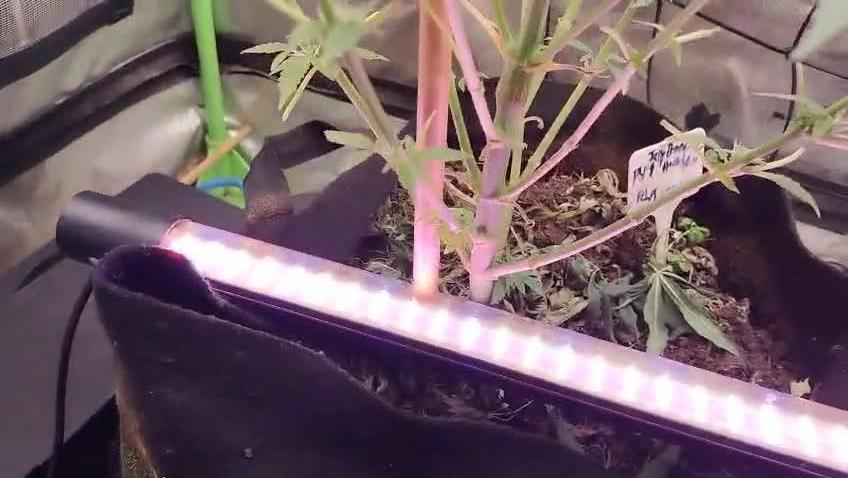
Swapped blue for the red CFL. Adding 1ml bloom per litre. Few tips are yellow think its having the light too close but only time will tell. All 3 plants have entered flowering stage. Due to the small grow space the plant that is directly under the LED is growing at a faster rate compared to the plant that's under the CFL
Likes
11
Share
Day 70- 2nd day of flush. Plant 1 is pretty much done, just waiting for trichs to amber up a bit. Plant 2 has a ways to go, but I’m flushing anyway. Wifey complained about the choking smell, but realized my in tent filter was off because a branch lifted the plug out of the socket 🙄🙄 Day 75 - past few days been feeding PK at 0.7 EC, waiting for the trichs to turn. Going back to plain water tonight. #2 plant has much larger buds, but is waaayyy behind #1 - still tons of white pistils.
Likes
55
Share
Battered & bruised. Give her another week in 14 then next week its 10/14. Nature uses: Mass Flow (Barometric Pumping): This refers to the bulk movement of air through soil pores caused by pressure differences. Fluctuations in barometric pressure (high and low pressure fronts) and wind speed over the surface create these pressure differentials, which can force air in or out of the soil. This is how soil "breathes" so to speak. Barometric pressure fluctuations can cause day-to-day variations in gas emissions by a factor of 20 to 35 times, a dynamic response that highlights its importance in the overall carbon cycle. Indoor growers use: Negative pressure can replicate the effects of barometric pumping by creating pressure differentials that induce air to flow in and CO2 and nitrogen out in a controlled manner. Carbon dioxide is released by microorganisms when they eat sugars, when there is no mass flow in a cycle/system where microorganisms are releasing CO2 from eating sugars, the CO2 accumulates in the medium, leading to several significant effects: cut a long story short, the lack of mass flow prevents essential gas exchange, causing the waste product (CO2) to become a self-inhibiting factor that limits the microbial activity and can eventually kill the organisms. Increasing the amount of carbon in a soil increases its moisture retention, an often-overlooked detail that often ends up around the 4th week of flower, people wondering why hypoxia occurred. Around 40% of all the carbon captured is exuded into the soil to feed microorganisms and converted to chemical energy; CO2 accumulates. This is why it's required if you want to reuse the soil. CO2 is a very stable molecule, sitting at a "bottom of the potential energy well". A significant amount of energy is required to break its strong bonds and convert it into a higher-energy, more useful molecule (like a fuel). Converting CO2 back into fuels requires the same amount of energy released during its original combustion (due to the conservation of energy), which often makes the process energy-intensive and expensive. Therein lies the key, 90% of the air that enters the tent, enters through the rootzones, up and through the underside of plant canopy, air comes in but all the CO2 accumulates in bottom half of the tent due to its density. The exhaust linked to rh keeps a constant negative pressure that links to the rate of cellular respiration performed at night. Come morning the compensation point is upwards of 1500pmm by morning. 300 dollar grow light on its 15th grow. The real star of the show is the 14000btu Portable ac unit.
Processing
Likes
43
Share
Jour42 defolliation Stretch 10 centimètres Jour47 arrosage avec de l'eau ph6.3 à laquelle j'ajoute 1ml par litre d'eau de topmax biobizz
Likes
4
Share
Beginn woche 3 Absolut robuste ladys. Hammer cut von roots_farms.at Selten so vitale babys gesehn
Likes
5
Share
@Darkuau
Follow
Que tal, voy a hacer este cultivo 100% orgánico, espero que todo salga bien
Likes
62
Share
@MeaCulpa
Follow
Third week in bloom. Everything is going well. My only concern is that I have defoliated too much and my humidity is too high. Difficult to get it down when it's just raining outside. I'll see what happens... 19.12.2023 I've made some space and flanged my old 60x60x120cm tent on the right site and switched on another PC fan. I hope I haven't made a serious mistake. All fans repositioned. And everything is taped off so that no light comes in. That was too crowded. Next time 4 or 5 will be enough for me.
Likes
47
Share
@Naujas
Follow
I am extremely impressed: Zamnesia and Plagron !!!! Auto Runtz showed no negative emotions throughout the growth :) Plagron nutrients gave her what she wanted ;) In general, this whole trip was something unreal, (with such a result I have a little hope of winning a prize from the ongoing competition :D :D ) Her aroma is full of tropical fruits!!!! (I can't wait to taste her :D:D) So from my travel suitcase, I got 225 gr of wet harvest weight, I am really happy about that :) (probably 50-60gr of dry flowers), by the way, I will also publish the dry flower weight, as soon as she is ready for it :) I did a lot of photoshoots, but unfortunately my lighting was not good, so I didn't get to take better photos ... Thank you to the sponsors @Zamnesia @Plagron for the opportunity, you are amazing!!! good luck to everyone!!!! And now I can think about a new Suitcase Lady :).
Likes
10
Share
Coming along nicely now , I've topped , defoliated , and lst too netting , well update more this week this lady didn't seem too take too well to the topping
Likes
114
Share
@GMSgrows
Follow
Gave these ladies a feed at 2.4 ec 400 ppm of Massive Bloom Formulation, 600 ppm of Floranova Bloom, and 200 ppm of Floranova Grow. Girls have all begun flowering now. Gelato is finally strated, Silver Widow is full on flower and the Breakup Cake is rockin. Weather has been a little better this last week. Were hoping for a good dry fall. Thnx growmies. You guys and gals are all great.👍
Likes
17
Share
@halexxo
Follow
Empiezan a oler bastante bien. El primer riego de esta semana fue de 1200ml. Les he conectado un extractor con salida a la calle porque empezaba a oler toda mi casa. Último riego de la semana 1500ml
Likes
13
Share
Estava sem celular, perdi várias mídias da semana passada e dessa semana
Likes
24
Share
The cannabis strain Grape Guava can be a purple strain, depending on its specific phenotype and genetic makeup. While not all phenotypes of Grape Guava are purple, some variations, such as the Zatix Grape Guava, are noted for their striking purple appearance due to the genetic expression of anthocyanin pigments. In a garden of green, Grape Guava gleams, With its fruity aroma, enchanting dreams. Clusters of grapes, guava's sweetness ignite, A strain so divine, in purple and white. Euphoria whispers, a lush fruity haze, Grape Guava's embrace, a tranquil daze. Off and away.@1400ppm. The increased CO2 allows plants to thrive at higher temperatures, which in turn necessitates higher humidity to maintain the ideal VPD for healthy growth and transpiration. 80F -5F = 75F LST with 70% RH = 0.72 kPa. Higher temperatures and humidity promote rapid growth, nutrient uptake, and photosynthesis while maintaining a lower stress level. Temperature influences the rate of enzymatic reactions involved in aerobic respiration. Enzymes, such as those involved in glycolysis, the Krebs cycle, and the electron transport chain, work most efficiently at an optimal temperature range. In low temperatures, enzymatic activity will slow down, thus reducing the rate of aerobic respiration. In high temperatures, enzymes can become denatured, thus impairing their function and stopping the process of aerobic respiration. Glucose is the primary fuel for aerobic respiration. The rate of aerobic respiration increases with the availability of glucose, as it is the starting point for glycolysis. If glucose levels are low, cells may rely on alternative energy sources such as fatty acids or amino acids , but these processes may yield less ATP or be less efficient. To determine this effect, carbon dioxide volume was measured (as carbon dioxide is an output of aerobic respiration) A seed germinated via skotomorphogenesis (in the dark) will generally develop faster in its initial stages to reach light, though it will be etiolated (elongated and weak) and will switch to slower, more robust photomorphogenesis (light development) once it emerges into light. While skotomorphogenesis is a rapid, growth-oriented process for soil escape, it's a temporary phase; photomorphogenesis is a more sustainable development program that prepares the seedling for photosynthesis. 18/6 with the 6 being IR instead of darkness, keeping temps overnight a neat 77F-80F. PPFD overnight 1.8. Think of my tent as a lung. What goes in must come out. When the rate of air going out exceeds the amount of air coming in, it creates a negative pressure. Tent concaves (bends in). If set up correctly, your RH will begin to drop slowly to the desired level you set, and the extraction turns off when it reaches 50% RH. The plant, as it performs cellular respiration, will always be releasing more water into the air, so the RH% of the tent overnight will always increase, so long as oxidative phosphorylation is occurring. As soon as the RH% creeps back up to 55%, the extraction turns back on, over and over, this creates a strong pressure differential which will work wonders on your grow. replicating high and low pressure fronts in nature, critical for oxygen diffusion, but more importantly, full control of your RH%. Moisture will not transfer from a saturated atmosphere to another if that air is already at or above its saturation point, meaning the air can't hold any more water vapor. Once I understood that water is produced as a by product during cellular respiration, specifically at the very end of the electron transport chain (ETC) where electrons are finally transferred to molecular oxygen, the higher the RH of the air, the more resistance there is for more moisture to be added to that environment, and effects the ease with which it does so. But none of that water comes from the pot; it's pulled from the air. If you run high daytime RH, your medium/pot is 100% reliant on transpirational root pull to move water. ZERO evaporation happens across the atmosphere if the tent air has high RH%, the medium cannot release its water through evaporation. Once a canopy develops, light no longer slowly wicks and evaporates from the topsoil. The Soil-Plant-Atmosphere Continuum (SPAC) describes the continuous pathway and process of water movement, driven by a gradient in water potential, from the soil, through the plant's roots, stem, and leaves, and finally evaporating into the atmosphere through transpiration. There is evaporation, there is transpiration, then there is evapotranspiration; Evapotranspiration (ET) is the combined total of two processes: evaporation (water lost directly from soil and surface water into the atmosphere) and transpiration (water released from plants to the atmosphere through their leaves). Evapotranspiration represents the total amount of water that moves from the medium into the air. There is no such thing as a medium with too much water, only a medium that retains too much for too long. The water must always flow efficiently from one atmosphere(Medium) to another(Air) in a timely manner. Moisture is a critical factor for bacterial growth and decay. Dictating how long it's allowed to sit in any one location for any given period is a key preferred control. To ensure a net reduction in a bacterial population, the rate of removal (ET) must exceed the rate of bacterial growth (decay rate), which is often modeled as a growth rate for the specific bacterium under the given conditions. By optimizing daytime VPD, we also optimize conditions for bacterial growth to explode exponentially above 77°F.. If water is allowed to sit in a medium without an escape within a timeframe, nothing good will happen. IF High RH is maintained overnight as well as during the day, placing 100% of water movement at the behest of daytime transpiration, roots can only pull where they can reach, and if soil is compressed above a certain point, moisture will become trapped in a medium with no way of moving day or night. This will begin the countdown for decay to take hold. When water stagnates in a medium, it loses oxygen, creating anaerobic conditions that foster the growth of harmful microorganisms like bacteria and fungi, which can produce toxins and disease vectors. Thigmomorphogenesis, the process by which plants respond to mechanical stimuli like touch by altering their growth and development, resulting in significant morphological changes to improve survival against mechanical perturbations. This complex response involves sensing touch and initiating physiological and genetic responses, leading to changes in form and structure over days or weeks. The process is triggered by physical forces such as wind, rain, or touch. Plants adapt to these stimuli by changing their shape and structure, which may include slower growth, thickened stems, or altered leaf development. Plants possess sophisticated mechanisms to detect even subtle mechanical stimuli and initiate responses. A variety of molecules, including calcium ions, jasmonates, ethylene, and nitric oxide, are involved in signaling these mechanical inputs. Touch can induce the expression of genes that encode proteins for calcium sensing, cell wall modification, and defense mechanisms. A plant exposed to constant wind may become shorter and sturdier. A plant that is touched frequently might grow slower to conserve energy and develop thicker cell walls. These changes increase a plant's resilience and ability to survive in harsh environments. Let's get Thiggy with it.
Likes
47
Share
👇 This week: --- Watered again as usual with the standard Plagron scheme + Calmag (last feeding with Alga Grow) (PLEASE CHECK YOUR WATER BEFORE USING CALMAG) Phosphorus foliar spray - red stems pretty much gone now PPFD at canopy height approximately 350-400, VPD ~1 Performed a major defoliation again Ordered more Autopots 😂 --- Happy growing and thanks for checking out my report! I really appreciate you! 😁💪🙏
Likes
47
Share
hey guys dinachem is looking better this week after swapping hps for led last week temps are a lot better but still high 70s even with no hps and just led but shes a lot happier removed lots of dead and faded leaves and dosnt seem to be getting worse. will start introducing bud candy at 0.5g per 2l it didn't really effect ph or e.c which I like . she's started showing some frost and should start fattening up from here on feed will be the same untill week before flush then will drop to half of the nutrient listed she's got a similar smell to gorilla so far which I'm liking a lot sounds weird but with a slight hint of garlic lol thanks for reading happy growing guys
Likes
17
Share