


Likes
Comments
Share


@Chuckwaggon420
Follow
This is the last week. These girls getting chopped they are all sooo fat so dense sk heavy it's insane. Going to be a large harvest I bet! Has a way loud gas sweet smell and are just so sticky they almost stick to ur fingers!!!
These girls have been fading Out all nice on their own just let the soil do its thing. Will chop these girls and give them a quick trim all the big leafs and let it sit and hang for 14 days in the cold. Got around 15% amber so it's time woop woop.

Likes
11
Share


@LSnake
Follow
I am very satisfied with the germination that took place in a few days. 🌱💪
This week I will continue to keep an eye on the development of the plant to prevent it from stretching too much in the first weeks. 🔍
I use BioBizz Light soil which for the first few weeks manages to provide enough nutrients, so I will water with a little water every day, to keep the humidity a little higher, without running the risk of overwatering. 🌊❌

Likes
65
Share


@Mrs_Larimar
Follow
May, 8th
Plant is still stretching, And Building some woonderful Flowers too
A lot of WWork and Energy for the Plant
I feed her in every Watering because shee is geting alittle Pale/ limy
And I added some Calmag too, to help with Photosynthesis
because she has still a big need In Nitrogen , added some flowering Nutrients, too

Likes
7
Share


@HardNuggGrow
Follow
Becoming a challenge to keep these branches trained. Looking for some more stretch before she reaches the beginning of her flower weeks. I will be performing a flush next week. So far it’s going well.


Likes
27
Share


@Zamzam974
Follow
Salut les cultivars sa roule ?!
C+29 a C+38 début floraison je pense... Sa pousse bien. Bonne vigueur des autofloraison surtout la critical... Arrosage tous les 3 4 jours 1litre par pot apport de mélasse à chaque arrosage... J'ai jouter deux ampoule une Led de 15w et cfl de 23w équivalente à une 100w la Led fait 4000k 1500lumens et la cfl 2700k 1500lumens la plante transpire pas mal mai pas de souci de moisissures... J'installe la cfl 250w 2700k quand la floraisons sera bien démarrer... Tous conseils sont les bien venu merci je c'est pas si je vais a 12/12 pour la wombat qui est féminisé pour ne pas perdre en quantité sur les auto qui et mieux 18/6 sinon bouturage pour la wombat je suis dans l'impasse total pour le moment 🙄


Processing
Likes
6
Share


@ganjaman24
Follow
Just got a new 600w mh/hps light for now it’s in my current setup with my 250 n it’s dimmed to 50%, only reason I mention is b/c the plants seem to be loving it!! They’re 12 days old from seed, still just ph’d water for them! So far so good :P


Likes
10
Share


@Kevjunior20
Follow
Beginning of third week, changed up my set up! Ready to see how these girls react to the Nutes also I have two slow growing plants(purple lemonade autoflower) & (seedsman autoflower lemon)

Likes
19
Share


@Wenz004
Follow
Die Woche getoppt und von 0.5 in 3 l umgetopft.
EC unter der Woche leicht auf 1.1 erhöht...mit etwas mehr AllinOne.
Likes
29
Share


@HarvesterOfSorrow
Follow
What I can i say other than Ethos Genetics kicks ass. I love growing their gear and will continue for as long as I can. This girl here took very well to training and feeding increases. Her terpene profile early on was undeniably Strawberry but gradually took a citrus dominant turn with some notes of pine. She was a moderate strechter and produced nice full trichomes that I'm sure would give a great return if pressed. The buds themselves are extremely sticky,pungent and dense. I used CX Horticulture and did what most dont do and used the recommended feeding chart 😲🙈🙊. I am glad to say she took it like a champ and for future grows of this strain I know I can up my ppm/EC next time. I yielded 6.25 ounces off of a 10 gallon pot and I know that's not impressive but it's my first time growing in a pot that big so many things learned. I will say after looking at the rootball I could have vegged for several more weeks but again knowledge is power and I've gained some 😉
Likes
11
Share


@madlangs
Follow
All going extremely well in the room. No problems. Purple punch is just starting to fade
20.4.23
Filled tank with winter frost
23gal
Ec 0.8
Ph5.9
Outside pineapple chunk
Looking lovely.
17.4.23
3L watered on top with
15ml bio heaven
12ml top max
Then put 750ml plain water on top
21.4.23
Started feeding winter frost
Ec6.4 no ph down


Likes
10
Share


@Biglegs_Cupboard
Follow
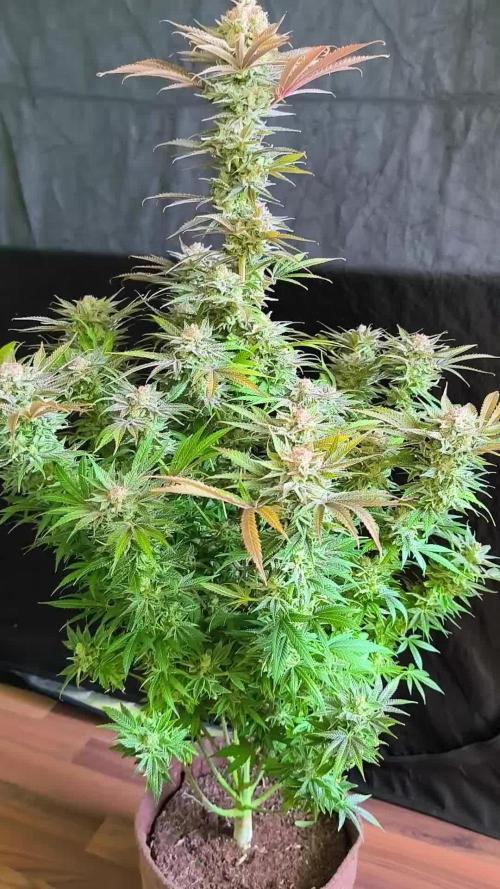
Week 3: Vegetative Stage – Training, Defoliation, and Entering Full Flower
The Apricot Autos have really taken off this week. I’ve been doing a little defoliation here and there, but over the course of training and tucking, I sometimes get a little heavy-handed and manage to break the odd leaf. Even with these occasional slips (you can see it in the pics), the plants are still shaping up nicely and getting huge, though not as much as my previous grow, which was also Fast Buds autos.
By the end of the week, the plants have started to noticeably stretch, which I’m happy about since it makes them easier to train. At this stage, I like to train using mental pegs, gardening wire, and leaf tucking. I rarely remove any leaves until I have a clearer idea of the plant’s final shape, which did evolve quickly this week, prompting me to take action.
On day 27, one of the plants is entering full flower, while the one with the misshapen leaf is a couple of days behind. The difference between the two is becoming less noticeable, although one is still bigger.
Current Setup:
Medium: 70/30 coco/perlite mix with Great White Mycorrhizae added during transplant
Lights: DLI set to 22
Nutrients: Big Plant Science (introduced midweek)
Despite breaking a leaf or two during training, both plants are progressing well, with flowering now fully underway.



Processing
Likes
43
Share


@Jack_Greenstalk
Follow
started flush on nemo on left, probably getting chopped in next week to 10 days, V still has a few more weeks to finish, after harvesting tops of nemo, I'll reweave V all around the tent to get more airflow, better light usage, and allow them to fill in and finish up. watching trichomes on Nemo, feed is just RO water with 20 ml of finish all the way til shes ready to get cut down. going to add a few ice cubes to outter edges of pot to slow trickle and cool the feed to bring out some blue, purple and silvers in fade
Likes
6
Share


@Momentum
Follow
Was hast du in den naturwissenschaftlichen Fächer gelernt? - Alkohol ist eine Lösung.


Likes
21
Share

@All_our_small_plants
Follow
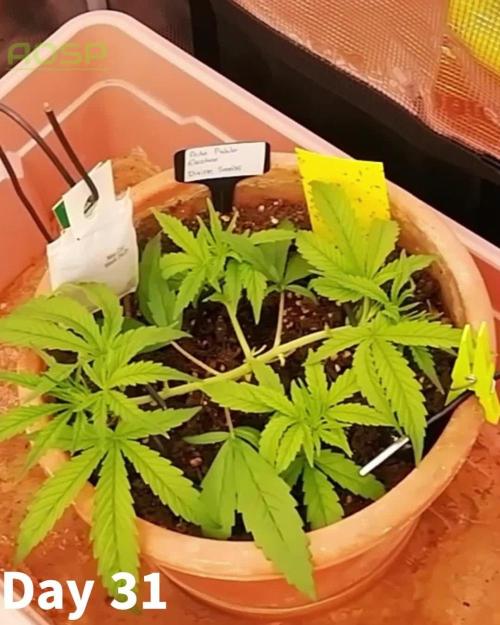
Bewässerung: 500 ml jeden 3 Tag in der Fünften Woche
pH-Wert: 6
EC-Wert: 1,8 mS/cm
Temperatur: 26ºC
Luftfeuchtigkeit: 55%
Schädlingsbekämpfung: im Moment haben wir keine Anzeichen das es was zu bekämpfen gibt, sobald die ersten Anzeichen da sind werden wir handeln :), aber zur Sicherheit haben wir wieder ein paar Raubmilben an die Pflanzen gehenkt.
PPFD: 600 µmol/m²/s
DLI: 38 mol/m²/Tag
Düngemittel: Sie bekommt CalMag von BioBizz zu Prävention. Ab Tag 8 haben wir angefangen sie mit einem Mineralischen NPK Dünger (NPK 10-4-7) zu Gießen .
Besonderheiten: Sie ist nun seit einer Woche im Großen Zelt und macht sich ganz gut.
-Tag 33 Heute haben wir sie Stark entlaubt und wieder nach unten gebunden. sie haben eine Portion Dünger bekommen und wird in den nächsten tagen weiter Trainiert.
-Tagg 35 Heute wieder Entlaubt und Gegossen mit Dünger, Sie wächst sehr schnell und erholt sich rasch vom entlauben. Sie wurde heute auch in einen der Größeren Töpfe umgepflanzt und muss sich nun ein paar Tage erholen.

Likes
35
Share


@StonedandSteady
Follow
6th W/Flower: 6th Feed of #HumboldtCountysOwn Packed and Stacked
6th w/ Flower: Budz getting Outstandingly Huge, Plump, Dense, Juicy and Everything is Supreme, Savory, Stinky, Sweet, Swelling Out, Skunky and Gasy at thier 6th week of Flower!
6th Week of Flower: 6th Flower Feed of #HumboldtCountysOwn and the Ladies Love the Bloom portion of Nutrients! They're Stacking Up Great and Filling Out thier Mighty Branches with Giant Gorgeous Budz! 5 Confirmed Females!!!
It's been a few days since I gave the Ladies thier 6th Feed of #HumboldtCountysOwn Nutrients and they look Fantastically Divine!!! We'll definitely Grow back to everything here soon! 11th w/ Veg and Flowers Update #Pre-Sexed🚺 #SuperCropped #Defoliated #Lollipoped
Good Day and Happy Growing Everyone! These Ladies were Growing into thier 11th Week of Veg and Looking Totally Tight and Phenomenally *Femed* from the Right!
#Pre-Sexed 4/9/21 #Opium/#PabloEscobar *Fems* breed by Team #DivineSeeds #DivineSeedsSquad #DivineSeedsBreedingCompany and #SuperCropping continued! I'm Very Excited and Extremely Gracious!!!
Heck Yeah Growmies and Growmets!!! Check Out these Confirmed Females with thier Wild Pistol Hairs popping and I'm still Training and Widening them Out with #SuperCropping Everything looks Expanded and Growing Great!
After #SuperCropping the plant will Grow Bushier, Produce More Buds, and possibly even Produce More THC! This is how the plant naturally responses to danger and protects itself! Growers take advantage of this technique to get Bigger Yields and More Potent Buds than would be produced otherwise!
Getting Trained out into thier 11th Week of Veg and Looking Mighty Fine!!! Thier getting Humongous and Hearty in thier 10 gallon Grow Bag from Broski #www.as420.ca These Cannabis plants are Camping out in the Closet for a week or so! Lol
This is my 2nd run using the Osree.Light QB1000w and Everything is Mesmerizing!!!
My #Opium and #PabloEscobar *Fems* from #DivineSeeds Regs: SalamiLegF3's×2 and FireAlienRomulan look$ Outstandingly Awesome and Growing Up Phenomenally Fine into thier 11th week of Veg in our 2- 10 gallon The Grow Bags from Broski #www.as420.ca and also 2- 5 gallons as Well! Our others are Super and Breed by #thehumancannabiniod #AlienBloodGenetix #TNBNaturals #Foop
Yo!!! Thanks Again for All the Love and Support my fellow Growmies and Growmets!!! These Magnificent and Magical Ladies were Growing in our 48×24×60 ViparSpectra Official Club 🌿 ®️ Grow Tent and under our #Osree QB1000w and #GrowStarStore Kokokala QB1000w and our Purple Rose Cutting×2, Aloe Vera Cutting, Maters×3, Morel Mushroom, Lavender×3, Sunflowers×5 and The 5 Brand New and Fresh Starts are Wonderful with a Huge Hint of Fantastical Fire is my #SalamiLegF3×2 by Broski #thehumancannabiniod #DankFlowGenetics #EastCoastSeedBank #FireAlienRomulan by Broski #AlienBloodGenetix my #PabloEscobar and #Opium by Team #DivineSeeds #DivineSeedsBreedingCompany We Grow with #Growatt 600w with #FoopOrangicBioSciences and #TNBNaturals The Enhancer Co2 Despersal canister and ph'd them w/ Declorinated watering w/ TNB ph Up and Down! Totally Top Quality Topz all Around! Thanks Again #GallowGlas420 #HarleyGrower #thehumancannabiniod #AlienBloodGenetix #TNBNATURALS #FoopOrangicBioSciences #www.as420.ca #divineseeds #divineseedssquad #divineseedsbreedingcompany #BioFlux Family's and Teams!!! Your Genetics are Merry Magnificent, Mega Marvelous and Mighty Medical! Love um!!! I really Can't stress enough how Thankful and Grateful I am of All of you and what you've Shared with Us! Means the World!!! It's definitely a Pleasure being able to Grow with these Phenomenal Grow Lights! Please Enjoy! BudBrothers4-Life! Cheers Famz!!! Much Props and Much Topz!💯🔥 #Osree #GrowStarStore #Growatt #TNBNaturals #TNBTeam #FoopOrangics #GrowYourOwn #Bliss
HumboldtCounty'sOwn:
Email: info@humboldtbottling.com
Phone: (707) 725-4119
Toll free: (866) 872-9434
Humboldt Bottling
Po Box 429 · Fortuna, CA 95540
HumboldtCounty'sOwn Website Link: https://humboldtcountysown.com/
HumboldtCounty'sOwn Instagram Link: https://instagram.com/humboldtcountysown?igshid=1qj809qkkwych
https://instagram.com/osree.light?igshid=1vrsbdyhzg2h8
https://instagram.com/growstarstore?igshid=2yjn0r00r6ru
https://instagram.com/divine.seeds?igshid=1r90iwe9xiwz8
https://instagram.com/thehumancannabinoid?igshid=17k159pumklkq
https://www.instagram.com/alienblood_genetix_official/
https://instagram.com/as420.ca?igshid=1f116alw054wp
The Grow Bags: https://www.as420
Likes
20
Share


@DeepRootsGrowTrees
Follow
KRITIC AUTO by KANNABIA
Week #14 Overall
Week #11 Flower
She's got one more week before harvest. She's a beautiful plant with her orange and shades of purple in her frosty buds and her danky smell! Stay Growing!!
Kannabia.com KRITIC AUTO

Likes
46
Share


@Ju_Bps
Follow
Hello my friends,
Start to be smeel end,
This end week more and more milky trichromes.
I've stop to give fertilizer this week,
I'll start flush.
I think my yellow leaves was the senescence, thanks for help guy 👍.
Have a good week, and see you next week.
Enjoy mt friends.


