


Likes
Comments
Share



Likes
1
Share

@4hundert20
Follow
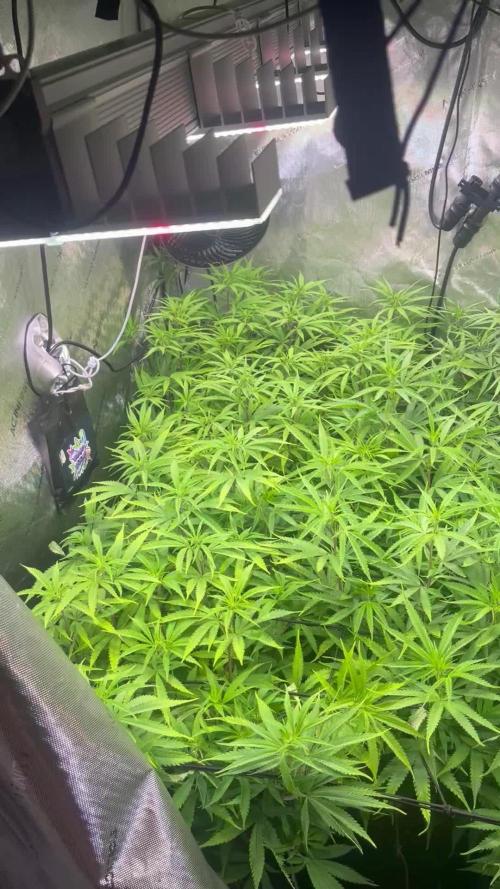
War ein drei Tage nicht daheim und konnte mir den Stretch nur bei Überwachungskamera ansehen. Wurde dennoch überrascht..
Das Netz macht so nicht mehr all zu viel Sinn aber ich lass das so einfach.
Muss immer wieder nach und nach ganze Äste abschneiden, um Platz zu machen. Teilweise teilen sich 4 Triebe eine Masche 😅

Likes
252
Share


@Tropicannibis_Todd
Follow
Well folks we chopped the Strawberry Cola 😁
And the third of the Strawberry Blast Series 🍓 🍓 🍓 🍓 Shes a killer for sure , incredibly frosty , and sticky , nice tight nugs wish I had more thoe guess I will need to grow her again , the smell is sweet and berry-licious but she's definitely got that cola whiff to her ......
FC4800 from MarsHydro Lights being readjusted and chart updated .........: 1:I've added a RU45 to the mix : 1:
www.marshydro.ca
👉I am using Agrogardens for nutrients for my grows and welcome anyone to give them a try .👈
👉 www.agrogardens.com 👈
Agrogardens Cal MAG
Agrogardens Grow A B
Agrogardens Bloom A B
Agrogardens Bud Booster
Agrogardens PK13/14
I GOT MULTIPLE DIARIES ON THE GO 😱 please check them out 😎
👉THANKS FOR TAKING THE TIME TO GO OVER MY DIARIES 👈
Would you like to hang with the growdiary community 👉 https://discord.gg/gr4cHGDpdb 👈


Likes
22
Share

@MARCTAKAHASHI
Follow
Semana 2 de crecimiento vegetativo completada.
La primera foto de esta actualización corresponde al día 15 de crecimiento vegetativo y día 21 desde la emergencia.
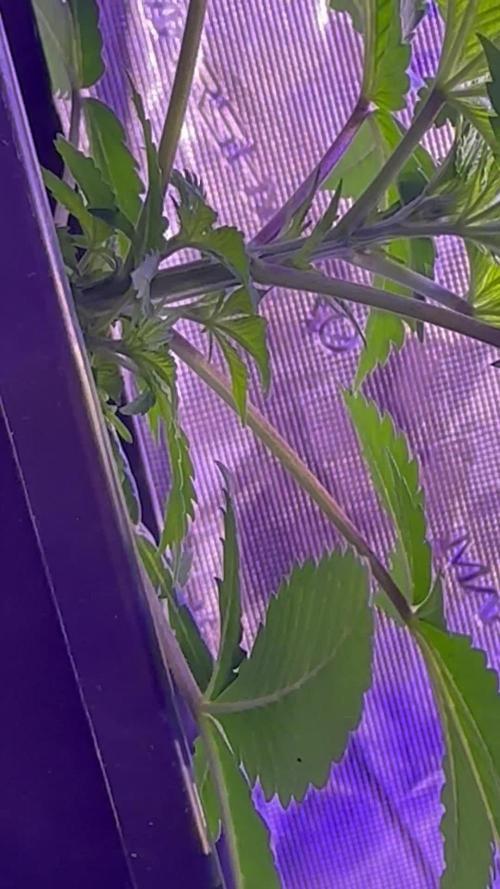
La Super Boof sigue mostrando un crecimiento fuerte y compacto, con tallo principal grueso, internudos cortos y buen desarrollo de las ramas laterales. Durante esta semana se adaptó muy bien a la maceta de 7 L y llegó a formar el sexto nudo.
La iluminación se aumentó progresivamente hasta aproximadamente 290–350 PPFD con la Mars Hydro FC-3000 y la Adlite Blue, manteniendo un fotoperiodo de 18/6. La planta respondió bien, sin signos visibles de exceso de luz, carencias ni sobrefertilización.
En el riego se utilizó ATA Rootfast a 0,5 ml/L y ATA Terra Leaves a 0,5 ml/L, ajustando la solución final a pH 6,5.
Al final de la semana se realizó el trasplante a la maceta final de 50 L. El cepellón estaba muy bien colonizado, con abundantes raíces blancas y sanas. Durante el trasplante se aplicó Micro Vita de Top Crop alrededor del hueco del cepellón para favorecer la colonización del nuevo sustrato.
Después del trasplante se realizó un riego de asentamiento de aproximadamente 7 litros, repartiendo cerca de 1 litro alrededor del cepellón y el resto por el sustrato exterior. El siguiente objetivo será dejar que la planta se recupere y vuelva a crecer con fuerza antes de realizar la primera poda de formación.

Processing
Likes
3
Share


@XxBILLZAxX
Follow
No food until I figure out what this leaf curl is. A couple of weeks left I'm thinking so flush week after.
Flushed this week as I thought the curl was salt however still happening :(
Likes
8
Share


@Shellshocked
Follow
Everything is going well I got a raptor hood for my 600 watt so I was able to drop my light right on top of my plants maybe 6 niches away . Noticed she was getting a bit lighter in colour so I brewed up a tea first 1 ever just switched to organics tea looked good hopefully not 2 strong . I also pulled some branches out to open up more branches to get light as she was bushy and I did not want to cut most of the branches off because I'm not trimming larf lol. Now it's smooth sailing to the end I got 1 more top dressing next week and all I gotta do is water once a week

Likes
25
Share


@Chubbs
Follow
What up fam. This girl has absolutely exploded into a beast. It's probably the one of the biggest Autos I've ever grow and definitely drink more then any I've grown. She's drinking a gallon a day and not showing any signs of slowing down. The flowers are definitely forming and looking phenomenal. Happy Growing
Likes
43
Share


@Mz876
Follow
We’ve made it to week 5 of Flower. She smells amazing . I’m excited for her harvest . She’s just fattening up . Just water for the rest of the run . No more soil amendments.

Likes
25
Share


@DrGanj
Follow
COntinued to apply small amounts of pressure with LST but aside from that, letting her do her thing.
Had to leave her for a few days and she got dehydrated, after a feed she perked up again but she's now started sucking all the nutes out of her lower growth. She has a lot so I'm hoping it doesn't affect the harvest. Would have preferred this to begin with my flush.
For more content on all my grows please check out my Instagram! Link is on my profile!
Likes
21
Share


@Ultraviolet
Follow
Heyókȟa
I desire to study nature, and to know better the mind of God, the creator, Holy art thou, O Father.
12x12=144, A dodecahedron is a polyhedron with 12 faces, and in coordination chemistry, it refers to a geometry where ligands surround a central metal atom (in this case, Magnesium) in a specific, 8-coordinate arrangement. Dodecahedrane is a hydrocarbon, meaning it's composed solely of carbon and hydrogen atoms. The carbon atoms are arranged at the corners of a dodecahedron, a 3D shape with 12 pentagonal faces. The water molecules in the dodecahedron form hydrogen bonds that are individually slightly weaker than in either the dimer or the tetramer. However, because three-quarters of the O -H groups in the dodecahedron form hydrogen bonds, it has a more negative energy per molecule than has either the dimer or the tetramer. Magnesium (Mg2+) is the essential, central metal ion in the chlorophyll molecule, crucial for photosynthesis by enabling light absorption and energy transfer. It is chelated by four nitrogen atoms within the porphyrin (or chlorin) ring structure. Chlorophyll appears green because it reflects light in the green region of the visible spectrum, specifically between 490 and 570 nm. The main resonance electronic frequency of a neutral Magnesium (Mg) atom corresponds to the transition from the ground state to the first excited state. Resonance Line Wavelength of Mg2+: 285.1nm (UVB light). The central atom of the chlorophyll molecule is Magnesium (Mg2+), which is coordinated within a porphyrin ring. The electronic "resonance frequency" of this central atom—meaning the frequency at which its electrons absorb energy—is primarily driven by the electronic transitions (ETR) of the surrounding conjugated chlorin ring structure, rather than a discrete atomic transition of the Magnesium atom itself. The resonant electronic frequencies of the chlorophyll porphyrin (technically, a chlorin) ring are determined by the energy required to promote π-electrons within its conjugated system, primarily appearing in the blue and red regions of the visible spectrum.
In standard physics, Chloryphyll b has peak absorption at 460nm (Blue). If we take the peak wavelength 460nm and a UV-B, UVR8 peak absorption wavelength 285nm Tryptophan-285 (W285) Sensing protein. 460/285=1.618 Φ, "natural harmony" and the "structure of light". The cryptochrome photoreceptor (CRY) is a UV-A/blue light receptor that shares this dual sensitivity with several other biological structures and functions, including significant sequence similarity and a common evolutionary ancestor with DNA photolyase enzymes. These are light-activated enzymes that use blue/UV-A light to repair DNA damage caused by UV-B radiation in plants.
Dodecahedrane (C20H20) is a hydrocarbon with a cage-like structure where carbon atoms form 12 pentagonal faces (a regular dodecahedron). It is highly symmetric (icosahedral), contains no delocalized electrons (no aromaticity), and has minimal angle strain, but significant torsional strain. Water Dodecahedron (H2O) forms hydrogen-bonded cages. While individual hydrogen bonds in this structure are weaker than in the linear dimer or tetramer, it has a more negative total energy per molecule. This is because three-quarters (75%) of the groups are involved in hydrogen bonding, creating a very stable, closed-shell configuration. a 3D carbon hydrocarbon (C20H20) to stable water clusters in hydrate, while the Magnesium ion acts as the central activator within a conjugated ring in biological systems, with its electronic absorption dominated by the ring, not the atom itself.
Effective quantum efficiency of photosystem II, often denoted as ΦPSII
In horticultural lighting, adding 730 nm (far-red) LEDs alongside standard red/blue lights has been shown to increase canopy photosynthesis by 20–30% in several crops by acting synergistically with shorter wavelengths. However, the limitation is that excessive, pure IR/Far-red light (without accompanying red light) can trigger the "shade avoidance response," causing plants to grow tall, weak, and spindly rather than robust. Knowing is half the battle however, engineering or utilizing infrared light (specifically the 700-750 nm far-red range) is a viable method to boost photosynthetic efficiency. It acts as a bridge to allow PSII to utilize a broader spectrum of light, breaking the traditional 700 nm barrier.
Extend, then multiply.
UVR8-mediated signaling (often in conjunction with CRY proteins) triggers protective mechanisms that maintain the stability of the photosynthetic apparatus (including LHCII and reaction center proteins), thus ensuring that the efficiency of Photosystem II remains higher in UV-B-exposed plants compared to plants lacking this receptor. ΦPSII indictates the rate of electron transfer from water to plastoquinone, which drives the production of ATP and NADPH. There is a close link between ΦPSII and the true rate of CO2 fixation (Φ*co2), particularly in C4 plants.
Effective quantum efficiency of photosystem II, often denoted as ΦPSII, represents the proportion of light absorbed by Photosystem II (ΦPSII) that is actually used in photosynthetic electron transport. It is a key indicator of how efficiently a plant is using light for photosynthesis, as opposed to losing it as heat or fluorescence. ΦPSII (effective quantum yield of photosystem II) functions primarily as a "multiplier" (a coefficient of efficiency) rather than an additive factor when estimating the overall photosynthetic electron transport rate (ETR). Multipliers are considered far more beneficial than additions because they generate exponential growth, leverage existing resources to their full potential, and create sustainable, self-multiplying capacity, rather than just incremental, linear increases.
Humans, and most other mammals, rely on other mechanisms, such as nucleotide excision repair, to manage and repair UV-induced DNA damage. As such, humans do not have the direct, light-driven repair mechanism that photolyase offers in plants.

Likes
18
Share


@CRK00
Follow
9th Week Report 12/12/19 - 19/12/19
In photos CMXL is on the left and LSD on the right
12/12/19
Unfortunately humidity at 80% and since is too high from next week I will try to give them more aeration. Hope there won't be mold.
Changed solution and raised its strength to 90% and unlikely the last change I didn't added a small quantity (0.5/L) of "grow" nutrient as both are in full flowering
13/12/19
CMXL got a bigger defoliation and now you can see even more bud sites! 😁 Just waiting for her ;)
Looking to LSD I guess next week we probably will be ready to harvest. As you can see she almost has no more space, CMXL is giant (and beautiful) and she is starting to cover LSD, but hopefully LSD will be harvested soon and consequently CMXL will have all the space she needs.
CMXL was defoliated every couple of days, the quantity of leaves that were removed during every defoliation session is more or less like in the photo uploaded.
However it looks like CMXL is not anymore stretching and just fattening up, so from the next week will get light defoliation just when needed (if she will cover everything again like last week probably will get one more last stronger defoliation).
Any comment or suggestions is appreciated, especially if you have tips about LSD time to harvest! Thanks in advance dudes 😁👊
Last Update 19/12/19
See you guys ;)


Likes
20
Share


@Stickybudz420
Follow
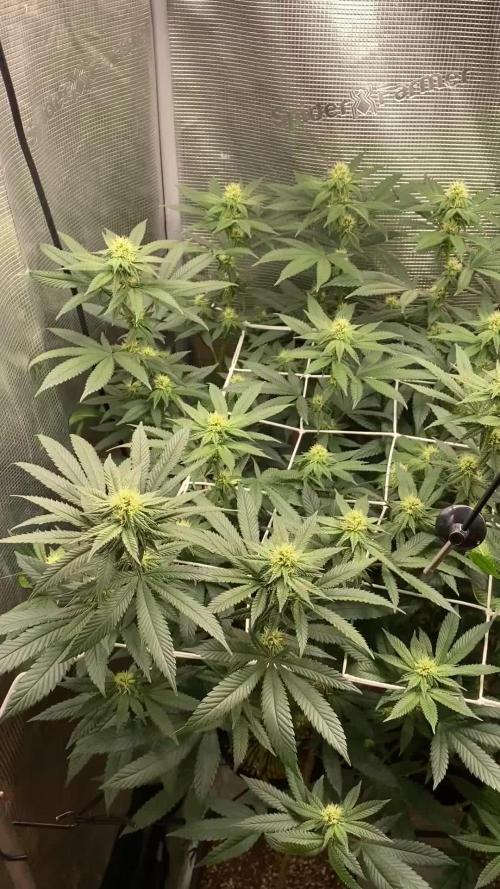
Decided to LST in the end was a bit scared after the state of my Zkittlez OG, but decided to take some advice from a fellow grower here on GD hope all grows well and HAPPY GROWING GEEZERS!! 🙏🙏🤞🤞🌳🎄



Likes
12
Share


@mircostuffff
Follow
Sieht bis jetzt gut aus .Gustavo brauch noch ein wenig länger' denke er wird den meisten ertrag bringen lass gern eine Meinung dar ist mein 2ter versuch
Brauchte vllt tipps zum trocken etc
Processing
Likes
17
Share


@Hawkbo
Follow
I still have to go thru all the photos but wanted to get the video up for all of them first. If your interested in the pics come back at the end of today and they will be up it just takes a while. Noticing more seeds poppin thru, I hope it's from the moonshine cookies pollen cuz the female turned out bomb and the male wasnt too bad either so they might be decent seeds. Started the flush on the citradellic and the other ones might have got their last feed yesterday. Should be finishing up next week and the week after.
Likes
49
Share

@RockoCalenberg
Follow
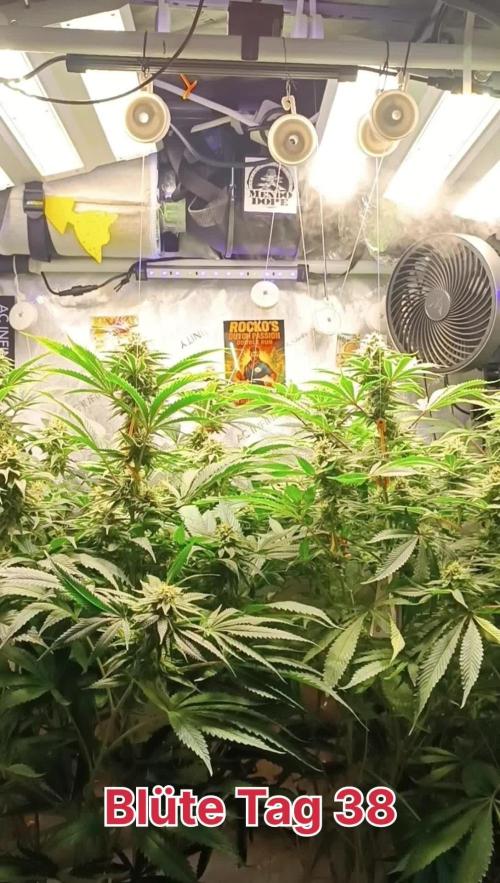
🌱 Blütetag 38 | Tag 98 gesamt
Klima – VPD Achterbahn
Wieder eine unruhige Woche draußen.
Mildes Regenwetter mit hoher Luftfeuchte → dann wieder kalt → dann wieder milder.
Typisches Hin und Her.
Die Pflanzen müssen ständig Transpiration und Nährstofffluss nachjustieren. Konstantere Bedingungen würden es ihnen leichter machen – aber sie arbeiten sich so durch.
🌿 Pflanzenstatus
White Gushers 33
Diese Woche zeigt sie etwas mehr Sensibilität.
An exponierten Trieben sind Klimaspuren sichtbar – kleine Nekrosen und leichte Transportanzeichen. Nichts Kritisches, aber erkennbar, dass sie die Schwankungen spürt.
Trotzdem baut sie weiter auf.
Blüten stapeln sich, die Harzproduktion nimmt zu und das fruchtige Aroma wird von Tag zu Tag intensiver.
Triangle Sherbet Kush
Deutlich die ruhigere im Zelt.
Sie geht gelassener mit den Schwankungen um und wirkt insgesamt stabiler. Auch hier kleine Spuren, aber weniger ausgeprägt.
Die Blütenstruktur wird kompakter, das Stacking läuft sauber, und aromatisch wird sie zunehmend runder.
🌸 Blütenentwicklung & Aroma
Beide Strains legen gut zu.
Mehr Dichte.
Mehr Harz.
Mehr Charakter.
Beim Öffnen des Zeltes kommt inzwischen direkt ein wahrnehmbarer, fruchtiger Duft entgegen. Wir sind klar in der Mitte der Blüte angekommen.
💧 Nährstoffe
Konstant gehalten:
CalMag: 1,5 ml/L
Bloom: 1 ml/L
Einfach, stabil, ohne größere Änderungen.
🐞 IPM / Biologischer Pflanzenschutz
Das biologische Team arbeitet weiter:
Florfliegenlarven
Raubmilben
Gelbtafeln zur Kontrolle
Ein leichter Rückgang der Trips ist erkennbar, aber sie bleiben hartnäckig. Kein akuter Druck – eher ein laufender Prozess.
🔎 Ausblick
Insgesamt bin ich zufrieden mit dem Stand.
Das Klima dürfte ruhiger sein, aber Blütenentwicklung und Aroma gehen klar in die richtige Richtung.
In der kommenden Woche plane ich eine leichte, gezielte Entlaubung (etwa 2-3 Wochen nach dem ersten Durchgang), um Licht und Luft für die letzten Wochen optimal zu führen.
Ich rechne mit etwa vier weiteren Wochen bis zur sauberen Ausreifung.
Toll, dass hier viele mitlesen, Input geben und Erfahrungen teilen – genau das macht so einen Run spannend.
Achterbahn-Woche.
Blüten bauen trotzdem.
Danke fürs Mitfahren.
— Rocko 🌿🔥💚
🌱 Flower Day 38 | Day 98 Overall
Climate – VPD Rollercoaster
Another unstable week outside.
Mild rain with high humidity → then cold → then mild again.
Classic back-and-forth weather.
The plants constantly have to readjust transpiration and internal nutrient flow. More stable conditions would definitely make things easier for them — but they’re pushing through.
🌿 Plant Status
White Gushers 33
She shows a bit more sensitivity this week.
On exposed tops, climate marks are visible — small necrotic spots and light transport signs. Nothing critical, but clearly showing she feels the swings.
Still, she keeps building.
Bud stacking continues, resin production is increasing, and the fruity aroma grows stronger day by day.
Triangle Sherbet Kush
Clearly the calmer one in the tent.
She handles the fluctuations more gracefully and appears more stable overall. Minor signs here as well, but less pronounced.
Bud structure is tightening up nicely, stacking remains solid, and the aroma is becoming rounder and richer.
🌸 Bud Development & Aroma
Both strains are progressing well.
More density.
More resin.
More character.
Opening the tent now immediately releases a noticeable fruity scent. We’re clearly in mid-flower mode.
💧 Feeding
Kept consistent:
CalMag: 1.5 ml/L
Bloom: 1 ml/L
Simple, stable, no major adjustments.
🐞 IPM / Biological Control
The biological crew is still at work:
Lacewing larvae
Predatory mites
Sticky traps for monitoring
A slight reduction in thrips is noticeable, but they remain persistent. No major pressure — just an ongoing balancing process.
🔎 Outlook
Overall, I’m happy with where we stand.
The climate could be smoother, but bud development and aroma are clearly moving in the right direction.
Next week I’m planning a light, selective defoliation (about 2-3 weeks after the first round) to optimize airflow and light penetration for the final weeks.
I’m expecting around four more weeks until proper maturation.
Great to see so many people following along, sharing input and experience — that’s what makes a run like this even better.
Rollercoaster week.
Buds keep building.
Thanks for riding along.
— Rocko 🌿🔥💚
Likes
Comments
Share


@JararacaHaze
Follow
Week 9: Growth, Clones, and Preparing for Buds
This week brought some important changes to the grow!
The plants stretched significantly, taking advantage of the rainy weather, despite the temperature fluctuations.
Overall, the conditions are supporting their development well.
Notes:
I made a few more clones, and so far, all of them are thriving. It's exciting to see a 100% survival rate for the clones so far.
Out of the 12 plants, I identified three males. Two of them have started opening their pollen sacs, and I’ve begun collecting. The pollen is being stored in the freezer for future breeding projects.
I did a light defoliation to improve light penetration to the lower branches, which should help promote even growth.
Likes
22
Share


@PrairieFrostGrow
Follow
*
*********** Week 11 - June 20 to 26, 2020 - Days 71 to 77 from germination ***********
*
These girls have been continuing their growth this week and looking better all the time. GSC2 still slow though and will not have much yield. Her leaves have turned very dark this week due to lockouts I suspect. Her hairs are still very white and coming out pointy looking for pollen and swelling. GSC is still swelling and her buds are bigger at the end of the week. Purple colours also coming out in her.
The big girl has done well being squished in the corner as I had to put the two in one tent this week. The frost in GSC has been coming out for the last two weeks and is really getting sticky this week. The pH is still crazy high for the girls but they are pushing through this issue and finishing up. These are very resilient plants and I am impressed with her vigour!!
Still giving them feedings in the 3.0 pH range to help as her runoff is still coming in at mid 7’s......for both girls. GSC has been feed hard because her leaves have a nice pale colour, unlike GSC2, so keep her going and swelling. They were given a heavy watering of 8L each on day 71 to find out where the medium is. They were 7.9pH when started and last runoff was roughly 7.1pH......should have gone further to bring down more but stopped there so I didn’t flush out all of the feed since they have a couple fo weeks left. The hairs on GSC are turning more of a tan colour rather than snow white. I suspect she they have roughly this week plus another yet before thinking about harvest.......I see them going to 84 days roughly, 12 weeks.
GSC bud sites are getting pointy this week. Added bamboo steaks to GSC to tie the long branches to and support her weight. GSC2 less so and are still looking more round as she continues to fill in her buds. GSC stems have been turning purple more and more this week. Suspect it is a combination of pH and stresses with temps. GSC2 was tied more this week as well to let more light in closer to the main stem. This paid off as well as she is stacking the lower points more. She, GSC2, has also paid a bit of a price over the last week because she was kept in the flower tent with other more mature girls. The environment in that tent was striving for 76 degrees and 51% humidity but GSC2 wants 82 degrees and 65% humidity........didn’t have much choice😢
Fast Buds has rocked this strain and dialled her in after the generations of breeding!! She is very frosty for an auto and had she been given the correct watering, she would be considered an easy grow In my opinion! The two girls are growing very different but that is grower related to transplant and not genetics. Awesome job Fast Buds......the girls are keeping me smiling......and scratching my head at the same time👍👍👍👍
Little more detail.......
June 20/20 - Day 71
- 6L low ph flush of plain water @ 4.0 to bring down pH..........3L each girl.
- Followed with a low pH feeding of 4L watering with Rezin, Liquid Wt, CalMag, B52 @ 2ml, Piranha @ 1ml, Voodoo @ 0.5ml/L, = 1170ppm and pH 4.4
- GSC1 tops are getting lots of purple in the bud.
- GSC1 is filling in nicely and top leaves are starting to fade yellow.
- GSC2 is dark😞
June 21/20 - Day 72
- continuing flush with 12L of plain water pH to 3.3 to bring down pH.
- 6L given to each girl.
- added bamboo stakes to pull GSC1 apart and open up the middle bud sites to more light.
- GSC1 is 38" tall and 36" across now😀👍
- GSC2 is 20" tall and 24" wide👍
June 22/20 - Day 73
- 2L each watering with Rezin @ 1ml
- hairs are turning more red and more white to tan now.
- GSC1 is closer.....getting to home stretch soon.
June 23/20 - Day 74
- 5L - Massive @ 3ml/L, Rezin & L.Weight & B52 @ 2ml/L, Vitathrive & Dual Fuel @ 1ml/L = 1110ppm
- GSC 3L, GSC2 - 2L
- they are getting close to the end so getting the last bits of everything into them😀
- noticing GSC1 top cola may start to bleach out a bit.
- GSC2 feels like she has stalled.
June 24/20 - Day 75
- watering 3L each with Massive & Terpinator @ 3ml/L, Rezin & Vita & L.Wt @ 2ml/L, Dual Fuel @ 1.5ml/L, CalMag @ 1ml/L = 1385ppm and pH to 3.9...crazy!
- moved the two girls together today as the other two are going into darkness now, they are done.
June 25/20 - Day 76
- Dry out day
- GSC is doing well with her buds filling in now and firming up. Top leaves are drying more.
- GSC2 is dark.....F......plain water and not much more we can do.
June 26/20 - Day 77
- 7L watering with Rezin and Sensyzime @ 2ml = 75ppm and pH at 4.0
- 4L given to GSC and 3L given to GSC2.
- Staying with RO water now.......tap water appears to have been an issue.
- too bad the ph was such an issue.....GSC would be a monster😞
- run off numbers in pots:
GSC 7.6pH and 780ppm
GSC2 7.6pH and 1850ppm (she has stalled)
Awesome strain Fast Buds.......will be running her again!!!!!!
Likes
6
Share


@PussyMoneyWeed
Follow
Those experimental weaklings managed to survive in a hand size plastic pot))
The 2 biggest are the auto white widow, the average one - is purple lemonade, and the smallest is auto crystal meth.
and 2 side seeds ( were to be a Plan B) in a plastic pot and size of my hand and shot size plastic pot

Processing
Likes
22
Share


@Silverback_Guerilla
Follow
5/25:
It rained again today for most of the day, but I managed to get back out there and take some photos after it let up. I also shot a short video early in the a.m while it was sprinkling and the lights were on...
I heard that this strain flowers really fast, but I really don't think she can finish before June 21 (the summer solstice). The other two seedlings (FFT#5 and FFT#6) are in the same boat. The 5 clones outdoors might be able to finish before they get the signal to reveg. I may end up bringing as many of them as I can fit into my closet to finish and starting another batch of beans to grow outdoors this summer...
5/26 - 5/31:
I did some training on her early in the week between rain showers, and foliar fed with Microlife maximum bloom formula. She was looking a little N deficient, so I assume the dry amendments have petered out. I top-fed her with another couple tablespoons of cavern culture and on the 31st, they were dry enough to feed them. I gave them big bloom, tiger bloom, grow big, beastie bloomz, silica, endoboost, signal, humic acid, liquid kelp/fish emulsion, and liquid molasses.
It just feels so strange that I'll be harvesting outdoor photos in June!?!
That's it for week 8-

Processing
Likes
5
Share


@Bigsmokes420
Follow
First week of flower in the bigger tent and on the Autopot xl smart pot system. Trying a new product on this run which is rock resinator which starts on Monday. Will leave these now to grow through out each week till day 20.