Likes
Comments
Share


@Chuckwaggon420
Follow
This week has been time to put on weight!! They are getting so heavy glad put in secondary scrog net.
Have only been doing water so plants can just pull what they want our the soil they are starting to fade on their own. They have some amazing kinda blue tent to the buds. They have a gassy sweet smell to them!
This will be the last week I feel but still see some clear heads and no amber so shall see over next week!!

Likes
1
Share


@BruWeed
Follow
Esta semana ya realice la poda. Se encuentra en estos momentos en etapa de secado dentro de una caja especial para secados de flores que uso siempre y nunca me falla.
En humedo hay 195g y utilice una lampara led de 150w en todas sus etapas.
Próximamente estaré publicando cuando este en curado.

Processing
Likes
30
Share


@CBD_Sweden
Follow
2018-04-03 Week 14 Day 1
Not much to say, there isn't much drama going on in growroom 2, the only things I do is giving them water and nutes 2 - 3 times/week and making sure that the lamp don't burn the girls.
I gave them 4 liters today, and since they live in smartpots I can see when the pot gets wet when watering the girls, but you could hardly notice that. They are getting thirsty 😛
The flowers are developing very good, they look really healthy and their colors are fine.
Crazy Cookies nr 1 is 66 cm
Crazy Cookies nr2 is 52 cm
2018-04-04
Raised the lamp to it’s highest level and turned all girls 1/4 turn, it’s really hard to get in to the ladies in the back, I need to push the girls up against the walls on each side and crawl on the floor to be able to turn them and give them water/nutes.
Damn these plants, why do they have to grow and become so BIG?! 😆💪
Added a new video, enjoy my SoG 😄
-----------------------------------------------------------------------------------------------------------------------------------
Strain information:
The word synergy is a business term first quoted in the early eighties to describe mutual enhancement through interaction or cooperation, where the end result gained is greater than the sum of the parts used. What do synergy and the Crazy Cookies cannabis strain have to do with each other you may well ask?
The parents of the forthrightly indica Crazy Cookies are marijuana royalty. OG Kush and Girl Scout Cookies. These strains of contemporary legend have been combined to cerebrum shattering effect. The cured flowers deliver a mouth-watering and couchlocking 24% THC. The initial delectable spacey upbeat onrush compliments of the Durban Poison coursing through the genes of the Cookies soon becomes a lush and rich, inescapably delicious body flux.
There should be a picture of a Crazy Cookie nugget in the dictionary next to the word synergy. Crossing the OG back into the Cookies has amplified the psychoactive effects of the notorious lineage of both parents. This is an indica with a capital I.
As a breeder it would be fair to assume that injecting more OG into the Cookies would result in an OG-dominant Cookie, or even close to a pure OG, but something else has happened. Some long dormant genetic switch has been flipped and a standalone indica has emerged whose spicy notes and earthy tones, hints of grape and horny pheromone are an absolute pleasure.
Paying this breed some careful attention as it grows will reward you substantially, indoors or out. Typical hybrid vigour is shown throughout each grow phase. Stout plants to 80cm can be expected indoors and muscular examples with fluted stalks growing to two metres can be easily achieved outdoors. Good bracing is necessary as the flowers mature. With more than 500g at harvest per robust plant, colas can easily snap and twist branches.
--------------------------------------------------------------------------------------------------------------

Likes
25
Share


@m0use
Follow
Weeks been chill, plants are not drinking as much as I thought they would be. Still annoying to water them separately with PH'd shit, some days I just give them tap and say fuck it.
Can't say they are doing the best they could be doing. Been to busy with other things to give them the full attention they need for a first time liquid feed grow. Really should have done this indoors but I hate running a tent in the summer when the sun and heat are free. Granted the tomatoes are blocking some of their sun, have to move them aorund. been meaning to do that but no where to put them where they won't block out some other plants.
Been having some fun making the little videos each week, been using open shot video editor to mash it all together and it works quite nice. Few crashes here and there as this laptop is garbage. It has so many features that I am not fully utilizing like cuts and effects but I've kept it stupid simple.
Bugger one of the videos did not upload into the diary. Annoying AF these things take forever to "resize/convert"
I like how the dead Blue Cindy plant looks like a biophage, sifi like alien thing.

Likes
7
Share


@SkunkleDamo
Follow
She's doing ok. Looking forward to this.
I have topped her at the third node and remove the first so I will have 4 tops in a fashion. These will each be topped and node 2 removed so she should end up with 16 equal tops in size and location.... hopefully

Likes
94
Share


@JUNGLE_B4RNS
Follow
Hey all ! Here we go again, with some super duper genetics (... and so f*ck*ng expensive 😱).
If you have a Growing Lad and you past here , STOP ! I NEED YOU ☝️
I wanna a job in the Cannabis industry, just leave me in your Lab I will do the rest 🐞
The Jumanji will be powered by Cellmax Nutrients :
[Day 113]
Last week for the Super Skunk , flushed the soil to 450ppm, the buds are .... big ? Massive ? Stunning ? Donkey d*ck buds ? .... I can't find my words ... just look by yourself the video and the pictures I'll let you judge 😉
Now I really want to point the efficiency of Cellmax nutrients, as you can see the Alga-Max has done a wonderful jod, buds has exploded, but the most important thing is the scent and aromas... O...M...G so beautiful !!!! The Flower Stimulator has triggered and pushed to max level all the terpenoids and sweetness, all this combined with the Allzymes to increase a bit more the absorption I'm getting quality and quantity, this is a proof of high premium quality ingredients 👍
[Day 114]
- Water pH 6.5 (Cellmax pH Down Bloom)
GSC
GG
[Day 115]
- Water pH 6.5 (Cellmax pH Down Bloom) + Flower Stimulator 2ml/1l + Allzymes 1ml/1l : 400ppm / 0.9mS
BBG T.H, SS
OG
- Water pH 6.5 (Cellmax pH Down Bloom)
SS 1,2,3
WW 1,2,3
[Day 117]
- Water pH 6.5 (Cellmax pH Down Bloom) + Allzymes 1ml/1l + Flower Stimulator 2ml/1l + Alga-Max 1ml/1l + Earth Bloom Mix 2ml/1l : 800ppm
GSC
- Water pH 6.5 (Cellmax pH Down Bloom)
SS 2
[Day 118]
- Water pH 6.5 (Cellmax pH Down Bloom)
BBG T.H,SS
OG
SS 3
-Water pH 6.5 (Cellmax pH Down Bloom) + Allzymes 1ml/1l + Flower Stimulator 2ml/1l : 400ppm
GG


Likes
44
Share


@RakonGrow
Follow
Note :
+ jegliches Zubehör wird in der GermniationsWoche aufgelistet . Zeitraffer Videos folgen immer nachträglich.
+ videos werden so geschnitten das nur ein geschlossenes Zelt erscheint , ergo Fehlen paar reale Minuten (ca 1 Std) .
Sanlight Tageslichtzyklus in Lebenswoche 6 :
+ 200PPFD - 1h - 750PPFD - 16h - 750PPFD - 1h - 200PPFD = DLI 46.60
+ + Formel : DLI = PPFD * h * 0.0036
+ + in LebensWoche 6 ist der Max-DLI ohne CO² : 45.0
Dazu kann man sich gerne die Zeitraffer angucken . Die Pflänzchen brauchen schon Ihre Zeit auf touren zu kommen . Ergo ist Sonnenaufgang und Untergang reines Stromsparen .
Day 36:
+ 2Liter Flaschenwasser
+ + Dünger für Büte
+ + + Canna Terrar Flores (Achtung wirkt wie PH-)
+ + + Canna Boost
+ + + Cannazym
+ + + Canna Rhizotonic
+ Final : PH 6.2
Nach dem die Mangelerscheinungen wie gewünscht aufgetreten sind, gehts jetzt mit Blütedünger weiter . Sie hat sich prächtig in die neue Umgebung eingelebt. Wetter werte sind hier Super , also ist auch im Zelt super Stimmung :))
Videos folgen in den Tagen .
Day 37:
Sie wächst gerade noch paar Zentimeter :)) Blühten werden mehr .
Day 38 :
Und wieder das Licht etwas höher händen , den Sie wächst noch immer !!!
Day 39 :
+ 2Liter Flaschenwasser
+ + Dünger für Blühte
+ + + Canna Terrar Flores (Achtung wirkt wie PH-)
+ + + Canna Boost
+ + + Cannazym
+ + + Canna Rhizotonic
+ + + Greenhouse Feeding BioEnhancer als PH+
+ Final : PH 5.5 (das Urgesteinsmehl zieht das sowieso auf mindestens PH 6.5)
+ etwas Entlaubung der defiziet Blätter.
Day 40:
Day 41:
+ 2Liter Flaschenwasser
+ + Dünger für Blühte
+ + + Canna Terrar Flores (Achtung wirkt wie PH-)
+ + + Canna Boost
+ + + Cannazym
+ + + Canna Rhizotonic
+ + + Greenhouse Feeding BioEnhancer als PH+
+ Final : PH 5.5 (das Urgesteinsmehl zieht das sowieso auf mindestens PH 6.5)
Day 42:
+ 2Liter Flaschenwasser
+ + Dünger für Blühte
+ + + Canna Terrar Flores (Achtung wirkt wie PH-)
+ + + Canna Boost
+ + + Cannazym
+ + + Canna Rhizotonic
+ + + Greenhouse Feeding BioEnhancer als PH+
+ Final : PH 5.6 , Drain PH 6.89

Likes
20
Share


@greenAF
Follow
Lights 6500EVO 8(580w) UV (50w) 15min a hr, Under canopy (86w) 12hrs, IR 15min pre and post main lights, Deep Red 20min per hour
pH 6.2
EC 2.5
PPFD 1150-1300
Likes
6
Share

@PhinolaGreen
Follow
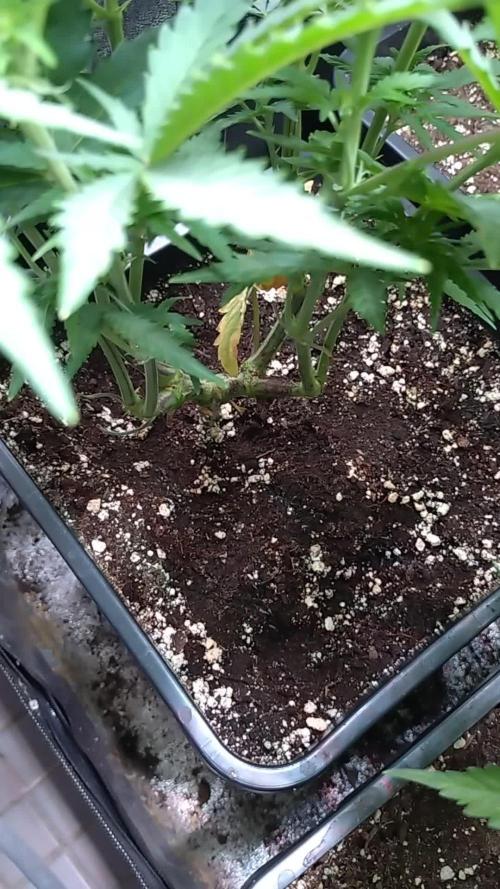
7. Woche
Halbzeit denke ich, North Thunderfuck Auto entwickelt sich gut, sie hat die Umstellung auf den großen Topf noch nicht vollends ausgebaut, die Wurzelstruktur und Masse war bei ihr in dem Stadium am geringsten. Sonst bin ich soweit zufrieden, Morgen gibt es wieder Dünger 😊


Likes
4
Share


Likes
49
Share


@Roberts
Follow
The Mandarin Squeeze girls are making progress. I did clip the long tail on the roots. I also lst the two plants apart. This is tge first time I have tried 2 plants together. Everything is going well, and there is nothing more to report. Thank you Spider Farmer, and Terpyz mutant Genetics. 🤜🏻🤛🏻🌱🌱🌱
Thank you grow diaries community for the 👇likes👇, follows, comments, and subscriptions on my YouTube channel👇.
❄️🌱🍻 Happy Growing 🌱🌱🌱
https://youtube.com/channel/UCAhN7yRzWLpcaRHhMIQ7X4g

Likes
11
Share


@Professor_Daank
Follow
8/30 - Day 65:
All is great. Plant 1 will be harvested very soon, I'm thinking September 6th or 13th... all depends on the trichome development.
I have come across a wicked calcium deficiency that I am solving with foiler spray and a little more supplemented in the nute mix, but I don't quite understand what's happening. I will post a question and update with information. I read it takes about a week to fix, so I'm not to worried about it ruining my harvest, it just sucks and I want to fix it.
8/3 - Day 69: Fuck... man... it's CRAZY how much they change overnight at this stage. We are flushing plant 1 (center plant in photos) Sunday, and we will harvest her September 13th, at the latest. I check her trichomes everyday and they are still not milky — so we wait! Colors are beautiful, bright orange and a wonderful violet purple. The sugar is just piling itself on. Smell is average, but if you bump them, or trim a leaf... it gets much, much more potent. The buds are sticky as literal superglue. I cannot wait to smoke.
We have been fighting a small CalMag deficiency the past 8 days, but I think we are out of it. Typically takes 6-8 days to see any sort of relief from this, and I haven't seen it spread to a few of the older colas, so that's good!
I'll get some more micro shots later this week.
Harvest scheduled for September 13th. Flush starts tomorrow - 9/6. Fuck. Yes.


Likes
1
Share

@tvojekarma
Follow
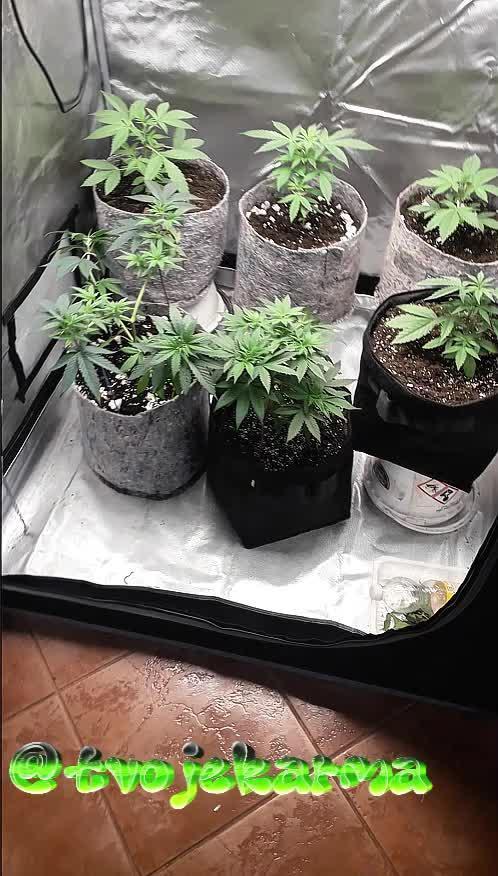
Welcome to Week 5! The tent is getting really full and all plants are looking healthy with a great green color. No signs of nutrient deficiencies, overfeeding, or pests.
- Auto Ultimates (Back Left, Back Right, Front Right): The back-left plant is currently the biggest auto and is already showing visible white pistils, officially starting its pre-flowering stage. The other two Auto Ultimates are catching up nicely, looking vital, and I expect them to push out pistils within the next few days.
- Lemon Kix (Back Middle): Growing very strongly with an active top. No visible pistils yet, but the structure looks amazing.
- Runtz × Layer Cake (Front Left) & Big Bud (Front Middle): Both photoperiodic plants are doing great. Runtz has an amazing dark green color and is branching beautifully. Big Bud recovered perfectly after the transplant, showing healthy new growth. Keeping them in the vegetative phase for now.
Likes
26
Share


@Nistnov
Follow
I left the honey cream outside in a dark place, which turned out to be a big mistake.
None of the branches that I trimmed and dried directly had bud rot but around 6 buds that were left outside had bud rot.
The mass of this plant really put me to the test took a whole lot of time to trim every branch. In fact I still have a bunch of branches that I'm too lazy to trim right now so I'll do a dry trim someday.
Although this grow had some problems it was an absolute pleasure to watch these plants grow and to now having this harvest is absolutely beautiful, a perfect strain mix.
I won't ever let them grow this big again since I really don't need that much weed and I think I'll going to have more fun with some extreme LST or something like it and I guess I'll look for strains that will flower earlier and not for ones that flower fast.
Likes
10
Share


@Murojuanna
Follow
Gave each medium around 15L water flushing,
Will continue to give only water for the next 14 days or so.
Flush began 30tht August.

Likes
422
Share


@Crashoverite
Follow
Hi all,
Welcome to my🍌💜👊 week update
Thank you so much for all support on this bananas journey. Much appreciate all your likes, follows and comments. 🙏💚❤️💜
Week 13
Jan 8- Jan 14
This was another amazing week. Girls are behaved very well. Drinking their juice like crazy. 2 waterings of 9ltrs on Jan 10th and Jan 13th. Runoffs at ph 6.2. Buds are gaining some serious weight and the trichomes development is of the charts. Girls are covered with frost. Trichomes are mainly milky now with individual ambers here and there. On Jan 10 noticed on one Athena top colas a white topped bud! It's something that has never happened to me. It may be only led bleach or it's something abnormal and phenomenal. It's white and has red and amber pistil hairs in between and all covered with trichomes. Few days after. White coulour is not spreading and not seeing any damages. The smell in my cabinet its insane. Very sweet scents. I wouldn't say bananas but definitely sweet berries and gummies 🤤 new dehumidifier doing an amazing job. Humidity when light is on is between 49-54% and 52-58% when lights are out.
It's all looking that my 🍌💜👊 girls will be ladies very soon. Harvest is coming big time. Next week planning to gradually cut nutrients down and prepare for flush.
Stay tuned for new week update very soon!
Peace and love brothers and sisters ✌️💚👨🌾
Links
https://2fast4buds.com/seeds/banana-purple-punch-auto
https://plagron.com
https://www.biobizz.com/
https://fishheadfarms.com/
Likes
4
Share

@Marihuahnma
Follow
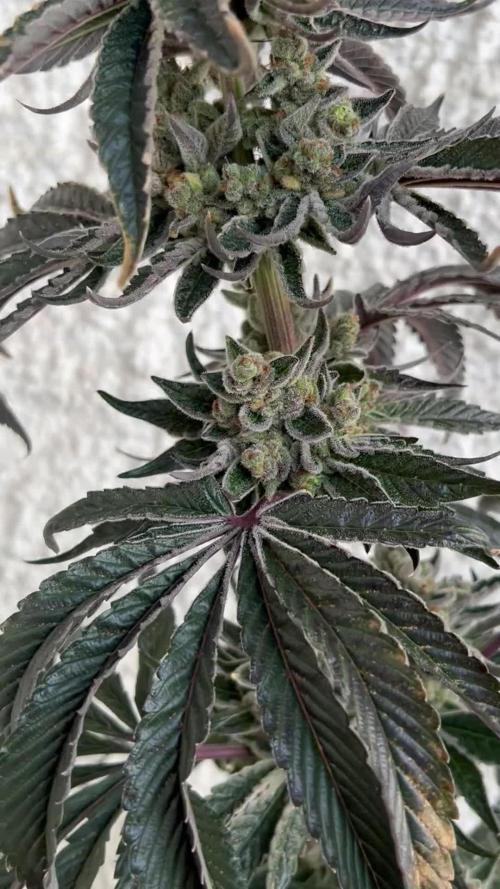
Erfolgreicher Grow/ernte.
Würde die Melonade Runtz jeder Zeit wieder machen.
Einfach zu growender Strain der wunderschön aussieht!