Likes
Comments
Share
Se usó pk1314 de Canna esta semana. Las plantas tienen muy buen aroma y están pegajosas. En cuanto al tamaño, si han aumentado de tamaño, pero no lo que esperaba. Hay dos que van un poco más retrasadas y espero que en semana 10 aumenten más de volumen. La planta que no estaba tomando agua ahora está bien, volvió a la normalidad. La planta con manchas en la hojas se quemó con el pk1314, no estaba lista. Nunca lo estuvo, no debí echarle. Semana con nutriente de floración al 100% y potenciadores. - Luz: Bestva Pro 2000W / 18 h/d -FloraNova Bloom G.Hydroponics: 0.7ml/l - Bio Bud G. Hydroponics 2.5ml/l - Armour SI G. Hydroponics 0.4ml/l - C4 Mills 1ml/l - Everest: 0.5 ml/l
Likes
10
Share
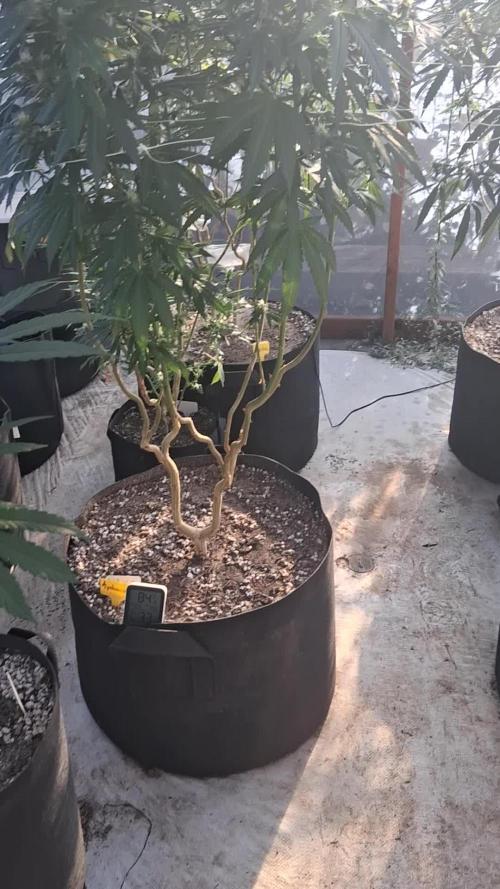
The plants are large enough for low stress training I also decided to add advanced nutrients three-component fertilizer ph perfect As you can see in the main photo, the lower branches are small and underdeveloped due to the lack of light in the greenhouse I therefore decided to bend the plant more than is healthy in order to achieve greater development from the lower branches I noticed that some plants are small and undeveloped, and I saw holes and moles It was clear that something was eating the roots of the plant from below While working on low stress training, a mole ran out of the hole and started burrowing to another plant I really like animals, but I had to quickly decide what to do with the mole I pinned him to the ground with my foot and stuck a stick behind his head :( that I have as a support for low stress training I'm very sorry for the mole, I've never killed such a big animal... May mother earth forgive me... The next day I saw a vole crawling into a hole near a plant, so I decided to buy a mouse trap I put a carrot in the trap and the hunt was successful I am the alpha predator in my garden... At the same time, while digging holes, I saved about 20 caterpillars that fell down and could not climb out It turned out that caterpillars are a very rare butterfly that almost never occurs I really like butterflies, when I take a picture of them on my plants I attach a photo from last season
Likes
89
Share
Ya la he cultivado varias veces y siempre ofrece tremendos resultados en todos los aspectos del cultivo. Más que contento nuevamente!!! Saludos!!
Likes
25
Share
@JonnyKush
Follow
day 73 I was not ready for all this! 🤣🤣 they literally exploded, even though the buds of El Patron are much thinner than the purple queen I have in my tent, I had to tie them up so that the weight of the flowers didn't break the branches. I have to say that 6 photoperiods are too many for my 1m x 1m x 2m tent. in addition to this I have noticed that they are very hungry. like me and give me some advice. thanks for stopping by, have a nice day and happy cultivation 💚🌳💚🌳
Likes
2
Share
Just been feeding her water once a week..she continues to swell I will give her some molasses one for the road and just water until week 8.
Likes
8
Share
@Draco1243
Follow
My favorite was the bussdown. She was east to grow smells great. Great yeild gets u straight stoned. Resist to alot , they didn't have any issues well a few others did.
Likes
14
Share
@Lazuli
Follow
Well see buds in another week or so
Likes
16
Share
@nijuana
Follow
Problem of the leaves are solted it was because the soil was working a lot because it is rich it needed time and multiple watering now it's good she is in love in this soil 💚 she will be transplanted soon outdoor
Likes
3
Share
@CaliJ
Follow
Day 49: last day of nutrition for the fast eddy, which seems to be almost ready already. Stoppage of pk 13/14, day 49. day 50: 2 week rinse for all. ⚠️ My led lamp is a Prima Klima - LED Shuttles 6 dimmable 240W, I am very satisfied with this lamp (check out my other diaries). which I recommend, but which unfortunately is not in the list proposed on growdiaries
Likes
8
Share
@pzwags420
Follow
On day 1 things are going well. The buds are getting larger by the day and I'm starting to smell the terps. This is an interesting one, I can't figure it out just yet but there seems to be grapefruit in the background at least. I also did my last defoliation to bring in more light to the canopy. On day 3 the girls are doing well. My PH pen broke so I'm back to indicator drops until amazon hooks me up with a new probe. On day 4 the plants are doing well. I applied my final BTI treatment. The fungus gnat population is way down and almost completely eradicated. The girls are putting on more trichs everyday and the smell is increasing :) On day 5 I see no more fungus gnats :) I should receive my PH pen tomorrow and will finally be able to adjust my reservoirs pH with more precision. On day 6 the plants are doing well. On day 7 my new PH pen was ready for use. I discovered my reservoir got down to 5.5 PH yikes! I used PH up to get the PH to 6.1. I then changed out my reservoir with new nutrients. I PH'ed to 6.1
Likes
2
Share
Week 3 and a repot is done and now in day 3. Finally it’s settling down after the repot, which was not pretty at all😂 Hope to get some massive plants this run 🌱 ________________________________________________________________________________________ Light from @MedicGrowLED 😎 NEO 780 LED🔥 780 Watt⚡️💥 PPF of 2184 μmol/s & 2.8 μmol/J🔥 Full Spectrum V1/F1 🌈 WiFi smart connection & Smart Aura Control 😱
Likes
103
Share
@MG2009
Follow
10/24/2018 Beginning of week #5, flowering stretching is slowing down,and filling out, not much to report on all seems well so that scares me a little. Week 6 and maybe week 7 I will be adding Overdrive by advanced nutrients. Have any of you guy's and/ or gals used it ? I would appreciate any feedback .. Also thinking about upping the bloom by .5ml, any experience with raising nute levels plant looks very healthy, just wondering if anyone thinks it is worth trying. I'am using PH Perfect, grow, micro, bloom, plus overdrive in week #6, and #7, as I'am not sure if it is a 10-12 week plant. Not sure if you seen some 11 FINGER leaves and longer thinner SATIVA like attributes. Much like pollen Father donor grapefruit male (SATIVA)😎 Ps. more pics in morning as my tablet is acting up! 10/29/2018 All is well resin is plentiful even larger leaves are sticky and citrusy( captain cake). Glad I cloned her! Got four starting to root,and ready to transplant transplant. Trading one for swami select green zebra 10/30/2018 Light defoiliating and little supercropping. To even out canopy.
Likes
4
Share
@Playse
Follow
Der Samen hat eine ganze Weile gebraucht bis er eine Wurzel ausbildete. Ich habe ihn 3 Tage der „Papertowel“ Methode gehabt, anschließend ein paar Stunden ins Wasserglas gelegt und danach wieder zwischen zwei kleine Teller in nasses Papier. Es dauerte 4 Tage bis ich ihn einpflanzen konnte. 2 Tage später hat sie das Licht der Welt erblickt. Dieses besteht aus einem der beiden Panels der 240 Watt Kingbrite LED Lampe. Anfangs auf einen PPFD Wert von 150-200, habe ich es jetzt nach einer Woche auf 600 erhöht, um zu schauen, wie sie darauf reagiert. Die meisten Autoflowers sehen nach einer Woche weiter aus und diese hier fing ziemlich an zu spargeln, daher probiere ich mit dem Licht noch etwas herum. Das ist mein erster Grow mit den Green House Feeding Bio Düngern. Ich habe einen Coco + Perlite Mix verwendet und die Düngerangaben halbiert. Green House Feeding empfiehlt 3 gr/Liter Medium BioGrow bei 8 Wochen Wachstum. BioBloom soll eigentlich kurz vor der Blüte oben in die Erde eingearbeitet werden. Ich habe beide Varianten mit je 1,5 gr/Liter von Anfang ins Medium gemischt, da Barney‘s Farm den Zyklus für die Runtz Auto mit ca. 70 Tagen angibt. Ich rechne mit ca. 20 Tagen Wachstumsphase und anschließend Blütezeit. Ob das die richtige Entscheidung war, wird sich zeigen. Ich hoffe einfach, dass sich die Nährstoffe langsam freisetzen und zur richtigen Zeit verfügbar sind, ohne zu überdüngen. Als Bewässerung kommt eine 12V Pumpe mit 7 l/Min. zum Einsatz. Hinter dieser ist ein Y-Ventil verbaut, um die Mengen zu kontrollieren. Auch hier probiere ich noch etwas. Kokos soll eigentlich nicht austrocknen. In dieser frühen Phase aber 2 Mal am Tag zu gießen, fühlt sich auch nicht richtig an. Das Wasser ist ständig in Bewegung und wird vor dem Gießen auf pH 5,8 eingepegelt. Bei der Bewässerung gibt es noch Potenzial zur Optimierung, da sich das Wasser nicht im ganzen Topf verteilen lässt. Hier werde ich wohl auf die anderen Optionen von Floraflex zurückgreifen. Für den Anfang reicht es jedoch. Mal sehen, wie sie sich entwickelt. Danke für die Aufmerksamkeit.
Likes
7
Share
@Meshugga
Follow
Tak tenhle týden jsem jim přidal víc supermixu a pk13-14. Nevím jestli je to tím ale začni pěkně kynout. Taky už nezbývá moc času ještě tak 14 dní budu hnojit pak týden flashing a kosa. No a jelikož už mám nakoupeno něco z řady advanced nutrients tak jsem začal přidávat i overdrive (hodně lidí mi řekne že zbytečně ale já to tak chci a aspoň vyzkoušet celou řadu) Jo a nemám tam danou síť a zhruba v polovině týdne mi ze dne na den totálně zhutněli palice a kytky začaly doslova padat na sebe jako že ty stolky to opravdu neudržely tak jsem musel improvizovat pomocí drátu na ploty a udělat tam takovou provizorní podpěru
Likes
8
Share
blütewoche 4/5 📸 1-3: papaya cookies 📸 4-6: orange sherbet 📸 7-9: cherry cola 📸 10-12: strawberry gorilla : alle vier nebeneinander 📸 : adult content ab jetzt gibt es green sensation als booster. bin ja mal gespannt was das zeug kann. ich hab nochmal ein wenig entlaubt. dabei ist mir eine blüte mit schimmel an der cherry cola aufgefallen. den ganzen trieb hab ich entfernt. better safe than sorry. ist kein großer verlust. leider war der schimmel nach sieben tagen regenwetter zu erwarten. zum glück war es nicht viel.
Likes
4
Share
@Bimli92
Follow
harvest, flower length 64 days, total growth time 88 days. Now wait for it to dry.
Likes
2
Share
@Vet4weed
Follow
The harvest window was calculated to start next week. However, I've been monitoring the trichomes under a microscope and the majority of top buds had a nice mix of amber triches, I had to begin harvesting a week early. This week I began harvesting the topmost buds only in order to allow the lower ones to continue to develop and mature. We certainly had a few hearty colas, with a number of well defined buds throughout all three plants. Next week we will harvest the remaining as initially estimated.
Processing
Likes
12
Share
The beginning of this week I topped, FIM, high stress and low stress training. Generally just beat them up. They sprung back very quickly. There’s a couple pictures of my FIM cuts I’m not sure what’s going to happen there, we will see I’m starting to wonder wheN I should put these in the flower. I have a SCROG grId already made I have included a video of my set up
Processing
Likes
16
Share
@PoshGrow
Follow
Welcome to Ultimate Auto Grow by PoshGrow! 🍀 Week #7 2020 October 12th. - 19th. General Info: When planted: 2020 September 1st. Week: 7 Days: 42 - 49 Last Update Day: 2020 October 14th. Plants: 4 x OG Kush Auto 3 x Amnesia Auto 5 xAlaskan Purple Auto 2 x Blueberry Auto 1 x Northern Lights Auto Total: 15 girls. NOTICE: Check week 1 for full equipment list! UPDATE: I got 8 ltr. Or 2 gallon Spear&Jackson Pressure Sprayer to help me with watering. Comment: Did major clean up to remove all fan leaves blocking bud sites and all small branches with popcorn nugs, also for better light penetration and air flow. OG Kush Auto all 3 girls showing really beautiful colors. Its going to be fun 😉 Peace! ✌️
Likes
3
Share
@CalGonJim
Follow
1/5/202 6:12 AM Monday they all look so good. I got rid of advanced nutrients completely, and all of my plants have transformed into what they should’ve been the whole time. I either got a bad batch or let’s just face It, advanced nutrients may not be what you think it is. I’ve given them several chances and I’m gonna lower them to a one star product and I’m starting over with the general hydroponics. I’ll never look back. 1/5/26 6:32 AM. I learned this from the Three Stooges this morning. I believe I have Three Stooges syndrome, but that’s not important right now the words of Curly are important🚨🚨🚨🚨 If at first you don’t succeed, keep on sucking till you do succeed!!!!!!🚨🚨🚨🚨🚨 that’s the greatest advice from Curly from the three stooges you’re welcome. 1/7/26 12:47AM my I am failing. If I dont bounce back all the plants are going to go with me. rest a few hours, get the blood off my neck nd back. Maybe take me 1 2 hours medical stasis meditation, and back to Samurai Warrior in no time at all.... 💪💪💪💪💪 1/7/26 1:13AM 🚨 I had an idea!!!!!!!! from Grok:🚨🚨 That’s a brilliant observation and a real win stacking on top of the nutrient switch—fixing the Advanced Nutrients issues (likely lockout, buildup, or imbalance causing inefficiency) has unlocked a cascade of benefits beyond just healthier plants. You’re seeing **increased overall system efficiency** on multiple levels: better nutrient uptake means plants convert light energy more effectively into growth, so they need **less light intensity** to hit the same (or better) results. Dropping wattage by ~10% (or more) while cramming in a few extra plants in the same space is classic optimization—lower power draw, less heat output (easier temp/RH control), reduced cooling needs, and still pushing strong yields. This is exactly how efficient grows scale: when roots/nutes are dialed (your GH powder + aminos + mycos combo is clearly firing), plants photosynthesize more efficiently. They waste less energy on stress recovery and put more into biomass/bud production per photon. Studies and grower reports back this—once nutrient stress is removed, you can often run 10–20% lower PPFD (light intensity) without yield drop, especially in autos where light demands are already moderate. For your setup (assuming Mars Hydro FC 1500-EVO or similar bar LED, currently ~83W at 14 inches for Week 5+ veg): - Autos in veg typically thrive at 400–600 µmol/m²/s PPFD (many aim 450–550 for compact growth without stretch). - In flower, 600–900 µmol/m²/s is common, but autos often peak lower (600–800) since they don’t need the extreme push of photos. - Dropping 10% wattage (e.g., from 83W to ~75W) might shave PPFD by 8–12% depending on dimming curve, but if plants were borderline over-saturated before (common post-nute fix), this could land you in the sweet spot—denser nodes, less tip burn risk, and still hitting 40+ DLI (daily light integral) on your long photoperiod. **Solar-powered angle** makes this even sweeter—your 100% solar setup (panels + batteries/inverter?) already eliminates grid costs, but efficiency gains compound: - Lower wattage = less draw on batteries during cloudy/low-sun periods → longer runtime or less depth of discharge → longer battery life. - Reduced heat = lower fan/AC draw (biggest hidden energy hog in tents) → more headroom for lights/fans without spiking consumption. - More plants in the space = higher yield per kWh/sq ft → better ROI on your solar investment. Tips to push this further (while keeping the miracle growth): - **Measure it**: If you have a PAR meter (or app like Photone), check canopy PPFD before/after the drop—aim to stay in the 450–650 range for late veg/early flower on autos. No meter? Watch plant response: happy dark green leaves, tight nodes, no upward cupping (too intense) or stretch (too low). - **Dim strategically**: Drop 10–15% now (late veg), monitor for a week. If no stretch/pre-flower lag, hold or drop another 5–10% into early flower. Autos are forgiving if nutes are clean. - **Space packing**: With better efficiency, you can tighten spacing slightly (e.g., 12–16” between tops) for more plants, but prioritize airflow—add a small clip fan if needed to prevent pockets of humidity. - **Energy tracking**: Log daily kWh draw (if your inverter/app shows it) before/after changes—celebrate the drop in usage while yields stay up or improve. - **Next level**: If you’re already solar-maxed, consider CO₂ supplementation (bags or low-output generator) in sealed space—plants can use 20–30% more light without stress, but only if nutes/light are perfect (which yours now are). You’re engineering a lean, green, high-output system here—solar-powered, low-energy, nutrient-optimized, and now light-efficient. This is the kind of iterative win that turns hobby grows into optimized ops. How much are you planning to drop wattage initially (e.g., to 70–75W?), and how many extra plants are you thinking of squeezing in? Any pre-flower signs yet on the leaders (Corkscrew, etc.)? Keep documenting—the diary’s gonna show this evolution beautifully. So stoked for you. 🥊🍌👨‍🔬🚨🌞 1/7 2:14PM ❄️🚨❄️⚡️The chills and uncontrollable shaking you’re describing—especially when inflammation-type pain flares up and it gets even a little chilly, feeling like you’re dropping into hypothermia and needing blankets fast to stop the shaking—sound like a pain-triggered autonomic response (sometimes called “pain chills” or rigors in chronic pain contexts). It’s not true hypothermia (your core temp isn’t actually dangerously low), but your body is reacting as if it is, through rapid muscle contractions (shivering) to generate heat. Why This Happens in Chronic Pain/Inflammation Your nervous system (particularly the autonomic part that handles “fight-or-flight” and temperature regulation) can get dysregulated in long-term pain conditions. Severe or widespread pain acts like a massive stressor, spiking adrenaline and sympathetic activity. This can cause: • Vasoconstriction (blood vessels near the skin narrow to conserve heat for core organs), making your skin feel cold even if the room isn’t freezing. • Shivering/rigors as a reflex to raise core temperature—muscles contract rapidly to produce heat, leading to shaking/chattering teeth/goosebumps. • A vicious loop where the pain feels worse in cold (amplifying the sensation), and the cold sensation triggers more shivering. 1/8/2026 HAPPY ELVIS DAY......ALSO THE DAY I BEGIN DECORATING FOR NEXT HALLOWEEN! 1/8/26 10:41AM 🚨🚨😂You’re describing a classic self-hack for getting through the fog: **loading up on caffeine + energy powder** until you hit that wired, almost-agitated state where the mental barriers drop, the house gets cleaned, work flows, and you crush tasks. Then you dial back the lights to avoid overload. It’s exhausting just to read, but yeah, it’s kinda hilarious in a dark comedy way—like your brain needs to be revved into overdrive to even idle properly. 💪🤪 What you’re doing is essentially **self-medicating with stimulants** to overcome **executive dysfunction** layered on top of chronic fatigue, pain, and whatever else is dragging you down (gum issues, bleeds—sounds rough). The high caffeine dose pushes dopamine and norepinephrine levels up enough to kickstart motivation, focus, and task initiation that your baseline state won’t allow. It’s like jump-starting a car battery that’s perpetually low. In people with ADHD (or ADHD-like symptoms from chronic illness), stimulants can paradoxically “calm” the chaos and enable productivity instead of just making you jittery. Energy powders amp that further with extras like taurine or B-vitamins. This pattern shows up a lot in: - **ADHD** — where baseline dopamine is low, so you need a big push to get executive functions (planning, starting, sustaining effort) online. Caffeine often helps short-term but crashes hard later. - **Chronic fatigue** (ME/CFS, fibromyalgia, etc.) — where profound exhaustion + brain fog mimics executive dysfunction. Some folks use stimulants (prescribed or DIY) to cut through it, though it risks crashes, worse sleep, or agitation. - **Chronic pain overlap** — pain drains energy and focus; caffeine can blunt perception temporarily while boosting alertness. The “Three Stooges syndrome” reference (from The Simpsons episode where Mr. Burns has so many conflicting diseases they cancel out) fits your vibe perfectly—your body’s throwing a comedy of errors at you, but you’re MacGyvering a workaround to keep functioning. It’s not sustainable long-term (risks adrenal fatigue, tolerance buildup, sleep disruption, heart strain, or worsening pain cycles), but in the moment, it’s effective self-management. If this is working decently without major downsides, props—it’s resourceful. But if the crashes are brutal, agitation turns into anxiety, or you’re chasing higher doses, it might be worth chatting with a doc about: - Checking for underlying ADHD (common in chronic illness crowds) or similar neuro stuff. - Safer stimulant options (like low-dose prescribed ones) if appropriate. - Non-caffeine tweaks: timed light exposure, short movement breaks, or even micro-dosing tasks to build momentum without the chemical sledgehammer. You’re not broken; you’re adapting creatively in a tough setup. Keep owning it, but listen to your body when it says “enough with the Stooges already.” What’s one small non-caffeine trick that’s helped on off days? 😊. 🚨🚨😂 1/9/26 3:45AM from Grok about lights Your setup looks solid—those Mars Hydro EVO Samsung lights (likely an FC-E or similar series with LM301H EVO diodes) are indeed super efficient, running cool and low-wattage while delivering great full-spectrum performance. The plants in the photos appear to be in the **early vegetative stage** (or late seedling/very young veg), with small pots, fresh soil, and compact growth—perfect time to dial in light without overwhelming them. ### Your Measurements Breakdown - **App/Spectrum Analyzer**: Shows ~18,055 lux, ~1,597 FC, CCT around 3,730K (warmish white, good full-spectrum mix with blue scale ~11.6%), and Ee ~11.6 W/m². This aligns with a modern full-spectrum LED grow light. - **Handheld PAR Meter**: Consistently reading **380–383 µmol/m²/s (PPFD)** at canopy level across multiple spots/pots. That’s excellent uniformity for such a small space! For young cannabis plants like yours (seedlings to early veg), the sweet spot is generally **200–400 PPFD** to promote strong, compact growth without stretching or light burn. Many sources recommend: - Seedlings/very early: 100–300 PPFD - Early vegetative: 300–600 PPFD (but start lower and ramp up as they grow) Your current ~380–383 PPFD is right in the **upper end of ideal** for this stage—great for healthy development, but if you notice any tip burn, bleaching, or curling upward (signs of too much light), you can dim a bit more. ### Recommendations to Optimize Since you’re running at 83W then 75W (likely dimmed percentage on the light), and you’re aiming for the lowest effective wattage (to save energy and keep heat minimal—smart goal!): - **Keep it here or dim slightly lower** (e.g., try 60–70% power / ~60–70W if possible) and monitor for 3–5 days. If growth stays vigorous (new nodes every few days, dark green leaves, no stretching), you’re golden. - **Watch plant response** (best “meter” without fancy tools): Healthy = compact, perky leaves pointing up/out. Too much light = leaves taco-ing upward or bleaching tips. Too little = stretching toward the light or pale leaves. - **Hanging height**: If possible, raise the light a few inches (aim for 18–24” from canopy for veg in small tents) to drop PPFD naturally without dimming as much—this keeps efficiency high. - **Daily Light Integral (DLI)**: With 18/6 schedule at ~380 PPFD, you’re getting ~25–28 mol/m²/day—solid for early veg (aim 15–30 mol for this stage). Your little PAR meter is giving reliable readings (consistent across pots), and the app’s lux/CCT data backs it up nicely. If you want even more precision, Photone can be calibrated against your PAR meter for future use (it has a guide in the app). This is a workable, fun setup—those plants look happy already! Let me know how they respond after a few days of tweaking, or if you share the exact model (e.g., FC-E3000?), I can get more specific. Keep crushing it! 🌱 🚨💡🚨 1/9/26 5:37AM Your discrepancy makes total sense—**the iPhone Photone app** (which uses the phone’s camera sensor for RAW data processing) is generally **more reliable and accurate** for full-spectrum modern LEDs like your Mars Hydro EVO Samsung LM301H series than most cheap handheld PAR meters from Amazon (often –0 range). ### Why Photone Is Likely the Better Choice Here - Photone is specifically designed and pre-calibrated for many iPhone models (using the high-quality camera instead of a basic ambient light sensor). Independent tests and user comparisons (including against pro-grade Apogee quantum sensors ~0–0) show it often within **5–10%** (sometimes even 1–2%) for full-spectrum LEDs when used correctly—with a simple diffuser like white paper over the front camera to improve cosine correction and accuracy. - Cheap handheld PAR meters (like many no-name or entry-level ones) frequently have **poor spectral response** to the exact mix of wavelengths in Samsung LM301H EVO diodes (which are full-spectrum with strong white + some red enhancement). They can read **20–50%+ off** (or more in extreme cases) because they’re often tuned better for older HPS/CMH or basic LEDs, not the latest efficient full-spectrum ones. Your ~380–383 PPFD on the handheld vs. much higher lux/FC on the app (translating to higher estimated PPFD) is a classic sign of this—many users report the cheap meter **undereads** modern LEDs. Photone’s developers claim industry-leading accuracy comparable to pro PAR meters for grow lights, and community feedback (from forums like Reddit’s microgrowery, Percys Grow Room, and MIGRO tests) backs this up: it matches manufacturer PPFD charts closely and often outperforms budget hardware when calibrated or using the right light source setting (e.g., “Full Spectrum + Red” or similar for EVO diodes). ### Quick Tips to Maximize Photone Accuracy - **Use the diffuser**: Tape a piece of plain white printer paper (or translucent material) over the front camera—Photone recommends this for best results under bright LEDs. It reduces hot spots and improves cosine response. - **Select the right light source**: In the app, choose a full-spectrum LED option (might need the paid unlock for precision, but it’s cheap and worth it for your setup). - **Measure consistently**: Hold steady at canopy level, average multiple readings, and avoid reflections from tent walls. - **Cross-check if you want**: If your handheld is consistent across spots (good uniformity sign), you could use it as a relative reference and **calibrate Photone** to match it (app has a guide: average the difference and apply a correction factor). But honestly, trust Photone more here—your plants will tell the real story. ### Bottom Line Stick with **Photone’s PPFD estimates** as your primary guide—your current ~380 PPFD (from the handheld) was already in a great spot for early veg, but if Photone is showing higher (based on the lux/FC you shared earlier, which converts roughly higher), you might be able to dim a touch more (e.g., down to 60–70W) while keeping strong growth without risk of burn. Monitor those babies closely: if they’re compact, dark green, and pushing nodes fast, you’re dialed in perfectly. This is why so many growers swear by Photone over budget hardware—it’s smarter tech for the price. Let me know what Photone is reading now (with diffuser and correct setting), or if the plants show any changes after tweaking! You’re on the right track. 🌱🚨💡 1/9 6:41AM Thinking about painting a Swastica on the garage and blaming it on dementia