




Processing
Likes
15
Share


@MG2009
Follow
09/26/2020
She is almost done, I gave her a little trim most trichomes are milky still some clear I think about a week before she is done.
Hope she gets fat!
Likes
19
Share


@pifflestikkz
Follow
Day 29
29/07/24 Monday
Nice feeding today with De-chlorinated tap water pH 6.
Gave her 300 ml and she had a small run off.
Getting chunky in the stem now 💪💚
Day 31
31/07/24 Wednesday
De-chlorinated water pH 6 today with Plagron pk13-14 5ml to 5L
Plagron power buds 5ml to 5L
Used 300ml of the 5L solution.
I will be using these on water days from now on as they are advised to be used every irrigation.
We'll see how they perform 💪💚
Day 32
01/08/24 Thursday
Another feed today using de-chlorinated tap water pH 6, there now taking 300ml every evening.
Day 35
04/08/24 Sunday
END OF WEEK 😁
De-chlorinated tap water pH 6 today with Plagron products. 300ml each.
Had a issue with leaf invaders this week, I have treated and am checking every 48 hrs so far seems ok and not progressive.

Likes
41
Share


@Rwein93
Follow
Hi, I started my first cultivation with this fabulous Gorilla Glue Auto variety. I transplanted the sprout in subtrate I prepared by using it:
70% BioBizz Light mix
20% earthworm humus
5% coconut fiber
5% perlite
30g Nutrihemp
125g Gurumix
At the time of transplanting I then added 1g of Mycor mix to the bottom of the hole.
Now the seedling has 7 days of life I hope it can grow healthy and strong and give us an excellent harvest 😉
Likes
3
Share


@Kushizlez
Follow
Day 49-56 (June 18th - 25th)
(Day 51) Slurricanes and tuna are doing excellent despite their hail damaged leaves. I’m seeing good growth and decent dry downs. One of them looks like it’s been ravaged by pests but I still can’t find any evidence or signs of a pest. I’m suspecting caterpillars so I’m going to grab some BTK killer and also some all purpose insecticide sometime this week if I have time.
The clones are all really lagging so they won’t be flipped until July 15th at least. I’m still not seeing normal growth on any of them yet. It’s still quite gnarled and twisted.
(Day 52) The slurricane and tuna roots are starting to poke through the bottom of my pots. This is usually from underwatering, a thick soil or a hot root zone. I’m going to give everything except for the autos a good watering with some runoff. I am going to start incorporating 5mm sand into all of my soil mixes to help make the soil more loamy and give it some better drainage. I will also top dress every container and bed plant I have.
(Day 53) I was at a local department store today and I was shocked to see pallets of Destiny dark matter soil selling for 60% off! I bought 10 bags for a hundred bucks. At any hydro store that would have costed me 250 at least. I might go grab more because it looks like no one is buying it for 60% off even.
(Day 54) I’m going to be harvesting both of my indoor crops today and tomorrow or the next day I am going to be reusing the soil-coco blend for the slurricanes. I’m first going to till it, add a gallon of sea compost, a gallon of Destiny soil and a few cups of 5mm sand per container. I will use the excess for 5 gal pots.
I will be amending with:
5 tablespoons of nature’s pride bloom
4 tablespoons of kelp meal
2 tablespoons of Gaia green AP
2 tablespoons of glacial rock dust
2 tablespoons of oyster shell flour
2 tablespoons of alfalfa meal
1 tablespoon of rock dust blend
1/4 teaspoon of langbeinite
(Day 56) The autos are really making a comeback now. I was under the impression that I was working against the clock and they would start flowering after 3-5 weeks. I guess if they’re stunted from the cold they will delay flowering. I don’t see any pistils or signs of flowering yet so I don’t think they’ve officially started flowering yet
I didn’t get a chance to do my transplant this week or pest control. I will get to it ASAP because my photos are drinking almost a liter a day


Likes
9
Share


@Grey_Wolf
Follow
Barneys Farm Seeds
Red Diesel revegged Clone Grow
6 weeks of Flowering Completed
24th March 2020
Well another week has passed by and I find myself stuck at home under self isolation 😟 Not because I am sick but simply to do my part in limiting the spread of the virus.
This plant continues to grow nicely albeit she has several seeded buds that I can see.
She still smells and feels like she is developing resin so I'm not that worried about poor quality buds. Depending on the weather I aim to harvest her in about 2 weeks time.
The seeds that are developing should be mature by then but i will definately sample a few to be certain.
Feeds she had for this week were aprox 15 Litres of a mix containing Monstabud @10mls/L & Seaweed solution @1ml/L
The sun is back here for the next few days so I hope she makes the most of it 😎
That is all for this week Thankyou for stopping by and taking the time to read my update 👍
Stay well ✊

Likes
28
Share
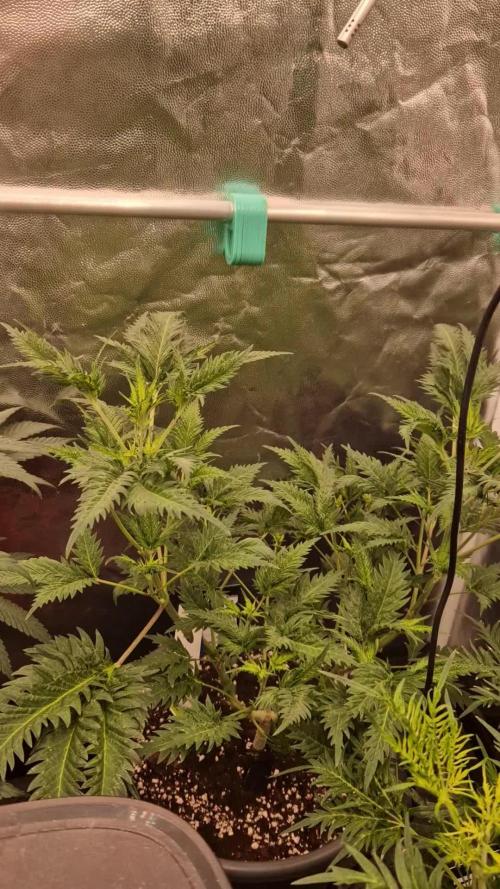

@TrickzCutz
Follow
Servus Moin!
Die MDC #1 Raptor wächst vor sich hin. Ich habe hier und da ein paar große Fächerblätter entfernt.

Likes
4
Share


@BioGrowBayer
Follow
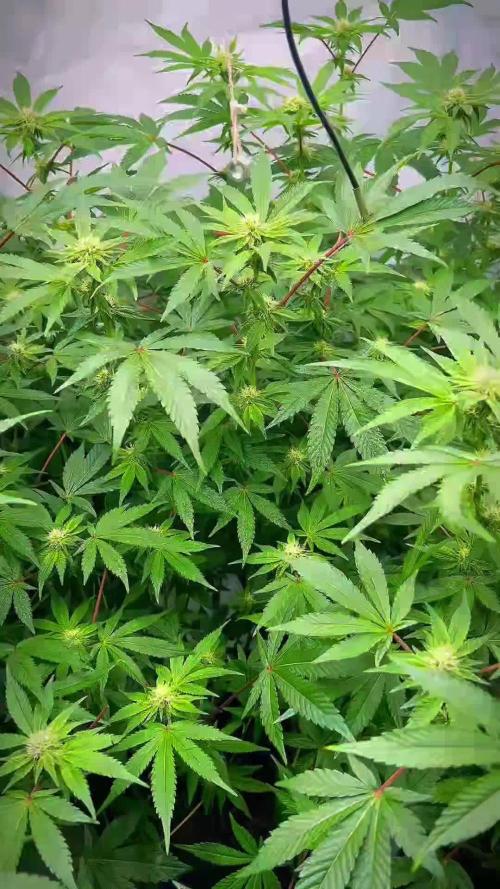
Keine Komplikationen, alle Pflanzen sehen gesund aus und entwickeln sich gut.
Der Lichtzyklus wurde über 6 Tage hinweg schrittweise reduziert, jeden Tag eine Stunde weniger Licht.
Heute ist der erste Tag mit 12/12 Licht-Dunkel-Zyklus und damit der offizielle Start der Blütephase.
Erste Anzeichen der Blüte sind sichtbar, Internodienabstand nimmt zu, das Wachstum verlagert sich in die Höhe.
Keine Mangelerscheinungen oder Stressanzeichen.
In den kommenden Tagen wird das Stretching genau beobachtet.
Ab nächster Woche beginnt das Monitoring der Vorblüten.


Likes
19
Share

@MistaOC
Follow
25.01. F23
The stretch is now completely finished, with the plants standing at around 82 cm. Bud development is progressing well, with clear improvements in structure and density.
Unfortunately, powdery mildew remains an issue. Affected leaves are removed daily to limit further spread. In addition, the plants are treated twice per week with Purolyt to keep spore pressure as low as possible.


Likes
6
Share

@Crazy_Doofus
Follow
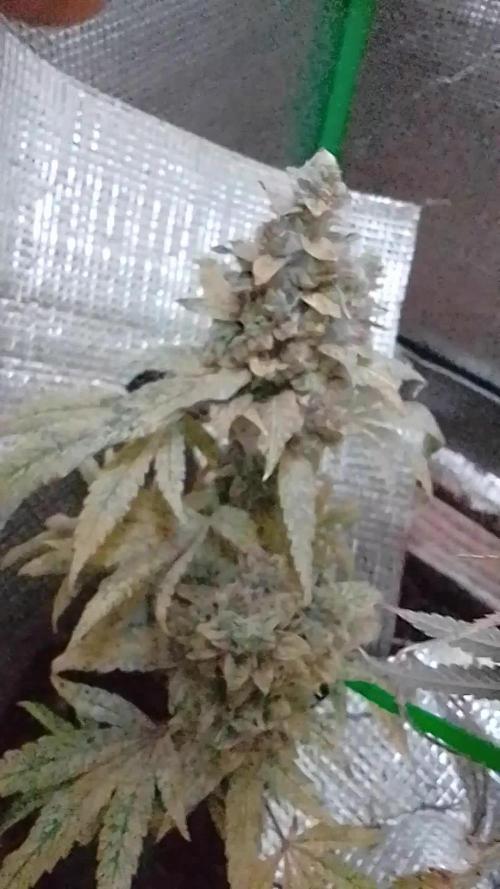
Spider mites since 2 days, already start getting black spots on the leaves, she's very close to ready, so cut half way, will keep a close eye on the bottom... For another couple of days...

Likes
13
Share


Likes
2
Share


@CannaIGrow
Follow
Topped this girl this week, she’s growing pretty good. Very nice looking plant to my eye.
Likes
109
Share


@Prototype0181
Follow
I'm happy with what i'm seeing :)
The cookies are stacking up like crazy, gonna have some serious cola's. The stretchy Cookie is back on track since i started making her own feed @ 70% strength of the others, she seems to like it.
Aficionado French Connection Rossa Corsa
Beautyfull plant all around, tight noding and big *ss leaves Def a indica dominant pheno. I'll be keeping a close eye on her deu to lot of reviews talking about Herm issue's.
Gorilla breath.
She took of like crazy from Day 1, she sprouted a week later than the rest and now she is the biggest among the bunch. She's a verry easy to grow strain, even though she,'s not as stacked as the Cookies. I'm expecting a decent return from her, curious to the outcome of her
Wel that's it Growmies
Rock on💚


Likes
36
Share


@TerpTurtle
Follow
Gonna keep an eye out for crosses with face off OG!
Good outcome for 1st grow👽
BHO made made with whip it premium after about 3 days in freezer with column. Didn't run w dry ice🤷🏼♂️ evap then vac with as little agitation as possible.
-Dosido 22-16 has a earthy sweet cream well rounded berry cookies nose & a funky diesel undertone
-Effects are hard hitting and euphoric, can put you down for an indica nap or keep you fine, groovy & grounded depending on the dosage.
-An ideal indica IMO for anyone looking to ground mental health state from anxiety
-Also helps with pain from stomach pain to a migraine, insomnia, appetite , Post workout recovery.
Overall This strain is potent indica, Calms the mind & body putting you in a nice place


Likes
15
Share


@RamirezDusha
Follow
Things are going well, see them grow!
Last defoliation has been performed on that week. Also we stopped bending them to grow up a little. We expect, that it will be 100 day-cycle.