Likes
Comments
Share
@BudBeat
Follow
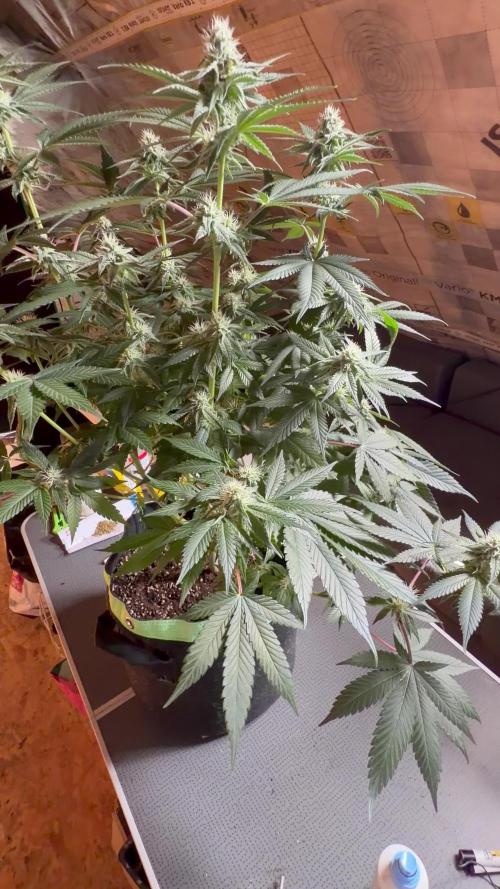
Die Deadryder hat früh die Blütephase eingeleitet! Ob so gewollt? Es kommt mir so vor, dass sie aufgrund der kurzen vegetativen Phase nicht wirklich Blattmasse aufbauen konnte. Schaut eher aus, wie ein kahler Tannenbaum 😜. Blüten entwickeln sich auch schon rasch und werden sogar schon ein wenig lila. Na da bin ich aber echt gespannt!
Likes
5
Share
@pzwags420
Follow
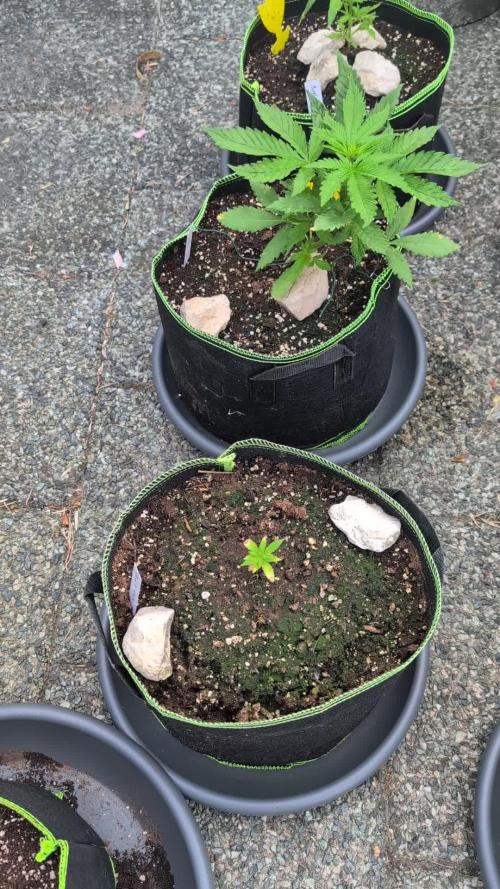
I started the GSC seeds from HSC by soaking in a glass of water overnight then planted in coco coir under a humidity dome in my veg tent. I will plant them in flower box in a couple weeks when they can handle the feed that my BB clone is on right now. On day 5 my 2 other Gsc seeds rotted perhaps too wet but I have one good remaining for this run. I started White widow seeds and will run 2 phenos. Gsc is looking good so far.
Likes
46
Share
@Horantu
Follow
Very good week for both Agnes and I. New King Kola supplement arrived as a birthday gift for me, so thats exciting. Also stopped using the nitrogen heavy grow nutes. She is drinking a lot. I am watering 3-4 times a week at 1/2 gal. And alternating nutrient waterings. She seems happy and is responding well. Added some microscope photos as well. It seems to work nicely and uses a micro-usb so it can be operated through my phone. Hope everyone has a stellar week and happy growing! KCCO
Likes
48
Share
~ WEDDING CHEESECAKE FAST FLOWER by FastBuds ~ Well fam, here we go again with another epic strain from FastBuds Fast Flowering stable. After having such tremendous success growing their Gorilla Cookies Fast Flower outdoors last year, I've decided to run another of their fast flowering strains outdoors this year... Wedding Cheesecake Fast Flower! The best description of this awesome cultivar comes directly from my friends at FastBuds which is as follows: "A delight for the mind and body: Wedding Cheesecake FF (Fast-Flowering) is a delicious strain that offers XXL yields in a 7-8 weeks flowering cycle. This terpene powerhouse produces loads and loads of mouth-watering vanilla-creamy-cookie-scented terps with hints of citrus and cinnamon. In addition to its delicious aromas, this variety grows very well in both indoor and outdoor setups, yielding up to 650 g/m2 without extra maintenance, making it the ideal strain for beginners as it allows you to maximize yields while minimizing work. This super-fast feminized photoperiod version offers upbeat and energetic yet deeply relaxing effects that are perfect for consumers looking for a heavily focused, motivating, and creative high. It’s the ideal strain for those needing that extra energy boost to start a busy day on the right foot. Wedding Cheesecake FF boasts chunky, large-sized buds with a thick layer of silvery-white resin and bright orange hairs scattered all over: that just screams ‘quality’. The lime-green flowers sparkle with an array of hues ranging from dark to light green, to magenta and purple, and reek of a delicious aroma that’ll remind you of fresh store-bought cheesecake. This is an XXL hybrid that grows extremely tall in height, reaching up to 3m with one huge main cola and multiple long side branches that can withstand enormous yields of up to 650 g/m2 with ease. Wedding Cheesecake FF is extremely resilient to the elements and can be grown in almost every climate as long as you’ve got the space and basics covered, making her an excellent choice for those looking for large-scale harvests with a quick turnaround time without much effort." ____________________________________________________________________________________________________________________________________________________________________________________________________________________________________________________________________________________________________________________________________________________________ The Setup: This is going to be an outdoor grow, but I have started the Wedding Cheesecake FF indoors as our weather is still too cold to put her outside (nighttime temp's dipping regularly into the 30's℉). The plan is simple... let her grow inside under a 19/5 light schedule until the nighttime temperatures stay above the mid 40's℉, at which point she'll be moved outside and transplanted into the soil which I have already setup and inoculated with beneficial microbes, and then let the fun begin!🤪💚 ____________________________________________________________________________________________________________________________________________________________________________________________________________________________________________________________________________________________________________________________________________________________ Weekly Updates: 4/12- Here we go into the third week for the FastBuds Wedding Cheesecake Fast Flower and there's nothing but good news to report! This little lady is basically on autopilot for now and all I'm really doing is making sure that I check her daily and water when needed with well water straight from the garden hose! 4/14- All is well with the Wedding Cheesecake FF. Because of the colder nights, her growth is not going to be as rapid right now compared to when nighttime temp's stay above the upper 50's to 60's℉, which is when she should really start to take off! 4/16- It rained yesterday and today, so Mother Nature took care of my watering for me! 4/18- There goes another week on the books for the FastBuds Wedding Cheesecake Fast Flower and I can't wait to see her take off with warmer weather that's not too far away! Hope to see you next week! Thank you for checking out my diary, your positive comments and support make it all worthwhile! 💚Growers Love!💚😎🙏
Likes
24
Share
Week 7 Veg - January 16/21 to 22/21 ***** Week 7 will be their last week being able to take them out of the tent😟 SCROG netting going in on the weekend ahead. Not really a lot to report this week as the girls are doing well and I am just wanting their side branches to grow longer to help filling in the canopy anyway. Performed more LST this week and bending over the branches daily. Didn’t do any HST this week, will once the net is in and I have a better visual of how the branches need to bend. They have come a long ways over the last 2 weeks when you look back at pictures. They have filled out with more side branching and other than battling a little purple striping on the main stems they seem pretty happy. Leaf colour is good and should be in good shape for the flip soon. Will go through all of week 8 before flipping so hopefully week 9 will be transition week and week 10 the start of flower.......have to get through next week first though😀👍 Switching over to tap water again. I have been struggling with calcium and magnesium deficiencies on all grows for the last year. I can’t seem to get the right amount added back to the RO water I use in all feedings. So running with straight water again now. Ppm coming out is 325 so I will work with that. Going to explore my own RO system in the house rather than bottled water, a system that adds back calcium, magnesium, and iron. It’s been flowing okay for the first week and will continue on for now. Using RO water I have been feeding full strength on the nutrients and have been working on backing them down a bit to compensate for the starting point of 325 now. They have continued to be fed once a week roughly and supplemented with calmag and microbes. Little more detail....... Jan 16/21, Day 43 Veg - 3L each of full line at full strength in RO water - 1150ppm and 5.8pH given to the girls - didn’t add any other nutes other than IPP line. Jan 17/21, Day 44 Veg - dry out day - pulled down all the girls again tonight to train them outwards. - Jan 18/21, Day 45 Veg - 3L for each girl today with tap water and CalMag @ 1ml, Microbes @ 2ml, Nature’s Candy @ 1.5ml - 700ppm and 5.7pH is what that works out to. - have to use a considerable amount of pH down to adjust the tap water, over 6ml in 16L Jan 19/21, Day 46 Veg - measured the girls today, GSCHB Is 12” tall. They were topped already😀 - dry out day for the girls. - pulled two large fan leaves from her. They were just getting the way too much of lower branches light. Jan 20/21, Day 47 Veg - 2.5L each with plain tap water - 295ppm and 5.8pH. - all the girls are looking big and bushy today.......they are ready for flip soon. Jan 21/21, Day 48 Veg - dry out day for the girls. Jan 22/21, Day 49 Veg - pulled all the girls down again......repeating the same LST each day manually rather than tying down for now. - this should be water day but leaving for today as I am going to lolipop the lower branches and a heavier leaf stripping tomorrow. - will feed tomorrow as they will benefit more. Very solid week ETS......the girls are taking off and expect to see lots of leaves popping out over the next couple of weeks😀👍 Work on the side branching to come up higher closer to the tops next week.......continue tap water and give a feed with Epsom Salts new week
Likes
2
Share
Been on the Spananbis so I wasnt able to check on them but they did really good the last few days. Put a net on them to spread them out a bit cause im scared of not enough airflow between the plants
Likes
15
Share
@Be4ry20
Follow
Hello People! I harvested my Honey Runtz now some days ago already, was busy with life and didnt post. yet she is drying well in my dry tent! im a bit nervous about making the dry sift soon. will be my first time sifting a whole plant! will post more once she is dry and sifted! :) Hello People! guess its time to show my first time making hash off. its my first time doing this kind of dry sift so didnt know what to expect or what to do. i did alot of research and just free balled as i felt like is right. After Harvesting and Drying i took all the sticks out, left the sugar leaves on the nugs and then put everything in the freezer for like 3 days. ordered some dry ice and did alot of preperations. like getting some big sifting screens. so first i put like 1/4 of the frozen material in a 220 micron bubble bag inside of a big bucket. threw some dry ice in and then started to shake it, so the trichomes felt off.then i collected everything from my bucket and put it in a glass jar with parchment paper (to get better out again)did this 4 times so no material got left over. after the first sifting with the bubble bag, i threw everything on these big sifting screens with 190; 160 and 73 micron. then the drumming started, i used 2 spoons to like hit/drum the screens so the trichomes get seperated by size. i felt like the screens got clogged at some point so i stopped and was like yea thats okay enough lets go to the next step, collecting everything and pressing. the first layer 190+ got discarded. layer 190-160 got saved as well as layer 73-160. everything below the last screen got destroyed by my own mistake. the tape i used to secure the parchment paper on a plank ripped and everything went flying. well i wanted to discard it anyways.. after the sifting screens i used the frenchy cannoli methode with a hot water bottle to press the trichomes to some nice hash. the results: 190-160 micron: 12,4 G 73-160 micron: 32,2 G Total: 44,6 G fully legal here :) im very happy with the results, even tho the hash is a bit green. after all it was my first time doing it like that. i feel like i need to dry it a bit more next time. so the screens aint clogged and thus i can better seperate the trichomes, maybe it is less green then. maybe next time im not using the big sifting screens but rather go for some static with a glove or a ballon.
Likes
19
Share
@Mazgoth
Follow
If you are going to try this beauty for 2 weeks dont give her 0 nut because you are gonna have 100% nut burn,dont even use root juice or whatever nut you have for early stage but just water,she dont need anything special to grow bigger and bigger just good conditions and right food and you will se the magic to happen,give her more space than i gave because in my situation the roots got on the top and she needed more space BUT she didn't disappoint me😍
Likes
15
Share
Half way through flush; final week before harvest. Photos/video taken 98 days after breaking soil, day 56 of flower UPDATE: Plant harvested on 11/5; day 101 after breaking soil, day 59 of flower.
Likes
4
Share
@ValtripOG
Follow
Comienza la floración ya podemos ver algunos brotes
Likes
293
Share
@Ju_Bps
Follow
Hello growmies 👩‍🌾👨‍🌾🌲🌲, 👋 Girls are beautiful, I really enjoy the #2, with her big stems, Buds keep coming along, start to bump,turning purple 💜💜😋😋 💪 Finally did a big defoliation, was time 😅✂️✂️ 💧 Give water each 2/3 day 2 l Water + Bloom + Green Sensation + Sugar Royal (3.5 + 1 + 1 ml/l) PH @6 💡Mars Hydro - FC 3000 50% 13 cm Mars Hydro Fan kit Setting 9 Have a good week and see you next week 👋 Thanks community for follow, likes, comments, always a pleasure 👩‍🌾👨‍🌾❤️🌲 Mars Hydro - Smart FC3000 300W Samsung LM301B LED Grow Light💡💡 https://www.mars-hydro.com/fc-3000-samsung-lm301b-led-grow-light Mars Hydro - 6 Inch Inline Fan And Carbon Filter Combo With Thermostat Controller 💨💨 https://www.mars-hydro.com/6-inch-inline-duct-fan-and-carbon-filter-combo-with-thermostat-controller Fast Buds - Gorilla Cookies FF🌲🌲 https://2fast4buds.com/us/seeds/gorilla-cookies-fast-flowering
Likes
25
Share
@DrGanj
Follow
Some mild defoliation this week. Budding up nicely and starting to frost. This girl was having a foliar feed of algae last week but this week she's getting light foliar sprays of the Lacalva stress treatment from madame grow on top of her other feed. I'll do this every 2/3 mornings and I'll only lightly mist the top. I'll concentrate most of my foliar feed on the lower growth and undersides, away from the buds. This is the main reason I kept so many lower fan leaves this time.
Likes
37
Share
@RFarm21
Follow
Boas growmies! Esta semana apareceram mais folhas amarelas mas penso que seja normal, penso eu, visto que já estão caminho da 10ª semana. O cheiro delas é fantástico! 17 Agosto - O gráfico representa a nutrição misturada em 2,5L de água da Royal Gorilla 1. EC = 1,55; pH 6,4 17 Agosto - Alimentaçao da Royal Cheese (2L): CE = 1,5mS; pH 6,3 -BioGrow - 3ml; BioBloom - 4ml; TopMax - 2ml; BioHeaven - 5ml; Activera - 5ml; Calmag - 1ml 17 Agosto - Alimentação Royal Gorilla2 e royal cheese 2 = Só água . ph 6.3) ----------------------------------------------------------------------------------------------------------------------------------------------------------- 21/08 - Alimentação Royal Gorilla #1 (2,5L): CE = 1,64; pH = 6,3 -BioGrow - 4ml; BioBloom - 6ml; TopMax - 2,5ml; BioHeaven - 7ml; Activera - 6ml; Calmag - 1,5ml 21/08 - Alimentação Royal Gorilla #2 (2,5L): CE = 1,33; pH = 6,1 -BioGrow - 3ml; BioBloom - 5,5ml; TopMax - 2ml; BioHeaven - 5ml; Activera - 5ml; Calmag - 1,5ml 21/08 - Alimentação Royal Cheese #1 (2L): CE = 1,36; pH = 6,1 -BioGrow - 3ml; BioBloom - 5ml; TopMax - 2ml; BioHeaven - 6ml; Activera - 5ml; Calmag - 1ml 21/08 - Alimentação Royal Cheese #2 (2L) - EC = 1,38; pH = 6,3 -BioGrow - 3ml; BioBloom - 4ml; TopMax - 2ml; BioHeaven - 5ml; Activera - 5ml; Calmag - 1ml
Likes
11
Share
Day in and exit fan 15 min off 15 min on Van is full on Night in and exit fan 30 min off 15 min on Van is full on
Likes
22
Share
Day 69: Watered each plant with 1.5L with nuts 1379 ppm, 2951us/cm, 2.9 EC (1 purple punch, wedding Cheesecake) 1391 ppm, 2959 us/cm, 2.9 EC (gorilla cookies) 1L 319 ppm, 678 us/cm 0.6 EC (3 strawberry banana and 2 purple punch) (2L each) 3 different feedings for the 10 plants Still flushing all the strawberry banana and 2 purple punch with flawless finisher, 2ml per L. (1st week flawless finisher, 2L each, 2nd week clear water, 150L each pH tap water) Day 71: I've been struggling with the humidity, always around 70%, I can't turn the lights off at the moment. I lost one of the main fans during 2 days, and I found mold on all the tops on one purple punch and on the smaller strawberry banana as well. First timing having this issue! High humidity plus not enough air circulation equals this. Mistakes happen for a reason. Need to start rethinking my whole air circulation, exaustor, fans, etc etc. I removed the infected buds, I used a magnified glass to help me do the job better. I did everything like the book. Already have 3 fans on the tent, let's see how it goes. Humidity between 65-75% Day 73: Watered each plant with 1.5L with nuts 1458 ppm, 3101us/cm, 3.1 EC (2 wedding Cheesecake and 1 gorilla cookies) 283 ppm, 602 us/cm 0.6 EC (3 strawberry banana, 3 purple punch and 1 wedding Cheesecake) (2L each) 2 different feedings for the 10 plants Still flushing, 1st week flawless finisher, 2L each, 2nd week clear water, 150L each pH tap water) Everything running smooth, they are starting to show the colors from the flush I've been doing. Day 75: Watered each plant with 1.5L with nuts 290 ppm, 617 us/cm 0.6 EC (3 strawberry banana, 3 purple punch and 3 wedding Cheesecake) (2L each) Day 77: Watered each plant with 1.5L with nuts 1811 ppm, 3810 us/cm, 3.8 EC (gorilla cookies) 253 ppm, 538 us/cm 0.5 EC (3 strawberry banana, 3 purple punch and 3 wedding Cheesecake) (2L each) Still flushing... Going to cut some of them this week.
Likes
47
Share
What's in the soil? What's not in the soil would be an easier question to answer. 16-18 DLI @ the minute. +++ as she grows. Probably not recommended, but to get to where it needs to be, I need to start now. Vegetative @1400ppm 0.8–1.2 kPa 80–86°F (26.7–30°C) 65–75%, LST Day 10, Fim'd Day 11 CEC (Cation Exchange Capacity): This is a measure of a soil's ability to hold and exchange positively charged nutrients, like calcium, magnesium, and potassium. Soils with high CEC (more clay and organic matter) have more negative charges that attract and hold these essential nutrients, preventing them from leaching away. Biochar is highly efficient at increasing cation exchange capacity (CEC) compared to many other amendments. Biochar's high CEC potential stems from its negatively charged functional groups, and studies show it can increase CEC by over 90%. Amendments like compost also increase CEC but are often more prone to rapid biodegradation, which can make biochar's effect more long-lasting. biochar acts as a long-lasting Cation Exchange Capacity (CEC) enhancer because its porous, carbon-rich structure provides sites for nutrients to bind to, effectively improving nutrient retention in soil without relying on the short-term benefits of fresh organic matter like compost or manure. Biochar's stability means these benefits last much longer than those from traditional organic amendments, making it a sustainable way to improve soil fertility, water retention, and structure over time. Needs to be charged first, similar to Coco, or it will immobilize cations, but at a much higher ratio. a high cation exchange capacity (CEC) results in a high buffer protection, meaning the soil can better resist changes in pH and nutrient availability. This is because a high CEC soil has more negatively charged sites to hold onto essential positively charged nutrients, like calcium and magnesium, and to buffer against acid ions, such as hydrogen. EC (Electrical Conductivity): This measures the amount of soluble salts in the soil. High EC levels indicate a high concentration of dissolved salts and can be a sign of potential salinity issues that can harm plants. The stored cations associated with a medium's cation exchange capacity (CEC) do not directly contribute to a real-time electrical conductivity (EC) reading. A real-time EC measurement reflects only the concentration of free, dissolved salt ions in the water solution within the medium. 98% of a plants nutrients comes directly from the water solution. 2% come directly from soil particles. CEC is a mediums storage capacity for cations. These stored cations do not contribute to a mediums EC directly. Electrical Conductivity (EC) does not measure salt ions adsorbed (stored) onto a Cation Exchange Capacity (CEC) site, as EC measures the conductivity of ions in solution within a soil or water sample, not those held on soil particles. A medium releases stored cations to water by ion exchange, where a new, more desirable ion from the water solution temporarily displaces the stored cation from the medium's surface, a process also seen in plants absorbing nutrients via mass flow. For example, in water softeners, sodium ions are released from resin beads to bond with the medium's surface, displacing calcium and magnesium ions which then enter the water. This same principle applies when plants take up nutrients from the soil solution: the cations are released from the soil particles into the water in response to a concentration equilibrium, and then moved to the root surface via mass flow. An example of ion exchange within the context of Cation Exchange Capacity (CEC) is a soil particle with a negative charge attracting and holding positively charged nutrient ions, like potassium (K+) or calcium (Ca2+), and then exchanging them for other positive ions present in the soil solution. For instance, a negatively charged clay particle in soil can hold a K+ ion and later release it to a plant's roots when a different cation, such as calcium (Ca2+), is abundant and replaces the potassium. This process of holding and swapping positively charged ions is fundamental to soil fertility, as it provides plants with essential nutrients. Negative charges on soil particles: Soil particles, particularly clay and organic matter, have negatively charged surfaces due to their chemical structure. Attraction of cations: These negative charges attract and hold positively charged ions, or cations, such as: Potassium (K+) Calcium (Ca2+) Magnesium (Mg2+) Sodium (Na+) Ammonium (NH4+) Plant roots excrete hydrogen ions (H+) through the action of proton pumps embedded in the root cell membranes, which use ATP (energy) to actively transport H+ ions from inside the root cell into the surrounding soil. This process lowers the pH of the soil, which helps to make certain mineral nutrients, such as iron, more available for uptake by the plant. Mechanism of H+ Excretion Proton Pumps: Root cells contain specialized proteins called proton pumps (H+-ATPases) in their cell membranes. Active Transport: These proton pumps use energy from ATP to actively move H+ ions from the cytoplasm of the root cell into the soil, against their concentration gradient. Role in pH Regulation: This active excretion of H+ is a major way plants regulate their internal cytoplasmic pH. Nutrient Availability: The resulting decrease in soil pH makes certain essential mineral nutrients, like iron, more soluble and available for the root cells to absorb. Ion Exchange: The H+ ions also displace positively charged mineral cations from the soil particles, making them available for uptake. Iron Uptake: In response to iron deficiency stress, plants enhance H+ excretion and reductant release to lower the pH and convert Fe3+ to the more available form Fe2+. The altered pH can influence the activity and composition of beneficial microbes in the soil. The H+ gradient created by the proton pumps can also be used for other vital cell functions, such as ATP synthesis and the transport of other solutes. The hydrogen ions (H+) excreted during photosynthesis come from the splitting of water molecules. This splitting, called photolysis, occurs in Photosystem II to replace the electrons used in the light-dependent reactions. The released hydrogen ions are then pumped into the thylakoid lumen, creating a proton gradient that drives ATP synthesis. Plants release hydrogen ions (H+) from their roots into the soil, a process that occurs in conjunction with nutrient uptake and photosynthesis. These H+ ions compete with mineral cations for the negatively charged sites on soil particles, a phenomenon known as cation exchange. By displacing beneficial mineral cations, the excreted H+ ions make these nutrients available for the plant to absorb, which can also lower the soil pH and indirectly affect its Cation Exchange Capacity (CEC) by altering the pool of exchangeable cations in the soil solution. Plants use proton (H+) exudation, driven by the H+-ATPase enzyme, to release H+ ions into the soil, creating a more acidic rhizosphere, which enhances nutrient availability and influences nutrient cycling processes. This acidification mobilizes insoluble nutrients like iron (Fe) by breaking them down, while also facilitating the activity of beneficial microbes involved in the nutrient cycle. Therefore, H+ exudation is a critical plant strategy for nutrient acquisition and management, allowing plants to improve their access to essential elements from the soil. A lack of water splitting during photosynthesis can affect iron uptake because the resulting energy imbalance disrupts the plant's ability to produce ATP and NADPH, which are crucial for overall photosynthetic energy conversion and can trigger a deficiency in iron homeostasis pathways. While photosynthesis uses hydrogen ions produced from water splitting for the Calvin cycle, not to create a hydrogen gas deficiency, the overall process is sensitive to nutrient availability, and iron is essential for chloroplast function. In photosynthesis, water is split to provide electrons to replace those lost in Photosystem II, which is triggered by light absorption. These electrons then travel along a transport chain to generate ATP (energy currency) and NADPH (reducing power). Carbon Fixation: The generated ATP and NADPH are then used to convert carbon dioxide into carbohydrates in the Calvin cycle. Impaired water splitting (via water in or out) breaks the chain reaction of photosynthesis. This leads to an imbalance in ATP and NADPH levels, which disrupts the Calvin cycle and overall energy production in the plant. Plants require a sufficient supply of essential mineral elements like iron for photosynthesis. Iron is vital for chlorophyll formation and plays a crucial role in electron transport within the chloroplasts. The complex relationship between nutrient status and photosynthesis is evident when iron deficiency can be reverted by depleting other micronutrients like manganese. This highlights how nutrient homeostasis influences photosynthetic function. A lack of adequate energy and reducing power from photosynthesis, which is directly linked to water splitting, can trigger complex adaptive responses in the plant's iron uptake and distribution systems. Plants possess receptors called transceptors that can directly detect specific nutrient concentrations in the soil or within the plant's tissues. These receptors trigger signaling pathways, sometimes involving calcium influx or changes in protein complex activity, that then influence nutrient uptake by the roots. Plants use this information to make long-term adjustments, such as Increasing root biomass to explore more soil for nutrients. Modifying metabolic pathways to make better use of available resources. Adjusting the rate of nutrient transport into the roots. That's why I keep a high EC. Abundance resonates Abundance.
Likes
13
Share
@Luv2Grow
Follow
Day 43 - Starting week 7 and did a little adjusting to a couple of the tie downs. A few branches were starting to get really lengthy so wanted to keep them somewhat tied down so when the bud weight starts coming, it’s not too heavy. Other than that, she seemed to of liked the drink yesterday and is doing really well overall. Day 44 - Nothing much new today, just gave her a little once over, snapped a few new pictures and put her back into the tent. All seems to be going well. Day 46 - This girl is still going strong and she’s starting to smell a bit more each day. For the most part, LST is done with the exception of a few that may still be bendable here and there. Had to give her a little under a half gallon of water today and tucked her leaves. Day 48 - Still chugging along and budding up nicely. Not much happening with her, just giving her water when she needs it and tucking leaves but I have removed a couple that just stayed in the way. Should be ready for some water in another day or two. Day 49 - Ended week 7 today with a full on of water, she’s really starting to drink a lot. Not much else going on or done with her today besides removing a couple fan leaves and tucked the rest.
Likes
2
Share
@LastinG
Follow
After the first update of the “Testrun of the new Setup!” grow, things have started to settle in nicely. The plants have recovered from the early establishment phase and are now putting their energy into building structure, stacking branches, and filling out the canopy. The differences between the genetics are already becoming very obvious. The two larger plants are clearly taking control of the room: * Rainbow Melon (top left in the overview) * Nectar (bottom center) Both are showing vigorous vegetative growth with strong lateral branching and healthy leaf development. The canopies are becoming increasingly dense, and the internodal spacing remains tight, which is exactly what I was hoping to see in this setup. Meanwhile, Something Good (top right) is developing at a slower pace. While noticeably smaller than the others, it remains healthy and continues to push new growth. Sometimes the slower starters end up becoming the most interesting plants later in flower, so I’m curious to see how this one evolves. Rainbow Melon Rainbow Melon is currently showing the most balanced structure in the tent. The plant has developed a wide, bushy profile with multiple strong tops emerging across the canopy. The leaves are broad and healthy with a rich green color, indicating that the living soil is doing its job. Branch development is strong, and the plant is responding well to the environment without showing signs of stress. At this stage, the goal is simply to keep opening the canopy and allowing light to reach the interior growth sites. If she keeps this pace, she should become a serious producer once flowering begins. Nectar Nectar is proving to be the powerhouse of the run so far. The plant has exploded with vegetative growth and is building a very dense canopy. The top-down view really shows how aggressively she is filling her space. New growth is vibrant and vigorous, and the branching structure suggests she will respond extremely well to further training. Defoliation and canopy management will likely become more important over the next couple of weeks to maintain airflow and prevent overcrowding. For now, though, she’s looking exactly like the kind of plant that can dominate a room if given enough space. Something Good The smallest plant of the group is still finding its footing. Compared to Rainbow Melon and Nectar, Something Good is developing at a much slower pace, but the growth remains healthy and symmetrical. The leaf color looks good, the stem structure is strengthening, and fresh shoots continue to emerge. Rather than chasing size, the focus here is simply maintaining healthy growth and allowing the root system to establish itself. There is still plenty of time for this plant to surprise me later in the cycle.
Likes
15
Share
Bon excès de nutriments dans la plante. obliger de faire un gros rinçage, plusieurs avis de cultivateurs mon conseiller de faire cela meilleur moyen pour que la plante repart sur une bonne base, je rajouterai une dose d'enzyme pour nettoyer correctement la base puis croisons les doigts pour qu'il se passe aucun problème par la suite.
Likes
15
Share
@valiotoro
Follow
I can’t upload the week comment… Screenshot🔝 See you soon for the Banana Purple punch in coco😈