




Likes
1
Share

@undermink
Follow
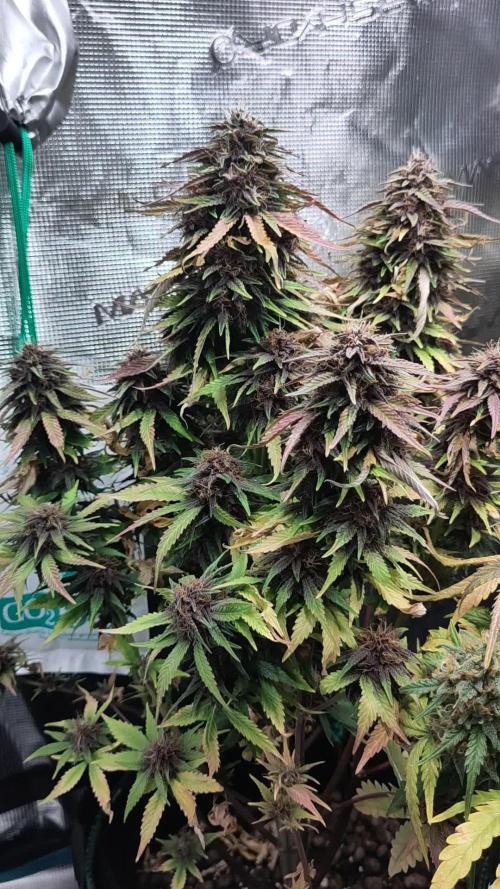
Her buds are all purple by now. Just lovely. Can't wait to try her... Hope she tastes just as she smells... awesome. I love all the diffenrent colors.

Likes
17
Share


@Leonardo_DaGrower
Follow
This weeks nutrients were identical to last minus the CalMag. The smaller of the two plants continued to stretch until the end of week three of flower. The larger plant already started to bulk. Trichome development is ramping up.

Likes
65
Share


@3lementa1
Follow
August 23: Just finishing up about 36 hours of darkness, then I'm going to wash the buds, then hang them. Harvesting a bit early due to time constraints but it looks good. The smell is very dank, not a tropical skittles smell, much more like wood glue as I've seen mentioned in other reviews, although I'm starting to occasionally catch a sweeter tropical scent as well.
I wanted to leave it a little longer. There were still a lot of white hairs when I started the dark period, but a lot of them seem to have developed into swollen calyxes so I'm pretty happy. I was a little worried they were making seed pods after last time, but I broke one open and all that was inside was red hairs. I'm going to keep an eye on the RH while they're drying and get them into jars and try to wait as long as possible before I start sampling. I can tell this is one of those batches that's going to get better and better if left alone for a couple months.
Just did the wash, did 1.25 cups of 34% food grade H202 and a squeezed lemon in a 5 gal bucket. Another bucket of just water to rinse. Then I had a fan on it while hanging in the sunlight from a skylight in the bathroom for 30 min, then put the fan further back and on oscillate, then turned it down an hour later. Left it in there for a few hours, then hung it in the grow tent with everything removed except an oscillating fan, pointed away from the buds. I have the whole plant hanging in the middle of the tent and the tent is holding at 60% rh.
Next run I'm going to do 2 buckets and only top once. I might leave them a bit longer in veg too to maximize the height in my grow space, and I'll get a proper 500w bulb instead of continuing to run 1000w bulbs at 50% to lower the heat a bit. The weather will be cooler and I'll only run one air stone in each bucket which should help with res temp. I'll probably foil-wrap the buckets again as well. I should be able to get another run done by the end of the year. I have a White Widow fem seed I've been waiting to use but I'm not sure what else I want to grow yet. Maybe Granddaddy Purp.
I'll take some micro pics of the trichomes this week and start curing, and I'll post a proper review in a couple weeks.
Happy growing everyone!
August 24: I took it out of the tent to inspect. No mold or mildew. The middle of some buds are still pretty wet. I'll keep an eye on it. Wet weight on the stem is 158 grams/ 5.5oz.
I harvested a couple branches last week and hung them up. I just ground up one of the buds, left it overnight and vaped some today. There was a bit of Chemdawg Tangerine in the grinder already but overall I got a lot of thick vapour, instant effects, and a really great tropical taste.
I busted out the microscope camera and I realized I had a couple buds that fell off before I washed the plant in the H202, and a couple buds that came off in the washing process. It doesn't look like washing the buds took off any of the trichomes. I do seem to find less debris in the buds, not that there was much there before. The trichs look great. Just a light toasting of amber. The washed bud actually seems more dry than the unwashed bud.
August 25: there's a real chlorophyll smell coming from the drying room today, it was much terpier yesterday. Leaves are getting crunchy, stems are still fully bendy. I ended up taking it down in the evening. The drying room rh dropped from 60% to 55% and the buds were starting to look too dry based on my last grow. I put it all in a paper bag for the night and I'll put it in jars tomorrow morning. Broken down most of the way it came out to 48-49 grams. From the bud structure, I definitely feel like it would have benefitted from more grow time if I didn't have to travel. More to come.
August 26 - the edges of the buds are getting really crispy and the buds are getting tighter. I checked the paper bag earlier and it was 65-70%. I got the impression it was time to put it into jars. I'll keep the lids off for a bit.



Likes
12
Share

@HighHolidays
Follow
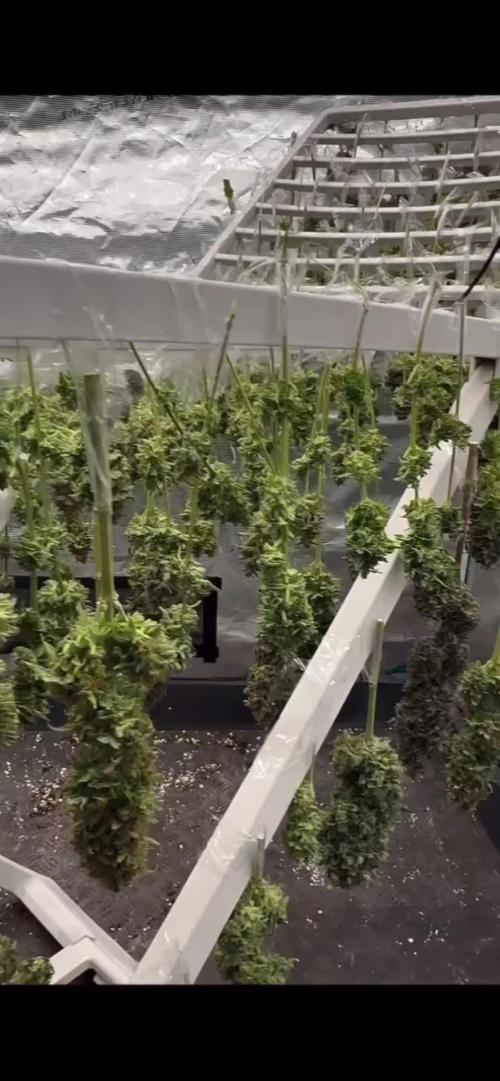
They’re already drying, so now it’s time to wait for what one has been looking forward to so much. It hasn’t taken very long, and it’s been a good return. What I like least about everything is trimming the buds.


Likes
1
Share

@thesocialclub
Follow
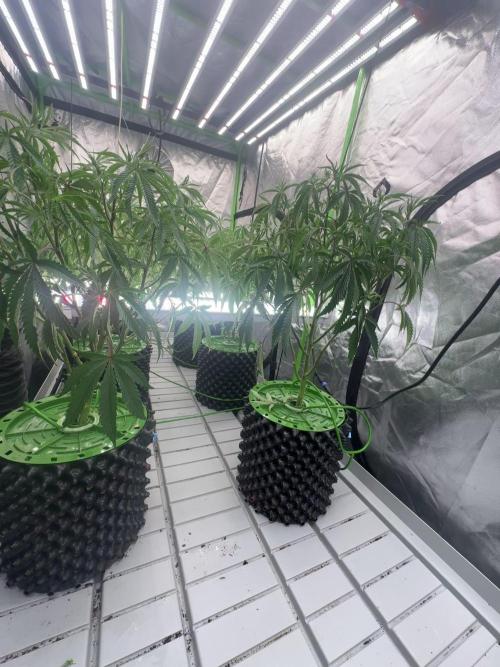
All in all, the week went well with the switch to Bloom. The levels were all within a good range. Next week or so, I’ll do the next round of defoliation.


Likes
3
Share

@Krautis_IndoorFarm
Follow
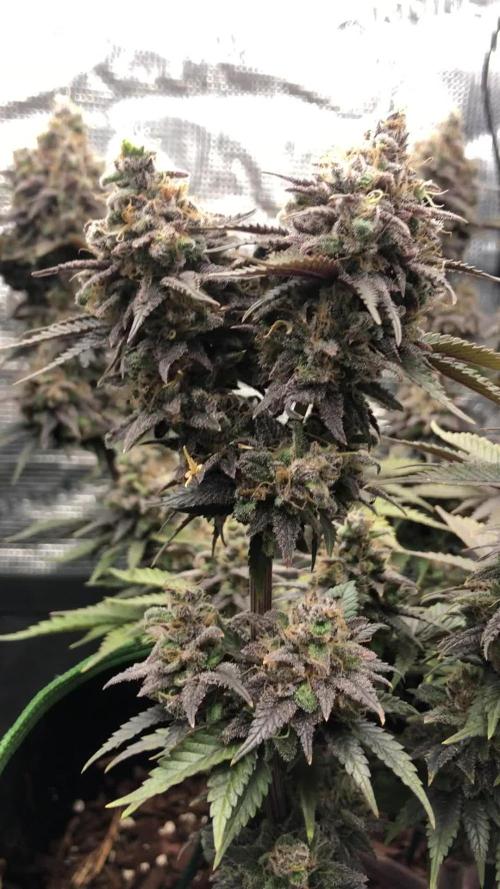
Beide Sorten bekommen nur noch wasser … ich entferne nichts mehr die z- velly wird die Tage fallen aber die Oreoz wird noch 3 Wochen brauchen wir sind gespannt wie die Reise weiter geht


Likes
6
Share


@Kannamar
Follow
05/04/2024, last pruning, rapid flush, EC down to 0.9, Falsh Clean @3ml/L, from now to harvest I will refill the tank with water EC 2 (approx. 3L/Day (target EC should be close to 0.3 at cut, Sunday or Monday).
I stopped the heating control, and set day ligth to 14h and will follow decreasing 1h/day, till 8h light only.
10/04/2024 This is amazing, this year no rush to harvest, we can wait and I have to say it seems to us it's still getting fatter!
My issue now is that the humidity has some pics at 100% at night! What could I do?!?!?
11/04/2024 EC dropped at 0.7 by adding only water, pH was up to 6.7 but back to 6.5.

Likes
38
Share

@Wastent91
Follow
Eccoci qua ragazzi, le ultime 2 settimane prima del raccolto, spero che vi piaccia il risultato anche se putroppo ho avuto vari problemi e le cime sono rimaste piccole, ma vi posso assicurare che sono stra piene di resina e dure come sassi, anche a livello terpenico è qualcosa di eccezionale è dire poco! Ora sto per raccogliere, grazie a tutti voi che mi avete seguito e supportato, siete la mia più grande forza! Grazie a Mars hydro e ai nutrienti di Terra Aquatica per aver reso possibile tutto ciò! Vi adoro! Continuate a seguirmi e spero che vada tutto per il. Meglio! Un buon 420 a tutti voi 🙏💪😸🌱🌿😽💨❄️❄️❄️❤️

Likes
24
Share


@Oyziphar
Follow
Hello everybody, ✋
it's been a great week. Plants are doing great. So I'm happy 😋
To resume :
👉 8 plants ; all clones of a selection of plants from RQS feminized seeds
👍 Cookies Gelato #1
👍 2 x Cookies Gelato #2
👍 Cookies Gelato #3
👍 Wedding Gelato #1
👍 Wedding Gelato #2
👍 Wedding Gelato #3 (no pics this week 😪)
👍 Sweet ZZ #1
2 x 600 watt HPS👉
8x Autopot fabric pots 18.9 liter
1x 200 liter watertank
Dimlux controller
50/50 recycled Plagron lightmix / perlite
Biovin, RQS Easy Boost
GenOneELeven nuts & wellness products 😜

Likes
Comments
Share


@Comfrey
Follow
Das Substrat ist nach heftigen Regenfällen vollgesaugt aber dennoch gut belüftet. Die Blätter sehen etwas mitgenommen aus, keine Ahnung was das ist. Es stürmt, sie brauchte etwas halt und überstand diese Woche ohne ein nächtliches Glasdach über dem Kopf.

Likes
5
Share

@GrowMaster93
Follow
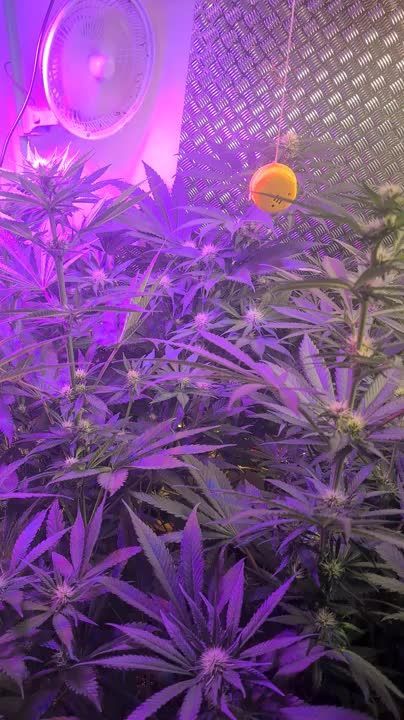
Update : 01.06.2023 -I had totally miscalculated, apparently because the co2 is so effective and my system is great and the plants for the 3 bw day 1 or 2 are really big and already have good buds, the gushmints already had buds as big as others in week 5 had without co2 - i had marked may 9 in the calendar, and if you look at the day intervals of the weeks, you can see that i'm on the right track now, i can hardly believe it, 3 weeks of flowering and such good, beautiful, vital plants . normally the Buden starts now slowly. Overall seen on all grows! WATCH THE VIDEO I POSTED TODAY! I CREATED IT EXACTLY 3 WEEKS OF FLOWERING YESTERDAY.
SORRY FOR MY MISTAKE PEOPLE, MY TANGERINE DREAM IS WORKING 😂😎 60/40 SATIVA YOU KNOW.
HAVE A BUD OF EACH PLANT SENT IN, YOU SEE I have a good system, I drive with over 400 watts led on 1 sqm and use a lot of expensive organic products, all of which keep their promises :)
We then know exactly the values for the new varieties, and the values are justifiable, my system is almost perfect. In my opinion.


Likes
22
Share


@eldruida_lamota
Follow
Vamos que os explico un poco critical es una variedad indica con una floración rápida, sus flores son compactas , y bastante resinosas, tiene aromas fuertes.
El ambiente en el secado estuvo en 23 grados de media y 40% de humedad se pasaron rápido al bote de cristal, 7 días en concreto.
Hasta aquí todo familia, espero que os agrade un saludo y buenos humos💨💨💨


Likes
6
Share

@MO_PureLeaf
Follow
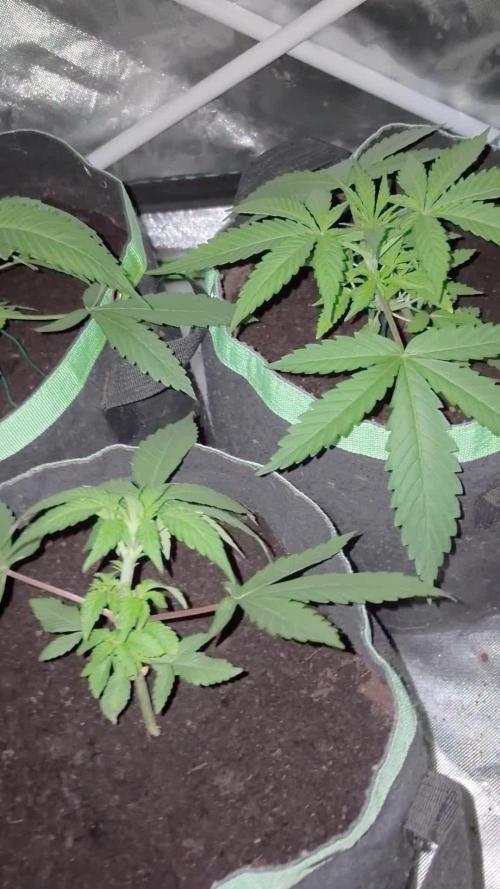
Foto 3 Frosted Grape
Foto 4 Tezla OG
Foto 5 Tezla OG 2
Bis lang wächst die Frosted Grape am wenigsten. Ich habe bei ihr mit dem LST aufgehört, weil ich denke das die Pflanze nicht mit zu recht kommt. Auf jeden Fall, es läuft aber dafür umso besser mit dem beiden Tezla OG. Die haben richtig Bock und die bekommen in der jetzigen Woche auch ihren cut :) bis lange haben die Pflanzen nur eine gießung bekommen und das dann direkt auch mit 4ml/L Alga Grow. Und super vit einmal die Woche als blattdünger