


Likes
Comments
Share


Likes
14
Share


@SunshineBud
Follow
Finally started seeing some baby buds! YES!!!
I really start running into issues with humidifier staying on so I've basically gave up on it, at some point around here I added a heater near the inlet fan and it's jumped the temp numbers up quite a bit
Some log entries:
1/21: Fed w/ 2 gallons for all 4 15ml big bloom, 10ml grow big and tiger bloom, 2.5ml cleankelp. all units per ga h2o
1/24: Fed w week 7 noots, trimmed 1-4, heavy on 1 & 4

Likes
10
Share

@LAShugars
Follow
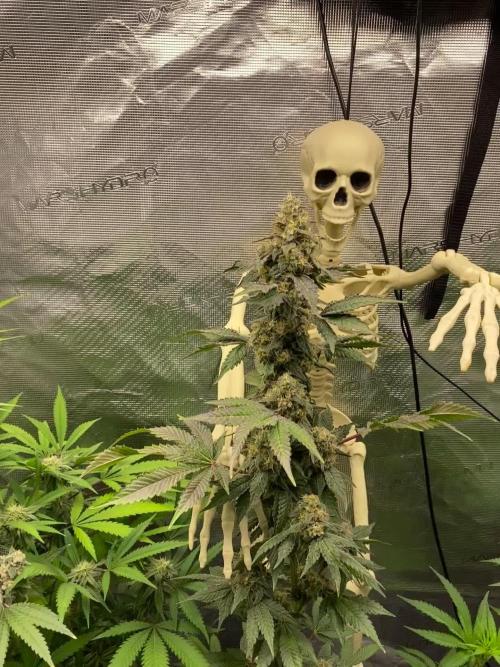
She’s a little sensitive to nutrients. Shes had some light nutrients but very light. Mostly Ph’d water. Going to give her the full Canna coco line tomorrow and introduce a pk booster but low streangth

Likes
12
Share


@Lysidious
Follow
Was bummed out plant got red mites at the end but that’s fine, it didn’t not impact the grow (or at least I didn’t notice.)
Harvested at the end of the 6th week of flower. Trichomes had already started turning amber due to heat degradation (couch lock party) what trichomes that were not dust ridden or amber was milky so I’d say it’s ready.
Choosing the best time to harvest is still puzzling for me due to the fact that this is my 4th time harvesting cannabis.
Thanks for reading... more info to come ...TBC
Likes
21
Share


@Siriuz
Follow
Started Week 10
Day 64
Fed them some nutes
Day 65
Looking good
Day 66
Outdoors for 3 hrs in the morning due to blackout T_T
Rested like 6hrs zZzz no lights
Day 67
Back to 20/4 schedule
Everything is good
Day 68
Lil defoliation
Got some pics and videos for you all
Day 69 Cool Juicy Video
Day 70 End of week 10
Overrall she is great!
Plan on to give her last meal tomorrow
Floranova bloom

Likes
Comments
Share

@Budhunter
Follow
Week 1 flowering - Day 6 of flowering & Day 62 of life
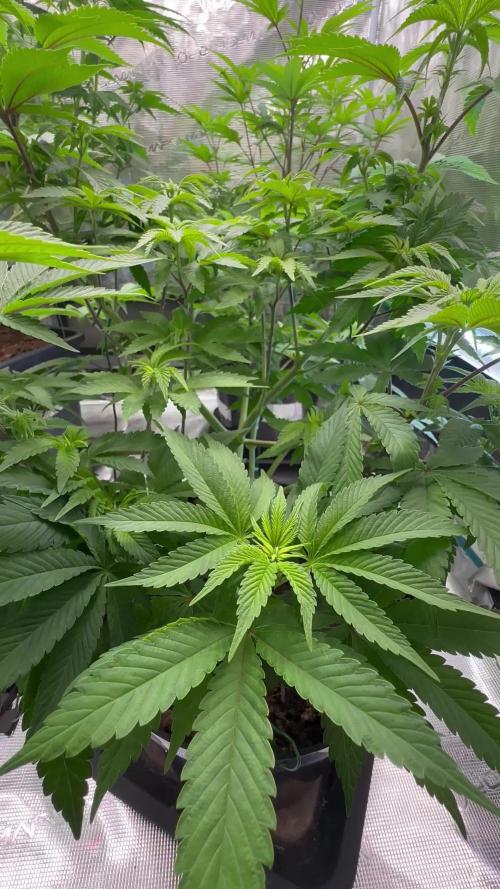
Finally flowering here. It’s been 5 days on flowering, still pre flowering but finally the best is coming.
Lemon cherry pie is going well, many bud sides, let’s fatten up them 💪🏼🔥✨
Likes
124
Share


@SlowpokeFuegobud
Follow
Hello growmies, welcome to week 3! 🍪 💜
Foliar sprayed with Nutrispray on day 20. 💦Potted later that day..
Watered on day 17 and after potting. 💧
Thanks @Green_Buzz_Nutrients for sponsoring my grow, those products really do their job! 💚 If you want to give them a try, there's a generous discount code in my setup description. ⬇️
Thanks @SensiSeeds for the opportunity, let's do this!! 🚀 💚 🖤
_______________________________________________________________________________________
Purple Cookie Kush Feminized Seeds
[Girl Scout Cookies x Purple Kush]
Purple Cookie Kush Feminized seeds come from two well-known strains, Girl Scout Cookies and Purple Kush. The 60% indica / 40% sativa heritage leads to a well-balanced hybrid flower. Flavours range from grapes to sandalwood, and the terpene profile is a concoction of many complimentary aromas. Purple Cookie Kush Feminized is a short plant with good yields. Bud formation is dense, similar to many Kush strains.
About Purple Cookie Kush Feminized
Purple Cookie Kush Feminized takes the hottest GSC genetics and mashes them with a Purple Kush cultivar that was hand chosen for this project. No corners were cut in creating and selecting the right breeding stock for this fantastic strain. The result is a well-balanced hybrid that retains key qualities from its lineage.
The Purple Kush parent of Purple Cookie Kush Feminized has a lot to contribute, as evidenced by the plant morphology. The compact nature and sturdy branching can be attributed to those indica-dominant genetics. Another area that the indica influence is evident is in the terpene profile, which includes scents of spicy hashish and earthiness.
GSC contributes selected indica traits to Purple Cookie Kush Feminized, but the sativa side of the genes also had an impact. Complex, fruity expressions are detectable in both the mouth and nose of this strain. Before harvesting, during the last few weeks of flowering, growers will notice pleasant scents with floral notes lingering in the garden area.
Growth pattern of Purple Cookie Kush Feminized
Purple Cookie Kush Feminized seeds grow into a plant that represents in appearance both sativa and indica inheritance. Because this is a feminized strain, growers will not need to sex the plants at the early stages of flower and can accurately anticipate yields knowing that all plants will be flower-producing.
Purple Cookie Kush Feminized has sturdy branches, similar to its GSC parent. The strong branches can support the weight of flower growth through harvest. The plant itself is stocky with a compact stature. This is attributed more to the Purple Kush influence. Due to the lower profile and many branches, defoliation is beneficial at various stages of growth.
Indoor growers with a controlled climate report final heights in the 120 - 140 cm range. Purple Cookie Kush Feminized finishes flowering in a quick 50-60 day window, which is a distinctly indica quality. Outdoor growers in temperate / Mediterranean climates have seen plants reach over 160 cm with ideal weather.
The bud formation of Purple Cookie Kush Feminized is similar to the popular Kush structure. Flowers are dense and compact. The buds are a mixture of swollen, trichome-covered bracts with dark forest-green foliage below. During the last weeks of flowering, the GSC influence adds purple hues to the vegetation.
Purple Cookie Kush Feminized is a solid-performing, easy-to-maintain plant with good yields. It is not difficult to achieve the optimal indoor climate, and yields of 425 - 475 grams per m² are possible in these conditions.
The ideal outdoor environment will have moderately warm weather and a small percentage of rain within the growing season. Growers in those regions have reported yields reaching 550 grams per plant, sometimes even more!
Common plant training techniques are not crucial to the success of this robust, sturdy plant, but some growers looking to maximize yields will use them. Techniques that have been used with great success in canopy control include SOG, SCROG, Supercropping, and Lollipopping. Purple Cookie Kush Feminized handles them all without skipping a beat.
Effects, taste and smell of Purple Cookie Kush Feminized
The effects of Purple Cookie Kush Feminized usher in a more relaxed and easy-going day than most. It has the benefit of merging both indica and sativa attributes. Euphoric and uplifting effects are associated with sativa cultivars, and these effects are precisely how the Purple Cookie Kush Feminized experience begins.
Blissfully distracted from the fast-paced world, thoughts shift to creative endeavours and inspirational goals. As these feelings are front and centre, a mild buzz begins radiating from the inner core. Soon, the indica-leaning effects are felt. Effects turn towards the loosening of tense muscles, the easing of minor aches, and an embracing full-body stone.
The flavour profile of Purple Cookie Kush Feminized is almost like a full-course meal. The pairing of flavours is unique and somehow works perfectly. The taste of fresh peeled grapes sits well with the coffee and caramel elements. The indica genetics once again show their dominance with undertones of earthiness and spicy sandalwood to complete the flavour profile.
Purple Cookie Kush Feminized has an unmistakably loud grape smell. This trait is not commonly seen in cannabis, but it is fully displayed with this strain. The remainder of the terpene profile is what many would consider the finer aromatic qualities of the GSC strain.
Scents of spicy hashish float through the air, complementing the grape aroma whenever the jar is opened. Background notes of earth and sandalwood add another enjoyable layer to the terpene profile.
https://sensiseeds.com/en/research/purple-cookie-kush-feminized?sqr=purple%20cookie
_______________________________________________________________________________________
Setup:
140x70x200 cm Spiderfarmer tent
2x Monkey 16W fans (not oscillating)
1x Secret Jardin 30W
1x box fan 50W oscillating (on lowest level)
LED
Full Spectrum 320W AGLEX AGL-320W-MA
5,6 kg
foldable, dimmable
864 pieces Samsung LH301H
864umol/s
2,7umol/J
full spectrum white + RED 660nm + IR 740nm
wavelength range 380-780nm
covering 3x4ft
Green Buzz Nutrients https://greenbuzzliquids.com/
❗ Use code GD42025 for generous 25% discount (for orders of minimum 75€)
Biobizz Lightmix + coco + wormcastings + perlite
Carbon Active Granulate Filter 125/360 cm³/h
PrimaKlima exhaust EC 125-400/240 cm³/h

Likes
10
Share


@GrowerGaz
Follow
Great strain all three phenos are really greasy and high in resin. Two phenos are very kushy gassy , one has more citrus than the other. The third pheno is a the super frosty #1 more sweet and a little funkier than the other two


Likes
82
Share


@WhiteEdge
Follow
12.03.2024
Continue into week two. Target EC is the same for this week
Girls looking great. One Purple Lemonade fall into bucket! That lid is not cut with precision😏 Put some plastic to hold till now
Clean tanks and filters with h2o2+vinegar acid +bleach
Replace all filters
Mix new batch with 2ml AN connoisseur AB + Big Bud Powder + Silica - total 20l @
Donne one pass off long misting 2m
TrolMaster Tent-X arrived! Setup and registration done in seconds. Finding best placement ...
700 PPFD @ center, VPD 1.0, RH 53-56% day, RH 45-48% night, Temp Night-20c, Day-25/26c, Leaf temperature 23c, Light distance 60-65cm, CO2 750+ppm
540w@70cm distance
NT-Nutrient Tank - PH -5.9, EC -1.15, Temp-21c
14.03.2024
Top up tank with 10l off 1.2EC solution - 2ml AN Connoisseur A+B + 3g Big Bud @ 18l (1.16EC)
Replace all filters
Before top up, nutrient solution in tank is 0.86, after adding 1.2EC new mix is 1.03
PH is slightly rising, normal when EC is drooping
Girls grow nicely, no deficiencies, this week is start off stretchy faze.
Remove some big and bottom levees
PAR map 800max/600min PPFD, VPD 1.0-1.1, RH 50-54%, Temp Night-21-22c, Day-25/26c, Leaf temperature 23c, Light distance 60cm, CO2 750+ppm
580w@60cm distance
50s ON time 20min OFF time Day Time
50s Off time 30min OFF time Night Time
NT-Nutrient Tank - PH -5.92-5.99, EC -0.89-1.0, Temp-20-22c
15.03.2024
Position TrolMaster Tent-X Box on tent and connect to internet. Temperature ,Light and humidity sensor is great, I lake that all sensors and connector boxes are on RJ connectors
Great and fast install, registration and connections off all cables, censors and light! Like ability to expand system with Aqua-X and Hydro-X for irrigation ,PH/ EC/Temp monitoring off nutrient tank
Controlling solenoid valves and pump will be SUPERB!!! Recycling type off timer are great for Aero misting!
With Inkbird equipment i have issues that all connections are permanent and if you have longer cables....😡
HLG Scorpion Diablo LED light is connect via LMA-14 light adapter ! Wow i can control dimming and timing off my light via Wi-Fi😀😊😎👏🙏🙌
PAR map 800max/600min PPFD, VPD 1.0-1.1, RH 50-54%, Temp Night-21-22c, Day-25/26c, Leaf temperature 23c, Light distance 60cm, CO2 750+ppm
HLG Scorpion Diablo@83%
580w@60cm distance
50s ON time 20min OFF time Day Time
50s Off time 30min OFF time Night Time
NT-Nutrient Tank - PH -5.95-5.99, EC -0.89-1.1, Temp-20-22c
16.03.2024
Top up tank with 15l off 1.2EC solution - 2ml AN Connoisseur A+B + 3g Big Bud @ 18l (1.16EC)
Replace all filters, still everything in pristine condition after every changing, nutrient solution in tank looking and smell fresh and clean.
Reducing humidity in night time below 50% , humidifier rise temperature to 22-23c at night
Day RH is 53%, in first two hours keeping temps and humidity lower to reduce deferential form night time to 1-2c
Don't want to have more than 10-15cm off stretch in next week
Girls drink more water and nutrients every day, think around 10-12l per day
Managing EC strength with adding slightly higher nutrients solution when top up tank. Overall its around 0.9-1.0EC for most of the time
PH is stabile , slowly rise in small increments. Need to adjust @ 6.2 to 5.9 every two-three days. Probably i will leave it to swing even more.
Diablo is at 80% power @ 45-55cm from top canopy, 900+PPFD in center, lowest corners get 650+
PAR map 920max/650min PPFD, VPD -1.1, DRH 50-54%, NRH48-50%, Temp Night-21-22c, Temp Day-25/26c, Leaf temperature 23c, Light distance 45cm, CO2 750+ppm
HLG Scorpion Diablo@80%
580w@45cm distance
50s ON time 20min OFF time Day Time
50s Off time 30min OFF time Night Time
NT-Nutrient Tank - PH -5.95-5.99, EC -0.89-1.1, Temp-20-22c
17.03.2024
Top up tank with 10l - 1.2EC solution - 1.8ml AN Connoisseur A+B + 3g Big Bud @ 18l (1.16EC)
Replace all filters, install one new. Total 5 mash filters + 2 disc filters
Remove some large fan leaves from all girls. Nothing crazy. Next week is final BIG defoliation and pruning
Clean room benches a little bit after defoliation.
Whole week all girls are doing great , no sign off any kind off stress or deficiencies. Superb fast growth.
Stretching is more apparent in the end off this week. Next week is going to be madness!
18.03.2024
Raise light 10cm , adjusting to canopy level..
HLG Scorpion Diablo@83%, Set sunrise/sunset dimming @ 30min - TrolMaster Tent-X
PAR map 890max/650min PPFD, VPD -1.1, DRH 50-54%, NRH48-50%, NT-21-22c, DT-25/26c, Leaf temperature 23c, Light distance 45cm, CO2 750+ppm
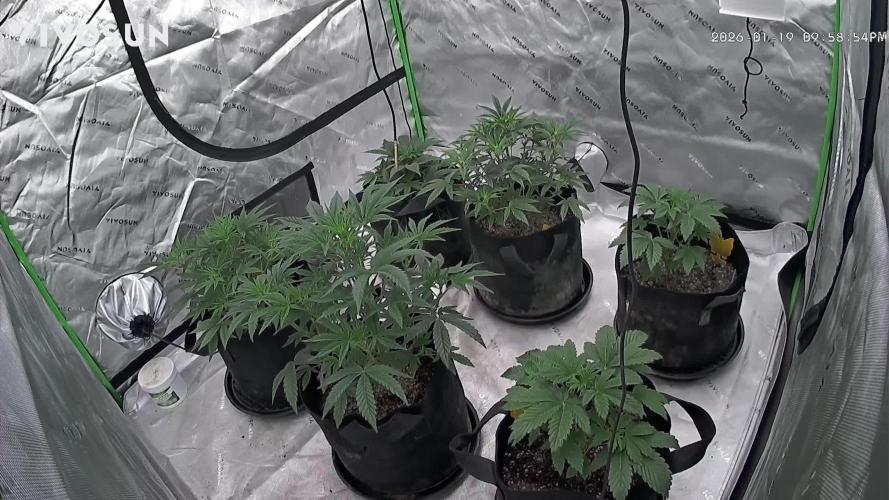
Week 2 off Flowering in Summary
100l off RO water
190ml+190ml AN connoisseur A+B, 15g Big Bud Powder
70kW electricity in total for light, Pumps and AC Infinity Fans. 58kW for Light + 8kW Dehumidification + AC Infinity ventilation
Week start @ 1.14EC, nutrient strength. Strength dropping every day by 0.1-0.2. Topping up tank with 1.2EC solution bring back strength to 0.9-1.0EC
Start using AN Big Bud powder for day two off this week. For next slowly reducing Nitrogen and add more Big Bud. Next week start @ 1.2EC
Girls look superb all time, Wedding Cheesecake is going to be a biggest strain in this run. Two off them are gigantic plants, third one is little smaller.
Tropicana Cookies is short and bushy with lots off side branching. Need good defoliation next week . Purple Lemonade is also huge , all three girls
Flowering going nicely, obvious sign off formation off bud sites, pistils have shown an all girls.
PH was stabile and move from 5.85 min to 6.2 max. Swing all week without chasing perfect number.
Light distance start at 65cm from canopy finish week at 45-50cm , PPFD levels around 800-940 in center, trough whole week
Temperature vary slightly from 23c at start off day to 26c max at some points. AC Infinity T6 extracting fan program in AUTO to kick in @ 26c
Night temps around 21-23c, dehumidifier start to work at night time to bring down humidity, trying also to minimize Day/Night temperature differential for this week also
Continue in next week at same environment settings and light strength..

Likes
6
Share


@Roller
Follow
Semi Jealousy-Zamnesia, messi ieri nel bicchiere, si aspetta che germini, intanto sto preparando il box e la lampada, per quando saranno pronti per la vegetazione

Likes
175
Share


@love_2_grow
Follow
Day 29 Flower (Day 71)
Woohoo! First day of week five of flower and an easy day at that. I just gave the right girl 3 liters of pH 6.2 water and took some pics.
I'm still experimenting with bud photography. This time with a tripod but still no additional lights. I also need to take the pics when the lights are off as the flowers look funky under the LEDs.
The right girl is slowly starting to bulk up, but the left girl is lagging. That is no wonder, though, considering that she has had much less light due to those space issues.
Also, there's a huge quality difference between the lights in each tent. So I'm looking forward to comparing the bud quality that each tent will generate.
Day 30 Flower (Day 72)
It slipped my mind, but it's been over two weeks since I gave the girls nematodes to get rid of the gnats. As always, the nemos did their job quickly and effectively, and I haven't seen any gnats since. However, to ensure that they stayed gone, I did a second treatment today, mixed up 10 million nemos into 6 liters of water, and gave each girl half at pH 6.6.
Day 31 Flower (Day 73)
Chill day. I just gave the right girl 3 liters of pH 6.5 water and cut some clones from her.
She is deep in flower so I'll try to monster-crop her. Never tried that before but have heard that it creates some really bushy plants. As she already is bushy I'm curious to see how bushy a monster-cropped clone of her will be. She had a few low branches that I left during lollipopping for this reason and I cut four of them with a sterile razor blade, then scraped the lower part of the stem and dipped them in Clonex. They're now sitting in the window with a small LED spot to make sure that they have enough light to re-veg.
Day 32 Flower (Day 74)
I know that I got a new tent for my left girl only a few days ago, but I decided to upgrade to give her a bit more space.
I went to my local grow store today and picked up a tent made by the same company as my main tent (UndrCovrLab).
This new tent is also made specifically for my wardrobe, maximizing the available space. I went from a tiny 40x40 cm tent to a "massive" 75x45 cm tent. Still very small but almost 2x bigger. Woohoo!
The left girl was squeezed into the 40x40 tent for so long that I had to use some LST to spread her out and increase light penetration now when she has some more breathing room.
Speaking of lights, my small ViparSpectra is a bit underpowered now in this larger space, so now I have to consider upgrading that as well. The simplest solution would be to get another ViparSpectra, and while this little light has been performing well, it lacks UV diodes. I'll look around for options.
We have gotten hit by a heatwave here, so now my tents are sweltering. The main tent reached 36 degrees C today at one point :/
Oh well, I cannot do much about it except hope that the heat doesn't stress out the girls too severely.
The girls are very thirsty in this heat though, and I gave each 4.5 liters of pH 6.5 water.
Day 33 Flower (Day 75)
All I did today was to give the right girl 3 liters of pH 5.9 water. A bit low as I used too much pH down and then was too lazy to fix it.
Day 34 Flower (Day 76)
No idea what happened, but an army of fungus gnats invaded my right girl. It's only four days ago since I watered her with Nematodes against gnats, and there were no gnats at all then. A few days later, it is gnat central in my main tent (the left girl in the other tent has no gnats). It's almost like I didn't give nemos to the plant but instead gave her gnats. Weird as the nemos have always worked great in the past. Now I need to start fighting these annoying little shits. Sigh. I'll give nemos another go, and if they don't work, then I'll use some sand. Worst case scenario, I'll use Neem oil, but I really don't want to go that far.
I gave each girl 3 liters of pH 6.5 water, and that was it for today.
Day 35 Flower (Day 77)
The last day of the fifth week of flower and all is (pretty well) well in the tents.
The left girl is 103 cm tall (6 cm increase in a week), and she is lagging quite a bit behind the right girl. She is healthy and quite sticky to the touch, but the flowers still have a lot of fattening up to do. I hope that will speed up now when she has a bit more room to spread out so the light can penetrate the canopy deeper. Getting a more powerful light would also help. When in doubt, add more photons!
Someone who doesn't need more photons, though, is the right girl. The top bud has been burnt slightly, and there's light bleaching on a couple of colas as well as on a few fan leaves. I removed the driver from one of the lights and raised the light a bit higher. Every centimeter counts when you're running out of space! The right girl increased another 3 cm this week and is now 123 cm tall. I hope that is it as I'm now completely out of room.
The gnat army in my main tent is still going strong. So strong that they have now sent out a small expeditionary force to my small tent and started to colonize the area. Sigh. I Will hit the girls in a day or two with nemos, but today I just put up some yellow sticky traps and gave the right girl 3 liters of pH 6.5 water.

Likes
7
Share

@AestheticGenetics
Follow
4/9/25
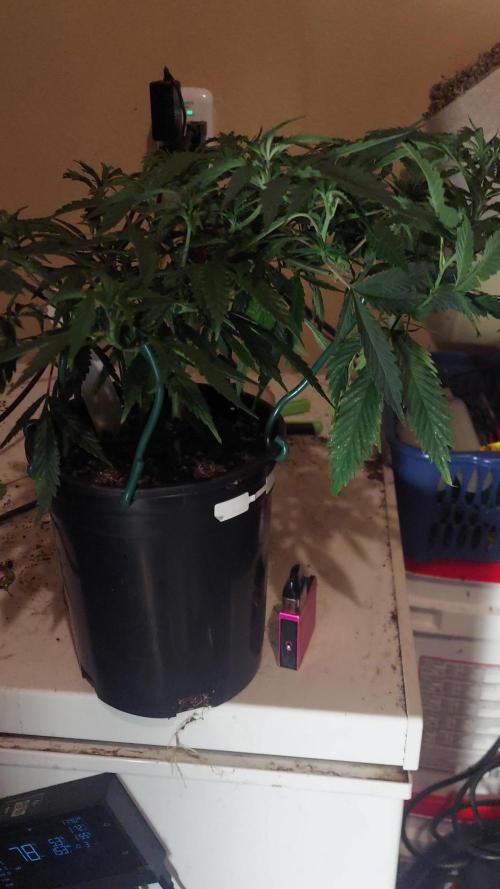
I have finally moved her into a proper tent and she seems much happier now with space to grow up.
Need to transplant soon.
Still no nutrients besides the dr earth a few weeks ago. and a top dress of microbe charge
4/13/25 shes happy and healthy and is taking a nice flat bush. She has so many branches and such tight internodal spacing. its crazy looking underneath her at all the structure shes got going

Likes
11
Share


@thereshegrowz
Follow
Noticing signs of too much nitrogen. Flushed with 3 gallons of water on Day 16, and another 2 gallons on Day 17. Plant is looking great and thriving despite having a big split that doesn’t look to be coming back together. I’m thinking the plant may be re-routing it’s stem. It’s getting nutrients somehow!

Likes
4
Share


@Ieiogrow94
Follow
Eccoci di nuovo qui!!!
Super eccitato per questa nuova collab con Sweet Seeds, team davvero al top, che mi ha dato l’opportunità di testare questa nuova genetica e di condividere i progressi con tutti voi!!!
Come sempre partiamo nei bicchieri per poi travasare.. Questa volta verrà svolto tutto sotto la Lumatek Zeus 465 ProC, mi aspetto molto da questo ciclo!!
Purtroppo ho perso i file delle scorse settimane e dovrò reiniziare il report da ora scusate per il disagio
Grazie a tutti per il supporto ❤️🍀🔥

Likes
112
Share


@Dunk_Junk
Follow
What a major growth spurt this week! Must be loving her new pot and all the lights switched on!
She grew 25cm this week! 10 inches! She is the tallest in the tent.
But anyway, she is doing her thing this week. Nutrients this time are 20-20-20 NPK powdered fertiliser I'm trying this time around. About 12 grams mixed with 10L of water makes ~1000ppm. My clean water alone is ~300ppm of that.
I do have a CO2 bag generator thing... It's not doing a lot though. My CO2 meter reads barely over 400ppm.........
Likes
45
Share


@masterofsmeagol
Follow
9/17 Didn't know this was a new week or I would've taken more pictures. I'm glad I took those two plants. As it dries and I start to trim I could see where it could've turned to rot real easy. It rained enough last night to soak all the girls. The two bottoms I harvest look like the have pm on them. If so I'll wash it or through it in the concentrate bag. Found a few colas a dropped which will go in the concentrate bag. Scoping the toasted toffy and the event horizon and the both look AMAZING! I've scoped the others and I'm extremely impressed. They may be difficult to grow strains but they have high cannabinoid content. The sherb cream pie has really come to life and turned totally purple with beautiful flowers. The girl in the 50 has several soda can sized buds. I hope this weather holds up. I don't like flowers this size getting wet. The sativa leaning hydrid us the only one I may have trouble with. It's only in a 10 gal but it's enormous! If needed I coyld bring it inside at night. The buds look like cat tails. I'm used to growing indica dominant strains. Plant us super healthy though. I'll be intrigued jail for a while and I've gotta make contact with whoever is going to do my extracts. I'll keep this updated. It's a lot of work bur it's worth it.
9/18 WATERED EVERYTHING I GALLON BUT THE BOTTOMS OF THE 2ND EV AND THE TT WHICH EACH GOT A HALF. Since harvest I've noticed some pm spring up on the toasted toffy. Looking at the other event horizon through a scope the trichs are all milky with some amber. I'm just waiting for A LITTLE more amber. And for me to have time and or room. I decided to harvest the tops and majority of one of my event horizon and toasted toffy. Today during an inspection I found a couple grey mold branches and some botrytis on my big GMO on the back. This plant is done. It's by far the furyhest ahead. Septoria effected the yield a little but pistols were retracted and amber was at like 10%. I thought about it and I watched the plant next to it with the pm have a branch I supported just "slough off". Right in my face. I figured if there was a sign tjis was it. I cut that rot off and put the buds from the branch in a bag and froze them then I went around and harvested the limbs on the other plant that were furyhest along. I took about half of it. I could've taken more and maybe I should've but I'm tired. I also noticed a couple spots of grey mold on the plant in the 50. All the leaves were falling off. I finally scoped it and it was right whetr I wanted it to be. Looking at the colors I'm glad I spent so much time the past few days. That one I hung whole. The sherb cream pie has something eating the fresy shoots (probably ear wigs. But the buds are fattening and the trichs aren't quite there. I'm going to let the rest of this stuff go ad long as possible. With the exception of the other event horizon. I finally tried it. It's fucking killer. I could take that plant now. The only reason I'm not is because I have to much work on my husband's as is. I'll do some videos amd pictures but I'm tired as fuck. Got to try event horizon. Very fucking impressed!
9/19 The past 3 days I've been working 5 a.m. to dark. I went back and harvested the bottoms of the toasted toffy and event horizon 1. After injury from harvest they contracted wpm. I used this as a learning experience and put some away in the freezer for concentrates and used a peroxide and water bucket. That's what kills the p.m. anyway. I hung them and they spun in the wind. I blew them lightly with a leaf blower before putting them ok strings I had previously setup with a fan in front of it. I kicked ass today. Toasted toffy got sampled and did NOT disappoint. I had it in a jar though and it was green so I'm not counting this. I do have some dry. I have indoor left too. Like in the video that one GMO looks like it's fucking dying or something. I'd rather cut it and use it for concentrates if it effects my healthy plants. I just checked on that plant in the 50 I hung. It looks amazing under the scope and smells better. Decisions, decisions. I do have a few calls I should make sooner rather than later. We are supposed to be getting rain.
9/20 The past 3 days have been hard. The wife's medical stuff is acting up and I had to tend to harvesting a few. My whole body hurts. I even did my first bud wash yesterday! The ev and tt I took and left some buds on ended up covered in pm. So I decided fuck it and tried bud washing. I also froze some for extracts. Speaking of which I need to male contact with whoever I'm going with this year because I think I've reached the point of diminishing returns on that dieing GMO. When it comes to grey mold and botrytis I don't fuck around. Winds are really high today. Putting the scope to the sherb pie is making me second guess myself too. Oh well. It's not going to rain today. And if needed I can move them in the barn. If I get ahold of Mt processor I'll chop that GMO and bring it right there. The other thing is that I've got tons of weed and a lot of its hanging so I've gotta find someone that will do a batch of live rosin then like a elbow of dry. This is the best part of the year. We'll It's supposed to be. Cutting down good plants us bittersweet. I don't mind chopping that one gmo a little early though because it's close to hitting the point of no return. That little sativa dominant hybrid in the ten is HUGE! The buds are swelling like crazy too. It's got a COUPLE septoria spots but this thing is resilient and easy to move around. This will finish perfectly. So far I'm happy with what I have. I'm GRATEFUL. The two September plants I tried were GREAT. A 90/10 and an 80/20 and they both suprised me and got me exactly whete I wanted to be. I'll keep things updated. I did a video I'll upload.
9/21 Weather is still great and the buds don't even seem wet in the morning. The thing is is that something (rot or ear wigs probably both) have stripped lower interior branches. In some cases stripping them ENTIRELY or chewing the stem right off. It wasnt happening to my favorite GMO or the one in the 30 and the like on in the ten. The Sherb pie I noticed grey mold on 3 different branches. Last time I checked trichs it wasn't ready but I've got to get a handle on this mold/pests or it's going to he taken a little early. We have incliment weather coming Wednesday I think. I'll bring the 10 inside and if I have to I'll bring that perfect GMO in as well. I'm going to scope everything again today. I called a bunch of extractors for prices. I was going to do fresh rosin and just yank and drive but that is looking to be harder. I can get badder made CHEAP from a reputable lab. I think I'll do that. They prefer dry and that way I could through what's left from last year in there. I have this other one GMO that I've had the same issues with. I'm sick of removing bud rot or having to cut interior branches off due to pm. Tried toasted toffy and it was fucking amazing. I'm planning on trimmingvthe ev and if I finish I can bring the other one in. It's done. It's not getting any bigger. Trichs aren't changing. That GMO I am going to scope when I get home and it will be coming down in the next couple days. Otherwise I'll end up with half of what's there. The GMO I took the tops from is finishing up too. If I scope that and it looks decent and I have the time I'll take the remainder. I'm leaning towards doing at least a lb dry for extracts. I've got some frozen. I've got some hanging and most is still in the ground. I sleep on all major decisions. However, I know getting my nice buds soaked when I'm already losing shit to budrot and grey mold isn't the smartest thing. I'll probably take what I can and bring the others inside to keep them safe. I didn't think I'd have this much quantity. I knew quality would be good but this isn't a bad year quantity wise either. I'll keep this updated.
9/22 Busy as hell! Rain coming Tuesday. After a final check of the scope and the flowers and I took the GMO that all the leaves had fallen off of. That plant is going straight to extracts with the one in the thirty. I also "finished" harvesting that GMO that was furthest along. Trichs were getting amber. Been in trim jail. Was going to take the Sherb Pie but I'm not seeing amber yet. I did have to cut off some branches that had rotted. I'll keep an eye on it. It will come down when it's ready. It just sucks losing little bits of it. My favorite GMO is sooooo close to perfect. I should just take it but I'll wait. If we get rain I'll bring that and the sativa looking one in the ten is the barn. Back to work now. Before I forget what strain is what lol.
9/23 Still busy as fuck. I chopped the other event horizon amd hung it whole. It's DONE and it doesn't need to go through the rain storm. I also took the majority of the GMO early pheno. What's left will get plucked off and used for extracts. The big one in the 50 is getting dry. I have finished the event horizon and I'm not "finished" with the toasted toffy but I have it in 5 gal buckets with a food grade lid so u can at least cure correctly. The gmo is still hanging. I'm wondering whether I should wait it out or chop. I'm gonna take care of what I have inside first and hope that shit doesn't eat my plants or that it doesn't rot off. That perfect GMO has one branch with some grey mold. I might cut it off. I'll keep this

Likes
61
Share


@McBubatz
Follow
14. Woche, P1 fällt morgen, die ist soweit gut denke ich (ca. 20% aufwärts Bernstein Trichome).
P2 braucht leider noch ca. 1 woche länger.
93. Tag ist für P1 das Ende, sie wurde heute vorgetrimmt und zum trocknen aufgehängt.
Ergebnisse gibt es wenn die P2 auch geerntet wird, denke nächste Woche um die Zeit.
Aber eins kann ich euch versichern, is mit Abstand die schwerste die ich ist jetzt hatte😊🍀🍀.
Gebt euch auch mal wie viele Trichome die gute produziert hat, Duft is noch sehr pflanzlich, Blüten sind ziemlich fest gewesen hoffe das es nach dem trocknen noch so ist. Alles in allem super Run.
Hoffentlich is die gute bei den Top 10 das wäre ein träumchen, wobei ich es wirklich jedem gönne zu gewinnen und bei soviel starker Konkurrenz geht ich wahrscheinlich unter.
ABER was ein geiler Contest trotzdem, hier ein dickes fettes Dankeschön an Zamnesia und Plagron für die Möglichkeit hier überhaupt mitmachen zu dürfen 🙏💙💜
98. Tag , werd die gute am Samstag/Sonntag je nachdem wie ich Zeit finde, umlegen und zum trocknen aufhängen.
Likes
9
Share


@KarlysCannabis
Follow
Week 7 Flower - Lots of leaves and height gained this week. Not quite showing sex but it will with the light change yesterday!
@Grove Bags, @Fishshit, @SoHumSoils, @KindwayFarms @KindwayConsultationsLLC @nutetools, @mjarsenal, @ElevatingTravel, @IntegraProducts @AyaofAfrica @WaxyBrownsFlowerPowerHour-Interactive @BowlBuddy, @cannakamp, @HoneycombHydroLLC @ChillZHQ @TheCannaCoaches, @VibesByDesignLLC @CryptoCannabisClub, @REALMetaMinds @SeattleHempfest @Buttheadz @SwadeSoul @abagaletv, @abagoldcoin, @Idonfts, @ASRG
#wegrowstrongertogether #mocannacup #LFG #letsfngrow #jawwbreaker #danmccann #jawwbreakerbreath #jackterror #legaladultuse #getmoftomyourgrow #honeycombhydrollc #heropackz #nft #crypto #blockchain #metaverse #seedtheworld #greenfarmy #drugsdontmakeseeds #NFSOT
Likes
Comments
Share

@SolitudeCorners
Follow
Overall Development
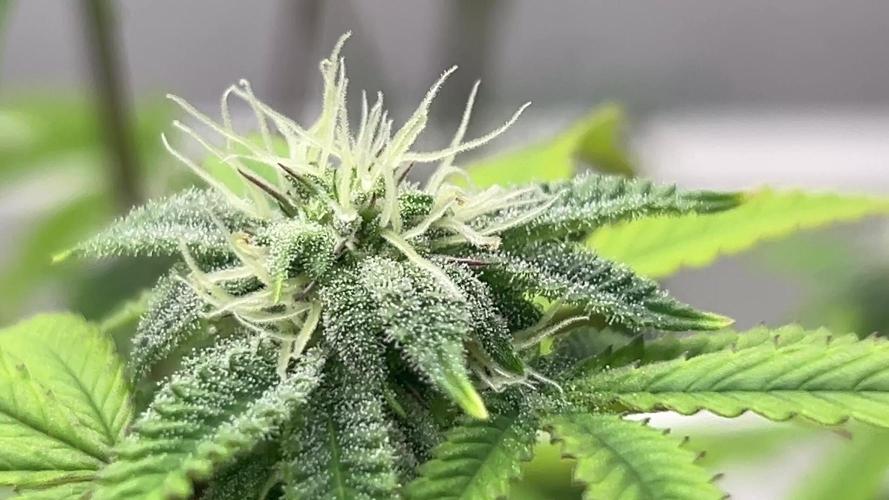
Week 4 marks the transition into mid-flower. Stretch has mostly stopped, and the plants are now directing energy into bud formation. The canopy remains uneven, with some taller, thinner phenotypes and others more compact and structured.
Bud sites are clearly established across all main branches. Flower stacking is progressing steadily, and early cluster formation is visible on the tops.
Plant Health & Observations
• Significant yellowing on older fan leaves, especially mid-to-lower canopy.
• Some plants appear pale green overall, indicating high nutrient demand during bulk transition.
• One or two phenotypes remain darker green and structurally stronger.
• Lower interior growth is lighter and less vigorous.
• Selective removal of old yellow leaves was continued to improve airflow and light penetration.
Despite visible leaf fade, bud development continues actively.
Bud Development
• Flower clusters are expanding and beginning to connect along the stems.
• Pistil production is strong and consistent.
• Buds are not yet dense but are clearly transitioning into the bulk phase.
• Resin production is beginning to increase.
This week represents the start of the main swelling period.
Environmental Adjustments
• Temperature reduced slightly (~1°C) to stabilize the flowering environment.
• Airflow maintained across canopy level.
• Canopy density moderately thinned to prevent moisture buildup.
• Light coverage remains strong across the upper layer.
Current Focus (Entering Week 5)
• Support nutrient demand during bulk phase.
• Prevent excessive early leaf loss.
• Maintain stable humidity to protect developing flowers.
• Monitor weaker phenotypes closely for further decline or nutrient imbalance.
Overall, the crop is entering the critical mid-flower stage. The next two weeks will determine final bud density and structure.