


Likes
Comments
Share


@Saylles
Follow
Heute mal inklusive einem kleinen Video.
Was soll ich sagen, ich habe in diversen Foren und auch hier das Problem geschildert und musste wohl feststellen, dass ich es tatsächlich geschafft habe mit Bio Dünger zu überdüngen und das wahrscheinlich mit zu viel Stickstoff.
Ich habe mir die Trichome angeschaut und rechne mit einer Ernte in ca. 14-20 Tagen. Diese Woche wird das letzte Mal Blütedünger gegeben. Der Wachstumsdünger ist komplett raus. Ab nächsten Sonntag wird je nach Zustand entschieden, ob TopMax und die anderen Zusätze noch 1 Woche gegeben werden oder ob ich spüle. Ich werde die Töpfe auch nicht mehr voll saugen, da die Luftfeuchtigkeit kritisch wird (nachts 82%, tagsüber 65-70). Schimmel konnte ich noch nicht feststellen und auch vom Geruch her glaube ich, dass noch kein Schimmel vorhanden ist.

Likes
5
Share


@BigGGrows
Follow
Week 7 of flower, she is pushing along well. I went ahead a began flush and cut the feed. I want to fade her out nicely. I tied down her lower branching and really opened her canopy up. She is nice and bushy, running budsites up and down each cola. She looks like she may need another 2 weeks. But we shall see. She is very sticky and has fuel/pine terps coming off her. Her buds are starting to swell, but calyxes not very dense/firm yet. May need to let her go for maybe 3 more weeks to fill out nicely.

Likes
3
Share


@synistergate54
Follow
It was very easy to grow this plant, she did everything by herself. The results are amazing, the taste is absolutely stunning and one joint is enough to be stoned for the rest of the day.

Likes
91
Share


@CAMOGROWN
Follow
I've pretty much gone over everything in the video.
Super not happy I've had to turn this auto grow into a photoperiod grow. I'm not really set up for light leaks hence why I grow auto's.
On the only plus side, I think two are MABEY starting to flower. They would be the smart pot pair.
The big sativa is still stretching even though it did that during week 3-4!
All I can say is thanks for suggesting the 12/12 switch @biggreens420, if this grow turns out fine then we'll be smoking buddy lol
I was gunna kill three off and start a fresh grow with BETTER GENETICS. But I'm willing to see how messed up they can get so I can give a PROPER review.
Thanks for all your time !

Likes
2
Share


@TTerpz
Follow
4/22/25: last flush 2 tsp of sledgehammer with 1 gallon of water used 2 gallons between all three plants…more cool colors coming in with the fade
4/24/25: fed with recommended dosage for week 11 on my schedule card (day 31 of flower)
4/27/25: watered with plain ph water at 6.8


Likes
16
Share


@Yog69
Follow
After overfeeding the plants in the past, I've been feeding not enough, lateley. Plant #1 shows nutrient deficiencies.
after giving more nutrients, plant #1 seems to recover. The build up of flowers is amasing. The flowers smell really sweet.😀
Likes
78
Share

@RockoCalenberg
Follow
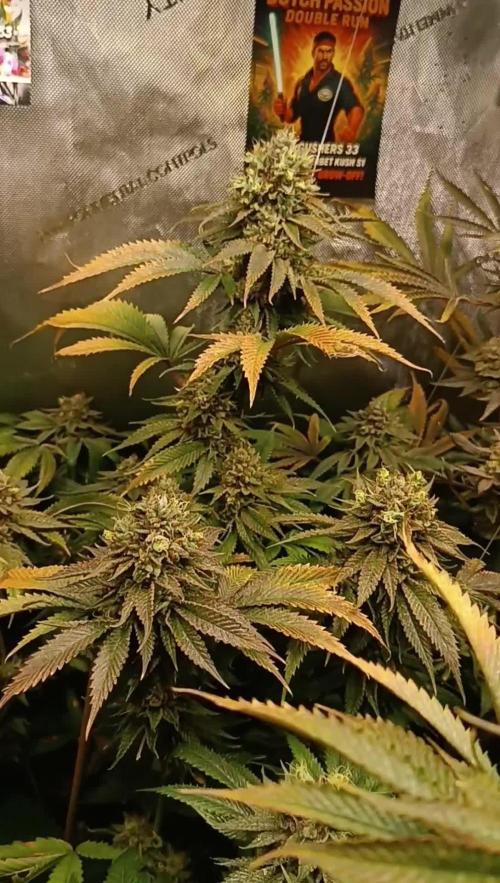
Letzte Tage vor dem Chop – Flieder-Terps & milchige Trichome 🌸👀
📅 Blütetag 73 | Gesamttag 133
Jetzt wirklich die letzten Meter im Double Run. Viel passiert nicht mehr – außer dass beide Ladies sichtbar auslaugen und immer zerlotterter wirken. Genau das, was man sehen will: sie ziehen jetzt konsequent die letzten Reserven aus den Blättern.
Die White Gushers 33 braucht weiterhin Geduld, während die Triangle Sherbet Kush schon fast komplett milchig ist – kaum noch klare Trichome zu sehen. Reif ist sie definitiv, aber ich gebe beiden noch ein paar Tage extra, um den Sweet Spot sauber mitzunehmen.
Beim Öffnen des Zelts kommt jetzt ganz klar eine florale Fliedernote durch – richtig angenehm und deutlich wahrnehmbar. Das Ganze geht in eine fruchtige, leicht süßliche Flieder-Richtung, sehr rund und schon jetzt ziemlich ausgeprägt.
Seit einer Woche gibt es nur noch Wasser. Trotzdem trinken beide noch erstaunlich gut weiter – läuft also sauber bis zum Ende durch.
Draußen wird’s langsam frühlingshaft, VPD deutlich entspannter – aktuell eher nebensächlich, aber zumindest keine kritische Feuchtigkeit mehr.
Was mich etwas fuchst: die White Gushers 33 schiebt auf eigentlich fertigen Buds noch diese kleinen Türmchen. Nicht ideal, aber jetzt auch nichts mehr, was man noch beeinflussen kann.
Ich gebe ihnen noch 3–4 Tage, maximal 5 – dann ist Schluss. ?
💬 Grow Frage Feedback – Dark Period vor der Ernte
Im Zuge meiner Frage zur Dark Period vor der Ernte wollte ich das Ganze hier nochmal zusammenfassen:
Vielen Dank erstmal an alle für den starken Input! 🙏
Es war wirklich interessant, die unterschiedlichen Meinungen zu sehen. Die meisten Grower sind sich einig, dass die Ernte am Morgen vor dem Einschalten des Lichts im normalen Zyklus der gängigste Weg ist.
Einige setzen weiterhin auf eine 24–48-stündige Dunkelphase, während andere diese für unnötig halten und den natürlichen Rhythmus der Pflanze nicht unterbrechen wollen.
Am Ende scheint es so zu sein, dass der richtige Reifegrad und das Timing wichtiger sind als eine abschließende Dunkelphase.
Ich schätze die vielen Erfahrungswerte hier sehr – richtig wertvoller Input!
Danke & Grow on 🌱
– Rocko
🔥 Final days before chop – lilac terps & cloudy trichomes 🌸👀
📅 Flower Day 73 | Day 133 Total
Now it’s really the final stretch. Not much is happening anymore – except both ladies clearly fading and looking more worn out by the day. Exactly what you want to see: they’re pulling every last bit of nutrients from the leaves.
The White Gushers 33 still needs a bit more patience, while the Triangle Sherbet Kush is already almost fully cloudy – barely any clear trichomes left. Definitely in the harvest window, but I’ll give them a few more days to really hit that sweet spot.
When opening the tent now, a very clear floral lilac note comes through – super pleasant and quite pronounced. It leans towards a fruity, slightly sweet lilac profile, already very round and well developed.
For about a week now, they’ve only been getting plain water. Interestingly, both are still drinking quite well – smooth finish so far.
Spring is slowly kicking in outside, VPD is getting more stable – not very relevant at this stage anymore, but at least no excessive humidity.
One thing that bugs me a bit: the White Gushers 33 is throwing small foxtails on already finished buds. Not ideal, but nothing you can really influence at this stage.
I’ll give them another 3–4 days, max 5 – then it’s chop time. ?
💬 Community Feedback – Dark Period before Harvest
Following my question about dark period before harvest, I wanted to sum it up here:
Thanks everyone for the great input! 🙏
Really interesting to see the different opinions here. Most growers seem to agree that harvesting in the morning before lights turn on during the normal cycle is the most common approach.
Some still like to add a 24–48h dark period, while others consider it unnecessary and prefer not to interrupt the plant’s rhythm.
In the end it seems that proper ripeness and timing matters more than the final dark period itself.
Appreciate all the experience shared here – lots of good insights!
Thanks & Grow on 🌱
– Rocko
Processing
Likes
14
Share


@PlantGod
Follow
Excited to see the pistols keep coming and coming
I have such tight spacing that the buds will probably start connecting by the end of the week on the Royal Gorilla
Day 19- Tomorrow I will tie some branches down to open up the plants more. The LSD plants needs it the most!

Likes
1
Share


@Sjake72
Follow
All pics are from the 1st day of each week
I upped the nutes considerably this week saw some weird spots forming on several of the plants just figured it was nute lock so i drained a gallon of water from the affected plant and replaced with basic ro ph balanced water to dilute was this the rt thing to do? Will be doing only 50% nutes from here on

Likes
22
Share


@EelGrows
Follow
Week 6 Summary: First off, Happy New Year! May the new year filled with peace, love, joy and dank buds! 😄😉
Day 36-39: Despite my heavy defoliation they seem to bounce back quite quickly every time, but this is my first grow so I could be completely wrong and slowly murdering my plants... 😅 WC1 starting to frost up, the two double buds are starting to split themselves up while stretching: WIN! WC2 and WC3 really starting to show their size compared to just a week or 2 ago, really spread out now, and starting to stretch.
Day 40-42: WC2 and WC3 really stretching now. WC2 almost catching up to WC1's height, and has probably spread out the most out of all plants when you compare it to a few weeks ago. Maybe defoliating is a good thing for Autos after all? I'm stoked about these. Although WC2 and WC3 are a few days behind of frost production it's definately starting to show itself by the end of week 6. Stoked for these!!
These are stinking aswell, but for now the 4AM in the tent is sweetening it up!
On to week7!!!

Processing
Likes
4
Share


@Cannibalgardens
Follow
This strain is one of my favourite to grow I'm addicted to the flavour and how fast she grows.. The team at @fastbuds have been very generous towards me and I'm happy to be growing out there strains ... She is healthy and will be growing a lot by next week cheers


Likes
12
Share


@Philippovic
Follow
Die Blüten bilden sich schön, bin sehr gespannt was da in ein paar Wochen dran hängt.
Gestern haben alle Pflanzen nur Wasser bekommen, da die Platt spitzen leicht gelb waren. Ab morgen gibt es wieder die normale Düngung laut BioBizz Schema.
Ist es normal das die Wurzel bis zur Oberfläche vom Topf kommen?
Seit dem die Nematoden und die Raubmilben im Zelt sind gibt es nur noch vereinzelt mal eine Trauermücke zu sehn .
Werd ich auf jeden Fall bei nachfolgenden grows beibehalten.
Painkiller 1 und 2 sind in Der Blüte, nr. 3 noch nicht, sie hat aber schön an Höhe aufgeholt.
06.07:
Mittlerweile sind wir ende Blütewoche 3 und die Painkiller 3 hat immer noch keine Blütenansätze, das wird interessant bei der Ernte…
08.07
Painkiller 3 ist immer noch stark im Strech und ist mittlerweile die höchste Pflanze im Zelt, Blütenansätzt sind endlich zu erahnen,
Likes
30
Share


@WeWantItToGrow
Follow
This week has been such a gift! I have learned so much about proper care for a plant I had no idea how little I knew sitting down and observing these majestic trees produce such a potent flower has really humbled me. Premium cultivars strain has shown resilient and self sustaining easy to grow traits that it is hard to mess up. (Which I’ve done a few times lol) Notice the trichomes (I put the zoom lens on and got up in there so they could be better seen the bud itself is slathered in them ! This is going to be an amazing smoke! Also looking at the structure of the bud it’s self it has volume very full bodied bracts with pistils throughout It’s just an all-around beautiful thing to observe



Likes
53
Share


@AutoCrazy
Follow
It was a fairly busy week for this fine lady. No one likes their lady too bushy, right, 😉 so I have been cleaning up lower growth every 2-3 days as of late.
I also put her in a 20 gallon pot this week and that was a bigger challenge then I anticipated 😅😅. First I had to get her untied. Then I didn’t quite get her tied down as well as I had her in the 10 gallon pot but she is still nicely laid out IMO.
I may have to adjust how she is tied down in the weeks to come as these genetics can really stretch out!!
Stay tuned
😎🍿🍻🌱

Likes
3
Share

@KovasGrows
Follow
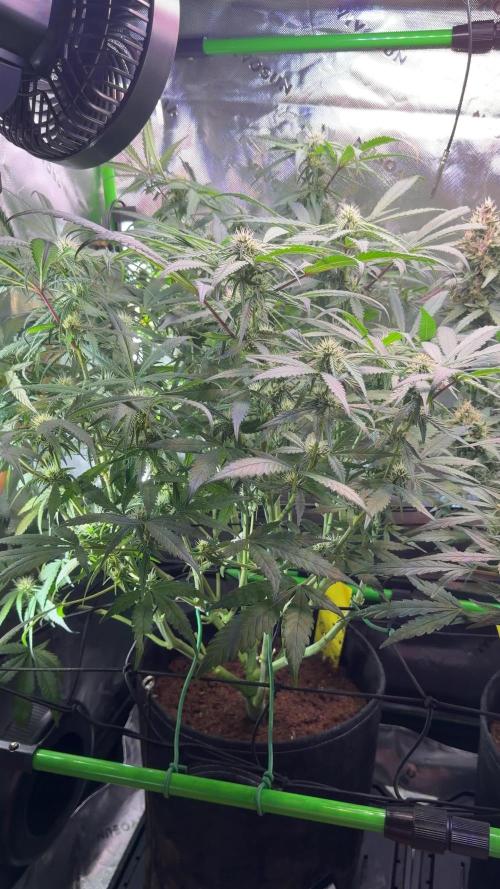
Heyho Growmies! The Mango Frost is in the end of stretch and now fully starts to develop her Buds. The Mango Cherry Runtz is getting purple and fatter and fatter.
I still removing a few fan leaves here and there,to optimize airflow & light. While trying to remove as less as possible plant material for now. Maybe next week they get a little bit more defoliation.


Likes
16
Share


@Raizativa
Follow
250ml c/u
0.5 Micorizas @colectivo
1ml Calmag @biobizz
1ml Bio Grow
1ml Bio Heaven
Riego día 21
250ml c/u
1ml calmag
