


Likes
Comments
Share


@Hempface86
Follow
Well today is day 42 I think it might be 41 LOL.. but anyway she's in full stretch I think she has maybe another week or so of stretching and we'll start seeing some crowning.. this is across of blueberry and somango so I'm hoping she's going to be tasty.. as I said it before I'm doing this small pot run just a sample the flower itself.. she's in a gallon container that's about 65% of the way full of soil.. she's at 23 in and growing so let me just say MaxiBloom with silica and Cal mag is like steroids for your plants... You just got to make sure you flush correctly to get that salt out and all the nutrient buildup.. thanks to everyone stopping by and taking a moment to see what I have I really appreciate it.. give me a like if you approve of what you see much love everyone.. and again sorry about the picture and video quality I'm going to have a good phone again and then I'm really going to step my game up I'm hoping to even be able to get some micro shots in the future.. happy growing ✌️

Likes
293
Share


@Ju_Bps
Follow
Hello growmies 👩🌾👨🌾🌲🌲,
👋 No more burning this week, using nutes again.
Buds start to bump and are more and more frosty ❄️❄️
💪 Will do a big defoliation next week ✂️✂️
💧 Give water each 2/3 day
2 l Water Only
2 l Water + Bloom + Green Sensation + Sugar Royal (3 + 1 + 1 ml/l)
PH @6
💡Mars Hydro - FC 3000
50% 13 cm
Mars Hydro Fan kit
Setting 8
Have a good week and see you next week 👋
Thanks community for follow, likes, comments, always a pleasure 👩🌾👨🌾❤️🌲
Mars Hydro - Smart FC3000 300W Samsung LM301B LED Grow Light💡💡
https://www.mars-hydro.com/fc-3000-samsung-lm301b-led-grow-light
Mars Hydro - 6 Inch Inline Fan And Carbon Filter Combo With Thermostat Controller 💨💨
https://www.mars-hydro.com/6-inch-inline-duct-fan-and-carbon-filter-combo-with-thermostat-controller
Fast Buds - Gorilla Cookies FF🌲🌲
https://2fast4buds.com/us/seeds/gorilla-cookies-fast-flowering
Likes
Comments
Share


@Bread_n_Buds
Follow
Our Zookies Automatic are very cute.
Remember that we are growing 1 Plant worked with the techniques and one left to grow without cutting techniques to preserve its speed.
In this diary we find the plant that is growing free and beautiful with just a little cleaning. We are at the time of going into flowering for a couple of days we have switched to bloom to avoid the yellow tips but for the most abundant in this week in which we have stretched we have given the grow again.
The comparison is the salt of the experience so the plant of the other diary will be worked very differently go and see it to compare them.
We have started the Plagron fertilization program, we are in 100% organic configuration, the soil is recycled Promix + 1/3 fresh soil + 10% Perlite + RQS Mycorrhiza Mix (4 g in the mix, 1 g under the small fiber pot).
We are administering // 1 ml/l Power Roots - 1 ml/l Pure Zym - 1 ml/l Sugar Royal - 3 ml/l Alga Grow
We sprayed Vita Race Foliare 3 ml/l.
https://plagron.com/en
The doubts about the compatibility between Pure Zym and mycorrhizae have been dispelled, they can get along according to Plagron experts. If someone tells you that enzymes eat mycorrhizae, which in principle may seem possible, explain to them that it is not true.
https://www.royalqueenseeds.it/growing/452-easy-roots-mix-di-micorrhize.html
Is a top strain of the last few years very high level of thc ---- https://www.zamnesia.io/it/11174-zamnesia-seeds-zookies-auto.html
Brief description of Zamnesia // The result of the cross between Animal Cookies, GG#4 and ruderalis, this compact variety produces top quality buds, maintaining all the charm of a modern US hybrid. Thanks to the hard work of the Zamnesia genetics team, Zookies Automatic is easy to grow, fast flowering and exceptionally vigorous. Regardless of whether you grow indoors, outdoors or in a greenhouse, if you are looking for a stable autoflowering strain that is quick to harvest, Zookies Automatic is definitely the one for you.
Like all Zamnesia autoflowers, Zookies Auto promises rapid harvests of top-quality bud with minimal effort. And she delivers on that promise. After germination, Zookies Automatic plants grow vigorously for around 3–4 weeks. At the end of the pre-flowering phase, plants typically reach a height of between 90–110cm, depending on the size of the pot.
You can find the whole world of growing on Zamnesia and more, just check out the site and you will find "all the best that nature has to offer" in various shapes and colours.
The new strains are fantastic and the old ones are no exception... p.s. no hermaphrodites so far, can you growers say the same?
You can find the entire world of growing on Zamnesia and more, just take a look at the site and you will find "all the best that nature has to offer" in various shapes and colors.
The new strains are fantastic and the old ones are no exception...
The new varieties are exceptional and the old ones are no different... p.s. zero for now Hermaphrodites, cultivators, can you say the same?
--- // www.zamnesia.com

Likes
13
Share


@ButterfliesLittleFarm
Follow
Hello Diary,
Titan F1 is definitely the most mature of all three plants on the Farm, and I think he will be the first to be ready in a few days.
Looking under the microscope, the trichomes are mostly milky, so I'll let it go for a few more days.
The flowers are hard and compact, very sticky to the touch and spread a wonderful sweet fragrance.
The leaves are still a healthy dark green color, only a few leaves have turned yellow in the past three weeks, so I removed them.
Still watering every three days.
As of this week, I have stopped adding supplements, I only water with clean water that I lowered the pH value.
The conditions on the farm are still good (unchanged), the temperature is around 28 degrees while the humidity is around 45%.
Here's what it looked like last week.
18/06/2023 - Day 50.
Watering.
I prepared the usual 7 liters of water, lowered the p.H. at 6.0 I watered all three plants evenly with the hundredth amount.
21/06/2023 - Day 53.
Watering.
I repeated the same procedure as three days earlier.
24/06/2023 - Day 56.
Photography for the end of the 8th week and after that I watered the plants.
That's all for this week, see you soon.

Likes
9
Share


@Hashsmokinslasher
Follow
Some of the buds/ leafs were starting to turn brown. It seems like it was a bit past it's prime, I harvested on day 60 of flower. The strain was 56-63 days Jack Herer by pHenos Nursery. The trichoms looked ready, I did have some issues that I've noted in previous weeks but it smells amazing and I can't wait for it to finish drying and curing!
Likes
7
Share


@Whacky_tobacky
Follow
Started off beautiful showing the little tails after being kept in a glass of water for 12hrs then transferred to a paper towel allowing the little ones the germinate and show off their exciting slight signs of growth once kept in the paper towel for 48hrs they presented as seen in the photos with strong beautiful roots ready to be placed into their assigned potting bags for their exciting journey ahead !
Likes
16
Share


@Vps420
Follow
The baby's have suffer some ph stuff, have watering with acid solution to balance the soil ph, hope work.. 7 week of flowering 💥💥💥💥💥💥
More photos soon!
Likes
3
Share

@Drobubba
Follow
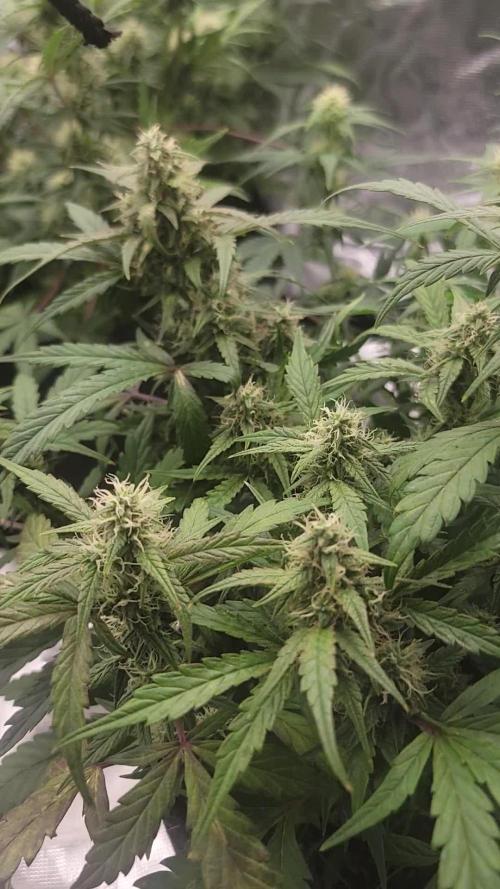
Subpar week id say. The bearknuckles is flowering the fastest of all 4. Looks like they'll be different finishing times. Got doggit...either way goes they went it together and they'll be coming out together. Stay tuned!

Likes
43
Share


@Regenwurm
Follow
Diese Woche alle Ladies (jedoch besonders die orange Sherbert) entlaubt. Die Indicas neigen schnell zur Überdüngung mit nur der Hälfte der Menge des Düngeplans mit Regenwasser EC=0,0…..also Düngemenge etwas reduziert! Die Orange Sherbert liegen ca. 2 Wochen zurück und bilden nun Blüten ohne Ende. Ich muss die 2 Pflanzen leider unterschiedlich zu den Indicas düngen da die Ladies das Futter anders verwerten und einen anderen Entwicklungsstand haben. Nächste Woche gibt es mal bessere Bilder ohne Beleuchtung der NDL Lampe. Klima keine Probleme, läuft sehr gut. Bewässerung alle 2 Tage mit 2 l pro Pflanze. Aktive Zuluft und aktive Abluft mit Unterdruck im Raum für die Dauer der 18 Std Beleuchtung….


Likes
5
Share

@BUDbidi
Follow
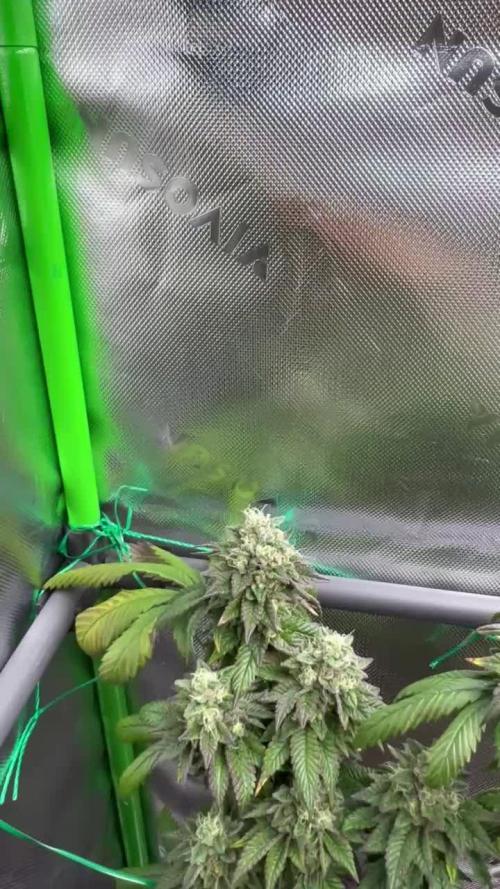
Week 9 is still going, the next days i upload some pics of the Strawberry Cough too.
And more close ups
I Stopped with biobizz scheme now and give only water, maybe it was the last time watering dunno now.
Strawberry Cough is strong really Sativa pheno and pretty foxtaily this week :D
She was the last in germination and pretty slow early on


Likes
21
Share


@Hempy_The_Kid
Follow
11/10/22 another week down. Suprised she's still going. Still battling WPM. She'll probably be done this week.

Likes
5
Share


@Ringoworm
Follow
Every thing is looking fine I think the two at the back looks really good 👍

Likes
15
Share


@Shizzlemanizzle
Follow
This week I planted them in their final 11L pots! For the feeding I feed after the chart from advanced nutrients „Master Grower for COCO“

Likes
Comments
Share


@SmithNuggets
Follow
Flower tent is ac infinity 4x8 tent. With two spider farmer sf-4000. This tent has the exhale 360 co2 grow bag.
The nutrients are not what each plant receives. Each stage gets its appropriate nutrients.
I will be going back and trying to name each plant in the
2-7 feeding
Likes
13
Share

@MrGrowDiarie
Follow
Day 77
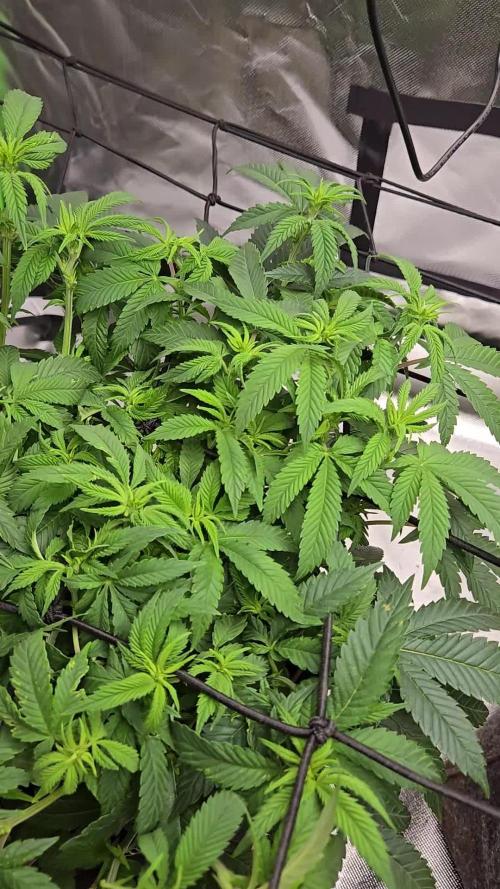
The canopy has really filled in nicely - the plant looks healthy, bushy, and well-trained. The SCROG net is doing its job perfectly, keeping the tops even and encouraging strong horizontal growth. Leaves are a deep, healthy green with no visible nutrient burn or deficiency. Growth appears balanced and vigorous.
Likes
15
Share


@Dico29
Follow
It’s now showing pistils pretty well, and I got some critical peyote from Barney farms In a napkin right now
There is a little burnt tip on fan leaves I think too much nitrogen since it’s in the big pot and the leaves are dark green. But looks good happy I picked the internodes during preflower too

Likes
4
Share


@UrbanBoer
Follow
I am back online, and another successful week of agriculture Lamby is taking her time while bulking up the stem, I love her short thick fan leaves, they started coiling up and hindering growth where it mattered, thought of defoliation but I promised myself I would only defoliate in September, what I’ve done with all the ladies if to LST all established out the way to all the sunlight to reach the new growth. The other reacquiring motif, is using the main stem as a single root that will covert brunches into stems. Lamby might be sprout at a snail pace however, I am certain she will produce fire numbing bud.
Likes
5
Share


@TheDutchGrower
Follow
Day 12
I lowered the light to 19 inches or 51 centimeter. It's on 50 %
I started giving roots nutrients 2 days ago
I guess they are doing good?
Soon i will be slowly giving some grow feeding with micro nutrients
I will add another video to this week in a few days
Day 15 :
Yesterday on day 14 i put the output on 75 % and lowered the light to 50 cm.
They seem to like it but for the amount of plant i have i need to put it to 100% and i willl put to 55 cm from the plants. For cover more area.
And will start with some lst training today.
Untill the next week! Or around day 21.
Peace!
*** i added a day 19 to this week so u can see the difference in just 3 days.
Likes
13
Share


@Nicoweed
Follow
my babies are enjoying life i give them 3ml/l of boost all the weak and start today to put some bloom 2ml/l
the creamatic and the gorilla start to produce the first sign of buds on the main cola
the northern light start to strech this week i think she is a weak later behind the other 2
i think to defoliate the undergrow but i don't now if its a good idea on autoflowering plant ?