Likes
4
Share
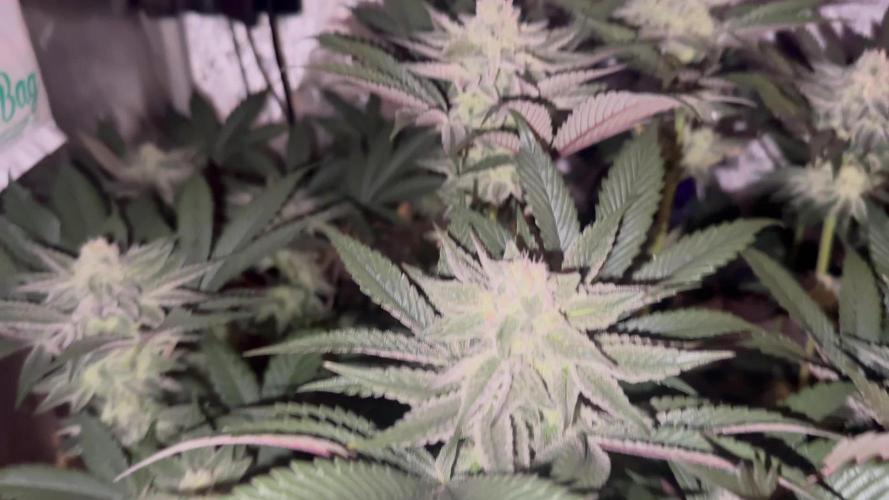
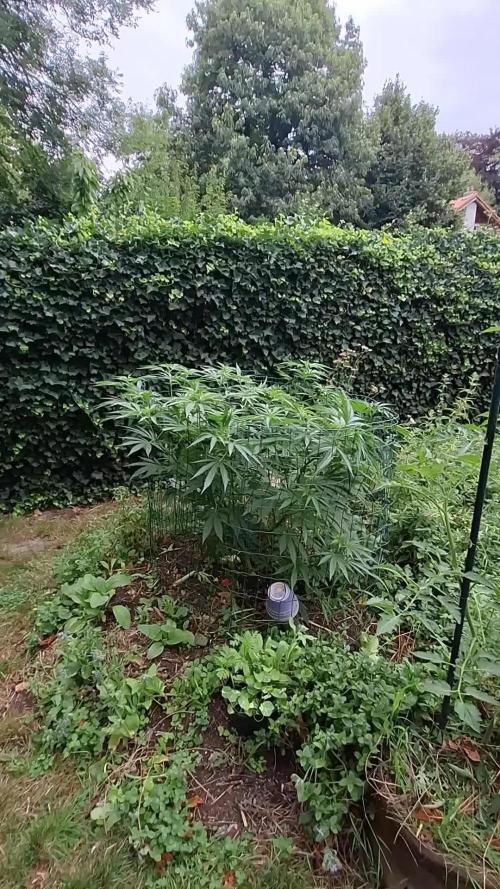
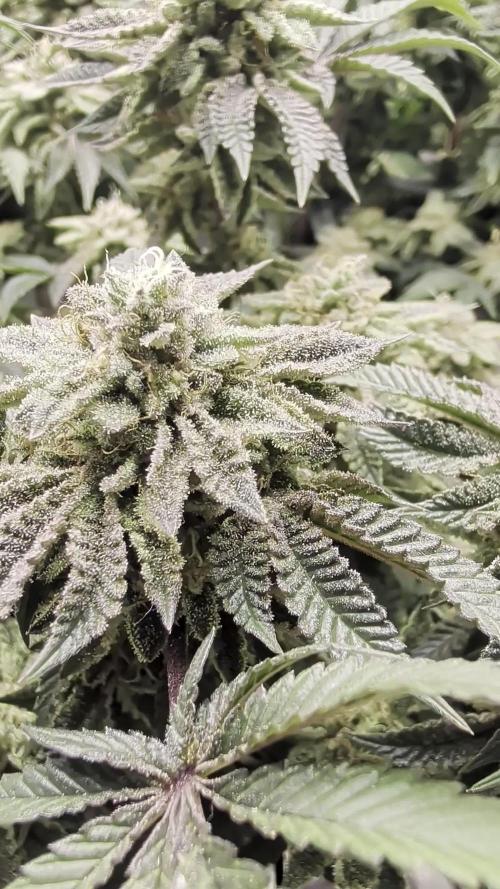
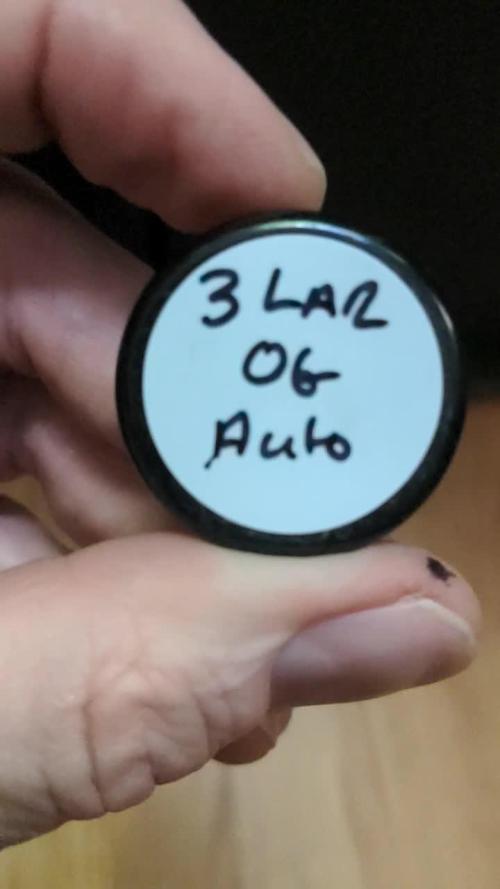
As Moby Dick tiveram 100 % de germinação, essa é a maior de todas e a mais rápida também. Vou seguir o diário só com ela , mas tenho mais duas na estufa.
Likes
25
Share
@Fatnastyz
Follow
Week 8 10-14 Water, both drinking around 750 ml a day! Pretty much just fun with pictures from here. Kosher still seems a bit hungry, but doing awesome! Ztrawberriez is just nasty! Cant seem to get good enough pictures! Lol 10-17 Water and Guy was up to no good! 😻 10-15 Guy stopped in to pose today! 10-19 Flushed both today. I thought they should be low on food, but I over loaded again, I guess. K ppm starting was 1200, now 440 Z 1050 now 310 Sheesh! One day I may Not over feed. 🤣 I even thought 2 tbs was light. 🤣 .
Likes
2
Share
Die dritte Blütewoche neigt sich dem Ende zu, und der vertikale Stretch der RS11 von Traphouse Genetics ist mittlerweile so gut wie vorbei. Die Pflanze hat ihre finale Struktur eingenommen und konzentriert sich nun voll und ganz auf das Formen der ersten echten Blütenbälle. Klassischerweise steht um den 21. Tag herum das Lollipopping auf dem Plan, um das untere Drittel zu bereinigen. Da das private Leben in den letzten Tagen aber verständlicherweise etwas mehr Aufmerksamkeit gefordert hat, wurde dieser Eingriff kurzerhand ein kleines Stück nach hinten verschoben. Ein spätes Lollipopping ist bei dieser extrem robusten Genetik absolut kein Problem – sie steht dank der verlässlichen Versorgung mit Advanced Nutrients so vital im Saft, dass sie die anstehende Rasur im unteren Bereich mühelos verkraften wird. Die Triebe sind perfekt aufgeteilt, das Blattwerk ist tiefgrün, und die Energie im 15-Liter-Topf ist maximal gebündelt, um nach dem anstehenden Clean-up die gesamte Kraft in die oberen Bud-Sites zu schießen.
Likes
10
Share
@MG2009
Follow
09/18/2021 At battle with catapillar this week Hand picking them off, some bud rot caused by catapillar's . Light defoiliating dying, yellowing leaves. Hand picking is tedious but well worth the effort. Feeding neptunes harvest 2-3-1 this is last week of feeding. Drinking lots of water this week gave each plant 2.0 gallons of Neptunes Harvest 2-3-1 hope it works out couldn't find fox farms, or big buds but I'm sure they will be fine.....will feed again on Friday then plain water for 3-4 weeks till harvest. Feeding should get them through the next two weeks then watering plain water should flush anything not needed by plants. Girls are thirsty this week, just in time for feeding! Neptunes Harvest seems to do the trick. Pistils piling on like crazy so one more feeding on Friday Of 2-3-1 and Week 7-8 banana peel tea, she should start Fattening up,and fading nicely by week 8-9.🙏🏻 The NPK value for banana skins is 0.6-0.4-11.5. But this is the value for dried banana skins. (I will make tea from peels) not sure of N-P-K Is for peel tea? But it works well in my opinion. Day # 6 week 6 applied gypsum today gypsum should help a little with PH issues,7.0 a little to alkaline but she will grow, but she thrive at 6.2 PH
Likes
2
Share
We become aware at such times of man's wonderful ability to bring seemingly unrelated elements into harmonic balance, and receive a glimpse into a world where everything exists in conscious sympathetic attunement to everything else. When we listen to a piece of music that seems to strike a beautiful chord somewhere inside us, or view a painting that simply glows with harmonic awareness well executed, we probably do not spare much time to contemplate the wonderfully intricate combination of vibrations that our sensors make it possible for us to perceive. We tend to appreciate the relationship between the parts of something by an awareness of the harmony or dissonance of the whole. This ability enables us to say "what a beautiful house!" instead of "analysis has proven that this collection of building materials exhibits certain elements of harmonic proportion." While this ability to instinctively appreciate the beauty of true harmony has an important role to play in evolution, a more analytical understanding of the laws involved can be most useful. This is especially so if we wish to create works of art where each part exists in true harmony, not only with the other part of that particular whole, but with the universe within which the creator and the created exist. Everything vibrates. From the most dense matter to the most subtle cosmic rays, everything which our senses allow our thoughts to become aware of, can be specified in terms of wavelength or frequency of vibration. These two terms define the same thing, but from different points of view. The following are the approximate wavelengths of various energy carriers: Cosmic rays 0.000,000,001 mm Gamma rays 0.000,000,1 mm X rays 0.000,500 mm Ultraviolet rays 0.003 mm Visible light 0.006 mm Infrared 0.01 mm Sound waves 1 meter Radio waves 300 meters Violet light 400 nm to 450 nm Blue light 450 nm to 500 nm Green light 500 nm to 570 nm Yellow light 570 nm to 590 nm Orange light 590 nm to 610 nm Red light 610 to 700 nm 1 nanometer (nm) = 0.000,000,1 cm = 1/10,000,000 cm If a guitar string is plucked and we hear a sound, it is not too difficult for the human mind to associate this sound with the vibration of the guitar string. With color it is quite different. It is difficult for us to conceive that the color of a substance is not an inherent property of the substance itself, but an indication picked up by our senses of that substance's ability to absorb or reflect the light which happens to be shining on it at that moment. Neither the matter nor the light is colored. What happens is that the brain learns to differentiate between the frequencies reflected or transmitted by the substance the eyes are focused on. The same thing happens with sound. When we say "Oh! Listen, they're playing my favorite song," what we really mean is: "My brain has stored within it a particular pattern of frequencies. I have compared the new information being received with this stored pattern and have deduced the answer that the two patterns are similar within certain specified tolerances." The 'pleasure' involved could have something to do with our running the pre-recorded pattern at the same time, in 'sympathy' with the new pattern as it is received. The word sympathy describes very well our ability to appreciate color and sound. It also describes the reason behind certain elements of harmony. For instance, if a substance vibrating at 100 cycles per second (tone 1) is in the proximity of another substance vibrating at 200 cycles per second (tone 2), we could perceive, if we had the right equipment, a certain sympathetic relationship between the two. We will see from this that there is a uniform doubling of the first tone seen in the second. At various points along the waves, the two are the same in amplitude. At other points, they are at opposite poles to each other. This doubled frequency has more points of similarity to the original than any other frequency except the original itself. If the equipment we had available for measuring these two frequencies was a soundboard amplifier and a pair of ears, then we would hear what would sound to us like one tone. If we had the opportunity to hear one at a time, we would hear that although they sound the same, one is higher in pitch than the other. This characteristic of 'the same but different in pitch', musicians have called the octave. Any two tones produced where one has exactly doubled the frequency of the other is called an octave. Speaking in ratios, an octave would appear then as the ratio 2:1 or 1:2, depending on whether we are talking of an octave up or down. A single note produced by almost any instrument will contain more than one wavelength or frequency. It will have a dominant frequency, the wavelength of which we would call the note's 'fundamental' or 1st harmonic. It will also have a varying number of upper harmonics, gradually fading in intensity into infinity or silence. Natural harmonics always have the same pattern of intervals between them. The interval between the 1st and 2nd harmonic is a perfect octave; between the 2nd and 3rd a perfect fifth; between the 3rd and 4th a perfect 4th; and so on, the intervals becoming smaller and smaller until they lose any relationship with the western 12 tone scale as it exists at the moment. Just as an octave has certain elements of sympathy with its fundamental, so some intervals have been noted to be more perfectly in sympathy with the fundamental than others. The ratio of the 'perfect 5th' or interval of 7 semitones, as it occurs in the harmonic series, is 3:2 or 2:3, while that of the 'perfect fourth" is 4:3 or 3:4. All the tones in the western 12 tone scale can be expressed in terms of the ratio between the upper tone and its fundamental. This would seem to be an ideal way of generating a scale from any given fundamental and several attempts have been made to do this, the Pythagorean system being probably the most well known. Although when working with a single tone instrument playing on its own, the Pythagorean formula works wonderfully well, if we had several instruments tuned this way together and asked them to play almost any western music, we would find that at times they sounded quite out of tune to each other. The lack of flexibility of the various scale systems based on the harmonic series has led to what is known as the 'tempered' scale. This uses as its primary unit of interval the ratio of the octave or 2:1. It then proceeds to divide the interval between any fundamental and its upper octave into 12 smaller intervals by applying the ratio: two to the one-twelfth power, to one (21/12:1). This equals 1.059463094, so by multiplying any frequency by this number, we will obtain the tempered semitone next up from our fundamental. We will also find that any tone twelve semitones up from any other tone, in a scale generated in this way, will have exactly double the frequency. If we took the note middle C on a piano and halved the wavelength, we would have the note C one octave above. If we halved this, we would have the C above, and so on. However, within about 6 octaves, we would find that although a 'sound' was being produced, no human ear could perceive it. If we kept on going, halving and producing upper octaves of our fundamental C, we would proceed through the infrared band, into the visible light spectrum. If we happened to be outside during the day, we would, for one octave only, see the note C with our eyes. The next octave above would already be in the ultraviolet band, and outside the eye's sensitivity range. If we can think of color as being an indication of a substance's vibratory rate or wavelength, we may begin to see a relationship that could exist between the color and sound spectrums. The logical extension of what has so far been said is that there exists a scale in the color spectrum that corresponds exactly to the scale in the sound spectrum, each color tone being an octave of the equivalent note in the sound range. This is not the end of the story but only the beginning. If we can for the moment accept that any wavelength in one band has upper and lower octave stretching out to infinity, then the next question is 'fine, but what shall we use as our fundamental? A particular color? A particular sound frequency?' The musicians among us will probably say 'A 440'. This means that the note A should vibrate at 440 Hertz, or 440 times per second. They would tell us that this is standard pitch has been adopted by most orchestras around the world; pianos are tuned to it, instruments are constructed to formulas based on it, and so to them it would probably seem the most appropriate place to begin. Some of these musicians may know of the battle that is still raging with regards to this being the standard, but few would know why A = 440 Hz was chosen except that it worked when it was set to be a suitable compromise between the many different pitches in use at the time. 432 Hz is said to be mathematically consistent with the patterns of the universe. Studies reveal that 432 Hz tuning vibrates with the universe’s golden mean PHI and unifies the properties of light, time, space, matter, gravity, and magnetism with biology, the DNA code, and consciousness. When our atoms and DNA start to resonate in harmony with the spiraling pattern of nature, our sense of connection to nature is said to be magnified. Another interesting factor to consider is that the A=432 Hz tuning correlates with the color spectrum, while the A=440 Hz is off. Audiophiles have also stated that A = 432 Hz music seems to be non-local and can fill an entire room, whereas A=440 Hz can be perceived as directional or linear in sound propagation. Once you adopt the idea that sound (or vibration in general) can have an equalizing and harmonizing effect (as well as a disturbing effect), the science of harmony can be applied to bring greater harmony into one's life or tune to specific energies. There is a form of absolute and relative harmony. Absolute harmony can, for example, be determined by the tuning of an instrument. The ancients tuned their instruments at an A of 432 Hz instead of 440 Hz - and for a good reason. There are plenty of music examples on the internet that you can listen to in order to establish the difference for yourself. Attuning the instrument to 432 Hz results in a more relaxing sound, while 440 Hz slightly tenses up the body. This is because 440 Hz is out of tune with both macro and micro cosmos. On the contrary, 432 Hz is in tune. To give an example of how this is manifested microcosmically: our breath (0,3 Hz) and our pulse (1,2 Hz) relate to the frequency of the lower octave of an A of 432 Hz (108 Hz) as 1:360 and 1:90. It is interesting to note that 432 Hz was the standard pitch of many old instruments and that it was only recently (19th and 20th century) the standard pitch was increased. This was done in order to be able to play for bigger audiences. Bigger audiences (more bodies) absorb more of the lower frequencies, so the higher pitch was more likely to “cut through”. One of the oldest instruments of the world is the bell ensemble of Yi Zeng (dated 423 BC), tuned to a standard F4 of 345 Hz, which gives an A= 432 Hz. The frequency of 345 Hz is that of the platonic year! Similarly, many old organs are tuned in A=432 as well; for example, St. Peter’s Capella Gregoriana, St. Peter’s Capella Giulia, S. Maria Maggiore in Rome. Maria Renold’s book “Intervals Scales Tones and the Concert Pitch C=128 Hz” claims conclusive evidence that 440 Hz and raising concert pitch above scientific “C” Prime=128 Hz (Concert A=432 Hz) disassociates the connection of consciousness to the body and creates anti-social conditions in humanity. The difference between concert pitch A=440 Hz and Concert A=432 Hz is only 8 cycles per second, but it is a perceptible difference of awareness in the human consciousness experience of the dream we share called existence.
Likes
12
Share
@Crimm
Follow
3 of the 4 plants didn't do much stretching at all. I'm excited to compare the harvest between all of them too see which yields more. The one plant that did stretch seems like it will take a little bit longer than the others to be ready, but I am not sure. Had I known they wouldn't have stretched much I would have considered some light defoliation to increase light pen but this will be a nice experiment. As of 11/23 the plants have stopped doing any vertical growing and I can tell the buds are starting to fatten up a bit and getting frosty. I am leaving the tent open now 24/7 to help control the humidity, trade-off is I can smell the plants from my office two stories up. The sent is very fresh and fruity so it's not so bad. We will see how my family feels when they visit for Thanksgiving 😆
Likes
4
Share
9weeks and 4 days seed to harvest, 125g dry weight👊🏻 Banging straight after a dry 💯 white ash, gonna be killa when had a good cure😎😤
Likes
8
Share
🐹I pruned them FIM a few days ago, and future outbreaks appear. I also did a slight large leaf defoliation. 👌🏻
Likes
22
Share
@DrGanj
Follow
Gave both these girls approx 46 hours darkness before the chop but wish I hadn't. All it did was cause all the sugar leaves to dry out and make the trim so much more work haha!
Likes
6
Share
@bud_goode
Follow
Total was 10 and 1/2 weeks. Final week was good and filled out a little more. it looked to get a little more sticky. Trichomes started turning Amber last week that's just how I wanted it. Smells is toxic and sweet if that's even possible. All in all, a great little plant, I would like to see it go free in a larger space, I bet the yields would be amazing!!
Likes
9
Share
@Chupadeos
Follow
Buenas shurs después de la poda FIM,las plantas han respondido muy bien excepto sweet skunk que no se si sera por su raza o por que ella simplemente es así pero están muy bien,se ha hecho una selección de clones,las plantas están en 28/32 cm siendo las sweet skunk las más pequeñas a las más altas se les ha repetido la poda FIM cuando termine esta semana comenzaremos la floración,en cuanto a abono todas están deseando de coger aún más nutrientes,veremos la reacción de ellas tras una segunda poda FIM. saludos y dulces humos
Likes
5
Share
This week's been intense 💪. Right after dropping the week 5 report, I did the heaviest foliar spray yet—used 25ml of brasinolide's mother solution mixed with water, plus 30ml of aloe and 6ml of sugar fulvic 🌿. Then, two days later, it was watering day: just calmag with some microbes, sugar fulvic, and aloe vera in 3L of water. The last watering was also pretty heavy—deep soak, loaded with micro-life to flush out salts. Did some defoliation and chopped off a few branches that weren't gonna make it ✂️. Also hit them with a foliar spray of aloe and LAB to help the plants chill after the stress 🌱✨.
Likes
18
Share
@Pokan187
Follow
Was on a 2 weeks vacation, just got back, found a lot of yellow leaves on the Runtz which is normal at this stage I think, te Sour Diesel is looking light green and the G13 is looking great and smelling marvelous. I will be adding some natural flowering mix
Likes
1
Share
@Mr_Terps
Follow
Surprise Surprise 🎁. She's turning purple
Likes
9
Share
Kok gubresi sonlandirildi. Big bud ve b 52 ye 2 hafta aranin ardindan baslandi evet azot biraz fazla geldigini farkindayim fosfor ve potasyum agirlikli ilerlemeye devam ve bebeklerin bulunduklari ortam geregi boceklenme olmamasi icin duzenli sekilde neem yagi takviyesine devam ediyoruz emegimizin karsiligini alicagimiz bir hasat olucak kalite hic bir zaman tesaduf degildir..
Likes
13
Share
Hey this is still week 1 flowering but I just a update , I have HST and bowled trained a few of them and they look like they will be monster seedsman strawberry grape banana are massive girls and so is the slurricane inhouse genetics, all girls are looking happy this is going to be a nice garden stay tuned