


Likes
Comments
Share


@Sieben
Follow
Fullgas , take place and enjoy the ride.
She has grown wide with strong and heavy branches, buds also exploded.
This strain is my personal favorite of this grow, love the added note from Sherbert OG to one of my favorite Cheese strains.
Behind the big Lemon Orange she growed undisturbed, as a Cheese Lover i expected much and are more then satisfied.
The taste is typical Cheese but more creamy with a gassy note, huge buds full of resin. High is uplifting , with a strong body, it really gets u and take u on a ride.
I want to remeber Franco Loja with this Fullgas grow especially, he was part of Greenhouse family and this strain is a hommage to him.
Franco Loja Foundation and strains that support his family are available at Greenhouse Seeds.
I thank Arjan and all Greenhouse employees, especially Georgia from CS , for this wonderful plant.

Likes
17
Share


@The_Projexx
Follow
Welcome to week 5 of flower! Things are moving along and where gaining mass on the flowers daily! With some of the plants starting to fade into a nice purple in their leaves I can only imagine at the end in 4-5 weeks! With every passing day I get more and more excited by the characteristics on the plants!
Huge shout outs to @MarsHydroLED for making outstanding gear for growers to use and enjoy! HUGE shout outs to @Seedsman , @PyramidSeeds and @GreenHouseSeedCo for making outstanding genetics that pump great medicine!
Huge shout outs to all my followers and people who stop in to the diary to check it out alike! Keep inspiring to grow!
Follow along and stay tuned this shows getting juicier by the day!
-The Projexx
Day#29F Pictures N/A. Ladies are starting to focus on bulking more or less now.
Day#30F Pictures N/A. Fade on Kings Juice#2 is starting to really come in now.
Day#31F Some of the pistols are starting to turn orange now. Still lots of time left on the cycle.
Day#32F Pictures N/A. Fuel D.og 1 and 2 are starting to pump some mass now!
Day#33F Fuel D.og#2 is still yellow but she's not getting worse or better, it may be something I can't control as I can't come up with any solutions to the issue. Installed the first net. May install another.
Day#34F Pictures N/A. Flowers are thickening up and starting to give off their scent really well now.
Day#35F Pictures N/A. Cleaned up the bottoms of the plants abit more as well as took away some leaves blocking light to flower sites.
Recap: Things went well this week the ladies are pumping trichomes and weight won't be long till we see some real thick flowers. Over all really pleased with this run so far!


Likes
17
Share


@Eddjack
Follow
Arrivato fresco fresco dalla Spagna si pianta subito.
12/01 12 h in acqua
13/01 l'ho messo in un tovagliolo di carta umido ed è è uscita la prima parte di radice ed è stato trapiantato in un vasetto.
14/01 e uscito dalla terra sfogliando le prime 2 foglioline tonde. Questa è una super partenza 72 h e già cerca la luce.

Likes
3
Share


@RunicKevin58675
Follow
These two plants have given me the experience and the desire to do even better!
Next genetics I thought I would bring another pure Indica...

Likes
Comments
Share


@brownbae420
Follow
Method Steps
1. Get all materials set out and prepared
2. Pre-Freeze all tools
3. Add Bubble Hash bags
4. Mix ice + water into a 5g bucket
5. Mix the water and add fresh frozen trim
6. Mix for 15m
7. Let mixture rest for 10m
8. Filter each Hash bag out
9. Begin collecting hash at 120 microns
10. Scoop hash onto a 25 micron sheet + press water out
Likes
15
Share


Likes
19
Share


@emeraldlabs
Follow
The struggle is real as we continue limping to the finish line... A few more feedings this week and then on to the flush. Struggles aside, she smells great and is packing on.
Photos/video taken 119 days after breaking soil, day 42 of flower.
Likes
109
Share


@Wackytabacky_420
Follow
What's up fellow growers another week in the books!!! So after my last update I installed my Scrog net and everything was going along amazing until lastnight! I was doing some final tucking and Lst training trying to get the girls looking pretty for pictures today for u guys and pop goes the weasel!(Branch Snaps 😒🤕) at first I was concerned but after some good tips and reassurance from this great growing community I did a tape repair on the girl but she still looked wilty last night but boom got up this morning and the leaves were standing and the bud sight was rising back to the light. I'm not out the woods for a few days and possibly a week of stress but I'm confident she will recover and drive on. We'll until next week fellow growers Happy Growing😎💚🌱💪💪
Critical purple #1- is my slowest grower but is still vegging so I have faith that she will out produce Critical purple #2.
Critical purple #2- I haven't noticed much growth in this plant since going into flower at just a day or two over three weeks old. But I have noticed growth in buds and pistols..
Pineapple auto #1- This girl was really coming along this week! I was so excited to show u guys/gals her progress so did some last minute tucking lastnight before bed and snapped a branch:(. Today she seems to be doing ok so hopeful she will not stress out and back track me a week but u live and u learn.
Pineapple auto #2- Guys this is my 🌟 she is doing amazing and loving the scrog as you can see from the photos. With a fabric tape I measured her out to be 19 7/8 inches. This is my best growing plant of both grows I have going now.

Likes
49
Share


@Guerilla_Jack
Follow
End of fifth week of flowering!!All four girls looks really fine.Cant't wait to smoke 😋😁


Likes
43
Share


@Just_Weed
Follow
Only watered with water this week and runoff ppm still shows around 1000. There is no burning so it seems Bio tabs did their job.
Removed the SCROG at the end of this week in preparation for harvest. Harvest will be tommorow at day 176 ( 71 from flower)
Trichosomes seem around 50% cloudy with around 25% amber and 25% clear.
Chopped her Day 71 from flower, completed budwash with 3 buckets solutions using filtered water and lemon juice, soda b and , hydrogen peroxid 3%, only using very low amount compared to Doc Budwash tehnique found on forums cause I didn't have more then 250 mL at home.
Weight is around 2.5 KG wet before washing.
Now trying to achieve stable humidity around 50%, 60 % and planning to start trimming i na few days....
Likes
5
Share


@Silvadragon
Follow
Hello everyone hope you staying cool
Cause the weather is over 100 degree and everything is drying and dying. We really need some rain! Anyone with the heat wave I trying keep this gals water up. The biggest one drink water like no tomorrow, well both of them. I give them a tea liquid compost 3.11.11 of organic fertilizers. Just to keep up with the flowering stages she using up a lot nutritions and I’m glad that I was on top of my game with these outdoors grow. Not bad for novice first timer. My family love them. I’m keep in the sun as thst will help with resins production and the bees are doing a fine job pollen them.
Likes
142
Share


@MadeInGermany
Follow
Hey everyone :-)
This week it smells more and more sweet and fruity in the whole room 😍.
There is actually not much to report, everyone is now under 12/12 :-).
This is the last grow that comes in the entire diary.
From now on, each plant will be added to the diary 👍.
I wish you all a lot of fun watching, stay healthy 🙏🏻 and let it grow 😎👌


Likes
7
Share
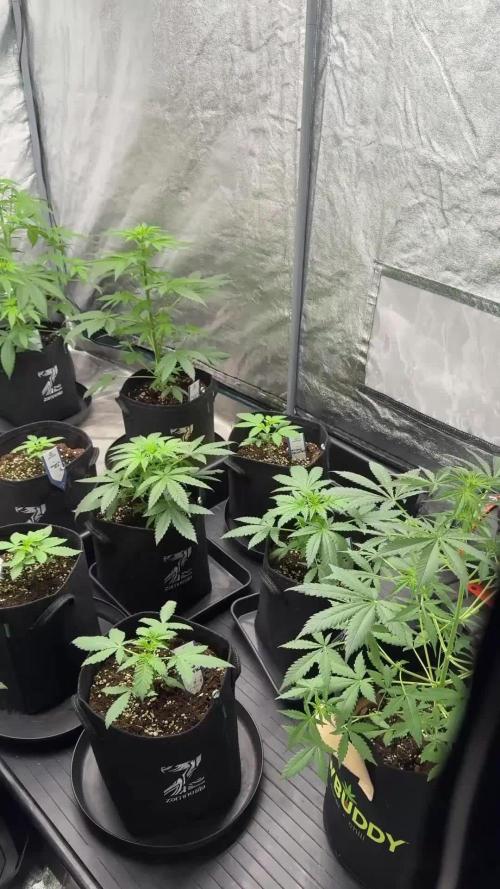

@DogDoctorOfficial
Follow
🌿 Week 4 Veg – Beauty, Branching & Bio-Tech Symphony
Grower’s Journal – BlueBerry by Zamnesia Seeds | Entry 005
Welcome to Week 4 of Veg, and let’s just say it clearly:
These BlueBerry girls are growing like there’s no tomorrow.
Branching like crazy, stretching into their potential, and looking like true queens under the lights.
⸻
📸 Visuals to Match the Growth
This week, we pulled them out of the tent for a special photoshoot, just to honor how gorgeous they’ve become. Their structure is perfect, the leaves are flawless, and the pace of development is exactly where we want it.
These are the kinds of plants that make growers pause, smile, and say, “Yes, this is working.”
⸻
🌱 Nutrition – A Balanced, Thoughtful Feed
We’re continuing our Aptus nutrient regimen, supporting explosive vegetative growth while maintaining biological harmony in the root zone:
Current Feed (per liter):
• Regulator – 0.15 ml: Cell wall integrity, anti-stress armor, and enhanced nutrient uptake
• CalMag Boost – 0.25 ml: Supporting structural development and leaf strength
• All-in-One Liquid – 1 ml: The nutritional foundation, covering macro and micronutrients
• 🌿 Start Booster – 0.25 ml: Still supporting root density, node stacking, and early branching
🌿 Why we’re using this:
Because we’re in rapid growth mode, and we want to fuel expansion without pushing too hard. This combo delivers strength, balance, and root vitality, exactly what we want before any training or pre-flower stretch.
⸻
🌞 Lighting – Now a Two-Zone Setup
We’ve expanded the operation—stretching across an 8x8 space, creating two active light zones:
⚡️ Zone 1 – Black Series 600 by Future of Grow
• Full-spectrum LED designed for early veg and structured growth
• Gentle but powerful PPFD—keeps internodes tight and leaf color rich
⚡️ Zone 2 – THINKGROW Model One LEDs
• Ultra-efficient LEDs with controllable spectrum
• Ideal for pushing vigorous vegetative growth across a larger canopy
• Controlled via the TrolMaster system for precise lighting schedules and dimming
💡 Both systems are delivering clean, cool light, helping shape the canopy while managing energy use smartly.
⸻
🌬️ Airflow & Environmental Control – Total Tech Harmony
We’re not just growing plants—we’re growing a controlled microclimate, with every element tuned:
Airflow Setup:
• Exhaust: Two 6” inline fans
• 1x Spider Farmer 6” Exhaust w/ Carbon Filter – Controlled via Spider Farmer GGS Controller
• 1x TrolMaster AeroFan 6” Exhaust w/ Carbon Filter – Controlled via TrolMaster Tent-X Controller
• Intake: One 6” fresh-air intake pulling air into the tent
🌀 This system keeps:
• CO₂ fresh (~632 ppm)
• Temperatures steady (~27°C)
• Humidity ideal (~57.4%)
• And filters in place keep the air pure, clean, and odor-controlled, even at this early stage
🧠 Sensors & Controllers:
• TrolMaster Tent-X Ecosystem – the brains of the setup
• Managing lights, exhaust, intake, CO₂, temperature, and humidity
• Connected to:
• CO₂ sensors
• Temperature & Humidity probes
• PPFD sensor (light intensity measurements for accuracy)
Every zone, every variable is dialed in with care.
⸻
🌿 Why All This Matters – Creating Plant-Centered Intelligence
We’re not just creating a grow tent.
We’re creating a living, breathing system that adapts, protects, and encourages growth. Each element, from airflow to light to nutrition, is designed to support the natural intelligence of the plant.
And the BlueBerries are responding.
They’re thriving, stacking, stretching, and showing gratitude through leaf expression, branch angles, and rhythm.
⸻
🔮 What to Expect Next Week
• More branching, tighter nodes
• Early signs of pre-flower development
• Possibly early LST if needed
• Continued sensor data collection as we dial in the automation
⸻
🙅♂️ What Not to Expect
• No topping yet—structure is still unfolding
• No transplant (they’re in final 11L fabric pots)
• No overfeeding—we’re keeping it steady and strategic
⸻
🎥 Video Update – Inside the Setup
A video has been added to this week’s update, just a quiet visual journey through the setup:
💡 No narration, just the gear, structure, and rhythm of a garden built with intention. The systems speak for themselves.
⸻
💬 Final Thoughts – BlueBerry as a Statement
This isn’t just another grow.
It’s a special BlueBerry run.
A classic cultivar grown with modern methods, storytelling, and reverence.
We’re blending nature with tech, instinct with data, and roots with rhythm.
Thank you for being here. The best is yet to grow. 🌿
With light and love,
Your faithful garden companion 🌱💚
DD💚
As always, this is part of our ongoing Grow Series, an open diary of everything we do and why. Whether you’re a new grower or just here for the vibes, you’re invited to come along.
📲 Don’t forget to Subscribe and follow me on Instagram and YouTube @DogDoctorOfficial for exclusive content, real-time updates, and behind-the-scenes magic. We’ve got so much more coming, including transplanting and all the amazing techniques that go along with it. You won’t want to miss it.
• GrowDiaries Journal: https://growdiaries.com/grower/dogdoctorofficial
• Instagram: https://www.instagram.com/dogdoctorofficial/
• YouTube: https://www.youtube.com/@dogdoctorofficial
⸻
Explore the Gear that Powers My Grow
If you’re curious about the tech I’m using, check out these links:
• Genetics, gear, nutrients, and more – Zamnesia: https://www.zamnesia.com/
• Environmental control & automation – TrolMaster: https://www.trolmaster.eu/
• Advanced LED lighting – Future of Grow: https://www.futureofgrow.com/
• Root and growth nutrition – Aptus Holland: https://aptus-holland.com/
• Nutrient systems & boosters – Plagron: https://plagron.com/en/
• Soil & substrate excellence – PRO-MIX BX: https://www.pthorticulture.com/en-us/products/pro-mix-bx-mycorrhizae
• Curing and storage – Grove Bags: https://grovebags.com/
⸻
We’ve got much more coming as we move through the grow cycles. Trust me, you won’t want to miss the next steps, let’s push the boundaries of indoor horticulture together!
As always, this is shared for educational purposes, aiming to spread understanding and appreciation for this plant. Let’s celebrate it responsibly and continue to learn and grow together.
With true love comes happiness. Always believe in yourself, and always do things expecting nothing and with an open heart. Be a giver, and the universe will give back in ways you could never imagine.
💚 Growers love to all 💚

Likes
14
Share


@grower1212
Follow
Ayer hice el primer transplante a un solo cup de litro.
Encontré un gusano, debe ser del humos que le pongo al sustrato que reciclo, lo bueno que ahora puedo decir literalmente suelo vivo.
Les puse de top dress harina de neem como preventivo de plagas, insect frass y harina de malta para los microorganisms.
Likes
127
Share


@Tropicannibis_Todd
Follow
💩Holy Crap Growmies , we are outdoors and in the Ground💩
👉It's been another full week and she's doing great , very nice Growth, considering shes been up against the wind and rain 👈
No problems 😊 so far so good 👍 She's in her preflower faze and shes leading the pack so cool 👈
I GOT MULTIPLE DIARIES ON THE GO 😱 please check them out 😎
👉THANKS FOR TAKING THE TIME TO GO OVER MY DIARIES 👈
👉NutriNPK NUTRIENTS USED FOR FEEDING 👈rain water to be used entire growth👈
👉www.nutrinpk.com right now get 10% off using SPRING2022 as the coupon code👈


Processing
Likes
4
Share


@inxxx
Follow
Week 4 of flower just started,
Everything is under control, I gradually remove bigger fan leaves as I want as much light on buds as possible, I’ve added small led at the pot level shining upwards on all the popcorn buds, just testing this idea. Any one tried that before ?
I’ve decided to transplant all the plants in veg into final 11l pots, 2 smartpots and 3 airpots (no point for bigger pots since they are clones and don’t develop big roots),
Another 4 weeks on veg, flip on cfl and then I’ll be moving them straight under 12/12 cmh
In a week I’ll be sprouting new seeds from RQS
- Kush
- Medical mass
- AK47
- Cheese
Hopping for baby gorilla to spread her wings quicker, she is very shy ☺️
Have a nice weekend folks
Likes
1
Share


@drrrt
Follow
They all got very heavy and big buds, the plant/stems do not have just a chance to support the weight of the flowers on their own.
Since I'm in lack of flower/smoke material currently, I chopped on D51 already one tree. Going to take care of the remaining in the upcoming days and will post next update once everything is dried.
Smells lemony with a taste lavender flavor, a bit like a very masculine after shave. And it's very very stinky, leave it open in the basement and you are going to smell it also on the 3rd floor of the house. Grew the clone now the second time and nailed it this time much better.
She's for sure a keeper. High yielding, fast flowering sativa like growing terp monster 🔥

Likes
16
Share


@PigBearMan
Follow
High.
I‘ll keep this week updated in a few days. Everything‘s according on plan so far.
Never thought it would be that easy… these results…
Likes
13
Share


@goeser
Follow
Doing a bit of defoliation thats it
Giving all the plants more clear water because i overfeed them. Next time definitely with scrog . Good genetics love it


