Likes
Comments
Share
15 Day dry then trimmed using the Trim Bin. Curing with Grove bags, first harvest filled 3, 1/4lb grove bags. *Updating with clone pictures of this pheno in late flower labeled in diary as you look through
Likes
9
Share
@MG2009
Follow
01/26/2021 She's a 9 week strain, hopefully puts on some more weight, one bud is flopping over, took _ liter of water
Likes
12
Share
Likes
10
Share
@MrJones
Follow
Original Sensible Seeds White Chrystal Meth Auto 🔸🔸🔸04.20.23🔸🔸🔸 Day 38 - Above Ground 📝Sunday 05.28.23 - This girl is so stunted, but from where she was and where is now is pretty good, so I will keep her and let her be what she is, flipped the Smart LED over to the flower setting, it increased the wats a bit but the far red is going to be amazing! 📝Wednesday 05.24.23 - Besides being very small this girl looks pretty healthy, I would love more of these seeds to have another go at this strain, not sure if it ever recovered from the poor germination and remains stunted. The Medic Grow Smart 8 LED is doing very well, at 60% the plants are getting plenty of light and not showing any signs of over-stretching! 🔸🔸🔸🔸🔸🔸🔸🔸🔸🔸 ▪️Grown By: MrJones ▪️Medic Grow Smart 8 LED / Settings 60% & V1 ▪️@medicgrow420 ▪️@originalsensibleseeds ▪️@gaiagreenorganics ▪️Soil - ProMix HP 🔸🔸🔸🔸🔸🔸🔸🔸🔸🔸 📝The taste and aroma of White Crystal Meth Auto are equally appealing as her shining stunning looks and hard-hitting effect. The taste and aroma are a throwback to the Old School, Skunky with herbal and citric tones, and overall a great strain for making hash or rosin. These tantalizing flavors and aromas are conjured up from an exquisite formation of terpenes the earthy myrcene and the floral essence of terpinolene being the dominant, a mix of caryophyllene and pinene combine their tones to produce the musky citric scent.
Likes
Comments
Share
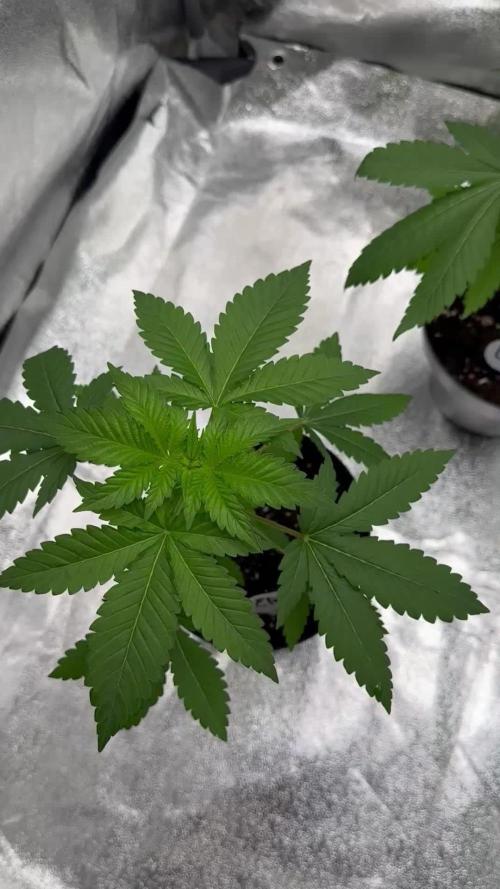
Week 2 - Vegetation | Black Diamond Auto Pheno B Hello everyone, and welcome back to another update from the 12/12 From Seed adventure. Today we’re checking in on Black Diamond Auto Pheno B as she continues her journey through the early vegetative stage. For anyone joining the diary for the first time, this project follows a 12/12 From Seed cultivation approach, documenting each phenotype individually from germination through harvest. One of the most enjoyable parts of this process is watching how different plants express themselves, even when growing side by side under the exact same environmental conditions. Black Diamond Auto Pheno B has certainly started developing a personality of her own. Throughout Week 2, growth remained strong and consistent, with the plant finishing the week around the sixth to seventh node while continuing to build a compact and balanced structure. The canopy is developing beautifully, and when viewed from above, the symmetry is immediately noticeable. Every new growth point is stacking neatly, creating the kind of shape that growers love seeing during the early stages of development. One of the most interesting observations this week comes from a small quirk found in one of the earlier leaves. Rather than forming completely separate leaflets, two fingers appear partially fused together, creating a unique shape that immediately catches the eye. Fortunately, this has remained purely cosmetic. New growth emerging from the center of the plant is developing normally, showing healthy leaf formation and excellent vigor. These small genetic curiosities are one of the reasons documenting phenotypes individually is so rewarding. While Pheno A introduced us to a beautiful camouflage-like leaf pattern, Pheno B decided to express herself through a slightly unusual leaflet structure. Neither trait has affected health or performance, but both contribute to the unique story of each individual plant. Beyond that little piece of personality, everything else continues moving in the right direction. The transplant completed previously appears to have been accepted without issue. Root development is clearly supporting vigorous above-ground growth, and the plant continues expanding steadily with each passing day. Stem development is strong, leaf size is increasing, and the center growth is becoming increasingly active as the week progresses. Coloration remains excellent throughout the canopy. The foliage displays a healthy, vibrant green tone from top to bottom, while leaf posture remains upright and confident throughout the photoperiod. The plant shows no signs of stress and continues responding positively to the stable environment provided inside the tent. Nutritionally, the feeding program remains simple and focused on establishing a strong foundation for future growth. Plagron Terra Grow provides the primary vegetative nutrition, while Power Roots supports continued root development following transplant. Pure Zym assists in maintaining a healthy root zone by helping break down organic matter within the substrate, and Sugar Royal continues as part of the overall cultivation strategy for supporting healthy plant metabolism throughout the cycle. Sometimes the most successful weeks are the quiet ones. No major interventions, no major corrections—just healthy growth, stable conditions, and the plant doing exactly what nature designed it to do. Overall, Week 2 has been another excellent week for Black Diamond Auto Pheno B. The structure is beautiful, the growth rate remains impressive, and the plant continues proving that a little early quirkiness can coexist perfectly with outstanding health and vigor. Thank you to everyone following along, supporting the diary, sharing advice, and contributing to the incredible growing community that makes projects like these so enjoyable to document. A special thank you as always to Zamnesia for the genetics, Plagron for the nutrition, and to all growers around the world who continue sharing their knowledge, successes, and lessons learned. Until next week, growers love and happy growing everyone. 🌱💚
Likes
2
Share
We become aware at such times of man's wonderful ability to bring seemingly unrelated elements into harmonic balance, and receive a glimpse into a world where everything exists in conscious sympathetic attunement to everything else. When we listen to a piece of music that seems to strike a beautiful chord somewhere inside us, or view a painting that simply glows with harmonic awareness well executed, we probably do not spare much time to contemplate the wonderfully intricate combination of vibrations that our sensors make it possible for us to perceive. We tend to appreciate the relationship between the parts of something by an awareness of the harmony or dissonance of the whole. This ability enables us to say "what a beautiful house!" instead of "analysis has proven that this collection of building materials exhibits certain elements of harmonic proportion." While this ability to instinctively appreciate the beauty of true harmony has an important role to play in evolution, a more analytical understanding of the laws involved can be most useful. This is especially so if we wish to create works of art where each part exists in true harmony, not only with the other part of that particular whole, but with the universe within which the creator and the created exist. Everything vibrates. From the most dense matter to the most subtle cosmic rays, everything which our senses allow our thoughts to become aware of, can be specified in terms of wavelength or frequency of vibration. These two terms define the same thing, but from different points of view. The following are the approximate wavelengths of various energy carriers: Cosmic rays 0.000,000,001 mm Gamma rays 0.000,000,1 mm X rays 0.000,500 mm Ultraviolet rays 0.003 mm Visible light 0.006 mm Infrared 0.01 mm Sound waves 1 meter Radio waves 300 meters Violet light 400 nm to 450 nm Blue light 450 nm to 500 nm Green light 500 nm to 570 nm Yellow light 570 nm to 590 nm Orange light 590 nm to 610 nm Red light 610 to 700 nm 1 nanometer (nm) = 0.000,000,1 cm = 1/10,000,000 cm If a guitar string is plucked and we hear a sound, it is not too difficult for the human mind to associate this sound with the vibration of the guitar string. With color it is quite different. It is difficult for us to conceive that the color of a substance is not an inherent property of the substance itself, but an indication picked up by our senses of that substance's ability to absorb or reflect the light which happens to be shining on it at that moment. Neither the matter nor the light is colored. What happens is that the brain learns to differentiate between the frequencies reflected or transmitted by the substance the eyes are focused on. The same thing happens with sound. When we say "Oh! Listen, they're playing my favorite song," what we really mean is: "My brain has stored within it a particular pattern of frequencies. I have compared the new information being received with this stored pattern and have deduced the answer that the two patterns are similar within certain specified tolerances." The 'pleasure' involved could have something to do with our running the pre-recorded pattern at the same time, in 'sympathy' with the new pattern as it is received. The word sympathy describes very well our ability to appreciate color and sound. It also describes the reason behind certain elements of harmony. For instance, if a substance vibrating at 100 cycles per second (tone 1) is in the proximity of another substance vibrating at 200 cycles per second (tone 2), we could perceive, if we had the right equipment, a certain sympathetic relationship between the two. We will see from this that there is a uniform doubling of the first tone seen in the second. At various points along the waves, the two are the same in amplitude. At other points, they are at opposite poles to each other. This doubled frequency has more points of similarity to the original than any other frequency except the original itself. If the equipment we had available for measuring these two frequencies was a soundboard amplifier and a pair of ears, then we would hear what would sound to us like one tone. If we had the opportunity to hear one at a time, we would hear that although they sound the same, one is higher in pitch than the other. This characteristic of 'the same but different in pitch', musicians have called the octave. Any two tones produced where one has exactly doubled the frequency of the other is called an octave. Speaking in ratios, an octave would appear then as the ratio 2:1 or 1:2, depending on whether we are talking of an octave up or down. A single note produced by almost any instrument will contain more than one wavelength or frequency. It will have a dominant frequency, the wavelength of which we would call the note's 'fundamental' or 1st harmonic. It will also have a varying number of upper harmonics, gradually fading in intensity into infinity or silence. Natural harmonics always have the same pattern of intervals between them. The interval between the 1st and 2nd harmonic is a perfect octave; between the 2nd and 3rd a perfect fifth; between the 3rd and 4th a perfect 4th; and so on, the intervals becoming smaller and smaller until they lose any relationship with the western 12 tone scale as it exists at the moment. Just as an octave has certain elements of sympathy with its fundamental, so some intervals have been noted to be more perfectly in sympathy with the fundamental than others. The ratio of the 'perfect 5th' or interval of 7 semitones, as it occurs in the harmonic series, is 3:2 or 2:3, while that of the 'perfect fourth" is 4:3 or 3:4. All the tones in the western 12 tone scale can be expressed in terms of the ratio between the upper tone and its fundamental. This would seem to be an ideal way of generating a scale from any given fundamental and several attempts have been made to do this, the Pythagorean system being probably the most well known. Although when working with a single tone instrument playing on its own, the Pythagorean formula works wonderfully well, if we had several instruments tuned this way together and asked them to play almost any western music, we would find that at times they sounded quite out of tune to each other. The lack of flexibility of the various scale systems based on the harmonic series has led to what is known as the 'tempered' scale. This uses as its primary unit of interval the ratio of the octave or 2:1. It then proceeds to divide the interval between any fundamental and its upper octave into 12 smaller intervals by applying the ratio: two to the one-twelfth power, to one (21/12:1). This equals 1.059463094, so by multiplying any frequency by this number, we will obtain the tempered semitone next up from our fundamental. We will also find that any tone twelve semitones up from any other tone, in a scale generated in this way, will have exactly double the frequency. If we took the note middle C on a piano and halved the wavelength, we would have the note C one octave above. If we halved this, we would have the C above, and so on. However, within about 6 octaves, we would find that although a 'sound' was being produced, no human ear could perceive it. If we kept on going, halving and producing upper octaves of our fundamental C, we would proceed through the infrared band, into the visible light spectrum. If we happened to be outside during the day, we would, for one octave only, see the note C with our eyes. The next octave above would already be in the ultraviolet band, and outside the eye's sensitivity range. If we can think of color as being an indication of a substance's vibratory rate or wavelength, we may begin to see a relationship that could exist between the color and sound spectrums. The logical extension of what has so far been said is that there exists a scale in the color spectrum that corresponds exactly to the scale in the sound spectrum, each color tone being an octave of the equivalent note in the sound range. This is not the end of the story but only the beginning. If we can for the moment accept that any wavelength in one band has upper and lower octave stretching out to infinity, then the next question is 'fine, but what shall we use as our fundamental? A particular color? A particular sound frequency?' The musicians among us will probably say 'A 440'. This means that the note A should vibrate at 440 Hertz, or 440 times per second. They would tell us that this is standard pitch has been adopted by most orchestras around the world; pianos are tuned to it, instruments are constructed to formulas based on it, and so to them it would probably seem the most appropriate place to begin. Some of these musicians may know of the battle that is still raging with regards to this being the standard, but few would know why A = 440 Hz was chosen except that it worked when it was set to be a suitable compromise between the many different pitches in use at the time. 432 Hz is said to be mathematically consistent with the patterns of the universe. Studies reveal that 432 Hz tuning vibrates with the universe’s golden mean PHI and unifies the properties of light, time, space, matter, gravity, and magnetism with biology, the DNA code, and consciousness. When our atoms and DNA start to resonate in harmony with the spiraling pattern of nature, our sense of connection to nature is said to be magnified. Another interesting factor to consider is that the A=432 Hz tuning correlates with the color spectrum, while the A=440 Hz is off. Audiophiles have also stated that A = 432 Hz music seems to be non-local and can fill an entire room, whereas A=440 Hz can be perceived as directional or linear in sound propagation. Once you adopt the idea that sound (or vibration in general) can have an equalizing and harmonizing effect (as well as a disturbing effect), the science of harmony can be applied to bring greater harmony into one's life or tune to specific energies. There is a form of absolute and relative harmony. Absolute harmony can, for example, be determined by the tuning of an instrument. The ancients tuned their instruments at an A of 432 Hz instead of 440 Hz - and for a good reason. There are plenty of music examples on the internet that you can listen to in order to establish the difference for yourself. Attuning the instrument to 432 Hz results in a more relaxing sound, while 440 Hz slightly tenses up the body. This is because 440 Hz is out of tune with both macro and micro cosmos. On the contrary, 432 Hz is in tune. To give an example of how this is manifested microcosmically: our breath (0,3 Hz) and our pulse (1,2 Hz) relate to the frequency of the lower octave of an A of 432 Hz (108 Hz) as 1:360 and 1:90. It is interesting to note that 432 Hz was the standard pitch of many old instruments and that it was only recently (19th and 20th century) the standard pitch was increased. This was done in order to be able to play for bigger audiences. Bigger audiences (more bodies) absorb more of the lower frequencies, so the higher pitch was more likely to “cut through”. One of the oldest instruments of the world is the bell ensemble of Yi Zeng (dated 423 BC), tuned to a standard F4 of 345 Hz, which gives an A= 432 Hz. The frequency of 345 Hz is that of the platonic year! Similarly, many old organs are tuned in A=432 as well; for example, St. Peter’s Capella Gregoriana, St. Peter’s Capella Giulia, S. Maria Maggiore in Rome. Maria Renold’s book “Intervals Scales Tones and the Concert Pitch C=128 Hz” claims conclusive evidence that 440 Hz and raising concert pitch above scientific “C” Prime=128 Hz (Concert A=432 Hz) disassociates the connection of consciousness to the body and creates anti-social conditions in humanity. The difference between concert pitch A=440 Hz and Concert A=432 Hz is only 8 cycles per second, but it is a perceptible difference of awareness in the human consciousness experience of the dream we share called existence.
Likes
12
Share
They were super easy to grow but took ill very quickly and didn't bounce back all that well but no great impact on the harvest, I'm still really happy with what's on the scales and I learned plenty from this round.
Likes
5
Share
@McLovin53
Follow
Girls are really starting to explode in height this week. Went with a 1-4-4-7 nutrient schedule and the plants seem to be taking it well. Been struggling with my VIVOSUN controller failing to read humidity and temp values from the external probe so at times humidity is getting super high, but I don’t think it will be a major issue as the dehumidifier seems to work well until it gets full but if I’m at work then I’m kinda screwed until I get home.
Likes
63
Share
@Ferenc
Follow
Day 101, 12th of November 2020: All good. Poor girl too many buds lol some buds are bending too heavy for her haha.... Well, day 102 now so 3 days more and the 7th week starts. Harvest comes very soon I think in 10 days but may be earlier a bit trying to extend till the 8th week of flowering but she seeems to be ready but still giving some more time for sure ;)
Likes
Comments
Share

Likes
5
Share
She is getting nice and fat next few weeks and it will be harvest time. This strain should taste nice so another strain I'm looking forward to smoke
Likes
12
Share
These girls are in full flower in week 5. They stayed the typical size of an auto. The two were seperated in anticipation but clearly it may have been unnecessary
Likes
32
Share
@hodette
Follow
So apparently ive been stoned as fuck... These plants have been in 3 gallon pots the whole time 😂 So the one plant that is a week behind the other one and I these plants look so different from each other for some reason. they are both dank as fuckkkkk
Likes
35
Share
@MS2845
Follow
day 44 size 38cm she looks good. im waiting to arrive bio bizz bloom to try on her see if gets better. guys what you think about her? leave your opinion thanks update.. day 46... 44cm
Likes
17
Share
@GreenSkyz
Follow
Such an easy strain to grow for a beginner like me! She handled ph problems like a boss. Humidity swings? No issue. Very very pleased with this strain and super excited to try her. I'm just starting to see some light amber in the trichs. I'd like to go for more of a stoney couch lock so about 2ish weeks I'm saying until the chop
Likes
21
Share
Likes
1
Share
Start of week 8 - days 30 to 6 April/May Week Temperature and RH: Max - 27.4c - 68% Min - 21.4c - 51% 4/5/2020 - Pot feeIs light gave her 1L RO water with: GHE Terra Aquatics Cal -Mag - 30 PPM Biobizz Acti-Vera - 30 PPM Biobizz Heaven - 30 PPM Biobizz Top-Max - 30 PPM Biobizz Alga-a-Mic - 30 PPM Biobizz PH Up RO Water - 4 PPM About 155 PPM PH 6.4
Likes
7
Share
@AsNoriu
Follow
Day 102 since seed touched soil. Again troubles .... Came to check them and found tent dark. Normally theirs day was in the night, now one day we again had no electricity and everything moved 8 hours, so day is day now .... Humidity spikes as hell. I dont want to make wounds, so no defoliation ... just too big of a risk to damage or bring infection in .... Ground level 99% rh, canopy level - 85, lights level - 80 .... never grew in such hight, i did in 65-70 without problems, but this goes overboard ... Drinking slowed down, will reduce volume by 20% next watering. One more feed left. Keeping sticky pads as prevention and it helped to catch 50 or so bugs and maybe prevent infestation. Gnats mostly ... This this girl is most behind, she is heavily overcrowded , would need defoliation , will be many airy lime green buds, but ill still smoke them ;))) 10 days till chop !!! Hope no bud rot !!! Happy Growing !!!
Likes
18
Share
Fed at start of this week with 2 litre each with bio blizz schedule. Very clear signs of nitrogen deficiency in higher up leaves now, hopefully I am now feeding enough nutes. trichomes still looking clear to me hopefully only another week or so until it’s ready to harvest.
Likes
102
Share
@Roberts
Follow
I am harvesting Ztrawberriez autoflower. She grew in a 1 gallon perlite Ice cream bucket. She did excellent under the Spider Farmer SE3000. The worst issues I had was keeping her moist. She did really well. I am eager to try her out. Thank you Spider Farmer, and Fast Buds. 🤜🏻🤛🏻🌱❄️🌱 Thank you grow diaries community for the 👇likes👇, follows, comments, and subscriptions on my YouTube channel👇. ❄️🌱🍻 Happy Growing 🌱🌱🌱 https://youtube.com/channel/UCAhN7yRzWLpcaRHhMIQ7X4g If anyone needs to purchase fastbuds here is a link for my affiliate program https://myfastbuds.com/?a_aid=60910eaff2419
Likes
47
Share
@GMSgrows
Follow
It has been a good week for the girls. 14 days old today and these ladies are some fast growing plants. They will get their next feed tonight when the lights come on. Their feed will be 600 ppm 1.2 ec and it will be ph'ed at 5.8. Good growth this week so we increase by 100 ppm. The runoff values I will post after feeding. Thanks to Kannabia for some good growing genetics. Looking like it's going to be a trouble free grow. Just the way I like it.. Shout out to all my growmie family....Cheers.. Fed at 600 ppm at 5.8 ph runoff was at 600 ppm and the ph was at 6.0 Sept 16th Fed the girls another round at 620 ppm ph'ed at 5.7. Runoff came out at 600 ppm 6.1 ph