


Likes
Comments
Share


@TwinExotics
Follow
Everything is doing good despite me not having ac at the moment! House has been staying at 85 degrees so the plants are happy at least. Plan on solving the ac issue by next week to start possibly flowering soon 🤞🤞. No health issues to report, just added another fx3 to the 3x3 to have 2 different phenos!


Likes
1
Share


@RussianGrower
Follow
Hi, everybody. With you back in touch with the Russian gardener. Today I decided to show you my friend's tent. The size of 100 cm by 100 cm has 5 plants of auto AK 47. 5 plants-63 days. 9 weeks. He did not do LST training, but pulled them with a lamp, raising it every week by 10 cm. This is one of the most common cannabis strains on the Russian market. Thanks to strong undemanding genetics, grows almost anywhere in the most adverse conditions, great for the harsh Russian climate and for novice gardeners who with minimal skills want to get the most.
As you can see, yesterday we planted 21 sprouted young plants that are preparing for guerrilla cultivation in the open air
Later, when we grow them outdoors, I will create a separate diary with a detailed description.
Despite the little experience of growth, my friend is a good student and a reliable person, we have grown grass together and harvested. That's why I trust him. Except him, more no one knows about my Hobbies. In this case it is necessary to observe secrecy.

Likes
53
Share


@SativaSteve88
Follow
First week of flowering out the way all plants seem nice and healthy, there has been big improvements with the 3 tropicana and 2 mimosa what i had stunted over the past 7 days havent half shot up in size and looking nice plants now cant wait to get the next couple of weeks out the way and start to see these ladies fatten up

Likes
55
Share


@Max1973
Follow
Day 37 - Everything looks good.... they are drinking so much.... i built a bit more stable light setup, and i'll need to buy afew more plugs and stuff, to fill it out ...... i organised all the 2700k globes, ready to swap in..... still waiting on the exhaust fan, so i'll keep em in "grow" mode another week or 2 .... i'm vaping a leaf or 2, and drinking "green tea hot chocolates" .... it is so delicious in hot chocolate .... my health has picked up since starting the vape/drinks... the 21 thc/19 cbd is supa healthy ...
Day 38 - Getting them ready for Flower, noticed they are lacking in nutrients, so i started em on the heavier dutch master gold flower nutrients.
Day 40 - Added some pics. (they look droopy because they in night mode, just turned on lights for pic) - Started them on 12/12 flower, still working on getting all the lights, gear, and globes, for the right spectrum and amount of light.... atm got - 7x 2700k (click) , 2x 6400k (osram), + 60w light panel .... i'll go get some more gear today and hope to expand it to 10x 2700k , 2x 6400k ...... I put the exhaust filter fan on seperate power, so it doesn't go on/off with the timer, but stays on all the time.... it totally fixed up any odour problems, haha ....... Added some different pics for my light spectrum ... etc.....
the outside winter temp is now at 40-60oF (5-15oC) so with the 12/12h, the temp inside the tent is dropping to 60-80oF (18-22oC), abit low, but flowering is supposed to be in winter, so idk, see how it goes.....
I'm new to growing, so idk how this will work out....... just working it as i go.... i noticed afew spots on a leaf, so i upped the neuts abit more, they are still drinking like fish, huge amounts....
Day 40 late - new vids - Got the extra gear and installed it all... redesigned the initial setup, refined it with proper measurements, had to get my steel rule out, lol.......
got the 12 leds in and running, 10x 2700k clicks, and 2x 6400k osrams, with the panel..... it's lookin beautiful and got the exhaust on 24 hrs now, all working perfect with 12/12 timer.... they are forming a few spots on leaves, so hammering the nute water into them now... they are drinkin 1-2 litre of nute water a day each.... (nute water = Dutch mater gold one grow/flower, 800-1000 ppm 6 PH)
😎
Some details about lights.... i did some maths on it, and included some handy pics..... because i'm using cheap leds, i'm keeping the distance at 25cm, they are leds so they won't burn, and it massively increases the lumens/lux/Par, and with my home built light setup, the leds are spread out enough to keep it lower.... worked out good..... something of note is that all the led globes are built/made in china... however different marketing/selling companies from around the world... and the german osrams are 1w leds ... by far the most superior, but anyone can design and send the requirements to china to build em, haha) it's not a contest, we all work together.... haha.... the person with the best led light globes gets my business, because i want the best for my babies.... :)
(let me explain- 1w led vs 0.5 w led, the watt of the led projects the light, lumens, LX/PAR etc much further the higher the watt of the led....my 600w panel has 0.5w leds, the philips has 0.75, the osrams have 1w leds..... )
each globe
philips (dutch)- 10.5w
internal - 14 leds 0.75w
1055 lumens
each globe
osram (german)- 10.5w
internal - 10 leds 1w
1080 lumens
each globe
click (cheap)- 9w
internal - 16 leds 0.56w
800 lumens
light panel - 70w - 600w
30 red - 8 red
12 blue - 8 white 7500k
1 ir - 1 uv
= 20x blue 6400k - 38x red 2700k
internal - 60 double leds - 120x0.5w
6000 lm


Likes
141
Share


@Anonymous_2022
Follow
Thanks for stopping by.. Please hit the like button if you like what you see and ill be sure to check you out too Growmies 🌱
Week 8 of flower .. the smell is intense i just want to cut them down now ✂️
Leaves are looking a little bit more healthy now and being this close to the end of flower I’m not that concerned,
Trichomes are mainly cloudy so I’m guessing I will be flushing from next week 👍
Temps 21 - 27 ✅
Humidity 45 - 60 ✅
Thanks for checking in 💚


Likes
15
Share


@902EastCoast
Follow
This week went great. The ladies are still looking happy and healthy. Bud sites everywhere. One plant is monster cropped and looks insane. As far as I can tell they are done stretching out now. Took off some leaves covering bud sites and some of the bottom limbs not getting much light. Happy Growing y’all 🔥💨💚✌️🏼

Likes
61
Share


@Natrona
Follow
Auto Opium went outside on 7/19 because she grew to 46 inches. This past week has been rainy so I only got to feed once. I top dressed all gals with Bloom Soil. She is in 3 gal air pot and has already consumed all nutrients in the soil and has proven to be a hungry girl. Pics were taken on Friday and Saturday. Wow the amount of yellow leaves in one day. She had another growth spurt and is 53 inches tall. Her sister photo opium is 72 inches from t the pot. Her buds are forming nicely with some slight smell if I get close.

Likes
19
Share


Likes
15
Share


@SweetheartOG
Follow
Started the girls with some LST to see how they all coped and they bounced back well.

Likes
10
Share


@nonick123
Follow
🚀 4 clones de Blueberry Pie F1 Fast seleccionados por @stacksfarmz - https://www.instagram.com/stacksfarmz/
🚀 Breeding by @seedsmangenetics - https://www.seedsman.com/eu-en/blueberry-pie-f1-fast-feminised-seeds-sman-blpi-fast-fem
💦 BioTabs 15% DISCOUNT code "GDBT420" biotabs.nl/en/shop/ @biotabs_official
🌱Substrate PRO-MIX HP BACILLUS + MYCORRHIZAE @promixmitch @promixgrowers_unfiltered
💡2 x Mars Hydro FC1500 EVO Led Grow Light (2024 NEW FC 1500-EVO Samsung LM301H 150W LED) - https://marshydro.eu/products/fc1500-evo-led-grow-lights/ - https://www.amazon.de/dp/B0CSSGN5D8?ref=myi_title_dp

Likes
6
Share


@Muravushka
Follow
text to edit nbvnbvnbvnbvnbvnbvnvnbvnbvbbbbnjbmhgdhgshcnkbvfxvvb,nmmbvcxcvbncxcvbnbvcvbnmtext to edit nbvnbvnbvnbvnbvnbvnvnbvnbvbbbbnjbmhgdhgshcnkbvfxvvb,nmmbvcxcvbncxcvbnbvcvbnm
Likes
18
Share


@Canadian
Follow
The plants seem to be growing very fast very strong.
thank you for reading I will continue to update have a happy grow
Likes
25
Share


@Ratch33
Follow
All went steady!
Re-Adjusted my Fan positions & velocity!
Full 900W running again - Lights were moved further from canopy to decrease leaf temperature.
I pruned some affected leaf tips/fingers
Pest & Mould prevention H2o2
Lets hope for the best

Likes
117
Share


@PEAKYPLANTERS
Follow
hello everyone, weed masters!
your Peaky is raising some very good queens !!
I had to improvise something to pull the lights higher because these girls are getting really tall!
their buds are filling with sticky trichomes like glue! mmmmm a sweet lemon aroma can already be perceived!
damn ... I can't wait!
HAPPY AND ABUNDANT HARVESTS FOR EVERYONE
BEST REGARDS
PEAKYPLANTERS
Likes
3
Share


@NocturnalGardner44
Follow
I think I'm missing a week or 2 but topped twice... I run feeding on feel... living soil in hugelkultur with worms.. this is 2nd run


Likes
43
Share


@R_Dank
Follow
It’s not all glam fam, Im being challenged by the heat so I added another fan + adjusted hps light to max! These biches have sprouted like no other I’ve experienced in the past, and the smell is incredible already, strawberry being the most pungent 💯
Jah bless 🙏💨

Likes
2
Share

@HASSE4EVER
Follow
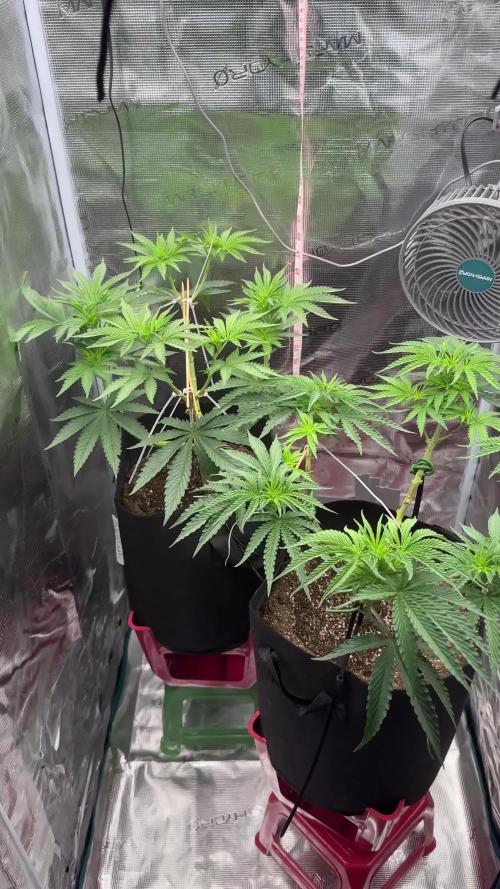
Ligth chuanging tiime to my 6 photoperiodic plants. It was some earthqueke in Colombia , so my seeds mixed up. I lkmow for sure GG4 Spirit Seeds and Banaana Runtz by Barneys is here and if any of you recodnize any straine) Help me )) here is list of 10- Barmeys 3 strains -Dorban Poisson,,Banana Runtz,London Pound Cale, 2x42Buds LemonPaya,Sweet seeds Jack 17 , Sensi seeds Purple Kush and something else)
Enjoy