


Likes
Comments
Share


@eldruida_lamota
Follow
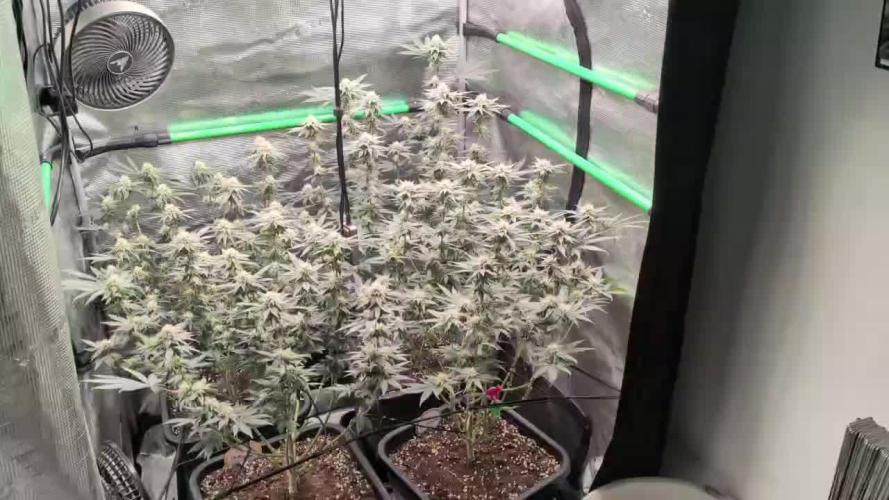
Vamos familia quinta de vida de estás apollo black cherry de SeedStockers.
Que ganas tengo de ver el progreso de esta variedad, las plantas están sanas, se ven con buen color.
La cantidad de agua cada 48h entre riegos.
Esta semana añadimos nutrientes de la gama Agrobeta.
Tuve problemas de trips en un indoor y tengo todas plagadas pero ya las e tratado con aceite de neem y un insecticida genéricoy jabón potásico también añadí tiras azules, trataré esta semana.
Estas próximas semanas veremos cómo avanzan.
Mars hydro:
Code discount: EL420
https://www.mars-hydro.com/
Agrobeta:
https://www.agrobeta.com/agrobetatiendaonline/36-abonos-canamo
Hasta aquí todo, Buenos humos 💨💨.

Likes
25
Share


@Lou_Grows
Follow
Not much to say, by the end of this week I will defoliate. She is running fibe without any problem so far


Likes
45
Share


@Ultraviolet
Follow
2nd net is up. Early bud formations are promising. holding up to the extremes pretty well, some leaves taking minor damage, but overall, she is holding up, gave her 1 night at 50F see how she would react, stressful. Not advised as it messes with her metabolism, but I want to see if it triggers any anthocyanin response. Love to see her purp up but no signs yet.
My homework.
Rubisco regeneration is intrinsically linked to nitrogen supply because Rubisco is a major sink for nitrogen in plants, typically accounting for 15% to over 25% of total leaf nitrogen. The regeneration phase itself consumes nitrogen through the synthesis of the Rubisco enzyme and associated proteins (like Rubisco activase), and overall nitrogen status heavily influences the efficiency of RuBP regeneration.Structural Component: Nitrogen is an essential building block for all proteins, and the sheer abundance of the Rubisco protein makes it the single largest storage of nitrogen in the leaf.
Synthesis and Activity: Adequate nitrogen supply is crucial for the synthesis and maintenance of sufficient Rubisco enzyme and Rubisco activase (Rca), the regulatory protein responsible for maintaining Rubisco's active state. Nitrogen deficiency leads to a decrease in the content and activity of both Rubisco and Rca, which in turn limits the maximum carboxylation rate, Vmax, and the rate of RuBP regeneration Jmax, thus reducing overall photosynthetic capacity.
Nitrogen Storage and Remobilization: Rubisco can act as a temporary nitrogen storage protein, which is degraded to remobilize nitrogen to other growing parts of the plant, especially under conditions of nitrogen deficiency or senescence.
Nitrogen Use Efficiency (NUE): The allocation of nitrogen to Rubisco is a key determinant of a plant's photosynthetic nitrogen use efficiency (PNUE). In high-nitrogen conditions, plants may accumulate a surplus of Rubisco, which may not be fully activated, leading to a lower PNUE. Optimizing the amount and activity of Rubisco relative to nitrogen availability is a target for improving crop NUE.
Photorespiration and Nitrogen Metabolism: Nitrogen metabolism is also linked to the photorespiration pathway (which competes with carboxylation at the Rubisco active site), particularly in the reassimilation of ammonia released during the process.
To increase RuBisCO regeneration, which refers to the process of forming the CO2 acceptor molecule Ribulose-1,5-bisphosphate (RuBP) during photosynthesis, the primary methods involve optimizing the levels and activity of Rubisco activase (Rca) and enhancing the performance of other Calvin-Benson-Bassham (CBB) cycle enzymes.
Biochemical and Environmental Approaches:
Optimize Rubisco Activase (Rca) activity: Rca is a crucial chaperone protein that removes inhibitory sugar phosphates, such as CA1P (2-carboxy-D-arabinitol 1-phosphate), from the Rubisco active site, thus maintaining its catalytic competence.
•Ensure optimal light conditions: Rca is light-activated via the chloroplast's redox status. Adequate light intensity ensures Rca can effectively maintain Rubisco in its active, carbamylated state.
•Maintain optimal temperature: Rca is highly temperature-sensitive and can become unstable at moderately high temperatures (e.g., above 35°C/95F° in many C3 plants), which decreases its ability to activate Rubisco. Maintaining temperatures within the optimal range for a specific plant species is important.
•Optimize Mg2+ concentration: Mg2+ is a key cofactor for both Rubisco carbamylation and Rca activity. In the light, Mg2+ concentration in the chloroplast stroma increases, promoting activation.
•Manage ATP/ADP ratio: Rca activity depends on ATP hydrolysis and is inhibited by ADP. Conditions that maintain a high ATP/ADP ratio in the chloroplast stroma favor Rca activity.
Enhance Calvin-Benson-Bassham (CBB) cycle enzyme activity: The overall rate of RuBP regeneration can be limited by other enzymes in the cycle.
•Increase SBPase activity: Sedoheptulose-1,7-bisphosphatase (SBPase) is a key regulatory enzyme in the regeneration pathway, and increasing its activity can enhance RuBP regeneration and overall photosynthesis.
•Optimize other enzymes: Overexpression of other CBB cycle enzymes such as fructose-1,6-bisphosphate aldolase (FBA) and triose phosphate isomerase (TPI) can also help to balance the metabolic flux and improve RuBP regeneration capacity.
Magnesium ions, Mg2+, are specifically required for Rubisco activation because the cation plays a critical structural and chemical role in forming the active site: A specific lysine residue in the active site must be carbamylated by a CO2 molecule to activate the enzyme. The resulting negatively charged carbamyl group then facilitates the binding of the positively charged Mg2+ion. While other divalent metal ions like Mn2+ can bind to Rubisco, they alter the enzyme's substrate specificity and lead to dramatically lower activity or a higher rate of the non-productive oxygenation reaction compared to Mg2+, making them biologically unfavorable in the context of efficient carbon fixation. The concentration of Mg2+ in the chloroplast stroma naturally increases in the light due to ion potential balancing during ATP synthesis, providing a physiological mechanism to ensure the enzyme is activated when photosynthesis is possible. At the center of the porphyrin ring, nestled within its nitrogen atoms, is a Magnesium ion (Mg2+). This magnesium ion is crucial for the function of chlorophyll, and without it, the pigment cannot effectively capture and transfer light energy.
Mg acts as a cofactor: Mg2+ binds to Rubisco after an activator CO2 molecule, forming a catalytically competent complex (Enzyme-CO2-Mg2+). High light + CO2) increases demand: Under high light (60 DLI is a very high intensity, potentially saturating) and high CO2, the plant's capacity for photosynthesis is high, and thus the demand for activated Rubisco and the necessary Mg2+ cofactor increases. Mg deficiency becomes limiting: If Mg2+ is deficient under these conditions, the higher levels of Rubisco and Rubisco activase produced cannot be fully activated, leading to lower photosynthetic rates and potential photo-oxidative damage.
Optimal range: Studies show that adequate Mg2+ application can enhance Rubisco activation and stabilize net photosynthetic rates under stress conditions, but the required concentration is specific to the experimental setup.
Monitoring is key: The most effective approach in a controlled environment is to monitor the plant's physiological responses e.g., leaf Mg2+ concentration, photosynthetic rate, Rubisco activation state, and adjust the nutrient solution/fertilizer to maintain adequate levels, rather than supplementing a fixed "extra" amount.
In practice, this means ensuring that Mg2+ is not a limiting factor in the plant's standard nutrient solution when pushing the limits with high light and CO2.
Applying Mg2+ through foliar spray is beneficial to Rubisco regeneration, particularly in alleviating the negative effects of magnesium (Mg) deficiency and high-temperature stress (HTS). While Mg can be leached from soil, within the plant it is considered a mobile nutrient, particularly in the phloem. Foliar-applied Mg is quickly absorbed by the leaves and can be translocate to other plant parts, including new growth and sink organs.
Foliar application of: NATURES VERY OWN MgSO4 @ 15.0g L-1 in a spray bottle.
Foliar sprays are often recommended as a rapid rescue measure for existing deficiencies or as a supplement during critical growth stages, when demand for Mg is high. Application in the early morning or late evening can improve absorption and prevent leaf burn.
The starting point [of creativity] is curiosity: pondering why the default exists in the first place. We’re driven to question defaults when we experience vuja de, the opposite of déjà vu. Déjà vu occurs when we encounter something new, but it feels as if we’ve seen it before. Vuja de is the reverse—we face something familiar, but we see it with a fresh perspective that enables us to gain new insights into old problems. Come walk in the enchanted forest.
Processing
Likes
3
Share


@MOTB666
Follow
These girls are doing great. Running out of room to move my light so hopefully they're done growing up lol.
Small nugs are starting to form and the smell its starting to get strong smells very nice.
Got a bigger dehumidifier to help with humidity was staying between 50-70 the last couple weeks finally getting down to 40.
They're appetite is really ramping up now and they're drinking about a gallon a day between the three of em.

Likes
4
Share


@IamCy
Follow
Here we go into flower. If what they say is true, we're in for a nice color show.
Likes
176
Share


@NuggetPawn
Follow
So, with the harvest complete and the dry finished, the rest is now going into jars for the final cure and storage.
Overall I enjoyed this grow, it needed minimal interventions and had a smaller work load compared to the other grows.
The amount of dried flowers is 752g (1.11gpw) so a decent haul, I threw a lot of B grade buds in the hash bag due to the large number of low level flowering sites (I need to rethink my canopy management) and also with the lack of stretch after flipping made the internodal spacing a bit too tight. Managed to extract 215g of grade a hash from her as well which I have pressed into a slab (pictures).
I learned many things along the way, namely root health and the importance of keeping organic additions as low as possible. I also decided to try out clones for my next run, just to get a little more canopy and growth consistency - those of which are in an aeroponics tub at the moment waiting to root (picture).
Thanks for those of you who followed along most of the way, good luck with all your grows!

Likes
5
Share


@LittleBigTrees
Follow
I've defoliated a little as I go.
One of the watermelon candy has a flat stem (Fasciation) I've been trimming the leaves as they are growing in abundance on the affected branches.
The black orchid smells so good it's very pungent and captivating, I'm really looking forward to trying it now.

Likes
3
Share
@Organic710
Follow
Not too bad I'm enjoying the smell of these so far 2 are super garlic gassy and the other 2 just smell like a fruity hash 😃
Added some side lighting as this tent only has a 300w SE3000. Other tent is getting the mammoth nova sun canopy lighting in the next few days 😄


Likes
11
Share


@plant
Follow
One or two weeks and this little beaut should be finished. Really happy with the trichome development in the last week or so starting to smell gassy 🤙 stay lit everyone, happy new year 👍🐞🤙🌲

Likes
Comments
Share


Likes
12
Share


@StoneyJake
Follow
I really like this strain! This was by far the biggest and frostiest plant I have ever grown. Most of the buds are hard indica style but a few branches grew more like sativa all buds coated in trichs. It took me 2 days to get this monster down. The picture of my hanging buds doesnt do it justice. I probably got a pound but not sure. I'll post dry weight and a smoke report in a few weeks.

Likes
1
Share


@spanish420pasiongrow
Follow
Resultado muy bueno, fue con la tabla completa de Advanced Nutrient y funcionó la maravilla, volveré a repetir las cepas, sacaron tonalidades preciosas.




Likes
32
Share


@NoProbation4Weed
Follow
- Day 63 of Flower Light reduction to 50%
- Day 65 of Flower Last time Watering
- Day 67 of Flower Lights out for 3 days
- day 70 of Flower Harvest
Trichomes are about 15% amber and 80% cloudy with 5% clear
Temperatures for drying gonna be 19°C and RH around 55%.
She is looking beautiful and her Smell is so intensive you cannot unsmell it. Its Loud!
Has Some Fruity (Plum or Tangie like), Soapy and Floral Notes to it.
I cant wait for the smoke.


Likes
21
Share


@Hydronaut
Follow
A step back recently:
Started a final flush (2 days in), and decided to start feeding her again - thanks to some great GD input!
250 ppm at re-start and will work my way to 500ppm? She's still rockin' along - like nothing happened.
She topped out at 350 ppm without tanking PH, so she is stable here.
PH is now swinging down fairly quickly last 12 hours. Drained off 1/3 of reservoir and get reservoir down to 250PPM.
5 days later, major PH swings down again. Mixed another fresh reservoir. I am using Zero Water 5 gallon system, and just realized the PPM coming out was 100, and PH at 3! If I am at 100 today, that means these filters have been shot for a while, maybe since start of my PH issue. There is also interesting information about when zero water filters reach their expectancy. They put out fishy smell and otherwise. I will be watching my filters more often and taking more notes since this ZeroWater 5 gal system is really the way to go if you are only growing a plant or two. Filters are a bit spendy but when you take time, gas, convenience etc. its a no brainer (if the water coming out is zero:) - I get about 15 gallons per filter (175ppm from tap).
Day 70. It’s been about a day since new res change. Steady Eddie at 250 ppm and 6.2. I’ll let her drink the bucket down a good ways if things remain stable with a drift down. I doubt it though, 5 gallon is fine for 12” autos but at 2’ she really needed 8 gal. Time to up the R&D on the cabinet! Also checked Zero Water again and filter is now putting out 200ppm of 3.0 water. New filters installed!
Hope she finishes soon, the top of her canopy slowly getting cooked over the last 10 days. 8" of light distance is too little. PPFD 2000+ at the top, but leaf temps are in the upper 70's. Gotta hit a decent DLI on these lower buds - without nuking the top nugs, right?!
As the week concludes, she’s in a fresh bath, at 250ppm @ 6.0 and running stable again. New water filters installed so zero water variable removed. Last serving of half+ teaspoon of GH dry KB ripening, and will reduce ppm by 25/day until I reach 10-15%. 1-2 day flush, if at all.
Likes
1
Share


@CheeRz
Follow
It's vegi week 4, and the two lemon ladies are doing splendidly. If they continue to grow like this, they should be ready to switch to the flowering stage by the end of week five.

Likes
43
Share


@ButtersStotch
Follow
-Went out of town for a couple days so I premixed my nutes and showed the girlfriend how to feed the girls. Thank the lord shes on board with my grow lol. This was their last feeding and from now until the end they will only be getting PH'd water. The end is near!
-After 24hrs of darkness and cold midget plant still didn't flower, I doubt its a photo because I'm growing photo WWs from cropking and they do not look similar at all. Might switch to 12/12 once these girls are done.
-Started flush on day 68
