




Likes
57
Share


@SmokieMcPot
Follow
***UPDATE***
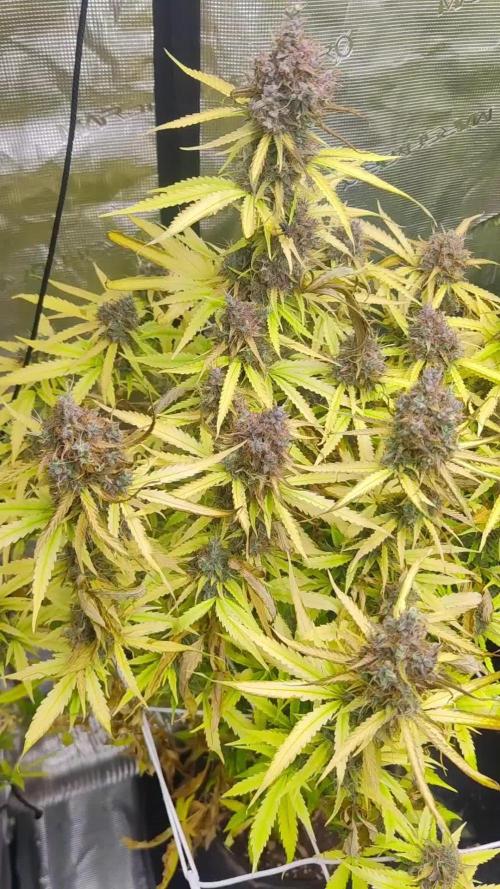
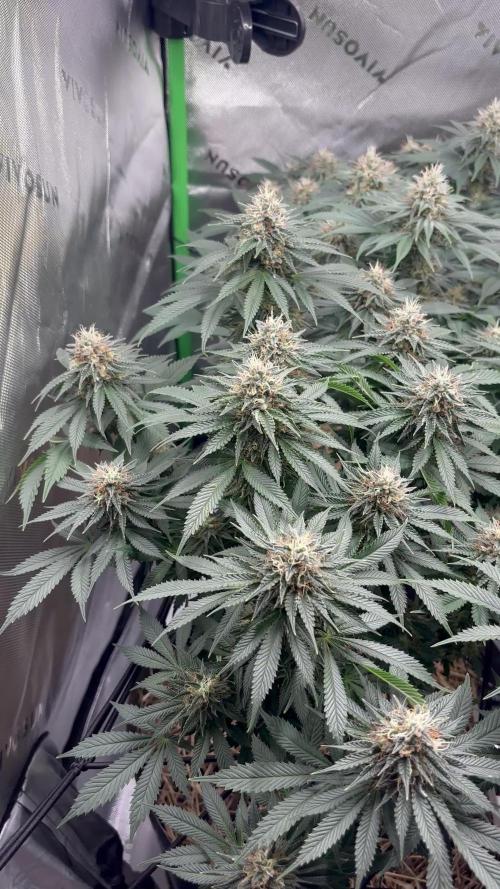
ITS CHOPPIN DAY!! Late in day 87 I was going for macros. Made the decision while seeing MANY yellow trichomes that Wedding Glue from FastBuds is DONE! Attaching pics to the beginning of the weeks uploads. She sure turned out pretty asf didn't she? Lights out occurs in like 30min, and I'm going to work through the dark period stripping the large fans off. Utilizing my green Christmas lights hung up above lol. May turn light on low for a quick pic before chopping/hanging. Next update will be harvest!
2 Girls 1 Cup week 12? Hopefully the finish is this week... My my my how WG has fattened up the last 2 weeks. Trying to get some good macros since it's too hard to hold the scope to my phone and focus everything. Probably better for the existing trics too since they're not being touched.
Day 84- these trics are taking their sweet time to ripen. Was considering picking up some GHE Ripen to speed the process up.. especially because a local shop is closing and everything is 40% off. Let's keep it simple this run. I'll get some additives for the next grow to enhance GHE's perfected formulas of macro/micros in the Flora series. An update on the "sample" I clipped from WG the other day. It's not dried/cured proper. Actually been sitting in a brown bag with the outlet of the tent blowing on it lol. Can taste some vanilla in it through the chlorophyll and shit still in the flowers. VERY heady effect that hits me like a friggin wave. Creativity and energy uplifted for sure. Looking for the bodies in there too to help with pain, so we shall wait even longer for those ambers to show.
====================================================
==========================
==========================
Day 85- stepped up our hole a size or two.. lol. May bring home the step bit to drill again before a dark period at the end. The girls STINK! Getting VERY close to chopping day. Ooooh I can't wait (but I gotta). Headies lasting between 2-3hrs which is great.
====================================================
==========================
==========================
Day 86- yellowing more as the days pass. no more ambers showing yet.. wasn't able to score anything good from the local shop today since it was almost empty already. Picked up a grove bag to give it a whirl with curing. May put some in glass to compare side by side with the bags. Figured I'd give their roots an ice bath since I've done other bro science. Shit, GK still hasn't popped a nanner after all I've put her through 🤣.
*edit* added some late day WG only pics to show her fall colors coming in. Moving in fast now. Gotta get back up in WG's guts now and scope the progress daily.
====================================================
==========================
==========================
Day 87- the smell in the tent has become so powerful, I next day air'd a new charcoal filter 🤣. This one was reaching the end of its lifespan anyway.. but oh boy has the aroma increased. May be starting the 48hr lights out within the next day or two from the smells of it.
====================================================
==========================
==========================
As always, thanks for stopping by and checking out my current grow. If it's your first time, check previous weeks for these girls progress throughout their lives. days 27-70 timelapse @ https://youtu.be/8JdUkR36Wfc

Likes
5
Share


@Deli_Weed
Follow
Esta semana engordaron bastante las flores, los últimos dos dias de esta semana deje de regar con nutrientes, pura agua 🚿 para empezar el flush


Likes
26
Share

@Greenkush420
Follow
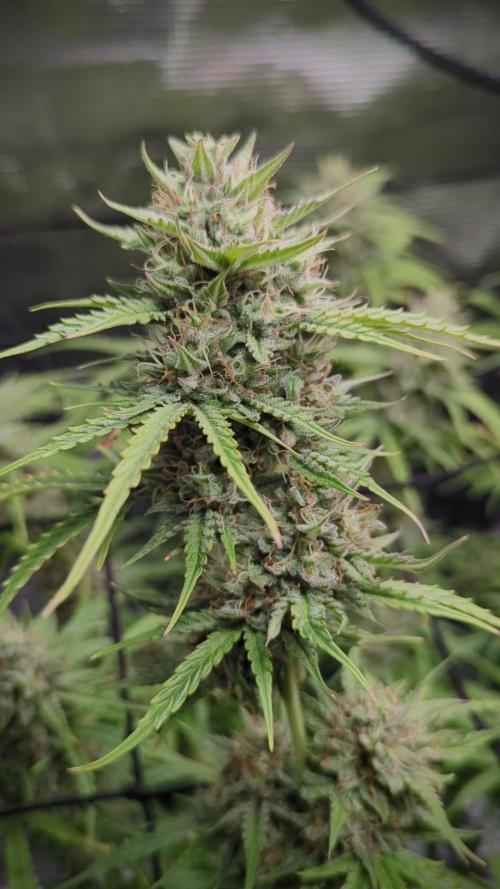
Cosechamos las 2 blueberry, tiene un aroma increíble dulce y afrutado y unos cogollos bien compactos


Likes
13
Share
@DutchBarnacle
Follow
Week 8!
Day 58: 2L (pH6.8) + 1ml CalMag + 1ml PK13-14
Today I learned that CalMag contains about 5% nitrogen. So, her nutrient solution comes down to about a half dose of 5-13-14 with added calcium and magnesium - kinda. More importantly, I assume it thus would be worth trying to abstain from CalMag just before harvest.
Also, she seems thirsty and since her last nutrient solution was a week ago, I figured we might as well try a half dose of PK13-14. I'm aware she's still got the organic feed, but I'm also curious to learn whether this will burn her again - now that she's bulked up. The remainder of the week will probably consist of watering.
Day 59: Still damp
Decided to try and even out the canopy further. Remaining two highest branches have been pulled outward, light has been lowered. While the highest apex still reaches about 900 PPFD - which is more than ideal - the entire canopy now receives on average 600 PPFD, while slightly turning down the light intensity from 85% to about 80%.
Addition: after browsing other diaries; the Northern Light Automatic strain information pages on Growdiaries.com, and RoyalQueenSeeds.com, I noticed that about 10 weeks after germination is her expected harvest time. That's one week out!
I'll thus dial down on the nutrition and keep an extra eye on her water consumption. About half of her pistils are still white. If those start to turn rusty and her water consumption slows down, I assume her leaves will also start going yellow.
With the nutrition solution of yesterday she should hold out until harvest, so any leaves turning yellow this week won't be caused by a deficiency, I assume.
Day 62: Soil is dry but cool to the touch, no water
Nothing much going on currently. She's done most of her bulking I assume. While the soil is dry, she's not showing signs of thirst so I'll water her tomorrow. I'm curious whether watering will increase the bud size.
Day 63: 2L (pH6.5) bottom water.
Opened up the tent about an hour before lights-on to water her with 2L tapwater pH-ed at 6.5. Instead of the regular top watering, I gave her a royal gulp on the soil and poured the rest in her runoff tray.
Day 64: Humid, no water.
Some extra defoliation of withered leaves. She won't be needing those as we're nearing the last week. There's the sporadic amber coloured trichome here and there. I've picked up advice saying that, when in doubt, you should give her another week or so and check again. Enjoy the last picture of this week, the money shot!
Likes
39
Share


@Adamlovesgreen_98
Follow
MACARON KUSH IS DOING WELL . SHE STARTING TO DRINK DOWN NUTRIENTS A BIT MORE. IM GOING TO PUT A SCREEN UP OR ON HER FOR MORE LST,HST. WELL HOPE YOU ALL ARE BLESSED WITH GOOD MEDICINE!
AUG,25,2022:) She is doing well. I'm very happy with her growth. I'm debating on how fast I want her into flower. Other then that just growing each day steady Pace.Well blessings on all you grow and harvest my fellow growers!!!
AUG26,2022:) SHE IS DOING GOOD. IN FACT I JUST CHECKED HER AND SHE NEEDS SOME JACKS321. SHE WAS A BIT LIGHT AND THE OTHERS WERE NOT SO SHE DRINKING GOOD. OTHER THEN THAT JUST BEING PATIENT AND WAITING FOR HER TO GET OVER 65 DAYS AND READY FOR FLOWERWELL BLESSINGS ON ALL YOU GROW AND HARVEST!
AUG.27,2022 MACARON KUSH IS VERY NICE TOO WORK WITH. SHE GOT SOME HST AND HANDLED IT LIKE A CHAMP.IM MAKING TONS OF CLONES! OTHER THEN THAT, IM BLESSED and HOPE YOU ALL MANY BOUNTIFUL HARVESTS!!
AUG.28,2022- WELL SHE DOING GOOD AND I LIKE HER GROWING. TODAY SHE GOT A FEEDING OF HER JACKS 321 AND B52 . OTHER THEN THAT JUST WAITING FOR FLOWER TIME! BLESSINGS ON ALL U GROW AND HARVEST MY FELLOW GROWERS!!
AUG.29,2022- MACARON KUSH IS DOING WELL,FAST GROWTH THAT IM REAL HAPPY WITH. IM GOING TO GET AS MANY CLONES AS I CAN GROW HER BEFORE SHE GOES INTO FLOWER. I WAS GOING TO TRAIN MORE BUT IM TRYING TO GET A PERPETUAL GROW GOING SO TRYING TO GET MY MEDICINE SOONER. IM RUNNING LOW. WELL BLESSINGS ON ALL U GROW AND HARVEST MY FELLOW GROWERS!!
AUG.302022- WELL MACARON KUSH IS DOING WELL. I HOPE FLOWER IS JUST AS FAST AS VEG. IM GETTING CLONES BECAUSE SHE GOING TO BE SICK I CAN TELL! WELL BLESSINGS ON ALL U GROW AND HARVEST MY FELLOW GROWERS!!
Likes
7
Share

@ThatsmyGrow
Follow
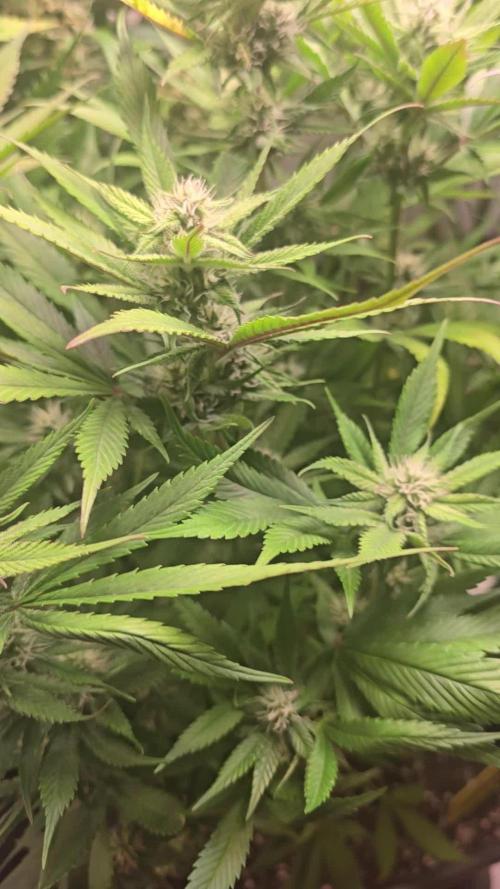
How beautifully it's slowly turning purple. I'm already looking forward to the RF3 version of Strawberry Gorilla. It's really not the biggest, but I hope it will still produce thick buds.
Likes
4
Share


@QixxGrows
Follow
Switched to flowering. She grew 10cm in 3 days... absolutely crazy.
I took the tough decision to discontinue the TimeLapse. My tent is not big enough to have the camera in a place that kinda makes sense. So I'll be taking manual photos in the coming days and uploading those.

Likes
14
Share


@Toughpuff
Follow
Care Bears was an awesome plant to grow, it grew fairly smaller but massive colas on the whole plants. The fruity smells that come off this plant is amazing but also has a hint of that good old dank smell, awesome purple/pinkish colours off of it . Highly recommend growing this strain is you haven’t already.
Breed by: firebuds genetics


Likes
6
Share


@IrvingFarmz
Follow
So started this in mid June/early July in my greenhouse. This was my first greenhouse grow! During the summer temps reached up to 130f. I was a little nervous with the heat during early flower but she handled the heat very well. Before the chop, temps got low as 45f at night. I never had any issues with pest (I used 500 lady bugs and 2 praying mantis). Checked every week for mold since the buds are super stacked. No bud rot or any type of issues. I will grow this again because I didn’t take clones :(


Likes
7
Share


@Polakush420
Follow
MACK AND CRACK 30 % THC / Hidroponia
(TERPENO A LIMONELO)
Lo mas clave de la Hidroponia es el CLIMA PERFECTO - EL AGUA NO DEBE SUPERAR LOS 24 GRADOS !!
Saludos de Argentina
Likes
47
Share


@Ultraviolet
Follow
The cannabis strain Grape Guava can be a purple strain, depending on its specific phenotype and genetic makeup. While not all phenotypes of Grape Guava are purple, some variations, such as the Zatix Grape Guava, are noted for their striking purple appearance due to the genetic expression of anthocyanin pigments.
https://www.youtube.com/watch?v=cKdVmdoKJ5k
In a garden of green, Grape Guava gleams,
With its fruity aroma, enchanting dreams.
Clusters of grapes, guava's sweetness ignite,
A strain so divine, in purple and white.
Euphoria whispers, a lush fruity haze,
Grape Guava's embrace, a tranquil daze.
Off and away.@1400ppm. The increased CO2 allows plants to thrive at higher temperatures, which in turn necessitates higher humidity to maintain the ideal VPD for healthy growth and transpiration. 80F -5F = 75F LST with 70% RH = 0.72 kPa. Higher temperatures and humidity promote rapid growth, nutrient uptake, and photosynthesis while maintaining a lower stress level. Temperature influences the rate of enzymatic reactions involved in aerobic respiration. Enzymes, such as those involved in glycolysis, the Krebs cycle, and the electron transport chain, work most efficiently at an optimal temperature range. In low temperatures, enzymatic activity will slow down, thus reducing the rate of aerobic respiration. In high temperatures, enzymes can become denatured, thus impairing their function and stopping the process of aerobic respiration. Glucose is the primary fuel for aerobic respiration. The rate of aerobic respiration increases with the availability of glucose, as it is the starting point for glycolysis. If glucose levels are low, cells may rely on alternative energy sources such as fatty acids or amino acids , but these processes may yield less ATP or be less efficient. To determine this effect, carbon dioxide volume was measured (as carbon dioxide is an output of aerobic respiration)
18/6 with the 6 being IR. The near infrared (IR-a) borders around 700nm up to 1400nm @ photon par flux density of 1.8 instead of darkness, keeping temps overnight a neat 77F-80F.
Think of my tent as a lung. What goes in must come out. When the rate of air going out exceeds the amount of air coming in, it creates a negative pressure. Tent concaves (bends in). If set up correctly, your RH will begin to drop slowly to the desired level you set, and the extraction turns off when it reaches desired% RH. The plant, as it performs cellular respiration, will always be releasing more water into the air, so the RH% of the tent overnight will always increase, so long as oxidative phosphorylation is occurring. As soon as the RH% creeps back up to 55%, the extraction turns back on, over and over. This creates a strong pressure differential which will work wonders on your grow. Replicating high and low-pressure fronts in nature. Critical for oxygen diffusion at the critical time of peak cellular respiratory function..
Moisture will not transfer from a saturated atmosphere to another if that air is already at or above its saturation point, meaning the air can't hold any more water vapor. Once I understood that water is produced as a by product during cellular respiration, specifically at the very end of the electron transport chain (ETC) where electrons are finally transferred to molecular oxygen, the higher the RH of the air, the more resistance there is for more moisture to be added to that environment, and effects the ease with which it does so. But none of that water comes from the pot; it's pulled from the air. If you run high daytime RH, your medium/pot is 100% reliant on transpirational root pull to move water. ZERO evaporation happens across the atmosphere if the tent air has high RH%, the medium cannot release its water through evaporation. Once a canopy develops, light no longer slowly wicks and evaporates from the topsoil. The Soil-Plant-Atmosphere Continuum (SPAC) describes the continuous pathway and process of water movement, driven by a gradient in water potential, from the soil, through the plant's roots, stem, and leaves, and finally evaporating into the atmosphere through transpiration. There is evaporation, there is transpiration, and then there is evapotranspiration; Evapotranspiration (ET) is the combined total of two processes: evaporation (water lost directly from soil and surface water into the atmosphere) and transpiration (water released from plants to the atmosphere through their leaves). Evapotranspiration represents the total amount of water that moves from the medium into the air. There is no such thing as a medium with too much water, only a medium that retains too much for too long.
The water must always flow efficiently from one atmosphere(Medium) to another(Air) in a timely manner. Moisture is a critical factor for bacterial growth and decay. Dictating how long it's allowed to sit in any one location for any given period is a key preferred control. To ensure a net reduction in a bacterial population, the rate of removal (ET) must exceed the rate of bacterial growth (decay rate), which is often modeled as a growth rate for the specific bacterium under the given conditions. By optimizing daytime VPD, we also optimize conditions for bacterial growth to explode exponentially above 77°F.. If water is allowed to sit in a medium without an escape within a timeframe, nothing good will happen. IF High RH is maintained overnight as well as during the day, placing 100% of water movement at the behest of daytime transpiration, roots can only pull where they can reach, and if soil is compressed above a certain point, moisture will become trapped in a medium with no way of moving day or night. This will begin the countdown for decay to take hold. When water stagnates in a medium, it loses oxygen, creating anaerobic conditions that foster the growth of harmful microorganisms like bacteria and fungi, which can produce toxins and disease vectors.
Thigmomorphogenesis, the process by which plants respond to mechanical stimuli like touch by altering their growth and development, results in significant morphological changes to improve survival against mechanical perturbations. This complex response involves sensing touch and initiating physiological and genetic responses, leading to changes in form and structure over days or weeks. The process is triggered by physical forces such as wind, rain, or touch. Plants adapt to these stimuli by changing their shape and structure, which may include slower growth, thickened stems, or altered leaf development. Plants possess sophisticated mechanisms to detect even subtle mechanical stimuli and initiate responses. A variety of molecules, including calcium ions, jasmonates, ethylene, and nitric oxide, are involved in signaling these mechanical inputs. Touch can induce the expression of genes that encode proteins for calcium sensing, cell wall modification, and defense mechanisms. A plant exposed to constant wind may become shorter and sturdier. A plant that is touched frequently might grow more slowly to conserve energy and develop thicker cell walls. These changes increase a plant's resilience and ability to survive in harsh environments.
Let's get Thiggy with it.

Processing
Likes
57
Share


@Silverback_Guerilla
Follow
11/2:
Both Sweet Zkittlez are looking great, as is the first Black Jack. The other Black Jack has popped and is growing in the DWC cloner for a couple days.
Neither Gorilla Girl has popped yet.
11/3:
One of the Zkittlez, the Black Jack, and a few other seedlings suddenly look like they are starving, so I fed them and am foliar feeding with a kelp/fish emulsion product every few hours.😕
I can see some green just below the surface on both Gorilla Girls now...fingers crossed.
11/4:
I planted the baby Black Jack today and foliar fed them a few times. The Zkittlez with the deficiency looks better today, but her first set of leaves won't last long...
Neither Gorilla Girl has emerged yet...
11/7:
The younger Black Jack is starting to catch up now.
Both Gorilla Girls popped and got planted on the 5th, late at night.
Both SZ's look great...the one that was deficient has corrected and is doing well now.
Likes
3
Share


@Inertia_Collective
Follow
Really starting to take off. Hoping they settle out but I am off on vacation next week gonna let them run while I'm gone to test my setup. Wish them luck! Just worried about humidity.
Likes
2
Share


@The_Doctor_Green
Follow
Hola a todos!. La planta viene creciendo bien y fuerte. se rego con 2ml x l de agua de oro negro de namaste.
En los próximos días estaré actualizando mejor el diario.
Likes
209
Share


@BioBuds
Follow
They are going slow but steady. Holding back on watering to help fight the gnats. They were with too many last week. Some yellow points because of an 'on the limit' foliar feed. Nothing to worry about.
Still very lush greens. I'm thinking the main reason for their slower growth, is the fan that is on high. My mission from the start s to get thick stalks and branches, to facilitate larger buds.
Also, I'm pushing the SP 3000 to its max for the age of my plants, they don't have to reach for the light, resulting in shorter, bushier plants. I don't mind, I think the flowering stretch will make up for that and fill the tent.
Still very happy with the SP-3000 from Mars Hydro, a much more constant and manageable climate in the tent, a dream to work with. I made a thank you video for @MarsHydroLED, of course, to also show off my music.
I'm thinking one or two more weeks before resetting the light schedule for flowering. I'm already late and if another week will deliver bigger and more buds, I will give them what they need.
For those living in Europe, wanting to try super soil, see my recipe in the images.
Thank you for following and your likes and support! It really keeps me motivated. Big Hug Bud

