


Likes
Comments
Share


@AestheticGenetix
Follow
5/12/24 happy Mother’s Day
5/15 she is frosting up ever so nicely and the pistils are still looking healthy

Processing
Likes
34
Share


@LockDownGrow
Follow
My first time making alcohol tintcure
Using the c1 ,
Hold on tight gonna be a trip


Likes
11
Share


@JaysBuds
Follow
Day 21 in the flower tent and I think the stretch is now complete. The girls are 12" tall above the screen and I'll probably put up a 2nd layer of trellis just to be safe. Will definitely only run 4 of these next time, or maybe 2 with the same veg time to keep the canopy lower, but I don't think the Photontek x465wPro will have any trouble penetrating down into this!
Also time for another big strip! These girls just keep putting out the fans, so we'll just keep stripping them off, keeping tabs on airflow and budsites. We're still not setting bud yet - seriously, four full weeks of stretch so far here...

Likes
14
Share


@TerpyTears
Follow
Hello friends of good taste 😊✌️...this week was relaxed. The ladies look good and the GHSC Bio line is really great I only watered with clear water ph 6.0 EC 0.4 and lollipopped the ladies. Hope they tolerate it well! One more hermaphrodite in the box and I'm dying 😅 my heart is still bleeding from the last two plants 😂 I would be
be happy if you like the post and follow me😅✌️ stay tuned and stay high 💚 your Terpy Tears
Likes
11
Share


@Krakt85
Follow
Iniziamo l'ultima settimana di vegetativa , dopo aver defogliato un pó le ragazze e piegato i rami più bassi sembra che vada tutto bene .
Felice crescita e alla prossima settimana ;)

Likes
16
Share


@DOOBS_N_BREWS
Follow
Tight on space in the tent so she is definitely a little crammed. She's stacking nicely though =)
Day 64- NFTG feed/Mammoth P/Recharge @ 6.8 ph
Day 65-66 No Water
Day 67- Mammoth P/Recharge/ Cal-Mag/ Bloom Khaos feed @ 6.8
Day 68-70 no water

Likes
45
Share


@Ultraviolet
Follow
2nd net is up. Early bud formations are promising. holding up to the extremes pretty well, some leaves taking minor damage, but overall, she is holding up, gave her 1 night at 50F see how she would react, stressful. Not advised as it messes with her metabolism, but I want to see if it triggers any anthocyanin response. Love to see her purp up but no signs yet. Remember, For every molecule of glucose produced during photosynthesis, a plant needs to split six molecules of water. This process provides the hydrogen needed for synthesizing glucose and other organic compounds, while oxygen is released as a byproduct.
Homework.
If Rubisco activity is impaired and it cannot properly function or regenerate its substrate, the plant's leaves are likely to turn a pale green or lime green, a condition known as chlorosis. Essentially, Rubisco activity is highly regulated and susceptible to various environmental and metabolic factors that can cause it to become inhibited, leading to an apparent failure in RuBP regeneration due to a lack of consumption.
Rubisco regeneration is intrinsically linked to nitrogen supply because Rubisco is a major sink for nitrogen in plants, typically accounting for 15% to over 25% of total leaf nitrogen. The regeneration phase itself consumes nitrogen through the synthesis of the Rubisco enzyme and associated proteins (like Rubisco activase), and overall nitrogen status heavily influences the efficiency of RuBP regeneration. RuBisCO is a very large enzyme that constitutes a significant proportion (up to 50%) of leaf soluble protein and requires large investments in nitrogen. Insufficient nitrogen supply limits the plant's ability to produce adequate amounts of RuBisCO, thereby limiting the overall capacity for photosynthesis and carbon fixation. Maintaining the optimal, slightly alkaline pH is crucial for the proper function and regeneration of Rubisco. Deviations in either direction (too high or too low) disrupt the enzyme's structure, activation state, and interaction with its substrates, leading to decreased activity and impaired RuBP regeneration. (Lime/yellowing)
Structural Component: Nitrogen is an essential building block for all proteins, and the sheer abundance of the Rubisco protein makes it the single largest storage of nitrogen in the leaf.
Synthesis and Activity: Adequate nitrogen supply is crucial for the synthesis and maintenance of sufficient Rubisco enzyme and Rubisco activase (Rca), the regulatory protein responsible for maintaining Rubisco's active state. Nitrogen deficiency leads to a decrease in the content and activity of both Rubisco and Rca, which in turn limits the maximum carboxylation rate, Vmax, and the rate of RuBP regeneration Jmax, thus reducing overall photosynthetic capacity.
Nitrogen Storage and Remobilization: Rubisco can act as a temporary nitrogen storage protein, which is degraded to remobilize nitrogen to other growing parts of the plant, especially under conditions of nitrogen deficiency or senescence.
Nitrogen Use Efficiency (NUE): The allocation of nitrogen to Rubisco is a key determinant of a plant's photosynthetic nitrogen use efficiency (PNUE). In high-nitrogen conditions, plants may accumulate a surplus of Rubisco, which may not be fully activated, leading to a lower PNUE. Optimizing the amount and activity of Rubisco relative to nitrogen availability is a target for improving crop NUE.
Photorespiration and Nitrogen Metabolism: Nitrogen metabolism is also linked to the photorespiration pathway (which competes with carboxylation at the Rubisco active site), particularly in the reassimilation of ammonia released during the process.
To increase RuBisCO regeneration, which refers to the process of forming the CO2 acceptor molecule Ribulose-1,5-bisphosphate (RuBP) during photosynthesis, the primary methods involve optimizing the levels and activity of Rubisco activase (Rca) and enhancing the performance of other Calvin-Benson-Bassham (CBB) cycle enzymes.
Biochemical and Environmental Approaches:
Optimize Rubisco Activase (Rca) activity: Rca is a crucial chaperone protein that removes inhibitory sugar phosphates, such as CA1P (2-carboxy-D-arabinitol 1-phosphate), from the Rubisco active site, thus maintaining its catalytic competence.
•Ensure optimal light conditions: Rca is light-activated via the chloroplast's redox status. Adequate light intensity ensures Rca can effectively maintain Rubisco in its active, carbamylated state.
•Maintain optimal temperature: Rca is highly temperature-sensitive and can become unstable at moderately high temperatures (e.g., above 35°C/95F° in many C3 plants), which decreases its ability to activate Rubisco. Maintaining temperatures within the optimal range for a specific plant species is important.
•Optimize Mg2+ concentration: Mg2+ is a key cofactor for both Rubisco carbamylation and Rca activity. In the light, Mg2+ concentration in the chloroplast stroma increases, promoting activation.
•Manage ATP/ADP ratio: Rca activity depends on ATP hydrolysis and is inhibited by ADP. Conditions that maintain a high ATP/ADP ratio in the chloroplast stroma favor Rca activity.
Enhance Calvin-Benson-Bassham (CBB) cycle enzyme activity: The overall rate of RuBP regeneration can be limited by other enzymes in the cycle.
•Increase SBPase activity: Sedoheptulose-1,7-bisphosphatase (SBPase) is a key regulatory enzyme in the regeneration pathway, and increasing its activity can enhance RuBP regeneration and overall photosynthesis.
•Optimize other enzymes: Overexpression of other CBB cycle enzymes such as fructose-1,6-bisphosphate aldolase (FBA) and triose phosphate isomerase (TPI) can also help to balance the metabolic flux and improve RuBP regeneration capacity.
Magnesium ions, Mg2+, are specifically required for Rubisco activation because the cation plays a critical structural and chemical role in forming the active site: A specific lysine residue in the active site must be carbamylated by a CO2 molecule to activate the enzyme. The resulting negatively charged carbamyl group then facilitates the binding of the positively charged Mg2+ion. While other divalent metal ions like Mn2+ can bind to Rubisco, they alter the enzyme's substrate specificity and lead to dramatically lower activity or a higher rate of the non-productive oxygenation reaction compared to Mg2+, making them biologically unfavorable in the context of efficient carbon fixation. The concentration of Mg2+ in the chloroplast stroma naturally increases in the light due to ion potential balancing during ATP synthesis, providing a physiological mechanism to ensure the enzyme is activated when photosynthesis is possible. At the center of the porphyrin ring, nestled within its nitrogen atoms, is a Magnesium ion (Mg2+). This magnesium ion is crucial for the function of chlorophyll, and without it, the pigment cannot effectively capture and transfer light energy.
Mg acts as a cofactor: Mg2+ binds to Rubisco after an activator CO2 molecule, forming a catalytically competent complex (Enzyme-CO2-Mg2+). High light + CO2) increases demand: Under high light (60 DLI is a very high intensity, potentially saturating) and high CO2, the plant's capacity for photosynthesis is high, and thus the demand for activated Rubisco and the necessary Mg2+ cofactor increases. Mg deficiency becomes limiting: If Mg2+ is deficient under these conditions, the higher levels of Rubisco and Rubisco activase produced cannot be fully activated, leading to lower photosynthetic rates and potential photo-oxidative damage.
Optimal range: Studies show that adequate Mg2+ application can enhance Rubisco activation and stabilize net photosynthetic rates under stress conditions, but the required concentration is specific to the experimental setup.
Monitoring is key: The most effective approach in a controlled environment is to monitor the plant's physiological responses e.g., leaf Mg2+ concentration, photosynthetic rate, Rubisco activation state, and adjust the nutrient solution/fertilizer to maintain adequate levels, rather than supplementing a fixed "extra" amount.
In practice, this means ensuring that Mg2+ is not a limiting factor in the plant's standard nutrient solution when pushing the limits with high light and CO2.
Applying Mg2+ through foliar spray is beneficial to Rubisco regeneration, particularly in alleviating the negative effects of magnesium (Mg) deficiency and high-temperature stress (HTS). While Mg can be leached from soil, within the plant it is considered a mobile nutrient, particularly in the phloem. Foliar-applied Mg is quickly absorbed by the leaves and can be translocate to other plant parts, including new growth and sink organs.
Foliar application of: NATURES VERY OWN MgSO4 @ 15.0g L-1 in a spray bottle. For those high-intensity workouts when 1 meal a day is just not enough!
Foliar sprays are often recommended as a rapid rescue measure for existing deficiencies or as a supplement during critical growth stages, when demand for Mg is high. Application in the early morning or late evening can improve absorption and prevent leaf burn. The plant was getting a little limey yellow in the centre. Shortly thereafter, she was back in business, green mostly regenerated. The starting point [of creativity] is curiosity: pondering why the default exists in the first place. We’re driven to question defaults when we experience vuja de, the opposite of déjà vu. Déjà vu occurs when we encounter something new, but it feels as if we’ve seen it before. Vuja de is the reverse—we face something familiar, but we see it with a fresh perspective that enables us to gain new insights into old problems.
Confidence is evidence... nothing more. You are confident because you have driven 10,000 times, you are confident because you have spoken 10,000 times. People think confidence is a feeling, but it's not. If you want more confidence, then you need to create evidence, take more shots, collect more data, build more experiences, take more risks; fail, confidence doesn't come first; it is the reward you get for doing the work. no one else wants to do.
Likes
22
Share


@Mr420
Follow
Day 106 think its ready so cloudy time to chop maybe in a couple of days want more amber Trichomes.
Day 107 turned heater off night time Temps 65° day time Temps 78° see if we can get so nice color b4 chop.
Day 108 nothing. New
Day 109 tomorrow's the big chop day.
Day 110 plant is ready to chop.


Processing
Likes
6
Share


@CzAlmighty
Follow
Čau growři,🤠
Vůbec nehnojim. Zkouším je chvilku nechat na vodě. Cca 10 dni. Začnu hnojit až bude přeplá a připravena na květ. Trosku mám obavy. Ale snad to bude mít ještě Happy end .😀😇


Likes
69
Share

@GreenHobbit
Follow
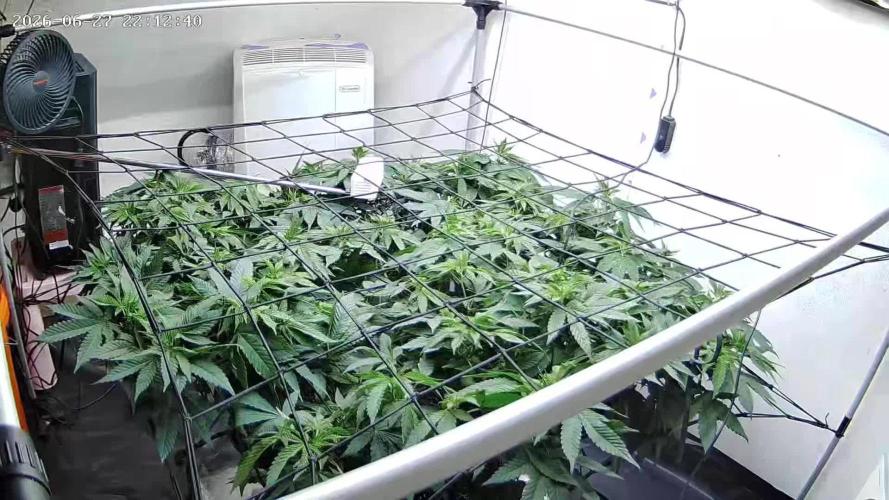
Woche 14 – Urlaub? Die Buddha kennt das Wort nicht. 🌴🌿
Eigentlich sollte diese Woche ganz entspannt werden. Koffer gepackt, 10 Tage Türkei, Sonne, Meer und abschalten. Zumindest für mich. Meine Laughing Buddha hatte da allerdings ganz andere Pläne. 😄
Bevor es losging, bekam sie noch einmal 8 Liter Wasser, der 40-Liter-Topf wurde zuvor noch mit frischer Erde aufgefüllt und anschließend hieß es: “Bis in zehn Tagen.”
Zum Glück hängt inzwischen eine Kamera im Growroom. So kann ich jeden Tag kurz nach dem Rechten sehen. Es ist schon verrückt, wie beruhigend so eine kleine Kamera sein kann, wenn man hunderte Kilometer entfernt am Pool sitzt. 😅
Da ich diese Woche natürlich keine Fotos machen konnte, gibt es diesmal einen kleinen Zeitraffer der Hobbit-Cam, damit ihr trotzdem verfolgen könnt, wie sich die Lady in meiner Abwesenheit entwickelt. 📹🌿
⸻
Das zweite Netz erwacht zum Leben
Eigentlich hatte ich gehofft, dass die Triebe während meines Urlaubs langsam bis zum zweiten Netz wachsen.
Die Buddha hatte offenbar andere Vorstellungen.
Schon wenige Tage nach meiner Abreise schoben sich die ersten Spitzen durch das obere Netz. Mit jedem weiteren Tag kamen neue dazu.
Genau so hatte ich mir das vorgestellt.
Ich wollte vor dem Urlaub bewusst nicht noch einmal trainieren oder auslichten. Die Pflanze sollte einfach wachsen dürfen – ohne zusätzlichen Stress.
Im Nachhinein war das genau die richtige Entscheidung.
Die Triebe entwickeln sich gleichmäßig, die Höhe bleibt erstaunlich homogen und die Fläche wird immer geschlossener. Genau diese gleichmäßige Krone wird mir nach dem Urlaub das Verteilen im zweiten Netz deutlich erleichtern.
⸻
Grow aus der Ferne
Es fühlt sich immer noch etwas ungewohnt an, einen Grow komplett aus der Ferne zu begleiten.
Normalerweise stehe ich täglich im Growroom, kontrolliere jede Spitze und freue mich über jeden Zentimeter Wachstum. Dieses Mal bleibt mir nur der Blick auf die Kamera – und genau das macht dieses Update irgendwie besonders.
Umso schöner ist es zu sehen, dass die Buddha ihren eigenen Plan verfolgt und offensichtlich bestens zurechtkommt.
⸻
Wie geht es weiter?
Noch ein paar Tage Urlaub.
Bis dahin heißt es für die Buddha nur eines:
Wachsen.
Nach meiner Rückkehr wartet dann der wahrscheinlich spannendste Abschnitt der gesamten Vegetationsphase:
* alle Triebe sauber im zweiten Netz verteilen,
* unterhalb gründlich auslichten,
* der Pflanze ein paar Tage Erholung gönnen
* und anschließend endlich den Wechsel in die Blüte einleiten.
Ich habe das Gefühl, dass sich die vielen kleinen Entscheidungen der letzten Wochen langsam auszahlen.
Und wenn ich die Entwicklung über die Kamera sehe, freue ich mich jetzt schon darauf, die Tür zum Growroom wieder zu öffnen.
Ich glaube, die Laughing Buddha nutzt meinen Urlaub mindestens genauso gut wie ich. 🍀🌿

Likes
13
Share


@TiRobotProds
Follow
Buds pleins de résine, grosse odeur afghan, irrigation engrais 1fois sur 3.

Likes
3
Share


@Unruly999
Follow
Week 3ish Update
Two weeks have passed since my last update, and I have to say—it’s been an interesting ride. We’re now in week three for both the OG Kush and Gorilla Skittles plants, and there’s already a noticeable difference between the two. I’m not entirely sure if it’s due to the fact that OG Kush is an indica strain and Gorilla Skittles is a hybrid sativa, or if the OG Kush has been a bit stunted in its growth. Either way, both are holding up fairly well.
Feeling like the OG Kush needed a bit of encouragement, I decided to top it and follow up with some low-stress training (LST). Growth is decent, but for being nearly three weeks in, it’s still on the smaller side. I’m curious to see how it responds in the next week or two.
Gorilla Skittles, on the other hand, looks fantastic. It’s also at the beginning of week three, and I’ve applied some LST without topping it—I want to see how it performs naturally with minimal intervention.
Both plants experienced a bit of nutrient burn or light burn or something lol early on, but after adjusting the pH of the water, all new growth looks healthy and vibrant. Thankfully, the issue didn’t spread. I'm growing organically using a mix of bush doctors coco coir and fox farms ocean forest so just watering only when dry, and supplementing with Cal-Mag as needed.
In addition to these two, I now have three younger plants that all sprouted about 10 days ago (on the 15th and 16th of this month).
Moon Beam: This strain came from a cracked seed I received from Multiverse Beans. They told me to go ahead and plant it, and so far, it's doing great. I’m really excited to see how this one turns out.
AK: This one is a bit smaller—similar in size and growth pattern to the OG Kush. I'm thinking the genetics play a role here, possibly an indica-dominant strain. Curious to see its development.
Super Lemon Haze: Also looking strong and healthy. All three of these new additions are already showing faster growth compared to OG Kush at the same age.
I’ve been carefully monitoring VPD, pH levels, and watching for pests like fungus gnats and fruit flies. I’m using sticky traps, mosquito bits, and neem oil to keep things under control, which has been effective so far.
This being my first grow, I’ve learned a ton already from working with the older plants—OG Kush and Gorilla Skittles—and I’m now applying those lessons to the newer ones. I’ll admit, having five plants with different genetics might be a bit ambitious for a beginner, but I’d rather learn through hands-on trial and error than just watching videos.
Again I don’t know what I’m doing however Right now, I’m feeling excited and proud. Everything is looking good—better than I expected, honestly. I can’t wait to share more updates in the coming weeks as these plants continue to develop.


Processing
Likes
19
Share


@eldruida_lamota
Follow
Vamos familia, empieza lo bueno, y es que estás gorillas si han estirado, la primera semana de floración, aportamos algo de big bud para ir amoldándolas.
Es una cepa que se comporta bastante bien en indoor, tallo grueso y bastante distancia entre internudos, deseando ver que flores nos da.
ph controlado en 6,5 ahora va todo fenómeno, temperaturas ideales, humedad correcta 50 % , y pronto la bajaremos a 40 %.
Hasta ahora lo que hay, próximamente nos vemos familia.
Likes
105
Share


@PEAKYPLANTERS
Follow
ladies and gentlemen
Welcome to peaky house gardens
One of the four strains is undergoing an over ... but the strange thing is that they all do the same feeds .... we'll see ... The others are enchanting
Likes
34
Share


@ScotlandHaze
Follow
Finally seeing some fluffy flowers!! A small bit of trimming this week to get the light hitting more bud spots. should I defoliate further or let nature take its course??

Likes
12
Share


@2Stones1Bird
Follow
Checkout my Instagram @smallbudz to see the Small budget grow setup for indoor use, low watt, low heat, low noise, step by step.
01/11/2019 -
Started using BioBizz Alg-a-Mic on spray, using it once per day at lights off, 1 or 2 puffs to create a light mist, only on non feed days,
I mixed 0.1ml on 100ml water 6.4 PH.
03/11/2019 - Gave her 250ml plain water with 6.4PH
05/11/2019 - Gave her 0,15ml of each BioBizz Grow, Max and Bloom on 300ml water 6 PH didn't manage to get it higher to 6.3 at least.
06/11/2019 - She started to show some pistols, probably entering pre-flower.
07/11/2019 - Soil was to dry due to 2930c temps gave her 0,500ml of 6.5PH water with 0,25ml Grow, 0,25ml Max, and 0,45ml Bloom BioBizz.

Likes
9
Share


@NanoLeaf
Follow
End of Week 9 (Second week of flower)
Increased the CO2 to 1300ppm and the ladies have stopped stretching.
The main top-sites are starting to form buds. I defoliated a few fan leaves again because the fan leaves are growing so fast and blocking bud sites
I also gave a cup of worm castings as a top-up to each pot to give the microbes a boost and it replenishes vital minerals to the soil.
Pest Report: None
