Likes
Comments
Share
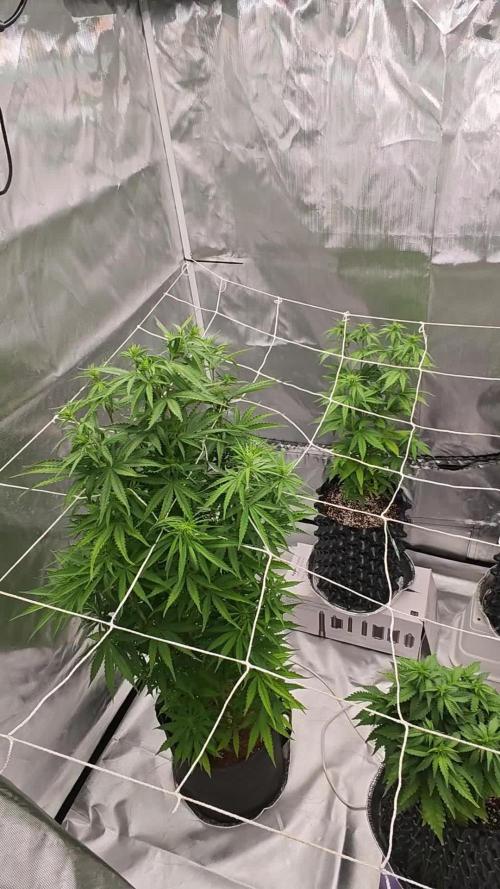
Muy buenas mi gentee. Otra semanita más por aquí, ya en la semana 5 de crecimiento. Y se puede observar como va bastante bien, con buena estructura, buen color y buena ramificación. Se le están dando riegos semanales con bioestimulantes de The hype company y aparte dos riegos de agua más semanales. La temperatura la estamos empezando a subir, para esta semana cambiala a maceta final y pasarla a floración. Así que veremos cómo sigue la próxima.
Likes
8
Share
Mango Kush – Week 4 Flower (Week 8 from Seed) The bulking begins: pistils, stacking, and balanced nutrition Grower: Dog Doctor Strain: Mango Kush (Pheno #1 & Pheno #2) Environment: 8×8 Grow Room Control System: TrolMaster Tent-X brain + WCS substrate sensors (The ThinkRoulette ecosystem) Lighting: • ThinkGrow Model One • ThinkGrow ICL-300 (x2 inner canopy lights) • Future of Grow Black Series 600W • Lumatek Zeus 465W Compact Pro ⸻ 🌸 Week 4 Flower – Bulking Mode Activated Week 4 is an important checkpoint in any bloom cycle. The Mango Kush sisters are no longer just “in flower”, they are now building flowers. Pistils are everywhere, thick and vibrant, forming the foundation for what will become dense, resin-packed buds. Both phenos are looking strong: • Pheno #1 – More advanced, pistil clusters stacking into early budlets, filling her frame with confidence. • Pheno #2 – A little behind, but catching up fast. She may have taken longer to flip (since she germinated later), but she’s now pushing out strong, healthy white hairs that signal the start of her bulking stage. This week’s studio and improvised studio photos capture this perfectly—the transition from “flower set” to flower building. ⸻ 💧 Feeding Update – Simplifying for Strength This week, we made an important nutritional adjustment: • Removed: Aptus All-in-One Liquid & Aptus Top Booster • Kept: • Aptus Regulator – 0.15 ml/L • Aptus CalMag Boost – 0.25 ml/L • Plagron Power Buds – 1 ml/L • Plagron Sugar Royal – 1 ml/L • Plagron Green Sensation – 1 ml/L Why this change? At this stage, the super soil’s NPK balance (nitrogen, phosphorus, potassium) is already strong enough to sustain healthy growth and flower formation. Adding the All-in-One Liquid or Top Booster would risk redundancy, too much nutrient overlap can actually slow the plant down, cause salt build-up, or push her into unnecessary stress. By keeping only the boosters and biostimulants, we are: • Supporting flower stacking and density (Power Buds). • Enhancing terpene and resin production (Sugar Royal). • Adding a multi-function bloom enhancer (Green Sensation, famous for its late-flower results). • Maintaining structure, transport, and stress resistance (Regulator). • Keeping calcium and magnesium in check (CalMag Boost). 🌱 Educational takeaway: Week 4 is about controlled nutrition, not force-feeding. Too much input can overwhelm plants; the art is in balancing what the soil already provides with just enough supplements to guide the plant’s energy toward flowers. ⸻ 🌡️ Environment – Stability Matters The Mango Kush girls continue to thrive under the TrolMaster Tent-X + WCS ecosystem, giving live readings of: • Soil moisture (watering when ~19–20%) • EC levels (tracking buildup) • Temperature & RH (still peaking high at times, but stable airflow keeps the canopy safe) The ThinkRoulette ecosystem (TrolMaster + lighting synergy) has been running flawlessly, creating a stable and responsive environment. This consistency is what allows the girls to focus their energy on bulking rather than on fighting stress. ⸻ 💡 Lighting – Canopy in Harmony The four-light setup continues to shine as a perfectly balanced orchestra: • ThinkGrow Model One – Deep canopy penetration. • ThinkGrow ICL-300s – Mid-canopy energy, no sites left behind. • Future of Grow Black Series 600W – Spectrum balance. • Lumatek Zeus 465W Compact Pro – Evening out the footprint. Result: The canopy is even, pistils are popping from top to bottom, and no part of the plant is left in the dark. ⸻ 🌱 Genetics Check-In – Mango Kush in Mid-Flower Mango Kush (Mango × Hindu Kush) is famous for her fruity-sweet aroma with earthy Kush undertones. Week 4 is where the genetic potential starts to show: • Bud structure is beginning to define itself—rounded calyx clusters forming the early shape. • Aroma is still light, but brushing against the plants gives faint hints of fruit and spice. • Phenotypic difference: Pheno #1 is flowering earlier and faster, while Pheno #2 lags a week behind. This may result in staggered harvest windows, giving two slightly different expressions of the same strain. ⸻ 🔮 What to Expect & What Not to Expect ✅ What to Expect in Week 4–5: • Noticeable bud bulking. • Rapid calyx development, pistil clusters getting denser. • First trichomes appearing under macro view. • Water demand increasing steadily. • Early terpene hints becoming stronger week by week. ❌ What Not to Expect Yet: • Full aroma profile (that comes around Week 5–6). • Major resin frosting (Week 5 onward). • Final bud density or color changes (those happen in later bloom). Educational takeaway: Patience is key. Week 4 is about building structure. The “icing” (frost, density, aroma explosion) comes later. ⸻ 🔄 Recap So Far – The Journey • Weeks 0–2: Seedlings established with Aptus Start Booster. • Weeks 3–4 (Veg): Pheno #1 stretched tall, Pheno #2 filled out compact. • Week 5: Flip to 12/12 → stretch begins. • Week 6 (Flower Week 2): Bloom boosters introduced, lights upgraded. • Week 7 (Flower Week 3): Clear flower set, pistils everywhere, irrigation system added. • Week 8 (Now, Flower Week 4): Bulking stage, pistils thick and abundant, nutrition simplified, environment stable. ⸻ 🙏 Gratitude To the community—thank you for following along, for sharing knowledge, and for keeping the love of cultivation alive. These reports are more than just grow logs, they are learning tools, and together we’re documenting the journey of two Mango Kush sisters from seed to flower. And to the gear, the TrolMaster, the ThinkRoulette ecosystem, and the full lighting orchestra, you make this possible. Technology doesn’t grow the plant, but it empowers the grower to let the plant reach her full potential. ⸻ 📸 This week’s highlight: Studio and improvised studio shots capturing the moment where flower set becomes flower build. ✨ In short: Week 4 Flower is the week of foundations. The pistils are thick, the flowers are forming, and the stage is set for resin and density in the weeks to come. 📲 Don’t forget to Subscribe and follow me on Instagram and YouTube @DogDoctorOfficial for exclusive content, real-time updates, and behind-the-scenes magic. We’ve got so much more coming, including transplanting and all the amazing techniques that go along with it. You won’t want to miss it. • GrowDiaries Journal: https://growdiaries.com/grower/dogdoctorofficial • Instagram: https://www.instagram.com/dogdoctorofficial/ • YouTube: https://www.youtube.com/@dogdoctorofficial There’s a new series blooming and it’s more than just plants. It’s about process, patience, and paying attention. ⸻ Explore the Gear that Powers My Grow If you’re curious about the tech I’m using, check out these links: • Genetics, gear, nutrients, and more – Zamnesia: https://www.zamnesia.com/ • Environmental control & automation – TrolMaster: https://www.trolmaster.eu/ • Advanced LED lighting – Future of Grow: https://www.futureofgrow.com/ • Root and growth nutrition – Aptus Holland: https://aptus-holland.com/ • Nutrient systems & boosters – Plagron: https://plagron.com/en/ • Soil & substrate excellence – PRO-MIX BX: https://www.pthorticulture.com/en-us/products/pro-mix-bx-mycorrhizae • Curing and storage – Grove Bags: https://grovebags.com/ ⸻ We’ve got much more coming as we move through the grow cycles. Trust me, you won’t want to miss the next steps, let’s push the boundaries of indoor horticulture together! As always, this is shared for educational purposes, aiming to spread understanding and appreciation for this plant. Let’s celebrate it responsibly and continue to learn and grow together. With true love comes happiness. Always believe in yourself, and always do things expecting nothing and with an open heart. Be a giver, and the universe will give back in ways you could never imagine. 💚 Growers love to all 💚 P.S. – Pheno #1 vs. Pheno #2 A quick note on the sisters’ timelines: • Pheno #1 remains ahead—already deep in flower, stacking pistils fast and showing more advanced bud formation. • Pheno #2, while it started later, is catching up beautifully. Her pistils are now bursting and forming thick clusters, but she still sits a bit behind her sister. This difference is natural: Pheno #2 germinated later and is effectively running on a slightly younger internal clock. The 11/13 light schedule (11 hours on, 13 hours off) means she is easing into flower at her own rhythm. 👉 What this means: Both plants are thriving, but don’t expect them to bulk or finish at the same exact time. This staggered development could actually be a gift—two harvest windows, two terpene expressions, one journey. Educational takeaway: Even seeds from the same strain can flower on different schedules. Rather than forcing uniformity, let each phenotype tell its story. Patience reveals the full genetic spectrum. 🌿 Grower’s Note “This week felt like the real beginning of bloom. The room is alive—white hairs, bulking pistils, and that early whisper of aroma that promises so much more to come. Pheno #1 leads the charge, Pheno #2 follows on her own time, and together they remind me that growing is not about control, but about partnership. The plants teach us patience, and in return, we give them care.”
Likes
15
Share
Processing
Likes
13
Share
*ADVISE NEEDED* The day before yesterday I discovered a huge error in my system. I placed filter material in the feed-throughs of the breeding boxes. This is to prevent the roots from growing together over time. However, what I caused with that is very difficult to explain. The bottom line is that the distribution of food and circulation was actually not good at all. This also explained the differences in the water temperature, but also PH and EC values. That is now completely under control because it now runs stably for 2 days. However, you can see that the records have had a bad start. I am thinking about starting over. Week 3. Week 2 was looking for the correct settings for my system. I found out that the temperature in the bins is quite different. When I set the water chiller to 19 degrees, it all flows fine into the first container. There it rises about 0.5 degrees per bin. The margin of the chiller is about 1 degrees, causing too many fluctuations in the system, with tray 1 becoming too cold and the last one too cold. I solved this by shielding the box at the inlet of the tent with heat-protective foil. I also put a fan on the water chiller. If that catches on, the entire loft heats up, whith more fluctiations. However, I have enough space to measure very precisely and I am getting more and more control. I think the brown leaves were the cause of much too hot water. Since I have the water temperature under control, I see that the new leaves are growing nicely. Moreover, since yesterday (13-5) I received the nutrition. 10 days late. I just finish the root scheme I think. That is still 3 days a 70 mm per day combined with BioBizz Heaven. I tried to take some pictures of the roots and some close ups. I hold the lid with my left hand and with my right hand I try to take a picture zoomed in (max). While the wind makes the roots dance past my lens😵 Something different than usual ... Hope you like it. If you see something that needs to be addressed, let us know. It is my first breeding so there will undoubtedly go wrong. This week I also connected the water reservoir with which I can flush the entire system at once. With this I also control the Ph in the system. Will post photos soon.
Likes
30
Share
The harvest came pretty soon compared to my others autos under a 12/12 schedule and the yield is more than satisfying for me since the grow were done one 7L pot. The taste is far away from a real cookie strain but also far away from the average The effect is pretty positive on the body and mind , you will not get too stone but you'll also not be too high ( No deep reflection or philosophical thought but maybe a higher conscience of everything's) One month later : The jar is now empty , I feel like I smoked only that one during the last 30 days , of course I did smoke some of my other strain but I was always coming back to that one. One day I gave 2g to a friend and I instantanously regret it 😅
Likes
31
Share
Bewässerung: 2000 ml jeden 2 Tag in der neunten Woche pH-Wert: 6,4 EC-Wert: 2 mS/cm Temperatur: 30ºC Luftfeuchtigkeit: 65% Schädlingsbekämpfung: im Moment haben wir keine Anzeichen das es was zu bekämpfen gibt, sobald die ersten Anzeichen da sind werden wir handeln :), aber zur Sicherheit haben wir wieder ein paar Raubmilben an die Pflanzen gehenkt. PPFD: 600 µmol/m²/s DLI: 38 mol/m²/Tag Düngemittel: Sie bekommt CalMag von BioBizz zu Prävention. Ab Tag 44 haben wir angefangen sie mit einem Mineralischen NPK Dünger (NPK 3,5-6-6) zu Gießen, Plagron wurde auch hinzugefügt. Besonderheiten: wir versuchen bei diesem Grow Effektive Mikroorganismen aus. -Tag 50 sie mag das man sie Pablito nennt, Pablito entwickelt sich gut und hat heute wieder Wasser mit Dünger bekommen ;) -Tag 52 Pablito hat heute Nematoden bekommen 😌 -Tag 54 Sie wurde heute mit mineralischen Dünger gegossen und jetzt ist Puck bei Pablito angesiedelt 😎 -Tag 56 wir haben ihr wieder etwas Dünger gegeben und den Runoff gemessen und er ist leicht erhöht 2.8 mS/cm 😱
Likes
24
Share
@Seedler
Follow
Roots looking good, plant looking good but look close and you can see a nute deficiency coming. most likely because my lazy ass did not change the water yet so i got some pH problems. but i wasn't paying attention to this yet haha
Likes
20
Share
@BudXs
Follow
Plants are getting big enough to train through the fence. Im thinking a vertical scrog, but its gonna be a bitch to harvest . We will see, still dunno if they are even female
Likes
9
Share
Update of Goofiez 2 !! It’s incredible this strain is so strong and fast grow !! Stay tu ed
Likes
8
Share
Likes
5
Share
Starting week 3, the ladies look good as far as I can tell 😉 The slight problems in week 2 turned out to be a Cal Mag problem. I have a value of 5.25 to 1 in the irrigation water, I have this value with bitter salt balanced out that a 3 to 1 value is created and also foliar fertilization was carried out, this seems to be good for the ladies. As an information, the Cherry Cola Auto already has a very strong smell so it is not recommended without an activated carbon filter. I hope the aroma becomes even more intense when it blooms 😋 Week 3 Day 6 it appears the Cherry Cola Auto is now in pre-flowering I will adjust the fertilizer next week for pre-flowering. The Gorilla Cookies Auto shows no signs of pre-flowering yet.
Likes
283
Share
D42 - Today is the first day in the sixth week of veg for #2 and the fifth for #1. It has been six days since the first topping for the first girl, so I went ahead and topped her for the second time. I kept a couple of clones from her this time since she is so vigorous. I also had planned to do the third and final topping on the second girl but knew that I had to buy some more soil staples first. However, this morning a red warning showed up in my Corona warn app. It's the first warning I have ever gotten, but I'm triple vaccinated, of course, and I was wearing my N95 mask for this five-minute exposure, but I want to act responsibly and quarantine for a few days, just in case. So I improvised with BBQ skewers and some electrical tape. The skewers won't hold that well, but the branches are still small, so it shouldn't be a problem until I can venture out again. The cover crop was getting a bit unruly again, so I cut it back again. Finally, I gave both girls around 1.2-liters of water @ pH 6.3 and added a couple of qtips with peppermint oil to deter pests. D43 - I gave each girl about two liters of compost tea that I started brewing yesterday. A bit soon, possibly since I watered them only yesterday, but I needed to feed the girls in the other tent, so these girls got some as well. D45 - Aaaaaaaaaarrrrrgggghhhh! Thrips have found their way into the tent. Lately, I've noticed some discoloration on the older leaves but haven't thought much about it. Today though, it was much more pronounced. I took out my loupe and microscope, and sure enough, I could see thrips larvae. Ugh. I ordered some predatory mites immediately to help with the problem, but they won't get here until a few days, and I want to start fighting the infestation as soon as possible. So, I went out shopping and picked up some pure alcohol, chili flakes, and a spray bottle. After soaking the flakes for a couple of hours, I strained the mixture and prepared a 1:10 solution with distilled water in the spray bottle. I removed all older leaves that were affected most and then sprayed all the remaining leaves, taking care to get them soaked on both sides. This chili tincture is nasty stuff, though, and I was coughing like mad, and the snot was flowing like a spring-river. Next time I'll wear a mask! I also sprayed the clones outside the tent and the Chocodope girl in my other tent, just in case. The Colorado Cookies girl is in flower, though, so I couldn't spray her. She has no sign of infestation, but I'll treat her as well with the mites when they get here. D47 - I resprayed the girls yesterday with the chili tincture to ensure I got to all the little critters, and today, the predatory mites arrived. I hung one sachet on each plant, and I hope that's the end of the little buggers. D48 - The end of another week of veg. The second girl thrives after her third topping, and I will do the third and final topping on the first girl in a couple of days. Once that is done, I can install the scrog net. As for the thrips, I can still see larvae, but they are far and few in between. Hopefully, the predatory mites will soon make short work of them. I haven't even flipped yet, but there are already flowers in the tent!!! Alfalfa flowers that is :D
Likes
223
Share
💩Holy Crap We Are Back At It And Loving It💩 Growmies we are at DAY 35 and she's just killing💀it👌 👉We are in the Preflower stretch 👈 OG 👍 GP 👍 AF was the hold out be she finally went into Preflower 👈 So Shit , I gave them just a tad to much nutes on the last feeding 👈 But I have since fixed it So I'm starting to pull her over and do some low stress training 🙃 and some defolation 😳 Lights being readjusted and chart updated .........👍rain water to be used entire growth👈 👉I used NutriNPK for nutrients for my grows and welcome anyone to give them a try .👈 👉 www.nutrinpk.com 👈 NutriNPK Cal MAG 14-0-14 NutriNPK Grow 28-14-14 NutriNPK Bloom 8-20-30 NutriNPK Bloom Booster 0-52-34 I GOT MULTIPLE DIARIES ON THE GO 😱 please check them out 😎 👉THANKS FOR TAKING THE TIME TO GO OVER MY DIARIES 👈
Likes
14
Share
Posting the phenos when I do them
Likes
10
Share
@MarryJuan
Follow
Growing faster then ever getting big and green 🍀
Likes
8
Share
beginning 8 weeks of growth. second girl put into the final 10-liter bucket, I bought these new space-saving bags.
Likes
20
Share
We are in Flush !! Was giving them GH Flora series + rapid start + cal mag
Likes
18
Share
Green light is radiation with wavelengths between 520 and 560 nm and it affects photosynthesis, plant height, and flowering. Plants reflect green light and this is why they appear green to our eyes. As a result, some growers think that plants don’t use green wavelengths, but they actually do! In fact, only around 5 – 10% of green light is reflected from leaves and the rest (90 – 95 %) is absorbed or transmitted to lower leaves [1]. Green wavelengths get used in photosynthesis. Chlorophyll pigments absorb small amounts of green wavelengths. Light that doesn’t get absorbed is transmitted to leaves that are shaded out from direct light. This means that leaves at the bottom of the canopy get more green light than leaves at the top. A high proportion of green wavelengths compared to other colors tells lower leaves that they are being shaded out, so they are able to react accordingly. Lower leaves may react by opening or closing their stomata or growing longer stems that help the leaves reach brighter light [1, 2, 3]. When it comes to growing cannabis, many cultivators are interested in the quality of light used for the flowering stage. In many plants, flowering is regulated by two main photoreceptors: cryptochrome and phytochrome. Both photoreceptors primarily respond to blue light but can also respond to green, although to a lesser extent. Green can accelerate the start of flowering in several species (although cannabis has yet to be tested) [1, 4, 5]. However, once flowering has begun, it’s important to provide plants with a “full spectrum” light that has high amounts of blue and red light, and moderate amounts of green, in order for photosynthesis to be optimized. Green light mediates seed germination in some species. Seeds use green wavelengths to decide whether the environment is good for germination. Shade environments are enriched in green relative to red and blue light, so a plant can tell if it is shady or sunny. A seed that senses a shaded environment may stay dormant to avoid poor growing conditions [1]. Some examples of plant species where researchers have documented this response are: ryegrass (a grass that grows in tufts) and Chondrilla (a plant related to dandelion) [1, 6]. Although green wavelengths generally tell plants NOT to germinate, there are some exceptions! Surprisingly, green wavelengths can stimulate seed germination in some species like Aeschynomene, Tephrosia, Solidago, Cyrtopodium, and Atriplex [1, 6, 7]. Of course, light is not the only factor affecting seed germination – it’s a combination of many factors, such as soil moisture, soil type, temperature, photoperiod, and light quality. When combined with red and blue light, green can really enhance plant growth [1, 8]. However, too much green light (more than 50% of the total light) can actually reduce plant growth [8]. Based on the most current research, the ideal ratio of green, red, and blue light is thought to be around 1:2:1 for green:blue:red [9]. When choosing a horticultural light, choose one that has high amounts of blue and red light and moderate amounts of green and other colors of light. Not many studies can be found about the effect of green light on cannabis growth or metabolism. However, if one reads carefully, there are clues and data available even from the very early papers. Mahlberg and Hemphill (1983) used colored filters in their study to alter the sunlight spectrum and study green light among others. They concluded that the green filter, which makes the environment green by cutting other wavelengths out, reduced the THC concentration significantly compared to the daylight control treatment. It has been demonstrated that green color can reduce secondary metabolite activity with other species as well. For example, the addition of green to a light spectrum decreases anthocyanin concentration in lettuce (Zhang and Folta 2012). If green light only reverses the biosynthesis of some secondary metabolites, then why put green light into a growth spectrum at all? Well, there are a couple of good reasons. One is that green penetrates leaf layers effectively. Conversely red and blue light is almost completely absorbed by the first leaf layer. Green travels through the first, second, and even third layers effectively (Figure 2). Lower leaf layers can utilize green light in photosynthesis and therefore produce yields as well. Even though a green light-specific photoreceptor has not yet been found, it is known that green light has effects independent from the cryptochrome but then again, also cryptochrome-dependent ones, just like blue light. It is known that green light in low light intensity conditions can enhance far red stimulating secondary metabolite production in microgreens and then again, counteracts the production of these compounds in high-intensity light conditions (Kim et al. 2004). In many cases, green light promoted physiological changes in plants that are opposite to the actions of blue light. In the study by Kim et al. blue light-induced anthocyanin accumulation was inhibited by green light. In another study it has been found that blue light promotes stomatal opening whereas green light promotes stomatal closure (Frechilla et al. 2000). Blue light inhibits the early stem elongation in the seedling stage whereas green light promotes it (Folta 2004). Also, blue light results in flowering induction, and green light inhibits it (Banerjee et al., 2007). As you can see, green light works very closely with blue light, and therefore not only the amount of these two wavelengths separately is important but also the ratio (Blue: Green) between these two in the designed spectrum. Furthermore, green light has been found to affect the elongation of petioles and upward leaf reorientation with the model plant Arabidopsis thaliana both of which are a sign of shade avoidance symptoms (Zhang et al. 2011) and also gene expression in the same plant (Dhingra et al. 2006). As mentioned before, green light produces shade avoidance symptoms which are quite intuitive if you consider the natural conditions where the plants grow. Not all the green light is reflected from the highest canopy leaves in nature but a lot of it (50-90%) has been estimated to penetrate the upper leaves at the plant level ((Terashima et al., 2009; Nishio, 2000). For the plant growing in the understory of the forest green light is a signal for the plant of being in the shade of a bigger plant. Then again, the plants growing under unobstructed sunlight can take advantage of the green photons that can more easily penetrate the upper leaves than the red and blue photons. From the photosynthetic pigments in higher plants, chlorophyll is crucial for plant growth. Dissolved chlorophyll and absorb maximally in the red (λ600–700 nm) and blue (λ400–500 nm) regions of the spectrum and not as easily in the green (λ500–600 nm) regions. Up to 80% of all green light is thought to be transmitted through the chloroplast (Terashima et al., 2009) and this allows more green photons to pass deeper into the leaf mesophyll layer than red and blue photons. When the green light is scattered in the vertical leaf profile its journey is lengthened and therefore photons have a higher chance of hitting and being absorbed by chloroplasts on their passage through the leaf to the lower leaves of the plant. Photons of PPFD (photosynthetic photon flux density) are captured by chlorophyll causing an excitation of an electron to enter a higher energy state in which the energy is immediately passed on to the neighboring chlorophyll molecule by resonance transfer or released to the electron transport chain (PSII and PSI). Despite the low extinction coefficient of chlorophyll in the green 500–600 nm region it needs to be noted that the absorbance can be significant if the pigment (chlorophyll) concentration in the leaf is high enough. The research available clearly shows that plants use green wavelengths to promote higher biomass and yield (photosynthetic activity), and that it is a crucial signal for long-term developmental and short-term dynamic acclimation (Blue:Green ratio) to the environment. It should not be dismissed but studied more because it brings more opportunities to control plant gene expression and physiology in plant production. REFERENCES Banerjee R., Schleicher E., Meier S. Viana R. M., Pokorny R., Ahmad M., Bittl R., Batschauer. 2007. The signaling state of Arabidopsis cryptochrome 2 contains flavin semiquinone. The Journal of Biological Chemistry 282, 14916–14922. Dhingra, A., Bies, D. H., Lehner, K. R., and Folta, K. M. 2006. Green light adjusts the plastic transcriptome during early photomorphogenic development. Plant Physiol. 142, 1256-1266. Folta, K. M. 2004. Green light stimulates early stem elongation, antagonizing light-mediated growth inhibition. Plant Physiol. 135, 1407-1416. Frechilla, S., Talbott, L. D., Bogomolmi, R. A., and Zeiger, E. 2000. Reversal of blue light -stimulated stomatal opening by green light. Plant Cell Physiol. 41, 171-176. Kim, H.H., Goins, G. D., Wheeler, R. M., and Sager, J. C. 2004.Green-light supplementation for enhanced lettuce growth under red- and blue-light emitting diodes. HortScience 39, 1617-1622. Nishio, J.N. 2000. Why are higher plants green? Evolution of the higher plant photosynthetic pigment complement. Plant Cell and Environment 23, 539–548. Terashima I., Fujita T., Inoue T., Chow W.S., Oguchi R. 2009. Green light drives leaf photosynthesis more efficiently than red light in strong white light: revisiting the enigmatic question of why leaves are green. Plant & Cell Physiology 50, 684–697. Zhang, T., Maruhnich, S. A., and Folta, K. M. 2011. Green light induces shade avoidance symptoms. Plant Physiol. 157, 1528-156. Wang, Y. & Folta, K. M. Contributions of green light to plant growth and development. Am. J. Bot. 100, 70–78 (2013). Zhang, T. & Folta, K. M. Green light signaling and adaptive response. Plant Signal. Behav. 7, 75–78 (2012). Johkan, M. et al. Blue light-emitting diode light irradiation of seedlings improves seedling quality and growth after transplanting in red leaf lettuce. HortScience 45, 1809–1814 (2010). Kasajima, S., et al. Effect of Light Quality on Developmental Rate of Wheat under Continuous Light at a Constant Temperature. Plant Prod. Sci. 10, 286–291 (2007). Banerjee, R. et al. The signaling state of Arabidopsis cryptochrome 2 contains flavin semiquinone. J. Biol. Chem. 282, 14916–14922 (2007). Goggin, D. E. & Steadman, K. J. Blue and green are frequently seen: responses of seeds to short- and mid-wavelength light. Seed Sci. Res. 22, 27–35 (2012). Mandák, B. & Pyšek, P. The effects of light quality, nitrate concentration and presence of bracteoles on germination of different fruit types in the heterocarpous Atriplex sagittata. J. Ecol. 89, 149–158 (2001). Darko, E. et al. Photosynthesis under artificial light: the shift in primary and secondary metabolism. Philos. Trans. R. Soc. B Biol. Sci. 369 (2014). Lu, N. et al. Effects of Supplemental Lighting with Light-Emitting Diodes (LEDs) on Tomato Yield and Quality of Single-Truss Tomato Plants Grown at High Planting Density. Environ. Control Biol. 50, 63–74 (2012).
Likes
12
Share
Pues terminando las entradas de los cinco diarios de la temporada y he dejado para el final, la Tropicanna Poison Fast de Sweet Seeds...y como podéis ver algo aquí es muy distinto tanto a las fotodependientes cuanto a las automáticas. Las fast son en mi opinión, una "tierra de nadie" y aún habrá que evolucionar en lo que las genéticas de estas F1, terminan expresando en sus grows Primera de las evidencias. Son raras en su expresión de vegetativo y os explico, solo las Fast en indoor te pueden regalar hojas fan con casi 20 centímetros cada una, pero ojo al dato, no solo una de estas hojas y si un montón de ellas. O sea que el diseño genético de esta cepa F1, te lanza hojas primarias gigantes como si fueran paneles lumínicos y co o si con ellos quisieran chuparse todas las áreas de luces que puedan estar en un armario grow. Otra característica que me tiene patidifuso y que es sencillamente el grosor de tallos, el central es como un árbol y las inserciones de hojas primarias son tremendas en tamaño. Esta F1 tiene una característica que me ha sido posible registrar y que es no haber una definición clara de una cola principal...son ramas que a espacios fueron compitiendo en el particular del aprovechamiento de la posición de los paneles de luces y lo que ha pasado es que nonçe he puesto una malla SCROG, pero el grow por "voluntad" propia generó como que un nivelamento de sus ramas y es casi como ver que este grow tiene como media docena de colas. Los primeros señales de floración son muy específicos, con el grow sacando pistilos tremendamente grandes, lo que representará a la postre cogollos que serán al menos en el tope, también gigantes y todo en este grow Fast es sobredimensionado...es como si fuese una planta gigante y es ya muy claro que por su tamaño existirán internudos muy apartados, pero por la estructura cada punto donde haya floración, habrá un cogollo de dimensiones muy grandes y la pregunta del millón es "que esperar de algo así?"...siempre tendremos unos cogollos rojos y con mucha carga psicoactiva o será esta Tropicanna Poison F1, como una otra también de Sweet Seeds y también F1, que fue la S.A.D. (la afgana delicious) y que fue uno de los humos que menos me gustó (ya os comenté que fue un humo sin mucha imaginación, muy a los aromas y sabores a hachis de toda la vida; y con cogollos no muy buenos en densidad, pese a su tamaño. Y esa es mi reflexión final de la semana, serán las F1 ya plantas que sus genéticas son lo suficiente estables, para que salga algo especial. Para mí, que una F1 pueda llegar a término, dos semanas antes de una fotodependiente nunca ha sido la principal idea en desarrollarlas y aún necesito entender si lo que pasa con las Fast es algo como ese chiste de dos amigos que tenían cada uno un burro y decidieron crear descendencia y uno tenía un burro macho muy grande pero poco empeñado en trabajar y otro tenía la burra, que era pequeña pero muy dispuesta al trabajo y en lo que pararon, el burro nacido que esperaron que fuera grande y muy fuerte para trabajar, les salió casi un "perro" o sea un burro enano y que el curro no le gustaba ni un poco...así que mi pregunta sobre las F1 es un poco, que "burro" nos sale en regla en estos grows??? Las F1 heredan que características por lo general?!? Dudas tengo y no son pocas y como ya os había comentado, a las Fast quizás sea esta la oportunidad de oro para que me decante, por si sigo haciendo apuesta en ellas o las dejo de una vez y en este momento, solo el tiempo podrá decirlo. 420 siempre y el Dios Jah siempre con todos los hermanos growers!