


Likes
Comments
Share


@Kinghaze
Follow
Begin of week 7 flower
This is the last week of nutrients.
Next week i wil start flushing with advanced nutrients flawless finish
The buds are swelling en the trichomes start to build up.

Likes
26
Share


@BlackDragon22
Follow
Incredibili gli odori di questa gorilla punch, non si notano le leggere sfumature viola che invece erano più visibili con le foto di notte fatte in precedenza. Super colla anche per lei è cime belle e compatte, anche se nel complesso non è tanta per la quantità, ma la qualità è superiore. Grazie fast buds, a presto per altre foto e ulteriori aggiornamenti amici miei!

Likes
22
Share


@Comfrey
Follow
Der Elephant ist ziemlich klein geblieben, aber mit seinem riesen Rüssel beeindruckt er mich doch ziemlich. Etwas wird er noch stehen bleiben, aber auch nicht mehr sehr lange vermute ich. Der Duft ist sehr angenehm. Der Elephant ist bereits jetzt in der zehnten Woche sehr harzig und klebrig, was sich vermutlich bis Woche 12 noch einmal intensivieren wird. Bin zufrieden und freue mich auf das Ergebnis.

Likes
235
Share


@SlowpokeFuegobud
Follow
DAY 23
Watered with 0.5L
Prepared a new pot.
15L soil mix with 40% Biobizz Lightmix + 40% Tomato soil 🍅 + 10% perlite + 10% wormcastings
moistened with 1ml/L Fishmix 🐟 💩
From now on every watering will be with about 5L.
DAY 25
Potted in 15L fabric pot.
Plant hole was dusted with Rootmax. 🍄
Watered thouroughly with 1ml/L fishmix, only 4L. 💧
Let's see if we can switch to 12/12 next week.. 😌
💚
Wishing you a great week! 😘
__________________________________________________
SET UP
Mars Hydro LED TS1000 sponsored by @marshydrococo2 😘
https://www.mars-hydro.com/led-grow-lights/ts-1000-led-grow-light
custom exhaust fan 270/320 m³/h
3x Garden High Pro fans 5W
tap water EC 0,25 - adding Calmag (Plant Magic) to EC 0,4-0,6 - adding pH minus Bloom (AHH) to pH 6,5
biobizz Lightmix - later Plantaflor organic tomato soil 🍅
Likes
152
Share


@BioBuds
Follow
The end of the fourth week. Only 2,5 to 3 weeks to go, since this is the FAST version of Gelato 33 by Advanced seeds.
Last week temps were better, so that was a lot better to manage. The smell is a different story. We are trying to combat it as we speak with a double filter which my friend still had from a previous grow.
The ladies are performing, however, because this is a monstercrop with many budsites, none of them will be very big. We anticipate a lot of cutting come harvest time.
The stickieness and smell (cookies, dough, herbs, spices, gingerbread, vanilla) promise a lot to make up for that hopefully!!
The middle plant that seemed to go fastest, now looks like to have the hardest time flowering. Her more advanced stage of flowering as a bigger clone, made it harder for her to return to veg, which she never really did.
This seems to make her want to rush to the finish, as she is already browning the pistils. Also these buds seem more flakey, popcorny. As if the many flowers and grapelike bundled growth was too much for her.
I put the light a little closer, to help her fatten up in the time she is given. I never expected the two 'runts' to outperform the mighty middle clone, but hey seem to fatten up and age much more nicely.
So for now, prelimenary tip: make sure all your plants are completely revegged before flowering and consider that faster flowering species might have some ruderalis ancestry that might siderail all your lighting intentions and remains in flower what ever the growers lighting schedule.
So with at least two more weeks for the two outer plants, and well see how many for the middle one, we are going to make them as comfortable as possible the final push of this flowering.
Thank you for following and see you next week!!

Likes
8
Share


@Froggman
Follow
The ICE is almost done; the NL doesn’t even seem close. Interesting since ICE sprouted a day later than the NL.
Likes
6
Share


@DogDoctorOfficial
Follow
🚂 8×8 Adventure – Week 14 🌸
Cash Express – Pheno B
💚 Beast Mode Activated — Big Flowers, Big Presence, and Absolutely No Hurry to Follow Anyone Else's Rules!
Welcome back to another chapter of the 8×8 Adventure! 🌱💚
My friends...
LOOK AT THIS GIRL! 😂🚂🌸
Seriously.
Look at her.
Look at those flowers.
Look at that structure.
Look at the way she's carrying herself in the room.
This is Cash Express Pheno B, and I think we can officially say that her beast mode is still very much switched on!
💚🔥
And after everything that happened with her sister, there's something especially satisfying about seeing this girl continue her journey without losing her main cola.
Her sister had a rough chapter.
We lost a beautiful flower, and that was a proper bummer.
But this girl?
She's still carrying hers.
And what a beautiful main cola it is!
😂🌸
She's shining.
She's developing.
She's continuing to evolve.
And she's doing it in her own way, at her own pace, without asking anyone for permission.
She's not waiting for the other plants.
She's not checking the calendar.
She's not asking me when she's supposed to finish.
She's simply doing her thing.
And honestly?
I love that.
We are getting into the later part of her journey, but I'm not going to pretend I know exactly when she'll be finished.
She'll get there when she's ready.
Until then, we're going to keep observing, keep documenting, and keep giving this beautiful beast the spotlight she deserves.
🚂💚🌸✨
────────────────────────
🌱 THE 8×8 ADVENTURE — SAME ROOM, DIFFERENT STORIES
────────────────────────
For anyone discovering this diary for the first time, welcome to the 8×8 Adventure!
The idea behind this project is simple:
Different genetics and phenotypes sharing the same general environment.
Same room.
Same 12/12 light schedule.
Same general environmental conditions.
Same lighting ecosystem.
Same nutritional program.
Same grower.
And yet...
completely different personalities.
😂🌿
That's the part I love most about this experiment.
Some plants are compact.
Some stretch.
Some build enormous structures.
Some take their sweet time.
Others seem to wake up every morning and decide that today is another opportunity to surprise us.
And Cash Express Pheno B?
She's bringing the beast mode.
🚂🔥
Her sister has experienced a very different journey, including the unfortunate loss of her main cola.
This girl has kept hers, and we're continuing to follow her development as she moves toward the later part of her flowering journey.
Two phenotypes.
Shared genetics.
Shared environment.
Different experiences.
And that's exactly why every plant gets her own diary.
We're not simply documenting a cultivar name.
We're documenting the individual plant in front of us.
And this girl has plenty of personality to document!
────────────────────────
💚 HER MAIN COLA IS STILL HERE — AND SHE'S SHINING!
Let's give this flower the appreciation it deserves.
😂🌸
After what happened to her sister, I think it's impossible not to pay a little extra attention to this girl's main cola.
It's beautiful.
It's substantial.
And it's still part of the plant.
That's something worth celebrating.
When you've watched a flower develop over so many weeks, you start appreciating all the little changes that brought it to this point.
The structure.
The way the flowers develop together.
The way the surrounding foliage frames the cola.
The changing appearance as the plant progresses.
And now, here we are, looking at a beautiful main flower that's still very much part of her story.
💚🌸✨
I'm not going to make predictions about exactly how much longer it has.
I'm not going to put a finish date on her.
And I'm certainly not going to start calling the run finished just because the plant looks impressive.
We're going to keep watching.
We're going to keep observing the whole plant.
And we're going to let her development tell us where she is in the journey.
For now?
I'm enjoying the view.
And this girl is giving us plenty to enjoy!
────────────────────────
🔥 BEAST MODE — A MEDIUM PLANT WITH A BIG PRESENCE
────────────────────────
One of the things I really like about Cash Express Pheno B is that she doesn't need to dominate every centimetre of the room to make herself noticed.
She's got presence.
She's got character.
And those flowers certainly know how to attract attention.
😂💚
There's a difference between a plant being physically enormous and a plant simply having an impressive expression.
You can have a giant plant that doesn't necessarily produce the individual flower structure you're looking for.
And you can have a more moderate-sized plant that develops some seriously impressive flowers.
Cash Express Pheno B is a great reminder that plant height alone never tells the entire story.
Look at the structure.
Look at the individual flowers.
Look at the way the plant has developed.
Look at her main cola.
And then tell me she isn't bringing some serious beast energy to this adventure!
🚂🌸🔥
She's doing her thing.
And we're here to appreciate it.
────────────────────────
🌸 MOVING TOWARD THE FINISH — BUT WHO SET THE DATE?
────────────────────────
This is where things get interesting.
We're moving into the later part of her journey, and she's continuing to evolve beautifully.
But when is she going to be finished?
Honestly?
I don't know.
😂💚
And that's not me avoiding the question.
It's simply me refusing to pretend that a calendar can tell us everything we need to know about a living plant.
The week number gives us context.
The photographs help us track changes.
The appearance of the flowers gives us information.
But no single observation tells us everything about the plant's overall maturity.
Different phenotypes can develop at different rates, even when they're grown under the same general conditions.
And Cash Express Pheno B has already shown us that she has her own rhythm.
So we're not going to force a deadline onto her.
We're going to keep observing the overall development and document what we actually see.
No guessing for the sake of guessing.
No promises.
No imaginary finish date.
Just the plant, the camera, and another week of the 8×8 Adventure.
🌿📸💚
────────────────────────
🌱 SAME ROOM, SAME OPPORTUNITY — DIFFERENT GENETIC EXPRESSION
────────────────────────
The room remains under the same general setup.
We're not changing everything around simply because one plant is developing differently from another.
The lighting ecosystem remains in place.
The nutritional program remains consistent.
The environmental strategy remains the same.
And the plants continue to express themselves individually.
This is one of the most important things to understand about the 8×8 Adventure.
Keeping the environment consistent doesn't mean every plant will behave identically.
Genetics influence plant architecture, development, flowering patterns, and how individual plants respond to their surroundings.
The environment provides the conditions.
The plant's biology determines how it responds to them.
And the results can be fascinating.
The Blueberry Muffin sisters have been taking their time.
Cash Express Pheno B is showing a very different rhythm.
And even within Cash Express, Pheno A and Pheno B have experienced different journeys.
That's not a problem with the experiment.
That's precisely what makes the experiment interesting.
Same room.
Different stories.
And we're documenting every one of them.
────────────────────────
💡 THE ARTIFICIAL SUN — FUTURE OF GROW BLACK SERIES
────────────────────────
The lighting setup remains unchanged this week.
The Future of Grow Black Series LEDs continue to provide the main lighting for the room, with the two additional Black Series 600W fixtures remaining part of our upgraded setup.
After adding those fixtures, we reduced the output to approximately 59% from the plug rather than running everything at maximum.
Our working reference remains around:
☀️ ~1,500 PPFD across the upper canopy.
Actual intensity varies depending on the plant's height and position, so this is an upper-canopy reference, not a claim that every flower receives exactly the same amount of light.
And Cash Express Pheno B continues her journey beneath that lighting environment.
Same artificial sun.
Same general setup.
Different plant.
Different response.
Different expression.
💡🌿
The extra fixtures have given us more lighting capacity and more flexibility in how we use that capacity.
And that is worth highlighting.
More available capacity doesn't automatically mean we need to operate every fixture at maximum output.
The useful question is how the lighting performs within the complete environment and how the plants respond.
That's part of what we're exploring throughout this adventure.
A massive thank you to Future of Grow for supplying the additional Black Series fixtures and giving us the opportunity to test this expanded lighting setup!
────────────────────────
❤️ THE RED-LIGHT DISCUSSION — WHAT DOES IT ACTUALLY DO?
────────────────────────
Now, let's talk about the extra 15 minutes of red light after the main lighting period.
Since we're documenting this lighting routine across the individual reports this week, I want to explain the science rather than simply repeat a claim.
Plants have photoreceptors that help them interpret their light environment.
One important group is the phytochromes, which respond to red and far-red wavelengths.
These photoreceptors participate in signalling processes that can influence plant development and responses to changing light conditions.
Red and far-red light are related, but they are not interchangeable.
Their effects depend on the wavelengths involved, the intensity, the duration of exposure, the timing, and the plant's physiological state.
Our additional 15-minute red-light period is part of the lighting routine we're documenting.
However, we shouldn't automatically claim that this short period guarantees better flowering, larger flowers, increased yield, or a better transition into darkness.
Those are specific outcomes that would need appropriate evidence.
For this run, we're recording what we're doing and keeping the scientific explanation separate from any assumptions about the result.
That's important.
It's possible to explore lighting techniques while remaining honest about what we know.
And if we want to understand what a particular treatment actually changes, we need to look at the evidence and the plants' responses rather than assuming the result in advance.
❤️💡🌱
────────────────────────
🔬 THE EMERSON EFFECT — A LITTLE PHOTOSYNTHESIS SCIENCE
────────────────────────
Since we're already talking about light, let's take a moment to look at the Emerson effect.
This is a genuine phenomenon in photosynthesis, and it's a fascinating example of how plants use light.
In simplified terms, the Emerson effect describes an increase in photosynthetic activity observed when certain red and far-red wavelengths are supplied together, compared with what would be expected from their individual effects under the experimental conditions.
Why does that happen?
Photosynthesis involves two cooperating photosystems:
🌿 Photosystem II — PSII
🌿 Photosystem I — PSI
Both are involved in the light-dependent reactions that help convert light energy into chemical energy.
The two photosystems have different absorption characteristics, and their cooperation is essential to the overall process.
Under suitable conditions, combining particular wavelengths can improve the balance between the activity of the two photosystems.
The resulting photosynthetic response can be greater than expected from either wavelength acting alone.
That's the key idea behind the Emerson effect.
But here's where we need to be careful.
The Emerson effect does not simply mean that adding red light at the end of the day automatically increases photosynthesis.
The classic effect concerns the combined action of red and far-red wavelengths under particular illumination conditions.
Our additional 15-minute red-light period after the main lights is a different situation.
We shouldn't assume that it reproduces the Emerson effect or that it automatically produces a measurable benefit.
The actual spectrum matters.
The intensity matters.
The timing matters.
And the response being measured matters.
So, yes, the Emerson effect is an important and interesting part of photosynthesis research.
But we need to distinguish the established phenomenon from the particular lighting routine we're using in this grow.
That's how we keep the science useful.
Curiosity is good.
Experimenting can be interesting.
But understanding what an effect actually describes is even better.
🔬🌱💡
────────────────────────
🌙 RED LIGHT, FAR-RED LIGHT, AND DARKNESS ARE NOT THE SAME THING
One final clarification, because these subjects are often mixed together.
Red light and far-red light can influence plant signalling in different ways.
The phytochrome system responds to these wavelengths and helps plants interpret changes in their light environment.
But the response to a particular treatment depends on the exact conditions.
A short red-light period after the main lights switch off is not automatically equivalent to a far-red treatment.
And neither treatment should be assumed to guarantee a particular outcome without supporting evidence.
For this report, the important point is simple:
We're documenting the additional 15-minute red-light period as part of our current lighting routine.
We're explaining the relevant science.
And we're not claiming that the Emerson effect proves this particular treatment will improve the plant.
If we want to understand the actual effect of a lighting treatment, we'd need suitable comparisons and measurements.
That's the difference between an interesting idea and a demonstrated result.
And I think growers deserve that distinction.
💚🔬
────────────────────────
🌱 NUTRITION — KEEPING THE ROOM CONSISTENT
────────────────────────
The nutritional program remains unchanged this week.
We're continuing with the same general recipe across the room rather than creating a new feeding plan for Cash Express Pheno B simply because she's developing at her own pace.
The current recipe remains:
🌱 Plagron Pure Zym — 1 ml/L
⚗️ Plagron pH Plus — 0.03 ml/L
🍋 Plagron Lemon Kick — 0.03 ml/L
🌸 Plagron Terra Bloom — 2 ml/L
🌱 Plagron Power Buds — 1 ml/L
🍯 Plagron Sugar Royal — 1 ml/L
🌿 Plagron Green Sensation — 1 ml/L
Current solution readings remain approximately:
⚗️ pH — 6.04
⚡ EC — ~2.05 mS/cm
Same general program.
Same room.
Same opportunity.
And the plant continues to show us her own expression.
We're not trying to make every phenotype follow the same timeline.
We're watching the plants and documenting what happens.
────────────────────────
✂️ NOT MUCH INTERVENTION — JUST OBSERVATION
One thing that hasn't changed is our approach to the plant itself.
We're not looking for unnecessary work.
We're not trying to manipulate her simply because she's entering a later stage.
We're observing.
We're documenting.
We're keeping an eye on her overall condition.
And we're letting her continue her journey.
The plant has already developed her structure.
The flowers are there.
The room is stable.
So there's no reason to invent an intervention just to make the week feel busy.
😂🌿
Sometimes the grower needs to take action.
Sometimes the grower needs to solve a problem.
And sometimes the grower needs to put the camera down, take a step back, and appreciate what the plant has become.
Cash Express Pheno B is definitely giving me plenty of reasons to do that last one.
────────────────────────
🌡️ WEEK 14 — ROOM CONDITIONS
The room continues under the same general setup used across this week's individual reports:
🌸 Flowering — Week 14
💡 Light schedule — 12/12
💡 Future of Grow Black Series LEDs — upgraded setup
🔌 Approximate lighting output — ~59% from the plug
☀️ Upper-canopy PPFD reference — ~1,500
🌡️ Day temperature — ~27°C
🌙 Night temperature — ~26°C
💧 Relative humidity — ~61%
⚗️ pH — ~6.04
⚡ EC — ~2.05 mS/cm
🌡️ Nutrient solution temperature — ~25°C
🌱 Substrate temperature — ~25°C
🌬️ CO₂ — ~693 ppm
🌱 Pot size — 15 L
💦 Irrigation — ~1.45 L per plant / 24h
These are the shared room readings and setup references, rather than measurements unique to this individual plant.
Same room.
Same lighting ecosystem.
Same general nutritional program.
Different phenotype.
And Cash Express Pheno B continues to show us what she can do within that environment.
────────────────────────
💚 HER SISTER'S STORY IS DIFFERENT — AND THAT'S OKAY
I think this comparison deserves a moment of its own.
Cash Express Pheno A lost her main cola.
It was unfortunate, and we documented it honestly.
Cash Express Pheno B has kept hers, and we're continuing to follow her development.
It's tempting to think that two plants sharing the same genetics and room should experience the same journey.
But living plants don't work like that.
Their individual structures, development, and responses can differ.
And sometimes their experiences differ for reasons that have nothing to do with a simple comparison of the cultivar name.
We don't need to turn the two sisters into a competition.
One plant's setback doesn't diminish the other plant's success.
And one plant doing well doesn't make the other plant's difficult chapter any less important to document.
They each deserve their own report.
Their own photographs.
Their own observations.
And their own story.
Cash Express Pheno B is bringing her beast mode this week.
So that's what we're celebrating.
🚂💚🌸
────────────────────────
📸 THE CAMERA LOVES THIS GIRL
And honestly?
I could keep taking photographs of this plant.
😂📸
There's something satisfying about looking at a plant you've followed for weeks and seeing how her appearance has changed over time.
The structure.
The flowers.
The main cola.
The way she occupies her space.
All those details become part of the record.
And that's why I enjoy keeping the reports separate.
A single overview of the whole room would never tell us everything about each plant.
Here, we can stop and appreciate Cash Express Pheno B individually.
We can admire her flowers.
We can follow her development.
We can compare this week's photographs with previous weeks.
And we can document the journey without pretending we already know how the final chapter will look.
That's the beauty of keeping a proper diary.
One plant.
One week.
One more piece of the story.
💚📸🌸
────────────────────────
🔭 WHEN WILL SHE FINISH?
The million-dollar question!
😂💚
And my answer is still:
I don't know yet.
She's moving toward the later part of her journey, and her development is continuing.
But I'm not going to invent a finish date simply because we're at Week 14.
The calendar gives us context.
It doesn't make the decision for the plant.
We'll continue to observe her overall maturity and development, and we'll document what we actually see.
No false certainty.
No promises.
No pressure to finish on somebody else's schedule.
Cash Express Pheno B gets to write her own ending.
And we'll be here with the camera when the next chapter arrives.
────────────────────────
✨ FINAL THOUGHTS — BEAST MODE, BRIGHT LIGHTS, AND HER OWN FINISH LINE
Week 14.
Cash Express Pheno B.
And what a beautiful beast she is!
🚂💚🔥
Unlike her sister, she hasn't lost her main cola.
She's continuing to develop.
She's looking beautiful.
She's showing us her own structure and her own personality.
And she's moving toward the later part of her journey without giving us a reason to rush her or invent a deadline.
I'm loving what I'm seeing.
I'm enjoying the photographs.
I'm enjoying the opportunity to follow this phenotype individually.
And I'm especially enjoying the contrast between the two sisters.
Same genetics.
Same room.
Different experiences.
Different expressions.
Different stories.
That's what this adventure is all about.
We've also taken the opportunity to discuss the extra 15-minute red-light period and the Emerson effect.
Red and far-red light have fascinating roles in plant signalling and photosynthesis, but the science deserves to be explained accurately.
The Emerson effect describes a specific photosynthetic response involving the cooperation of photosystems under particular illumination conditions.
It doesn't automatically prove that our short end-of-day red-light period produces the same effect.
We're documenting our lighting routine, learning about the underlying science, and keeping our conclusions grounded in what we actually know.
Because growing is not just about watching plants develop.
It's also about asking questions, exploring ideas, and learning to separate observations from assumptions.
And this girl?
She's giving us plenty to observe.
😂🌸💚
So let's celebrate the beautiful main cola that's still here.
Let's appreciate the flowers.
Let's enjoy her beast-mode personality.
Let's keep the room stable.
Let's keep learning.
And let's allow Cash Express Pheno B to reach her own finish line in her own time.
She's not following the calendar.
She's following her own journey.
And we're here to watch it unfold.
🚂🌸💚✨
────────────────────────
🙏 THANK YOU
A huge thank you to Zamnesia for the Cash Express genetics and for giving us the opportunity to explore these individual phenotypes throughout the 8×8 Adventure. 🌸💚
Thank you to Plagron for supporting the nutritional side of the journey and helping us maintain consistency throughout the room. 🌱
A massive thank you to Future of Grow for the Black Series lighting and especially for supplying the two additional Black Series 600W fixtures that have expanded our lighting capability. 💡🙏
Thank you to LumiFlora for adding another lighting dimension deeper into the canopy.
Thank you to TrolMaster for helping us monitor and maintain the environment behind the scenes.
And, of course, thank you to everyone following along on GrowDiaries.
Thank you for the comments.
Thank you for the questions.
Thank you for the support.
And thank you for appreciating the individual stories behind these plants.
Because that's what makes the 8×8 Adventure special.
We're not simply showing you a room full of plants.
We're documenting different genetics, different phenotypes, different experiences, and everything we learn along the way.
Sometimes we celebrate a beautiful main cola.
Sometimes we document a setback.
Sometimes we explore the science behind a lighting technique.
And sometimes we simply stand there, look at a plant, and say:
"Damn...
you're beautiful."
😂💚🌸
Cash Express Pheno B is giving us one of those weeks.
So keep shining, beautiful beast.
Keep doing your thing.
Keep following your own rhythm.
And whenever you're ready to finish your story...
we'll be here to document it.
🚂💚🌸✨
Growers Love & Happy Growing! 🌱💚🚂



Likes
1
Share


@HumboldtHomegrown
Follow
Bottomed the plants on day 22
Over three weeks into flower and they’re still stretching but starting to slow down
nice pistils forming
I like the way she is stacking up
Likes
38
Share


@Aedaone
Follow
We're starting off this week with more thunderstorms. They will only be for the first two days of the week. This week is much cooler. The rain kept me from feeding my generative one formula nutrients with their water. On day 2 these are still feeding on the 800ml of coop poop 2-4-3 I top dressed with. They are nice and green and the centers are showing it was a little hot but it should grow out of that in a day or two. Day 5 of this week. Everything grew into the fertilizer. Buds are stacking and trichromes are beginning to show on the leaves. The smell is very noticeable now. The #1 plant has a smokey cheese smell. The #2 plant is skunky and sweet but more skunky. The #3 plant is a little behind the other two and isn't really putting off any distinct smell yet. Day 7 I'm starting to see trichromes


Likes
4
Share
@DogDoctorOfficial
Follow
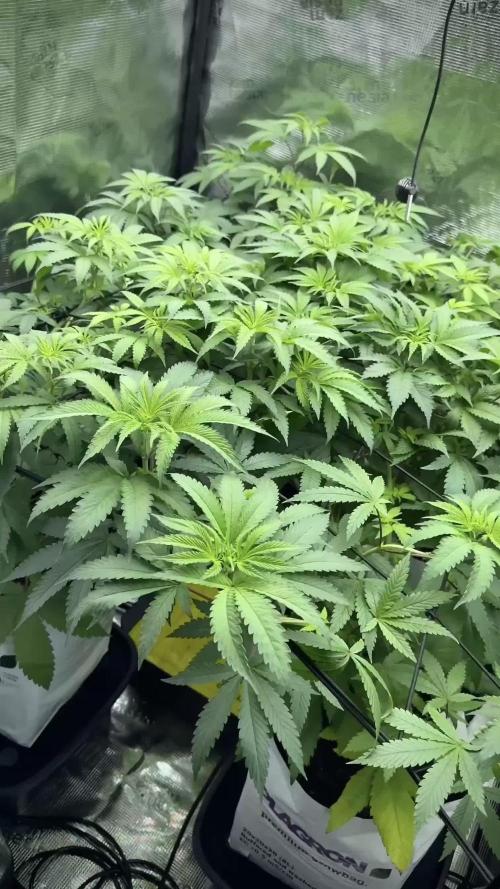
🥒 Project Blue Tent – Week 7
Pickle Lemon Haze F1 – Pheno B (Folder 14B)
Hello everyone, and welcome back to another chapter of Project Blue Tent! 💙🌱
If you're discovering this diary for the first time, welcome aboard!
Project Blue Tent follows four individual plants, each documented in its own dedicated diary from seed all the way to harvest. Every plant shares the exact same environment, lighting, irrigation, nutrition and training strategy, allowing us to observe how each phenotype develops its own personality while keeping the growing conditions as consistent as possible.
Today we're checking in with Pickle Lemon Haze F1 – Plant B.
And this week marks another important milestone.
The canopy is full.
The structure is ready.
And we're preparing these beautiful ladies for their transition into flowering.
────────────────────────
🌱 Week Seven – The Canopy Is Complete
Looking across the Blue Tent this week, it's becoming increasingly difficult to distinguish the four plants from above.
The SCROG has done exactly what we wanted it to do.
Instead of four individual plants growing vertically, we now have one remarkably even canopy spreading across the available space.
Plant B has been particularly well suited to this process.
From the beginning, she's shown a natural tendency to grow outward rather than constantly trying to reach upward. Her compact structure, strong side branching and excellent response to training have allowed her to fill her section of the screen beautifully.
After lowering and tightening the SCROG net, all four plants are now sitting at approximately 60 cm.
At this point we're no longer trying to gain height.
We're managing the surface we've created.
Every branch has found its place.
Every available section of the screen has been used.
And now it's time to prepare that canopy for what comes next.
────────────────────────
🕸️ SCROG – From Training to Flowering
For anyone joining this diary without having followed the previous weeks, SCROG stands for Screen of Green.
The purpose of the screen is to guide branches horizontally instead of allowing a few dominant tops to grow significantly taller than everything around them.
As branches reach the screen, they're gently guided into neighbouring openings.
This spreads the future flowering sites across a wider area and creates a much more uniform canopy.
It's not about forcing the plant into an unnatural shape.
It's about taking the growth the plant is already producing and distributing it more efficiently across the available space.
And after several weeks of doing exactly that, the mission has essentially been completed.
The screen is full.
The canopy is even.
Now we move into the cleanup phase.
────────────────────────
✂️ Defoliation – Preparing the Plants for Flower
This week's biggest job is defoliation.
And because this technique is often misunderstood, it's worth explaining what we're actually doing.
Defoliation isn't about stripping a plant of every leaf.
Leaves are essential to the plant. They capture light and support photosynthesis, so removing healthy foliage without a reason isn't the objective.
Instead, we're performing a deliberate canopy cleanup.
After weeks of vigorous vegetative growth and SCROG training, the interior of the plants has become extremely dense.
Leaves overlap.
Branches cross through one another.
Some areas are heavily shaded.
And airflow through the middle of the canopy becomes increasingly important.
So we're selectively removing foliage from areas where the density has become excessive.
We're opening the interior.
Creating more space between branches.
Improving airflow.
Improving visibility.
And creating a cleaner structure for the flowering cycle.
The objective isn't:
"Remove as many leaves as possible."
It's:
"Remove what is no longer helping the structure we're trying to build."
That's a very important difference.
────────────────────────
🌬️ Why Defoliate Before the Flip?
Timing is everything.
A significant defoliation is a form of stress. Even when performed correctly, the plant needs some time to adjust to the loss of foliage and return to its normal growth rhythm.
That's why we're doing this before flowering, rather than waiting until we're already well into the bloom cycle.
Right now the plants are still running an 18/6 vegetative schedule.
They have time to recover.
We can perform the cleanup.
We can watch how they respond.
We can allow fresh growth to resume.
And then we can flip the lights once the plants have settled again.
I don't want to ask the plants to deal with a major cleanup at the same time they're dealing with the physiological transition into flowering.
Instead, we're following a simple sequence:
Build the canopy.
Fill the screen.
Clean the canopy.
Recover.
Flip.
The goal is to enter flowering with healthy plants and a well-organised structure.
────────────────────────
🌿 Pickle Lemon Haze F1 – Plant B
Plant B continues showing exactly the personality we've come to know throughout this project.
She's balanced.
She's compact.
She's incredibly branchy.
And she seems perfectly happy growing sideways.
While Plant A has always shown a little more vertical ambition, Plant B has naturally concentrated her energy into lateral growth and secondary branching.
That has made her particularly enjoyable to work with under the SCROG.
Her stems have continued thickening nicely, her internodal spacing remains compact, and her foliage has developed that rich green colour we've been looking for.
The recovery from topping is now nothing more than a memory.
She's completely moved on from that stage and has spent the last few weeks concentrating on building the framework that will eventually support her flowering sites.
Looking at her now, it's easy to see how much the plant has changed.
She's no longer simply a young vegetative plant.
She's become a properly structured little bush with a full section of the canopy to her name.
And now we're preparing her for the next chapter.
────────────────────────
🥥 Feeding – Staying With What Works
The nutrient recipe remains unchanged this week.
Current feeding:
• Plagron Hydro A — 1.9 ml/L
• Plagron Hydro B — 1.9 ml/L
• Plagron Hydro Roots — 1 ml/L
Current pH:
5.8
Current EC:
1.92 mS/cm
The plants continue showing excellent colour and vigorous growth, so I don't see a reason to change the recipe simply because we're approaching flowering.
Sometimes consistency is the better decision.
We'll see how the plants respond after defoliation, and depending on their recovery and appetite, we may increase the nutrient strength next week.
For now, however, they're telling me exactly what I want to hear.
Healthy colour.
Strong growth.
Good leaf posture.
And no obvious signs that they're asking for anything different.
So...
Nothing changes.
────────────────────────
💧 Drip Irrigation – Keeping the Roots Consistent
The Mars Hydro automatic drip irrigation and drainage system continues to perform beautifully.
Each plant is receiving approximately 1.2 litres of nutrient solution per 24 hours, delivered through the automated drip system.
The slow and consistent irrigation keeps the coco supplied with fresh nutrient solution while the automatic drainage system removes the resulting runoff.
This is particularly valuable in a project like this.
Four plants are sharing the same environment.
The same nutrient recipe.
The same lighting.
The same irrigation schedule.
That consistency helps us keep another major variable under control.
And as the plants become larger, the benefit becomes even more obvious.
The irrigation system simply keeps doing its job every day.
No rushing around with watering cans.
No trying to remember which plant received what.
Just consistent irrigation while I concentrate on observing the plants themselves.
It's one of those systems that doesn't necessarily demand attention when it's working properly.
And honestly...
That's exactly how I like it.
────────────────────────
🌡️ Blue Tent Environment
The environmental conditions have remained very stable as we approach the transition into flowering.
This week's average conditions were:
• 🌡️ Day Temperature: 28°C
• 🌙 Night Temperature: 25°C
• 💧 Relative Humidity: 65%
• 🥥 Substrate Temperature: 24°C
• 💦 Nutrient Solution Temperature: 18°C
• ⚗️ pH: 5.8
• ⚡ EC: 1.92 mS/cm
• 💨 CO₂: approximately 450 ppm
• 💡 Light Schedule: 18/6
• 💧 Irrigation: approximately 1.2 L/plant/24h
• ? Pot Size: 8 L
• 📏 Height: approximately 60 cm
At this stage, stability is more important than constantly changing numbers.
The plants are healthy.
The canopy is full.
The roots are receiving consistent irrigation.
And the current nutrient strength is producing beautiful growth.
So we're staying the course.
────────────────────────
🌿 A Full Canopy Means a Different Kind of Work
One of the interesting things about reaching this stage is that the work changes completely.
Earlier in the grow, the challenge was getting the plants to occupy the space.
Now the challenge is managing everything they've produced.
When the canopy was still developing, every new branch was welcome.
Now we have to start asking different questions.
Does this leaf contribute enough?
Is this area too crowded?
Can air move through here?
Is this branch getting enough light?
Is this part of the plant going to benefit from remaining in the canopy?
That's what good canopy management is really about.
It's not simply growing as much as possible.
It's deciding what growth deserves to remain part of the final structure.
And Plant B has given us plenty to work with.
────────────────────────
Recovery Before Flowering
Once the defoliation is complete, the most important thing we can do is give the plants time.
No unnecessary additional stress.
No rushing.
No immediately piling another major intervention on top of the first one.
The plants need time to rebalance after the cleanup.
We'll watch the new growth.
We'll monitor their posture and overall appearance.
We'll keep the environment stable.
And we'll let them recover.
Once they're settled again, we'll be ready to move forward.
This is why the timing of the defoliation matters so much.
We're not trying to make the plants do everything at once.
We're preparing them step by step.
────────────────────────
👀 Looking Ahead
The next few days should be particularly interesting.
The SCROG has been filled.
The canopy has been cleaned.
The plants now have room to breathe.
And we're approaching the moment we've been working toward for weeks.
The nutrient recipe will remain unchanged for now, although we may increase it once we see how the plants respond after defoliation.
The irrigation continues at approximately 1.2 litres per plant per day.
The environment remains stable.
And most importantly...
We're not rushing the flip.
We'll allow the plants to recover properly first.
Then, when they're ready...
We flower.
🌸
────────────────────────
💙 Thank You
A huge thank you to Zamnesia for making Project Blue Tent possible and for providing these outstanding Pickle Lemon Haze F1 genetics.
A heartfelt thank you to Plagron for the Premium Growbags and Hydro nutrient line that continue supporting this beautiful growth.
A special thank you to Phytonaut for the LED lighting helping us maintain such a consistent and beautifully structured canopy throughout the Blue Tent.
And a massive thank you to Mars Hydro for the automatic drip irrigation and drainage system that continues bringing consistency and simplicity to the daily routine.
Thank you to GrowDiaries for providing growers around the world with a place to document their journeys, exchange knowledge and inspire one another.
And finally...
Thank you to everyone following Project Blue Tent.
Whether you've been here since germination, recently discovered this diary, leave comments every week or simply enjoy watching these four sisters develop...
Your support genuinely means the world to me. 💙
Plant B has spent the last several weeks quietly building herself into one beautiful, compact and incredibly well-structured phenotype.
Now the canopy is ready.
The cleanup is complete.
All that's left is to give her time to recover...
And then see what she can do.
Until next time...
Growers Love, happy growing, and take care everyone! 🌱💙
Likes
1
Share


@Meincornwall
Follow
All in all, as my 2nd grow of Cindy, I can't recommend it highly enough.
Great stealth grow, had no filtration at all for the 1st grow & had a mild lawn / grapefruit hint, stronger when pruned or harvested.
Your neighbours wouldn't know, if you care.
It's a survivor, my 1st was too hot, too moist, wrong pot, over watered, pruned too often (until near bald of leaves).
Had a total grow of 25wks, Veg stage 12wks (should've been less)
First harvest @ 21wks & completely undeserved but gobsmacking harvest of... total bud wet just over 2kg (2053g) & Dry 14oz (399g)
It was led (1200w) & hps (150w) grown & the new plant has behaved very differently under the cmh's.
The 2nd stretched considerably, the first didn't but was probably permanently in shock.
It'll be interesting to see how this one compares.
Although, yet again, I let it get far far too big before putting it to flower so will selectively harvest in the hope of bulking some of the lower buds.
Same smoking effect as the first but more temple numbing.
It's a beautifully flavoured smoke, doesn't smell much & is grapefruitey.
Very uplifting, happy, bordering on giggley. No couch lock at all & good function retained.
There's a long lasting sedative / happy high after the initial whack wears off & surprisingly doesn't diminish overly in effect from tolerance.
My personal fave

Likes
15
Share


@NewOfficialDrillInvaders
Follow
Ladys Start to drink much more also one of 10 seed bag show off as a Autoflower i pass it to my friend because i dont like auto so i upload video how it looks she got really fruity smell

Likes
226
Share


@Crashoverite
Follow
Hi everyone 😁
I would like to thank you all fellow growers and breeders for such a great support on this journey. Thank you Grow Diaries and Green House Seeds. Without you all this wouldn't be possible. Love you all
First ever recorded diary so don't know where to even start 😅
I am returning to growing after many many years of break. This is my first ever experience with autoflowers, scrog, lst, led and such tiny grow space.
Choice of strain - Big Bang Auto from Green House Seeds. I have run so many strains from this seed bank in the past and I was always happy with the final outcome. Was looking for indica dominant strain, fast flowering cycle and very important heavy yields on small spaces. Again thank you GHSC in very happy of choosing this strain.
Little bit about my cabinet.
External dimensions:
64 x 50 x 114 cm (W x D x H)
Growing area:
55 x 47 cm cm (0.26 m2)
Panel based on SAMSUNG LM301B diodes
Spectrum:
Samsung LM301B – 5000 x72
Samsung LM301B – 3000k x136
Samsung LM301B – 660nm x9
Samsung LM301B – IR 760nm x1
Regulation in the range of 20W - 110W - Meanwell XLG 100-H-AB
PPF 300 umol/s
PPFD 890 mol/m2/s @30c
Total of 6 adjustable fans, 4 exhaust fans 4 modes - silent/drying, vegetation, flowering, full power
Active carbon mass in the filter 2kg
Absolutely love my grow cabinet. Thinking of next build already.
My grow
3 beautiful ladies - Nuna, Luna and Sweet Mary Jane.
This was a pleasure experience growing autos for the first time. All 3 ladies on the end developed perfectly.
Nuna, left corner lady- tall and beautiful. She had some problems to switch to flowering and was even considering removing her but very happy that I was patient enough and turned great.
Luna, right corner lady - have to say she is the queen. She has the most heavy buds from all, the most. colorful. Her wet weight was 420g, can't say how much of dry but guessing approx. 100g
Sweet Mary Jane, front seat lady. I think she was the most pleasant to grow of her location but due to no other spare space for drying I belive that I have harvested her at least a week to early. If keep longer I belive she could be the most yielder from all 3.
Thank you all for all the support, help, comments, likes, messeges.
Love you all 💚💚💚
Will update this diary in some time and when puff perfectly cured 😎
Peace and love ✌️💚

Likes
3
Share


@Chubbs
Follow
What up Fam, weekly update on these lovely ladies. They're growing amazing so far and now that I got my humidity and vpd dialed in we're seeing daily growth. Super excited to see the upcoming weeks and the progression they make. All in all Happy Growing.
Processing
Likes
2
Share


Likes
17
Share


@Paultemp
Follow
Hi all!🤗👊
Week 4 flower
Big trouble with this plant :/ all the other plants is good..
In coco With perlite 80/20
Remo nutrients
Vivosun 600w hps
Autopot systeme

Likes
49
Share


@Roberts
Follow
FBT 2401 is starting to stack. She is not gonna get really big due to my errors. I will get a nice sample of the flower for sure. Everything is looking good now. Thank you Medic Grow, Athena, and Fast Buds. 🤜🏻🤛🏻🌱🌱🌱
Thank you grow diaries community for the 👇likes👇, follows, comments, and subscriptions on my YouTube channel👇. ❄️🌱🍻
Happy Growing 🌱🌱🌱
https://youtube.com/channel/UCAhN7yRzWLpcaRHhMIQ7X4g
If anyone needs to purchase fastbuds here is a link for my affiliate program
https://myfastbuds.com/?a_aid=60910eaff2419
Likes
37
Share


@MrJones
Follow
Cream Mandarine XL-Auto #2 / FOOP Nutrients
======WEEKLY GOALS =======
🌞Environment - 80F and 50%Humidity - using Humidfyer as needed.
💧 Feeding - Feeding with FOOP Canna Organic Nutrient Line
🍃Training / Keeping Stems Stable and Strait
🕷️ IPM - Will be using Green Cleaner" 1 OZ per Gallon, and CannControl from Mammoth alternating between product each month for Integrated Pest Management.
🔅 Vegetation & Flower Kingbrite 240W QB288 v3 LM301H 4000k+ 660nm Red x2 - Maintianing 575 PPFD
========Plant Update===========
🌱 Plant - Week 6 started today, the plants are doing great very healthy, will need to do another IPM treatment in the mornting.
===========================
▶️Monday 03.29.21 / These girls are re well into flower, they are soundly in the 9/10 week glide path, they should start building up this week, may need to remove a few more leaves.
▶️Tuesday 03.30.21 / These look great every day, and have gotten too tall!! Feeding about 30 ounces per day.
▶️Wednesday 03.31.21/ Decided to cut the FOOP to 60%, feeding 30 ounces per day.
▶️Thursday 04.01.21 / Decided to cut the FOOP to 60%, feeding 30 ounces per day.
▶️Friday 04.02.21 / Decided to cut the FOOP to 60%, feeding 30 ounces per day.
▶️Saturday 04.03.21 / Decided to cut the FOOP to 60%, feeding 30 ounces per day.
▶️Sunday 04.04.21 / Decided to cut the FOOP to 60%, feeding 30 ounces per day.
Likes
13
Share


@raulmoat123
Follow
The girls are getting on fine week 4 flower
Strawberry banana are packing on loads and loads on weight
Slurricane wow just wow
Dolato is slightly slower but smells amazing
Wedding cake is limited edition Black Friday from seedsman is the most gas weed I have ever grown just amazing
Larry bird kush doing wonderful
I will take a proper picture and video of the girls when I have time out of the tent


