Likes
Comments
Share


@Ultraviolet
Follow
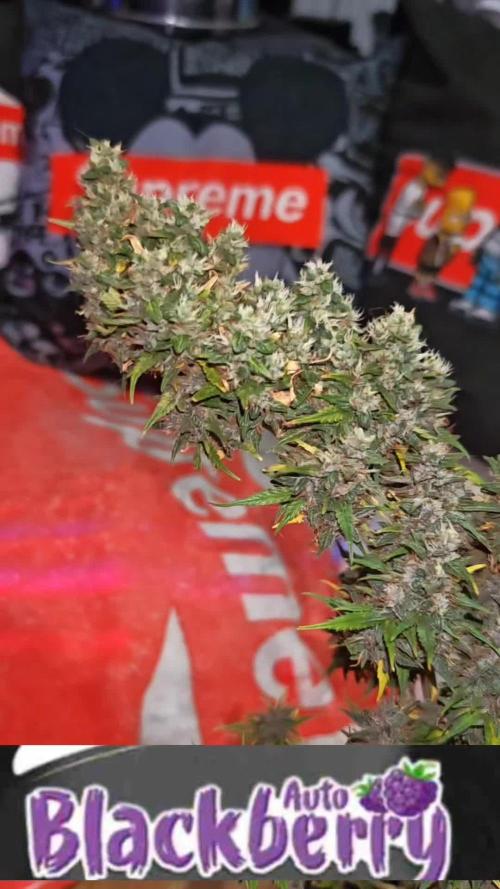
Once again she passes my expectations, late to the show with trichome production. I'm surprised there is purple on the bud, maybe Purpinator does work. I thought I could see hints under the grow lights and thought my eyes were deceiving me, I was just being hopeful. But nah 2 of the 3(under the UV) have developed a beautiful tone of purple. I was never going to bother with a deep freeze but maybe the whole bud will change given conditions, that would be something, fingers crossed. 🤔 was a little skeptical that reducing temps humidity would change density, but it does, buds are solid something I've not been able to achieve before.
Rule of thumb is never to surpass 60% RH in the flowering phase and try to progressively reduce it down to 40% in the last 2–3 weeks before harvest. The plant will react as it seeks to protect its flowers, responding by producing denser buds and a higher concentration of resin. Cannabis plants are sensitive to sudden temperature changes, especially in the flowering stage. Extreme heat or cold can impact bud density and overall yields. In nature as a defense mechanism from cold, the plant sensing sudden dips in temperature will attempt to remove the pockets of air within the bud, it achieves this by compacting itself in doing so to better protect itself from cold snaps which are normally indicators in nature that worse weather is on the way.
Terpene levels are the highest just before the sun comes out. Ideally, you want as many terpenes present in your plants as possible when you harvest. Cannabis plants soak up the sun during the day and produce resin and other goodies at night. The plant is at its emptiest from "harvest undesirables," so to speak,k right before the lights come on.
Freshly cut buds are greener than dried buds because they still contain loads of chlorophyll. However, when rushed through the drying process, the buds dry but retain some chlorophyll, and when you smoke it, you will taste it. Chlorophyll-filled buds are smokable, but they aren’t clean. Slow drying gives the buds enough time and favorable conditions to lose the chlorophyll and sugars, giving you a smoother smoke. How the plant disposes of the chlorophyll and sugars by a process of chemically breaking them down and attaching the decomposed matter once small enough to water molecules, which then evaporate back into the ether. Time must be given to the process to break down the chlorophyll and sugars. Think of it like optimizing the environment for decay.
Plant growth and geographic distribution (where the plant can grow) are greatly affected by the environment. If any environmental factor is less than ideal, it limits a plant's growth and/or distribution. For example, only plants adapted to limited amounts of water can live in deserts. Either directly or indirectly, most plant problems are caused by environmental stress. In some cases, poor environmental conditions (e.g., too little water) damage a plant directly. In other cases, environmental stress weakens a plant and makes it more susceptible to disease or insect attack. Environmental factors that affect plant growth include light, temperature, water, humidity, and nutrition. It's important to understand how these factors affect plant growth and development. With a basic understanding of these factors, you may be able to manipulate plants to meet your needs, whether for increased leaf, flower, or fruit production. By recognizing the roles of these factors, you'll also be better able to diagnose plant problems caused by environmental stress.
Water and humidity
*Most growing plants contain about 90 percent water. Water plays many roles in plants. It is:*
A primary component in photosynthesis and respiration
Responsible for turgor pressure in cells (Like the air in an inflated balloon, water is responsible for the fullness and firmness of plant tissue. Turgor is needed to maintain cell shape and ensure cell growth.)
A solvent for minerals and carbohydrates moving through the plant
Responsible for cooling leaves as it evaporates from leaf tissue during transpiration
A regulator of stomatal opening and closing, thus controlling transpiration and, to some degree, photosynthesis
The source of pressure to move roots through the soil
The medium in which most biochemical reactions take place
Relative humidity is the ratio of water vapor in the air to the amount of water the air could hold at the current temperature and pressure. Warm air can hold more water vapor than cold air. Relative humidity (RH) is expressed by the following equation:
RH = water in air ÷ water air could hold (at constant temperature and pressure)
The relative humidity is given as a percent. For example, if a pound of air at 75°F could hold 4 grams of water vapor, and there are only 3 grams of water in the air, then the relative humidity (RH) is:
3 ÷ 4 = 0.75 = 75%
Water vapor moves from an area of high relative humidity to one of low relative humidity. The greater the difference in humidity, the faster water moves. This factor is important because the rate of water movement directly affects a plant's transpiration rate.
The relative humidity in the air spaces between leaf cells approaches 100 percent. When a stoma opens, water vapor inside the leaf rushes out into the surrounding air (Figure 2), and a bubble of high humidity forms around the stoma. By saturating this small area of air, the bubble reduces the difference in relative humidity between the air spaces within the leaf and the air adjacent to the leaf. As a result, transpiration slows down.
If the wind blows the humidity bubble away, however, transpiration increases. Thus, transpiration usually is at its peak on hot, dry, windy days. On the other hand, transpiration generally is quite slow when temperatures are cool, humidity is high, and there is no wind.
Hot, dry conditions generally occur during the summer, which partially explains why plants wilt quickly in the summer. If a constant supply of water is not available to be absorbed by the roots and moved to the leaves, turgor pressure is lost and leaves go limp.
Plant Nutrition
Plant nutrition often is confused with fertilization. Plant nutrition refers to a plant's need for and use of basic chemical elements. Fertilization is the term used when these materials are added to the environment around a plant. A lot must happen before a chemical element in a fertilizer can be used by a plant.
Plants need 17 elements for normal growth. Three of them--carbon, hydrogen, and oxygen--are found in air and water. The rest are found in the soil.
Six soil elements are called macronutrients because they are used in relatively large amounts by plants. They are nitrogen, potassium, magnesium, calcium, phosphorus, and sulfur.
Eight other soil elements are used in much smaller amounts and are called micronutrients or trace elements. They are iron, zinc, molybdenum, manganese, boron, copper, cobalt, and chlorine. They make up less than 1% of total but are none the less vital.
Most of the nutrients a plant needs are dissolved in water and then absorbed by its roots. In fact, 98 percent are absorbed from the soil-water solution, and only about 2 percent are actually extracted from soil particles.
Fertilizers
Fertilizers are materials containing plant nutrients that are added to the environment around a plant. Generally, they are added to the water or soil, but some can be sprayed on leaves. This method is called foliar fertilization. It should be done carefully with a dilute solution because a high fertilizer concentration can injure leaf cells. The nutrient, however, does need to pass through the thin layer of wax (cutin) on the leaf surface.
It is to be noted applying a immobile nutrient via foliar application it will remain immobile within the leaf it was absorbed through.
Fertilizers are not plant food! Plants produce their own food from water, carbon dioxide, and solar energy through photosynthesis. This food (sugars and carbohydrates) is combined with plant nutrients to produce proteins, enzymes, vitamins, and other elements essential to growth.
Nutrient absorption
Anything that reduces or stops sugar production in leaves can lower nutrient absorption. Thus, if a plant is under stress because of low light or extreme temperatures, nutrient deficiency may develop.
A plant's developmental stage or rate of growth also may affect the amount of nutrients absorbed. Many plants have a rest (dormant) period during part of the year. During this time, few nutrients are absorbed. Plants also may absorb different nutrients as flower buds begin to develop than they do during periods of rapid vegetative growth.

Likes
18
Share


@Stonyways
Follow
flower week 8,
2nd week of flush and my 15th week of crappy sleep due to this VIVOSUN 4"high cfm fan. I would just get rid of it as it does not owe me anything (2 full grows) but I am planning on gifting my old complete set up to someone I know that's in need.
and shit.... Spider Farmer never even got back to me....so my next grow will include my first HLG to supplement the Spider....
no contest this month due to...... well I gotta move. I don't think id be winning any contest but on the off chance I would.... address change. lol
HAPPY FRIDAY
Likes
12
Share


@Magic_frequency
Follow
Im still continuing the rest. Will update on the harvest this weekend

Likes
74
Share


@ThrashedTV_BakedByGlaze
Follow
Week 9 - Day 58 - 02/23 to 2/28 2021
All phone pictures. Go off site to my instagram for HD/DSLR content: https://www.instagram.com/glazedgrow/
Glad this LSD-25 took off way more than i expected due to grower error/past grower error experience 😅 . Very familiar earthy purples/gassy varnish/deep boozy citrus coming in. The accidental HST snap on the main stalk in first week of flower turned into a solid canopy of 7 Bud Sites with the main premature flower already thicker than the first time I grew this strain and cooked it under a humidity dome by accident 🙏
Gave all the plants mostly water feeds this week in order to avoid salt build up. Some staining on the bottom of the fabric pots from the bottom feeds so just making sure the soil is fine for the final major nute feeds before flushing in a week or so.
Made some caps with homemade thc olive oil from a friend that sent me some "Intergalactic Cable" viewing materials as well 😎 Have to use them fast but been stable for a week and not just starting to come through the gel caps, will have to get something harder next time still a lot left in the bottle.
It's 2nd closest to the window and i keep my tent open so when the light is off it's getting a solid 16-18 Celcius helping out the genetic purple pop a bit more in the leaves like the Red Poison next to it, look and smell very similar overall except more Sweet/Candy in the RP and Boozey/Earthy in LSD.
Other than that, the new @MarsHydroLED TSL 2000 and @ViparSpectraLED PS1500 for veg definitely made a huge difference and the buds on the Dark Devil.
Big thanks to @ViparspectraJennie for putting a new XS1000 in the mail to test on my next grow. The FB testers finally came in so excited to get some of those in the tent and under the new tester.
*Sponsored Content*
Feel free to check out/save some money on your next @ViparSpectraLED using discount code "GLAZEDGROW" at this link: https://www.viparspectra.com/?aff=378&utm_source=affiliate
(Again check out my insta, very limited quality content will be posted here)
Thanks for checking out the latest #GlazedGrow🍩
--
Go off site and check out my Instagram for better content: https://www.instagram.com/glazedgrow/
Go off site and check out my CannaBuzz profile: https://www.cannabuzz.app/users/GlazedGrow

Processing
Likes
4
Share


@BangLaadje
Follow
Ph 6,8 and 1 liter a day, sometimes 0,8l then 1,2l depending on the weight of the soil. Yesterday I gave them each 1,4l with enhancer.
Every 2 days I give 2 gr Great White on 3liter as the Purple Punch is in his last 2 weeks. I got some Green House Booster that I wa't to try on the Amnesia Skunk, what do you think? Or keep it bio aswell? Greetings


Likes
14
Share


@GodZilla_Owner
Follow
Week 3 Update
Day 18 (VT18):
The nutrient comparison has been running for a week now. While it's too early to draw conclusions about plant performance, the effort required for preparing the irrigation water is clear: GHF is the quickest, followed by BioBizz, and Advanced Nutrients takes the most time.
The new pots are amazing—no water leaking out the sides during watering, and the zipper feature for moisture control is a game-changer!
Attaching today’s pictures along with a poll for your input.
Cam Check Issue:
While away, I noticed on the cam that GHF#2 has started curling its lower leaves. It’s well-watered, treated identically to BioBizz#1. Should I repot with fresh soil?
Day 20 (VT20) – GHF#2 Emergency:
As the title suggests, GHF#2 is in serious trouble.
I’ve ruled out overwatering, tap water issues, CalMag deficiency, and soil quality. BioBizz#1, which received the same treatment, is fine. The only variable is the GHF nutrients added during repotting:
2g GHF BioBloom per liter
1g GHF Enhancer per liter
Symptoms: All fan leaves are curling from the bottom upwards, while shoots remain unaffected. Unsure what’s causing this, I replaced the substrate entirely with BioBizz LightMix and skipped any additional nutrients for now.
The discarded #3 plant was on the windowsill but has been returned to the tent as a backup. It’s looking rough but might be better than losing GHF#2 entirely. Unfortunately, this development jeopardizes the nutrient comparison for GHF, as I’m confident it’s not overfertilization.
Let’s see if GHF#2 recovers in LightMix. If it does, the issue was the nutrients.
Day 23 (VT23):
BioBizz#1: Thriving as expected, consistent with past grows using BioBizz.
GHF#2: Still struggling, with all fan leaves curling. Growth is significantly slower than the others.
AN#4: Incredible growth and root development—roots are visible everywhere after just five days.
Unfortunately, GHF#2's condition has worsened: curling is now spreading to the shoots, moving from the bottom upwards. Growth has stalled almost entirely over the past four days.
Next Steps:
GHF#2 is likely beyond saving. I may replace it with #3, though its week on the windowsill has stunted its growth. Catching up to AN#4 seems unlikely. I’m considering moving BioBizz#1 alongside AN#4 in the main tent, while #3 gets 1-2 weeks in the smaller tent.
However, I’m unsure if #3 should remain with GHF nutrients. It hasn’t been fed yet, and starting an organic regimen this late might not work.
Side Note: My girlfriend insisted on saving #3—seems like fate played a hand, and so far, she’s been proven right! 😅
Attaching updated pictures for your insights.
Likes
25
Share


@Grower_Of_Persia
Follow
week intel:
its time for second pruning they grew up too fast and need second pruning as below :
first i remove big fan leaves and only leaves then let them rest for 1 day then the second part of pruning will get done that is removing branches based on these conditions:
1-if the branch is very low and never can make it to the top ,
2- if branch is in shade even after pruning fan leaves ,
3- if there are too many branches at the small space then non of them will get resources so if there is no space for branch then , they must get remove.
everything is perfect!
stresses :
pruning big fan leaves and lower branches + a little E.C stress around 1.7 once a week
feeding:
i feed them 3 times this week with this order :
day 1 : i feed them heavy with silicate +base nutrients(calcium & micros + Bloom) about 884 ppm - 1.7 e.c to cause a little stress.
day 3 : i feed them low dose of Feeding Booster + Karbo Boost around 325 ppm - 0.6 e.c to let them recover a little but not fully recover still a little stress will caused.
day 5 : i feed them with low dose of Top-Max + B-52 around 213 ppm - 0.4 e.c to let them recover the stresses to get ready for another stress next week.
guide of the week :
no more stresses from now on till the end and from next week i'll reduce the amount of nitrogen and calcium to below half to the end.

Likes
16
Share


@DniceWJ
Follow
I was out of town this but everything looks great I did some stress training added More nutrients.

Likes
63
Share


@Chubbs
Follow
420Fastbuds
StrawberryGorillaAuto
Week 3
What up grow fam. Weekly update for these three beautiful girls. All are growing absolutely amazing. Showing no signs of any issues at all. I'll introduce nutes this week using General Hydroponics Flora 3 part flora series. Will continue the same routine as they seem to be responding great.
All in all Happy Growing
Likes
8
Share


@Rinna
Follow
She's acting a bit weird. Some fresh leaves are kind of crumbling, as if it's mutating. Might be due to the stress from the topping, since she started flowering very soon after that. Also, I (semi) broke some branches when attempting to bend them, that might also be a reason.., Still spraying weekly with cannacure.

Likes
13
Share


@XanHalen
Follow
Mar 24:
Watering till runoff now...
runoff ppm was 2500+...
Will be using very mild nutes to flush over 1 - 3 feeds... or until I am near my input.
Mar 26:
Continuing to use 650ppm feed with bloom focus, 2L per plant gives 15% runoff...
Runoff ppm is still very high...
I wanted to check pH of runoff but the color is so vibrant i cant use the pH drops to view color, need to get a pH probe.
Plants are thriving, no issues at all. the extra fan fixed the post-water droop.
One plant is bushy and has the most bud sites,
One is the smallest but has the most uniform structure, this one has the biggest buds and thickest stalk,
One is about in the middle of the 2.
Mar 29:
one of these girls gets droopy early when its time for water, thought the canopy was too high so i tied down some more, no cigar...
gonna try increasing calmag, if that doesent work im going to reposition in the grow box to a side instead of middle, may not need the upper end ppfd...

Processing
Likes
10
Share


@BodyByVio
Follow
After 21 days in turbo cloner I transplanted 4 Sweet seeds Green Poison into 1 gallon plastic pots filled with Cana coco. Few days later I transplanted another 4 clones into DWC!
Stay tuned!
Coco feed at 700ppm
Dwc feed at 480ppm

Likes
7
Share

@CheeRz
Follow
Week 7: Flowering Stage – The Frost Factory & Bud Swelling 🦍❄️
Development: 🌿
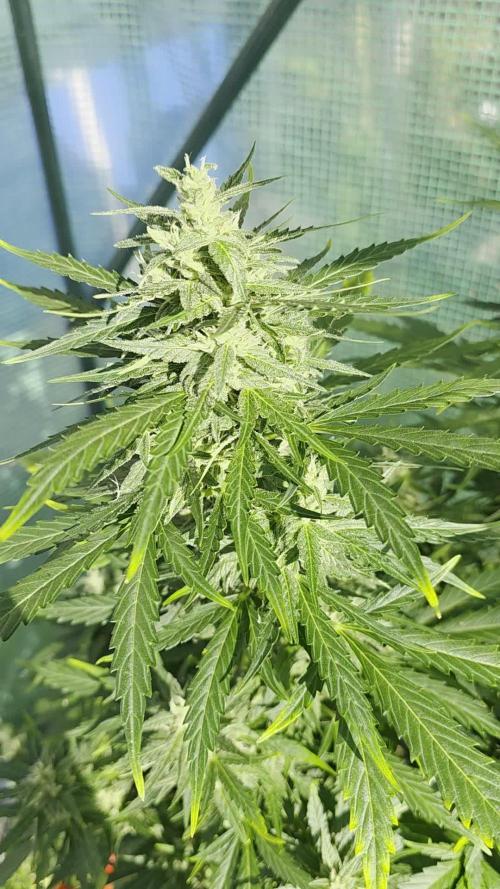
We have officially advanced into Week 7 of bloom, and the Gorilla Z is turning into an absolute masterpiece. The resin production is skyrocketing—the sugar leaves and calyxes are heavily coated in a thick blanket of glittering trichomes, filling the air with a pungent, sweet, and gassy terpene profile. The buds are swelling massively, packing on dense weight and expanding in size along the strong, supportive branches. Almost all of her energy is now locked into final flower maturation and maximizing potency. 🚀📈
Setup & Environment: 🌡️
She continues to thrive inside her outdoor greenhouse shelter. The environment is warm and bright, allowing the plant to push its resin defenses to the absolute limit under the natural sun. Excellent passive ventilation is keeping the airflow constant around the dense flower clusters, which is vital for keeping the humidity down inside the heavy canopy during this deep maturation phase. ☀️🌦️
Nutrients & Water 💧
Watering: Consuming a steady amount of water to keep the metabolic processes active. I am strictly maintaining the wet-to-dry cycle to ensure the root zone stays healthy and properly oxygenated.
Feed (per Liter):
Fish·Mix: 3 ml
Bio·Bloom: 3 ml
Top·Max: 1 ml
Acti·Vera: 3 ml
Bio·Heaven: 3 ml
CalMag: 1 ml
Grower’s Notes 💭
Goal for this week: Support the peak flower development and monitor trichome cloudiness. The colas are becoming extremely heavy, compact, and sticky to the touch. The genetics are really shining through now with that legendary Gorilla frost combined with a rich, candy-like undertone. We are getting closer to the finish line, and she is looking incredibly promising! 🦍🔥
Likes
1
Share


@Hustle786
Follow
Hopefully Lemon 🍋 Should Be Fire
One 🍋 Plant Is Very Small HopeFully It Gives Big Bud
420💨💨💨


Likes
2
Share

@gr3g4l
Follow
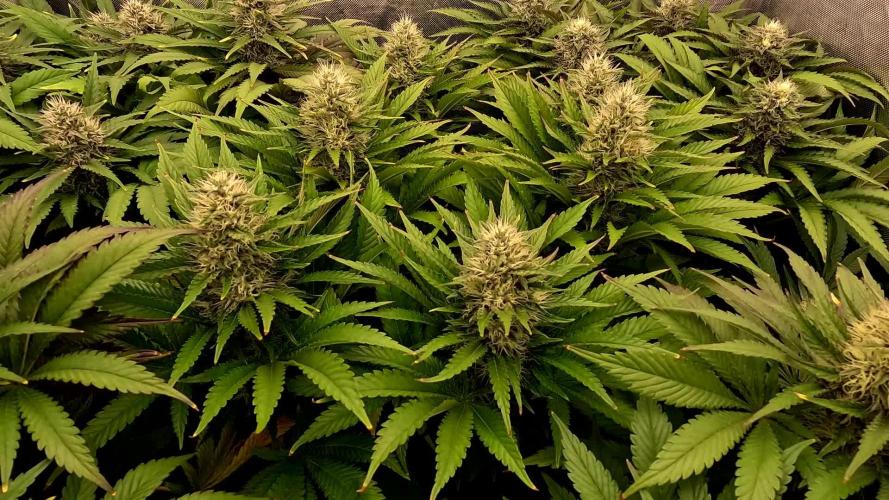
Semana de una más que notable transición cromática , formación de lindas porras y engorde de cogollos.
La nº6 sigue mostrando albinismo aunque parece que no aumenta de tamaño, se mantiene.
Subí los led 5ctms y parece que funcionó bastante bien.
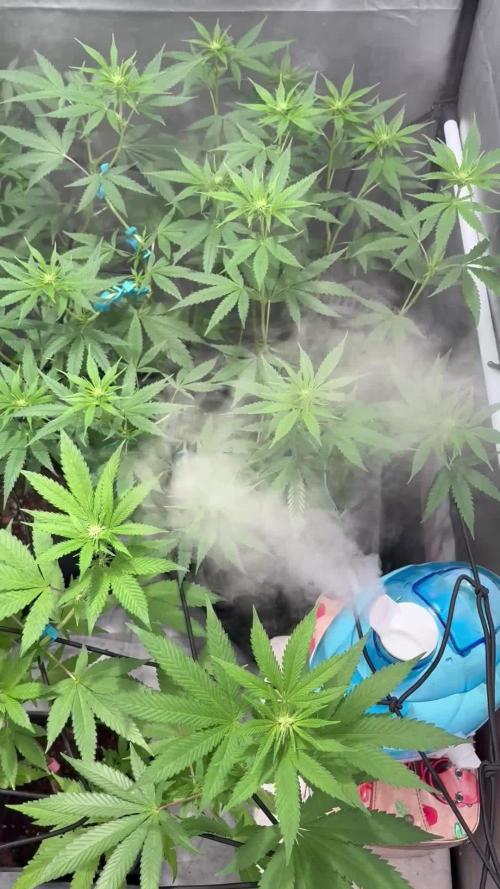
Entramos en una fase delicada por lo que añadí un deshumidificador que se enciende cuando se apagan los led. Más adelante otro ventilador y deshumidificador las 24h. encendido.
Durante la noche con los led encendidos el ambiente es mucho mas seco que durante el dia con las luces apagadas así que el ventilador lo dejaré encendido unas horitas más durante el dia, noche para las plantas.
Hay que bajar la humedad tanto como se pueda durante esas horas en la que sube tanto.
Likes
4
Share

@deseed_uy
Follow
Hace unos dias puse los ultimos clip lst para nivelar las ramas mas altas del medio, muy orgullosa q pude hacer bien el scrog quedo re lindo


Likes
31
Share


@SkunkyDog
Follow
Hallo zusammen 🤙.
Sie wächst sehr schön und macht keine Probleme.
Sie erhalten 25 Prozent Rabatt in unserem Shop
Mindestbestellwert beträgt 75 Euro
https://greenbuzzliquids.com/en/shop/
Code: GD42025

Likes
6
Share


@mikheil007
Follow
Vanilla Latte from Huboldt Seed Company seems to be very stron strain! others still going very well...