


Likes
Comments
Share


@420DeepGrow
Follow
Gracias al equipo de MSNL Seeds y XpertNutrients sin ellos esto no sería posible.
💐🍁 CBG SOUL FEMINIZED:
CBG Soul es un híbrido rico en CBG con una proporción Indica/Sativa 50/50, creado por sus efectos calmantes y relajantes. Sus sabores dulces, limón y cítricos se complementan con terpenos limoneno y mirceno, ofreciendo una mezcla única para el alivio y disfrute terapéutico.
🚀🌻 Consigue aqui tus semillas:
https://www.marijuana-seeds.nl/cbg-soul-feminized-seeds
🍣🍦🌴 Xpert Nutrients es una empresa especializada en la producción y comercialización de fertilizantes líquidos y tierras, que garantizan excelentes cosechas y un crecimiento activo para sus plantas durante todas las fases de cultivo.
Consigue aqui tus Nutrientes:
https://xpertnutrients.com/es/shop/
📆 Semana 6:
Buena semana, ha habido sol agradable y buenas temperaturas, empieza q tomar fuerza.
Mantengo las dosis de nutrientes a 1/3 de lo recomendada por el fabricante al estar en suelo virgen ☘️🌲🌳.

Likes
5
Share

@TrickzGrowz
Follow
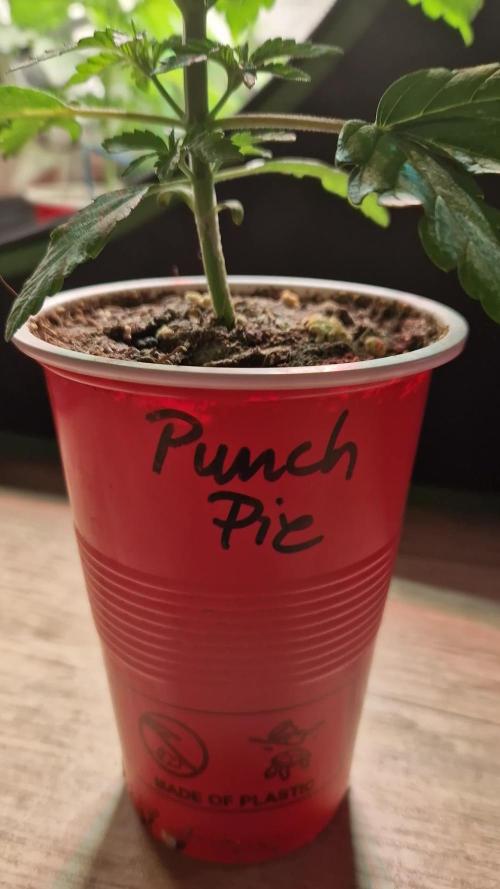
Für die Punch Pie war es nun so weit für das toppen. Über der 2. Nodie wurde getoppt, damit sich 4 schöne Triebe ausbilden können.

Likes
Comments
Share

@DogDoctorOfficial
Follow
Cash Express – Pheno B | Week 3
Small Sister, Big Potential
Welcome back to another week of the 8×8 Adventure, where every phenotype earns its own place in the spotlight. While sister plants may share the same parents, they rarely tell exactly the same story—and that is one of the most fascinating parts of growing from seed.
This week brings us to Cash Express Pheno B, the quieter sister of the pair.
At first glance she may appear slightly behind Pheno A in overall size and development, but spending a little time with the photographs reveals something far more interesting.
This is not a weak plant.
This is a plant writing her own chapter.
⸻
Week 3 Environment
🌡️ Temperature: 27.4°C
💧 Relative Humidity: 55%
💡 PPFD: ~700 µmol/m²/s
🌱 Medium: Plagron Lightmix
? Growing Method: 12/12 From Seed
💦 Water Consumption: ~0.9–1.2L per day
Feeding Schedule
Days 18
* EC 1.0
* pH 5.99–6.0
* Approximately 1L
Days 21
* EC 1.3
* pH 6.0
* Approximately 1.2L
The environmental conditions remained stable throughout the week, allowing differences between phenotypes to become increasingly visible.
⸻
Cash Express Pheno B
If Pheno A represents symmetry and textbook structure, Pheno B represents individuality.
She is slightly smaller.
A little less aggressive.
A little less imposing.
But she possesses something equally valuable.
Character.
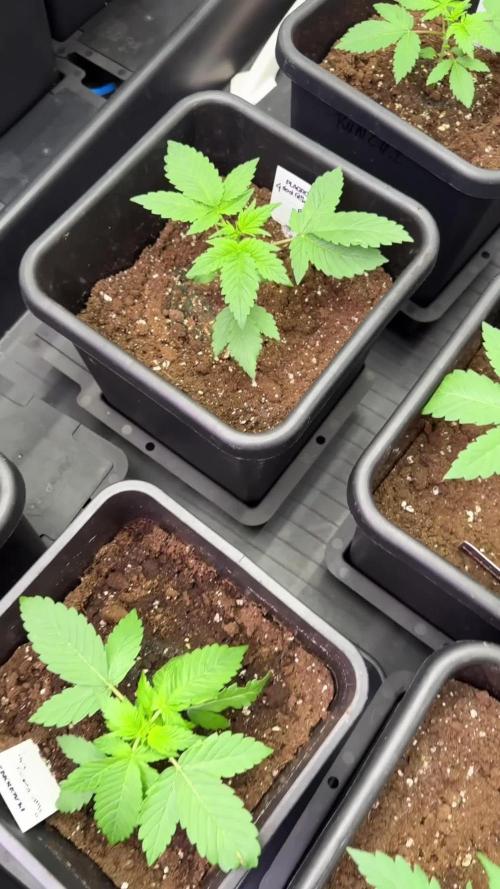
Looking at the canopy from above, the first thing that stands out is how compact and tidy she remains. While her sister is charging forward with obvious vigor, Pheno B appears to be investing more energy into establishing structure before accelerating upward.
The leaves are healthy and evenly colored.
The stems remain strong.
The new growth is vibrant and active.
Most importantly, the plant shows no signs of struggling despite her slightly slower pace.
In fact, many experienced growers learn over time that the fastest seedling is not always the plant that finishes strongest.
Some phenotypes sprint.
Others build momentum.
Right now, Pheno B feels very much like the second type.
⸻
A Different Growth Rhythm
One of the most interesting aspects of growing multiple phenotypes side by side is seeing how differently plants can respond under identical conditions.
Same tent.
Same nutrients.
Same environment.
Same light.
Yet each plant interprets those conditions through its own genetic lens.
Cash Express Pheno B seems to prefer a more measured approach.
The internodes remain relatively compact.
The branching is beginning to establish itself.
The center of the plant is becoming increasingly busy with fresh growth.
And while she may not command attention immediately through sheer size, she rewards closer observation.
There is a quiet confidence developing here.
A feeling that she is preparing rather than rushing.
⸻
Healthy Signs Everywhere
Several positive observations stand out this week:
* Excellent leaf color throughout the canopy
* Strong, healthy petiole development
* Compact structure
* Good node formation
* Active new growth
* Positive response to increased feeding and PPFD
The fresh growth emerging from the center is particularly encouraging.
Those younger leaves display the lighter green color typical of rapidly expanding tissue, showing that the plant is actively building new biomass and continuing to adapt to the increased light levels.
Nothing about this plant suggests limitation.
Only a slightly different timetable.
⸻
The Beauty of Phenotype Variation
One of the goals of documenting every phenotype separately is to capture these subtle differences.
If both sisters looked identical, there would be little to learn.
Instead, we get to observe how two related plants express themselves in unique ways.
Pheno A currently impresses through vigor and structure.
Pheno B impresses through balance and composure.
Both approaches are valid.
Both are beautiful.
And both deserve their own spotlight.
Sometimes the plant that receives less attention early on becomes the one that surprises everyone later.
I’ve seen that story play out many times before.
Perhaps Pheno B has a surprise waiting for us too.
⸻
Looking Ahead
Over the coming week I will be watching closely for:
* Increased branch development
* Changes in growth rate under the higher PPFD
* Early flowering indicators from the 12/12 schedule
* Structural differences compared to Pheno A
* Signs of unique phenotype expression
At this stage she remains healthy, happy, and steadily progressing.
And honestly, that’s exactly what I want to see.
No drama.
No problems.
Just growth.
⸻
Thank You
A huge thank you to everyone following along with this project.
Thank you to the GrowDiaries community for creating a place where growers from around the world can learn from one another.
Thank you to Plagron for supporting this cultivation journey.
Thank you to Zamnesia for the genetics and the opportunity to document these cultivars from seed to harvest.
And thank you to every grower who takes the time to stop by, leave a comment, share advice, or simply enjoy the journey.
Every plant has a story.
Some tell it loudly.
Others tell it quietly.
This week, Cash Express Pheno B reminds us that quiet stories are often worth listening to.
🌱💚
Growers Love and see you next week, little lady. Keep growing your way.

Likes
29
Share


@CannbellFarms
Follow
Was such a pleasant harvest from start to finish, no issues at all. A tip for next time would be to have the SCRoG lower as I couldn’t really tuck any node sights this time round, smells absofuckinglutely amazing from 3RD week bloom onwards!

Likes
3
Share


@Dargaville_Dukes
Follow
Gave the plant a big defoliation this week and have put the net in place. This is my first time using the net so am a little unsure if I should be flattening the four main tops as much as I have. If anyone sees anything I should be doing better, please let me know 👍
Likes
3
Share

@MrGrOH1008
Follow
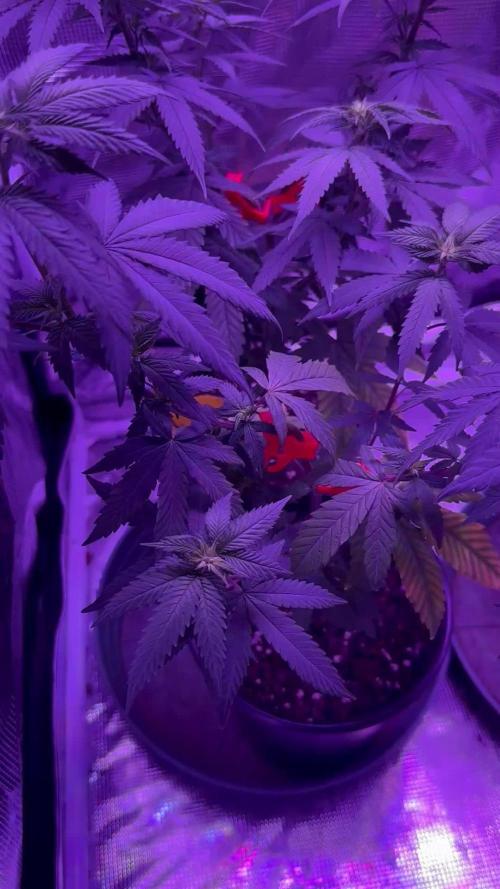
Alots transpired but not really lol. Chopped 3 so far for being male and as you can see this week I may (99% sure) have another male. I’ve given one light feed of Cronk grow, kelp me kelp you, and some cal mag.
So looks like I’ll be taking 3 into flower which is all I wanted to know before spent too much effort and time on em. Prolly transplant the 2 smaller ones this week and just continue to wait it out.
I know next time I could wait a few weeks before popping new beans if they’re regs atleast…
Likes
7
Share


@Skull
Follow
Has anyone else grown Buddha magnum Auto before I'm 30days in no sign of flower. As far as I can research it's 100 day Auto any thoughts would be appreciated

Likes
11
Share


@DESERT_DANK_FLAVER
Follow
ENDING WEEK 4, THEY SEEM TO BE HAPPY. QUESTION? WHEN SHOULD I TOP THESE GIRLS. ?
Likes
181
Share


@GODSGIFT_2005_JM
Follow
🍼Greenhouse Feeding BioGrow & Bio Bloom
🌱GARDEN OF GREEN SEEDS
⛺️MARSHYDRO
The ⛺️ has a small door 🚪 on the sides which is useful for mid section groom room work. 🤩
☀️ by VIPARSPECTRA (models: P2000 & XS 2000)

Likes
11
Share

@MistaOC
Follow
Biotabs Interview
1. Tell us a bit about yourself: who are you, where are you from, and what do you do outside of growing?
I’m 40 years old and based in the western part of Germany, living a grounded life as a family man. My main profession is in sales within the automotive spare parts industry, operating in a large-scale B2B wholesale environment across Germany.
We work with around 7,500 active business clients, and my role is less about day-to-day orders and more about the bigger picture. I’m the first point of contact for business-related matters — handling contracts, partnerships, and acting as the face of our department. It’s a role that requires structure, reliability, and a strong sense for communication.
Outside of that, I’ve always been someone who works with his hands. I take on a wide range of manual projects — from tiling and drywall construction to more specialized work like sealing fire protection openings. I enjoy creating things, improving spaces, and paying attention to the small details that make the difference.
That mindset follows one simple rule: all or nothing. If I do something, I do it properly. This attitude has shaped me for over 40 years — and it naturally carries over into my grows and the way I document them. I put a lot of care into every step, from the grow itself to how I present it in my diaries.
If I had to describe my life in a few pillars, it would be four: my family, my main job, my hands-on side work, and growing. And growing isn’t just a hobby for me — it’s a real passion that ties everything together. 🌱
2. How did you get into growing? Tell us about your very first steps.
My first contact with cannabis goes way back to when I was around 14. Back then, there was no WhatsApp or social media — if you wanted to meet people, you’d call them or maybe send a (pretty expensive) text, and then everyone would just hang out in the same spot. For us, that place was simply “the street.”
I was one of the younger guys in the group, hanging around with a few older ones, maybe 17 or 18. One of them used to disappear into a nearby field every now and then — everyone knew what he was doing, even if it wasn’t really talked about. At that age, I was curious, but also a bit hesitant.
At the same time, I was heavily into football, and most of my circle came from there. One day, during some kind of event at the sports ground, I ended up trying it for the first time with some of the older guys. It wasn’t the smoothest experience, especially mixed with alcohol, but it stayed with me.
After that, things developed naturally. Our small circle grew, especially through school, and we became what you’d probably call a typical smoker group. The real turning point, though, was when one of the guys — who had just moved to our area — showed me his hidden grow in the attic. It was a super basic setup with fluorescent tubes, no real climate control, no deep knowledge — but he was growing his own plants.
That moment stuck with me. It sparked something. Even back then, I knew I wanted to do it myself one day.
That chance came years later. When I was around 22, I moved into my first apartment with my girlfriend — who is now my wife. For the first time, I had my own space, and that’s when I started my first real grow. I converted an IKEA cabinet in a spare room into a small grow space, just big enough for two indica plants. Nothing fancy, but it was mine.
I got my seeds from the Netherlands back then, and I kept growing for about two to three years. My setup evolved over time — back then it was all HPS lamps and fluorescent tubes, long before LED became what it is today. I still have my old Homebox tent from that time, and it’s funny — it still looks almost brand new.
At some point, life changed and we moved into a place where growing just wasn’t possible anymore. So I had to stop, even though the passion never really left.
Then came 2024 and the partial legalization in Germany. For me, that was the moment everything came back. It’s still far from perfect, but for growers like us, it opened the door again to follow this passion a bit more freely — and that’s when I picked it back up.
3. What role does cannabis play in your life – personally and as a grower?
Cannabis has fascinated me from the very first moment — whether it was the smell, the experience, or just the whole vibe around it. For me, it was never really about medicine in the beginning. It was more like a way to unwind, almost like a switch that brings you into a different, more relaxed state.
What always stood out to me was the feeling — that deep physical relaxation and the sense of connection. It was never something negative in my life. In fact, I’ve always preferred it over alcohol, both back then and still today. It just fits me better.
Depending on the situation, it can even sharpen my focus. Of course, it can also do the opposite if you overdo it — but used the right way, it helps me slow down, reset, and find that “end of the day” feeling.
Over time, though, my perspective has evolved. As you get older, your body starts reminding you that you’re not 20 anymore. I recently had a shoulder tendon injury, and that was the first time I really experienced the medical side of cannabis in a noticeable way. It helped reduce the pain and even improved my mobility — something I hadn’t really thought about before.
But as a grower, cannabis means something even deeper to me.
Growing is a true passion. It’s not just about consuming — it’s about the entire process from start to finish. Watching a plant develop, learning from each cycle, improving step by step — that’s what really drives me.
It’s not about being better than anyone else. It’s about becoming better than I was before. That mindset carries over into other areas of my life as well — always refining, always learning.
At the same time, growing teaches discipline. You can’t just let things run and expect great results. Timing, care, consistency — all of that matters. If you don’t put in the effort at the right moments, the outcome won’t be what you’re aiming for.
That’s why I don’t see it as something lazy or passive at all. For me, it’s the opposite. Growing brings structure, focus, and a certain calmness into my life. It grounds me — and that’s what makes it so valuable to me. 🌱
4. What growing method do you prefer and why?
I’ve always preferred indoor growing over outdoor. It comes back to my mindset — all or nothing. In my opinion, especially here in Germany, outdoor simply doesn’t give me the level of quality I’m aiming for. Indoor gives me full control, and that’s exactly what I want.
At the same time, I’m someone who constantly experiments. Even if I know it might cost me yield, quality, or cause stress to the plants — I still do it. That’s how I improve. I need to see things with my own eyes and learn from my own experience to really understand what works best for me.
I’ve always grown in soil. Over time, my setup has evolved a lot. I started with simple plastic pots, switched to fabric pots after legalization, and now I’ve come full circle back to plastic pots — mainly because I moved into an AutoPot system, which fits my current approach better.
My goal today is to keep everything as efficient and stable as possible. I run an automated watering system connected to a 50-liter tank, which is filled through an RO system that I can control via app. The water runs through a calcium filter to help stabilize the pH. I’m not chasing perfect numbers anymore — as long as it’s stable and within a good range, that’s what matters more.
In general, I prefer working with organic nutrients. For me, it’s important to know that the final product is as clean and natural as possible. I’ve gone through all the typical struggles before — adjusting pH, dealing with deficiencies, spending hours mixing water — and over time I’ve simplified my system more and more.
That’s also where Biotabs fits perfectly into my setup. It’s a very natural match — simple, organic, and reliable. It allows me to focus more on the plants themselves instead of constantly adjusting inputs.
My standard setup is pretty consistent: a 1.2 × 1.2 m tent, around 480W LED, AC ventilation with a carbon filter, and usually five plants. I top every plant at minimum, veg for about five weeks, and often run a SCROG net to maximize the canopy.
But even here, I keep testing things. For example, I’m currently experimenting with and without a SCROG to see how it affects yield — because in the end, I’m not only chasing quality, but also efficiency.
That’s really my approach in a nutshell: build a solid system, keep it simple, but never stop refining it. 🌱
5. Which strain is closest to your heart and what fascinates you about it?
That’s a tough one — I don’t think there’s just one single answer.
In general, I’ve always been a fan of fruity, citrus-forward strains. Every now and then I also enjoy something more gassy, but if I had to go with what naturally comes to mind, it’s actually the very first strain I ever grew.
Back in 2012, during my first grow, I ran Super Skunk from Vision Seeds — and to this day, that one stands out. Funny enough, that first grow was probably my best one in terms of how it felt at the time. Everything was new, exciting, and that final product just hit different. Grown under a simple 400W setup, nothing compared to what we have today — but it was, without a doubt, the best weed I had smoked up to that point.
It’s not just about the strain itself — it’s about the moment, the experience, and what it represented.
At the same time, there’s another one I have to mention: Amnesia Haze (Core Cut). That strain is pure nostalgia for me. It was everywhere when I was younger — that classic haze we all knew. Growing it myself today brings back a lot of memories. It’s like a throwback to those early days, but now with the knowledge and control to really do it justice.
So if I had to sum it up: one strain represents where it all started for me, and the other connects me to the roots of the scene I grew up in.
6. What has been your biggest learning moment as a grower – a mistake or a success that helped you grow?
One of the biggest lessons I’ve learned as a grower is that routine can become your biggest enemy.
When you grow consistently over time, you start to build confidence — and that’s a good thing. But at some point, that confidence can turn into complacency. You think you’ve seen it all, you start skipping small steps, and you tell yourself, “it’ll be fine.”
That’s exactly where problems begin.
Looking back at my earlier grows, especially before my longer break, my setup simply wasn’t good enough. I was growing under the roof with temperatures easily hitting 30°C, humidity was all over the place, and the environment just wasn’t dialed in. On top of that, I started letting things slide because I thought I had it under control.
That combination was my wake-up call.
Since getting back into growing after legalization, I’ve taken a completely different approach. I take it seriously now — not just as a hobby, but as something I want to master. And I also recognize that being able to grow under good conditions is a privilege. There are a lot of factors that need to align — your environment, your living situation, responsibility, especially with family — it’s not something you can take for granted.
What really keeps me hooked is that growing never gets boring. I’ve had many hobbies in my life, but this is the only one that never lost its appeal. Even the “dirty work” — cleaning the tent, dialing everything in — it’s all part of the process.
Of course, I’ve made every mistake you can imagine. Overfeeding, underfeeding, overwatering, underwatering — pests like aphids and thrips, and currently my biggest challenge: powdery mildew.
That has been my toughest opponent so far. Even with controlled humidity, it can still show up, and it forces you to really understand your environment and your plants. The difference now is: I know how to deal with it. It’s under control, and that’s what growth is about — not avoiding problems, but learning how to handle them.
Every mistake teaches you something. And over time, you build the confidence that no matter what shows up, you’ll find a way to fix it.
7. What does your typical grow routine look like – how much time do you invest and what do you enjoy most?
My routine is pretty structured — I like to keep things consistent, but still leave room for adjustments when needed.
It all starts with popping seeds. I usually germinate around five to six and then select the strongest five to continue with. They begin in small 0.2L pots under a humidity dome, using Canna Professional soil enriched with Biotabs Startrex according to the feeding schedule.
After about two and a half weeks, I transplant them into 15L AutoPot containers. At that point, I water them in manually — first with about one liter of RO water, followed by another liter mixed with nutrients according to the schedule.
After that, I give them a few days to settle before watering again — usually around five to six days later, again with RO water. This approach has worked well for me to avoid overwatering and to let the roots establish properly in the new medium.
Even though the AutoPot system is already set up, I don’t activate it immediately. During the vegetative phase, I prefer hand-watering to encourage strong root development and avoid overwatering early on. Once I’m close to flowering, I switch the system on — basically just opening a valve, and everything runs automatically from there.
From that point on, the workload drops significantly. I don’t really have to worry about watering anymore. Nutrients are kept simple as well — every couple of weeks I add a small top feed, and that’s basically it. Compared to how complicated things used to be, it almost feels like it runs by itself.
That allows me to focus on what really matters: the plants.
I still check on them regularly, usually every evening when I’m home. Not because I have to, but because I want to. Instead of mixing water or adjusting pH, I can actually observe — the leaves, the structure, the bud development. That’s where the real connection happens.
That’s also when I decide what to do next — defoliation, LST, sometimes HST, or working with a SCROG net. It’s not always a fixed plan, more a combination of experience and feeling in the moment.
Environmental control has also become a key part of my routine. I start with around 70% humidity during germination, then gradually bring it down — around 65% in early veg, and closer to 55% after transplant. Keeping things stable has made a huge difference for me.
After roughly five weeks of veg, I flip to flower. From there, it’s about maintaining the system and letting the plants finish strong. Flowering usually runs around 8–10 weeks, depending on the strain.
And then it all starts over again.
What I enjoy most is exactly that balance — having a system that runs smoothly in the background, while I can fully focus on the plants themselves and the craft of growing. 🌱
8. What advice would you give beginners who are just stepping into the world of growing?
If I had to give one piece of advice, it would be this:
The rule is…there is no rule.
That’s my mindset, and it’s something I truly believe in. Of course, there are guidelines, best practices, and a lot of information out there — but in the end, every grow is different, every environment is different, and every plant reacts in its own way.
So instead of trying to follow everything blindly, sit down, observe, and learn from the plant.
Growing is a process. You won’t get everything right from day one — and that’s completely normal. Mistakes are part of it. In fact, they’re one of the most important ways to learn.
Today, it’s easier than ever to get into growing. There’s endless information online, tutorials, perfect pictures, and step-by-step guides. But that can also be misleading. You see these flawless results and think that’s the standard — but what you don’t see is the experience behind it.
When I started, it was completely different. There were forums, very limited pictures, and you had to figure out a lot on your own. That forced you to really pay attention and understand what was happening in front of you.
And that’s still the most important skill today.
Look closely at your plants. They will tell you what they need — through their leaves, their structure, their growth. Once you start understanding that, everything else becomes much easier.
So don’t chase perfection. Learn, adapt, and enjoy the process.
And most importantly — enjoy the grower’s life. 🌱
9. How did you first hear about Biotabs and what made you want to try it?
I’ve actually known about Biotabs for a long time.
Back when I first started growing, I was running a fully mineral setup — using products like Canna Vega and Flores. At that time, the market wasn’t nearly as saturated as it is today, but brands like Hesi and Biotabs were already around. I remember seeing Biotabs on the shelves back then, but I never really made the switch. I just stuck to what I knew.
My first real contact with Biotabs came much later, when I started diving deeper into soil biology — things like mycorrhiza and trichoderma. I became more interested in how the soil itself works and how to build a healthy microbial environment.
That’s when I came across Bactrex.
Funny enough, looking back now, I was using it completely wrong. I treated it like a different product and just added it straight into the planting hole, thinking that’s how it’s supposed to be used. Whether that was beneficial or not… I guess only the plants know.
But that was my entry point into the Biotabs world.
From there, I started learning more, testing different approaches, and understanding how the system actually works. Over time, I moved further and further away from mineral feeding and more towards a biological approach.
And the more I experimented, the clearer it became to me: the combination of organic growing with a simplified system is exactly what I was looking for.
10. How has Biotabs influenced your grow and what do you appreciate most about the product?
Biotabs has made my grow simpler, more stable, and overall more controlled.
Before, I spent a lot of time adjusting things — mixing nutrients, checking pH, reacting to problems. With Biotabs, that complexity is reduced to a minimum. The system is straightforward: prepare the soil, add the tabs, water it in properly — and from there, it’s mostly just water.
And the surprising part is: it works. Really well.
For me, it fits perfectly into my current setup and mindset. I’ve built a system that is as efficient and automated as possible, and Biotabs complements that in the best way. It allows me to focus on the plants themselves instead of constantly managing inputs.
That’s what I appreciate the most — the balance between simplicity and performance. You don’t have to chase numbers or overcomplicate things to get great results.
At this point, it feels like a natural fit — almost like a symbiosis between my way of growing and the product itself. And once you find something that works reliably on that level, there’s really no reason to change it.
For anyone who wants to grow organically and take their setup to the next level, it’s definitely worth exploring. 🌱.
Likes
2
Share


Likes
12
Share


@GanjaFarmerGrow
Follow
She is a plant with great genetics from BIG Seedbank..
She is verry tall and longed branched but...
The buds are getting verry BIG...
I needed to support some branches 😉..
Feeding not a lot...
hope she goes good untill the end...
fingers crossed..
🙏

Likes
12
Share


@Bread_n_Buds
Follow
Here we are at the halfway point, after the first month our photoperiod plants are multiplying their florets and then going into flowering.
The Purple Urkle has just undergone the topping of 8 florets, you can see the 4 fresh florets just cut. So we are at 8 very small branches growing my program for photoperiodic plants is to get to 16 wait a few days and move on to flowering. 16 Tops as I see it is the perfect size for the 11 liter pot. You are going strong from the beginning there was a bit of a shortage but as I explain this week during the topping everything changes.
We are in competitive days, the world lives the competition in a lively way and so if someone were to ask me or were interested which is the best of the photoperiodic plants I have inside for now I would say the Purple Urkle.
Topping is an extremely delicate moment as regards cutting the tops to split them, we always take care not to damage the new branches in growth.
Topping is also a delicate moment as regards fertilization because the plant slows down and absolutely does not need all that nitrogen that it would normally need and that the producers recommend in their sheets. So you should arrive with the plant green and perfectly fit at this point and dose the fertilizer very well for growth.
Mine came from a slightly deficient veg because I kept it low fearing this over effect during the topping that I know well and now they are a bit over. Nothing to worry about, of course, but if you do repeated topping my advice is to use preferred soil or prepare the soil with Monster Bud Mix by Zamnesia or Plagron Super Mix, in short, enrich the soil and from the start and add nitrogen only if necessary, especially during repeated topping.
In any case, everything is under control and I will demonstrate it to you during the flowering phase. Wait for the Uncle BreadandBuds and see what he does.
Remember the cold temperature makes the girls absorb food much more slowly than in summer so be careful to give the right amount and to dry the plant in maximum 2 days or you risk imbalances.
We are still using soil, feeding and all the recommended additives from Plagron 100& organic we just lowered the amount of grow in this topping phase for the reasons above.
---- Decide on the right soil and calculate your fertilizer schedule according to the soil on the official website.
-- www.plagron.com
Try a seed of this strain that drives us crazy..
---- https://www.zamnesia.io/en/11168-zamnesia-seeds-purple-urkle.html
Zamnesia Description // A direct descendant of a Mendocino Purps phenotype, Purple Urkle is a high-performance cultivar from Zamnesia Seeds. This feminized, indica-dominant strain is sure to win over any cannabis grower. With a THC content of 20%, Purple Urkle has a lot to offer from seed to harvest and beyond. A grape-flavored adventure, Suitable for indoors, outdoors or in the greenhouse, Purple Urkle is a very resilient strain. Growers will be impressed by how easy this cultivar can be managed. Purple Urkle can reach 120cm indoors and 160cm outdoors, but if you want more control over the height you can use the LST technique.
Purple Urkle has fantastic flavors and aromas that intensify during the flowering phase. Regardless of the method of consumption, Purple Urkle offers tangy, fruity flavors that lean towards notes of grapes, berries and plums. The effects of this strain are soothing and relaxing, with uplifting sensations that make the experience suitable for any occasion, whether in a social setting or alone.
All the best that mother nature can offer is on ---- www.zamnesia.com
Likes
10
Share


@ljw2792
Follow
Really starting to smell of blueberries. Cant wait to smoke this, checkrd my ppm run off it was 2800 but no sign of burn or defeciency ph was in rang. Flushed with about 8 litres of phd water to bring it down to 1600ppm . Will start to flush next week allthough all of the pistols are still white so maybe end up being 9 week strain


Likes
1
Share

@PapaTerps
Follow
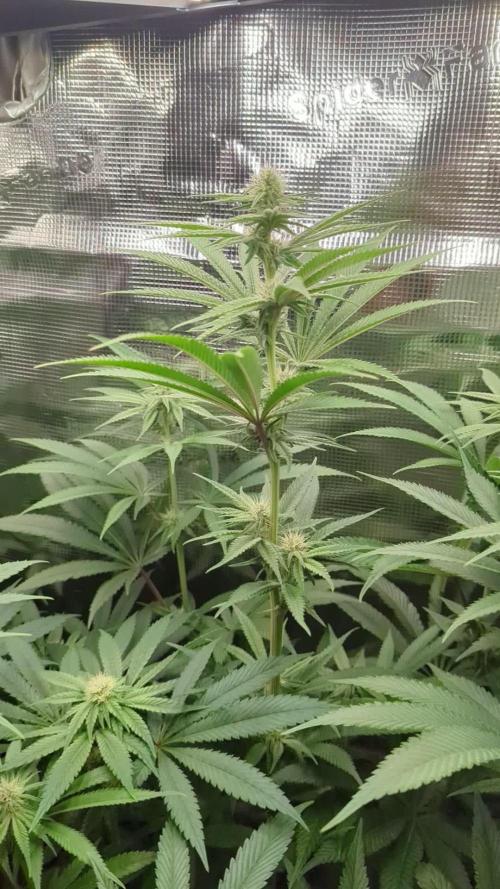
Blue Zushi - Dutch Passion
Day 74 - Watered with 3 litres of RO tap water, with defined nutrients, pH'd to 6.3. She had a massive growth spurt this week and was stretching so fast, I had began plan's to bend her main stem, but thankfully she finished that and is now focusing on developing her bud sites 💪 This week, I removed a few leaves, but other than that, I've just let her do her thing.🙏


Likes
10
Share


@Dunk_Junk
Follow
She shot up this week!!!!! Grew 15cm/6"!
Day 42 - I took off about 6 huge fan leaves to give lower levels of the plant some more light.
This is her last week on 20/4 lighting. 12/12 from now on.

Likes
4
Share


@AustinRon
Follow
OG 4Q24 Flower Week 10
Orangegasm (Fem) [ IRIE Genetics ]
12/12 @ Bolt (Day 21)
Germination: 20 November 2024
#3A Earliest Harvest Date: 9 February 2025
#3B Latest Harvest Date: 19 February 2025
_________________________________________
Start of Week: [Wed Feb 12, 2024 CR2 4Q24 64:F:9:1]
End of Week: [Tue Feb 18, 2024 CR2 4Q24 70:F:9:7]
OrangeGasm Fertigation:
- MAX: EC: [ 1.6, mS]
- LightIntensity MAX: [ 850, µMol/m2/s]
______________________________________
__
Wed Feb 12, 2025
OG 4Q24 64:F:9:1
Refresh Reservoir
- Amount: [ 5, gal]
- EC: [ 1.6, mS]
- Primer A&B: [ 48, ml]
- SLF-100: [ 15, ml]
Reclaim Dehu
- Amount: [ 4, gal]
EC: 1.6
Runoff
- Amount: [ 1.25, gal ]
- EC: [4.3 , mS/cm2]
- EC∆: [ 1.6 , mS/cm2] # Danger!!! (I don’t think so - Happy Plants)
__
Thu Feb 13, 2025
OG 4Q24 65:F:9:2
Runoff
- Amount: [ 2, gal ]
- EC: [ 4.6, mS/cm2]
EC: 1.5
Refresh Reservoir
- Amount: [ 2, gal]
- EC: [ 1.5, mS]
- Primer A&B: [ 32, ml]
- SLF-100: [ 10, ml]
Reclaim Dehu
- Amount: [ 2, gal]
If we see the pistils of the last two plants shrink/collapse in the next 3 days, we may be ready Tuesday/Wednesday . . .
I also note we’re about 2 days after from OPTIMAL BUD Structure, Foxtailing is becoming less well formed at largest top and some of the sooner ready buds …
__
Fri Feb 14, 2025
OG 4Q24 66:F:9:3
EC: 1.4
1.5 gal dehu
3 gals+ refresh
Reduced Fertigation Time 50% as Tank is at refill after 4+ gal yesterday, again. :-{
__
Sat Feb 15, 2025
OG 4Q24 67:F:9:4
Reclaim Dehu
- Amount: [ 2.5, gal]
Refresh Reservoir - 2 Gal
- Primer A&B: [ 17.9, ml]
- Resin Bloom: [ 9, ml]
EC: 1.3
Runoff
- Amount: [ 0.5, gal]
- EC: [ 3.0, mS/cm2]
- EC∆: [ 1.7, mS/cm2]
__
Sun Feb 16, 2025
OG 4Q24 68:F:9:5
Refresh Reservoir - 2 Gal
- Primer A&B: [ 16.5, ml]
- Resin Bloom: [ 8.3, ml]
Runoff
- Amount: [ , gal]
- EC: [ , mS/cm2]
- EC∆: [ , mS/cm2]
EC: 1.2
__
Mon Feb 17, 2025
OG 4Q24 69:F:9:6
EC: 1.1
__
Tue Feb 18, 2025
OG 4Q24 70:H:9:7
1000
- Remove Plants from Tent
- Remove Drip Tray
- Remove Light
- found water unseen in bottom tray - the reason for unreasonable humidity
- Removed Drip Rings
- Dried bottom drip tray
- Resealed Tent - Low RH
_______________________
Harvest Log
Max Min Average
Height (in)
40 21.5 29.875
Weight (g)
700 157 385.5
Secondary Stem Count 30 17 21.125
Est Dried Trimmed Wt 140 31.4 616.8

Likes
7
Share

@OnlyBuds
Follow
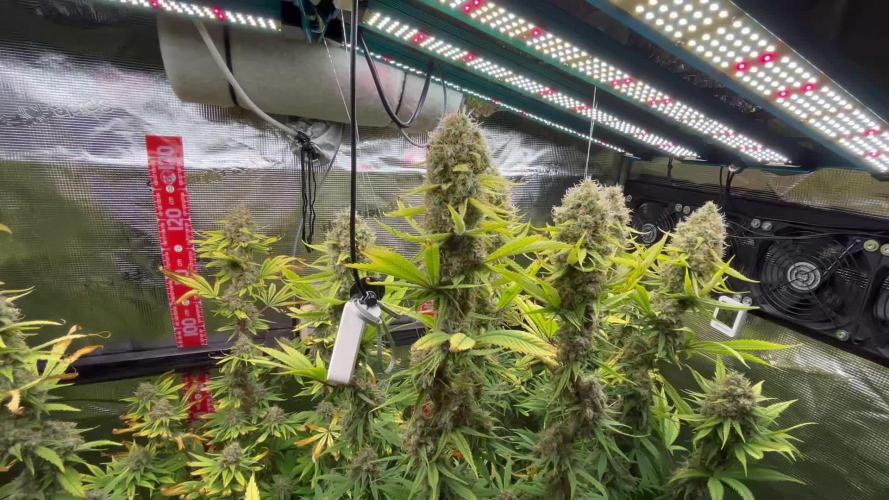
Week 16 – Close to the Finish Line 🏁🌾
Week 16 and we’re clearly heading into the finale. Harvest is very close now.
The smell is absolutely insane — lemon, sweet candy, bonbon vibes, bright and loud. The buds are looking fat, heavy, and fully developed.
One thing still bugs me a bit:
the front right plant in the 15L pot.
That one turned out absolutely amazing — a really special pheno. Strong structure, beautiful buds, insane aroma. It honestly hurts that I didn’t take a backup or a cut from her. Lesson learned the hard way.
Still, I’m very happy overall. This run delivered big time, and the flowers look mature, sticky, and ready for the final step.
👉 Next update will be the Harvest Update.
Until then, Muchachos😎
OnlyBuds 🌱✨