


Likes
Comments
Share


@DeepRootsGrowTrees
Follow
GORILLA KING AUTO / KANNABIA
WEEK #13 OVERALL
WEEK #8 FLOWER
This week no issues she's just about done she's covered in trichomes her buds are nice and dense they also have a purple hue to them and she smells great sweet aroma just punches you in the face when you open the tent. Stoked for this strain!! Stay Growing!!
Thank you for stopping by and taking a look it's much appreciated!!
Thank you KANNABIA!!
KANNABIA.COM GORILLA KING AUTO

Likes
5
Share


@eldruida_lamota
Follow
Que pasa familia, vamos con la primera semana de floración de estas GG4 Sherbet Fast Flowering, de FastBuds.
Agradezco a Agrobeta todos los kits obtenidos de ellos 🙏.
Vamos al lío, El ph se controla en 6.2 , la temperatura la tenemos entre 21/24 grados y la humedad ronda el 50%, 7 litros de sustrato. Iremos viendo cómo avanzan.
Agrobeta:
https://www.agrobeta.com/agrobetatiendaonline/36-abonos-canamo
Hasta aquí todo, Buenos humos 💨💨💨

Likes
2
Share


@Lazuli
Follow
I like how the plant got a perfect leaf/bud ratio good airflow not too much defoliation needed and flowers pretty quick 10/10

Likes
8
Share


@Kirsten
Follow
☆♡ Purple Punch: I'm just watering with flower nutes, when dry.
I installed a small monkey fan to keep the air moving at the back of the tent, where they are.
Waiting on the harvest, but may still be a little while yet. I DID NOT TOP DRESS THESE! ☆♡
16.2.25:
I decided to check out the lower canopies of all plants to see if I need to get rid of any foliage.
I did get rid of a few small branches and leaves.
However, whilst I was doing this, I saw more garden pegs from my LST remaining.
There were about 6 or more in Pink Mist alone. Additionally, on Watermelon, there were some left in, too.
I'm so annoyed to see that because the plants are really stretching, and I could've potentially disrupted this by leaving the pegs in for all this time without realising it.
🤞 that I haven't compromised things too much. We'll see.
I watered today with 2ltrs of dechlorinated water PH'd to 6.3 containing the following nutrients;
♡ .8g Green Leaf Nutrients PK booster
♡ .5g Ecothrive Biosys
I ordered quite a few things for the garden. I got Greenleaf Nutrients Sea K(elp) and Mega Crop Parts A+B. To go with their PK Booster I got last month. I'm excited to try it all together. Next run, maybe just using these. We'll see how it goes.
18.2.25:
The plants are going crazy for water! Everything is getting used right up so fast!
Today, I decided to add some more Black Strap Molasses to add some carbs and other micronutrients. I'll add the jar with the label in the photos section above.
I watered a very small amount to each plant.
What I put in:
♡ Black strap molasses 150g
♡ 2g Sea K(elp) Greenleaf nutrients.
I dissolved everything in 4ltrs of dechlorinated water PH'd to 6.4.
19.2.25:
I received the majority of the garden purchases that I made. I'm still waiting for the Ecothrive Life Cycle. I wanted to top dress, but it's been delayed unfortunately.
I am using my Greenleaf nutrients products which I bought on Amazon. I got the Mega Crop 2 part system Part A and Part B. I have the Sea K(elp), and the bud explosion PK booster.
I really wanted to get some of their sweet candy asking read many positive reviews. Unfortunately, for me, this is unavailable to buy currently. So that's a little disappointing.
I needed to do a good watering so when my nutes were delivered today, I got excited 🤗
I watered 2ltrs of dechlorinated water per plant, PH'd to 6.4, containing the following nutrients:
♡ 1g Mega Crop Part A
♡ 1g Mega Crop Part B
♡ .5g Sea K(elp).
The plants drank this up within a few hours.
I'm going to try and hold off on watering in hopes that my Ecothrive Life Cycle will arrive so I can top dress and water it in then.
20.2.25:
My Ecothrive Life Cycle arrived yesterday, and the plants are ready for their top dress and a good watering in.
I have some Biobizz Light Mix, Canna Coco,and perlite. I'm going to use this as a base to mix my amendments in.
I'm going to fill my 5 gallon bucket with about 4.5 gallons of my top dress mix. I will distribute this across 6, 4-5 gallon pots. Then I will water in well with Greenleaf nutrients Mega Crop Parts A+B and Sea K(elp).
I've made a crude attempt to video mixing my top dress. Don't listen to the audio. lol, my YouTube didn't stop playing whilst I recorded this 😂
So anyway, I added the following amendments to the above base mix of 4.5 gallons;
♡ 3 TBSP Ecothrive Life Cycle
♡ 3 TBSP Vitalink Bat Guano
♡ 3 TBSP Ecothrive Charge
♡ 1 TBSP RHS Mycorrhizal Fungi granules
♡ 6 TBSP Ground Cinnamon.

Likes
13
Share


@cookingwithninja
Follow
Day 12 pushing hard like the last 4 grows. I’m very impressed so far. Maybe a little calcium that’s about it


Likes
9
Share


@b_C6969
Follow
day 68, i know im a week ahead but whatever.
She's chugging along nicely, kind of. To be honest she's looking a bit overcooked in my opinion lol, i thought the light may be too close but nope, light meters reading between 50,000-70,000 which is normal, plus the 70k is at the tip of those big colours.
Super frosty, smells delicious, its mostly the 2 big colas at the back that need to hurry up, i've included photos.
She's had 2 flushes now, last one was a few days ago. So hopefully she'll finish up nicely. No more nutrients, definitely looks like the leaves are starting to deplete themselves of food and may start dying soon. I'm guessing she may be done at day 75? hopefully. gotta remember shes about a week behind because of the time she was stunted.
Just a quick update and a bunch of photos :) oh! and a video.
Likes
6
Share


@Mr_nugs_lover_David
Follow
This wonderful plant is amazing man, I have fallen in love with this strain and the hard rocks nuggets she has produced, beutiful orange pistils, it's just pure fire. Very dense and compact nuggets guys, she's been 100% organic grown, she has been watered with pure water and beneficial bacteria all the way and also with guano liquid by guanokalong, the aromas are very complex is very gassy stinks like a skunk however it's got some piney in and kush aroma,definitely awesome man need to keep growing this strain many more times no doubt.

Likes
9
Share


@Krissci
Follow
Day 1 - LST train both plants... Mostly SB1 to have a wider canopy let the smaller nodes catch up.
SB2.. Nice structure, really upset to break 1/2 of it... But loads of energy and recovered /train well.
Nodes larger than SB1, but SB1 has mode nodes

Likes
79
Share


@Salokin
Follow
Hello Growmies,
As we wrap up the seventh week of our Epic Buzz cultivation, our tent is bustling with life, with each plant showcasing the fruits of our labor. The training techniques, including defoliation, lollipopping, and scrogging, have been executed to near perfection, allowing our plants to transition into the flowering phase with robust vigor. Epic Buzz #1 and #2, in particular, are the epitome of horticultural excellence, with their sturdy stems and lush foliage setting the standard in our green haven.
This week marked a pivotal shift in our lighting strategy, as we nudged the PPFD values from a modest 250-350 up to an assertive 450-500. This increase is designed to optimize the light intensity during this critical phase of growth, catering to the heightened demands of our flowering beauties.
Our nutrient regime has been meticulously fine-tuned to accommodate the changing needs of our Epic Buzz varieties. The switch from Alga Grow to Alga Bloom signifies our plants' transition from vegetative growth to flowering, ensuring they receive the ideal nutrient profile for bud development. This, paired with our steadfast mix of Sugar Royal, Power Roots, and Orca, is dispensed religiously every four days to maintain optimal health and vitality.
The controlled conditions within the Tent-X continue to be monitored with precision, keeping the VPD levels within a desirable range, despite occasional deviations due to manual fan adjustments. However, the imminent arrival of the Prima Klima EC fan is set to revolutionize our environmental control, promising seamless day-to-night transitions and a well-deserved retirement for the Mars Hydro fan.
I humbly seek the collective expertise of this community for guidance on integrating a 5-phased PWM motor with the TrolMaster controller. Your shared experiences and advice are invaluable as we strive for continuous improvement in our growing endeavors.
As we look ahead, the promise of what's to come with our Epic Buzz trio fills us with anticipation. Their impressive canopies and formidable structures are not just a testament to their genetic potential but a reflection of our dedication and the collective wisdom of this remarkable community.
Stay lifted, and may your gardens always grow bountifully,
Salokin

Likes
5
Share

@gse314
Follow
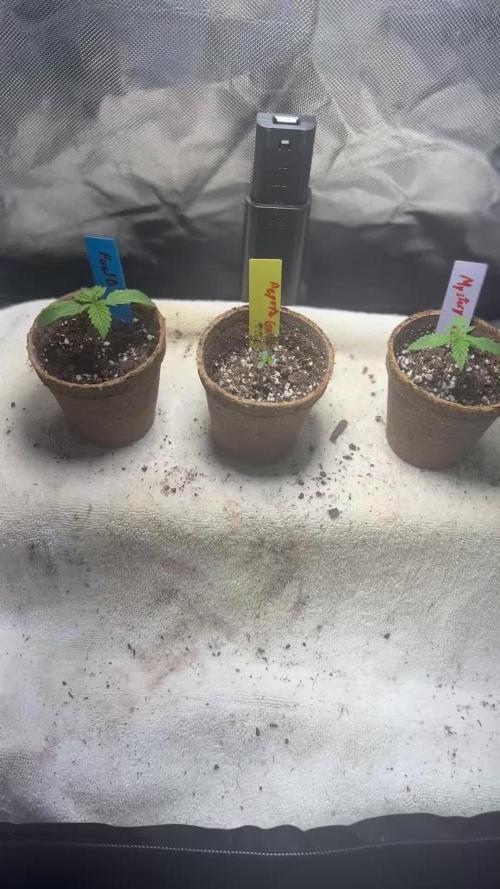
They getting transferred to a bigger pot today, I believe the peyote Gorilla is defective been having it for some months so that might be why
Likes
7
Share


@Robbaus
Follow
Sono bellissime! Più o meno era questo il risultato che volevo, non so se raccolgo di nuovo 400 gr ma ci dovrei andare vicino, devo comunque migliorare la fase vegetativa, sono lontano dal mezzo kg che ho raccolto lo scorso anno. Ad ogni modo sono soddisfatto, i tricomi iniziano a diventare ambrati, soprattutto la pianta di sinistra, che è sicuramente più avanti di maturazione rispetto all'altra, come si può vedere anche dal colore delle foglie. La pianta più matura penso che la raccoglierò tra una settimana, l'altra vediamo. Nel frattempo ho di nuovo svuotato i vasi e messo acqua liscia con flawless finish, tra 3 giorni la cambio di nuovo e questa volta dovrebbe essere migliore di gusto rispetto all'ultima volta che era tanto bella ma un pochino forte. 🍀😎🎉🎊🍀🍀🍀

Likes
36
Share

@Salokin
Follow
She continues to develop nicely. Unfortunately I managed to break two more branches, from both she recovered instantly and the branches started to heal already. (Need to be a bit more careful going forwards). The quick healing I would either account to the genetics, but would also contribute it to the rizothonic from canna, as her root system is also a lot further than the plants I grew before. She already smells super strong, can bare keep the tent open for long.

Likes
Comments
Share


@BIYEI
Follow
Vegetativo 29-11-2024 a 05-12-2024
Semana 2
29-11-2024 La planta manifesto un crecimiento considerable, se ve sana y fuerte.
01-12-2024 Se realiza cambio de solucion nutritica y recipiente hidroponico.
03-12-2024 La planta crecio desmesuradamente durante estos dias, pero noto que necesita algo de CALMAG.
05-12-2024 Sorprendente evolucion.
Parametros Utilizados
Temperatura del ambiente 22 C°
Extraccion de aire 4 pulgadas
Humedad 65%
Potencia de la lampara 75%
Ec Original 0.4
Ec Nutriente 1.3
Ph 6.0
Horas de Luz 18/6


Likes
2
Share


@CuriosityWebster
Follow
The two apple strudel are The oldest of the bunch, They are coming up strong like a dream! I have one sweet skunk auto by RQS I planted a few days after the Apple strudel came up
Also just had planted some Durban poison auto by premium cultivars
And 2 mix auto seeds by fastbuds, one I planted a couple days ago and just sprouted this morning and another one I just planted in soil this morning,
Likes
Comments
Share


@GrowDiaries
Follow
Tropicana Cookies Fastflowering by Fast Buds Genetics
Dark Buds for your darkest fantasies. 28% THC that’ll blow your taste buds off.
Grower: 'Highigan' (from Instagram & YouTube)
Likes
5
Share


@Cousinrandy
Follow
ok...serious growth..
My room is not high :) enough to harbour the ladies..
mmmm. let me think for a minute
I'll dominate the living sh@t out of them... ; SUPERCROPPING


Likes
39
Share


@GrowWiththeBro
Follow
Start of week 3.
Feeding a little more consistently. 1gal of the above every 3 days.


