


Likes
Comments
Share


@420DeepGrow
Follow
Gracias al equipo de AnesiaSeeds, Marshydro, XpertNutrients y Trolmaster sin ellos esto no sería posible.
💐🍁 Sticky Boof:
Prepárate para dejarte llevar por Sticky Boof, nuestra última obra maestra que está poniendo el listón muy alto para los amantes de las índicas. Nacida del legendario cruce de Super Boof y Cadillac Rainbow, Sticky Boof es una potente planta con un asombroso 80% de dominancia Indica que promete una relajación sin igual.
Prepárate para un viaje épico con el asombroso 37,5% de THC de Sticky Boof.
Sumérgete en una cosecha abundante con Sticky Boof, que produce hasta la friolera de 500 g/m² en interior y 800 - 900 g por planta en exterior. Esta variedad es generosa y está lista para llenar tu alijo de cogollos de la mejor calidad.
Sticky Boof es todo rapidez y eficacia, acelerando el tiempo de floración en sólo 7 u 8 semanas.
💡TS-3000 + TS-1000: se usaran dos de las lámparas de la serie TS de Marshydro, para cubrir todas las necesidades de las plantas durante el ciclo de cultivo, uso las dos lámparas en floracion para llegar a toda la carpa de 1.50 x 1.50 x 1.80.
https://marshydro.eu/products/mars-hydro-ts-3000-led-grow-light/
🏠 : Marshydro 1.50 x 1.50 x 1.80, carpa 100% estanca con ventanas laterales para llegar a todos los lugares durante el grow
https://marshydro.eu/products/diy-150x150x200cm-grow-tent-kit
🌬️💨 Marshydro 6inch + filtro carbon para evitar olores indeseables.
https://marshydro.eu/products/ifresh-smart-6inch-filter-kits/
🍣🍦🌴 Xpert Nutrients es una empresa especializada en la producción y comercialización de fertilizantes líquidos y tierras, que garantizan excelentes cosechas y un crecimiento activo para sus plantas durante todas las fases de cultivo.
Consigue aqui tus Nutrientes:
https://xpertnutrients.com/es/shop/
💻 Trolmaster Tent-X TCS-1 como controlador de luz, optimiza tu cultivo con la última tecnología del mercado, desde donde puedes controlar todos los parametros.
https://www.trolmaster.com/Products/Details/TCS-1
🍣🍦🌴 Xpert Nutrients es una empresa especializada en la producción y comercialización de fertilizantes líquidos y tierras, que garantizan excelentes cosechas y un crecimiento activo para sus plantas durante todas las fases de cultivo.
Consigue aqui tus Nutrientes:
https://xpertnutrients.com/es/shop/
📆 Semana 5:
Definitivamente se ha adaptado muy bien a su hábitat natural, voy con dosis muy suaves de nutrientes ya que ellas tienen prácticamente todo lo que necesitan. El canto de las aves la pone feliz.
Poco que agregar, buen sol y buen tiempo 😍

Processing
Likes
17
Share


@Totogrowuk
Follow
Second week of flush and the girls are looking ready. I’m always learning though and will definitely have to be more savage with my lollipoping in the future as I’ve got a fair bit of larf on lower branches. Almost harvest time 😍😍

Likes
14
Share

@LoccoMotive
Follow
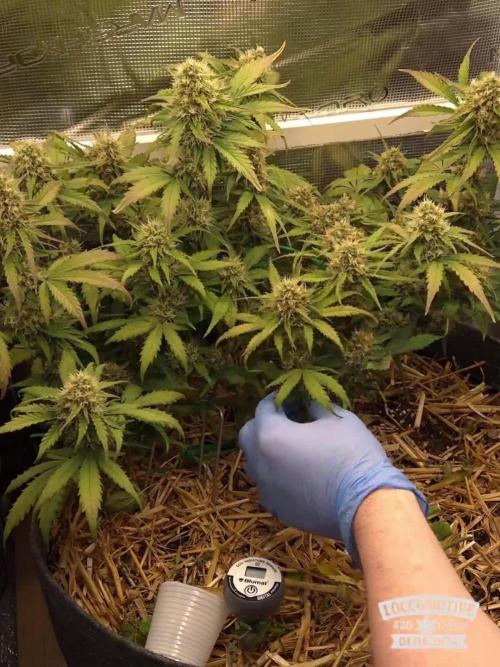
🌿 Woche 8 - Zweite Erntewoche ️🌿
🌱 Wachstum🌱
Lady 2 wurde Ende Woche 9 also nach knapp 10 Wochen auch geerntet.
Bei ihr kam erwarungsgemäß mehr rum bei rum. 47g bei Pflanze Nr. 2
Heißt All in All 83g.
Die Mängel sind kaum noch zu übersehen.
Ich bin überzeugt das die Pflanze zum Schluss ihr volles Potenzial nicht ausschöpfen konnte.
Trotzdem haben es viele gute Buds geschafft und der Rest sieht auch rauchbar aus 😋
🌱 Living Soil🌱
Ich bin mit der Erde so semi zufrieden.
Aber wenn man die Umstände bedenkt, und das eigentlich zu kleine Beet, für gleich 2 Pflanzen.
Kann ich mich doch noch glücklich schätzen. Nächstes Mal vllt nur eine Pflanze 😜
Vllt hab ich auch hier und da was falsch gemacht.
Der Blumat hat mich mitten im Run auch im Stich gelassen.
Vllt war es hin und wieder doch etwas zu Trocken. Grade in der 2. Hälfte des Runs.
Bevor ich den nächsten Grow starte , werd das wohl überholen müssen.
💡 Licht & Schatten
PPFD 📈 gegen Ende ca. 950 µmol/m²/s.
☀️ Wetter
Die Temperaturen sind und bleiben brutal: 25–31 °C 🌡️🔥
🎶 The Grow must go on! 🌱✨


Likes
2
Share


@GodZilla_Owner
Follow
Week 3 – Day 22
🔄 Looking back:
This week was full of activity!
Both Mimosa Evo plants were topped and light LST was started 🌿
They also moved into their final 15L fabric pots, watered in with 2.5L each 💧
💪 Mimosa Evo #3 is doing great – no issues at all. She's strong, healthy, and responding well to training!
🔧 To reduce overall stress (some strains reacted to EC 0.8–0.9), I lowered the DLI to 27. Mimosa Evo handled everything just fine, but I wanted to play it safe.
📅 Looking ahead to Week 4:
🔹 Increase watering to 4–5L, depending on how thirsty they get
🔹 I checked the root zone through the fabric pot – things look very promising 👀
🔹 LST will continue, and I might remove a few big fan leaves if needed ✂️🌿

Likes
12
Share


@2Stones1Bird
Follow
Checkout my Instagram @smallbudz to see the Small budget grow setup for indoor use, low watt, low heat, low noise, step by step.
25/10/2019 - First feed I gave her 0.25ml on 250ml of water of Biobizz-Grow, with 6.5ph.
26/10/2019 - Leafs looking a bit crooked, and some pale spot lets hope its not fungus. (gave her 100ml of just PH 6.5 water)
27/10/2019 - Feeding day, gave her 250ml water with 0.25ml Biobizz Grow, 6.4PH (changed feeding to once every 2 days with a plain water interval)
28/10/2019 - Started LST
30/10/2019 - Feeding day, gave her 250ml water with 0.25ml of each Biobizz - Grow,Bloom and Max, 6.3PH, added carbon filter and it raised the temps to 29c
31/10/2019 - A tad too much of nuts, little burn tip. (Sensi Seeds warned me but I still goofed it)

Likes
207
Share


@DogDoctorOfficial
Follow
DAY 23 Flower under VIPARSPECTRA P2000 with APTUSHOLLAND and they are loving both the light as the food and im loving the fact that they are loving it all 😆😆😆💚💚💚🙏🙏🙏 felling supper blessed with it all and with the fact that the universe allows me to take care of this sacret plant and grow my oun medicine 🙏🙏🙏💚💚💚🙌🙌🙌 special shout out to ZAMNEZIASEEDS for sending me this seeds for me to test, loving the quality on this genetics 🙌🙌🙌 , shout out to VIPARSPECTRA for sending me this LED for me to test and review, with his performance as been outstanding so far, seems like the perfect light for a 3x3 grow space , and a shout out to APTUSHOLLAND for the quality on the nutrients department, it truly is one last thing to worry wen you know by fact that what you feeding your girls is simple the best ( in my humble opinion, all i write here reflexes only my opinion and my experience 💚)
I decided to take some leafs of them to help the airflow , but i will take more asap.
One more week up weed go 😆💚
Day 24 and i defoliate them 😆😆😆💚💚💚
Growers love to you all , and as always thank you guys for reading my diaries , i truly appreciate your time , your love and it all 🙌🙌🙌
And with enormous honor and pleasure that i start collaborating with Zamnezia and Viparspectra
For this run i will have the pleasure of growing some Runtz genetics from Zamnezia seeds that they wore kind enough to send me for test and review 🙏🙏🙏💚💚💚🙏🙏🙏 and for the testing and reviewing i was blessed with the VIPARSPECTRA model P2000💚💚💚🙏🙏🙏 they wore amazing and send me this LED light for me to do some testing and some reviews. Special thanks to Zamnezia and to Viparspectra for this opportunity, lets make magic together 💚💚💚🙏🙏🙏
All i grow is medicine for myself, for me and for my best friend with is me 😆 nothing to sell, so don’t even ask 😅💚💚💚
All info and full product details can be find in can find @
https://viparspectra.eu/collections/grow-lights DISCOUNT CODE 5% - DOGDOCTOR ( all store )
https://www.zamnesia.com DISCOUNT CODE 10% - GROWITGD ( just for seeds )
https://aptus-holland.com/
More info and updates @
https://growdiaries.com/grower/dogdoctor
https://instagram.com/dogdoctorofficial
https://youtube.com/channel/UCR7ta4DKLFMg2xxTMr2cpIg
💚💚💚Growers love to you all 💚💚💚

Likes
Comments
Share


@BlumenBot
Follow
I'll be doing a cleanup sometime this week, the canopy is nearly as wide as the pot, I'm hoping to flip to flower in the next week or 2
Likes
16
Share


@Mo_Powers
Follow
we are at the beginning of the 5th week. the LST training is working quite well so far. it has become a bit caotic. it is possible that i have overfertilised her a bit, she has got two yellow spots. but nothing wild yet. she still gets canna rhizotonic, biobizz grow and biobizz bloom. i don't do any exact fertilisation, more like a guess. she has the first flowering starts. let's see how she develops further. :)
Likes
12
Share

@420DeepGrow
Follow
Gracias al equipo de AnesiaSeeds, Marshydro, XpertNutrients y Trolmaster sin ellos esto no sería posible.
💐🍁 Coco Jambo:
Con una composición genética 60% Sativa y 40% Indica, Coco Jambo es tu billete dorado a un verano sin fin, ofreciéndote una escapada a un mundo donde el sol nunca se pone en tu felicidad.
Con unos niveles de THC que oscilan entre un relajante 30% y un estimulante 34%, Coco Jambo es un faro de euforia que guía a sus usuarios en un viaje a través de olas de serenidad y vibrante alegría. Su aroma es una celebración de los sentidos; imagina el momento de euforia al abrir un coco y descubrir que rebosa de las frutas tropicales más suculentas.
🌻🚀 Consigue aqui tus semillas:
https://anesiaseeds.com/es/product/coco-jambo/
💡TS-3000 + TS-1000: se usaran dos de las lámparas de la serie TS de Marshydro, para cubrir todas las necesidades de las plantas durante el ciclo de cultivo, uso las dos lámparas en floracion para llegar a toda la carpa de 1.50 x 1.50 x 1.80.
https://marshydro.eu/products/mars-hydro-ts-3000-led-grow-light/
🏠 : Marshydro 1.50 x 1.50 x 1.80, carpa 100% estanca con ventanas laterales para llegar a todos los lugares durante el grow
https://marshydro.eu/products/diy-150x150x200cm-grow-tent-kit
🌬️💨 Marshydro 6inch + filtro carbon para evitar olores indeseables.
https://marshydro.eu/products/ifresh-smart-6inch-filter-kits/
🍣🍦🌴 Xpert Nutrients es una empresa especializada en la producción y comercialización de fertilizantes líquidos y tierras, que garantizan excelentes cosechas y un crecimiento activo para sus plantas durante todas las fases de cultivo.
Consigue aqui tus Nutrientes:
https://xpertnutrients.com/es/shop/
💻 Trolmaster Tent-X TCS-1 como controlador de luz, optimiza tu cultivo con la última tecnología del mercado, desde donde puedes controlar todos los parametros.
https://www.trolmaster.com/Products/Details/TCS-1
📆 Semana 1:
Ha sido una buena semana, ella ha dado otro gran cambio en su lugar definitivo 😎.
La carpa está ocupada al 75% y comienza una floracion explosiva gracias a @Marshydro y @Xpertnutrients y @Trolmaster con esta gran genética 💪.
A partir de ahora se riega manualmente con las dosis recomendadas por el fabricante.
Likes
7
Share


@SavageKraken
Follow
No problems this week. All running smoothly. No changes in feedings. Temps are going up here so I've piped the AC into the tents. I topped all of them mid-week and started LST on all the lil ladies this week.


Likes
22
Share


@herbalistssword
Follow
First day of week 6, I will be adding content as the week progresses, have a look at week 5 as that is now complete.
Status:
Candy Kush #1 d36 - Looking awesome, some pistils showing. Was too bushy so did some LST and slight defoliation today with supercrop on 1 branch.
Candy Kush #2 d36 - Looks like nitrogen deficiency is sorted, now I have excess? :D see the clawing tips? Gonna stick with the current feed, hopefully she'll overcome otherwise I'll flush her once if things get worse.
Bubble Kush d32 - Amazing, nothing to report, some tucking done
Fastberry d32 - Looking as weird as ever, some tucking done
Sugar Mama d36 - growing and getting really bushy, shame about the mess I did with the roots/stem but she is doing ok now.
----
Fed 2nd day of weeks 6 (day 37), 3ml biogrow 2ml calmag. pH was at 6.5 Ec was at 1.5.
New leaves are really yellow in candy Kush 2, iron deficiency? Not sure what is happening, will be monitoring.
----
Day 38, Removed the yellow leaves and a little defoliation on all the plants
----
Day 39, Raised the shorter plants so they get some more lights. All of them have finished 35 days (5 weeks from seedling today) and are looking great. Feed the same, although they still look very bright, brighter than I am used to.
----
Day 41, Feeding time, started giving them bloom at 5ml/l and the other normal dosages as in diary.
----
Day 42, End of week 6
The girls are all looking great, there is is so much hair on the buds, haven't seen so much with outdoor grows. Exciting :D
Sugar mama is way too bushy and not getting taller. The new blades are too thin, maybe I'm overfeeding her (only biogrow+calmag)? defoliated her, lots of fan leaves removes, she is asking for some training, I've ordered plant tie and will do some LST when delivered.
Fastberry also had a couple of leaves removed
All kushs doing great
Thanks for reading and happy growing!


Likes
2
Share


@Herbsmanington
Follow
Week 7. Just watering now while the plant matures. Buds are getting heavy and needed support so I ran a few twines to hold them up.


Likes
9
Share


@Chucky324
Follow
Hello. This is the end of week 10 and the beginning of week 11 of veg.
The plants are doing great and growing fast. Stretching out and filling their spaces.
SCRoG training, push the longer branches under the table rungs and cut off anything growing down.
Any branches that are growing down from that spread out main branch are just sucker branches and need to come off.
Any fanleaf that grows down and doesn't get much light needs to come off. Doing this will encourage new growth.
Don't take too many leaves off at once. If you take 1/3 or more leaves off at any one time the pant will go in to shock and not grow till it's healed.
It rained yesterday afternoon so the tent was only open for about 4 hours and the humidity was up to 70%...
So I turned on the dehumidifier when I closed up the tent.
The plants are still getting just rainwater for now. There's lots of compost on the pots, the roots just need to find to it
OK. Keep Growing Straight.
Chuck.


Likes
66
Share


@DrGreenThumb95
Follow
Soo! Eventful week in the tent as I think I I have discovered a lot of my problems with slow growth. So I purchased an EC meter at the beginning of the week and decided to test my run off (rookie mistake this was the first run off since the air pot transfer) and it's fair to say my EC was EXTREMELY fu**ing high... like 3.6 high so this week the first flush I did quarter strength feed I got the run off down to 2.8 then next flush it came down to 2.2 at half strength and the last flush was half strength with an introduction to terpinator and the run off came down to 1.6. It's fair to say I have notice a incredible difference in growth I really want to switch over this week but I'm going to let the plants recover and flick the next week. Little bit worried about space but I love a challenge.
Also been a bit of an expensive week as my carbon filter final packed up so I treat myself to a new ram air (6inch)
Happy growing!

Likes
27
Share


@RDWCGrowing
Follow
6/13/2023
Week 10- Day 1 of Flower (Day 131 overall) (Day 70 of Flower)
Auto Pilot Day 6.. Checked the Trichomes and the bud density and both are looking good.. Definitely needs a little more time for the Trichomes to be where I like, so based on my check I think we are still looking right around the end of the competition 22June to be done and ready for harvest. I do like that the fade is coming in the leaves nicely, so my chart I think is dropping off the Nitrogen exactly like it is supposed to.
6/14/2023
Week 10- Day 2 of Flower (Day 132 overall)
Auto Pilot Day 7.. Decided I would take some contrasting pics today with my light up to 100 and my light all the way on Dim. I hope you enjoy the pics.
6/15/2023
Week 10- Day 3 of Flower (Day 133 overall)
Auto Pilot Day 8.. Decided to take a look at the Trichome's today and Check to see where they are at and honestly if I might ho ahead and start my flush tomorrow and harvest on Sunday.
6/16/2023
Week 10- Day 4 of Flower (Day 134 overall) (Day 74 of Flower)
Today I pulled an Armageddon however instead of darkness they are going to get 48 hours of light. The reason why they are going to get light instead of dark is when I was taking out the netting a lot of the buds were so heavy they fell over and exposed some areas I really want to get some light to... so 48 hours of light at 40% while I watch what should be a beautiful final fade as the plant eats up the last Nutes. If anything goes wrong I can abort take the photos and cut so will pay really close attention to how it is looking over the next 48 hours.
Added 30 Gallons of PH only Water.
Reduced Lighting to 40% removed program time off. 48 hours of light.
6/17/2023
Week 10- Day 5 of Flower (Day 135 overall) (Day 75 of Flower)
I had someone tell me that a few growers had done as I did and Gone Armageddon on the plants. Filling it with PH only and said the plants did not respond well and they were taken out of the comp at the very end because they felt like the pictures just wouldn't come out right. Even though I did go Armageddon, The PPM is at 353PPM with the residue of what was left in the buckets after draining as well as what I am getting from the TAP so I think they are doing good but I am checking them every few hours to see how they seem to be doing and I think they are doing good still and are on track.
I also started prepping the area for the pics tomorrow
T-24 Hours until Chop
6/18/2023
Week 10- Day 6 of Flower (Day 136 overall) (Day 76 of Flower) (Harvest Day)
What a day.. what a day.. what a day.. as I was setting up and trying to figure out how I was going to get my pics #3 stems started breaking, it fell over and other stems broke.. So no really stunning competition photo for her, she had such a nice purple fade.. #2 stayed up in the Tent so that is the one I had to go with to submit for the contest. I wet trimmed them as they went into the tent and they took up three rows hanging in tent. I also decided I wanted to try some so I put a little in the freeze dryer for a 48 hour smoke test.. I will weigh it and add that to my total weight for the plants when it is all done.


Likes
37
Share


@iMpulsive_Grow
Follow
I went in scared that I would screw this up and waste money. I kept learning and fell kore and kore in love with it. Now I’m building a room and already growing 7 plants moving to 20 🙏🏼😝
