


Likes
Comments
Share


@Canadian
Follow
This plant have a very strong smell and there are very high THC with a good balance that allows you to still be productive on my day . All popcorn and small buds were chopped into pieces and put in a pot for edibles.
The buds that grow from the plant that did very well are very dense and heavy the main cola waited 15.56 grams dry

Processing
Likes
6
Share


@Mr_nugs_lover_David
Follow
A-M-A-Z-I-N-G! This alien gorilla is blowing me away maan, shit she stinks soo freaking strong, very spicy aroma very piney too, and woody, she's not sweet at all, at least this pheno but the strong spicy piney woody smell is just lovely, you fall in love instantly, the colas look like rockets 🚀🚀 very hard, dense and sticky as hell. I'm so in love with this genetic by the family of original sensible seeds man, what a crazy surprise, I need this girls in my garden every year. She's been 100% organic grown with FLO Living soil and guanokalong organic dry amendments. Hope I can make a big big xxl bush with this strain next season man💎🤤🦍👽🤞 peace everybody!

Likes
10
Share


@ThatsmyGrow
Follow
Einfach eine super Woche
Ich bin einfach wieder komplett überzeugt davon autoflower indoor anzubauen, dank fastbuds gibt's so geile Sorten.
Ich will am ende alle mal gegrowed haben


Likes
11
Share


@Badassxwar
Follow
So one thing about this strain that was kind of a bummer was the smells were literally all over the place in a great way. Sour gummies worms from the keef, diesle/gas from the leaves, and lemon hard candy/carrots/dab carts from the buds but when smoked it, the floral taste was so rounded that the other smells never came thru except the purple one that had tight smaller buds, had a lemony taste still. (Remember had to cut early from braking).
On the other hand, the way this plant grew had me in a state of personal amazement. I was actully super excited telling my friends that it got TOO BIG for the branches. Buds stacked perfectly on every plant. The topping and recover time went smooth. She shaped nicely right before flower. And back to my negative statement that I had..... the smells were INCREDIBLE!!! I recommend it to everyone soly for the smells.


Likes
5
Share

@CannDy420
Follow
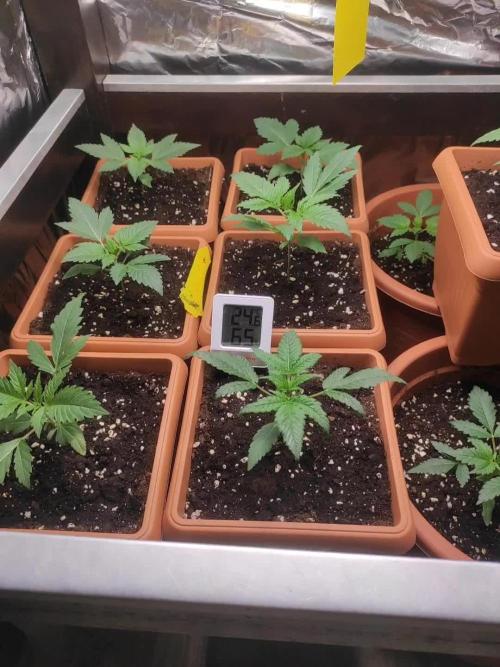
Die Pflanzen haben sich an die Neuen töpfe gewöhnt und wachsen gut an nächste Woche sind sie denk ich ready für die erste Nährstoff Zugabe .

Processing
Likes
10
Share


@balansa
Follow
hey there :) so we’ve started flowering she looks good she is bigger and healthier then my previous Mexican babe and i am proud )) so i have cut off many fan leaves already twice but she is bushing. next week i will cut some fan leaves for the last time for the buds to get more light. so heads up !!! puff puff pass !!!!!
Processing
Likes
33
Share


@Ferenc
Follow
Day 72: 600W LED, 18 hours on 6 hours off the same with ventilation. Ferilization is the same except BlackBerry Kush and LSD-25 they are being flushed. Water intake also remains the same 200ml per day. Humidity approx 35 percent.
Day 74: BlackBerry Kush and LSD-25 have to be harvested this week Friday so no more water. Colorado Cookies and Northern Light next week so started flushing them. Glueberry OG needs a bit more time.


Likes
28
Share


@GanjaGecko
Follow
Die Woche 5 der Blüte ist rum. Die bisher wärmste Woche mit Tagestemperaturen zwischen 25-31°C und Nachttemaparaturen zwischen 15-21°C haben die Ladys gut überstanden. Ich hab hier und da ein paar zu große Blätter entfernt oder Blätter die Buds verdeckt haben. Ansonsten habe ich hier und da ein paar Blattläuse mit der Hand oder Pinzette abgesammelt. Die blattuntereiten wurden auch großzügig auf Blattläuse und Eier kontrolliert. Auch hier mussten ein paarmal der Hand zerdrückt werden, aber soweit hält es sich in Grenzen. Auch von Mehltau war nichts mehr zu sehen. Alle Ladys sind gut stabil und entwickeln wunderschöne buds💚 die GorillaZkittlez sieht schon ziemlich final aus. Ich denke das es maximal noch zwei Wochen braucht bis sie getrocknet werden kann. Sie hat richtig schöne harzige dichte buds die ich outdoor nicht erwartet hätte. Und sie verteilt auch den intensivsten Geruch 💚 der Geruch geht stark in Richtung Zitrus mit würzigen untertönen.
Die StrawberryBanana denke ich wird 1-2 Wochen länger dauern als die GorillaZkittlez. Sie sieht aber auch schon ordentlich aus. Der heasbud wird ein ordentlich fettes Ding. Der Geruch ist unglaublich lecker aber noch nicht ganz definierbar, geht aber in die fruchtige Richtung.
Die GorillaAuto hängt etwas hinterher, wird aber wahrscheinlich soviel abwerfen wie meine StrawberryBanana und GorillaZkittlez zusammen. Die GorillaAuto hat einen sehr intensiven Zitrus Geruch mit Pinie/Kiefer im Hintergrund. Bis jetzt mein Favorit der drei Ladys rein vom Geruch.
____________________________
Düngen/Gießen:
Die Ladys wurden in dieser heißen Woche jeden Tag gegossen, an den zwei Tagen mit 30°C und kaum Wolken wurden die Ladys Morgens und Abends gegossen. Im Durchschnitt bekam jede Ladys pro gießen ca 700ml-1L. Der ph-Wert lag dabei zwischen 6.5 und 6.7.
An Tag 51/30F gab es als Zusätze auf 5L Wasser: 6ml BioBloom von BioBizz als kleinen Blütebooster, auch 1.5ml GreenSensation. Davon nur recht wenig, weil der Hauptdünger GreenHouseFeeding ist und der nicht ganz mit dem GreenSensation zurecht kommt. Davon abgesehen brauchen Automatiks auch etwas weniger Nährstoffe. Auch gab es 5ml PowerBuds und 3ml PureZym auf die 5L.
An Tag 52/31F gab es nur Wasser, dafür morgens und abends.
An Tag 53/32F gab es auf 5L Wasser 10ml StickyFingers von XpertNutrients und am Abend wieder Wasser.
An Tag 54/33F gab es wieder Wasser.
An Tag 55/34F gab es nochmal Wasser.
An Tag 56/35F gab es auf 5L Wasser 5g BioEnhancer von GreenHouseFeeding, 6ml BioBloom von BioBizz, 1.5 ml GreenSensation, 5ml PowerBuds von Plagron. Am Abend gab es auch nochmal 300-500ml für jede Lady. Der ph-Wert lag dabei immer zwischen 6.5-6.7.
Auf eine nächste Woche voller Freude und schönen Gerüchen💚
Likes
2
Share


@Canadian_Bud
Follow
Day 127 6-6
Started backing off on the light time and had to bring in a dehumidifier to bring down humidity. Strung some support up for the final weeks push. Continue to lower ppm's slowly getting her down to 15. Total Darkness coming soon.😎 This could be the last week t'ill harvest.


Likes
52
Share


@Ultraviolet
Follow
Lacewings seemed to have mostly killed themselves by flying into hot light fixtures. I may have left the UV on which was smart of me :) Done very little to combat if anything but make a sea of carcasses, on the bright side its good nutrition for the soil.
Made a concoction of ethanol 70%, equal parts water, and cayenne pepper with a couple of squirts of dish soap.
Took around an hour of good scrubbing the entire canopy.
Worked a lot more effectively and way cheaper.
Scorched earth right now, but it seems to have wiped them out almost entirely very pleased.
Attempted a "Fudge I Missed" for the topping. So just time to wait and see how it goes.
Question?
If I attached a plant to two separate pots but it was connected by rootzone, one has a pH of 7.5 ish the other has 4.5. Would the Intelligence of the plant able to dictate each pot separately to uptake the nutrients best suited to pH or would it still try to draw nitrogen from a pot with a pH where nitrogen struggles to uptake?
Food for stoner thought experiments!
Another was on my mind.
What happens when a plant gets too much light?
Well, it burns and curls up leaves.
That's the heat radiation, let's remove excess heat, now what?
I've always read it's just bad, or not good, but when I look for an explanation on a deeper level it's just bad and you shouldn't do it.
So I did.
How much can a cannabis plant absorb, 40 moles in a day, ok I'll give it 60 moles. 80 nothing bad ever happened.
The answer, finally. Oh great........more questions........
Reactive oxygen species (ROS) are molecules capable of independent existence, containing at least one oxygen atom and one or more unpaired electrons.
"Sunlight is the essential source of energy for most photosynthetic organisms, yet sunlight in excess of the organism’s photosynthetic capacity can generate reactive oxygen species (ROS) that lead to cellular damage. To avoid damage, plants respond to high light (HL) by activating photophysical pathways that safely convert excess energy to heat, which is known as nonphotochemical quenching (NPQ) (Rochaix, 2014). While NPQ allows for healthy growth, it also limits the overall photosynthetic efficiency under many conditions. If NPQ were optimized for biomass, yields would improve dramatically, potentially by up to 30% (Kromdijk et al., 2016; Zhu et al., 2010). However, critical information to guide optimization is still lacking, including the molecular origin of NPQ and the mechanism of regulation."
What I found most interesting was research pointing out that pH is linked to this defense mechanism. The organism can better facilitate "quenching" when oversaturated with light in a low pH. Now I Know during photosynthesis plants naturally produce exudates (chemicals that are secreted through their roots). Do they have the ability to alter pH themselves using these excretions? Or is that done by the beneficial bacteria?
If I can prevent reactive oxygen species from causing damage by "too much light".
The extra water needed to keep this level of burn cooled though, I must learn to crawl before I can run.
Reactive oxygen species (ROS) are key signaling molecules that enable cells to rapidly respond to different stimuli. In plants, ROS plays a crucial role in abiotic and biotic stress sensing, integration of different environmental signals, and activation of stress-response networks, thus contributing to the establishment of defense mechanisms and plant resilience. Recent advances in the study of ROS signaling in plants include the identification of ROS receptors and key regulatory hubs that connect ROS signaling with other important stress-response signal transduction pathways and hormones, as well as new roles for ROS in organelle-to-organelle and cell-to-cell signaling. Our understanding of how ROS are regulated in cells by balancing production, scavenging, and transport has also increased. In this Review, we discuss these promising developments and how they might be used to increase plant resilience to environmental stress.
Temperature stress is one of the major abiotic stresses that adversely affect agricultural productivity worldwide. Temperatures beyond a plant's physiological optimum can trigger significant physiological and biochemical perturbations, reducing plant growth and tolerance to stress. Improving a plant's tolerance to these temperature fluctuations requires a deep understanding of its responses to environmental change. To adapt to temperature fluctuations, plants tailor their acclimatory signal transduction events, specifically, cellular redox state, that are governed by plant hormones, reactive oxygen species (ROS) regulatory systems, and other molecular components. The role of ROS in plants as important signaling molecules during stress acclimation has recently been established. Here, hormone-triggered ROS produced by NADPH oxidases, feedback regulation, and integrated signaling events during temperature stress activate stress-response pathways and induce acclimation or defense mechanisms. At the other extreme, excess ROS accumulation, following temperature-induced oxidative stress, can have negative consequences on plant growth and stress acclimation. The excessive ROS is regulated by the ROS scavenging system, which subsequently promotes plant tolerance. All these signaling events, including crosstalk between hormones and ROS, modify the plant's transcriptomic, metabolomic, and biochemical states and promote plant acclimation, tolerance, and survival. Here, we provide a comprehensive review of the ROS, hormones, and their joint role in shaping a plant's responses to high and low temperatures, and we conclude by outlining hormone/ROS-regulated plant-responsive strategies for developing stress-tolerant crops to combat temperature changes.
Onward upward for now.
Next!
Adenosine triphosphate
(ATP) is an energy-carrying molecule known as "the energy currency of life" or "the fuel of life," because it's the universal energy source for all living cells.1
Every living organism consists of cells that rely on ATP for their energy needs. ATP is made by converting the food we eat into energy. It's an essential building block for all life forms. Without ATP, cells wouldn't have the fuel or power to perform functions necessary to stay alive, and they would eventually die. All forms of life rely on ATP to do the things they must do to survive.2
ATP is made of a nitrogen base (adenine) and a sugar molecule (ribose), which create adenosine, plus three phosphate molecules. If adenosine only has one phosphate molecule, it’s called adenosine monophosphate (AMP). If it has two phosphates, it’s called adenosine diphosphate (ADP).
Although adenosine is a fundamental part of ATP, when it comes to providing energy to a cell and fueling cellular processes, the phosphate molecules are what really matter. The most energy-loaded composition for adenosine is ATP, which has three phosphates.3
ATP was first discovered in the 1920s. In 1929, Karl Lohmann—a German chemist studying muscle contractions—isolated what we now call adenosine triphosphate in a laboratory. At the time, Lohmann called ATP by a different name. It wasn't until a decade later, in 1939, that Nobel Prize–-winner Fritz Lipmann established that ATP is the universal carrier of energy in all living cells and coined the term "energy-rich phosphate bonds."45
Lipmann focused on phosphate bonds as the key to ATP being the universal energy source for all living cells, because adenosine triphosphate releases energy when one of its three phosphate bonds breaks off to form ADP. ATP is a high-energy molecule with three phosphate bonds; ADP is low-energy with only two phosphate bonds.
The Twos and Threes of ATP and ADP
Adenosine triphosphate (ATP) becomes adenosine diphosphate (ADP) when one of its three phosphate molecules breaks free and releases energy (“tri” means “three,” while “di” means “two”). Conversely, ADP becomes ATP when a phosphate molecule is added. As part of an ongoing energy cycle, ADP is constantly recycled back into ATP.3
Much like a rechargeable battery with a fluctuating state of charge, ATP represents a fully charged battery, and ADP represents a "low-power mode." Every time a fully charged ATP molecule loses a phosphate bond, it becomes ADP; energy is released via the process of ATP becoming ADP.
On the flip side, when a phosphate bond is added, ADP becomes ATP. When ADP becomes ATP, what was previously a low-charged energy adenosine molecule (ADP) becomes fully charged ATP. This energy-creation and energy-depletion cycle happens time and time again, much like your smartphone battery can be recharged countless times during its lifespan.
The human body uses molecules held in the fats, proteins, and carbohydrates we eat or drink as sources of energy to make ATP. This happens through a process called hydrolysis
.
After food is digested, it's synthesized into glucose, which is a form of sugar. Glucose is the main source of fuel that our cells' mitochondria
use to convert caloric energy from food into ATP, which is an energy form that can be used by cells.
ATP is made via a process called cellular respiration that occurs in the mitochondria of a cell. Mitochondria are tiny subunits within a cell that specialize in extracting energy from the foods we eat and converting it into ATP.
Mitochondria can convert glucose into ATP via two different types of cellular respiration:
Aerobic (with oxygen)
Anaerobic (without oxygen)
Aerobic cellular respiration transforms glucose into ATP in a three-step process, as follows:
Step 1: Glycolysis
Step 2: The Krebs cycle (also called the citric acid cycle)
Step 3: Electron transport chain
During glycolysis, glucose (i.e., sugar) from food sources is broken down into pyruvate
molecules. This is followed by the Krebs cycle, which is an aerobic process that uses oxygen to finish breaking down sugar and harnesses energy into electron carriers that fuel the synthesis of ATP. Lastly, the electron transport chain (ETC) pumps positively charged protons that drive ATP production throughout the mitochondria’s inner membrane.2
ATP can also be produced without oxygen (i.e., anaerobic), which is something plants, algae, and some bacteria do by converting the energy held in sunlight into energy that can be used by a cell via photosynthesis.
Anaerobic exercise means that your body is working out "without oxygen." Anaerobic glycolysis occurs in human cells when there isn't enough oxygen available during an anaerobic workout. If no oxygen is present during cellular respiration, pyruvate can't enter the Krebs cycle and is oxidized into lactic acid. In the absence of oxygen, lactic acid fermentation makes ATP anaerobically.
The burning sensation you feel in your muscles when you're huffing and puffing during anaerobic high-intensity interval training (HIIT) that maxes out your aerobic capacity or during a strenuous weight-lifting workout is lactic acid, which is used to make ATP via anaerobic glycolysis.
During aerobic exercise, mitochondria have enough oxygen to make ATP aerobically. However, when you're out of breath and your cells don’t have enough oxygen to perform cellular respiration aerobically, the process can still happen anaerobically, but it creates a temporary burning sensation in your skeletal muscles.
Why ATP Is So Important?
ATP is essential for life and makes it possible for us to do the things we do. Without ATP, cells wouldn't be able to use the energy held in food to fuel cellular processes, and an organism couldn't stay alive.
As a real-world example, when a car runs out of gas and is parked on the side of the road, the only thing that will make the car drivable again is putting some gasoline back in the tank. For all living cells, ATP is like the gas in a car's fuel tank. Without ATP, cells wouldn't have a source of usable energy, and the organism would die.
Eating a well-balanced diet and staying hydrated should give your body all the resources it needs to produce plenty of ATP. Although some athletes may slightly improve their performance by taking supplements or ergonomic aids designed to increase ATP production, it's debatable that oral adenosine triphosphate supplementation actually increases energy.
An average cell in the human body uses about 10 million ATP molecules per second and can recycle all of its ATP in less than a minute. Over 24 hours, the human body turns over its weight in ATP.
You can last weeks without food.
You can last days without water.
You can last minutes without oxygen.
You can last 16 seconds at most without ATP.
Food amounts to one-third of ATP production within the human body.

Likes
141
Share


@Tropicannibis_Todd
Follow
💩Holy Crap Growmies We Are Back💩
Well growmies we are at 49 days in and everything is going as good as it can👌 Afraid she's had some major issues but that's just how it goes folks 😉
👉 Shes a short chunky little plant 👈 We got some very pretty colors😍 👌 She's got some odd colors kinda like tiger leafing,😉
Lights being readjusted and chart updated .........👍rain water to be used entire growth👈
👉I used NutriNPK for nutrients for my grows and welcome anyone to give them a try .👈
👉 www.nutrinpk.com 👈
NutriNPK Cal MAG 14-0-14
NutriNPK Grow 28-14-14
NutriNPK Bloom 8-20-30
NutriNPK Bloom Booster 0-52-34
I GOT MULTIPLE DIARIES ON THE GO 😱 please check them out 😎
👉THANKS FOR TAKING THE TIME TO GO OVER MY DIARIES 👈


Likes
99
Share


@DutchFarmer
Follow
Looks like she might have another week left started flushing this week.
Processing
Likes
9
Share


@GanjaThings
Follow
Continued growth, feeding every 3 days as soil dries out. Nice growth spurts noted and apical dominance broken via LST as limbs/new growth reach skyward. Minor fan leaf removal to permit light saturation and airflow to lower areas. Getting a little crowded! We will let the canopy grow towards the light another inch or 2 with minor LST adjustments or at 2 weeks from now (which ever happens first,) before we will make the decision to flip to flower cycle. Feeding 3/5 gallon per plant about every 3 days.


Likes
18
Share


@Bigbombbudz
Follow
Another week closer....
Well not a bad week, everything is going great. The only problem which seems to happen alot with low ceilings is ..these plants are big... Very Big, all pretty much the same height over 5ft each, its not that I don't like big plants, I do but when you start to run out of room and you have to get creative with them under the lights, they need to be at least 18 inch from the light or they will start to foxtail from the heat ...Yes I know I could of topped them to slow or stop the height, but I dont like to touch anything when growing, I like to let them do there thing including not clipping any leaves.
Besides that everything is going great,..the one plant I had a problem with snapped back once I corrected the PH and shes growing/budding like crazy...
Nothing else to report:::
Until next week, smoke a fatty, help out your fellow grower.


Processing
Likes
18
Share


@StuG69
Follow
Week two, girls seem to be OK still, although I have little clue as to how big they should be!
May 11th (day 9 since planting sprouted seeds into final pots),
I think they are doing OK? Pictures are from May 11th. No nutes given although I did add 0.5ml to 1 litre water, in a sprayer, but have restrained myself from using it yet!!
Watering has been using bottled spring water which I leave (5ltr bottles) in the grow tent so it's the same temp as air and substrate. I've pretty much let them dry out between watering.
Raised light height a little as I have a small amount of curl on the leaf ends. I also made the fan a little less direct. I feel like I know this has to be light or fan related as the girls are not root-bound and all other parameters are fine. I could well be wrong of course, but I'm determined to learn what the girls want by changing the obvious parameters first before worrying about the big stuff. It's a very mild curl anyhow so I believe it'll be heat/light and fan related.
Size-wise, the three are between 75 and 90mm tall and span in 95 to 110mm.
If anyone has any thoughts I would love to hear/read them!
May 12th
I was really pleased to see the progress when I checked on them this morning. I have added a picture. The difference between yesterday and today is pretty clear. Things seem to be OK(?) but what do I know; this is my first grow following reading and learning a little. I've been spraying the leaves before lights out. Is this a good thing?
I am aiming to LST the girls so, could anyone recommend when? How many nodes, how tall etc... It would really help me feel confident in the training.
May 13th.
Pretty amazed at how they're doing. Not that I particularly have anything to compare to experience-wise as these are my first grow. They're kinda praying a little so, doing some reading up on here, I have decided to raise the lights to 20" from 18". Maybe I should go higher? I'll see. Anyhow, temps went up over night as I had closed my grow room window so when I checked this morning they were sitting in 28.6C and 41% humidity. Now more stable at 25C and 47%. One thing I had not realised was how mercurial the temp and humidity would be and how quickly it changes so I need to be more mindful of this.
I have added .5ml Biobizz Bio-Grow per 1ltr bottled spring water, although I am still using water only at this time, but in the next couple of days (start of week 3) I will start adding low dose nutes and then foliage spraying them just before lights out and see what that brings. I can always back it off I guess. It's all a bit of educated guesswork, currently, whilst I find my feet with this!
May 14th.
Decided to hold back on the nutes; Biobizz schedule is seemingly for cuttings and not seedlings so I think I've avoided a potential issue there, given that the Biobizz All-mix soilds have enough nutes to carry the seedlings through almost to flowering of the autos. So, I will remain on giving just bottled spring water until day 21, so, another 1.5 weeks. Then I think I'll add grow and bloom together at the suggested rates. I have some foliar spray mixed up with grow at 0.5ml/L which I think I will use for misting just before lights-out.
No picture today... but I will post pics tomorrow instead.
May 15th, day 13. Pictures uploaded.
The girls are getting really broad, but height only 110mm. Should I raise my lights which are at 19" above top of canopy. They're certainly growing and seem healthy! Still watering (every two days, allowing for an almost dry substrate using the finger/knuckle test in the soil.
May 16th, day 14. Started LST with bendy pipe cleaners. Honestly, it was nerve-wracking. I placed anchors at the base and did a simple bend to between 55 and 70 degrees across them. Only thing is, some of the canopy/lower leaves are almost touching the substrate so, should I trim them? I couldn't get up to the top to pull down either and had to go lower, as the plants are very young and squat, seemingly, so not a lot of spacing so I did what I could, anchoring under whatever was free in terms of space.
Tomorrow - week 3 of veg starts!
Likes
29
Share


@Hasard
Follow
Starting week 6
Tent is being slowly full
A little bit too hot for the next days as the weather outside will climb to 36-38°C, I thnk I will bring them some CO2. I will check with the growshop. Any idea is welcome.
The stretch is really impressive, 1 of them get 20cm in 7 days
Waiting for the buds 😁
Day 39 I have now added CO2 with an organic boost, it is linked it to the fan. Should be a little bit better with that temperature