Check the winners The Grow Awards 2026 🏆
Likes
Comments
Share
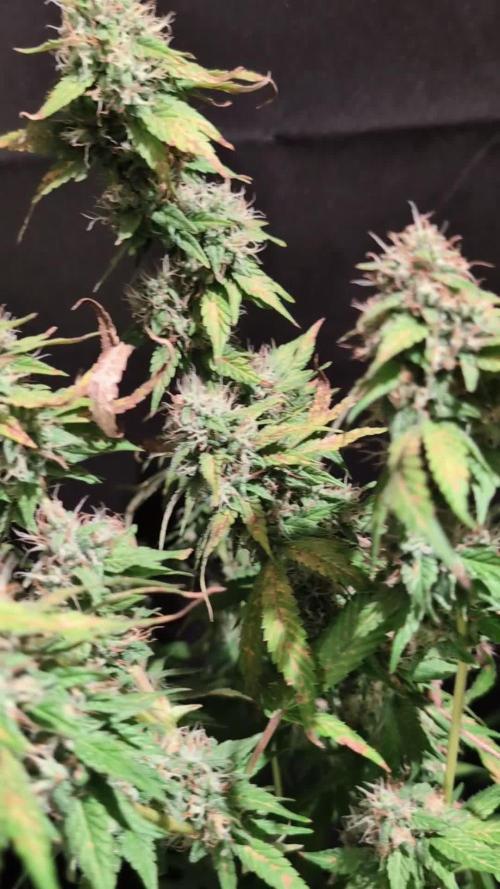
Welcome to my Black Jack b sponsored by Sweet Seeds 2 yrs ago nearly. Veg Weeks & Pre/Post Pre Flower Weeks 7-9 She was really healthy during her entire veg period. Moving into pre flower she didn't do any excess stretching. Plant was doing very well moving into pre flower it took a good few weeks for her to flip but it was building up a good base up and down the nodes. I used plagron right through half of flowering possibly more. For the last 4 weeks I moved all my plants to Xpert Nutrients. MAINTENANCE I carried out a good bit of work making sure all parts of her was getting light (as much as she didn't get, it was more then enough to get A grade bud just like it was done under a 100w). I stripped a lot of shoots coming into & during pre fower. So when coming in to fattening all her energy went into making buds that were brought to harvest. Knowing light would be an Issue (lack off) i made sure to use all my skills to move energy through a plant. After pre fower was over (plants nodes stop growing up) and I left her a few days for the leaves to take in energy building stigmata. Then I done 10-15% defoliations for mid wk into fattening and beyond until I felt was enough removed (3-4 stages). Now on her last few days I took loads of leaves off to help ripening. She's 95% cloudy and 15% or so Amber. I had to give 10l of water to flush the nutes I had given her. 4l was given and ppm was 650. So I had to give another 6L to get the ppm down to 250 area. 3 days its been under light for 11hrs with 30m of UV-A doses from 65cm away (they are attached to my light IR/UV45) FLOWERING/RIPENING WEEKS Plant moved very nicely through fattening. Buds are lots but whets there is pretty darn good for been at the side of a FC3000 300w light in a 1m2 tent doing many other plants. And this been by far been under the best part of it. It sat on the outskirts as this fem is one of my 1st 5 I started together with 7 autos in phase 1 of my 6 phase crop with 10-15 plants per phase. Took (NUMBER 4 this 1 is). 14 weeks from seed. And she's been through a hard flush. As the last 4.5 weeks she's been on Xpert Nutrients. NUTRIENT GIVEN So I know tats a large list. But as I updated my a lot of weeks into 1. I left on the list what was given. All of plagron was given through most of the grow right through to the middle of fattening and then I switched it (all my plants to Xpert Nutrients bloom nutes). And even then, I normally give more than 2-3 nutrients in 1 feeding 2-3 day window. Its important tat a plant take up these as individual so I typically leave a few days or at least 1-2 water feeds (or low ec feeds such as an enzyme, or calmag to help break down any excess nutrients left behind from last feed) I added my SE5000 and have this 60+cm away just finish off the ripening process. Pant has a good amount of bud. And really like this breeder. What have I been missing out on Sweet Seeds both plants are dreams to grow. Thanks to my sponsors. Xpert Nutrients have given me a gift for you guys. !!DISCOUNT CODE FOR XPERT NUTRIENTS!! CODE FOR 15% OFF & FREE SHIPPING IN EU:GGST !!DISCOUNT CODE FOR XPERT NUTRIENTS!! Much appreciation to Sweet Seeds. Seeds are nearly 2yrs old. I've had them for nearly all that time. They were packaged within a month of me getting them. Shout out to Mars-Hydro for their FC3000 & IR/UC45. Had to break out my SE5000 as nice as this plant is its needs fell short been in a tent with 15 other plants. My se5000 is giving 55k lux (that's the lowest level BTW in my corners I just about got that mid field using my 300w.)
Likes
4
Share
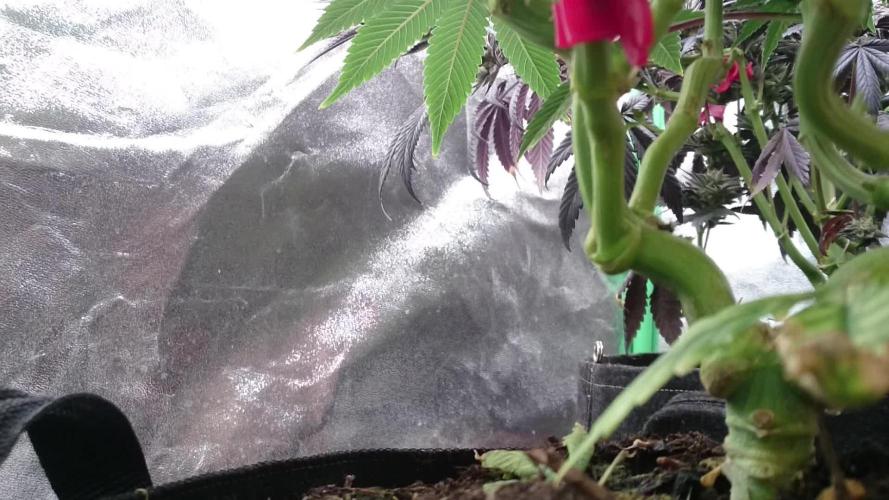
switched to bloom nutrients. Did extensive LST to pull the plant apart on day 30. seemed to do OK. main stem was very stout. nutrients at 215ppm on day 30.
Likes
15
Share
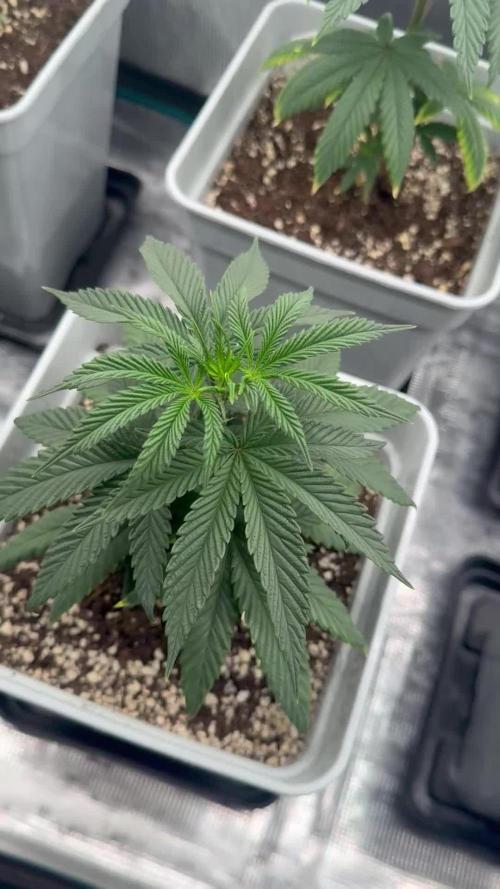
Нам уже мало места, много новых стволов после lst, жду на днях новый гроубокс и лампу, так же через 2 дня начну вводить GHE nutriens
Processing
Likes
35
Share
@Paulolo03
Follow
No more yellow leaves spreading problem, it was the lack of nutrients for sure ! Thanks for those who helped me ! :) Something to consider for my next grow: I decided to grow 10 plants to get a chance to have a decent harvest as it is my first time but it takes too much space, I barely have room to move myself inside the box and the plants have less light. I also think it is the reason it's too hot inside the box, when the plants were small and the outside temperatures the same as today, it was was less hot. Next time, I'll grow like 5 or 6 but making them bushy as hell !!
Likes
20
Share
Not particularly growing for speed or any dedicated reason this time round, just adding water and a abundande of positivity, gotta admit I do like the autoseed logo. Off we go again into the magical forest. (Arthrospira platensis) cultivated in high-alkaline, mineral-rich water in Kailua-Kona, Hawaii. It is renowned for having a higher nutrient content, including more carotenoids and essential fats, compared to other spirulina brands. It is frequently cited as a "complete food" due to its dense concentration of proteins, vitamins, minerals, and pigments. The nutritional profile of standard dried Spirulina platensis biomass. 3kg of spirulina powder has an approximate NPK ratio of 10-2-1 (or 10% Nitrogen, 2% Phosphorus, and 1% Potassium). Here is the breakdown of the nutrient content for 3kg of powder: Nitrogen (N): ~300g (10% of total mass) Phosphorus (P): ~60g (roughly 2% of total mass) Potassium (K): ~30g (roughly 1% of total mass) 3kg of spirulina powder is more than enough nitrogen for 4 cannabis plants in a 100-gallon pot—in fact, it is likely excessive and could cause severe nutrient burn or toxicity if not properly managed. Spirulina has a very high protein content (46% to 63% dry weight), which translates to a significant nitrogen source. It is often described as a 5-1-1 NPK fertilizer. 3kg (3000g) of powder in 100 gallons means 30g per gallon. General organic recommendations for potent amendments (like frass) are often around 1–3 tablespoons per gallon. 30g of powder is roughly 2-3 tablespoons, making this a very high-strength application rate if added all at once. Balance this with calcium/magnesium, and organic nutrient delivery in soil growing can lead to deficiencies in these nutrients. Not all of that 100 gallon is used, so figuring out precise measurements was ballpark, but there is about 10kg of engineered biochar in that pot. Mostly in the top half. Ideally, I'd have 25kg in a full active 100-gallon, but......... don't mess with something that is not broken. Roots do not utilize the entire 100 gallons. This has been a couple of years of trial and error, mostly error. The amount of cations you can add in grams depends entirely on the specific cation exchange capacity (CEC) of your biochar and the type of cation being added. Biochar CEC values vary widely, typically ranging from 4 to over 300cmolc/kg. Multiple Biochars in use, ranging upwards of 100cmolc/km. Different cations have different atomic weights Potassium K+ 39.1g/mol. Calcium Ca2+ 40.1g/mol. Magnesium Mg2+ 24.3g/mol. Nitrogen NH4+ 18.04g/mol. You get more nitrogen bang for your buck. It all depends on the CEC of the biochar you use, but brrrrrrrrrr roughly I'm looking at 500-600 grams worth of elemental cation exchange capacity, give or take. That's just for the biochar alone. Elemental cation exchange capacity refers to the ability of materials—such as soil, minerals, and biochar to adsorb, hold, and release positively charged ions Ca2+, Mg2+, K+, Na+, Al3+, and Zn2+. This capacity is a critical measure of nutrient availability in soil and energy density in electrochemical systems. Added calmag 2:1 to complement spirulina. Calcium (Ca): Approximately 150g - 300g of elemental calcium. Magnesium (Mg): Approximately 75g - 150g of elemental magnesium. So long as pH stays in 6.3 to 6.7 ish, the plant will unlock hydrogen. Plants will be able to cycle CEC for their own needs. Hydrogen ion pumping (proton pumping) is a fundamental mechanism used by plant roots to facilitate the cycling of nutrients within a medium's Cation Exchange Capacity (CEC), directly increasing nutrient availability. A growing medium's Cation Exchange Capacity (CEC) does not contribute directly to Electrical Conductivity (EC). CEC represents potential nutrient storage, while EC represents active nutrients in the water/soil solution. A medium with a high CEC can hold many nutrients, but if there is no water present, the EC will be low. 98% of plant nutrient uptake comes directly from the soil solution. 2% of nutrient uptake is directly from soil particles. Nutrients held on exchange sites (CEC) are not directly measured by EC until they are released into the soil solution through exchange with other ions (e.g., hydrogen ions from roots or fertilizer). Plants source the H+ ions (protons) used in cation exchange primarily by exuding carbon sugars into the rhizosphere, then microorganisms perform root respiration, which reacts with soil water to form carbonic acid H2CO3 that dissociates into H+ and bicarbonate. Roots also actively pump out H+ ions directly to acidify the rhizosphere, plants trade hydrogen produced through metabolism for essential nutrients held by the soil. In plant cells, the H+ (protons) used in proton pumping across the plasma membrane come primarily from the cytoplasm (cytosol). The protons are derived from internal cellular sources, including metabolic processes that release H+, and the regulation of intracellular pH homeostasis. Distilled water is highly useful in managing the electrical conductivity (EC) of a growing medium by allowing for precise control over nutrient concentration and assisting in the mobilization of nutrients from the cation exchange capacity (CEC) into the active, plant-available nutrient solution. Just add water & positive energy. Potential hydrogen. pH. + - , potential charge balance for hydrogen. So long as there is adequate oxygen in the soil and air and water moves at a decent interval, its practically impossible for the pH to skew in a soil that is taking in oxygen and releasing CO2 and nitrogen, I say practically, but meh, even with plenty of oxygen, the process of converting ammonium NH4+ to nitrate NO3- by bacteria releases hydrogen ions H+, which directly causes acidification (lowering pH). While water movement is necessary, consistent water moving through the soil can leach away basic cations Ca2+, Mg2+, K+, Na+, leaving behind acidic hydrogen and aluminum ions, causing pH to drop, especially in humid regions. High levels of CO2 in the soil (from intense respiration) dissolve in soil water to create carbonic acid, H2CO3, which lowers the pH. (barometric pumping removes that possibility) The pH in a cannabis cultivation environment, particularly in hydroponic or soilless setups, will often naturally drift towards acidic (lower pH) over time. Understand how to know when to lime the pH back up. Complex but critical. Once I understood this it helped ease the pain of understanding pH. Base saturation directly reflects the percentage of CEC occupied by base cations. Generally, as base saturation increases, soil pH increases because fewer acidic cations, H+ and Al3,+ are present on the soil colloid surfaces. At a pH of 7 or higher, the soil colloids are saturated with base cations, resulting in a base saturation of 90+%. While many sources include Sodium Na+ as a base cation, some calculations focused specifically on plant nutrients (like in some nutrient management contexts) may focus solely on the "Big 3": Ca2+, Mg2+, and K+. However, in soil science and CEC (Cation Exchange Capacity) measurements, sodium is usually included in the definition of total base cations, making it the "Big 4" base cations. At a pH around 5.5, soils often have a 45–55% base saturation, while a soil with a pH between 6.5 and 6.8 generally has an 80–90% base saturation. Base saturation is considered a reliable, albeit complex, indicator of soil fertility and the degree of soil weathering, acting as a crucial metric in soil classification and management. Once you take full control of the pH, so long as there is oxygen, and one keeps tabs on base saturation levels. Its near impossible for anything to go wrong. All you are essentially doing is adding water and waiting for any sign of deficiency. Not so much growing as eliminating the possibilities of things going sideways. Can't over or under water, can't skew pH, can't go anaerobic. Everything runs in optimal cycles, watering every 2 to 3 days or as required, depending on the rate of combined ET. A little warmer, a little drier, but never short on water. All the nutrients are already there in the medium, we still focus on the water, just not adding salts, but to mobilize nutrients held in the Cation Exchange Capacity (CEC) and move them into the active soil solution for plant uptake, the best supplements to add to water are fulvic acid, humic acid, or seaweed/kelp extract. Liquid solutions with high concentrations of essential trace elements. Distilled water has no alkalinity or minerals to help buffer or release nutrients. Adding these supplements turns the "empty" water into an active agent that forces nutrients off the CEC colloids into the solution for plant uptake. When to water? When Electrical Conductivity of soil gets low. No water, no conductivity.
Likes
120
Share
The Harvest Prelude: After a patient wait and 48 hours of darkness, the moment arrived. The Tropical Tangie Lego Ninja, standing proudly like a silent guardian, was ready for the grand harvest. The sound of each cut echoed through the grow space, reminiscent of felling a mighty tree. The compact structure of the buds was awe-inspiring, a testament to the ninja's disciplined growth. The Lego Ninja, like a stoic warrior, was then hung upside down, beginning a two-week drying ritual. Maintaining an ambient temperature of around 21°C and a relative humidity of 60%, this slow-drying process allowed the buds to retain their essence, preserving the symphony of terpenes and cannabinoids. The trimming phase unfolded like a fragrant masterpiece. Each bud, adorned with a glistening layer of resin, transformed the trimming process into a sensory delight. The zesty aroma of oranges enveloped the room, a tangible expression of the tropical lineage. The compact buds made every snip a careful dance, revealing an abundance of frosty trichomes. The moment of reckoning arrived with the scale's unveiling. The Tropical Tangie Lego Ninja, from a single plant, bestowed upon me 309 grams of dried medicine. Each gram was a treasure trove of cannabinoids, a promise of euphoria and relief. The sheer compactness of the buds translated into a concentrated potency that left me in awe. In parallel, the clones, nurtured with equal care, showcased a fascinating divergence. A twist in the tale unfolded as the intense oranges of the mother transitioned into vibrant tangerines. This unique expression, I believe, was a testament to the clones weathering a summer heatwave differently, bringing forth a distinct personality. The clones, resilient and generous, gifted me a bountiful 549 grams of pure joy. This now my keeper of the garden, an embodiment of the Lego Ninja's legacy. The harvest dance, though familiar, carried the nuances of tangerine zest, a refreshing twist that left me eager to explore its intricacies. Both harvests shared a common thread—their resinous abundance. The trim bin, akin to a treasure chest, gleamed with golden trichomes and fragrant joy. Sticky fingers became a badge of honor, a tangible connection to the resinous richness that filled the room. Shout Outs: No harvest report is complete without expressions of gratitude. A special nod to @DutchPassion_Official for crafting the genetic marvel that is the Tropical Tangie Lego Ninja. Their expertise paved the way for this epic journey, and I tip my hat in acknowledgment. In conclusion: As the dust settles on this epic harvest saga, my heart brims with happiness and excitement. The Tropical Tangie Lego Ninja has proven itself not just as a plant but as a living masterpiece. Stay tuned for the smoke report, where we delve into the true essence of this botanical ninja's legacy. Until then, fellow cultivators, may your gardens flourish, and your harvests be as bountiful as the joy they bring. As always thank you all for stopping by, for the love and for it all , this journey of mine wold just not be the same without you guys, the love and support is very much appreciated and i fell honored and blessed with you all in my life<3 <3 <3 #aptus #aptusplanttech #aptusgang #aptusfamily #aptustrueplantscience #inbalancewithnature #trueplantscience With true love comes happiness <3 <3 <3 Always believe in your self and always do things expecting nothing and with an open heart , be a giver and the universe will give back to you in ways you could not even imagine so <3 <3 <3 Friendly reminder all you see here is pure research and for educational purposes only <3 <3 <3 Growers Love To you All <3 <3 <3 P.S- I must extend my sincerest apologies for the missing video reports. Regrettably, Grow Diaries is still facing some technical issues that are preventing me from uploading them. Rest assured, as soon as the situation is resolved, I'll share those videos to give you an even closer look at this fascinating journey. or in my case apparently GD dont let me do uploads over 100mb with is super small file if you working and editing videos , doing my best here to upload them all but GD is not making my life easy on this <3 <3 <3
Likes
9
Share
Endlich geerntet. Trotz einiger Mängel sind die Buds doch sehr schön fest und klebrig geworden. 90g Nass, wet trim und in Dryferm Bags verpackt. Nach ca 5 Tagen, werde ich mir die schönsten Buds heraussuchen und weiter im Dryferm Bag bis zum Curing weitertrocknen lassen. Der Rest fällt dann leider dem CanG zum Opfer und wird im Misthaufen entsorgt.
Likes
9
Share
@Piorkeed
Follow
Week 2 (30/01 - 05/02) During this week I will continue as the first week. Light at 20cm from top of the plants, dimmered down to 30%. I will only add 2ml/l of Bio-grow every two watering days. Parameters for heating/cooling system: 23.5°C as reference temperature, -3°C for heating, +1.5°C for cooling. 30/01D8: - 31/01D9: watering day. Added 2ml of Bio-grow to 1.2l of tap water (approximately 40cl of water each plant) 01/02 D10: - 02/02 D11: watering day. Tap water only (50cl of water each plant) 03/02 D12: - 04/02 D13: - 05/02 D14: watering day. Added 2ml of Bio-grow to 1.5l of tap water (approximately 50cl of water each plant)
Likes
8
Share
Hello growers day 49 in the garden with the blue monster she is popping off she is standing at 83cm at the moment she looks very healthy thought I was going to have problems outside but she’s taking it very well loving the zami genetics I’m just going to keep feeding her and let her ride it out staring to get some nice buds starting to form now getting excited can’t wait to try her buds so until next week be safe and happy growing ✌️
Likes
16
Share
So this is purple punch from #fastbuds. I started a very early batch for outdoors to see if anything managed to survive to extend/add the outdoor growing cycle, out of 4 seeds only this purple punch managed to survive 3° nights during veg🤗 as small as she is she has a very nice structure and expresses great purple colour on both the leavestems as the buds. Harvesting in may is definetely my earliest ever outdoors
Likes
69
Share
[DAY 64] - 3/8/2022 - Lamp 40 cm from the center of the canopy (20 cm from the top) and 100% dimmer (144 watt); - TEMP. 30°/31° - RH 40-50%; - EC 1.7 - PH 6; started with EC 1.7 and after 24 hours EC is 1.95; - 73 cm height; - LST on 4 branches to open the canopy; - Removed some damaged leaves; - Added new PH down: CANNA PH DOWN BLOOM (instead PH DOWN by GHE). I prefer GHE, it seemed more effective; - Let's see what happen this week, I want to see big flower by the end of this week; next one I'll add Bloombastic again; - A lot of leaves with yellowed tips, I hope it is not suffering excessively the temperatures. [DAY 65] - 4/8/2022 - Lamp 40 cm from the center of the canopy (20 cm from the top) and 100% dimmer (144 watt); - TEMP. 30°/31° - RH 50%; - EC 2 - PH 6; tomorrow I add lighter solution to keep EC to 1.7; - In the last couple days I noticed plant drank less than usual, the half. I guess it was very stressed due defoliation, but seems to be recovering well. - Today I did bit defoliation and in the coming days I let the plant rests, then we'll see if another defoliation is still needed. I don't want to exaggerate. [DAY 66] - 5/8/2022 - Lamp 40 cm from the center of the canopy (20 cm from the top) and 100% dimmer (144 watt); - TEMP. 31°/32° - RH 60%; - EC 1.7- PH 6; tomorrow I add lighter solution to keep EC to 1.6; - Did a growquestion about some brown spots on some leaves: https://growdiaries.com/grow-questions/49286-brown-spots-on-some-leaves. [DAY 67] - 6/8/2022 - Lamp as yesterday; - TEMP. 31°/32° - RH 60%; - Plant is having problems. It is drinking little and I believe it drinks very few nutrients. For this reason I did a DWC change and added a lighter solution (EC 1). Despite this, the EC is continuing to rise. I hope it recovers soon! If tomorrow it continues to rise, I try to further dilute the solution. - Added a new better quality video. [DAY 68] - 7/8/2022 - Lamp as usual; - Temp. 31°/32° - RH 60%; - EC still rising, that's the reason why I added 2 l. demineralized water to bring EC to 1.1; - Solution in DWC at the moment has this composition: Silicate 0.25 g/l - Calmag: 0.25 ml/l - A: 0.8 ml/l - B: 1.6 ml/l up to EC 0.94 - Bloom stim. 0.5 ml/l and Bloombastic up to EC 1.05. [DAY 69] - 8/8/2022 - Lamp as usual; - Temp. 32° - RH 50%; - EC 1.2, almost blocked all day long. Added 2 l. dem. water to lower EC a little bit; - I guess plant is drinking about 2 l. of solution / day, good! [DAY 70] - 9/8/2022 - Lamp as usual, I'm planning to lower it near the tallest bud (from 20 cm to 15 cm) to reach better the lower bud sites - Temp. 30° - RH 50%; - Last day of this week, some problems last days.
Likes
16
Share
Starting to bud up & the gelatos are stretching quite a bit at 30" to 24" on the LSDs. Runoff PPMs are running a bit high at 1183/pH 5.7 average last watering, going to flush straight water next time.
Likes
10
Share
@Andres
Follow
nothing to say ... just that its outdoor growth ... looks good ... and tomorrow it will go to a 20-liter pot ... it looks healthy ..........
Likes
14
Share
@Saftino
Follow
Last week before harvest I am Exited
Processing
Likes
17
Share
@Mr_Bacon
Follow
The week is starting werry nicely. They keep growing, I think I didn't over or under water them. 9th day I'm starting to get the little conclusion, all the plants which are watered with Green Planet nutrients are looking a little bit bigger than their RQS rivals (when they were in the same day) Well anyways I think it's way to fast to make any conclusions. 2 days ago BlackBerry was bigger than Gg now I think it's the opposite so I won't make any conclusions before I'll smoke from both sides ;) Well its Thursday today, this Saturday I'll go to a local growshop to buy some more coco and 2 more pots so they have to wait 2 days more :) /edit. I decided to count only the days of first 3 ladies, other plants are like 4 or 5 or 6 days behind the first ones.
Likes
17
Share
Day 35 da seme. Sweet zkittlez portata outdoor vediamo se resiste agli insetti 😊
Likes
11
Share
Likes
44
Share
Easy grow, nice pretty plant, kept it small and performed lst early on, nice dense hard buds, wish I had space to run them all. I will be running the rest of my seeds very soon.
Likes
21
Share
@BLAZED
Follow
Week 12 (19-5 t/m 25-5) 19-5 Temperatuur: 25.8 graden (licht aan) 21.4 graden (licht uit) Luchtvochtigheid: 50% (hoogste) 40% (laagste) Vanaf nu plaats ik elke begin van de week een progressie video. Watergift: 850 ml, met 0.2 ml Silica Power per liter, 0.3 ml CalMag per liter en 1 gr Calcium PowderFeeding per liter. EC: 0.6 PH: 6.2 20-5 Temperatuur: 27.2 graden (licht aan) 22.9 graden (licht uit) Luchtvochtigheid: 52% (hoogste) 43% (laagste) Vandaag de lamp op 80% sterkte gezet. Watergift: 850 ml, met 0.2 ml Silica Power per liter, 0.3 ml CalMag per liter en 1 gr Calcium PowderFeeding per liter. EC: 0.6 PH: 6.2 21-5 Temperatuur: 29.3 graden (licht aan) 24.2 graden (licht uit) Luchtvochtigheid: 59% (hoogste) 47% (laagste) Vandaag weer best wat blad weggehaald. Watergift: 1000 ml, met 0.2 ml Silica Power per liter, 0.3 ml CalMag per liter en 1 gr Calcium, 0.6 gr Hybrids en 0.4 gr PK+ PowderFeeding per liter. EC: 1.7 PH: 6.2 22-5 Temperatuur: 31.4 graden (licht aan) 25.9 graden (licht uit) Luchtvochtigheid: 60% (hoogste) 50% (laagste) Watergift: 850 ml, met 0.2 ml Silica Power per liter, 0.3 ml CalMag per liter en 1 gr Calcium PowderFeeding per liter. EC: 0.6 PH: 6.2 23-5 Temperatuur: 28.8 graden (licht aan) 21.1 graden (licht uit) Luchtvochtigheid: 54% (hoogste) 45% (laagste) Watergift: 1000 ml, met 0.2 ml Silica Power per liter, 0.3 ml CalMag per liter en 1 gr Calcium PowderFeeding per liter. EC: 0.6 PH: 6.2 24-5 Temperatuur: 28.4 graden (licht aan) 22.5 graden (licht uit) Luchtvochtigheid: 53% (hoogste) 45% (laagste) Watergift: 1000 ml, met 0.2 ml Silica Power per liter, 0.3 ml CalMag per liter en 1 gr Calcium PowderFeeding per liter. EC: 0.6 PH: 6.3 25-5 Temperatuur: 28.4 graden (licht aan) 21.5 graden (licht uit) Luchtvochtigheid: 55% (hoogste) 45% (laagste) Watergift: 1000 ml, met 0.2 ml Silica Power per liter, 0.3 ml CalMag per liter en 1 gr Calcium PowderFeeding per liter. EC: 0.6 PH: 6.2