


Likes
Comments
Share



Likes
14
Share

@HOMEGROWBOOK
Follow
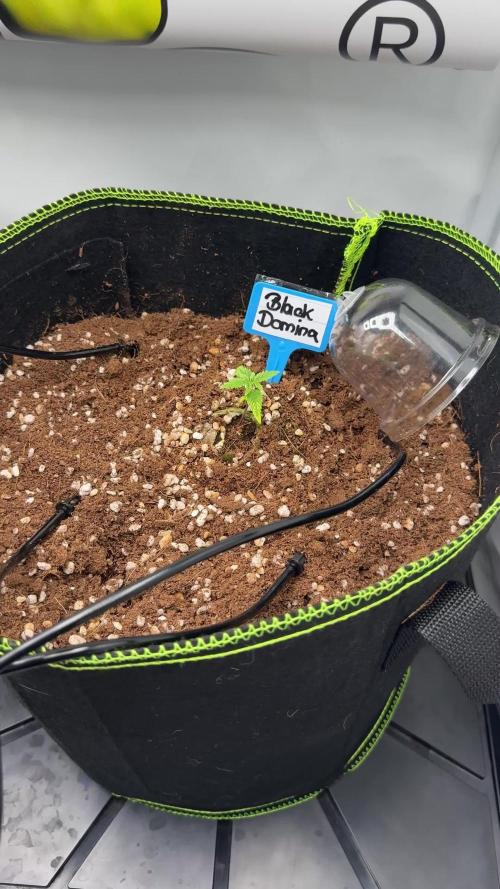
During Week 3, Black Domina is still developing at a slower pace than expected and remains quite small for this stage. However, the plant looks healthy and stable, with no visible signs of nutrient burn, deficiencies, or pest issues.
Growth appears compact, which suggests that the plant is currently focusing more on root development rather than above-ground growth. This can happen with indica-dominant genetics like Black Domina, especially in the early stages. Leaf color is consistent and healthy, indicating that the current feeding level is appropriate.
A mild nutrient mix based on Hy-Pro Coco A & B is being used, keeping EC low to avoid stressing the young plant. The medium is kept evenly moist, and watering is done carefully to prevent overwatering, which could further slow growth at this stage.
While overall size is still small, the plant shows signs of gradual progress and stability. With a stronger root system establishing now, more visible vegetative growth is expected in the coming week.
Likes
15
Share


@Sublyme_ness
Follow
im ceasing all nitrogen now. i can see its now starting to turn leaves yellow. buds are fat and chunky. at least 6 cm across with new expansion going on. lots of orange hairs coming...really looking sharp.
Likes
31
Share


@BudXs
Follow
Autos are starting to color up, and photo mothers are emerged. Spring is muthafuckin sprung


Likes
9
Share


@Ronin716
Follow
Loved it!! Relatively easy going!! Couple off moments but not worth getting into but the smell!!! It’s not super strong where you smell it throughout the house when you burp the jars but she has a very (what I could only reference as sour, sweet and lemony, almost like that lemon pledge your mom use to clean the house with) smell but I love it!!!


Likes
28
Share


Likes
2
Share


@GrowTF
Follow
habe an Tag 40 das Licht von 18/6 auf 12 um gestellt und dann angefangen NoVamax Grow und Novamax Bloom nach dem Düngeschema dosiert.
Wasser wechsel alle 1-2 Wochen
EC und PH wert jeden Tag gemessen und angepasst.( Düngeschema)
Processing
Likes
47
Share


@rhodes68
Follow
10/21 Day 23
Well may be seeing some improvement on Brandy and Maggie from the drench and mag foliar spray. Will spray again tomorrow.
Layla is just lovely and holding off another day on watering, temps have lowered and humidity is up so drying is slow.
Just dont get it but I have decided to go full Coco coir from here on, something aint right
10/22 Fed Layla
Big Bloom 3tsp - Fish Mix 1tsp - CalMag 1tsp - Recharge 0.5tsp - Fish Sh!t 0.5tsp / Gal at 6.5 ph for 0.5 gal
Brandy and Maggie seem to be improving, had to train and gave another foliar spraying nothing else done.
10/24 Update
New Pics - note new growth
Plants beginning to drink more and Maggie showing most improvement. Afraid Brandy will stunt but sure that was going to happen a week ago.
Leaf structure is improving greatly.
Prob will feed in a day or two and another foliar spray at the same time
10/26 Day 28 Finally fed all three girls - nothing much has changed appearance wise and pics tomorrow on new week.
Including initial dose of bloom nuets as hairs are showing strong - no foliar spray until Sunday.
Feeding:
Cal-Mag 5ml - Big bloom 15ml - Fish Mix 5ml - Bio-Bloom 5ml - Fish Sh!t 5ml / gal @6.45 ph for 1 gal (Layla) 0.75 gal (Maggie) 0.5 gal (Brandy) as they are drinking at different rates unfortunately. Final PH is taken after all nuets added, makes a difference.
NOTE:
Since this veg cycle is ending and the plants will be moving to the Flowering tent and this tent will be doing drying duty for the LSD-25 for a few days, time we were getting the Growit Coco coir ready for the Green Crack grow in a week or so. Hydrated the first brick (2 cuft hyd) and am single buffering the coco with 30 ml of cal-mag in four gallons of water for 24 hours.
This will also serve as a safety wash just in case the factory lies :)
Its supposed to be pretty good coco, little if any peat or croutons I can see.
Will do second brick when this one finished and I can store
Looking at using a different system this time around. Hope yall follow along
Went ahead and posted the daily pics of the problem children just for giggles.
Likes
5
Share


@Drtomb
Follow
Started the final week of nutrients. Then ill be switching to flawless finish and pure water the last week.
Saskatoon Berry has been a very pleasant growing experience. Csnt wait for them to fatten up this final 20 days.
Likes
91
Share


@squalino
Follow
Journal de Culture : Frost 1 – "Dora" (Retour de Vacances & Explosion des Buds)
Génétique : Frostbanger (F2 Perso) | Système : Autopot 20L
📣 Remerciements
Un immense merci à toutes les personnes qui suivent ce journal depuis le début ! Un merci tout particulier à@MIA_BIOTABSet à Mrs_Larimar pour leurs précieux conseils et leur accompagnement. Merci à tous pour votre soutien !
🛠️ Configuration Technique & Climat
Éclairage :
Lumatek ATS 300W Pro (réglé à 75%)
Distance lampe/canopée :
50 cm 📉 (Lampe légèrement rapprochée pour suivre l'évolution des têtes).
Climat :
Jour : 25°C / Nuit : 21°C
Humidité (HR) :
Contrôlée via déshumidificateur
Tente :
1m80 de hauteur
📅 Évolution & Entretien : Des bourgeons fermes, des "cornes" et correctif technique
Morphologie et état des fleurs :
Hauteur :
84 cm (+4 cm depuis la semaine dernière, le stretch est définitivement fini, place au gonflement).
Anatomie des têtes :
Les bourgeons grossissent à vue d'œil et sont déjà bien fermes au toucher. Fait amusant visible : les sommités développées des excroissances en forme de "mini-têtes" sur les têtes principales, créant un effet de petites cornes (foxtailing naturel).
Feuillage & Odeur :
Absence totale de sénescence pour le moment. Les feuilles arborent un vert clair magnifique et éclatant. L'odeur est devenue extrêmement forte et surprenante !
Santé :
Quelques légères brûlures de contact sont visibles localement sur de rares pointes de feuilles. Rien d'alarmant : cela est dû à l'évapotranspiration accumulée (la plante qui "transpire") lorsque les feuilles se touchaient ou étaient manipulées.
🚨 Remarque Technique Importante (Retour de Rimini) :
Au retour des 4 jours de vacances, constat d'une eau remontée à un pH de 8 dans le réservoir Autopot.
Cause identifiée :
La présence du bulleur dans la cuve, qui fait grimper le pH de l'eau très rapidement en chassant le dioxyde de carbone. Le réservoir tourne probablement avec un pH trop haut depuis un mois.
Actions correctives immédiates :
Retrait définitif du bulleur de la cuve.
Changement de correcteur pour le PH Down de Plagron (spécial Hydro), réputé pour sa bien meilleure stabilité en réservoir statique.
💦 Nutrition du jour :
Face à des plantes visiblement très gourmandes et prêtes à encaisser, le menu du jour a été augmenté :
Apport :
5 ml de Bio PK 5-8 (Biotabs) (dose augmentée) administrées manuellement par le haut.
Volume d'eau : 1 Litre
pH de la solution 6,3
Le correctif sur le réservoir va faire un bien fou à l'assimilation des nutriments, et avec ce repas de champion (5ml de PK),
Dora a tout ce qu'il faut pour continuer à durcir ses bourgeons !
08/06
apport nutriments
dernier apport de nutriments
5 ml pk 5-8 biotabs dans 1 litres d'eau
arrêter les autopots. passe en mode manuel pour le rinçage 14 jours
je pense que la fin est proche❤️
Processing
Likes
3
Share


@CoC407
Follow
The plants are growing fast, we forgot to check pH in this week but no problems.
Processing
Likes
14
Share


@ParadiseGrower
Follow
*BIG SORRY for the photo, hps light do that.)
🎄AND THESE IS CHRISTMAS, and an happy new years for you... plant is blooming very wel nice hollidays 😌🎄
Likes
14
Share


@Svansson
Follow
Diese Woche mal ein wenig basteln müssen um die Lampe noch etwas höher zu bekommen, da die kleine an der Spitze etwas viel Licht bekommt, so wie es aussieht. Ansonsten finde ich macht sie sich weiter sehr gut. Der Duft ist so geil, das man sofort probieren möchte 🤤😁 bin auf die nächsten Wochen gespannt und freu mich jetzt schon auf die Ernte.
Likes
4
Share

@dinosdarko
Follow
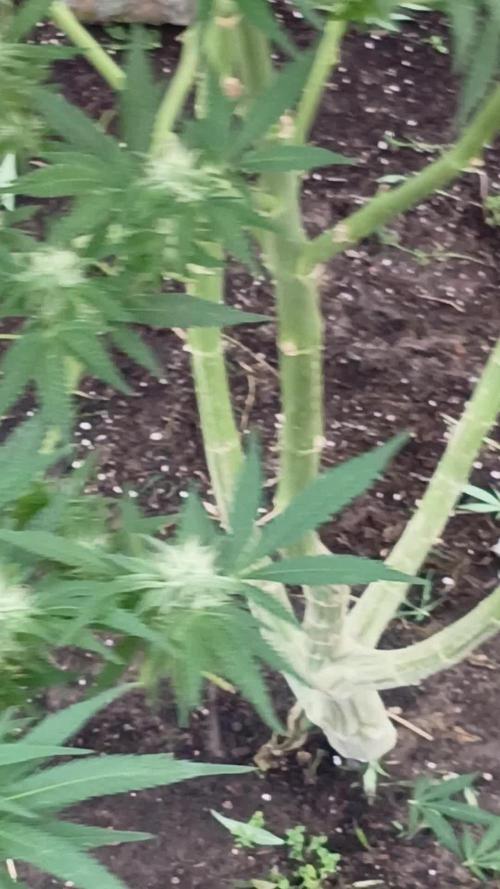
Der halk wird immer mehr zum halk
Anfang 5 woche nach der erste sichbare weise trichomen und sie wächst brutal
Der stam dürchmeser betregt 4,5 cm habe sie auf 3 triebe und der haupttrib behalten sie hat eine breite von 1,6 miter und eine höhe von 2 miter

Likes
142
Share


@MadeInGermany
Follow
Hi everyone 🤗
This week the two Kosher Tangie Kush were harvested by Amsterdam Genetics 😍.
extremely good phenotypes. The blue cheese pheno 2 and 3 were placed in the darkroom according to the video.
These were harvested yesterday, from which the pictures will come in the next update :-).
All others need 2-3 weeks.
I wish you lots of fun with the diary, stay healthy 🙏🏻 and let it grow 🌱


Likes
67
Share


@Ageddd
Follow
This week she is growing more buds every day and yellowing lower leaves, early flowering state...
Feeding schedule is for helping the plant to grow more bud sites in this stage..
Likes
31
Share


@The_Bearded_Grower
Follow
Welcome to 📅Day 15 of veg 3/29/2021 she is fully recovered from my micro top and growing fast under the MH TS 1000. I'm not going the change much at this point nutrient wise as she is doing good and she is still small.
Update 📅Day 17 of veg 3/31/2021 well it looks like she is growing fast and strong I'm very happy with the MH TS 1000 I have high hopes. I decided that at this point I can increase the light output to 60% that gives me a LUX of around 20,000 LUX 💡. The light intensity is much higher then the AGLEX at this point now with the AGLEX light not able to hit 20,000 LUX 💡 without the bloom switch on and I am going to wait till next week for that
Update 📅Day 19 of veg 4/2/2021 she is growing fast and I'm very happy with her progress. I installed the trellis net just above the canopy and over night she is through it lol. Can't wait to see how she does in flower under the Mars Hydro TS 1000💡, at this point I wish I had 2 TS 1000💡 so I could just run them.
that's it for this weeks updates as as always Happy growing🍃 and keep you stick on the ice 🏒


Likes
52
Share


@Ultraviolet
Follow
You don't become confident by shouting affirmations in the mirror, but by having a stack of undeniable proof that you are who you say you are, outwork your self-doubt.
Nitrogen fixation is a chemical process by which molecular nitrogen (N2), which has a strong triple covalent bond, is converted into ammonia (NH3) or related nitrogenous compounds, typically in soil or aquatic systems but also in industry. The nitrogen in air is molecular dinitrogen, a relatively nonreactive molecule that is metabolically useless to all but a few microorganisms. Biological nitrogen fixation or diazotrophy is an important microbe-mediated process that converts dinitrogen (N2) gas to ammonia (NH3) using the nitrogenase protein complex (Nif).[2][3]
Nitrogen fixation is essential to life because fixed inorganic nitrogen compounds are required for the biosynthesis of all nitrogen-containing organic compounds, such as amino acids and proteins, nucleoside triphosphates and nucleic acids. As part of the nitrogen cycle, it is essential for agriculture and the manufacture of fertilizer. It is also, indirectly, relevant to the manufacture of all nitrogen chemical compounds, which include some explosives, pharmaceuticals, and dyes.
Nitrogen fixation is carried out naturally in soil by microorganisms termed diazotrophs that include bacteria, such as Azotobacter, and archaea. Some nitrogen-fixing bacteria have symbiotic relationships with plant groups, especially legumes.[4] Looser non-symbiotic relationships between diazotrophs and plants are often referred to as associative, as seen in nitrogen fixation on rice roots. Nitrogen fixation occurs between some termites and fungi.[5] It occurs naturally in the air by means of NOx production by lightning.[6][7]
All biological reactions involving the process of nitrogen fixation are catalyzed by enzymes called nitrogenases.[8] These enzymes contain iron, often with a second metal, usually molybdenum but sometimes vanadium.
Green clover (Fixation)
White clover (Fixation)
Red Clover. (Fixation)
Yellow Clover. (Fixation, deeper roots)
Sweet Thai Basil. (Terpenes)
Italian Basil. (Terpenes)
Chamomile.(Oil production)
Borage.(Pest attraction taste)
Lavender.(Pest attraction smell)
Marigold(Pest attraction visual)
Mycorrhizae are beneficial associations between mycorrhizal fungi and a plant’s root system. Mycorrhizal fungi spores germinate in the soil, creating filaments (hyphae) that penetrate the root cells, thus establishing a symbiotic relationship. This collaboration leads to the development of both intra-radical and extra-radical networks of filaments, enabling efficient exploration of the soil for enhanced access to nutrients and water. Consequently, these vital resources are transferred to the plant, resulting in numerous benefits for crop cultivation.
Various mycorrhizal products are available in diverse formulations (powder, granular, and liquid), concentrations, and qualities. Ongoing advancements in products, technologies, and research are reshaping our understanding of mycorrhizae. Despite these positive developments, certain misconceptions persist. In the following discussion, we aim to clarify the truths and dispel the myths surrounding mycorrhizae products.
MYTH #1
A HIGHER NUMBER OF MYCORRHIZAE SPECIES MEANS BETTER RESULTS.
Contrary to common belief, having a higher number of mycorrhizae species in a product does not translate to better results; in fact, it often yields the opposite outcome. A plant can sustain only one association with a particular mycorrhizal fungi species. Introducing multiple species creates competition among them, which is not advantageous for the plant. The initial colonizer does not ensure the highest success; instead, it gains precedence. It is recommended to select a product with a concentrated presence of a single mycorrhizae species known for its effective performance, rather than opting for a product with multiple species at lower concentrations.
MYTH #2
ECTOMYCORRHIZAE ARE EFFECTIVE FOR CANNABIS PLANTS.
Although ectomycorrhizae can colonize five to ten percent of plant species, cannabis is not among them. Ectomycorrhizae do not penetrate the root cells; instead, they develop around the roots and on the exterior. For cannabis plants, it is essential to seek out endomycorrhizae. Endomycorrhizae are capable of colonizing 70% to 90% of plant species, including cannabis. Unlike ectomycorrhizae, endomycorrhizae penetrate the root cells, forming structures like arbuscules for the exchange of nutrients and water with the plant.
MYTH #3
WHOLE INOCULANT (PROPAGULES) PERFORM BETTER THAN ONLY VIABLE SPORES.
The propagule count specified on most mycorrhizae products indicates the presence of spores (viable and unviable), hyphae, and root fragments. However, it is crucial to note that only viable spores, those with the capacity to germinate, can successfully colonize a plant’s root system. Spores are to mycorrhizal fungi what seeds are to cannabis plants—a fundamental component enabling fungi reproduction. Consequently, even if a mycorrhizal product boasts millions of propagules, its effectiveness hinges on the presence of viable spores. Without viable spores, the product will not contribute to plant development. Therefore, the genuine value of a mycorrhizal inoculant lies in the quantity of viable spores it contains, as only viable spores can efficiently initiate symbiosis.
MYTH #4
ALL METHODS OF APPLICATION YIELD IDENTICAL RESULTS.
To establish the symbiosis, mycorrhizal fungi spores must be close to the plant roots. The optimal recommendation is to directly apply mycorrhizal inoculant to the roots, either in powder, granular or slurry form. This method ensures maximum proximity between the spores and the roots, facilitating a rapid establishment of symbiosis. Particularly with crops like cannabis, which have a short growing cycle, employing this technique is the most effective way to obtain optimal benefits. Alternatively, techniques such as blending the inoculant with the soil are effective, but there may be a delay in the establishment of symbiosis. This is because the roots need to grow and come into contact with the dispersed spores throughout the growing media.
MYTH #5
MYCORRHIZAE CAN ONLY BE GROWN ON LIVING PLANTS.
While the predominant method for commercially producing mycorrhizae involves growing them on the root systems of living plants (in vivo production), it is not the exclusive nor the optimal technique. In fact, this production approach has notable drawbacks that the “root organ culture” method just does not have (in vitro production). In vitro production occurs in meticulously controlled, aseptic laboratory conditions, allowing for the consistent generation of products that are viable, highly concentrated, species-specific, and free from pathogens. Achieving such precision and quality is impossible when relying on the cultivation of mycorrhizal fungi on plants exposed to external conditions.
In conclusion, it is crucial to take all these factors into consideration when choosing the appropriate product for your crop to fully harness the wide array of benefits provided by a high-quality mycorrhizal product.
STRONGER PLANT – Stress resistance.
FASTER GROWTH – Improve plant structure and shorter veg time.
INCREASE YIELD – Overall more biomass.
IMPROVED QUALITY – Increase cannabinoids and terpenes content.
