


Likes
Comments
Share


@PiusWaxis
Follow
Here we are at the end of my plant's wonderful eleventh week of flowering, another week full of exciting developments and new discoveries.
The constant and unstoppable growth of the plant has come to an end, showing a beauty and vitality that are a true spectacle for the eyes. 😎
The abundant layer of resin that has formed is a clear sign of the health and well-being of the plant, once again confirming the benefits of the premium nutrients used throughout the entire growth cycle.
TrollMaster's "TENT-X" environmental control system continues to prove its worth, precisely maintaining optimal temperature and humidity levels to promote vigorous plant growth.
The combination of advanced and precision technologies ensures that plants can thrive in a controlled and conducive environment😎
I am thrilled to share with you the latest video showing the temperature, humidity and VPD trends of this last week of flowering, providing further demonstration of the extraordinary performance of the TrollMaster control system and its synergy with the other elements of the grow room.
With each week that passes, the anticipation for the new discoveries and challenges that await us continues to grow.
With the constant support of Plagron nutrients, trust in the TrollMaster control system and the excellence of MEDIC GROW LED lighting, I am sure that I am always ready to face any challenge!
Thank you again for being by my side in this extraordinary adventure, dedicated to exploring the wonders of plant cultivation. Together we continue to look to the future with confidence and enthusiastically anticipate the successes that each new week holds for us. 💪👽🌱✨
REVIEW TENT-X:
I was pleasantly surprised by the effectiveness and functionality of the TROL MASTER!
This device is simply amazing, as it has allowed me to monitor the environments I use it in accurately and efficiently.
One of the most impressive features of this device is its ability to operate LED lights easily and intuitively. Thanks to its user-friendly interface, I could easily customize the lighting of my rooms according to my tastes and different situations. I particularly appreciated the possibility of programming the sunrise/sunset simulation, thus creating a more natural situation.
But that's not all: the device goes further and manages to keep me constantly informed about the humidity and temperature of the surrounding environment. This feature has proven to be very useful, especially in times when I am not present.
I was able to set humidity limits, so that the device would immediately alert me if the levels exceeded the desired threshold. This allowed me to intervene promptly and avoid excessive oscillations.
The accuracy of the temperature measurements was another welcome surprise. The device is equipped with a high precision sensor that allows me to constantly monitor the temperature of the rooms. Here too I was able to set temperature limits, allowing me to be notified immediately if they were exceeded.
Overall, I was really satisfied.
The TENT-X exceeded all my expectations. Its ease of use, precision of measurements and possibility of customization make it an indispensable tool for those seeking to monitor and optimize environmental conditions.

Likes
23
Share


@Mr_McNasty408
Follow
Day 29 (1/4/21)
Nutes:
Veg A: 3.83 g/gal
Veg B: 2.58 g/gal
PPM: 1050
Water temp: 62°F
pH: 5.8
Day 30 (1/5/21)
I transplanted all 8 plants today from 0.05gal pots to 1gal pots and watered. The light is 25” away from the plants now but using a lux meter I adjusted the power of my lights to be equal to what it was before.
Nutes:
Veg A: 3.83 g/gal
Veg B: 2.58 g/gal
PPM: 1050
Water temp: 60°F
pH: 5.8
Day 31 (1/6/21)
Nutes:
Veg A: 3.83 g/gal
Veg B: 2.58 g/gal
PPM: 1050
Water temp: 60°F
pH: 5.8
Day 32 (1/7/21)
Nutes:
Veg A: 3.83 g/gal
Veg B: 2.58 g/gal
PPM: 1050
Water temp: 60°F
pH: 5.8
Day 33 (1/8/21)
Nutes:
Veg A: 3.83 g/gal
Veg B: 2.58 g/gal
PPM: 1050
Water temp: 60°F
pH: 5.8
Day 34 (1/9/21)
Nutes:
Veg A: 3.83 g/gal
Veg B: 2.58 g/gal
PPM: 1050
Water temp: 60°F
pH: 5.8
Day 35 (1/10/21)
Nutes:
Veg A: 3.83 g/gal
Veg B: 2.58 g/gal
PPM: 1050
Water temp: 60°F
pH: 5.8
Likes
22
Share


@Spacedout
Follow
She’s hanging to dry and then will go into jars for a few weeks to cure. ✅
About 100g in all dry weight.
These buds are dense really sticky and stinking the place out. Burping daily still…👌🏼

Processing
Likes
1
Share


Likes
31
Share


@kingmcdaid
Follow
Another week down week 5 flower has brought huge gains in bud growth the structure of critical kush is awesome. And the best bud production is yet to come this should be a healthy yielding plant stay tuned !

Likes
2
Share


@Ninjabuds
Follow
Bubble og man these ladies loved being topped they were not growing the fastest before topping but after getting topped they have really been stretching out they very much have a scrog potential the branchs bend easily and have good distance between nodes to work with
The day has come and it's time to flip these ladies to flower. I was planning on letting them go untill Friday and let the smaller ones grow just a bit more but they will be fine. I have the eternity cup contest in mind and I'm thinking timing so I need to get these lady done and out my tent lol. This past week I turned the light up alot getting them ready to flower they have grown a bunch inhavendone lst maybe 5 it 6 times on the branchs and they arw nit bendy anymore that will help durring flower.


Likes
28
Share


@HIAZ_urbanbudfarmer
Follow
Started germinating Tropicana cookies & Orange Sherbet F1 FAST FLOWERING from Fast Buds, germinated in 24 hours, planted into jiffy starters & sprouted within 24 to 48 hours. So far I've been happy with Fast Buds genetics 100% success rate, 6 out 6 germinated FF1 & Auto's. Looking forward to see how these fast flowers go? This FF1 grow will start off my perpetual grow cycle again.


Likes
6
Share

@Splashy
Follow
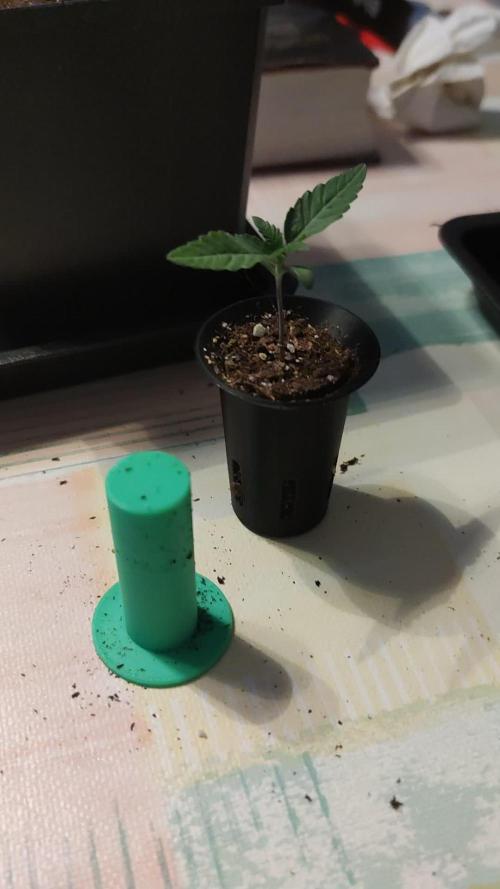
Die Samen wurden vor 2 Tagen direkt ins Substrat gesteckt und mit calmag und ph angeglichen Wasser gewässert. Das nach 2 Tagen schon die köpfe raus gucken ist stark.
10.03.2026
Sie sind beide nach 2 Tagen aus der erde gekommen, so schnell ist bei mir noch kein Samen oben raus gekommen.
16.03.2026
Heute wurden sie in 1l töpfe gesetzt mit biobizz Light mir und mit calmag ausgeglichenem Wasser angegossen welches ein ph von 6,5 hat. Bisher sehen die kleinen super aus,bin wirklich begeistert.
Likes
19
Share


@Cardiffgrown
Follow
Flower starting to form now for the fast buds the white widow is miles behind and so is the ww, first time in a new room & the mega pots has resulted in plants to big for my room the autopot ones look alot better tho get there eventually 😎soon hopefully the purple lemonade smells incredible.


Likes
8
Share


@Oldwied
Follow
Day 50
Merry christmas
I can hardly wait to roll the flowers into paper.
1-2 weeks untill haverst.
Happiness looks very heavy, give her a little defoliation.
Kush beginns to purple.

Likes
28
Share


@CrystalMeph
Follow
Rough week. Had a friend water for me while we were away. Didn't take my syringe watering seriously, fully saturated my little piggy and the roots are currently recovering from drowning... Is what it is, she'll recover. Already looking better than yesterday.
Bud sites are still looking great, happy overall with the canopy still. Now to get her back to full health.
Hope everyone had a smoother week than me, and all competition ladies are happy and healthy. Back to the farm for me. ✌️🌱
Likes
2
Share


@Ultraviolet_
Follow
67 days since April 16th, 2026
We become aware at such times of man's wonderful ability to bring seemingly unrelated elements into harmonic balance, and receive a glimpse into a world where everything exists in conscious sympathetic attunement to everything else. When we listen to a piece of music that seems to strike a beautiful chord somewhere inside us, or view a painting that simply glows with harmonic awareness well executed, we probably do not spare much time to contemplate the wonderfully intricate combination of vibrations that our sensors make it possible for us to perceive. We tend to appreciate the relationship between the parts of something by an awareness of the harmony or dissonance of the whole. This ability enables us to say "what a beautiful house!" instead of "analysis has proven that this collection of building materials exhibits certain elements of harmonic proportion." While this ability to instinctively appreciate the beauty of true harmony has an important role to play in evolution, a more analytical understanding of the laws involved can be most useful. This is especially so if we wish to create works of art where each part exists in true harmony, not only with the other part of that particular whole, but with the universe within which the creator and the created exist.
Everything vibrates. From the most dense matter to the most subtle cosmic rays, everything which our senses allow our thoughts to become aware of, can be specified in terms of wavelength or frequency of vibration. These two terms define the same thing, but from different points of view.
The following are the approximate wavelengths of various energy carriers:
Cosmic rays 0.000,000,001 mm
Gamma rays 0.000,000,1 mm
X rays 0.000,500 mm
Ultraviolet rays 0.003 mm
Visible light 0.006 mm
Infrared 0.01 mm
Sound waves 1 meter
Radio waves 300 meters
Violet light 400 nm to 450 nm
Blue light 450 nm to 500 nm
Green light 500 nm to 570 nm
Yellow light 570 nm to 590 nm
Orange light 590 nm to 610 nm
Red light 610 to 700 nm
1 nanometer (nm) = 0.000,000,1 cm = 1/10,000,000 cm
If a guitar string is plucked and we hear a sound, it is not too difficult for the human mind to associate this sound with the vibration of the guitar string. With color it is quite different. It is difficult for us to conceive that the color of a substance is not an inherent property of the substance itself, but an indication picked up by our senses of that substance's ability to absorb or reflect the light which happens to be shining on it at that moment. Neither the matter nor the light is colored. What happens is that the brain learns to differentiate between the frequencies reflected or transmitted by the substance the eyes are focused on. The same thing happens with sound. When we say "Oh! Listen, they're playing my favorite song," what we really mean is: "My brain has stored within it a particular pattern of frequencies. I have compared the new information being received with this stored pattern and have deduced the answer that the two patterns are similar within certain specified tolerances." The 'pleasure' involved could have something to do with our running the pre-recorded pattern at the same time, in 'sympathy' with the new pattern as it is received.
The word sympathy describes very well our ability to appreciate color and sound. It also describes the reason behind certain elements of harmony. For instance, if a substance vibrating at 100 cycles per second (tone 1) is in the proximity of another substance vibrating at 200 cycles per second (tone 2), we could perceive, if we had the right equipment, a certain sympathetic relationship between the two.
We will see from this that there is a uniform doubling of the first tone seen in the second. At various points along the waves, the two are the same in amplitude. At other points, they are at opposite poles to each other. This doubled frequency has more points of similarity to the original than any other frequency except the original itself. If the equipment we had available for measuring these two frequencies was a soundboard amplifier and a pair of ears, then we would hear what would sound to us like one tone. If we had the opportunity to hear one at a time, we would hear that although they sound the same, one is higher in pitch than the other. This characteristic of 'the same but different in pitch', musicians have called the octave. Any two tones produced where one has exactly doubled the frequency of the other is called an octave. Speaking in ratios, an octave would appear then as the ratio 2:1 or 1:2, depending on whether we are talking of an octave up or down.
A single note produced by almost any instrument will contain more than one wavelength or frequency. It will have a dominant frequency, the wavelength of which we would call the note's 'fundamental' or 1st harmonic. It will also have a varying number of upper harmonics, gradually fading in intensity into infinity or silence.
Natural harmonics always have the same pattern of intervals between them. The interval between the 1st and 2nd harmonic is a perfect octave; between the 2nd and 3rd a perfect fifth; between the 3rd and 4th a perfect 4th; and so on, the intervals becoming smaller and smaller until they lose any relationship with the western 12 tone scale as it exists at the moment. Just as an octave has certain elements of sympathy with its fundamental, so some intervals have been noted to be more perfectly in sympathy with the fundamental than others. The ratio of the 'perfect 5th' or interval of 7 semitones, as it occurs in the harmonic series, is 3:2 or 2:3, while that of the 'perfect fourth" is 4:3 or 3:4. All the tones in the western 12 tone scale can be expressed in terms of the ratio between the upper tone and its fundamental. This would seem to be an ideal way of generating a scale from any given fundamental and several attempts have been made to do this, the Pythagorean system being probably the most well known. Although when working with a single tone instrument playing on its own, the Pythagorean formula works wonderfully well, if we had several instruments tuned this way together and asked them to play almost any western music, we would find that at times they sounded quite out of tune to each other.
The lack of flexibility of the various scale systems based on the harmonic series has led to what is known as the 'tempered' scale. This uses as its primary unit of interval the ratio of the octave or 2:1. It then proceeds to divide the interval between any fundamental and its upper octave into 12 smaller intervals by applying the ratio: two to the one-twelfth power, to one (21/12:1). This equals 1.059463094, so by multiplying any frequency by this number, we will obtain the tempered semitone next up from our fundamental. We will also find that any tone twelve semitones up from any other tone, in a scale generated in this way, will have exactly double the frequency.
If we took the note middle C on a piano and halved the wavelength, we would have the note C one octave above. If we halved this, we would have the C above, and so on. However, within about 6 octaves, we would find that although a 'sound' was being produced, no human ear could perceive it. If we kept on going, halving and producing upper octaves of our fundamental C, we would proceed through the infrared band, into the visible light spectrum. If we happened to be outside during the day, we would, for one octave only, see the note C with our eyes. The next octave above would already be in the ultraviolet band, and outside the eye's sensitivity range. If we can think of color as being an indication of a substance's vibratory rate or wavelength, we may begin to see a relationship that could exist between the color and sound spectrums.
The logical extension of what has so far been said is that there exists a scale in the color spectrum that corresponds exactly to the scale in the sound spectrum, each color tone being an octave of the equivalent note in the sound range.
This is not the end of the story but only the beginning. If we can for the moment accept that any wavelength in one band has upper and lower octave stretching out to infinity, then the next question is 'fine, but what shall we use as our fundamental? A particular color? A particular sound frequency?' The musicians among us will probably say 'A 440'. This means that the note A should vibrate at 440 Hertz, or 440 times per second. They would tell us that this is standard pitch has been adopted by most orchestras around the world; pianos are tuned to it, instruments are constructed to formulas based on it, and so to them it would probably seem the most appropriate place to begin. Some of these musicians may know of the battle that is still raging with regards to this being the standard, but few would know why A = 440 Hz was chosen except that it worked when it was set to be a suitable compromise between the many different pitches in use at the time.
432 Hz is said to be mathematically consistent with the patterns of the universe. Studies reveal that 432 Hz tuning vibrates with the universe’s golden mean PHI and unifies the properties of light, time, space, matter, gravity, and magnetism with biology, the DNA code, and consciousness. When our atoms and DNA start to resonate in harmony with the spiraling pattern of nature, our sense of connection to nature is said to be magnified.
Another interesting factor to consider is that the A=432 Hz tuning correlates with the color spectrum, while the A=440 Hz is off. Audiophiles have also stated that A = 432 Hz music seems to be non-local and can fill an entire room, whereas A=440 Hz can be perceived as directional or linear in sound propagation.
Once you adopt the idea that sound (or vibration in general) can have an equalizing and harmonizing effect (as well as a disturbing effect), the science of harmony can be applied to bring greater harmony into one's life or tune to specific energies. There is a form of absolute and relative harmony. Absolute harmony can, for example, be determined by the tuning of an instrument. The ancients tuned their instruments at an A of 432 Hz instead of 440 Hz - and for a good reason. There are plenty of music examples on the internet that you can listen to in order to establish the difference for yourself.
Attuning the instrument to 432 Hz results in a more relaxing sound, while 440 Hz slightly tenses up the body. This is because 440 Hz is out of tune with both macro and micro cosmos. On the contrary, 432 Hz is in tune. To give an example of how this is manifested microcosmically: our breath (0,3 Hz) and our pulse (1,2 Hz) relate to the frequency of the lower octave of an A of 432 Hz (108 Hz) as 1:360 and 1:90.
It is interesting to note that 432 Hz was the standard pitch of many old instruments and that it was only recently (19th and 20th century) the standard pitch was increased. This was done in order to be able to play for bigger audiences. Bigger audiences (more bodies) absorb more of the lower frequencies, so the higher pitch was more likely to “cut through”. One of the oldest instruments of the world is the bell ensemble of Yi Zeng (dated 423 BC), tuned to a standard F4 of 345 Hz, which gives an A= 432 Hz. The frequency of 345 Hz is that of the platonic year! Similarly, many old organs are tuned in A=432 as well; for example, St. Peter’s Capella Gregoriana, St. Peter’s Capella Giulia, S. Maria Maggiore in Rome.
Maria Renold’s book “Intervals Scales Tones and the Concert Pitch C=128 Hz” claims conclusive evidence that 440 Hz and raising concert pitch above scientific “C” Prime=128 Hz (Concert A=432 Hz) disassociates the connection of consciousness to the body and creates anti-social conditions in humanity.
The difference between concert pitch A=440 Hz and Concert A=432 Hz is only 8 cycles per second, but it is a perceptible difference of awareness in the human consciousness experience of the dream we share called existence.
Processing
Likes
8
Share


@GrownwithLED
Follow
Both plants have almost stopped growing in heigth now and are in full flowering mode now. Barbarian (=AK-47 x Barbara Bud) Plant #1 is 15 cm shorter than plant #2, but a little bushier. Both have grown very well and are strong and healthy. They get more and more flower clusters now and start to fill up all branches. Trichomes start to appear all over...the plants start to get sticky and develop a weak sweet aroma now. Its time to take off the biggest fan leaves now for defoliation, I took a round of pics before and after.


Likes
17
Share


@BLAZED
Follow
W15 (8-5 to 14-5)
8-5
Temperature: 26.5 degrees (lights on) 20.1 degrees (lights off)
Humidity: 58% (highest) 45% (lowest)
Opened the reservoir for a couple of minutes.
Set the light to 80% strength.
9-5
Temperature: 28 degrees (lights on) 21 degrees (lights off)
Humidity: 61% (highest) 42% (lowest)
No pictures.
10-5
Temperature: 28.6 degrees (lights on) 21.4 degrees (lights off)
Humidity: 60% (highest) 40% (lowest)
Added 10L to the reservoir.
Dry weight:
Chemdog #1: 3.6 kg.
Chemdog #2: 4.1 kg.
11-5
Temperature: 29.8 degrees (lights on) 20.7 degrees (lights off)
Humidity: 59% (highest) 31% (lowest)
No pictures.
Opened the reservoir for a couple of minutes.
12-5
Temperature: 30.1 degrees (lights on) 21.2 degrees (lights off)
Humidity: 51% (highest) 36% (lowest)
Opened the reservoir for a couple of minutes.
13-5
Temperature: 31 degrees (lights on) 21.8 degrees (lights off)
Humidity: 53% (highest) 40% (lowest)
No pictures.
Opened the reservoir for a couple of minutes.
14-5
Temperature: 28.7 degrees (lights on) 20.6 degrees (lights off)
Humidity: 60% (highest) 39% (lowest)
Dry weight:
Chemdog #1: 4 kg.
Chemdog #2: 5.6 kg.
Added 8L to the reservoir.
Opened the reservoir for a couple of minutes.

Likes
12
Share


@Jaindoh
Follow
Week 6 day 2:
Week 6 Video (Clock Dial LST Tech): https://www.youtube.com/watch?v=lz-Z-PbSFWk
Tied the lower branches down to the rim of the pots to space them out for flowering and ensure flat, level canopy. Definitely going for at least 8 weeks, maybe 9-10, before the flip. Want to root out these 5.4 gallon air pots and see what kind of yield I can get.
Removed first node of each branch entirely & a few scattered leaves now shading, topped all but 1 of the plants at the pot edge; A couple didn't quite make it that long because amazon decided to lose my soft ties and the wire ties cut through the stem. It'll be fine either way. Not happy with the runty two, but three out of five are gorgeous. Shame there's little point in keeping a clone mother with a 6 plant limit.
Only Recharge once this week because I'm too snowed in to go get purified water; the PPM here is already 660-700, didn't want to add much to the water so I just put bio rhizotonic and pHed it.
Updates will happen live @ https://twitch.tv/jaindoh and be saved under my vod highlights. Aiming to make super introductory tutorials (as I am no Guru) and get constructive feedback on my techniques. Trying to convert smokers to growers!
