








@Mr_nugs_lover_David
Volgen
This lady is making me enjoy a lot her fragrance that come from her flowers, very good strain, the 3 phenos of ak420 smell exactly the same, very sweet and floral nugs, and they're starting to get very compact and dense, let's see how she keeps developing her beautiful flowers everybody! Hope you have enjoyed this journey as much as me! 👨🌾💚❤️💛🔝


@Waveform
Volgen
Day 17 (starting Aug. 2nd afternoon): Will water them with a lightly enhanced RO water that was imprinted with frequencies via a PEMF coli for about one day when their day starts.
After being away over the extended weekend, on day 20 ladies have grown very nicely. I topped nr# 1 and #2 after I took the photos and will give them a bit of water with Root Complex to compensate for the shock later. Sadly my brilliant control equipment has crashed completely and will not even take a photo currently. Yikes. Hope I can get it back alive this week again. Also turned the left light up by another 20%, now running at 40 W, and lifted it a bit. Eye inspection told me lights were lower here and ladies can get a bit more.
At the end of their day 20, they seem to have survived the topping well. I managed to cut right above the new nodes which are already growing. Ladies are at 20 cm height before going to sleep.
Day 21 shows great growth again, with lady #1 being at 22 cm now and lady #2, while being a bit less tall, extremely good side branch development. I hope that the rearranged lighting on the left side of the tent will make #1 grow a bit bushier too.
Besides from that, I am really happy I tested Hesi HPE. I had such enormous success with room plants that made me want to see how Cannabis plants react to it. It will not add much to salinity, so I dared to add it quite early. While the photos are processed to compensate the lighting, I did not add much to saturation, so leaves are indeed of a very vivid, luscious green and ladies looking extremely healthy. Speed of growth has increased too as the added video shows. It also tells me lighting is enough – they are turning their leaves away right at the end of their day. I am really uncertain if I will change to usual Hesi grow fertiliser at all …
Did a bit of LST to the lowest branches of lady #2 which spread almost to the border of her pot.
Both temporary girls will leave the tent soon, so that the competitors will have maximum space to develop.
Day 22, end of week 3:
Outside girl went to get fresh air from now on. Wishing her luck, good weather and not a single male in the vicinity.
I rearranged the lights and positioned them a bit higher. First preflower signs appeared on the ladies, so I will change the lighting phase when I return next week. Currently, I have them at 18/6, 45 cm above heads, with 80% running to a total of 80 W.
I wasn’t so lucky topping #2. She has only one "top side" branch now … But grows extremely well, so ok!


@RastaRick
Volgen
Coming on well. Turing into monsters... I need a bigger light. Day 45 got second dose of bio pk 5-8. I have a bad feeling i will have to do 3 separate harvest days hahaha


@BudsBanditUK
Volgen
Week 1 of veg, fast growth and plant is looking healthy. Will start feed in a few weeks along with some training. I am excited about this one. Cant wait to see the end result.


@MT_Farmer
Volgen
Still only watering ph'd water. The plants are actually quite different, the one in the front seems to expand out towards the sides much more the the one in the back. Also the colors of teh leaves are different


@So_sa_do_si_do
Volgen
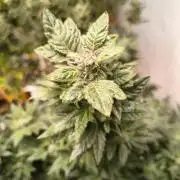
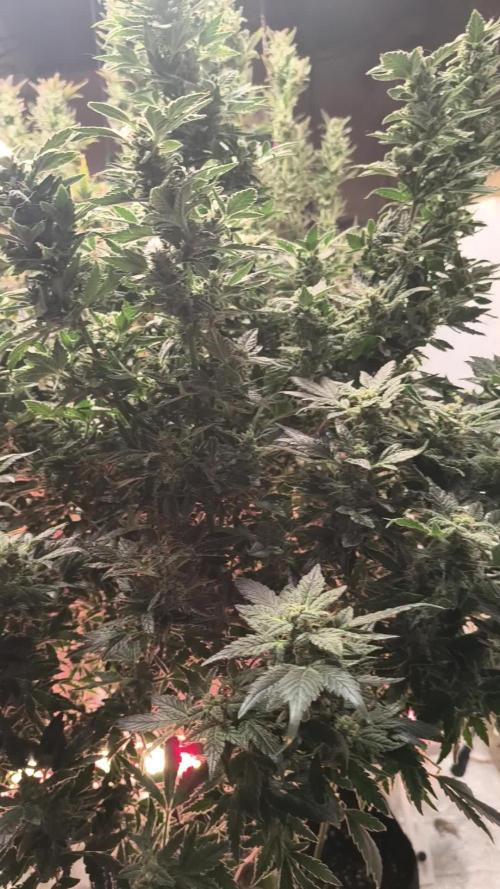
Whelp figured out my PH meter was not reading correctly which means I was not balancing the PH of my water correctly....that being said I had been using RO water that *read* it was testing around 7.0, so I was using PH down to 6.5
5/27 - Decided to top the plant. Again with this being my first grow, this was slightly nerve-racking
5/28 - Seems I didn't mess up the top chop, woooh!
I tested the PH of my soil today(5.6), if that even tells me anything(I find 2 articles that say it doesn't and another 2 that say the opposite...so that's magical)
and ended up just buying a few gallons of distilled water from the store since I didn't want to be running my RO system for my plant and the others in my house.(made sense in my head at the time)
Fed a dose of nutrients in the feeding tonight. I believe I was underwatering my plant.
5/29 Forgot to take a picture because I thought I might have overfed the nutes, on the night before.., So I spent the night researching info and trying to figure out if that was the case and how to correct it. But again since I am new to this, I have no clue lol. It also seems I had bumped up the light power from 50% to 100% some how the night before. Ended up dropping it down to 70% power.
5/30 I took the photo, then tied down the main stem. worries of overfeeding have subsided for now...
6/1 Looking extra bushy today. Holding off on defoliation, unless someone tells me otherwise. I am trying to hold off for a few days on doing anything more that could stress out my plant.


@Mrdub
Volgen
This girl is booming along colas starting to swell even more trichome coverage starting to reeks of rotten fruit kinda burns my nose a bit lol looks like she only has a few weeks left still waiting for the fade to start setting in loving these purple tips I'm going to get these branches spread out to get more light to inner colas she's so bushy don't look like I defoliated her but I did the added calmag had really helped I haven't seen any calmag spots so far running 6.2 ph lights at 100 percent give her a gallon of water every couple days now that I'm in late flowering I run one 24 hr cycle then let her rest for 8 hrs stopped using recharge jus feeding her heavy now starting to taper off so I can strating hitting her with the carbo flush and getting her ready for harvest so here's to another week of growing lfg



@ClydeGrows
Volgen
Seed was sown today ✨ 10/11 🇨🇦
Helmet on the rise 13/11
Good luck everyone!
Edit 24/11: I pulled the trapped seedling and sowed a new seed today... It's now a Seedsman freebie- critical+ 2.0 auto 🤙


@musashi_miyamoto
Volgen
Both popped after 36 hours, then put in soil - they popped out of the soil in less than 24 hours - literally none of my seeds (probably germinated 10 seeds) have failed in intratuin soil, it's amazing. Since i'll be transplanting in a few days anyway, i put them together in a 5L pot. made sure to get a good amount of water in the bottom 2/3 of the soil so the roots have something to reach for.
Now they're "under" (more to the side lol) my 45W LED, which seems to have worked for other seedlings. 16/8 light schedule, need my sleep


@gr3g4l
Volgen
Esta semana podemos empezar a diferenciar claramente la formación de cogollos de unas u otras variedades.
AMARETTO TARMAC
Fruto del cruce entre Amaretto Sour y Apollo Black Cherry, esta genética de dominancia sativa promete un efecto de altos vuelos, cerebral y estimulante, que despierta la creatividad.
MACK&CRACK The Mac (AKA Mac1 AKA miracle alien cookies) x Green Crack . De las pocas genéticas verificadas independientemente con más del 30% de THC.


@ArtisticGrown
Volgen
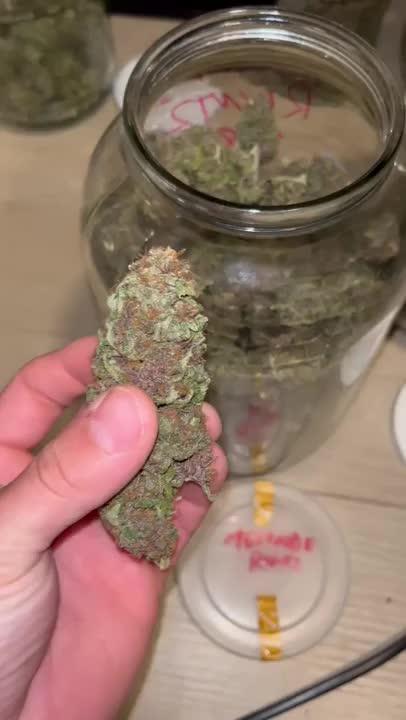
Hello, hope all is well! I’m going to be growing this clone that I got off my og kush plant that’s in flower now. I took the clones about 3 weeks ago, recently saw her root growth and transplanted her to a bigger pot for growth In the veg! I really like the genetics of the og kush. Wishing for a good week of root growth and stability! Happy growing


@ZhulenejJohny
Volgen
A je to konec dámy a pánové. Byl to náročnej grow skrz vedra, ale s výsledkem jsem spoko. Tak zase u dalšího dobrodružství! Peace 👽




@Ultraviolet
Volgen
Green light is radiation with wavelengths between 520 and 560 nm and it affects photosynthesis, plant height, and flowering. Plants reflect green light and this is why they appear green to our eyes. As a result, some growers think that plants don’t use green wavelengths, but they actually do!
In fact, only around 5 – 10% of green light is reflected from leaves and the rest (90 – 95 %) is absorbed or transmitted to lower leaves [1].
Green wavelengths get used in photosynthesis. Chlorophyll pigments absorb small amounts of green wavelengths. Light that doesn’t get absorbed is transmitted to leaves that are shaded out from direct light. This means that leaves at the bottom of the canopy get more green light than leaves at the top. A high proportion of green wavelengths compared to other colors tells lower leaves that they are being shaded out, so they are able to react accordingly. Lower leaves may react by opening or closing their stomata or growing longer stems that help the leaves reach brighter light [1, 2, 3].
When it comes to growing cannabis, many cultivators are interested in the quality of light used for the flowering stage. In many plants, flowering is regulated by two main photoreceptors: cryptochrome and phytochrome. Both photoreceptors primarily respond to blue light but can also respond to green, although to a lesser extent. Green can accelerate the start of flowering in several species (although cannabis has yet to be tested) [1, 4, 5]. However, once flowering has begun, it’s important to provide plants with a “full spectrum” light that has high amounts of blue and red light, and moderate amounts of green, in order for photosynthesis to be optimized.
Green light mediates seed germination in some species. Seeds use green wavelengths to decide whether the environment is good for germination. Shade environments are enriched in green relative to red and blue light, so a plant can tell if it is shady or sunny. A seed that senses a shaded environment may stay dormant to avoid poor growing conditions [1]. Some examples of plant species where researchers have documented this response are: ryegrass (a grass that grows in tufts) and Chondrilla (a plant related to dandelion) [1, 6].
Although green wavelengths generally tell plants NOT to germinate, there are some exceptions! Surprisingly, green wavelengths can stimulate seed germination in some species like Aeschynomene, Tephrosia, Solidago, Cyrtopodium, and Atriplex [1, 6, 7].
Of course, light is not the only factor affecting seed germination – it’s a combination of many factors, such as soil moisture, soil type, temperature, photoperiod, and light quality.
When combined with red and blue light, green can really enhance plant growth [1, 8]. However, too much green light (more than 50% of the total light) can actually reduce plant growth [8]. Based on the most current research, the ideal ratio of green, red, and blue light is thought to be around 1:2:1 for green:blue:red [9]. When choosing a horticultural light, choose one that has high amounts of blue and red light and moderate amounts of green and other colors of light.
Not many studies can be found about the effect of green light on cannabis growth or metabolism. However, if one reads carefully, there are clues and data available even from the very early papers.
Mahlberg and Hemphill (1983) used colored filters in their study to alter the sunlight spectrum and study green light among others. They concluded that the green filter, which makes the environment green by cutting other wavelengths out, reduced the THC concentration significantly compared to the daylight control treatment. It has been demonstrated that green color can reduce secondary metabolite activity with other species as well. For example, the addition of green to a light spectrum decreases anthocyanin concentration in lettuce (Zhang and Folta 2012).
If green light only reverses the biosynthesis of some secondary metabolites, then why put green light into a growth spectrum at all? Well, there are a couple of good reasons. One is that green penetrates leaf layers effectively. Conversely red and blue light is almost completely absorbed by the first leaf layer.
Green travels through the first, second, and even third layers effectively (Figure 2). Lower leaf layers can utilize green light in photosynthesis and therefore produce yields as well.
Even though a green light-specific photoreceptor has not yet been found, it is known that green light has effects independent from the cryptochrome but then again, also cryptochrome-dependent ones, just like blue light. It is known that green light in low light intensity conditions can enhance far red stimulating secondary metabolite production in microgreens and then again, counteracts the production of these compounds in high-intensity light conditions (Kim et al. 2004). In many cases, green light promoted physiological changes in plants that are opposite to the actions of blue light. In the study by Kim et al. blue light-induced anthocyanin accumulation was inhibited by green light. In another study it has been found that blue light promotes stomatal opening whereas green light promotes stomatal closure (Frechilla et al. 2000). Blue light inhibits the early stem elongation in the seedling stage whereas green light promotes it (Folta 2004). Also, blue light results in flowering induction, and green light inhibits it (Banerjee et al., 2007). As you can see, green light works very closely with blue light, and therefore not only the amount of these two wavelengths separately is important but also the ratio (Blue: Green) between these two in the designed spectrum. Furthermore, green light has been found to affect the elongation of petioles and upward leaf reorientation with the model plant Arabidopsis thaliana both of which are a sign of shade avoidance symptoms (Zhang et al. 2011) and also gene expression in the same plant (Dhingra et al. 2006).
As mentioned before, green light produces shade avoidance symptoms which are quite intuitive if you consider the natural conditions where the plants grow. Not all the green light is reflected from the highest canopy leaves in nature but a lot of it (50-90%) has been estimated to penetrate the upper leaves at the plant level ((Terashima et al., 2009; Nishio, 2000). For the plant growing in the understory of the forest green light is a signal for the plant of being in the shade of a bigger plant. Then again, the plants growing under unobstructed sunlight can take advantage of the green photons that can more easily penetrate the upper leaves than the red and blue photons. From the photosynthetic pigments in higher plants, chlorophyll is crucial for plant growth. Dissolved chlorophyll and absorb maximally in the red (λ600–700 nm) and blue (λ400–500 nm) regions of the spectrum and not as easily in the green (λ500–600 nm) regions. Up to 80% of all green light is thought to be transmitted through the chloroplast (Terashima et al., 2009) and this allows more green photons to pass deeper into the leaf mesophyll layer than red and blue photons. When the green light is scattered in the vertical leaf profile its journey is lengthened and therefore photons have a higher chance of hitting and being absorbed by chloroplasts on their passage through the leaf to the lower leaves of the plant.
Photons of PPFD (photosynthetic photon flux density) are captured by chlorophyll causing an excitation of an electron to enter a higher energy state in which the energy is immediately passed on to the neighboring chlorophyll molecule by resonance transfer or released to the electron transport chain (PSII and PSI). Despite the low extinction coefficient of chlorophyll in the green 500–600 nm region it needs to be noted that the absorbance can be significant if the pigment (chlorophyll) concentration in the leaf is high enough.
The research available clearly shows that plants use green wavelengths to promote higher biomass and yield (photosynthetic activity), and that it is a crucial signal for long-term developmental and short-term dynamic acclimation (Blue:Green ratio) to the environment. It should not be dismissed but studied more because it brings more opportunities to control plant gene expression and physiology in plant production.
REFERENCES
Banerjee R., Schleicher E., Meier S. Viana R. M., Pokorny R., Ahmad M., Bittl R., Batschauer. 2007. The signaling state of Arabidopsis cryptochrome 2 contains flavin semiquinone. The Journal of Biological Chemistry 282, 14916–14922.
Dhingra, A., Bies, D. H., Lehner, K. R., and Folta, K. M. 2006. Green light adjusts the plastic transcriptome during early photomorphogenic development. Plant Physiol. 142, 1256-1266.
Folta, K. M. 2004. Green light stimulates early stem elongation, antagonizing light-mediated growth inhibition. Plant Physiol. 135, 1407-1416.
Frechilla, S., Talbott, L. D., Bogomolmi, R. A., and Zeiger, E. 2000. Reversal of blue light -stimulated stomatal opening by green light. Plant Cell Physiol. 41, 171-176.
Kim, H.H., Goins, G. D., Wheeler, R. M., and Sager, J. C. 2004.Green-light supplementation for enhanced lettuce growth under red- and blue-light emitting diodes. HortScience 39, 1617-1622.
Nishio, J.N. 2000. Why are higher plants green? Evolution of the higher plant photosynthetic pigment complement. Plant Cell and Environment 23, 539–548.
Terashima I., Fujita T., Inoue T., Chow W.S., Oguchi R. 2009. Green light drives leaf photosynthesis more efficiently than red light in strong white light: revisiting the enigmatic question of why leaves are green. Plant & Cell Physiology 50, 684–697.
Zhang, T., Maruhnich, S. A., and Folta, K. M. 2011. Green light induces shade avoidance symptoms. Plant Physiol. 157, 1528-156.
Wang, Y. & Folta, K. M. Contributions of green light to plant growth and development. Am. J. Bot. 100, 70–78 (2013).
Zhang, T. & Folta, K. M. Green light signaling and adaptive response. Plant Signal. Behav. 7, 75–78 (2012).
Johkan, M. et al. Blue light-emitting diode light irradiation of seedlings improves seedling quality and growth after transplanting in red leaf lettuce. HortScience 45, 1809–1814 (2010).
Kasajima, S., et al. Effect of Light Quality on Developmental Rate of Wheat under Continuous Light at a Constant Temperature. Plant Prod. Sci. 10, 286–291 (2007).
Banerjee, R. et al. The signaling state of Arabidopsis cryptochrome 2 contains flavin semiquinone. J. Biol. Chem. 282, 14916–14922 (2007).
Goggin, D. E. & Steadman, K. J. Blue and green are frequently seen: responses of seeds to short- and mid-wavelength light. Seed Sci. Res. 22, 27–35 (2012).
Mandák, B. & Pyšek, P. The effects of light quality, nitrate concentration and presence of bracteoles on germination of different fruit types in the heterocarpous Atriplex sagittata. J. Ecol. 89, 149–158 (2001).
Darko, E. et al. Photosynthesis under artificial light: the shift in primary and secondary metabolism. Philos. Trans. R. Soc. B Biol. Sci. 369 (2014).
Lu, N. et al. Effects of Supplemental Lighting with Light-Emitting Diodes (LEDs) on Tomato Yield and Quality of Single-Truss Tomato Plants Grown at High Planting Density. Environ. Control Biol. 50, 63–74 (2012).


@MedicaL
Volgen
Den 62 od přepnutí.
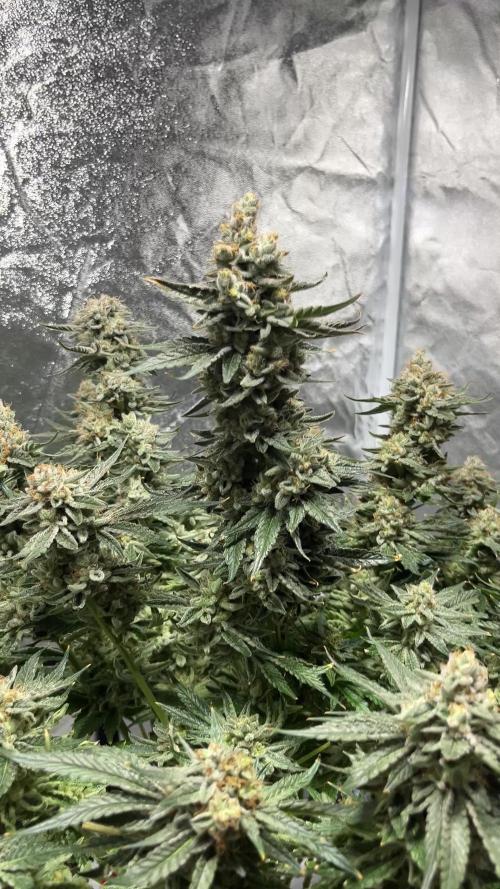
Hell yeah, třetí kolo za námi 🌴 posledních 10 dní pouze čistá voda.Trim proběhl za mokra, sušení probíhá mimo box, v sušící síti HerbDryer s podmínkami 15-17stupňů a 30-50rh 👌 Voní to moooc pěkně.
Shrnutí grow:
🗑️ Pot- 15l
💦 Voda- reverzní osmóza
🥥 médium- koko-perlit 70:30
💩hnojivo- Advance Nutrients Cultivator
Na tak slabé světo..Spokojenost 🙂 👍🏻


@Stealthman
Volgen
Nutrients are being changes every 2-3 days due to water consumption. Ideally the nutrient concentration remains more or less the same as the water level drops but I am not able to maintain optimum health as seen in the video. I tried a number of different brands and concentrations with not much in the way of improvement. It's amazing how the mood is effected when the plants are not doing perfectly well. Its can be quite upsetting :/


@Hawkbo
Volgen
Finally got my buddy to come out and add in a 20 amp outlet so I can fire up a better light. Still using quantum boards but with a 4500k spectrum. Got in a foliar with the Growzyme from green buzz liquids. Fed them right before I took the pics they look a little sad but hopefully they bounce back quickly. Not much else going on.
The code bangdang will get you discounts at..
Gorillagrowtent.com
Rainsciencegrowbags.com
KindLEDgrowlights.com and more (see Instagram Bio for @bangdangbuds)
Also check out my Instagram if your interested in entering a giveaway for a green buzz liquids starter kit including some living organics, fast plants spray and some seeds of the winner choice.


@Roberts
Volgen
The smaller Potter of Gorilla Glue is doing good. Looks like I will be changing to flowering In about a week. She is growing under the Spider Farmer G3000 light. Thank you Spider Farmer, and Amsterdam Marijuana Seeds. 🤜🏻🤛🏻🌱🌱🌱
Www.amsterdammarijuanaseeds.com
Thank you grow diaries community for the 👇likes👇, follows, comments, and subscriptions on my YouTube channel👇. ❄️🌱🍻
Happy Growing 🌱🌱🌱
https://youtube.com/channel/UCAhN7yRzWLpcaRHhMIQ7X4g
Spider Farmer G300w: https://amzn.to/3S2zvsd
Spider Farmer 10X20 Heat Mat Kit - https://amz.fun/lsa0J
Spider Farmer Amazon Store: https://www.amazon.com/spiderfarmer
Spider Farmer Official Site: https://spider-farmer.com
Discount code: saveurcash
