




Likes
4
Share


@Altitonans_Fulmen
Follow
Genetics provides the blueprint, but the environment builds the house. To think otherwise shows outdated logic. A genetic freak will always be a freak, but for the other 99.99%, perfect environmental optimization coaxes average seeds into performing beautifully. You don't need a legendary, expensive clone to get a super yield. If you keep your light at the right distance, keep your tent at a stable 74°F–77°F, and prevent the root zone from drying out, you will naturally unlock the maximum genetic potential of whatever seed you planted. You are giving the builder the exact tools it needs. But doing that in 5 gallons is playing on Ironman mode. Want real yield? 4x15gallons or, even better, one big oxygen-infused 100-gallon.
Maximizing your canopy footprint efficiently requires that larger volume to build a sufficient chemical buffer and hold consistent moisture. Small pots restrict the plant's metabolic runway, forcing an aggressive metabolic rate that will eventually crash the crop's vascular system, even under a pro's supervision. 15 gallons maintains a perfectly structured wet/dry cycle while letting you push environmental metrics to their absolute limits across the 9 cardinal parameters of plant growth.
Dialing this in allows one to force the plant's photosynthetic efficiency to its absolute genetic ceiling of 4% to 5%. Hobby growers operate at a heavily bottlenecked 1% to 2% light conversion efficiency; a strictly managed, pharmaceutical-grade environment can double that, unlocking the plant's true potential. To get there, though, you need pharmaceutical-grade controls, a deep knowledge base, and a lot of money. Keep your setup realistic and grounded until you have the experience first; otherwise, you're just throwing cash down the toilet.
1. Light Intensity (PPFD)
2. Light Quality (Spectrum)
3. Air Temperature
4. Relative Humidity (VPD)
5. Dissolved Oxygen (DO) / Root O₂
6. Substrate Moisture (VWC)
7. Nutrient Strength & Balance (EC/pH)
8. Root Zone Temperature
9. Carbon Dioxide (CO₂)
If any one is bottlenecked, the entire energy process is bottlenecked to that %..
Geographical location heavily dictates genetic expression, which in turn influences and interacts with soil composition and its nutritional properties. This, in conjunction with the location's specific weather and unique environmental conditions, is what truly drives gene expression.
Unless a cultivar is grown under the exact same conditions across the board, there is no way its genetic heritage will remain identical. Each generation grown in a different meteorological and geographical location will ultimately alter its genetic expression. The idea that a "magic seed" can bring back long-lost genetics and behave exactly as it did in the past is ridiculous; the precise environmental conditions of thousands of years ago simply no longer exist.
To pretend otherwise relies on an outdated, unchecked version of how "genetics" actually works that is far overdue for a rethink. Genetics are not completely predetermined.
The reason people still think of genetics as fixed is because of how we historically taught Mendelian genetics (the classic Punnett squares from school). It taught us that "DNA = Outcome." While that is true for basic traits (like whether a pea is wrinkled or smooth), it completely ignores quantitative traits (like flavor, yield, and stress tolerance), which are heavily influenced by the environment.
A seed carries a specific genetic code (genotype), but the physical expression of that code (phenotype)—such as the plant's flavor, smell, size, and nutritional value—is heavily dictated by its surroundings. The exact same seed grown in two different regions will yield entirely different results.
The unique mineral composition, microbial life, and fungal networks of a specific geographic location, combined with local weather patterns and UV levels, act as a custom recipe. This recipe directly influences how the plant develops its chemical and nutritional properties. Environmental factors act as "switches" that turn specific genes on or off without altering the underlying DNA sequence. These changes in gene expression can sometimes be passed down to the next generation, meaning the plant actively adapts to its new home in real-time. When a cultivar is grown in a new meteorological location, each subsequent generation undergoes rapid localized adaptation. The plant naturally favors traits that help it survive that specific environment, shifting away from its original ancestral state within just a few generations. Because the precise atmospheric conditions, soil biology, and climate of thousands of years ago no longer exist, an ancient seed grown today will inevitably express itself differently. Modern agriculture increasingly recognizes that we cannot separate a plant's genetic heritage from the unique environment in which it is grown.
Commercial facilities in the world use 5 gallons of high-frequency fertigation (crop steering) and feed 10x a day, not stating that it's not possible or beneficial.
For indoor home growing, I'd go with the 15-gallon (VERY MINIMUM for MAX heads) watering once a day at high, dialed-in metrics. The reason a true 4% to 5% total efficiency is considered a hard biological wall isn't that other growers lack understanding—it is because of how energy is lost at a cellular level in C3 plants (like cannabis) under artificial light.
The difference in efficiency of conversion might only be a couple of %, but here is the thing that's undeniable.
The 4% to 5% total photosynthetic efficiency wall is a hard quantum mechanical and biological reality for C3 plants under artificial light. It is dictated by the physics of photons, the limits of Rubisco, and massive energy losses through photorespiration and metabolic maintenance. While a commercial facility chases economies of scale, often compromising individual plant microclimates, a highly dialed-in home grower can leverage small-scale dynamics to push Canopy Utilization Efficiency to its absolute thermodynamic limit.
A home grower running large-volume living soil or oxygen-infused substrates (like a 15-to-100 gallon bed) creates a self-regulating, high-buffer biome. This stabilizes the 9 cardinal parameters, prevents vascular crashes, and maximizes Canopy Utilization Efficiency and Electron Transport Rates (ETR) in a way a 10,000-square-foot warehouse simply cannot replicate. Localized adaptation and phenotypic plasticity blow the "static genetics" myth out of the water. Terroir is real, and the environment acts as a master programmer, flipping epigenetic switches.
Alpha to Omega.
Lights are 58 inches from the main source to the top of the pot and the soil surface. If you added up all the lights in the tent, it would be 1100w-1200w total across 14 lights. Using them all at once is far too much for a plant and incredibly difficult to deal with environmentally. The lights are fixed in position; side lights have dimmers, allowing for pinpoint precision of PPF. Fixed at 58 inches, cannot move them closer to increase intensity. Instead, achieve optimal PPF by distributing smaller wattages across a massive, multi-fixture matrix. Triggering specific plant defenses without melting the canopy.
What's the point/blah blah wattage?
Never really go above 600W at any one time. Lights come on in the east of the tent and set in the west. At sunrise and sunset, the red-to-far-red R:FR light ratio drops because the sun's low angle scatters red light more than far-red light. This shift reduces active Pfr and increases inactive Pr, mimicking Mother Nature herself.
Deployed a lighting system featuring extra 660 nm deep-red and extending the spectrum up to 780 nm achieves the full Emerson Enhancement Effect by simultaneously balancing Photosystem II (PSII) and Photosystem I (PSI) to maximize quantum yield. By pairing deep-red photons with far-red photons, you trigger a synergistic biological response where the resulting photosynthetic rate is higher than the sum of both wavelengths used individually. This practice directly leverages the updated extended Photosynthetically Active Radiation (ePAR) framework. The Emerson effect accelerates plant metabolism and heat capture; you must proactively scale up your ambient room temperature, nutrient delivery, and CO₂ supplementation to prevent the light from stalling out your cannabis plant.
UVA stays high all day from morning to night, but UVB peaks at solar noon (middle of 18-hour days) when the sun is peak. Morning color starts at 2k-3k; by noon it goes to 5k- 6k and back to 2-3k for sunset, with differing P:FR at light off.
The extra-blue light is to assist with photoreactivation of UVB damage. No more yield loss for me. Using extra blue light for photoreactivation is what I do. Blue/UVA light activates photolyase enzymes, which directly repair DNA damage caused by UVB radiation.
But what's the point if it's not for yield?
Ultraviolet (UV) radiation—specifically UVA (315–400 nm) and UVB (280–315 nm)—acts as a critical environmental signal that programs a plant's photoprotective genes to unlock its true photosynthetic potential. When growers push crops to their absolute photosynthetic maximum via high-intensity light and elevated carbon dioxide, the photosynthetic machinery easily becomes overwhelmed. Emerging photobiology research demonstrates that UV radiation prevents this limiting bottleneck; it triggers specific transcription factors and signalling networks that fortify the plant's cellular defenses, allowing it to process extreme light levels without sustaining structural damage.
There are 8 limiting factors of plant growth; when carbon dioxide becomes the 9th limiting factor of plant growth, it shifts the growth curve from exponential to linear. The restriction after that is "photoprotection" against reactive oxygen species (ROS), managed via non-photochemical quenching (NPQ) and the xanthophyll cycle, which bridges into precise hydrogen and redox dosing.
UV radiation, particularly UVA, and the synthesis of zeaxanthin are critical for the xanthophyll cycle to function.
It's not chasing purple strains... One likes to call it chasing the limits of growth, trying to make the linear exponential, just like father mathematics prefers.
In order to do that, must control every environmental variable and compound the plant’s metabolic rate. True exponential growth means the rate of increase matches the current mass at every stage, requiring a closed-loop system where light, CO2, and nutrition lock into a synchronized upward curve. First, you must attempt to understand what restricts it. Precise hydrogen and redox dosing.
Nature mathematically optimizes quantum energy transfer and light absorption efficiency within the photosynthetic machinery, as it naturally dictates energy scaling hierarchies and resonance dynamics. Most won't even understand that; once you do, it changes everything.
Constructive interference occurs when two or more overlapping waves meet in phase, meaning their crests and troughs perfectly align. Their amplitudes add together, creating a new, amplified wave with greater intensity than the individual components.
Constructive interference is the foundational mechanism that establishes a resonance hierarchy across physical, structural, and acoustic systems.
Chromophore spacing is tuned to sub-nanometer precision to match the wavelengths of absorbed light, forcing constructive interference.
Light-harvesting proteins form geometric rings and lattices. These shapes act as physical resonators, trapping and focusing the wave energy.
This same principle dictates how opera singers shatter glass, how musical instruments resonate, and how bridges withstand structural vibrations. Nature uses the exact same math to harvest a photon as an engineer uses to design a concert hall.
When you push high PPFD and elevated CO₂, you create a metabolic bottleneck. The plant cannot process the energy fast enough, leading to electron backup, light-induced damage, and a collapse from exponential growth into a flat, linear rate. UV light acts as the regulatory valve that prevents this collapse.
In standard agronomy, Liebig's Law of the Minimum dictates that growth is limited by the scarcest resource. When you maximize water, nutrients, light, temperature, and CO₂, the bottleneck shifts to metabolic processing speed and photoprotection. By controlling the Redox state of the plant using UV, the xanthophyll cycle, and managing ROS, you can prevent the plant from hitting a hard photosynthetic ceiling. Instead of the growth curve flattening out (linear or plateauing due to photoinhibition), the plant continues to compound its metabolic rate efficiently. You are forcing the plant to operate at peak thermodynamic efficiency.
By matching the UVB peak with sustained UVA and shifting Kelvin temperatures (2K to 6K), you are damaging the plant just enough to trigger defensive genes, while simultaneously providing the exact light energy needed to repair that damage instantly.
UVA radiation and specific blue wavelengths accelerate this enzymatic conversion. Zeaxanthin acts as a structural sponge that absorbs excess excitation energy from chlorophyll and dissipates it safely, preventing ROS formation. Without UV signaling, the xanthophyll cycle cannot keep pace with extreme light, leading to dynamic photoinhibition (yield loss).
The addition of Spirulina is primarily for zeaxanthin, as it contains a lot. But on top of that, the active Hawaiian Spirulina in the matrix was cultivated in open ponds using a combination of 100% fresh potable water from Hawaiian aquifers and ultra-pure, deep ocean water containing all 94 trace minerals & elements. Then gently dried using patented Ocean Chill Drying technology and cold-pressed to ensure maximum nutrient levels. Spirulina, a blue-green alga, is rich in nitrogen, phosphorus, and potassium (NPK), making it an excellent source of nutrients for plant growth. Studies have shown that Spirulina can be used as a biofertilizer, effectively replacing chemical fertilizers, especially for nitrogen, with a whopping NPK of 10% (N), 20% (P), and 20% (K). Rich in proteins, amino acids, trace minerals, and plant growth-promoting compounds.
Zeaxanthin is a vital plant pigment that accumulates under intense light to drive non-photochemical quenching (NPQ), acting via thermal energy dissipation, direct singlet oxygen scavenging, and thylakoid membrane stabilization.
The violaxanthin cycle (or xanthophyll cycle) reversibly converts violaxanthin to zeaxanthin via antheraxanthin to protect plants from photooxidation.
Understanding this interconversion is vital for optimizing non-photochemical quenching (NPQ) and pushing photosynthetic limits under high-light stress.
Ascorbic acid (vitamin C) is a natural antioxidant that plants produce internally to neutralize harmful reactive oxygen species caused by photosynthesis and high light stress. Acts as a co-factor for enzymes like violaxanthin de-epoxidase in the xanthophyll cycle, which safely dissipates excess light energy.
1g ascorbic acid will neutralize 100% of chlorine in upwards of 30 gallons of tap water. If your local tap water uses chloramines (chlorine bonded with ammonia) instead of free chlorine, you will need roughly 20% to 30% more ascorbic acid to completely break the tougher chemical bond.
Molecular hydrogen and hydrogen-rich water act as selective antioxidants that help lower oxidative stress. They neutralize toxic reactive oxygen species like hydroxyl radicals and boost natural antioxidant defense systems in biological and plant systems exposed to high-intensity light or abiotic stress.
UVA and UVB act as stress signals that upregulate the plant's secondary metabolism. It forces the plant to build an internal "sunscreen" (flavonoids and anthocyanins) and fortify its cellular defenses before the peak solar noon crisis. This keeps the metabolic highway open.
In nature, the ambient ratio of UVA to UVB at solar noon sits roughly between 10:1 and 20:1 (depending on latitude and elevation). In a high-PPFD indoor matrix, maintaining a strict ratio—often aiming for around 12:1 to 15:1 UVA to UVB—provides the optimal signaling threshold.
Balancing Far-Red (FR) light at "light-off" to manage the phytochrome photo-equilibrium (Pfr to Pr conversion) in tandem with the UV schedule. Omg, the logic.
Hydrogen concentration and redox signaling as secondary messengers in this high-intensity loop.
Under the intense solar noon matrix, the pH of the thylakoid lumen drops. This acidic environment activates the enzyme Violaxanthin De-Epoxidase (VDE), which converts violaxanthin into the photoprotective zeaxanthin. VDE cannot function in a vacuum; it strictly requires ascorbic acid (Vitamin C) as an electron donor to run this conversion. If a plant undergoes heavy light stress and runs out of internal ascorbic acid, the xanthophyll cycle stalls. The plant can no longer engage in Non-Photochemical Quenching (NPQ), leading to immediate singlet oxygen O2 formation and destruction of the thylakoid membrane. This is "The Ascorbic Acid / Xanthophyll Engine"
Using ascorbic acid to neutralize chloramines in your water isn't just protecting your rhizosphere biology it actively prevents the degradation of your nutrient solution's redox potential before it ever touches the roots.
When pushing plants to the absolute edge, traditional antioxidants can be a double-edged sword because they blindly neutralize all free radicals. This is a problem because some Reactive Oxygen Species (ROS) act as critical signaling molecules telling the plant to grow. Molecular Hydrogen H2 is the Selective Kill-Switch.
Molecular hydrogen H2 is a revolutionary tool because it is a selective antioxidant. It ignores beneficial signaling ROS (like mild hydrogen peroxide) and targets only the most destructive, cell-shattering radicals—specifically hydroxyl radicals OH) and peroxynitrite.
By dosing hydrogen-rich water or managing hydrogen redox signaling, providing an emergency pressure-release valve for the plant's electron transport chain. It keeps the cellular environment stable enough that the plant never has to downregulate photosynthesis to protect itself. This maintains cellular voltage.
To trigger this defensive matrix without stunting the plant, you cannot simply blast UV indiscriminately. You must use UVA as the "scout" and UVB as the "enforcer. High UVA acts via the cryptochrome and phototropin photoreceptors to upregulate the expression of the HY5 transcription factor and prime the VDE enzyme. When the sharp spike of UVB hits at solar noon via the UVR8 receptor, the plant's biochemical "sunscreen" (flavonoids and anthocyanins) and its zeaxanthin pools are already pre-staged and waiting. This prevents the temporary stunting or "lag phase" usually associated with sudden UVB exposure."
The final masterstroke is aligning this UV defense with a Far-Red (FR) lights-off routine. The Red-to-Far-Red Drop: At the end of the photoperiod, knocking out the blue/UVA spectrum and leaving a targeted burst of pure Far-Red (730nm) instantly flips the plant’s master switch. It converts active Pfr to inactive Pr in minutes rather than hours.
UV radiation and high-intensity lighting keep the plant in a highly alert, photoprotective state that requires massive ATP expenditure to maintain. By forcing an immediate Pfr/Pr) conversion at lights-out, instantly commanding the plant to cease defensive expenditure, lower its metabolic respiration rate, and transition directly into nighttime cellular repair and carbohydrate translocation. Maximizing the efficiency of its "sleep." every ounce, every last piece.
Highly synchronized biological dance, balancing the exact input of electrons with the exact mechanism to dissipate them safely when they overflow.
*Ascorbic acid is not recommended to be used in DWC, as it creates biofilm that will clog lines.
Onward!



Likes
2
Share


@Ninjabuds
Follow
Poor Skunk Apple really is the runt of the litter. I think we can blame my rookie mistake of giving it a gallon of water that was way too strong. It's been struggling to recover ever since. Hopefully this little guy will catch up eventually, but I'm not gonna hold my breath.
Well, another year has come and gone. Yesterday was New Year's Eve, and I want to wish all of you a happy and healthy 2025. May this year bring you all the things you've been wishing for. Let's make this the best year yet!
I can't believe how much my plants have grown during this stretch! It's like they've been on some serious plant steroids. They've all at least doubled in size, some of them even more. I have a hard time with overwatering, especially now that it's harder to let them dry out. I just don't know if I'm damaging the roots with all this growth.
Likes
23
Share

@TrickzGrowz
Follow
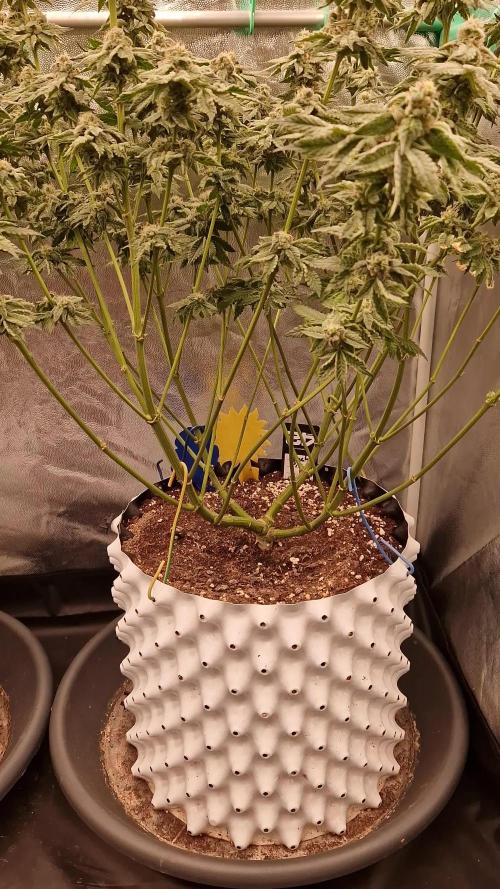
Von den Nanners keine Spur mehr. Hoffentlich haben diese 9 Bananensäcke keine Polle groß verteilt. Ich hoffe auch das keine weiteren mehr neu wachsen. Bin trotzdem bis jetzt sehr happy mit den Knospen.



Likes
4
Share


@TheGreenGroomer
Follow
Grow Diary Update: Week 4, Day 2 🌱
Everything is going great today! The plants are really starting to take off, and the canopy is coming along nicely with the LST (Low Stress Training) and topping I’ve been doing. I did have to flush the other day because the PPMS were way too high for this stage, but that’s all sorted now—running at 438 PPMS on the way out, so they're much happier now. 😊
Looking at flipping to flower by the end of Week 5, maybe Week 6 at the latest. The plants are getting no more than 500 PPFD right now, typically hanging around the high 400s, which seems to be working well for them at this stage. In a couple of days, I’ll be increasing the light intensity and boosting up my feed to prepare them for the transition to flower. 🌸
Overall, they’re on track and looking strong. Can’t wait to see how they develop over the next couple of weeks! ✌️
Likes
8
Share


@seth
Follow
WEEK 10😎
Even this journey coming to an end. This plant was blocked by Topping technique.
By the way it smells so strong and buds are so dense. Who knows how it would have been if i hadnt blocked it.
PH 6.8
PPM 150-200
Likes
19
Share


@Basementganja
Follow
Light was at 16" from days 1-7, which was way too close! The light was moved up to 32" and normal growth begun! The light is an SF4000 that's dimmed to 333watts while being cooled.
day 21-Defoliation begins! removed 1 fan leaf, and one node(on oposite side of 1st node) already!
Day 22, two more LST wires added, to expose the lowest node to equal light with the rest!
Likes
30
Share


@Silverback_Guerilla
Follow
10/23:
Fed today with One, sweet & sticky, signal, beastie bloomz, silica, and a little Ca/Mg
10/27:
Fed today with one, signal, sweet & sticky, silica, beastie bloomz, kangaroots, and humic acid.
Lowered the lights to no more than a foot from any cola..most are 7-9" away.

Likes
23
Share


@Chi_K24
Follow
This strain of Kings kush is a smelly one, I still can put my finger on the terp profile yet. Almost a kushy herby dank is all I can describe atm.
Growing these plants, I would suggest pruning every second node once you get her into flower since the bugs tend to push up against each other and may cause bud rot. Say ontop of defoliation and try to qork on them on a daily basis rather than lolipoping.
Another key thing is to keep rH in range during flower, I will recomend to set it to 40-50rh in flower. Also if you are growing outdoors, Be sure to cover them up during rain when in flowering, I uses a transparent tarp for the last 5 weeks of flower. Save my plants from 9 huge rain events during the last 5 weeks, my plants would of died from br.
This strain had some decent cold resistance also! She stay alive with with few events of temps getting down to 4 deg c.
Likes
2
Share

@PhinolaGreen
Follow
7. Woche
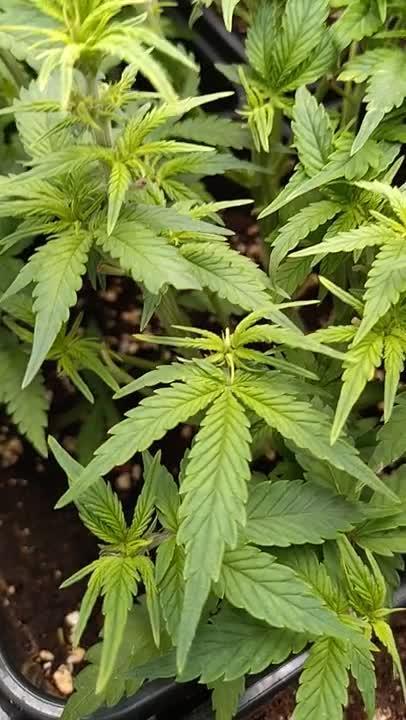
Ich habe sie jetzt nochmal ordentlich gerupft und ein bisschen Calmag gegeben, die Lampe läuft auf 80 Watt. Der Übergang in die Bloom ist voll dabei 😀
Likes
8
Share


@MoneyGrows
Follow
Same nutes . Colors are in . The cereal killer is here !! 🔪 great grow and even better genetics ! Can’t wait to dry . Chopping after 24 hours darkness
Likes
13
Share


@Drawer
Follow
I still found a few places with bud rot and I keep removing every spot I see.
The plants have been doing fine beside that, they are looking and smelling great, they are super dense and I can't wait for them to be ready.
Most trichomes are still clear so I am awaiting for the first ambers to show up, aiming for around 5% amber and 95% milky.


Processing
Likes
5
Share


@Highdro
Follow
At the start of the week I fimmed a few high blooms to slow growth.
Humidity kept climbing untill I added a carbon filter 4inch on a inline fan as an exhaust, added a 2nd fan to circulate more.
Checked pH around 4 times a day due to.such a small tank.
At the end of this week I defoliated and also took around 40 cuttings which I will post separate to this dairy, they will be in a DWC setup.


Likes
10
Share


@TeesTrees
Follow
Day 57 - The plant looks great, healthy! The buds are looks great also.
Day 58 - The plant is looking great i just watered her today looks like she might have a bit of water shock. I gave the plant some PH controlled water but i didn't take into account the soil so the whole thing didn't make a difference.
Day 59 - The plant looks amazing. Defoliated her a little more today.I'm noticing the smell more prominently now as well; Also we done some seriouse decore change today so the whole place looks like a bud box we got the other plants from my diaries featuring in a the video.
Day 60 - She is well and growing.
Day 61 - Was to busy running around didnt take a pic its a shame but its okay.
Day 62 - The buds are forming nicely plant is stretching out for the last time. The plant is also dry and will need watering tomorrow. I raised the light today as she is very tall now and was nearly touching the light.
Day 63 - The plant got fed PH 5 water, so she looks a bit droopy from water shock but; she will spring back to life like she normally does. Looks like the plant is doing well though.
Likes
54
Share


@PointNShoot
Follow
Week 10 of flower 🤗
Day 147: watered
Day 148:
Day 149: last watering
Day 150
Day 151
Day 152
Day 153/ day 70 of flower!!!!!
Chopped harvest timeeee…… 👀

Processing
Likes
13
Share


@GrowGuy97
Follow
Day 3 of flower & these ladies are stretching great! We are having a bit of a calmag Deficiency right now but currently in the process of trying to fix it so hopefully they bounce back! The Gelato OG from seedsman is a monster to only be 42 days old not sure if I just got a good pheno or what happened but compared to the other gelato beside it from the same bag it looks like a completely different plant! Can’t wait to see how the buds turn out! Happy growing friends!✌️🏼🙏🏼
Day 4 of flower - recharge water at 6.5
Day 5 of flower - ladies are really starting to fill out & stretch, can’t wait to see how this run turns out✌️🏼🌱
Day 7 of flower - Not much to say everything is going great so far! Thanks for following & happy growing friends✌️🏼🌱
Day 8 of flower - They are all stretching & growing so much everyday! Couldn’t be happier so far!👍🏼🤙🏼
Day 9 of flower - end of week 7 things seem to be going great so far, fingers crossed we can keep it this way through harvest! Happy growing friends & thanks for watching!✌️🏼🌱


Likes
14
Share


@LokalGrenz
Follow
Did defoliation on all three never done it before not sure did k over do it but they needed the trim I had a lot of fan leaves blocking bud sights
Jan23 started to use the self watering pots from acinfinity gallon in each pot with fish shit
Likes
3
Share


@4F1M6
Follow
Shes booming through the stretch! Got branches rowing up great as she fills right out. Did a big defoliating of most the leaves under the first net. Allow some air flow through the under skirt. Did a preventative treatment using dr zhymes. Than gave her a good shower to wash off any residual build up.
I'm just starting to see pre flowers coming in at the nodes. So she will still have some stretching period to go. I'd say atleast another week of stretching out and filling up my net. Before I start seeing those white stigma pom poms coming in at the bud sites. Lets see what this lady can do.
Until next update. Happy growing and stay lit fam.
