


Likes
Comments
Share


@sirstickyfingers
Follow
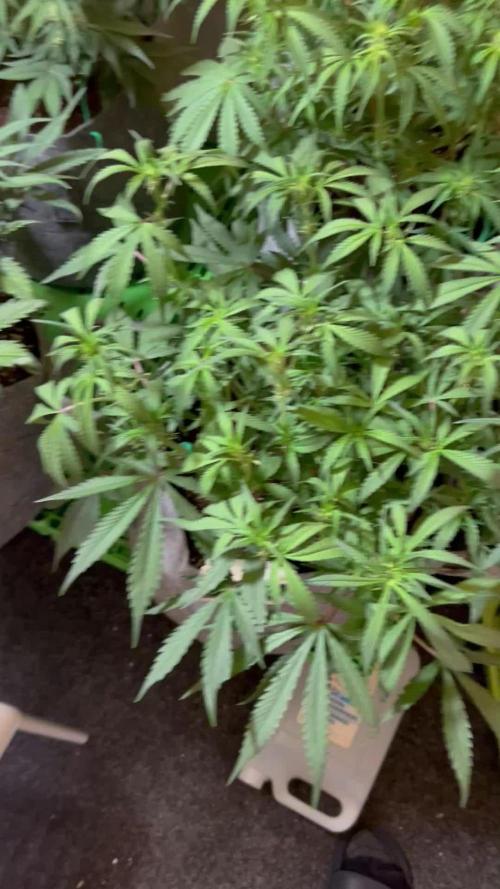
Start of Week 2 day 2 of flower!! These girls are stretching and starting to stack bud sites.
My little sour diesel is doing her best to reach that canopy with the others, she aint showing alot of sites at the moment but im hoping after stretch and defoliation I can get more to pop.
I decided to upgrade my light and now have a SE4500 450w on the way. From what I had researched Id like to be getting 1000ppfd in the center and then around 600-700 on edges
I picked up some stashblend and real growers recharge and added it to my water as a compost tea today and will be implementing that in the watering per the plant needs .
My biggest fear doing organics is getting behind on the food for these girls. I plan to top dress with worm castings, gaia green all purpose 4-4-4 and power bloom 2-8-4 every 3 weeks during flower, and then about the 4 week of flower I will be using more power bloom than all purpose to avoid too much nitrogen.
My biggest thing I been going back and forth on is when to defoliate. I dont wanna start removing abunch of leaves and force my plant to recover during the stretch rather than making bud sites. I figure once it is done stretching completely I am going to lollipop and remove all branches/larf and leaves under the canopy.
feel free to comment, provide tips, suggestions im open to all as im still new and learning
Thanks for looking and happy growing!!


Likes
3
Share


@Nookandplant42o
Follow
visual, coming nice visible granules great smell, resistant plant size small stature and probably will arrive soon I intend to go further with it.

Likes
44
Share


@SooSan
Follow
12/12 + 35 jours
Vu qu’il y a 16 plantes mais que sur growdiaries on ne peut mettre que 8 variétés j'ai divisé en 2 diaries pour le bas de la tente
1️⃣
🏠 90x60x90
☀️ FC-E 4800 => puissance a 20%
🍁
1x Black Bomb / Philosopher Seed
2x Amnesia Lemon / PEV Seeds
1x Blueberry / PEV Seeds
1x Blueberry / 00 Seeds
1x Wappa / Paradise Seed
1x Dark Phoenix / Green House Seed
1x Quick Sherbet / Exotic Seeds
1x Mango Cream / Exotic Seeds
1x Banana Frosting / Sensi Seed
1x Hindu Kush / Sensi Seed
3x Fast Mix / Sweet Seed
📎 https://growdiaries.com/diaries/122084-grow-journal-by-soosan
📎https://growdiaries.com/diaries/124052-grow-journal-by-soosan
2️⃣
🏠 30x60x50
☀️TS1000 => puissance a 50%
🍁 4x Quick Sherbet - Exotic Seed
📎 https://growdiaries.com/diaries/122080-grow-journal-by-soosan


Likes
6
Share


@gabigarcia
Follow
Third week of vegetation and the plants, especially the autoflowering ones, have grown a lot approximately 7 cm in 7 days, they have grown both long and wide, I think this harvest is worth it!!

Likes
22
Share


@DogDoctorOfficial
Follow
🌱 White OG - Week 11 VEG
Strain: White OG by Seedsman Seeds
Stage: Week 11 Vegetative
Grower: DogDoctor
Medium: PRO-MIX HP Mycorrhizae + Bacillus
Pot: 30L Fabric Pot
Lighting: Future of Grow LEDs
Climate Control: TrolMaster
Nutrients: Aptus Holland Clean Program
Environment:
🌡️ Temp: 18.3°C
💧 pH: 6.0
⚡ EC: 1.0
⸻
🔄 The Last Week Before the Flip
Week 11… a moment of calm before the bloom storm. A critical phase in our girl’s journey. This is the week we prepare her for greatness. 💪
✅ Defoliation Madness:
This week, we defoliate the hell out of her. That’s right—removing those large fan leaves that block light, those unnecessary suckers that won’t make it to the top floor, and freeing up her inner structure to breathe and expand.
Why now? Because right before flipping to flower is the perfect time to help her redirect energy to the strong tops and main branches. It reduces the risk of mold, improves air circulation, and ensures even light distribution. Plus, it gives us a blank canvas for the flower stage to explode onto. 🌸💥
✅ Clamp Release & Scrog Setup:
We gently remove the training clamps, and in she goes into the SCROG net. But not in a rigid way—we’re inviting her to stretch, encouraging her to reach out and take up space. She’s a big mama now, and it’s time she gets the full stage. Each branch is dancing through the net like a diva ready for her solo performance.
✅ Roots on a Mission:
She’s hungry for life. Roots are peeking out from the fabric pot, diving toward the light, the floor—everywhere. This PRO-MIX soil is magic, and with the help of the Aptus Clean Mix, she’s thriving. Her root zone is bright white and packed with potential. Healthy roots, healthy shoots, happy fruit.
⸻
Feeding This Week
We’re still rolling with the Aptus Clean Line for this stage. Simple, effective, elegant.
🔹 Regulator – Helping her stay strong and stress-free.
🔹 RO Water Conditioner – Stabilizing and prepping our base.
🔹 All-In-One Liquid – Feeding her exactly what she needs without overcomplication.
⸻
🌐 Shout Outs & Love
Forever grateful to our amazing partners and supporters:
💚 Seedsman Seeds
💚 Aptus Holland
💚 Future of Grow LED
💚 TrolMaster
💚 PRO-MIX Soil
💚 Cannakan
💚 GrowDiaries
💚 The entire community—lovers, haters, followers, and the in-betweeners—you’re all part of this journey. 🌍
Come say hi on Instagram [@DogDoctorOfficial] and check out the Dognabis Cup – First Edition—open now! 🎉 Let’s celebrate passion, plants, and positive vibes.
⸻
🌸 Let’s Bloom
White OG is ready to bloom. She’s strong, structured, and full of fire. Next week begins a new chapter—the flowering stage. Let’s see what she has in store.
🌱 Stay kind. Stay curious. Stay growing.
Much love,
DogDoctor 💚🐾
#GrowDiaries #WhiteOG #ToppingMadness #AptusHolland #Mainlining #PlantTraining #GrowersLove #SeedsmanSeeds
As always, this is shared for educational purposes, aiming to spread understanding and appreciation for this plant.Let’s celebrate it responsibly and continue to learn and grow together!
💚Growers Love 💚 🌿
DISCOUNT CODE - SeedsmanSeeds - DOGDOCTOR 10% off
As always thank you all for stopping by, for the love and for it all , this journey of mine wold just not be the same without you guys, the love and support is very much appreciated and i fell honored and so joyful with you all in my life 🙏
With true love comes happiness 💚🙏 Always believe in your self and always do things expecting nothing and with an open heart , be a giver and the universe will give back to you in ways you could not even imagine so 💚
Friendly reminder all you see here is pure research and for educational purposes only
💚Growers Love To you All and remember to keep that smile big and alive 💚

Likes
57
Share


@LockDownGrow
Follow
this lady from the off set was the fastest growing and largest plant from the off set growing bushy with lots of leaves needing the biggest defoliation's too get that important light down too the many branches below,
she is drinking about 8 pints of feed a week and loving life , and her bud production is also coming along nicely too ,
i cant wait too try this one ,


Likes
55
Share


@Max1973
Follow
Well, this was a interesting first journey.... the buds finished drying today, 5 days drying, added pics and vids.
Just curing to go.... ah nice buds :)
Edit: i forgot to mention i went over the buds when i harvested them, and checked / removed any impurities, like
gnats caught in the sticky bud.... picked em clean with tweezers... 👍
Edit: needed to air/dry out the buds abit more, and get some Boveda Humidipak for curing.... it's looking good...
i'll update with some pics of trimmed, cured buds 😎
The buds turned out beautiful, pungent, pine, berry, citrusy, daytime, medical..... this has theoretical 1:1 - 21% THC, 19% CBD, so it's not going to give u a knockout high.... its medical grade 1:1 ....... side effects - happy, relaxed.
haha :)
I weighed it dry and came up with about 123.32g (4.35oz) ... i used abit of guesswork in the weight, not to concerned with weight, as to
quality.... (that weight is with the test buds added in, +-15g.) .... you can guess the weight from the pics and vids, haha
I really enjoyed growing this.... i found the website by looking up the seeds, decided to start a grow diary,
it's my first grow, i made alot of mistakes and growdiaries really helped alot, joined a chat group with some other really good growers.
Edit - Day 111 - added vid/pic, Been curing for a week, burp and roll em abit twice a day....... smell and taste nicer each day, 👍
Edit - Day 112 - added good vid of trimmed up test bud, beautiful ......
I hope You enjoyed the Diary..... Good Buds 😎


Likes
2
Share


@eldruida_lamota
Follow
Que pasa familia, vamos con la cosecha de estas Orange Sherbet Fast Flowering, de FastBuds.
Por dónde empezar, las flores son poco compactas pero van repletas de resina y unos aromas bastante dulces y citricos
Es muy sencilla de cultivar, es de ciclo corto aunque también si le dais una semana más no pasa nada agradecer se agradece al final.
Mars hydro:
Code discount: EL420
https://www.mars-hydro.com/
Agrobeta:
https://www.agrobeta.com/agrobetatiendaonline/36-abonos-canamo
Hasta aquí todo, Buenos humos 💨💨💨
Likes
4
Share

@jdean88
Follow
All flowering nice now the og has stretched a lot with the strawberry and blue dream fod to like the last phenos I had but never the less the smell is amazing can’t wait to see them finish and enjoy a lovely smoke.the gorilla melon il be letting veg till mid November then il flip it she should fill the tent by then
Likes
3
Share


@123Grow
Follow
Week 1 is going fine. I am going to grow this out to 3 feet and flip it under a trellis net. Apparently, Mos Cutty genetics are supposed to be fire. We had some stretch, but that was taken care of by adding more soil to the container.
10-11 Something I will go over in each of the grows is exactly what I use and exact amounts and ppm’s. Most of the time that I read other grows, it isn’t specific enough to mimic ( organically speaking). In the container ( 1 gallon):
What’s inside the container exactly:
1: 1 Tablespoon 2-2-2 By Dr Earth
2. 2 Tablespoons earth worm castings
3. 3 Tablespoons Charcoal
4. 1/8 tsp recharge ( yes, I added it as dry amendment)
5. Mother Earth Soil



Likes
5
Share


@Rizza78
Follow
Smooth few days after the defoliations. They seem to be happy. Malted Milk can be very temperamental but I have been catching on to her ways. Still wary with my feedings tho. Want to give all these different nutes and unknown what the results will be? Installed ac units in each room to ensure good temperatures and RH outside the tents. Hoping for another good week!


Likes
21
Share


@DogterB
Follow
Week 14
Day 92 (10/16)
Checked her trichomes and she's just starting to show some amber. She may need watered tonight, probably will add in some Mammoth P and molasses too.
Day 93 (10/17)
I've been slacking on updates and pics, but there's just not too much to say or document. She's still doing her thing, really looking more frosty than the first partial harvest. Thinking I should have waited a bit longer for the first cut, but oh well, it still gets the job done. I have held off on watering as her pot is still pretty heavy. It was lighter this morning so maybe this afternoon I will water her. I'm keeping an eye on her trichomes as I want there to be more amber for the final harvest.
Day 94 (10/18)
Everything from the partial harvest has been dried and I finally weighed it all. Came out to around 48.5g (including the 4-5g we've been smoking on). There's still plenty more on her. Everything has been jarred up for a few days and I've got Boveda packs in the jars too.
Day 98 (10/22)
Checked the trichomes this morning and I think I might put her in the dark for 48 hours starting tomorrow night. She's turning into a fuggin 100 day auto.
Day 99 (10/23)
Well, I made the executive decision to prep her for harvest. When her lights went off last night, I unplugged it from the timer so she'll have her 48 hours of dark. I also added some ice cubes around her base. I've read about the dark helping and the ice simulating a frost, but I've never done this so we'll see. Shouldn't hurt right? So I'll be harvesting her Saturday night or Sunday. And hopefully popping another over the weekend 😃
Day 100 (10/24)
Well she's been in the dark almost her 48 hours. I have family in town tonight, so she may have to wait until tomorrow to get cut. Or I might just stay up half the night and get her down tonight lol. We'll see.
Day 101 (10/25)
Technically week 15, but who's counting. Cut her down today. Got her cleaned up and into paper bags to dry. Will get a weight and post the harvest once she's dry. Getting another one ready to go 😉

Likes
Comments
Share


@bluecake
Follow
Started flushing, definitely gets more white and sugary, not sure if buds got any bigger. From time to time still adding some Biobizz ActiVera to the water.
Likes
3
Share


Likes
93
Share


@Ferenc
Follow
Plants started growing very fast. 20 hours light a day and 140 ml water for 2 plants so 35 ml each plant. (70ml -35ml one plant- morning, and 70ml -35ml one plant evening). From Monday I will start giving 200ml water 100ml in the morning and then the rest in the evening. Ventilation almost 24 hours, They are getting bushy and the color looks healthy green. I am excited. Purple Punch ( the right one) does not have the smell but the Gelato Cookie D'ohpe started smelling from the 3rd week, it is not strong, it is smooth, enjoyable. I still use trigger spray but I stopped triggering directly on the plant to avoid any fungee or toxicity, I just keep the soil moist. I surrounded them with kitchen foil around the lamp to have a more effective light. It reflects the light and the light goes everywhere. This step has been done because I have only the 60w LED each plant so I try to provide the maximum strength this way, and by keeping close distance also. The lamp is not hot so it ain't gonna burn the plant I had checked it before. I just purchased today a 600w LED because these plants look so good so I wanna provide the best circumstances for them. 4th-week 4th day I a just waiting for my delivery my 600 W grow LED light will come. From today I started watering with 50ml each plant 2 times a day so all together 200ml a day. Plus I always use trigger spray for the soil to be kept wet. They are looking better and better. Nice color and bushy appearance. Wonderful. I realized some holes on the Gelato Cookie D'ohpe's leaf but there is no insect I was checking. I do not really know the reason for that. Tonight I will set up the new 600 W LED so I am changing the current 120W. Big Step forward! It is not that easy that I thought, the lamp is great but the temperature raised up a lot, so needed to buy a fan also and the humidity went down. It is not easy to find the proper solution to be acceptable, good temperature and humidity at the same time. So I decided to program a 6/2 schedule, so 6 hours light on and the fan always with 15 min more, and 2 hours off so I do provide 18 hours light and 6 hours darkness but it is divided. The plants can rest after every six hours and use the energy they received. Last day of the 4th week, LST has been done with the Gelato Cookie D'ohpe, both are growing rapidly, let's see what the 5th week brings! End of he week Gelato Cookie D'ohpe is 25cm, Purple Punch is 20cm😇

Processing
Likes
20
Share


@Mr_nugs_lover_David
Follow
This is a beautiful big bush of a plant, she's absolutely awesome,I had to Supercrop her to avoid too much height on the balcony, her smell it's exactly the same as her sisters, super sweet and floral,very stable genetic, I love this black cherry punch, I would love to keep on growing this strain and take some clones, what a beautiful strain to grow.
She's being fed organically and naturally 100%. 💚🤞🌱❤️
Let's see how this lady performs at the end! 💚🌱🤤
