


Likes
Comments
Share


@JohnnyBlaz3
Follow
Still smooth sailing! 😎 they look so good!!! One lady sure stretched up alot compared to the others but they look amazing!!! The Quebec blue is crushing it and will surely be putting out some good flowers!! I will be turning up the light now 5% a day and should be at 100% around the start of week 5. I am so happy currently and hope the flowers do this crop justice.


Likes
22
Share


@MonsieurDeLaRuche
Follow
D97 F50: what a week!!! I can't believe it, the plants are more and more fragrant, the flowers are bigger and bigger... I expected less than that!
I started the flush with simple osmosis water, corrected with a PH of 6.1! I managed to increase the EC from 2.1 to 1.3, with about 4 liters per plant!! I was able to remove the excess water in the tank using a pump! I'm aiming for an EC between 0.1 and 0.5 for half of week 9, before letting them dry on the foot.
In any case, there are fewer seeds in my flowers than I thought, I tried to remove a few seeds with tweezers, it worked for a few plants but the code red #1 didn't like it... some pieces of flowers dried a little and some trichromes matured faster!! I'm not touching anything anymore
smells:
Papaya Bang Bang #1: smells of exotic fruit candies, especially papaya, very deep and addictive!! a banger
LA Vanilla cake #2: smell of gas with ripe fruits, very cali gelato
Papaya bang bang #2: smell of exotic fruits on a very earthy background, a little og, it's not really what I was looking for but it looks interesting! I think it will be round in the mouth
cherry gar see ya #4: smell of exotic fruit compotes on a very fresh background!!
white runtz x Hollywood: a banger!! a very resinous runtz smell, almost rosin, with smells of lemongrass, ginger... I've never smelled that in my life!!
code red #2: smell of tangy strawberry, simple, not so many smells in the background, almost a little citrus
Code red #1: a banger too! a smell of strawberry syrup, cream, sugar, I can't take my nose off when I smell it
B-45: smell of citrus, grapefruit, with a bug background that I love
LA Vanilla Cake #1: very cali, gas, good gelato too, but without fruits
no TCO for the last two weeks, or very light! I'll give you the recipe anyway
in my flowering TCO, I put:
- kelp hydrolysate
- epsom salt
- bat guano
- mealworm guana
- castor bean shell ash
- palm ash
- vermicompost
- blackstrap molasses
- elycitor
-Yeasts Saccharomyces Cerevisiae
Bottom right: LA vanilla cake #2
Bottom middle: Code red #2
Bottom left: Papaya bang bang #1
middle right: cherry gar see ya #4 clone
middle: white runtz x Hollywood
middle left: Papaya Bang Bang #2
Top right: Code red #1
Top middle: LA vanilla cake #1
Top left: B-45


Likes
18
Share


@cheetah844
Follow
She's one of the tallest ones. I love this strain, for me it's a good nighttime - it's especially great at comforting me to sleep if I have a migraine. 😌 Works like a charm every time. I hope this pheno works like the flower I've had.

Likes
38
Share


@PolishFarmer
Follow
Hello! We are in week 7 now. Girls going so well, they looks so happy :) They get more light from yesterday I hang mh ts 600 so all together is 50k lumens now :) So proud of them atm and hopefully will be like that until the end :) how do you like my grow? Let me know what you thinking :) thanks for your attention! Take care guys!
Update Day 45 i found a little dark points on some od the leafs. I recive its cal and mag deficiency. I check soil pH was 5.9 🙈 i rise it up to 6.5 and waiting for results:)
Likes
9
Share

@RBG
Follow
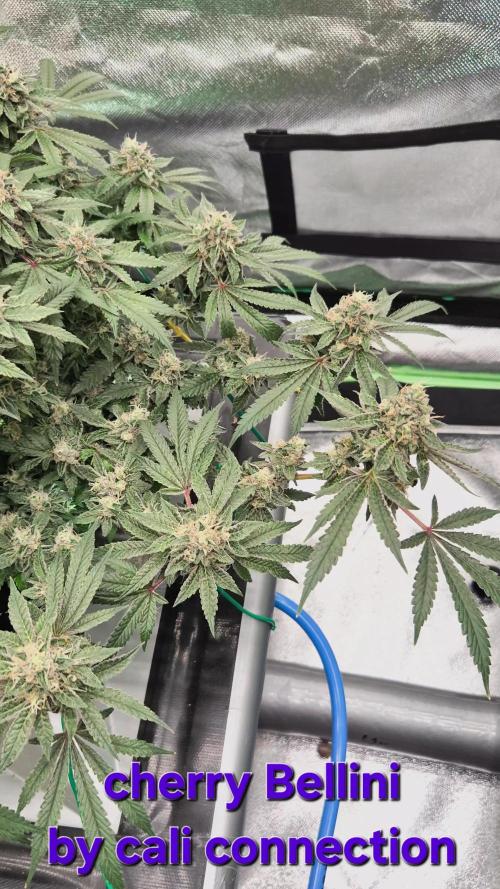
🌿 CherryBellini by The Cali Connection 🌿
Week 14
Flower week 8
Flower-day 1
3/12/25
( pisitils showed 25th of October) im timing from pisitils showed but diary runs from 12/12 light flip
No nutrients change today, I'm thinking about 2 weeks or so of feeding, maybe 2 more horti rawk doses before switching out to new millennium winter frost then onto flush with plain water/ph
Not sure, not sure. Maybe even give LA and Grape an extra week to get Bellini over the end instead of pulling a little early or pulling her as shes finishing up.
Next horti rawk dose probably saturday (48hr run ) then dump then new nutrients.
This is currently week7 day 1 flower from 6/12/25 ( pisitils first shown )
8/12/25
Will be dumping nutrients tomorrow, switching to winter frost by new millennium then onto flush
9/12/25
Dumped nutrients, winterfrost 500ml ( 10ml a gallon) will use for 7 days then flush for 10 or so
Likes
5
Share


@BuddyHolly
Follow
Recovering very well, noticeable growth daily. Topped, Lst, and pruned over the last week. Adjusted light height and spectrum to encourage more lateral growth. Hope I didn’t overdo it. The og kush(right) growing a little slow, strawberry gorilla(left) is an autoflower and its leaves are looking a little funky.

Processing
Likes
20
Share


Likes
8
Share

@Oldwied
Follow
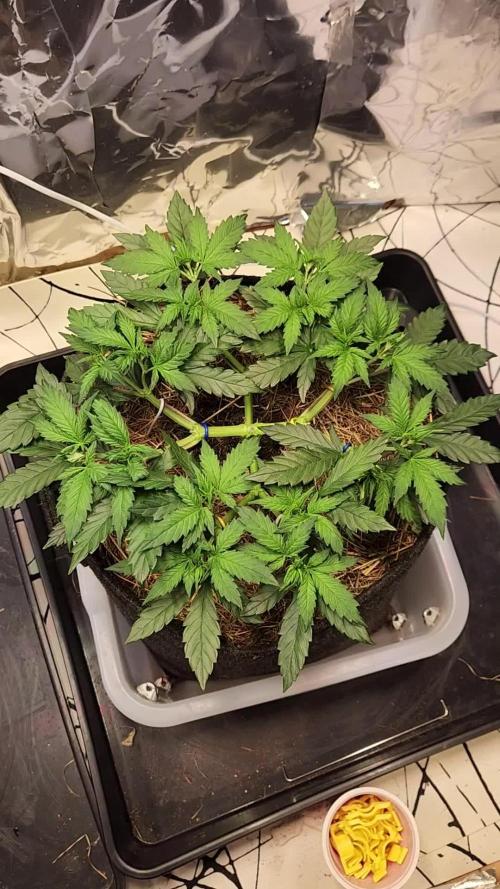
Let her grow. I'm in love with this strain.
Light Power: 60%
Day 45
Photoshooting

Likes
21
Share


@Stince1981
Follow
D71. I think I'll be putting her into darkness with a a few days to a week. She still getting fatter. Lovely smell.
D63. Into darkened room 36 hours.
D74. Chopped. Wet trimmed

Likes
4
Share


@Lazuli
Follow
Final defoliation was yesterday, she stretched a lot and is now in full flower she get bigger then any of my other plants and smells amazing
She did not stress at all from me cutting away so many branch and leaves


Likes
25
Share


@Grower_Of_Persia
Follow
my dry and cure style is this:
4 days of hanging upside down to get water activity lower to around 0.6 in 50% humidity and 26 C temp (i know its a little high but we are in a hot summer right now and i cant get it lower even with air conditioner) and then after 4 days of drying i remove leaves and stalks, trim buds and move them to jar for the rest of their life :D . and in the first 4 days of curing i open the jar door and let hem get some fresh air in the jar for about 5 minutes and close the jar door again, after 4 days of curing like that buds are smokable but they will get better as they getting cured about 1 month.
buds are one of the hardest as fucking rocks type of buds! very dense , compact , sticky , smelly , amazing at every aspect
growing stage was 60 days and flowering stage was 70 days total (harvested tops at day 63th)
the total weight of dry buds was : top buds 174 G + lower buds 55 G = 229 G
my overview of strain with details:
the seeds:
unfortunately i only got 1 seed cracked out of 5 so i will not know how much this genetic can get different but at least i got the chance to grow once of this wonderful strain
the plant :
in every stage you can ensure that you are dealing with a high level plant ,
she will get big so you have to control her height LST and SCROG highly recommended , will grow very well with tick stalks and big fan leaves , has good resistance for stress and will respond very well to stress trainings , she really has gorilla power in herself ,
fresh buds on plant :
buds are very compact and dense even from start , fresh blossoms smells like pineapple and mango , 2 different shades of sweet smells like you hold 2 junks of pineapple and mango in your hand and you smell them together, she is a trichome and resin factory , very very sticky , very oily , strong smell
dried buds:
very compact and dense , hard as rocks , has dark colors with purple hues inside it , it smells sweet
smoke :
very smooth and sweet like lollipop , pineapple , mango like , after 2 minutes it'll kick in and you'll get higher and higher with every breath , has a strange and especial high mind high mostly

Likes
13
Share

@Chubbs
Follow
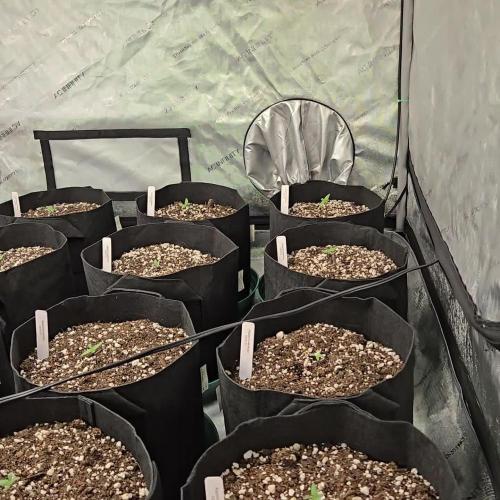
Excited to start these ladies. This strain has the temps that make you want to keep going back for more. The flowers come out super dense and covered in trichs. Let's see if they come out as good if not better then the last time I've grown it. Got 10/10 to sprout so where already off to a great start. All In all Happy Growing
Likes
7
Share


@Nacholicious
Follow
WEEK 4:
SHE HAS EXPLODED THIS WEEK!
Heavy LST with some light defoliation done throughout the week.
No notable deficiencies or toxicities.
~~~~~~~~~~~~~~~~~~~~~~~~~~
FF Ocean Forest Soil
Botanicare Cal-Mag: 4 ml/gal
Botanicare Hydroguard: 2 ml/gal
Added: Humboldt's Secret Golden Tree 1 ml/gal
Reservoir ppm: 250
Reservoir pH: 6.3
~~~~~~~~~~~~~~~~~~~~~~~~~~~
Notes:
At the start of this week I added Golden Tree supplement at half dose, and I'm happy with the results. I read some comments about it stinking up your grow room, it is NOT the case for me. I would definitely recommend it, my Pineapple seems to love it.
She has sprouted a ton of new shoots this week which have been LST'd to create an even flat canopy (see pics).
Through LST and defoliation, my goal is to create 7 or 8 large colas around the perimeter and a bunch of smaller ones in the center (see pics). Using garden ties i bend the main stem down to almost 90 degrees, exposing the lower bud sites to the light. As new bud sites grow, they also get tied down and some light defoliation is done, only removing what blocks the lower bud sites from the light. This means the leaves that face towards the center get clipped, everything else not blocking a bud site stays.
She ALWAYS responded positively to the LST and defoliation. Never slowed her down (see time lapse above).
Likes
Comments
Share


Likes
18
Share

@Grow4Releaf
Follow
Aug 19th,
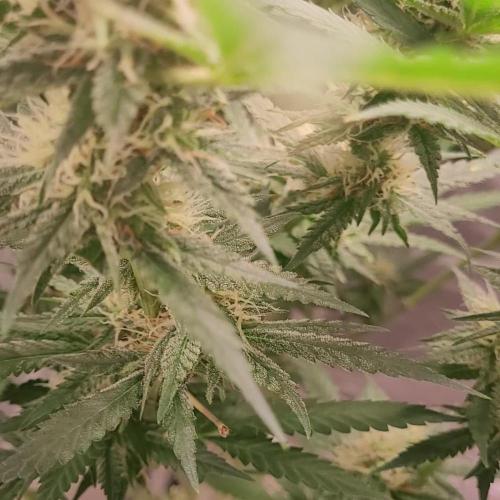
Cappy #2 has been steady and filling out really nicely so far.
Have added Phos-Fixer Blend Tea for her to build up her buds easier.
This stuff has been working great with the Growdots, Azomite, Langbinite, alfalfa meal combo lately. Gonna keep working on that but think I found my start point atleast ..
Still growing at a good clip tho, she's reaching for more light so I had adjusted the DLI some roughly between 35/40 now about the highest ill really ever go. Lights about 75% (640w) but get nice tight buds no need to run up my electric lol.
But that's really about it for this week. Can't wait to see how this one goes I kinda biffed up my first one not being home to harvast it wasn't handled right .. learned alot this last year lol, definitely gotta automate more and get atleast 1 solid helper for times I'm physically unable. Due time grow rooms still coming together slowly aswell. Getting there tho ..
Always appreciate everyone's time and support, hope ur all doing well !!
Till next week!! Can't wait to see this one filled out !!
