


Likes
Comments
Share


@Elmike
Follow
Une autres belles semaines de floraison pour mon bébé. Les fleurs ne sont pas les plus grosse que j'ai eu à se stade-ci. Par contre elle sont très compacte, collante et odorante se que j'aime bien ;) Les trichomes me laissent croire qu'elle sera prête à être récolté dans 20, 25

Likes
295
Share


@Polygus
Follow
Good day to all my friends and visitors here on GD.
Decided to finally finish this diary, I took my time with his one ;)
Now we cut the second POGP auto plant, the first cut you can find in week 17. The plant from week 17 weighted 660g. wet, this one finished at 1,85kg. wet.
The girls where autoflower but thanks to me starting this grow in cold day temps (14 degree Celsius) the started flower really late, maybe that's also the reason for all my problems with this strain during the grow?!
The two plants where different phenotypes, the smaller one (from Week 17)though small had nice hard flowers, the bigger one as the only plant from four I grew during the growop started foxtailing.
Both of them branched nicely the smell was quite strong and awoul xD like gasoline and something rotten, it smelled so bad i checked a couple times under microscope for any signs of mold in the flower and to my suprise I found nothing.
Thank God later during drying the smell would subdue to a more generic "hazediesel" smell
--------------------------------------------------------------------------------------------------
SE7000 done it's magic with this grow as with all my other grow ops.
For anyone who is interested in obtaining this efficient and affordable light fixture ($ to gram) here's the link:
https://spider-farmer.com/products/spider-farmer-upgraded-se7000-730w-commercial-led-grow-light/
A shout out to SSSC for the gift of genetics: supersativaseedclub.com/
Thank you all for your companionship on this voyage, I hope you enjoyed it at least as much as I did.
Also thank you for this awesome year together here.

Likes
18
Share


@NMGDOC
Follow
I was flushing all the plants since August 9.
You can see in the videos with de microscope ( I really try my best, but it was pretty difficult) the trichomes looks cloudy and some of them looks amber. Maybe in the videos you can't see it because my hand was really shaky.
August 17: all the plants were in dark.
August 18: i cleaned all the plants, buds, leafs, everything..., spraying water to remove the rests of potasic soap.
Today august 18, during the nigth, i'm going to harvest all the ladies.
In the past 3 days i didn't watering the plants and the smell was stronger.
August 19:
Before dry
-Critical Kush: 150g
-Red dwarf: 60g
-Syrup (2 plants): 270g
-Lemon (4 plants): 570g


Likes
31
Share


@JeyGanesha
Follow
Questa gorilla cookie cresce ben forte..spero arrivi al termine senza nessun intoppo....
Siamo arrivati alla fine della3 settimana. Tt procedere alla grande

Likes
73
Share


@MisterZ
Follow
Bienvenue dans ce nouveau diary,
Cette fois j'ai choisi une nouvelle variété dans le cadre d'un sponsoring de kannabia. C'est difficile de choisir dans leur catalogue, on a envie de tout cultiver ! J'ai donc choisi et reçu un sachet de chaque variété go fast. Merci les amis de @kannabia, je suis très heureux de cultiver ces variétés. Je vais m'appliquer.
Mon espace est petit, je ne vais cultiver qu'une plante à la fois. J'ai mis une graine en germination dans un verre d'eau. En même temps j'arrose le pot textile de 11 litres d'un litre d'eau très lentement. Lorsque la graine sombre au fond du , elle est rehydratée et posée directement dans son pot. La germination a pris 5 jours.
J'ai essayé un time lapse pour la germination, j'ai encore quelques paramètres à régler.
Voilà pour l'instant tout va bien !


Likes
10
Share


@Smokwiri
Follow
Welcome to my Super Silver Haze diary.
Genetics: Zamnesia seeds
Looks great, grows fast, nice big leaves alteady on day 15
Going to put it on 12/12 in a couple of days, when she grows past 20 cm
Likes
22
Share


@donovanliam
Follow
I have a new light with a bloom setting hopefully that will make a nice flowering. Got a new fan for air circulation. The new light has cooling fans. Haven't noticed any burns so im happy with my order. If you look at the last few pictures my tent is home made and cheap very cheap. The lights not an expensive one but I think its fine for now.


Likes
13
Share


@reirrac1
Follow
She started out stretching vertically faster than any strain I’ve grown before, and after laying her out for LST I thought she’d continue that stretch... she did to a certain degree, but more than half the canopy did not make it to the top. Next time I think I’ll top her instead, but regardless she has put out some picture perfect, sticky, pungent buds. A must have strain.

Likes
6
Share

@Simba732
Follow
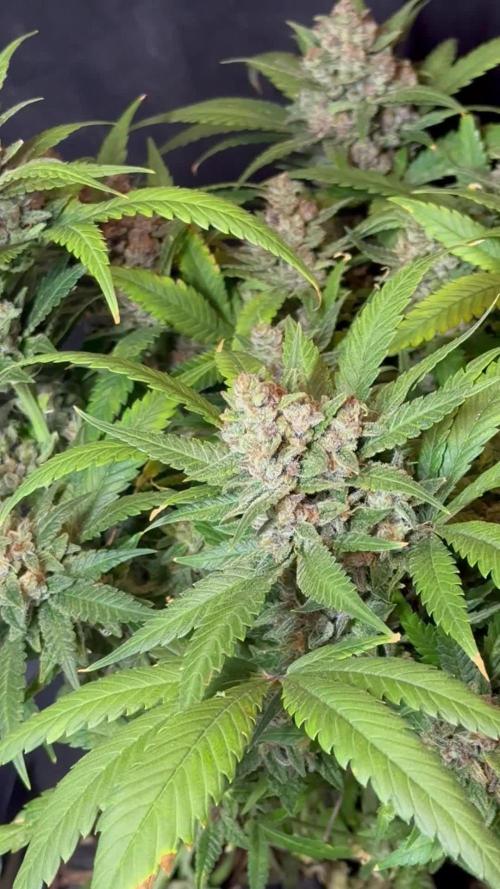
Week 11 over for Mama Tropicana 🍇🍋🍓
She smells delicious and has taken on her purple shade 🍬
I checked on the trichomes and we are getting very close to harvest day.
I’m stopping the feed and we switching to Flawless Finish to help flush the salts still present in the soil
Will let her go for a few more days then 🔪✂️
Happy growing Gang 💪🏾💚
Likes
33
Share


@Hydro_sweetness
Follow
Hey guys welcome back in week 13!! Almost there, this week i'll start building off nutrients so i can give them a proper flush next week.
Buds are still getting fatter each day and starting to smell real strong, i do have a bit of nute burn due to a massive PK boost (PK 50-31) but i managed to find the right amount i needed to give them,
this week i'll give them a milder PK booster.
So im keeping a close eye on the ladys and her crystals to get a nice 80% milky and 20% amber trichomes mix.
The NL X Haze clones are good to go so they need a little bit of patience, and when the time is right il put the left one of the picture in to flower, and the other one will me cut down for clones and prepare them for the outdoor season.
The other clonse i got is an "Ebola Virus" strain... the name isnt that beautiful but i've seen the mother where she was cutted from is an absolute beauty, not sure but i think i'll prepare 2 also for the outdoor season and save 1 as a mom, but like i said not sure yet.
Well thats it for now guys, see ya'll in week 14 (the last week if every thing goes as planed!)
PS: Sorry for the un-sharp pic's the lens on my phone isnt that good

Processing
Likes
22
Share


@Luv2Grow
Follow
Day 64 - Starting week 10 off and she’s looking gorgeous. Gave her the first week 10 feeding of the trio and all looks amazing with this girl. She’s getting fatter and filling in a ton each day and really looking forward to finishing this grow. Haven’t had a single issue with this grow and gonna try growing a few different strains to have a variety for different ailments!
Day 65 - Looking good as ever and getting fat. Gave her some water today and she’ll get her next feeding on Thursday. Just watching her fatten and grow each day and loving it!
Day 66 - Still fattening up and getting really frosty. Gave her the second feeding today and she’s drinking it up. Other than that, no big changes today.
Day 68 - Got busy yesterday and missed watering her and it showed today. All leaves were wilting but watered her and all looks good now. She’s definitely a gorgeous plant and can’t wait to harvest in the next couple weeks.
Day 69 - Closing in on the end of week 10 and not too much to complain about. Just gave her a feeding of the foxfarm and she’s really starting to fatten up and get frosty. I’m thinking about 2-3 weeks left before harvest and can’t wait.
Day 70 - Rounding our week 10 and not much to update. She’s fattening and getting frostier everyday still. 2-3 weeks and I think she’ll be ready.
Processing
Likes
17
Share


@Ashbash
Follow
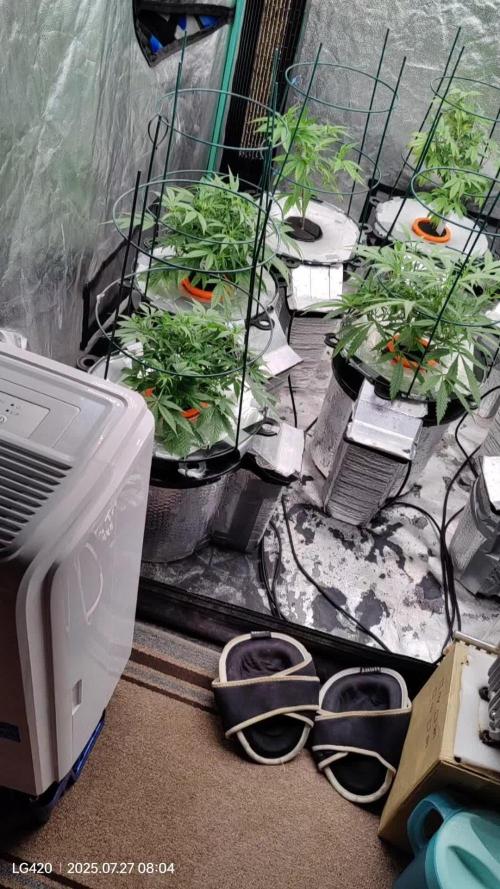
Made a big error this week and forgot to water these guys for about 5 days.
They did not enjoy it and dried up a lot, but theyre not dead yet! The Zkittlez shouldnt have been affected too badly cos it was nearly done, i hope the lemon ak will revover tho and keep bulking up. I am going to cut down the Zkittlez this week, and leave the lemon a couple more. It looks much bulkier just not dense so gonna leave it a little longer.


Likes
8
Share


@Franz1234567
Follow
increasing nutrient doses, monitoring EC and pH doesn't bear fruit, I think. Training also takes its toll and the girls flourish.
We will continue to feed and observe...
Second half of week brings quite intensive growth. Continue with LST, because need light penetration and some leaves out with same purpose.
What does next days bring? I am exciting...
Likes
15
Share

@GoodTimesOrganics
Follow
Hi liebe Community und Welcome Back! 💚
Slush Mint Cake von Dutch Passion!
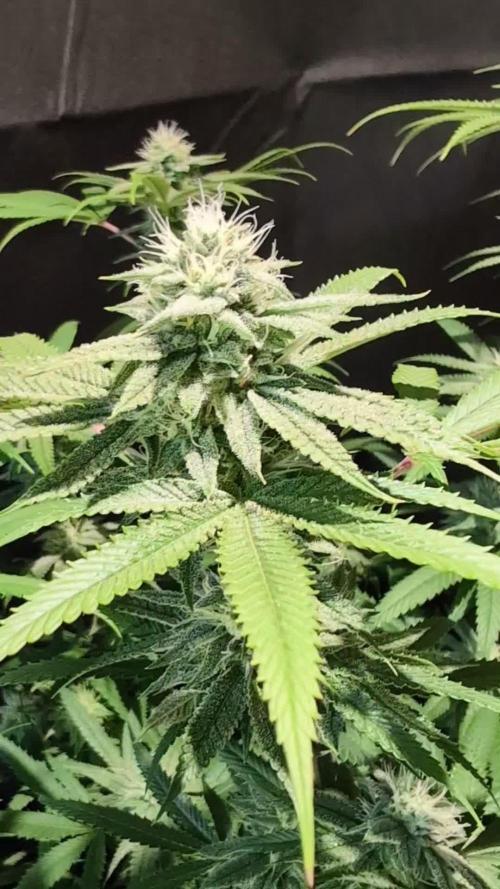
Die vierte Blütewoche ist vorbei und die Pflanze hat im Stretch bisher nochmal 2cm zugelegt, daher wird wars dass nun auf jeden Fall was die Höhe angeht.
Ich bin immer wieder begeistert von Antonio's breedings. Die Herkunft durch die Ice Cream Cake lässt sich auch bei diesem Strain gut erkennen.
Sie verhält sich sehr ähnlich wie die Ice Cream Haze, entwickelt aber schon Mal ein anderes Aroma!
Die Pflanze hat nun eine Höhe von 117cm erreicht.
Sie hat eine wunderschöne und homogene Wuchsform.
Das bin ich von Dutch Passion echt gewohnt. Tolle Strain s!
Die Stigmen bilden sich immer mehr aus und es sind schöne und immer mehr glänzende Trichome erkennbar.
Die Bedingungen im Growschrank sind für die Blütephase aktuell Top!
Die Lichtintensität wurde nun auch auf dass Maximum hochgefahren.
—————
🌞 Temp: 26
🌚 Temp: 18°C bis 19°C
💨 RH: 54%
VPD: 1,17 kPa
💡 ppfd: 830 mpm

Likes
5
Share


@BlackandGreen
Follow
Plants are really flowering still small but plant one has a lot of tops now and plant 2’s buds are already getting dense.

Likes
12
Share


@AllieO
Follow
1/12: lots more leaf tucking today. She's taking waterings like a champ. I'm always so worried about overwatering but she seems to be growing well
1/14: did a little more lst, so she's looking a little bit like an ugly duckling. Hoping the effort plays out. Attempted to adjust some clips and accidentally broke a stem. I splinted that up with some tape... Also my attempt at a fim is growing out... She's looking a little rough right now, but honestly, aren't we all?
1/15: watered and some leaf tucking this morning. Excited for the top to not look like a hot mess!
1/17: the ugly duckling phase is strong with this one. Gave her a good watering today and attempted some leaf tucking, only sacrificing one fan leaf.
Likes
30
Share


@valiotoro
Follow
Week 9🤓!!
Im entering in the last PuSsSh
Green ZenZaaation💥
FCE-6500 100% + adlite UV IR deep red🔛
Happy growing💚👨🏻🌾