Likes
Comments
Share
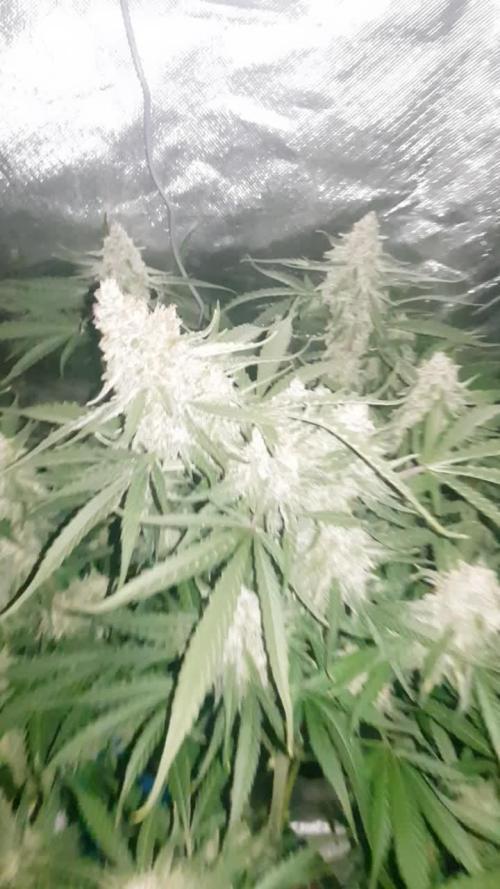
🌿 **Green-O-Matic Grow Week 9 Update: Nearing Harvest Time!** 🌱 Greetings, fellow growers! It's time for an exciting update on the progress of our Green-O-Matic journey as we reach Week 9 of the grow cycle. With anticipation building and buds swelling, let's dive into the latest developments: 🌟 **Bountiful Bud Development**: At Week 9, our Green-O-Matic beauties are truly showing their potential, with buds swelling and resin production kicking into high gear. The once-small flowers have transformed into dense, frosty nuggets, promising a bountiful harvest in the near future. Trichome production is in full swing, indicating peak cannabinoid potency and aromatic complexity. 📏 **Final Stretch of Growth**: As we enter the final stretch of the flowering phase, our focus shifts to maximizing bud development while ensuring optimal ripening conditions. With careful attention to environmental factors such as temperature, humidity, and airflow, we aim to create the perfect microclimate for our plants to thrive and reach their full potential. 🍃 **Leaf Senescence and Nutrient Management**: As expected in the late flowering stage, some leaves may begin to exhibit signs of senescence as the plant reallocates energy towards bud production. This natural process is perfectly normal and serves as a signal that the plant is nearing maturity. Meanwhile, our nutrient management strategy remains vigilant, providing the essential elements needed to support robust flowering without risking nutrient imbalances or deficiencies. 🔍 **Monitoring Trichome Maturity**: With harvest on the horizon, we're keeping a close eye on trichome development to determine the optimal time for harvest. Using a jeweler's loupe or digital microscope, we inspect trichomes for signs of maturity, aiming for a mix of cloudy and amber trichomes to achieve the desired balance of THC and CBD levels, as well as flavor and aroma profiles. 🌞 **Preparing for Harvest**: As we prepare for harvest day, our checklist includes gathering supplies such as trimming shears, drying racks, and storage containers, as well as ensuring a clean and sanitized workspace to maintain the integrity of our precious buds. Proper post-harvest care and curing techniques will be employed to preserve terpene profiles and enhance overall quality. In conclusion, Week 9 marks a pivotal moment in our Green-O-Matic grow journey, where patience and precision culminate in the imminent harvest of our prized buds. Stay tuned for the next update as we celebrate the culmination of months of dedicated cultivation with a bounty of premium-grade cannabis ready to be enjoyed and shared. Happy growing! 🌿✨ 🚫 **Addendum: Phenotype Bin Update** 🌱 In the spirit of transparency and continuous improvement, it's important to note that we've made the decision to bin one out of the three phenotypes due to poor development. Despite our best efforts and meticulous care, this particular phenotype failed to thrive and did not meet our quality standards. While it's always disappointing to part ways with a plant, this decision ensures that our resources and attention remain focused on nurturing the strongest and healthiest phenotypes to their fullest potential. By removing underperforming individuals, we can redirect our efforts towards optimizing the remaining plants for a successful harvest. Rest assured, this adjustment will not deter us from our commitment to excellence. We remain dedicated to the cultivation process, learning from each experience, and striving for the highest standards of quality and consistency in our cannabis cultivation journey. Thank you for your understanding and continued support as we navigate the complexities of plant development and refinement. Together, we'll continue to grow and evolve towards greater success in our cultivation endeavors. 🌿💪
Likes
69
Share
@ClubRiot
Follow
Kalini Asia Week 14 11L Pot LED: SP250 (245W) for Flow. Stage Canna COCO Mineral Nutrients: 👇 Sensi Cal-Mag Xtra: 1 ml/L Power House Part A: 1.5 ml/L Calcium Plus Part B: 1.5 ml/L Stimulus: 1.5 ml/L Bud Explosion: 1.5 ml/L
Likes
2
Share
🌼 About the grow This grow is focused on three autoflowering varieties, each with different characteristics – speed, terpenes, colors and yield. The plants have a very healthy start from the beginning, the root system responds great to the BioBizz program and so far without any signs of stress. Gorilla Zkittlez and LSD-25 have a strong stretch, approximately 90–93 cm. Titan F1 is compact, around 40 cm, but very dense and quickly sets flowers. Flowering is smooth, pistils healthy, without hermia, the aroma gradually becomes more pronounced – fruity and sweet terpenes. 🌞 The goal of the grow maximize the yield in a small 80×80 box keep low humidity in the flowering phase achieve dense, terpene top colas test the difference between the fast F1 variety and classic autos 📝 Current status Beginning of the 4th week of flowering. Gorilla and LSD after fresh fertilization. Titan still slightly damp – waiting for the next dose. All plants without deficit, beautiful color, healthy tops.
Likes
57
Share
Week 4 - 01/22 to 01/28 2021 Pictures from Days 25 + 26 TRANSPLANTED! Might have waited too long but hopefully the transplant and LST stress might slow the plant down since i think it's already flipping to flower like the Red Poison & Purple Lemonade in my other diaries 😱 Ended up more 50/50 ratio of Destiny Organic's Dark Matter Living Soil + ProMixHP since I had to make the Destiny last. Apparently they went out of business just after I decided it was my favourite/new soil :( Would rather stay away from Ocean Floor since I haven't had the best experiences with it (bugs/rust fungus etc) Feel free to drop some recommendations other than Fox Farms below 👍 The Dark Devil Auto is otherwise healthy and starting show hints of colour in the stems 😈 I raised the @ViparSpectraLED P1500 another eight inches after transplant and started basic LST. I really wanted to get these four under a ScrOG but if 3/4 are already flipping and the LSD is still runty I might have to wait it out again. It already has a solid skunky/hash plant smell on the fingers after adjusting them and it looks like it might actually be a tripod mute with three flower sites per node. Hopefully I can stretch it out and take advantage of the extra bud potential 🙏 I have the @MarsHydroLED TSL2000 set up and ready to go once the girls settle into their new pots. Have the new surge protector/heavy duty power cords/power tool grade timers as mentioned in Week 3. Some of it shown in the pictures. Threw some videos in this week as well with some Queen's Radio GaGa, Beastie Boys' Brass Monkey, and a little hint of Arkells ....COME TO LIGHT on the short @ViparSpectraLED ..GET IT.. 😓 -- Thanks for checking in! Throw down a like and/or follow so I can return the favour 🙌 Check out my Diary of the Year 2020 Entry for my Original Auto Sour Diesel: https://growdiaries.com/diaries/54258-fastbuds-original-auto-sour-diesel-grow-journal-by-glazedgrow IG: @GlazedGrow CannaBuzz: @GlazedGrow
Likes
81
Share
@m0use
Follow
SPONSORED DIARY===SPONSORED DIARY===SPONSORED DIARY Ok so I fell off the wagon a bit and forgot to place one of the weeks up in this contest. Bad news first, still no word or proof of the missing plant, I did get access to the camera room but there is so much footage to sort threw, so now it is just finding the time to get all that done. hopefully sooner then later. I was able to confirm it did not fall off the edge like I was thinking. That video feed is much easier to check. now all that's left is to check the roof top cams and inner hallways. Will know if it was a person from inside the building or outside of it soon enough. If your the one who took it and are reading this. Please return it and I'll give you some clones. Bird shit on the plant this week, fun fun, and its started to turn in colour already. had a cold wet week here. I thought it would have started bulking up a bit more before tuning, hopefully it will not get to cold in the next few weeks and it can finish up. Will take some clones and see if I want to grow them out. Its WPM resistance has been golden and its been aorund other plants on the deck that do have it. so a+ for that. Still have some dead leaves and yellowing going on. going to let it finish on its own. done feeding it, soil should have enouth in it to bring it to harvest. SPONSORED DIARY===SPONSORED DIARY===SPONSORED DIARY This is my diary entry into the Dynomyco Show Us What You Got Contest! #DynomycoShowUsWhatYouGot! @DynomycoShowUsWhatYouGot! @Dynomyco Big Shoutout to @Dynomyco for picking me in their contest. Happy to be involved and as a user of Dynomyco I am curious to see this side by side with my own eyes. I will be honest I am a little skeptical it will show any major differences. but we will see what happens. Some disclaimers, I am still using LABS serum I made, This is also beneficial to the root mass however it's a bacteria based product and not fungal or mycorrhizae like Dynomyco. https://growdiaries.com/giveaways/DYNOMYCO_Show_Us_What_You_Got
Likes
17
Share
@4chuk
Follow
When I began the contest I had only grown Magic Melon once before (last winter), it grew in an 18 litre pot, became around 4 feet tall, and completely filled a 3'x3' tent. A friend of mine successfully grew a seed I gave them this summer in a container about 4 litres and the plant was considerably smaller. The fact that it can be successfully grown in less than 250mL is astonishing, I have buds from the one grown last winter that are bigger than the can I grew this one in. Harvested 91 days from sprout.
Likes
1
Share
Remember that, however you are played, or by whom, your soul is in your keeping alone. Even though those who presume to play you be kings or men of power, when you stand before God, you cannot say, 'But I was told by others to do thus,' or that virtue was not convenient at the time. This will not suffice. Remember that. Day:18 84°F and 65% RH (VPD) for the vegetative stage. Approximately 1.15kPa(assuming leaf temperature is about 2°F cooler than the air), which falls right into the ideal vegetative sweet spot (0.8kPa to 1.2kPa). At 1.15kPa, plants can draw water and nutrients efficiently without risking stress or wilting. It keeps the leaf pores (stomata) open, allowing for ideal carbon dioxide intake and maximizing vegetative growth. VPD is determined by the leaf's temperature, not just the ambient air. Because leaves usually run 1° to 3°F cooler than room air under bright grow lights, my actual VPD will be slightly lower, closer to the 1.0kPa mark. As she transitions from vegetative growth to flowering, one can gradually lower the humidity (to around 45–60%) and drop temperatures slightly to prevent disease from settling inside dense buds when they appear. Night:6 At 70°F and 60% relative humidity, Vapor Pressure Deficit (VPD) is 0.86 kPa. This is right on the cusp of whats optimal for the vegetative stage. During the nighttime, plants generally close their stomata and undergo cellular respiration rather than photosynthesis. Transpiration slows to a near stop, making VPD less critical at night than during the day. However, maintaining a nighttime VPD between 0.8 and 1.0 kPa is highly beneficial in that it ensures the air is dry enough to prevent powdery mildew or bud rot, but moist enough to keep the plant from undergoing unnecessary stress. This range keeps the environment comfortable for cellular processes and prevents large atmospheric swings. Keeping it all flowing. (Not pushing them yet, these are photoperiods) The optimal soil (root zone) temperature for cellular root respiration and nutrient uptake in cannabis is between 68F & 72F This narrow range balances biological energy production (cellular respiration) with the dissolved oxygen levels in the soil, maximizing plant growth and health. Warmer soils hold significantly less dissolved oxygen. When soil temperature exceeds 74F oxygen depletion occurs, inhibiting cellular respiration almost entirely, At 68-72F root cells generate optimal adenosine triphosphate (ATP) via respiration to power root-tip elongation and the active transport of water and nutrients. Too Hot (Above 78F) Root respiration increases, demanding more oxygen, while the water's oxygen-carrying capacity drops. This creates a prime environment for anaerobic pathogens and Pythium (root rot). Too Cold (Below 60F) Root metabolism and cellular respiration slow to a crawl. This severely impairs nutrient and water absorption, leading to yellowing, wilting, and phosphorus deficiencies. A lot depends on whether it's automatic or photoperiod; with photoperiod, there is not as much of a need to push "hard" as the real countdown only begins once the flower is initiated. Automatics, on the other hand, the chronological "clock" begins ticking the moment the seed germinates. It is of critical importance that the seedling growth gets off to the races, understanding that early growth is like compound interest, which will pay off come harvest. This reality is why getting autoflowers "off to the races" early on yields such exponential benefits. The "compound interest" is directly related to the surface area of the leaves. Larger, faster-growing seedlings process more light and build bigger root networks early on, which translates into an explosion of vertical and lateral growth during their short vegetative window. The margins for error are so thin with autoflowers; this early-stage momentum depends on several critical practices. Seedlings exposed to increased atmospheric CO2 levels early in life will develop at an increased rate. To effectively "extend" or optimize the capacity of Photosystem II (PSII) for increased photosynthetic efficiency. In standard oxygenic photosynthesis, Photosystem II (PSII) is naturally limited to the red-light spectrum, peaking at 680nm. Extending its light-harvesting capacity past 700nm into the far-red region requires bypassing the natural limits of standard chlorophyll a. Adding 730 nm (far-red) LEDs alongside standard red/blue lights has been shown to increase canopy photosynthesis by 20–30% in several crops by acting synergistically with shorter wavelengths. However, the limitation is that excessive, pure IR/Far-red light (without accompanying red light) can trigger the "shade avoidance response," causing plants to grow tall, weak, and spindly rather than robust. Utilizing infrared light (specifically the 700-750 nm far-red range) is a viable method to boost photosynthetic efficiency. It acts as a bridge to allow PSII to utilize a broader spectrum of light, breaking the traditional 700 nm barrier. UVR8-mediated signaling (often in conjunction with CRY proteins) triggers protective mechanisms that maintain the stability of the photosynthetic apparatus (including LHCII and reaction center proteins), thus ensuring that the efficiency of Photosystem II remains higher in UV-B-exposed plants compared to plants lacking this receptor. ΦPSII indictates the rate of electron transfer from water to plastoquinone, which drives the production of ATP and NADPH. There is a close link between ΦPSII and the true rate of CO2 fixation (Φ*co2). ETR stands for Electron Transport Rate. It measures the speed at which electrons are moved through the thylakoid membranes in a plant's chloroplasts during the light-dependent reactions of photosynthesis. Infrared light (particularly Near-Infrared or NIR) improves cellular energy by interacting directly with the electron transport chain (ETC) in mitochondria. This process boosts adenosine triphosphate production, which acts as a metabolic coefficient multiplier by accelerating enzyme activity dramatically. Extend then multiply. Far-Red photons interact with plant photoreceptors to accelerate the plant’s biological "clock" or trigger a shade-avoidance response. Autoflowers don't use the plant's biological clock, although the IR will initiate a shade avoidance and make them stretchy. You can just add equal measures of 660nm-680nm to negate the shade avoidance effect. Replacing nights' "darkness" with a combination of IR+ and 660nm. Because autoflowers don't require a dark period to flower, many growers just blast them with light. 18/6 24/0. However, this ignores the plant's metabolic rhythms, where daytime photosynthesis (light reactions) must be perfectly balanced with nighttime carbon fixation and assimilation (Calvin cycle) to avoid bottlenecking plant development. Cellular respiration is a 24/7 process, but it can only function while the plant has the free oxidative capacity to do so. A 100% photosynthetically active leaf cannot perform cellular respiration. The viral trend of defoliation of every leaf that isn't "getting enough light" is of great detriment overall, putting 100% of the cellular respiratory "workload" and responsibility on the 0/4/6 hours of darkness in sub-optimal conditions for enzymatic activity. Photosynthesis captures nearly 100% of the initial energy as carbon, while cellular respiration is the process that unlocks 90% of that captured energy into usable ATP so the plant can use it. Respiration is considered roughly 30% to 40% efficient. It captures enough of the potential energy in glucose to synthesize around 30 to 38 ATP molecules per glucose molecule. The remaining 60% to 70% of the energy in the sugar is not captured in ATP; instead, it naturally escapes into the environment as heat, which helps regulate plant temperature. In plants, the primary enzymes of the Electron Transport Chain (ETC) and the ATP synthase complexes are typically adapted to function optimally in warmer temperatures (roughly 25°C to 35°C depending on the specific plant strain). As temperatures rise within this physiological range, molecular collisions increase, speeding up respiration and ATP production. The cannabis plant has a branched respiratory pathway. During heat or cold stress, plants activate Alternative Oxidase (AOX). AOX burns sugars to dissipate energy as heat rather than coupling it to ATP production. This pathway actually functions optimally at elevated temperatures to help protect the cell from the damaging build-up of Reactive Oxygen Species (ROS) during heat stress. Enzyme activity generally scales with heat; there is a strict biological limit. If canopy temperatures in a grow room exceed 40°C, the enzymes and their supporting lipid membranes lose stability. Not saying you need to go crazy, just optimize nights the same as we optimize days. Phosphorus is the driving force behind early seedling development. It acts as the "energy hub" of the plant, directly driving cell division, robust root growth, and the creation of DNA. Without an adequate, easily accessible supply early on, the plant's overall growth potential and final yield can suffer permanently. E=MC2 looks like a simple multiplication problem; it describes a fundamental physical truth: mass and energy are the same thing. The equation doesn't just calculate a value; it reveals that mass is effectively "congealed" energy. Energy is just numbers. Energy isn't a physical "substance" you can hold or touch. It is essentially an abstract, calculated number that we assign to a system to predict how it will change, interact, or move. A numerical label we attach to matter to track how it behaves. Because the universe runs on laws of symmetry (specifically, that the laws of physics don't change over time), a single global number must be conserved. We call that number "energy". We don't grow; we facilitate energy conversion. How well a seedling grows is essentially down to how much knowledge one can acquire to increase the level of conversion to occur. Applying knowledge effectively requires intuition, which comes from hands-on experience. A seasoned stoner learns to read subtle signs—like a slight change in leaf turgor (stiffness), subtle color shifts, or the specific texture of the soil—before a textbook diagnosis can be made. Ultimately, growing is the application of botanical science blended with active observation. Knowledge dictates your potential, but adaptability and attentiveness to the plant's immediate environment determine your results. 1.618 nature mathematically optimizes quantum energy transfer and light absorption efficiency within the photosynthetic machinery, as it naturally dictates energy scaling hierarchies and resonance dynamics. External vibration or electromagnetic wave that perfectly matches a plant's natural frequency directly influences plant growth. Low-frequency sound waves and targeted electromagnetic fields stimulate cellular processes and boost photosynthetic efficiency Does it produce better yields? How long is a piece of string? As long as you cut it. But isssss the juice worth the squeeze? The quantum framework of the IVM seems to think so. Good enough for the quantum firmware, good enough for the DNA software. Genetics are not dictated; they are expressed; the rate of that expression is dictated by the environment in which growth occurs. Quantum Coherence in Photosynthesis occurs When a photon of sunlight strikes a leaf, the energy it carries must travel to a reaction center to be converted into chemical energy. This process operates at nearly 100% efficiency. If the energy moved in a traditional "bunching" or random hopping manner, a large portion of it would be lost as heat. Instead, plants utilize quantum superposition. The energy particle (exciton) doesn't just take one path; it exists in a wave state and explores multiple pathways simultaneously. It essentially "chooses" the most efficient route to the reaction center simultaneously. Research shows that molecular vibrations and the specific network arrangements of chlorophyll molecules (like the naturally evolved Chlorophyll A & B ratios) actively protect against energy overflow, optimizing light capture across different light intensities. Enzymes are the biological catalysts that speed up chemical reactions within a plant's cells, allowing them to grow, metabolize, and repair. Rather than relying solely on the classical kinetic energy of molecules colliding, plants use quantum tunneling. Subatomic particles like electrons and protons (hydrogen ions) can literally "teleport" through energy barriers that they normally wouldn’t have the energy to climb over. This makes vital metabolic reactions happen far faster than classical physics could ever explain. Chloryphyll b has peak absorption at 460nm (Blue) and at 647nm(Red). If we take the blue peak wavelength 460nm and a UV-B, UVR8 peak absorption wavelength 285nm, Tryptophan-285 (W285) Sensing protein. 460/285=1.618 Φ If we take chlorypyhll b's Red absorption peak 647nm and a UV-A of 400nm, we get 647/400=1.618 Φ. "Structure of light". The cryptochrome photoreceptor (CRY) is a UV-A/blue light receptor that shares this dual sensitivity with several other biological structures and functions, including significant sequence similarity and a common evolutionary ancestor with DNA photolyase enzymes. These are light-activated enzymes that use blue/UV-A light to repair DNA damage caused by UV-B radiation in plants. Synergistic. But Shhh, it's a secret. Effective quantum efficiency of photosystem II, often denoted as ΦPSII, represents the proportion of light absorbed by Photosystem II (ΦPSII) that is actually used in photosynthetic electron transport. It is a key indicator of how efficiently a plant is using light for photosynthesis, as opposed to losing it as heat or fluorescence. ΦPSII (effective quantum yield of photosystem II) functions primarily as a "multiplier" (a coefficient of efficiency) rather than an additive factor when estimating the overall photosynthetic electron transport rate (ETR). Multipliers are considered far more beneficial than additions because they generate exponential growth, leverage existing resources to their full potential, and create sustainable, self-multiplying capacity, rather than just incremental, linear increases. This fascinating observation is rooted in the intersection of subatomic geometry, fractal scaling, and quantum dynamics. In specific molecular arrangements—such as in conjugated polymer networks or biomolecular architectures—the Golden Ratio (PHI) naturally dictates energy scaling hierarchies and resonance dynamics. Mathematically tied to the fine-structure constant, which defines the strength of the electromagnetic interaction. The Golden Ratio can be mapped geometrically as the Golden Angle (137.5 degrees) in atomic structures, linking the charge of the electron to fundamental quantum constants like Planck's constant. Electromagnetic. The Golden Angle (137.5): This angle is derived from the Golden Ratio (1.618). It is the smaller of two angles created when a circle is divided such that the ratio of the arcs equals the Golden Ratio.
Likes
16
Share
Added Exhale c02 and top dressed in each pot with 1 tablespoon per gallon of growing medium my pots are 3.6. I added 3 tablespoons. It is my hopes that with adding the slow release dry amendments and once the c02 bag sarts growing my plants will finally grow. They are short but have 4 nodes at day 21. What is an exhale c02 bag? “The ExHale bag is a patented strain of mycelium that produces an abundance of CO2 without fruiting. This means that when our bag is activated, the mycelium grows, eating the substrate it comes with, giving off heaps of CO2 straight into your garden, and it does all this for 6 months - guaranteed!” At day 25 I am not impressed with the size of these girls? Hope they hit a growth spurt soon? Their internodes are stacked very nicely. At day 28 growth is very slow. Practically none existent since my top dressing at day 23. 2 plants have received a very minimal nutrient burn. As I do not have a soil ph tester? I will be watering with a ph of 6.0 rather than 6.5, hopefully that helps. ONWARD!
Likes
20
Share
Welcome to 📅 Day 43: flower 4/26/2021 ok she is doing very good but I am seeing the she have a bit less development then her sister under the mars light. She is happy and healthy and right now that's what I want to see. for now that's it for the weeks update. Happy growing and as always keep your stick on the ice 🏒
Likes
13
Share
Day 31: 2L (PH6.3) with 1ml/L PK13-14 She's definitely well on her way to stretch, and some of the bud sites are already showing signs of consolidation and an increase of mass, not so much as to call it stacking or bulking, but a great early flower nonetheless. To aid with bud forming, I've started mixing in some flower nutes. I'm starting at half dose and will probably follow up with a regular watering later this week. Additionally, after taking the pictures, I removed the upper fan leaves of the main cola and the next highest too since it was outpacing the others. I'm trying to not agitate her too much to prevent stunting. Since she's grown so much, the main cola was receiving 900 PPFD, and the lowest canopy budsite - in the front on the pictures - was receiving about 450 PPFD. Hence, I raised the light up to 30cm above the main cola. I haven't remeasured the PPFD afterwards. Day 34: 2L (6.5PH) + 0.5mL/L CalMag
Likes
8
Share
@Lazuli
Follow
Hairs are still white but what a huge weight this plant has
Likes
1
Share
Really coming along, I'm very happy to watch her do her thing in this second half of flower. She's very earthy with some notes of pine. Smells just like the dank stuff I've been smoking my whole life! Man I can't wait to keep growing. I hope to expand the grow operation here soon, hopefully with another tent. I want to keep autos in different stages so I can streamline everything, have a plant popping while one vegges, while another flowers. Keep the flow steady and my fridge full of weed lol. Speaking of, I am using my fridge to dry! The Lotus Method for anyone familiar.
Likes
22
Share
12/25/2023-Germination Day 1 Merry X-mas 2023 I decided to start a run of SolFIre Gardens Hoodz Candyz S1. I am going to do a cup filled with RO water a touch of Hydrogen peroxide and let it sit for 24-48 hours until I see tap root then I am going to put it into a rapid rooter.. Tap root Down and put it about 1/4 of the say down the Rapid rooter. I made some modifications to my basket on this run.. I have taken a few Pods that I use for my cloning machine and decided that I am going to try and use them as sure plants, so that I can take my water right up to the bottom of the basket this time and see if these can make my planting more consistent.   12/26/2023-Germination Day 2 Tap root achieved Planting Commencing 12/27/2023-Germination Day 3 Misted the dome lightly misted the rapid rooter and added a little water to the bottom of the pan to encourage root growth to the pan. 12/28/2023-Germination Day 4 Ground Hogs day 12/29/2023- Germination Day 5 She is up, she has broken surface, I misted the root riot, and around the bottom of the tray to try and entice root growth down rapidly. 12/31/2023- Germination Day 6 Ground Hogs Day 1/1/2024-Germination Day 7 HAPPY NEW YEARS!!.. I did it I planned it out so my planting day would fall on New Years and it worked.. Yay!!! 1/2/2024- Germination Day 8 Since the roots are not to the water yet, I am pouring one cup of water lightly on the hydroton around the lady to try and encourage root growth down to the water.. 1/3/2024- Germination Day 9 Ground Hogs day, will continue until roots hit the water. 1/4/2024- Germination Day 10 Ground Hogs day, will continue until roots hit the water. I will just continue to top feed until roots are in the water.. Shouldn't be more than a few more days. 1/5/2024- Germination Day 11 Ground Hogs day, will continue until roots hit the water. I am going to change the water Sunday and kick off Week 1, I will just continue to top feed until roots are in the water.. Shouldn't be more than a few more days. 1/6/2024- Germination Day 12 Ground Hogs day, will continue until roots hit the water. I will just continue to top feed until roots are in the water.. Shouldn't be more than a few more days. 1/6/2024- Germination Day 13 Ground Hogs day, will continue until roots hit the water. 1/7/2024- Germination Day 14 Ground Hogs day, will continue until roots hit the water.
Likes
33
Share
I typically use the nutes at 1/2 tsp per gal but I have cut back on nitrogen since transitioning to flowering😎
Likes
49
Share
@Roberts
Follow
Green Cure CBD is growing great for a solo cup. She appears to be starting to bulk. She has a nice layer of frosty forming on her full of cbd goodness. Everything is looking great. She is very hungry, and thirsty with the limited root space. I removed some lower bits, but not much. Nothing else to report at the moment. Thank you Medic Grow, and Zamnesia seeds. 🤜🏻🤛🏻🌱🌱🌱 Thank you grow diaries community for the 👇likes👇, follows, comments, and subscriptions on my YouTube channel👇. ❄️🌱🍻 Happy Growing 🌱🌱🌱 https://youtube.com/channel/UCAhN7yRzWLpcaRHhMIQ7X4g
Processing
Likes
10
Share
@yaron
Follow
starting week 6,the wedding cheesecakes are in flower for a couple of days now and the gg are starting to flower. alot of wind and clouds and rain these past two weeks but the girls are looking good in my opinion. update:after 4 or 5 days of rain and low temperatures finally the re is sunlight so the girls have to recover a bit. but things are looking better wheatherwise. cheers!
Likes
6
Share
Wow going into the 3. Week of Flower. The plants have exploded since switching to 12/12 . #7 have close to doubled in size and are easily filling the second Trellis layer. #6 has also gotten bigger but it seems to have filled in more then shot up in height.. Will do a big defoiliate next Saturday. Will take everything below the first trellis including branches on #7  that do not reach the second trellis Turned IR to 75% 9-25-22 Feed the plants , they are looking great, but are ready for some trimming. Evening update: really don't know why but checked my soil this evening before lights turned off for the day and discovered it was bone dry. Watered the plants . Sure hope it starts cooling down soon. Temp in tent was upper 80's today, a tad warmer then wanted. 9-26-22 Plants seemed to have plenty of water left this morning, but might need checked on tonight. I am surprised that the plants are still stretching. Cheezy Puff & Cookies &Stash are much taller then the POG. The POG is more of a compact flower compared to the other two. The Flowers on all 3 are developing beautifully. 9-27-22 Day 17 It is amazing how much taller the Cheezy Puff as well as the Grandpa's Stash are compared to the POG All 3 look extremely happy and healthy and are developing plenty of bud sites. Feed plants this morning 9-28-22 Day 18 Is it only me that gets excited everyday when it's time to open the tent and feed the girls? Flowers are looking great but are ready for a trim! The incoming weather has me a little concerned, woke up to tent having RH of 70% closed the window and hope that helps 9-30-2022 day 20 The last two days have been tough on me and the geow. We got smashed by hurricane Ian and have been without electricity for the last 48 h with no end in sight. Opened the tent the last 2 days hoping the plants will get at least some daylight. With all the humidity in the air, the tent was at rh 98% when I opened it first this morning. Even after hours being opened the RH is still hovering around 75% Hope we get electricity back in the next 24h
Likes
50
Share
@squalino
Follow
Journal de Culture : Mac 1 – "Esprit" (Plante n° 2) – Pleine Floraison / Gonflement ​Date du jour : 09/06/2026 Âge de la plante : J+66 (Semaine 10) Taille actuelle : 134 cm Évolution : +3 cm (Le stretch est enfin stabilisé !) ​Excellente nouvelle cette semaine : la course vers le plafond est terminée ! Spirit s'est enfin posé pour concentrer toute son énergie là où ça compte le plus : la production de fleurs. 📊 État de Santé & Descriptif des Fleurs Fin du stretch : Spirit se stabilise à 134 cm. Un immense soulagement, car la gestion de l'espace vertical devenait critique. La cime la plus haute flirte toujours d'extrêmement près avec la lampe, à environ 15 cm, tandis que le reste de la canopée profite d'une distance de 35 cm. Explosion des bourgeons : Les têtes gonflent à vue d'œil et commencent littéralement à remplir et coloniser les branches sur toute leur longueur. L'allure générale est typique d'une belle Sativa, fine et élancée, avec des empilements de calices très prometteurs. Santé du feuillage : La plante conserve son manteau d'un vert profond et vigoureux. Toujours aucun signe de sénescence précoce à l'horizon, ce qui prouve que le système immunitaire et le métabolisme de la plante sont au top. La mascotte : Spirit la figurine est toujours fidèle au poste, surveillant le pied de sa plante homonyme près des pièges collants jaunes. ⚙️ Paramètres Environnementaux ​Climat & Tente : Les paramètres de la chambre restent stables et stables (24°C jour / 21°C nuit, HR gérée au déshumidificateur). ​Arrosage : Le système Autopot assure l'autonomie en eau de fond, désormais délivrée sans bulle pour garantir un pH parfaitement stable à 6,3. Nutrition & Entretien (Aujourd'hui) ​ Fidèle à son habitude et pour répondre aux besoins de cette grande gourmande, j'ai administré son apport hebdomadaire : 5 ml de Bio PK 5-8 de Biotabs dans 75 cl d'eau (pH 6,3). Appétit vorace : Elle encaisse ce traitement de choc à merveille, demandant son booster régulier pour densifier ses longues rangées de fleurs. 📝 Réflexions du Growmaster ​J'adore l'allure élancée et majestueuse de cette plante. Avec le recul, je me dis que si j'avais eu l'espace nécessaire pour étaler mes deux Mac 1 de manière optimale, elles auraient exprimé un potentiel encore plus dantesque. Cette session me servira de leçon pour l'avenir : il est fort probable que je change de tente lors des prochains cours pour optimiser de A à Z l'espace de ma petite technique locale et laisser les prochains monstres respirer comme ils le méritent. Pour le moment, les sites de têtes se garnissent de trichomes et la structure promet une récolte très généreuse. ​🙏 Remerciements ​Un grand merci à @mia_biotabs et à Mrs_Larimar pour votre présence et vos précieux conseils tout au long de cette aventure riche en rebondissements de hauteur ! Merci également à tous ceux qui suivent l'évolution de la fière "Spirit". ​Placez au durcissement des bourgeons, restez connectés !