


Likes
Comments
Share


@Natagoat
Follow
This week has seen a bit of stretch but theyre all hitting flower nicely opening the tent right now makes my heart sing. They all look so healthy and happy to me. This is hands down the deepest green Ive managed to get my plants compared to past grows I think the blurple has played a role in that and maybe from starting silicone from the moment they popped. Im glad I took a few clones from these before I flipped just hoping the clones pull through as these are some happy ladies in my opinion.

Likes
77
Share


@ArucambaAutoflowers297
Follow
I was out of town last week, not being able to update. During my vacation i left the garden in my sister's hands and the ladies got overfed because of a miscommunication. The girls have been flushed and will be flushed again tomorrow. followed by some waterings and will be harvesting around march 10 as long as the girls have enough amber thricomes. Aiming for 20 to 30% amber as i need my girls to help me sleep well. Shes cannibalizing herself allot through the last week and been picking of leaves that allow me to pull them off without too much force. Im finally getting ready for harvest

Likes
6
Share


@Dengued
Follow
Day 77...the one grown in soil that survived the dog attack when young, stopped drinking a couple of weeks ago, so got the chop...drying under a tree for 4 days
the other 2 grown in coco are doing great and still perhaps a couple of weeks away

Likes
16
Share


@Eroben
Follow
The Gorilla Glue has some rust spots on the top leaves, added some cal/mag to counteract that. Last week I thinned her out a good bit, no more fans covering bud sites more or less... Probably should have done that before she got into flower.
The Gelato has recovered from the topping/fimmings and is growing its new tops, I also removed the very top leaves to keep it from growing much taller before I yoink the Gorilla Glue. Still an experiment plant, still growing better than I thought it was going to, still just sitting in the back vegetating.
Day 63: This Gorilla Glue is doing markedly better than I thought it was going to. It has about 8 satellite nugs and one monster nug in the middle. The monster nug stem is zig zagged because I trained it multiple times so it's getting light on multiple levels directly to the top. I feel like there should only be 2 more weeks or so looking at the trichome production, there are some cloudy heads on the sugar leaves but still all clear on the nugs.
Day 69: Don't think I'm going to feed the Gorilla Glue again, whatever happens, happens. Final feeding was 1tsp Tiger Bloom 0.5tsp cal/mag.
I also removed the Gelato from the diary. It's still in there but I'll start a new diary if I decide to flower this plant.

Likes
90
Share


@CRiSPrGrow
Follow
Fucking chem og how resilient is she, for sure, she's a fighter, came back as determined as ever to pack it in some more, she didnt mind the dark, was a bit scared about the mold, so far no signs of it so let's all make a prayer for chem og, hope the taste is what i enjoy kinda fun flying blind ... but even a blind person would notice what an indica this is 😅 last week of smart proteins no nutrients added yet, just plain water and one point four bricks of shitting in my pants what a shake down my leg ! I'm smoking Dr. Grinspoon rn, and i've listened all i can to cypress hill's dr. green thumb and they say
"I never grow at my home" but what they dont say is all about the rest of it lol abricots? peaches ? 🚀
dropped her down to 10/14 so she's got plenty of time for resin production now she's a stinker smells like citrus and indica, or more like indica citrus, does that make sense ? 👊

Likes
14
Share


@Ganja_Victoria_Aus
Follow
I keep bending this lady quite a lot. She is growing super vigorous on a diet Front Row Ag. She starting to smell like a basket of super ripe mandarin. Stunk dunk big. She staking super nice. Super close internode. I defoliated her quite a lot too. Hopefully no many small buds. Still a great yeald is promising from the look.

Likes
11
Share

@HydroLab-Germany
Follow
*english version below*
🌿 HydroLab Germany – Vegiwoche 6: Zucker, Pilze & Präzisionswahnsinn
Willkommen zurück im HydroLab, wo Wissenschaft und Wahnsinn weiter Hand in Hand tanzen – diesmal mit einem ordentlichen Schuss Zucker im System. 🍭⚗️
Projektstatus
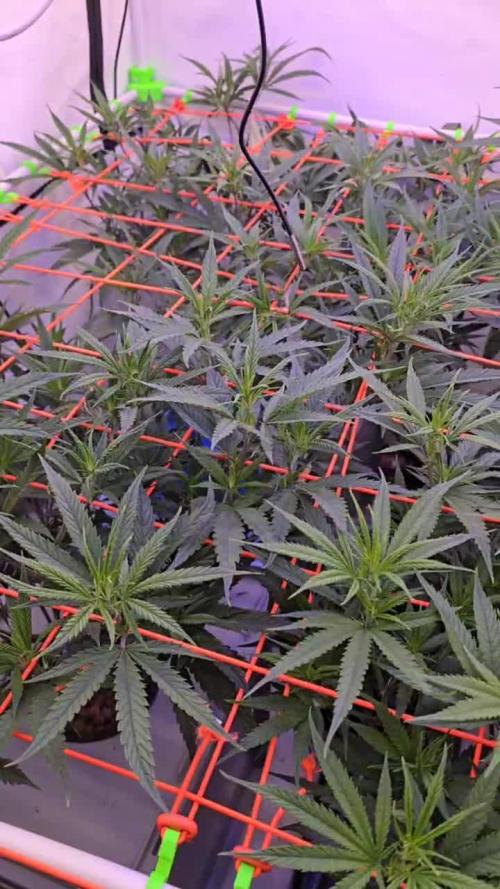
Die Damen machen sich weiter breit – Training läuft präzise nach Plan.
Das Scrog-Netz wird nach und nach gefüllt, Triebe werden durchgeflochten und Blätter geopfert.
Untenrum wurde ordentlich lollipopped – klinisch sauber, wie man’s im Labor mag.
Neue Seitentriebe wachsen nach und werden sofort wieder ins Netz eingearbeitet – kontrolliertes Chaos in Reinform.
⚙️ Systemparameter
🌡️ Temperatur (Tag): 26 °C
💧 RLF: 65 % (geregelt über AC Infinity Cloudforge)
⚗️ Düngung: Advanced Nutrients pH Perfect (Grow, Bloom, Micro + B52 + Bud Candy)
📊 EC: 1,1
System: RDWC (4 × 30 L Euroboxen, DIY – weil zu groß gibt’s nicht)
🌊 Wasser: kühl, klar, quirlig – und jetzt offiziell lebendig
Living RDWC Experiment
Das Labor wird biologisch aktiv – Mykorrhiza, Zuckerquellen wie Bud Candy und bald Aloe Vera Saft & Chitosan sollen das Mikroleben pushen.
Ziel: Den typischen „sterilen Hydro-Geschmack“ zähmen und mehr organische Tiefe schaffen.
Kurz gesagt: Wir impfen das System mit Leben – und hoffen, dass es uns nicht auffrisst. 😄
🔍 Beobachtung
Die Pflanzen zeigen kräftige Stämme, saubere Wurzeln und gleichmäßiges Wachstum.
Das Netz wird von Tag zu Tag dichter – fast so, als hätte es einen eigenen Willen.
Einige große Fächerblätter mussten für den Fortschritt sterben… aber hey, Wissenschaft verlangt Opfer.
🧠 Labornotiz
Im HydroLab riecht’s mittlerweile nach Zuckerwatte trifft Nährlösung – ein Duft, der Erfolg verspricht.
Alles deutet darauf hin, dass Leben im Wasser = Geschmack im Weed heißen könnte.
Phase 6 läuft stabil – aber Stabilität ist hier ohnehin nur die Ruhe vor dem nächsten Versuch.
------------------------------------
🌿 HydroLab Germany – Veg Week 6: Sugar, Fungi & Precision Madness
Welcome back to the HydroLab, where science and insanity continue their delicate dance – this time with a healthy dose of sugar in the system. 🍭⚗️
Project Status
The ladies are spreading beautifully – horizontal expansion: successful.
The Scrog net is being woven tight, trichome soldiers in training, leaves removed for maximum efficiency.
Below the net it’s now clinically clean – lollipopping complete.
New shoots keep popping up, and every single one gets trained into position – controlled chaos at its finest.
⚙️ System Parameters
🌡️ Day Temp: 26 °C
💧 RH: 65% – perfectly managed by AC Infinity Cloudforge
⚗️ Nutrients: Advanced Nutrients pH Perfect (Grow, Bloom, Micro + B52 + Bud Candy)
📊 EC: 1.1
System: RDWC (4 × 30L Euroboxes – DIY, because “too big” isn’t a thing)
🌊 Water: cool, clear, and officially alive
Living RDWC Experiment
This round, the Lab goes biologically active – Mycorrhiza, sugar sources like Bud Candy, and soon Aloe Vera juice and Chitosan join the mix.
Goal: erase that “sterile hydro” flavor and bring organic depth to hydro-grown weed.
In short: we’ve inoculated the system… and we just hope it stays friendly. 😄
🔍 Observations
Strong stems, glowing white roots, uniform growth.
The canopy is tightening up – like a neural network learning how to photosynthesize better.
Some big fan leaves were sacrificed in the name of progress – science demands casualties.
🧠 Lab Notes
The HydroLab now smells like nutrient solution and cotton candy – oddly promising.
Early signs suggest the theory holds: life in the system = flavor in the flower.
Phase 6 is stable… but in this Lab, stable only ever means “right before the next experiment.”
🔖 Tags:#HydroLab #RDWC #LivingRDWC #Scrog #AdvancedNutrients #BudCandy #ACInfinity #CannaScience #HydroExperiment #GrowTech #THCGrow #ScienceIsSexy #MycoPower


Likes
19
Share


@CookiesAndCake
Follow
Overall it was quite an easy grow, but one of the seeds had some kind of genetic disease so it looked very different to the rest and produced the least in the end.
Alpha: 16g
Bravo: 27g
Charlie: 19g
Delta: 19g
Echo: 33g
Total dry: 114g
It was very clear from the beginning of how Echo was trained that it will yield the most in the end. I need to try to replicate that during the next grows 😁
But overall this strain was very quick and produced extreeemely dense buds 😍

Likes
6
Share


@802FIZ0
Follow
Had to do the first res change, brought the ppm to 620+/- . This week was recorded on morning number 11. Roots are starting to come out of the net pots in all 3 plants. Looking forward to next week with a new res change to 800ppm.
Update. 4/10
Res change to 850 and ph of 6. Day 18.
Will do res change around the 28th to a heavy feed for late veg stage of around 950 to 1000. That will bring me into flower for the 2 blue dreams.

Likes
71
Share


@2x2growing
Follow
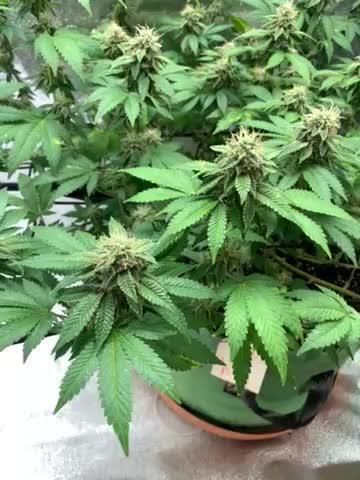
She’s made a beautiful recovery from the training we did last week as I expected:)
I am starting to get nervous as I am max out for the height in my tent and we still have another 2 weeks of stretch:/ may have to dim my lights significantly this run. So we’ll see🤞
Been leaving her alone for the most part as usual for this stage for me. Haven’t even cleaned up the bottoms yet. Well leave the defoliation for next week✌️



Likes
9
Share


@NanoLeaf
Follow
End of Week 15 (8th week of flower)
Still cruising, everything has been running very smoothly and the smell is just undoubtedly off the charts.
The ladies are showing off some colour and are fading naturally bringing out hues of orange and purple. I also noticed that the leaves and buds closest to the lights are showing significantly more colour that the ones that are further away.
The colas are also getting heavy and there are some side colas that are hanging and needed to be reinforced to keep them upright. (This is a good thing obviously)
I know I said I would start the flush (not giving any more nutrients/top-ups) but I decided to give them a small dose of Boom Bloom just to give the ladies that final boost. I boosted them in the middle of the week and the flush has begun after that. Only water from now until harvest.
Pest Report: None
Smell Report: HEAVEN

Likes
1
Share

@Cmftrblynmb
Follow
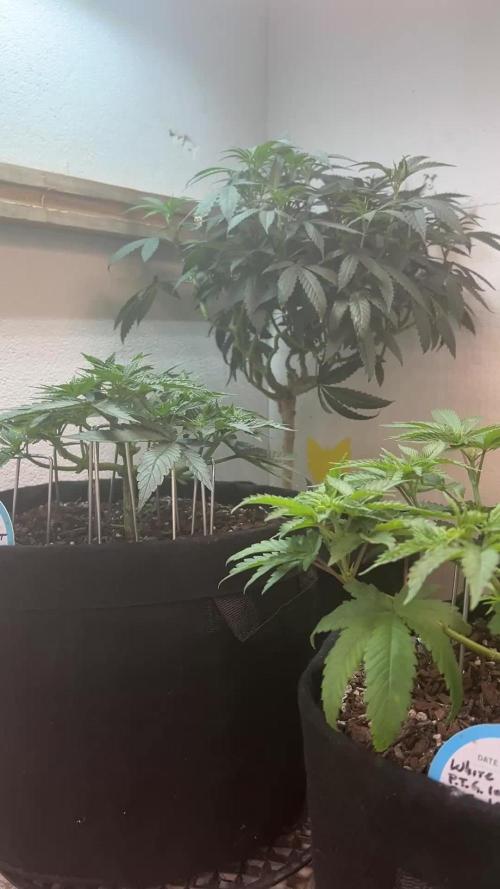
Five plants were showing deficiencies last weekend, but had just watered so I waited until Wednesday to feed 2 tsp/gal Grow Big.


Likes
15
Share


@Hashy
Follow
This week the Ams supreme has come along fine, she is as low as i can get her and has probably finished stretching, i had hoped she may have stretched a bit more then she has. All 4 strains in the tent are quite close in development still.
Notes
Day 50 manually feed this weeks nutes
Day 51 nothing
Day 52 nothing
Day 53 autofeed water.
Day 54 nothing
Day 55 autofeed this weeks nutes
Day 56 big defoliation. 456 ppfd, 29.5 DLi.
Back in a week
Take it easy.


Likes
10
Share


@BodyByVio
Follow
This week I top all 8 Green Poison ( 4dwc and 4 coco ) clones. They look healthy and happy and few days later I already start to low stress training (LST) them.
Likes
35
Share


@bypado_farm
Follow
Everything is going well. They are drinking good, they recovered as well, idk how but..
Let's go 💪
Likes
41
Share


@Growing88
Follow
Ripenes plant and deafling for penetration light pop corn buds,trichome is milky,wait other 2 week for harvest day

Likes
6
Share


@XanHalen
Follow
Nov 29:
They seem to be accelerating in veg growth but I see a small portion of the leaf on the smaller plant either grew in mutated or somthing cut it, I haven’t seen a single bug in the box so I don’t think it’s that but you never know, and the bigger plant has some issues near the base of its stem, I noticed it before I did the LST and now I’m wondering if I should have addressed that issue before starting the LST. Let me know what you guys think!
Dec 2:
Walked into the room and noticed a faint smell, wasn’t any smell last night when I started the LST on the slower girl. Further inspection showed some white pistols on the bigger girl, I believe she is the culprit for the smell as the other seems about a week behind. They are both now LST‘d and leaf tucked. Enjoy the pics and vid’s!
Dec 6:
I have tied down some of the longer chutes on the bigger plant (will see in week 5 update) to create more airflow and light penetration as I didn’t even realize how bushy the stem and node sections had gotten. I have also cut the chutes coming off the first true leaf. I don’t think I will make any cuts to the smaller one as it’s already a slower growing pheno. Going on a trip starting the end of week secede to late week 8, so I have a automatic feeder coming from Amazon, and I will continue using it through flower to reduce open tent time.
