









@Lady_NugWitch
Volgen
Getting ready to chop her down today. She's been in the dark a few days now...what a beast tho. Not sure ill be able to trim her entire plant and hang whole due to how big she is..
Update: Harvest complete. 2#8oz. She did foxtail on me, but I guess that's what happens when you let her grow and grow 😆. She's a huge unruly Medusa.. I expected nothing less!! Lol 😂😂00


@Herbalize
Volgen
Hello folks
For this second week of flowering the girls are doing well but i have i little prob with the Ph runoff of my 2 remo
I water every 4/5 days PH 6.2, without fertilizer this week, because I wanted to make a little "flush" before using fertilizers for flowering
Runoff : ph 5.7 / 1060 ppm while I water at Ph 6.2, Ph 5.7 is too acidic for soil and I noticed some deficiency just at the top ( nothing at bottom ) like zinc iron or something,
but I will fix that at the next watering 👌
Did a defoliation at the end of the week, mainly so that the light could cross the canopy, even though I usually dont like to remove leaves, I have to try👌
Follow, like and comment if you enjoy it
I also have a second diary with 2 Moby Dick
Peace Love & Weed 😍👊


@Growing_Spartan
Volgen
So this week last week I did 2 waterings of banana peels and then once with Fish Sh!t for more nutrient uptake to fix that calcium issue. I’ve been on top of PH and incorporated gypsum solution to my waterings but they don’t seem to want to uptake the nutes. It seems to be affecting my flower production so I might take an L on my thinner plant but the purple one is doing pretty good ✅ hopefully there isn’t more problems, if you have solutions, please I’m all ears!!


@mauigrown
Volgen
As week 5 came to a close and we move into week 6 of flowering, I am having really high hopes for the end result. The buds started to get some light orange hairs which is really nice and they are really starting to thicken up!
Towards the end of week 5 the plants started to show early signs of burn on their leaf tips, so I started the week 6 feeding a little early. In week 6 we bring the EC down quite a bit as we get into the late stages of flower. I also recently switch to measuring with EC vs PPM for ease and accuracy.
Also at the end of week 5 I did a calibration on my coco for each plant as week 6 nutrients are much lighter.
Coco Calibration Method
1. Mix up nutrients.
2. Water plants as normal and measure runoff.
3. If runoff EC is not at or close to the inflow EC
a. Water more and keep measuring runoff until the runoff is at or close to the inflow EC
4. Do steps 1-3 for all plants (One at a time)
Tips:
- I use a shop vacuum that I stick the end in the bottom of the pot saucers and leave it on while I water so it sucks the runoff as soon as it drains out the pots. Then I measure, empty and water again until I hit my targets)
For this calibration, I ended up using around 6 gallons of nutrient solution.
Watering technique used is to measure runoff at every watering and make sure we are staying as close as possible to the inflow EC. It does not matter how much water you need to put through the pots to get to the desired EC on runoff as that is a benefit of Coco. My main goal is to keep my runoff in check and the plants seem to do better than I have ever grown before!
The smell off these ladies are amazing and strong. I don't have a carbon filter and enjoy her smells and aromas all day long as my desk is right next to my tent.
There were no issues in Week 5. Plants continue to look amazing and the buds are continuing to bud up and structure very nice! I'm excited to see the end result after the ripening and flush stages. Also the colors that are soon to come! Stay tuned!
______________
We are 5 days into week 6 and the buds continue to grow fatter and fatter on a daily basis.
I'm really dialing in my EC and making sure to mix it at 1.1 EC and making sure my runoff is from 1.1-1.4.
I started playing with the mix as I am getting used to the grow schedule and how the base nutrients effect the EC.
I have found that doing 50% of the low strength calendar hits me right at my target EC and I don't have to dilute my mixture after.
The smells continue to be strong and fill my house up.
The weight is starting to make the colas lean over which is nice because it's opening up the canopy to get more light in.
I'm very excited to see what the buds look like in week 7 and then we are on to ripening stage, flush, and then finally harvest!!


@goeser
Volgen
At least one if the ladies is ready to harvest. Just made a final check with the microscope and i think she is ready. I could wait a bit more for more amber heads but i think thats ok.


@Calidoniacartel
Volgen
First week under the Lumatek 600 Pro set to 50% and aporox 40cm away from canopy.
Day 7 applied some pruning and supercropped the few taller girls to even out the canopy.
I will add a CO2 bag next week as i increase the power to avoid potential light stress.


@johdlong
Volgen
Hoping to see lots of bud densing this coming week. The smell of the terps this morning was crazy. A bit over 3 more weeks, I can't wait.
Day 44 update: Leaf yellowing has definitely been slowed, and senescence of lower yellowed leaves has also seemed to stop. Some leaves that continue to be of concern are particularly those accumulating anthocyanins, likely due to my low night time temps. I think they are doing very well, with some very minor problems. This cycle is in the winter for me, so the humidity and temps has been low, but I am happy to not have had to deal with pests or mold like in previous cycles.
Day 45 update: broke out the loop today to inspect the trichs, still looking very immature, as expected given there is still a few weeks left until the planned harvest date. Today I watered in a 1/4dose of Buildabloom, some quillaja, pineapple fpj, and some rootwise enzyme elixer.


@northsweed
Volgen
happy new year, everyone!
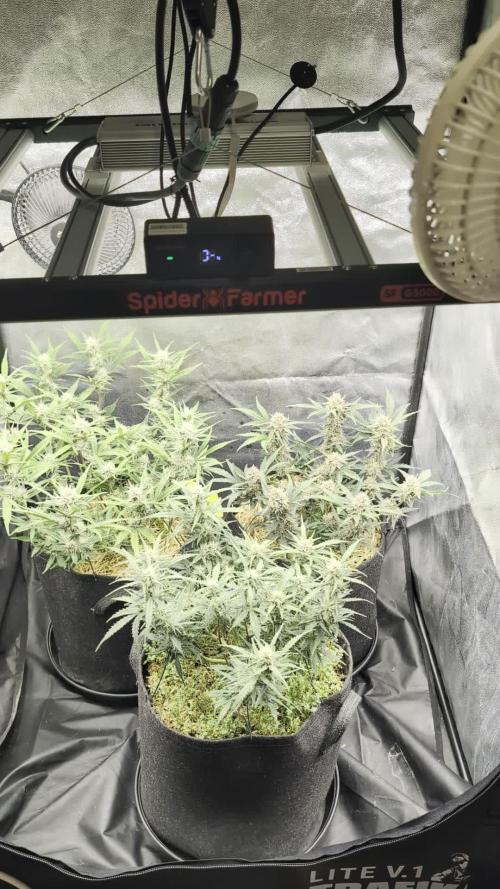
plants are thriving, stretch is happening and the experimental is showing buds already (it's been switched one week earlier) 😊
---
another major defoliation done – Barney claimed that lateral branching is heavy and it's indeed 😂



@BenandLippisfinest
Volgen
Die Geschwindigkeit die die Mango G hier hinlegt ist schon stark. Sie riecht sehr süß mit fruchtigen Gelato Noten und einem leicht erdigen Abgang was von der Mango kommt denke ich. Die anderen sehen auch super aus und entwickeln auch sehr süße zitronige und tropische Noten. Ich dachte erst wir hatten ein problem.mit Spinnenmilben, aber unter dem Mikroskop ließ sich nirgends etwas finden. Scheint entweder Lichtstress oder Calcium oder Magnesiummangel zu sein. Wir haben die Dosis an Callmag leicht erhöht.
The speed at which the Mango F has developed is impressive. It smells very sweet with fruity gelato notes and a slightly earthy finish, which I think comes from the mango. The others also look great and are developing very sweet lemony and tropical notes. I initially thought we had a problem with spider mites, but nothing could be found under the microscope. It seems to be either light stress or a calcium or magnesium deficiency. We've slightly increased the dose of Callmag.


@Gardens_of_Of
Volgen
Green House Feeded one is enjoying life and growing big health buds. She received her last lollipoping.
Advanced Nutrients one is still struggling. I am increasing the feeding per Advanced Nutrients supports suggestion. Let’s hope she recovers.


@Cogollo_eu
Volgen
*** Encontrarás la traducción a Español al final de la traducción en inglés ***
----- MEDIUM & EQUIPMENT -----
Luminary: HLG 100 v2 3000 k
Tent: DR60 - 0.6 x 0.6 m
Intractor/Extractor: None
Vent: 10W Static
Pots: 3 galon textile
Nutrients: B.A.C., Advanced nutrients & Atami
Soil: BioBizz
----- GROWING DATES -----
Seeds planted on Soil - May the 4th (be with you), I am them father
Harvest - June 21th
Complete Cycle from Seed - 76 Days
Light Hours complete cycle - 19 Hrs
----- NUTRIENTS USED -----
Bases & Stimulators: B.A.C.
Additives: Advanced Nutrients
Others: ATAMI Bloombastic
Cleaning: One Week with Advanced Nutrients “Flawless Finish”
----- GROWING -----
@Techniques, there were 2 plants:
A taller one that growed it’s own, she was 1.07 m tall, you can see in the videos how she looks like, itˋs an Auto Beast.
A smaller one on where i applied 2 techniques, a double topping (Topping x3), and a bit defoliation as can be shown in the video, she ended up with 0.5 m tall, 4 main colas, and the most dense buds i had among my autos.
@Weight:
The weight dried was surprisingly equal in both plants, while the bigger plant ended up in 67 gr, the small one was 62 gr and with much more bud density and crystal concentration, anyway both plants were very dense and crystal poblated. On wet, the weights were 276 g vs 226 g the smaller, what is translated wet2dry in a 24,28% vs 27,43% for the smaller one FTW!.
That difference is very well appreciated in the density of the smaller plant buds, while both are very dense/compact/strong, the smaller plant buds are really MoonRocks.
@Trim:
Well well well, this part was awesome, very very very little amount of trim material, i finish the trimming of the bigger plant in about 6 min and 15 for the smaller what is real awesome in both cases, and the quality of the trims was incredible too, very good to ice wash it.
@ Final product:
The final product is almost equal in both plants, the smallest one acquired a stronger taste and concentration of crystals than the taller one, while both tastes are strong grapefruit, when you smoke buds from the small one is like real eating a grapefruit and it leaves a residual taste to orange some seconds after exhaling it, and when you touch or tear up any of both plants, the smell is also very strong to Grapefruit. My friends were shocked by the strong taste and smell to grapefruit it has, really.
Good Job Spliff Seeds!, awesome strain!, I will grow it again for sure. 💪👌👌
***** ESPAÑOL *****
----- GENÉTICA DUTCH AUTO (Spliff Seeds NL) -----
Dutch Auto es una genética increíble en todos los aspectos, desde la facilidad de cultivarla hasta el producto final, pasando por la resistencia, la salubridad, el tamaño de la planta y la sencillez del pelado, son todo aspectos increíbles y notables de la planta. Sin podas, toppings ni cortes masivos, la planta ha alcanzado 1,07 m con una cola principal de más de 35 cm y una producción final de 67 gr de un producto espectacular, con un sabor de esos que se te quedan grabados y por el cual pasas a reconocerla de inmediato (lo que ocurría antiguamente (1998) con la Skunk). Los cogollos son compactos, gordos, duros, pegadizos y muy olorosos. El aroma y sabor del producto final es muy cítrico, es muy reconocible el sabor fuerte a pomelo, y en el caso de la planta pequeña deja un suave sabor a naranja en boca después de exhalarlo.
----- MEDIOS Y EQUIPO -----
Luminaria: HLG 100 v2 3000 k
Tienda de cultivo: DR60 - 0.6 x 0.6 m
Intractor/Extractor: Ninguno
Ventilador: 10W Static
Tiestos: Textiles de 3 galones
Nutrientes: B.A.C., Advanced nutrients & Atami
Sustrato: BioBizz
----- TIEMPOS DEL CULTIVO -----
Semilla a tierra - 4 de Mayo
Cosecha - 21 de Junio
Ciclo completo desde semilla - 76 Días
Horas de luz - 19 Hrs ciclo completo
----- NUTRIENTES USADOS -----
Bases y Estimuladores: B.A.C.
Aditivos: Advanced Nutrients
Otros: ATAMI Bloombastic
Limpieza: Una semana con “Flawless Finish”
----- CULTIVO -----
@Técnicas, son 2 plantas:
Una alta que ha crecido sin técnicas aplicadas, ha alcanzado 1,07 m de alto, en los vídeos se puede ver cómo es una Auto brutal.
Una pequeña a la que le he aplicado 2 técnicas, un topping doble (3 cortes) y una ligera defoliación que se puede ver en el vídeo. Esta planta ha acabado midiendo 0,5 m, teniendo 4 colas principales y los cogollos más densos que me haya dado ninguna auto.
@Peso:
El peso en seco es sorprendentemente parecido en ambas plantas, mientras que la planta grande ha terminado pesando 67 gr, la pequeña ha acabado en 62 gr y con cogollos más densos y poblados de cristales que la grande, aun así, ambas plantas han dado cogollos compactos y muy poblados. En húmedo los pesos fueron 276 gr Vs 226 gr la pequeña, lo que es una diferencia de húmedo a seco de 24,28% Vs 27,43% la pequeña. Esta diferencia es bien notable en la densidad de los cogollos de la planta pequeña que son como rocas lunares.
@Pelado:
Bueno bueno bueno, esta parte ha sido increíble, muy muy poca cantidad de restos de corte, acabé el pelado de la grande en unos 6 minutos y unos 15 para la pequeña lo que es increíble en ambos casos. Me he quedado sorprendido por la poca cantidad de material a pelar y la calidad de la misma, excelente para hacer bubble hash.
@ Producto final:
El producto final es casi igual en ambas plantas, la pequeña ha adquirido un sabor más fuerte y una concentración de cristales superior a la planta grande, mientras que ambas saben fuertemente a pomelo, cuando fumas de la pequeña, es como estar metiéndote un pomelo en la boca además de que deja un ligero sabor a naranja después de exhalarla. A la hora de tocarla o desmenuzar cualquiera de ellas el resultado es igualmente un fuerte aroma a pomelo. Mis amigos fumadores se quedaron realmente impresionados del fuerte sabor cítrico a pomelo que tiene, en serio, es increíble.
Muy buen trabajo Spliff Seeds, Dutch Auto es una genética increíble, la volveré a plantar seguro!!! 💪👌👌


@TheSpoonieCrone
Volgen
This little lady grew a little bigger than the others. The smell! I've been working to finish my dry room. I'll have 3 rooms dedicated to my medicinal gardens once all is said and done.


@Barzenegger
Volgen
I did a light lollipopping since stretch was over.
Flowers are starting to form nicely. I won't be able to fix the discoloration, so I am just going to live with it. It's not quite as bad as it looks through the web cam timelapse anyway. Despite all the things that went wrong at first, things were looking up now.
And the smell. Just wow, all of the plants smell incredibly strong and great. Very different, too. The Acapulco Gold is very sweet, GMO is very gassy, Sour Strawberry gassy with lots of pine, and the Glookies somewhat gassy but also very sweet at the same time.


@IQuSX
Volgen
Hi, topman!
It’s 21 day from seeding, so this the third week!
They will be have a new 8 liters pot to next week.
Its now we added new booster - Bud Candy by Advanced Nutrients!
What is doing?
1. Carbohydrates nourish beneficial microbes, creating ideal conditions to expand the roots for ample yields. (C)
2. Magnesium supports optimal conditions for chlorophyll production that can increase photosynthetic ability. (C)
Also, adding to Advanced Nutrients of words: we are use it for of mushrooms and mikariza food adds.
See you…
…keep an eve on this!


@I_Identify_As_A_Dan
Volgen
Week 9 for Ztrawberry by greenhouseseedco,
Shes finally coming back to life again with some proper colour to her... These greenhouse strains really are heavy feeders.
Really wanting to get her healthy again before flipping to flower + some extra height.


@Double_AAs_Garden1
Volgen
The madeshift Co2 hanger I had broke and fell on the Norther Lights! It almos split the plant down the middle . I tape it up and it's seem to be enough to keep it alive .


@captaincondor
Volgen
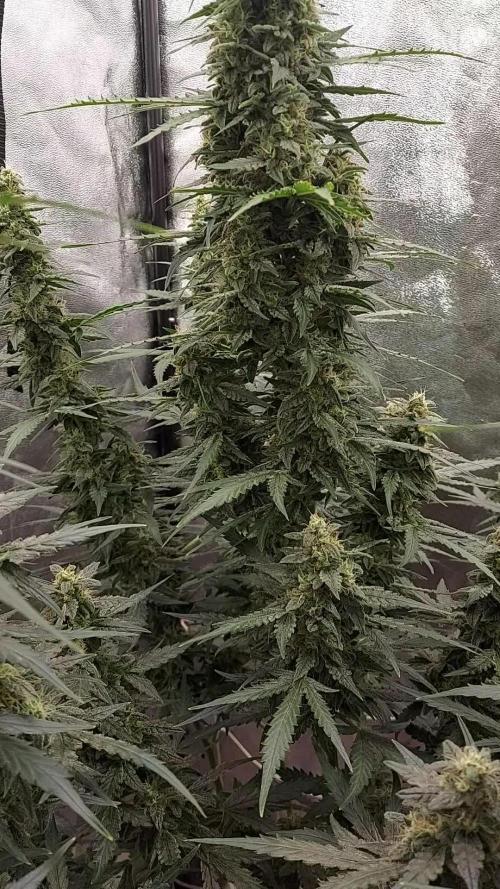
Day 103 just looked back through my calendar and discovered she started life in september, she wasn't in the best shape but after a couple of weeks she gained her strength and vigor back . Hopefully she will be finishing soon as I need the space for a photo period which is starting to overcrowd the other tent



@HUMO_Cultiva
Volgen
Update of Goofiez 2 !! It’s incredible this strain is so strong and fast grow !! Stay tu ed




@Ultraviolet_
Volgen
Wakíŋyaŋ, I am who I am, the salt of the earth.
Thunderbird is an allegory; his conflicts with other forces in nature are then an attempt to allegorize relationships observed in the natural order, such as the changing of the weather. He is essentially an attempt to represent the patterns of activity of a powerful, mysterious force in a way that can be understood simply and easily – sort of the way in which a weather map functions today.
Moving from18x60x60 = 64,800 seconds in 18 hours.
64800x860(ppfd) = 55,728,000 umol per daylight.
Into Flower
12x60x60 = 43,200 seconds in 12 hours.
43200x1145(ppfd) = 49,464,000 umol per daylight.
It's asking a lot of Rubisco regeneration to maintain 50 DLI in the 12 instead of 18. Raised the ambient CO2 to 1200 to 1500 ppm to achieve efficient gas exchange.
Not particularly recommended, but adding sugar to an indoor growing medium is a highly effective way to stimulate microbial activity, which rapidly breaks down the sugars and releases CO2 through cellular respiration. You can safely capture this CO2 to fertilize indoor crops and boost photosynthesis. While this process works, the setup requires precise understanding and management to avoid common indoor growing hazards.
The plant Carbon to Nitrogen C:N ratio defines the balance between structural carbon (sugars/cellulose) and nitrogen (proteins/enzymes). It acts as a master regulator of plant health, growth, and metabolism.
Rubisco (Ribulose-1,5-bisphosphate carboxylase/oxygenase) is the engine of photosynthesis responsible for fixing atmospheric CO2 into sugars. It is intimately tied to the C:N ratio for three primary reasons. It is the Plant’s Biggest Nitrogen Sink, Drives the Carbon Side, and it is the Nitrogen Control Knob. Understanding this relationship allows you to predict how plants respond to environmental stress or fertilizer.
Rubisco acts as the primary storage sink for leaf nitrogen, accounting for up to 30% to 50% of a C3 plant's soluble protein. Deep Green Leaves signal a rich abundance of both chlorophyll and Rubisco proteins. The plant possesses the heavy enzymatic machinery required to handle 1145 PPFD. Pale or yellowing leaves indicate a nitrogen deficiency. The plant is actively breaking down its own Rubisco to salvage nitrogen for newer growth, drastically reducing its light-tolerance threshold. Subtle difference, but understanding is important in order to be able to judge when to dial light intensity up and light intensity down, when to push, and when to back off. An extra dose of magnesium is vital if a plant is going to push through the growing pains of high-intensity lighting.
Foliar application of magnesium is an excellent and rapid way to assist with Rubisco regeneration within a plant, so long as it is applied correctly.
Spray strictly in the early morning or late evening, mixing your magnesium with a little fulvic acid or chelator, but only when she gets a little limey on top.
This, for me, is the experience of growing, akin to "riding the surf" maintaining efficient Rubisco regeneration through visual identification of the shade of green. Surf a razor-thin wave when balancing light intensity, nutrient availability, and transpiration to maximize Rubisco enzyme efficiency. Keeping the Calvin cycle fully charged without tipping into nutrient toxicity, light stress, or the dreaded chlorosis requires paying close attention to the visual cues the plant provides. By monitoring these subtle shifts in color, turgor pressure, and leaf posture, you adjust your environmental controls and surf that exact razor-thin wave.
Nute recycling acts as the vital execution mechanism for autophagy, which defines senescence. Natural senescence is a genetically programmed developmental stage aimed at nutrient recycling, whereas triggered autophagy is a rapid survival response activated by environmental stress. While both processes utilize the vacuole to break down cellular material, their triggers, selectivity, and overall goals are entirely different. Cannabis plant senescence is not separate from nutrient recycling protocols; rather, nutrient recycling is the primary physiological purpose of senescence, and autophagy serves as the core switch mechanism executing both processes.
Takes about 24 to 48 hours to notice visible changes once the signals have initiated the autophagic response. Not too late at all. A little bit of fade from senescence 2 weeks from harvest is normal and genetically expected. Send the C:N 32:1 signal 1 week from harvest for the best effect in your organic grow.
Understanding what makes leaves fade is not always senescence, but also strongly linked to Rubisco regeneration. That's a whole other subject. Vital to understand the differences if you want a correct diagnosis and to transition from hobby grower to master stoner, differentiating between a true genetic fade and a decline in photosynthetic proteins.
Nitrate is nitrate, whether it oxidizes or not is not up for debate. If it's not sunk by the plant you are smoking some if not all of, it's regardless of what your feelings are on the matter. Senescence is highly critical. It is the natural end-of-life stage where the plant redirects energy to ripen flowers. Properly managed, it breaks down harsh chlorophyll, allowing the terpenes (which provide taste and aroma) to peak. Harvesting outside this window leads to an "unripe" or degraded flavor comparable to going without.
To initiate the response you seek, you can trigger it multiple ways, when growing synthetically its triggered by nutrient starvation, generally when the entire medium is flushed. This is more to do with N starvation than being entirely empty. Nonetheless. PK boosters are N starvation through maximizing P and K. (Generally only works for synthetic grows)
Normally, a medium only holds 10-30% of its nitrogen as ammoniacal ta part boosts this to 50% as it triggers the "ripen" signal, but you don't want to keep ammoniacal above 30% for more than 7-10 days if you can help it. Its a trigger mechanism no more.
PK BOOST with 50% ammoniacal N signals floral maturation.
PK BOOST with N starvation signals nutrient recycling/sinking.
Because you are using organic nutes and you want to maintain the rhizosphere, what you want to do is add carbon in the form of sugars (powdered molasses). It's almost impossible to empty a medium enough when microorganisms are constantly releasing nutrients into the direct EC. Very difficult to initiate starvation responses with ammoniacal nitrogen. Manipulating the C:N ratio is the key to triggering an autophagic response and resulting nutrient recycling in the last days using organic nutes and without having to flush.
Generally not recommended for new growers. So do what you want. But if you don't trigger the plant to dump its nitrates into root zones, you will smoke nitrates as NO3- does not oxidize during the dry and cure no matter what you do or how long you dry or cure. Doesn't matter what anyone "feels" about it, how many grows they had with no fade.
"Clover steals valuable nutrients."
Crop and drop the clover come flipping to flower, its benefit comes from creating an airy and porous rootzone. I don't need to crop and drop once the plant fills the canopy, she blotches out the light, and the clovers die. This is the nitrogen the microorganisms use to convert carbon for respiration throughout the flowering stage.